SWAMI VIVEKANANAD INTERSTATE BUS TERMINAL ANAND VIHAR, DELHI
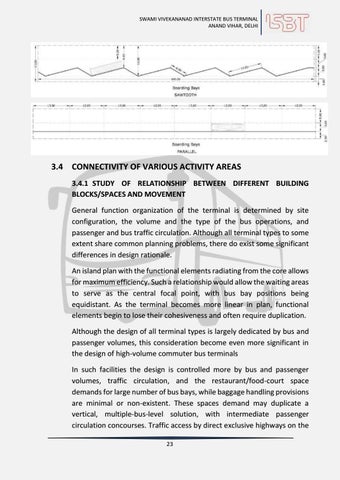
3.4 CONNECTIVITY OF VARIOUS ACTIVITY AREAS 3.4.1 STUDY OF RELATIONSHIP BETWEEN DIFFERENT BUILDING BLOCKS/SPACES AND MOVEMENT General function organization of the terminal is determined by site configuration, the volume and the type of the bus operations, and passenger and bus traffic circulation. Although all terminal types to some extent share common planning problems, there do exist some significant differences in design rationale. An island plan with the functional elements radiating from the core allows for maximum efficiency. Such a relationship would allow the waiting areas to serve as the central focal point, with bus bay positions being equidistant. As the terminal becomes more linear in plan, functional elements begin to lose their cohesiveness and often require duplication. Although the design of all terminal types is largely dedicated by bus and passenger volumes, this consideration become even more significant in the design of high-volume commuter bus terminals In such facilities the design is controlled more by bus and passenger volumes, traffic circulation, and the restaurant/food-court space demands for large number of bus bays, while baggage handling provisions are minimal or non-existent. These spaces demand may duplicate a vertical, multiple-bus-level solution, with intermediate passenger circulation concourses. Traffic access by direct exclusive highways on the 23