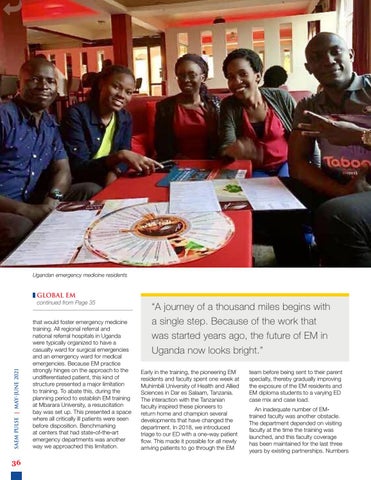
Ugandan emergency medicine residents
GLOBAL EM
SAEM PULSE | MAY-JUNE 2021
continued from Page 35
36
that would foster emergency medicine training. All regional referral and national referral hospitals in Uganda were typically organized to have a casualty ward for surgical emergencies and an emergency ward for medical emergencies. Because EM practice strongly hinges on the approach to the undifferentiated patient, this kind of structure presented a major limitation to training. To abate this, during the planning period to establish EM training at Mbarara University, a resuscitation bay was set up. This presented a space where all critically ill patients were seen before disposition. Benchmarking at centers that had state-of-the-art emergency departments was another way we approached this limitation.
“A journey of a thousand miles begins with a single step. Because of the work that was started years ago, the future of EM in Uganda now looks bright.” Early in the training, the pioneering EM residents and faculty spent one week at Muhimbili University of Health and Allied Sciences in Dar es Salaam, Tanzania. The interaction with the Tanzanian faculty inspired these pioneers to return home and champion several developments that have changed the department. In 2018, we introduced triage to our ED with a one-way patient flow. This made it possible for all newly arriving patients to go through the EM
team before being sent to their parent specialty, thereby gradually improving the exposure of the EM residents and EM diploma students to a varying ED case mix and case load. An inadequate number of EMtrained faculty was another obstacle. The department depended on visiting faculty at the time the training was launched, and this faculty coverage has been maintained for the last three years by existing partnerships. Numbers