JULY-AUGUST 2021 | VOLUME XXXVI NUMBER 4
www.saem.org
SPOTLIGHT ADVANCING THE FUTURE OF EM BY DEVELOPING RESIDENT AND MEDICAL STUDENT LEADERS An Interview with
Wendy Sun, MD
RESIDENT GUIDE TO ABEM CERTIFICATION page 40
Leading the advancement of emergency care through education and research, advocacy, and professional development in academic emergency medicine.
SAEM STAFF
HIGHLIGHTS
Chief Executive Officer Megan N. Schagrin, MBA, CAE, CFRE Ext. 212, mschagrin@saem.org
Manager, Business Development John Landry, MBA Ext. 204, jlandry@saem.org
Director, Finance & Operations Doug Ray, MSA Ext. 208, dray@saem.org Manager, Accounting Hugo Paz Ext. 216, hpaz@saem.org Manager, IT Dan San Buenaventura Ext. 225, DSanBuenaventura@saem.org Specialist, IT Support Simeon Dyankov Ext. 217, sdyankov@saem.org
Director, Membership & Meetings Holly Byrd-Duncan, MBA Ext. 210, hbyrdduncan@saem.org Sr. Manager, Membership George Greaves Ext. 211, ggreaves@saem.org Education Manager Andrea Ray Ext. 214, aray@saem.org Specialist, Membership Recruitment Berenice Lagrimas Ext. 222, blagrimas@saem.org Planner, Meetings Margaret Rivera Ext. 218, mrivera@saem.org Membership & Meetings Coordinator Monica Bell, CMP Ext. 202, mbell@saem.org
Director, Governance Kat Nagasawa, MBA Ext. 206, knagasawa@saem.org Coordinator, Governance Michelle Aguirre, MPA Ext. 205, maguirre@saem.org Director, Publications and Communications Stacey Roseen Ext. 207, sroseen@saem.org Manager, Journals and Communications Tami Craig Ext. 219, tcraig@saem.org Manager, Digital Communications Snizhana Kurylyuk Ext. 201, skurylyuk@saem.org Director, Foundation and Business Development Melissa McMillian, CNP Ext. 203, mmcmillian@saem.org Senior Manager, Development for the SAEM Foundation Julie Wolfe Ext. 230, jwolfe@saem.org
AEM Editor in Chief Jeffrey Kline, MD AEMEditor@saem.org AEM E&T Editor in Chief Susan Promes, MD AEMETeditor@saem.org AEM/AEM E&T Manager Tami Craig Ext. 219, tcraig@saem.org AEM/AEM E&T Peer Review Coordinator Taylor Bowen tbowen@saem.org Associate Editor, Pulse RAMS Section Aaron R. Kuzel, DO, MBA aaron.kuzel@louisville.edu
2021–2022 BOARD OF DIRECTORS Amy H. Kaji, MD, PhD President Harbor-UCLA Medical Center
Wendy C. Coates, MD Secretary Treasurer Harbor-UCLA Medical Center
Angela M. Mills, MD President Elect Columbia University, Vagelos College of Physicians and Surgeons
James F. Holmes, Jr., MD, MPH Immediate Past President University of California Davis Health System
Pooja Agrawal, MD, MPH Yale University School of Medicine
Ava Pierce, MD UT Southwestern Medical Center, Dallas
Christopher R. Carpenter, MD, MSc Washington University in St. Louis School of Medicine
Ali S. Raja, MD Massachusetts General Hospital/Harvard
Jamie Jasti, MD, MS Medical College of Wisconsin Michelle D. Lall, MD Emory University
Jody A. Vogel, MD, MSc, MSW Denver Health Medical Center University of Colorado School of Medicine
3
President’s Comments The Unforgettable Past and Hope for Facing Future Challenges
4
Spotlight Advancing the Future of EM By Developing Resident and Medical Student Leaders – An Interview with Wendy Sun, MD
8
Clerkship Directors in EM The Strangest Year in Medical Education: Looking Back and Moving Forward
10
Diversity and Inclusion The Evolution of Accommodations for Patients with Disabilities
30
Meeting at the Crossroads Telehealth + Education: Identifying the Needs and Building the Programs
34
My Year on the AEM Education & Training Editorial Board
36
SAEMF Announces New Enhancements to Grant Portfolio: Apply by August 1, 2021
38
Support SAEMF’s Investment in Emergency Medicine Research
38
Remembering Dr. Paul Auerbach
39
Thank You to Our 2021 Annual Alliance Donors!
15
Diversity and Inclusion Belonging: The Missing Piece for Our Learners
18
Diversity and Inclusion A Clarion Call for a Race-Aware Approach to Medical Education
20
Education Five Methods to Boost On-Shift Learning
40 42
22
Ethics in Action Discovering and Addressing the Root Causes of Why Patients Leave
44
From Match to First Promotion Webinar Series: Ensuring a Seat at the Virtual Table
24
Geriatric Emergency Medicine Dealing With Family Disconnects and Disrupted Social Networks in End-of-life Emergency Care
46
When a Residency Program Shuts Down: Advice from Three (Previously) Displaced Residents
26
Global Emergency Medicine Rethinking Global Health: Actions for a Decolonized Future of Global Emergency Medicine
29
SGEM: Did You Know? Headache: Not Just Migraine
Resident Guide to ABEM Certification Counseling the Family: An Intern's Perspective
50
Briefs and Bullet Points
52
SAEM Reports
54
Academic Announcements
59
Now Hiring
SAEM Pulse is published bimonthly by the Society for Academic Emergency Medicine,1111 East Touhy Ave., Ste. 540, Des Plaines, IL 60018. (847) 813-9823 Disclaimer: The views and opinions expressed in this publication are those of the authors and do not necessarily reflect the official policies, positions, opinions, or views of the Society for Academic Emergency Medicine or its members. © 2021 Society for Academic Emergency Medicine. All rights reserved. No part of this publication may be reproduced, stored, or transmitted in any form or by any means without prior permission in writing from the copyright holder.
PRESIDENT’S COMMENTS Amy Kaji, MD, PhD Harbor-UCLA Medical Center 2021–2022 President, SAEM
The Unforgettable Past – and Hope for Facing Future Challenges
“To tackle these challenges, it may sound cliché, but I truly believe that we are stronger when we act together, whether at the EM organizational, local, or individual level.”
“Unpredictable. Unprecedented. Unparalleled.” These words appropriately and accurately describe the past year and a half, in review. From the ways we worked, to the ways we interacted with others, this has truly been an unequaled time in medicine and in the history of our organization. Collectively, we experienced a global pandemic and worldwide lockdowns, the economic ripple effect, racial strife and injustice, and a divisive presidential election like no other. Yet, in spite of the challenges we faced these last months, SAEM is strong and stable and there are many reasons to look ahead with great hope to the coming years as members of the Society for Academic Emergency Medicine. To that end, I would like to recognize and thank our remarkable SAEM staff, led by CEO Megan Schagrin, for giving their hearts and souls to leading our organization through this unprecedented season. Though faced with a series of challenges, SAEM has not only survived the pandemic, but positioned us to come out the other side stronger than ever. (Case and point: the 2021 Virtual SAEM Annual Meeting had a record 2,603 registrants for four full days of educational content filled with cutting-edge research presentations, didactics, plenaries, panel discussions, and member engagement!) Yet, there are issues facing emergency medicine. First, there is our workforce. There has been an enormous growth in the number of residents being trained in emergency medicine, which is a manifestation of the popularity, maturation, and growth of our specialty. However, this growth is occurring concomitantly with the increasing supply of advanced practice providers and residency training programs. Second, burnout and unwellness continue to be critical issues that have been exacerbated by our COVID-19 experience as well as the reality of the pervasive poverty, extremism, and structural racism that contribute to inequities in health care. Even before COVID, there was a diminishing landscape of extramural funding for emergency care research — a situation likely exacerbated by the pandemic. Resolving these issues will require us to continue to be creative
and work towards growing federal funding for emergency care research while finding new sources of funding. To tackle these challenges, it may sound cliché, but I truly believe that we are stronger when we act together – whether at the emergency medicine organizational, local, or individual levels. Our public statements are stronger when our sister EM organizations join us in a unified voice. Solutions to the issues we face will require research to understand the issues, (perhaps with a shift in our research priorities), outside-the-box thinking, and being open to a practice of emergency medicine that might look very different from how it looks today. We will need to consider further expansion of telehealth, prehospital, and community care, and address the disproportionate imbalance in supply and demand in rural areas. This may seem daunting, but it is because of you — our members who are the future of academic emergency medicine — that I am confident we can and will solve these problems. As I finish my inaugural column for this issue and see the daily decreasing number of new U.S. COVID-19 cases, I am hopeful. Thus, I would like to close by thanking each and every one of you for knowingly and willingly putting yourselves at great personal risk to care for COVID-19 patients over the last 18+ months. I am incredibly honored to serve as SAEM president and look forward to working with you throughout the year. I am indebted to Dr. James Holmes, SAEM’s outgoing president, for leading our society into a new virtual world and out of the pandemic. I promise that I will do my utmost to continue to strengthen our Society and specialty.
ABOUT DR. KAJI: Amy Kaji, MD, PhD is a professor of clinical emergency medicine and vice chair of academic affairs in the department of emergency medicine at Harbor-UCLA Medical Center at the David Geffen School of Medicine at UCLA.
3
SPOTLIGHT ADVANCING THE FUTURE OF EM BY DEVELOPING RESIDENT AND MEDICAL STUDENT LEADERS
Dr. Sun on-shift teaching and mentorship with Dr. Safdar.
SAEM PULSE | JULY-AUGUST 2021
An Interview With Wendy Sun, MD
4
Wendy Sun, MD, is a PGY-2 at Yale-New Haven Health. She currently serves as the SAEM RAMS Board president. She also serves as the cochair of the SAEM Program Committee Speed Mentoring Subcommittee. Wendy is passionate about mentorship, health innovation, and increasing diversity within emergency medicine. She grew up in Toronto, received her BS in biomedical engineering from Columbia University and MD from Virginia Commonwealth University. In her spare time, she enjoys paddle boarding. How and why did you first become involved with SAEM? RAMS? Drawn to emergency medicine (EM) since college, my involvement with SAEM RAMS started at SAEM17 when I was a secondyear medical student. As an SAEM medical student ambassador, I was blown away by the incredible SAEM community of EM doctors who are so willing to sponsor and mentor. It was also at SAEM17 where I met my current program director, Dr. DellaGiustina, and a plethora of mentors with whom I still keep in touch. I continued to stay involved in SAEM by joining the RAMS Career Development and Mentorship Committee, SAEM Program Committee Speed Mentoring Subcommittee, Academy for Women in Academic Emergency Medicine (AWAEM) and Academy for Diversity & Inclusion in Emergency Medicine (ADIEM). As my passion for SAEM grew, I took on leadership opportunities including serving on the SAEM RAMS Board for the past two terms before becoming president and cochairing the SAEM Program Committee Speed Mentoring Subcommittee.
Dr. Sun (second from left) in a resident discussion of clinical cases with Drs. Suwondo, Bonner, and Buckley (left to right).
As the new president of SAEM RAMS, what issues do you feel are most germane to current and future emergency medicine trainees? What steps do you hope to take toward addressing these issues during your tenure as RAMS president? I believe the issues at the forefront of most of our members minds right now is jobs and the future EM workforce. As RAMS president, I feel it is important to listen, advocate, and communicate with our members so that they know SAEM RAMS has a seat at the table, being their voice. At the same time, being that we are a society for academic emergency medicine, my hope is to provide our members with the knowledge and understanding of workforce dynamics so they can make their own informed decisions and conclusions about the workforce.
“As RAMS president, I feel it is important to listen, advocate, and communicate with our members so that they know SAEM RAMS has a seat at the table, being their voice.”
My other vision for RAMS includes fostering organic mentorship opportunities among RAMS members and EM faculty by creating opportunities for them to collaborate. Another priority is cultivating future RAMS EM leaders while paying special attention to ensuring diversity and nurturing the RAMS community through active social media, quarterly socials/ townhalls, and direct communications on the community site. I am also committed to helping residents make the most out of their scholarly work during residency.
Any tips on surviving, perhaps even thriving, during residency — especially during this time of COVID?
Why should EM residents and medical students become involved with RAMS? What unmet needs does the group address?
What advice would you give to an individual who is struggling to manage stress and a maintain work/life balance?
SAEM RAMS is truly the premier organization for medical students and residents. We are unique from all other EM resident and medical student organizations in that RAMS members work alongside EM faculty on projects that impact emergency medicine. As a result, members are able to form organic mentoring relationships, network, and jumpstart their careers. Through this model of collaboration, SAEM RAMS is truly capable of fulfilling our core purpose of advancing the future of emergency medicine through the development of residents and medical students into leaders.
Self-compassion is key. In medicine, we often feel the drive to be perfect, but at the end of the day we are only human and it’s okay to not be perfect. It’s also important to realize that you are not alone. By sharing what you are experiencing — whether with a coresident, friend, family member, or therapist — you may find that it takes a load off your shoulders and more often than not, that you’re not the only one feeling that way.
Everyone is different but what has worked for me is surrounding myself with good people, taking time to do what I enjoy outside of medicine, and delving deeper into the things that matter to me in medicine. This past year, I’ve gotten a chance to try new things such as paddle boarding, clamming, and playing the ukulele.
continued on Page 6
5
continued from Page 5
What do you think our specialty as a whole can do to improve physician well-being and address COVID19-related posttraumatic stress? We can improve physician well-being by eliminating the barriers/stigmas to mental health treatment for EM physicians, ensuring there are resources in place for EM physicians, as well as understanding the factors that affect wellness in order to understand how best to affect change. The former we are addressing through a collaboration of all EM groups while the latter is addressed through a special wellness focus on the SAEM Foundation grants this year.
How and why did you become interested in diversity and inclusion? Why do you feel this is important? What are some of the specific ways you’ve become involved with addressing diversity and inclusion issues?
SAEM PULSE | JULY-AUGUST 2021
My interest in diversity and inclusion began as an interest in gender equity in the STEM field when I was one of a few girls competing at robotics competitions in high school. As I dove deeper beyond gender equity and into diversity and inclusion, I realized the tremendous amount of work that needs to be done. Diversity and inclusion are important to me because having a diverse team means better care of patients and a stronger team in advancing emergency medicine. I became active with diversity and inclusion through my involvement with RAMS, ADIEM, and AWAEM. I founded the Diversity and Inclusion Subcommittee before it merged into the Equity and Inclusion Committee where I served as the RAMS Board Committee liaison last year. In addition, I feel lucky to have collaborated with colleagues and mentors on topics in diversity and inclusion through SAEM21 didactics, webinars, and bias training.
6
Dr. Sun with her family.
Mentorship is another one of your areas of interest. What role has mentorship played in shaping your own career path? Who are some of the mentors who have shaped your thinking? Mentorship and sponsorship have truly been integral to getting me where I am today. I’m thankful for the mentors who know me so well that they know when to stop the imposter syndrome thinking before it starts; the mentors who are inclusive in the work that they do and challenge me to go one step further, and the sponsors who are always advocating on my behalf. My mentors and sponsors inspire me and, as a result, I’m passionate about helping other RAMS find their mentors within the SAEM community.
Dr. Sun in a research discussion with Dr. Della-Giustina on how to improve clinical feedback to residents via text message reminders.
Throwback to SAEM17 where it all started. The Medical Student Ambassador dodgeball team. (Dr. Sun second from the left)
Who or what influenced your decision to choose the academic/EM specialty and if you were not doing what you do, what would you be doing instead? I was drawn to emergency medicine as a freshman in college when I worked in the emergency department as a volunteer. After that I never left the ED as I continued on to lead the research program during the rest of college. Medical school further confirmed my love of emergency medicine. It is truly the best specialty out there. I love the collaborative nature of the academic EM community and I find myself so lucky to be a part of it. It’s difficult to imagine not doing what I’m doing right now but if I was somehow in that crazy parallel universe, I would probably be an engineer at a tech startup.
What do you find most challenging about the work you do? Navigating external limitations to do what is right for RAMS has definitely kept me busy and up at night. It’s a lot of learning, listening, and considering all viewpoints in order to make the
Dr. Sun on Match Day with her med school friends, dressed up as characters from the movie/book Crazy Rich Asians. (Dr. Sun is fourth from the left)
most thoughtful and informed decision, which makes this job both challenging and rewarding.
What do you find most rewarding about the work you do? People, people, people. It’s the people I get to work with and seeing the positive impact SAEM RAMS makes on people that make my job extremely rewarding. I feel so energized getting off the phone/Zoom meeting with my board members with action plans on new ideas and seeing the sparkle of excitement in our members eyes when they collaborate with their EM role models through SAEM RAMS.
Where do you see yourself in five years? Twenty-five years? In both five and twenty-five years I see myself in academic emergency medicine. Wherever I am in the time continuum, I see myself continuing to give back by mentoring, sponsoring, and teaching medical students and residents.
Up Close and Personal What one word would your friends use to describe you? Spirited
What is at the top of your bucket list? Hiking the Torres Del Paine W Trek once we quash the pandemic.
What would most people be surprised to learn about you? I’m Canadian!
Who would you invite to your dream dinner party? My grandpa. He passed away before I was able to meet him, but from all the stories I’ve heard he sounds like he was an incredible story teller, engineer, and adventurer.
Who would play you in the film of your life? Awkwafina What would that film be called? Adventure Day What is your guilty pleasure? Binge watching TV shows. (Any Lupin fans out there? Part 2 just dropped!)
What’s one book you’ve read (fiction or nonfiction) that has made a lasting impact on you? Outliers by Malcolm Gladwell What is a favorite FOAMed resource? AliEM (Academic Life in Emergency Medicine) 7
CLERKSHIP DIRECTORS IN EM
The Strangest Year in Medical Education: Looking Back and Moving Forward
SAEM PULSE | JULY-AUGUST 2021
By Julianna Jung, MD and Sharon Bord, MD on behalf of SAEM’s Clerkship Directors in Emergency Medicine academy
8
In 2020, the COVID-19 pandemic upheaved every aspect of American life. We amassed huge collections of face masks, learned to interact with others from a six-foot distance, and took our social and professional lives into the virtual sphere. Beneath these inconveniences to which we quickly grew accustomed, there were far deeper losses. With more than 600,000 COVID-19 deaths in the U.S., many of us lost people we love and almost all of us lost patients. In the interest of safety, we sacrificed time with our families and friends, we gave up the human connection of hugs and handshakes. Those of us in medical education worked harder during the pandemic than ever before, balancing frontline clinical duties with the daunting
task of taking our entire curriculum online, along with advising panicked students facing specialty selection and residency application in a year like no other. SAEM’s Clerkship Directors in Emergency Medicine (CDEM) academy spent the entire past year helping students and educators navigate the strange new world of COVID-19, and now that the first “COVID class” is graduating from medical school, it’s a good time to reflect on what this year has really meant. For the class of 2021, the pandemic has represented an unprecedented disruption in the educational process: they completely lost an entire quarter of clinical instruction. While many students did amazing things to support patient
care and research during those early months, they will never recoup that lost time. In order for them to graduate on time, their subsequent clinical rotation blocks were shortened. In addition, the pandemic severely disrupted the clinical environment, leading patients to stay home and avoid seeking health care except in the direst situations. Many institutions also enacted policies prohibiting students from participating in COVID-19 care. The end result of all of these factors was a radical reduction in the number and range of clinical experiences available to students — a situation that will inevitably have a negative impact on their readiness to begin supervised practice as interns in July.
“For the class of 2021, the pandemic has represented an unprecedented disruption in the educational process: they completely lost an entire quarter of clinical instruction.” Outside of the clinical area, COVID-19 has exacted a toll on medical education by forcing training activities online. While a lecture delivered online may be just as effective as the same lecture delivered in-person, there is no reason to imagine this is true for other teaching methods. It is beyond doubt that the loss of hands-on educational activities like simulation and procedural skills training will negatively impact student preparedness for intern responsibilities. Teaching of communication skills almost certainly loses some nuance when conducted virtually. Even cognitive exercises like problem-based learning and case conferences may lose some of their efficacy by being delivered online. We have all experienced “Zoom fatigue,” and we know intuitively that it is more difficult to engage learners in the online environment than in person, particularly late in the online day. So, in addition to a significantly attenuated clinical experience, there is every reason to believe that the class of 2021 has also had a suboptimal didactic experience, despite the best efforts of the medical education community to deliver effective and engaging online instruction. In addition to its impact on formal education, COVID-19 has also significantly altered the less tangible aspects of the medical student experience. Professional identity formation is a major part of medical school, and it is impossible to estimate the effect of physical separation from classmates, teachers, and mentors on this process. Relationships between students normally provide psychological support through the inevitable moments of doubt and pain during medical school,
yet social distancing has attenuated these relationships, potentially leading to reduced confidence and resilience. Specialty selection was also impacted by COVID-19, with students being required to plan for their future careers with reduced time and patient care experience in each clerkship, and complete curtailment of away rotations. Forced to choose a specialty with considerably less information than usual, it is likely that some interns will find themselves dissatisfied and will transfer to other disciplines. So, what does all this mean? For one, program directors will need to prepare to fill the educational gap, providing more robust orientation and ongoing educational offerings for interns. Programs will have to address professional identity issues and work with their interns on developing the necessary self-efficacy to progress towards greater independence in their medical practice. Interns themselves will need to commit to a program of self-directed learning and must strive to be resilient in the face of feedback about their learning needs. Most importantly, all faculty will need to remember that deficits in the knowledge and skill of the incoming interns is largely due to factors beyond their control, and approach them with compassion and positive regard. While the pandemic appears to be receding, its impact on medical education will likely be felt for years to come. People have grown accustomed to online life and the convenience and comfort it offers are a powerful inducement to continue interactions in the virtual realm. Educators will need to balance
the respective roles of online and inperson education, capitalizing on the best aspects of virtual learning without sacrificing the irreplaceable benefits of “real” educational activities. The equity benefits of virtual interaction must be seriously considered, as online learning and interviewing eliminates the financial and logistical barriers faced by students with disabilities or limited financial means. Most importantly, we must harness the creativity, resilience, and energy that we brought to our work during the pandemic and use it to continue improving the education of trainees across the continuum from medical school to residency and beyond.
ABOUT THE AUTHORS Dr. Jung is an associate professor of emergency medicine, Johns Hopkins University School of Medicine, director of medical student education in the department of emergency medicine, and associate director of the Johns Hopkins Medicine Simulation Center. She is the immediate past president of CDEM. Dr. Bord is an assistant professor in the department of emergency medicine at the Johns Hopkins University School of Medicine where she also serves as the codirector for the required medical student clerkship and subinternship in emergency medicine. Dr. Bord is the 20212022 president-elect of CDEM.
About CDEM Clerkship Directors in Emergency Medicine (CDEM) represents the interests of undergraduate medical educators in emergency medicine. It serves as a unified voice for EM clerkship directors and medical student educators and provides a forum for them to communicate, share ideas, and generate solutions to common problems. For more information, visit the CDEM webpage. As an SAEM member, you may now join as many academies* and interest groups as you choose. Just log into your member profile and click on the "Update (+/-) Academies and Interest Groups" button.
9
DIVERSITY AND INCLUSION
The Evolution of Accommodations for Patients with Disabilities By Jason Rotoli, MD; Anika Backster, MD; Wendy Coates, MD; and Cori Poffenberger, MD on behalf of SAEM's Academy for Diversity & Inclusion in Emergency Medicine and the ADIEM Accommodations Subcommittee
SAEM PULSE | JULY-AUGUST 2021
Historical Perspective
10
People with disabilities represent the largest minority population in the US, with approximately one in four people identifying as having a disability [1,2]. Historically, people with disabilities have been marginalized, disenfranchised, and have experienced othering (judgments of superiority and inferiority due to differences between groups, leading to oppression) because of their minority status [3,4]. Whether this represented a paternalistic view (“we know what’s best for them”) or an attempt to sanitize the mainstream society (“let’s not mix these people with those who are ‘normal’”), the result was that most people did not have daily contact with people
who were different from themselves. Institutions devoted to individual disabilities frequently isolated, housed, and educated members of these communities to prepare them for limited roles in society.
Health Care
A major contributor to marginalization is obvious when reviewing the historical medical model of disability, which reinforced ableism (the concept that able-bodied people are a representation of the “perfect self” or the perfection of the human species) and marginalization. Under this pretense, anyone who deviated from this image was abnormal (or even less human) and outside of “normal” should be fixed or cured [2,5]. Historically, this model of disability, like
the medical perspective of any other disease process, focused on identifying the abnormality and assigning a treatment to return it to normal. Studies have shown that U.S. physicians often have negative feelings about the disability community. This can create bias that may hinder appropriate physician-patient relationship development, limit the ability to obtain relevant information, and negatively impact and limit the care that is delivered to a patient with a disability [6]. Research has also shown that people with disabilities were more likely to rate their health as poor, had higher rates of obesity and smoking, utilized primary care services less frequently and were more impacted by social
“People with disabilities represent the largest minority population in the US, with approximately one in four people identifying as having a disability.” determinants of health than the general population [7,8]. These health disparities are multifactorial and have resulted from structural and systematic barriers to health care such as poor access to care, lack of awareness of the needs of the disability community, inadequate health care provider education and training, and provider bias rooted deep within the history of medicine and society [5,9,10].
Education
For people who were in school prior to the passage of the Americans with Disabilities Act (ADA) of 1990, it was rare to encounter anyone with a disability in mainstream education. Students with disabilities were typically segregated into specialized institutions. Examples included schools for the blind, schools for the deaf, and developmental centers (institutions for those with social challenges or autism spectrum disorders). It is likely that many of the resulting jobs far underestimated the capacity of the individuals. Example jobs included crafts (e.g., basket weaving, leather work), selling pencils at public places, etc. [11]. This segregation created a lack of familiarity with peers with disabilities and perpetuated marginalization.
Community Living
Over the subsequent centuries, many forces combined to promote the institutionalization and segregation of individuals with disabilities. Residential institutions for individuals with disabilities have existed since the Middle Ages, and have been present in many different societies [12]. Many residents of these institutions in the 20th century tragically reflected on sub-standard treatment and abuse [13].
Evolving Perspective Language
The language that has been used to describe individuals with disability has evolved over the years as we have gained understanding regarding the ableist roots of many terms that were historically used. A common problem with many of the previous terms used to describe various
disabilities is that they inappropriately medicalized the disability. For example, phrases like “suffers from” or “stricken with,” “wheelchair-bound” or “bedbound,” “crippled” or “handicapped.” These labels emphasized the dependency of individuals with disabilities and are unnecessarily negative. Rather than using these terms, there has been a shift toward utilizing terms that are more neutral and purely descriptive, such as physical disability or intellectual disability. Mental retardation is another term that was previously used to describe individuals with intellectual disabilities, but over the years it took on negative connotations and became stigmatized and offensive. In 2010, President Barack Obama signed a bill known as Rosa’s Law that required the terms “mental retardation” and “mentally retarded” be removed from federal records and replaced with “intellectual disability” and “individual with an intellectual disability” [14]. Another aspect of disability language that has evolved over time is the use of person-first language. The traditional teaching in most educational settings has been to focus on the fact that someone is a person with a disability, rather than a disabled person. However, many within the disability community prefer identity-first language, as they feel their disability is inseparable from who they are, rather than something that they “have.” Others may favor use of the term “disabled person” rather than “person with a disability” as they feel it reflects a social model approach, emphasizing that the person is disabled by the social structures they live in, rather than “having” a disability. When in doubt about the best language to use, it is always best to ask the person about their preference. Finally, there have been attempts over the years to avoid the word disability, using euphemisms such as “differently abled,” “handicapable,” or even “special needs.” These terms promote othering and exclusion of individuals with disability by suggesting that disability itself is inherently negative or bad. One study
specifically looking at the term “special needs” found that it is an ineffective euphemism, as it was associated with more negative connotations than the term “disability” [15]. The disability community, as well as all available evidence, has recommended using the word disability rather than any of the available euphemisms.
Legislation
Beginning with the election of President John F. Kennedy in 1960 and then progressing into the 1970s, the disability rights movement brought about substantial changes in policies to promote inclusion and community-based supports. This included the passage of the Rehabilitation Act of 1973 (amended in 1978) and the Education for All Handicapped Children Act in 1975 (later renamed The Individuals with Disabilities Act or IDEA) which provided legislation to support independent community living and public education, respectively [12]. Prior to 1990, there was no federal civil rights statute to advocate for accommodations in the medical setting. In 1990, the Americans With Disabilities Act (ADA) was enacted that mandated inclusion/accommodation and barred discrimination toward people with disabilities in all areas of public life [16,17]. For health care, the most relevant sections of the 1990 ADA were Titles II (state and local governments) and III (private businesses and nonprofit organizations), which required that medical providers afford individuals with disabilities full and equal access to their health care services and facilities, including making reasonable modifications to policies, practices, and procedures to allow the same access as the general population [18]. For some, the efficacy of the ADA remains in question. While it was intended to provide advocacy and a voice to those who have gone underrepresented, there have been unintended consequences
continued on Page 12
11
DIVERSITY AND INCLUSION
continued from Page 11
SAEM PULSE | JULY-AUGUST 2021
and concerns about its true impact. There has been some data to suggest that employers may be less willing to hire those with disabilities due to the fear of increased financial burden [19]. The same concept has been applied to health care organizations that frequently place the increased cost of providing accommodations on a single department or individual clinician’s office, creating negative incentives for providing appropriate care and access for patients with disabilities. Additionally, there has been data to suggest that many patients are still experiencing discrimination in the form of lack of appropriate access to accommodations in the health care setting [19,20].
12
Advances in Accommodations With the passage of the ADA, there has been a shift toward creating a more equitable environment by improving access to accommodations for those with disabilities.
Communication
Prior to the ADA, there was no federal mandate for auxiliary aids or language services for blind patients, nonverbal
“With the passage of the ADA, there has been a shift toward creating a more equitable environment by improving access to accommodations for those with disabilities.” patients, or language accommodations for Deaf American Sign Language (ASL) users or deaf/hard-of-hearing individuals who require transcription services. In some cases, organizations provided no accommodations or provided a “one size fits all” solution that did not meet the needs of the individual. For example, an ASL interpreter may have been provided to an oral deaf person who did not know ASL and communicated by speech reading and the written word with real-time captioning. This lack of access or mismatch of language accommodations led to diminished interaction between the deaf patient and provider, infringed on the patient’s right to health care, and perpetuated lower levels of health literacy among patients requiring language accommodations. With the ADA, increased access to a variety of
communication accommodations (e.g., ASL interpreters, captioning, cued speech, communication boards, screen readers, etc.) has created opportunity for more equitable care.
Physical modifications
The first nationally recognized accessible design for those with disabilities was not published until 1961 and finally received federal recognition in 1974. Then, in 1990, the ADA incorporated an accessible physical modification design plan into its provisions. There have been numerous updates, the most recent being in 2017, where wording specifically related to hospital medical equipment was added [18,21]. Title III of the ADA allowed for improved access to buildings with emphasis on automatic doors, ramps, pathways free of obstacles, and doors/
“Equitable access to education, employment, and health care is still challenging due to a system that is not designed to provide appropriate accommodations or promote understanding of the unique circumstances that those with disabilities face.” hallways and treatment rooms large enough to accommodate a person in a wheelchair.
Health Care
In an effort to shift provider educations, behavior, and attitudes, the World Health Organization recently published an integrated model of disability, the International Classification of Functioning Disability and Health, that shifted attention away from physical differences emphasized in the archaic medical model of disability and described bodily limitations or impairments in the context of the surrounding environment within society [22]. While this has been widely accepted internationally, its adoption has been slower to gain traction in the U.S. [23]. As previously mentioned, access to language accommodations has also improved. Additionally, some undergraduate and graduate medical programs have started to include education regarding the care of those with disabilities into their curriculum.
Community Living
The Rehabilitation Act created the National Institute on Disability, Independent Living, and Rehabilitation Research to better understand the independent living needs of people with disabilities and led to funding for a national network of Centers for Independent Living (CILs) [24]. CILs support community living and independence for people with disabilities, providing resources and support for the integration of people with disabilities fully into their communities.
Service Animals
Use of animals as an aid to a disability has been found as early as 1 CE (common era) on fresco wall paintings. For example, dogs were trained for people with visual impairments in the 1750s in Paris [21]. In the U.S., “seeing eye dogs” had some legal protections starting around the 1920s; however, prior to 1990 service dogs were not fully legally
recognized as aides [25]. Since then, we have refined and expanded the definition and Title II and III of the 2010 ADA state: “A service animal is a dog that is individually trained to do work or perform tasks for a person with a disability.” It further states that “governments, businesses, and nonprofit organizations that serve the public generally must allow service animals to accompany people with disabilities in all areas of the facility where the public is allowed to go” and that “When it is not obvious what service an animal provides, only limited inquiries are allowed. Staff may ask two questions: Is the dog a service animal required because of a disability? What work or task has the dog been trained to perform? [18] Even with the adoption of federal and state mandates regarding more inclusive language, improved communication accommodations, and more appropriate physical accommodations for people with disabilities, equitable access to education, employment, and health care is still challenging due to a system that is not designed to provide appropriate accommodations or promote understanding of the unique circumstances that those with disabilities face. For example, people with disabilities often struggle to arrange transportation, need to constantly remind office staff of accommodations needed prior to a meeting or medical appointment, must ensure that the needed accommodations are available upon return, and repeatedly educate office staff and medical personnel on one’s own disability. These people may also be inappropriately viewed as inflexible in cases where meetings or appointments are changed at the last minute or if accommodations are unavailable upon arrival.
Conclusion People with disabilities and those requiring accommodations represent a large, heterogenous, and marginalized
population. With the implementation of the ADA and other legislative changes, advances in accommodations in many facets of life have been made. However, continued forward progress is imperative to improve access, reduce disparities in health care, and combat discrimination. Through increased awareness and education, each member of the health care team can be empowered to reduce the prevalence of ableism, avoid othering, and to provide an inclusive environment for people with disabilities.
ABOUT THE AUTHORS Dr. Rotoli is the associate residency director of the emergency medicine residency and director of the Deaf Health Pathways at the University of Rochester. He is also the chair of the ADIEM Accommodations Subcommittee. Dr. Rotoli has a passion for improving the health literacy and health care for anyone who requires an accommodation, especially the deaf ASL user. Dr. Coates has been a disability rights advocate for more than 25 years. She is a professor of emergency medicine at UCLA Geffen School of Medicine/HarborUCLA Emergency Medicine where she specializes in education research. She currently serves as the secretary-treasurer on the SAEM Board of Directors. Dr. Backster is an assistant professor of emergency medicine, Emory School of Medicine and development officer on the ADIEM Executive Committee. Dr Backster is interested in promoting and educating on all forms of diversity and creating an inclusive environment for them.
13
SAEM PULSE | JULY-AUGUST 2021
DIVERSITY AND INCLUSION
14
“Underrepresented individuals often suffer from imposter syndrome, an internalized sense of not belonging or deserving their success or achievement, which can be devastating to growth and development.”
Belonging: The Missing Piece for Our Learners By Joel Moll, MD; Michelle Lall, MD, MHS and Sheryl L. Heron, MD, MPH for SAEM's Academy for Diversity & Inclusion in Emergency Medicine The United States continues to become more diverse in areas of race, ethnicity, sexual orientation, and gender identity; however, within emergency medicine, this diversity is not always reflected. Data shows that the demographics of current and future emergency physicians continues to lag behind that of the patients we serve (Table 1). Public data does not readily exist for representation in emergency medicine of lesbian, gay, bisexual, transgender, queer, or questioning (LGBTQ+) colleagues, either in our current work force or those in training. Some older studies suggest that in general, LGBTQ+ individuals may be less likely to choose professional careers such as medicine and within medicine may be more likely to choose primary care due to concerns with acceptance. With the focus on gender and racial inequities in the past year many programs have intensified efforts to recruit a more diverse residency class. Focusing on demographic numbers is one way to measure progress and success, but it is not enough. As your residents who matched in emergency medicine (EM) and your EM bound students arrive to your departments this summer, the question is, do they feel like they belong? Underrepresented individuals often suffer from imposter syndrome, an internalized sense of not belonging or deserving their success or achievement, which can be devastating to growth and development. Some, such as those in the LGBTQ+ community, may also feel like they must conceal who they fundamentally are in order to have a successful career in medicine or in residency. Much energy and effort may be siphoned away during this formative time to simply deny or hide who they fundamentally are, leading to
Table 1: Demographics of EM residents, faculty, and US population Demographic
EM Residents2
Active EM Physicians2
U.S. Population3
Female
34.9%
28%
50.8%
Black
3.9%
4.5%
13.4%
Latino
4.9%
5.3%
18.5%
LGBTQ+
Unknown
Unknown
Estimated 5.6% (C )
isolation. However, a recent article in Harvard Business Review questioned this phenomenon of imposter syndrome notably as it pertains to women and women of color aptly stating that imposter syndrome puts the blame on individuals, without accounting for the historical and cultural contexts that are foundational to how it manifests in both women of color and white women. The impact of systemic racism, classism, xenophobia, and other biases was not a part of the scientific literature when the concept of imposter syndrome was developed. The authors posit that rather than aiming our attention at fixing women at work, we should focus on fixing the places where women work. This is certainly applicable to all minoritized and disadvantaged groups. Programs can and should be deliberate and dedicated to creating a sense of belonging, not just opportunity, in EM training. Medicine is a social profession, and a sense of belonging is critical to feeling safe and developing emotional connections and well-being during a challenging time in training. Without belonging, isolation and imposter feelings can easily interfere with training, performance, emotion, and even physical health. Fundamentally, our residents and students need to be well to learn. Equally, our faculty and staff from marginalized
groups must also feel a sense of belonging to effectively teach. Individual identities are complex, multifaceted, and unique. Assumptions by societal majorities should not be made regarding any aspect of an individual’s identity or needs. There are many new and current resources focused on creating a sense of belonging in the learning and work environments. Below are some recurring suggestions that will hopefully help create a sense of belonging for everyone in your department.
State and reinforce diversity, equity, and inclusion as a value.
Commitment to this concept should be broad and visible. Your mission statement and specific aims should reflect the environment you have or which you have a desire to create. The statement should be provided not only to the Accreditation Council for Graduate Medical Education (ACGME) and your graduate medical education office, but to every person in your department. You should remind your learners, faculty, and staff of this statement when you recruit, onboard, and develop your residents throughout their training. Actions should mirror words to create an environment of safety and belonging. continued on Page 16
15
DIVERSITY AND INCLUSION
continued from Page 15
Your actions should demonstrate your inclusion.
SAEM PULSE | JULY-AUGUST 2021
Before an applicant or incoming resident considers your program, review and, if needed, revise your departmental policies and procedures to ensure they are inclusive. In addition, you must be knowledgeable of your institutional policies as they relate to discrimination and harassment. An institutional nondiscrimination policy that excludes certain groups does not show inclusion nor welcome the learner. Lack of supportive benefits, such as same-sex domestic partner benefits, may lead to a learner feeling excluded, devalued, and disconnected. Studies have shown that approximately one-third of program directors in EM are not aware of if their institutional policies protect LGBTQ+ individuals from discrimination.
16
Words matter. Majority and heteronormative assumptions are ubiquitous: asking a man about his wife, or a woman about her husband occurs daily. The process of visibly identifying one’s sexual orientation (coming out) is a very emotional and potentially negative and isolating experience depending on the individual’s circumstance. By making assumptions and not using inclusive language, the learner may feel pressured to have to “come out” by repeatedly correcting you or choosing not to correct the assumption and hiding a fundamental part of who they are. One study shows that half of LGBTQ+ individuals in the workplace “come out” on a weekly basis due to such assumptions. Use neutral terms such as “partner” or “spouse” instead of assumptions fueled by implicit bias. Certain words and phrases may be unintentionally hurtful. Sexual or gender “preference” can indicate that you believe their identity is a choice, despite no credible studies that reflect and support that assumption. Use neutral terms that let learners identify as they choose so everyone feels like they belong. Understand the value of using the correct pronouns to address your residents who are nonbinary. Social events may be an indicator of a real or potential chasm in your community. Take note as to whether or not everyone is included in these events,
“Rather than aiming our attention at fixing women at work, we should focus on fixing the places where women work.” feels comfortable attending, welcome to bring a partner, and participates in common social conversations. Leaving people who are not in the majority out of conversations about their holidays with their significant other can be a subtle but noticeable slight to that person. Leadership can facilitate inclusion and a sense of belonging by pulling these individuals into these types of conversations. Also, be careful not to celebrate only the holidays and/ or observances that are important to you. Be inclusive in your messaging; your learners will appreciate that what is important to them is also important to you. Confront microaggressions. Due to our implicit biases, microaggressions will happen even under the best of circumstances and with the best of intentions. That does not make them acceptable, but it does give us an opportunity to educate others and correct their behavior. Having scripts as aids for responding to microaggressions is an important investment in those who are the most likely to suffer from them — and it helps leaders respond professionally while at the same time sending the message that this behavior is not accepted nor tolerated. Microaggressions should not be ignored, and both education and intervention should occur by departmental leadership, residency program, and/or institution. The burden for addressing microaggressions, and worse, should not be on the victim but should be on every member of the faculty and every leader in the department and/or institution. Stop using the word “fit”. Nothing typifies your implicit bias by judging a candidate or individual as a “fit” for your program. For most of us a good “fit” is someone similar to ourselves and who is affected by our own biases, both positive and negative. Programs should seek to be welcoming
and create belonging for all. Individual applicants or learners should assess the program’s fit for their educational goals, not the other way around.
Recognize and acknowledge areas for improvement.
No program is unaffected by implicit and explicit bias. While a program may have an exemplary record of creating an environment of belonging for racial and ethnic minorities, it may still have few women and/or members of the LGBTQ+ community. This is an opportunity to learn how to improve your community and assess what overt and subtle factors may be adversely impacting your learners. We should not be offended when areas for improvement arise, rather we should embrace the criticism and
“All members of the community should be considered and developed to their potential in a way that is consistent, purposeful, and in line with the value of diversity, equity, and inclusion in the EM program.” acknowledge the blind spots with intentionality to improve and create a culture and climate reflective of our values. A deep and ongoing reflection on trends and results in areas of diversity, equity, and inclusion is essential as part of an annual program evaluation. Creating a sense of belonging is a journey not a destination.
burden or minority tax for that person, if not truly developed and valued, it can also undermine their significance and worth. All members of the community should be considered and developed to their potential in a way that is consistent, purposeful, and in line with the value of diversity, equity, and inclusion in the EM program.
Visibility matters.
Many education regulatory agencies, including the ACGME and Liaison Committee on Medical Education (LCME), require a focus and educational curriculum on disparities and inequities in health care. Education of your entire department meets many of these requirements and demonstrates the value that educational and department leaders place on addressing inequities in medicine. Inequities and disparities should address all vulnerable groups in emergency medicine whether it be by race, ethnicity, gender, gender identity, sexual orientation, religion, need for accommodation, or many other areas. In many locations, specific groups may require additional attention based on patient demographics to provide culturally appropriate and sensitive care.
Leaders must be visible and set an example for others to follow. This starts with the program director and clerkship director but should include all department leaders. Visible support and community involvement are great opportunities to demonstrate your values and build belonging. As previously mentioned, ask your residents before they arrive what are their pronouns. Avoid asking about “preferred” pronouns as this can cause unintentional offense. Provide your residents with badge buddies that identify their pronouns to each other, colleagues, and patients. Consider placing pronouns on your websites and/or shared rosters. Although most of your residents will likely use binary pronouns, consideration of pronouns creates and demonstrates an inclusive environment. Fairly or not, prospective and current learners will judge your values based on your website and the images displayed on it. Use visibility to your advantage not to your detriment. Avoid tokenism. Some feel that the quickest way to inclusion is a singular focus on an underrepresented faculty or learner. This not only creates an extra
Educate your team.
Part of education and leadership is learning where your unintentional offenses may have occurred. Apologizing for an unintended microaggression or unintended bias demonstrates your commitment to inclusion of all learners, colleagues, and importantly your patients.
Be an advocate and an ally for your residents and students.
Although it may seem at times that your learners have no difficulty advocating for themselves, this is clearly not true for many, especially with more sensitive topics or situations. Creating an environment of belonging requires that you step up and advocate for them when they cannot or are uncomfortable doing so for themselves. Being inclusive, open, and sharing your own vulnerability helps residents and learners feel supported, valued, and — importantly — like they belong.
Look for opportunities to support organizations and events that celebrate the diversity of humanity and your learners. Participating in organizations that advise underrepresented groups, such as the Student National Medical Association, National Medical Association, Latino Medical Association, Latino Medical Student Association, National Hispanic Medical Association, American Medical Women’s Association, or LGBTQ+ and other medical organizations sends a powerful message and helps you achieve your vision and goal of true belonging.
ABOUT THE AUTHORS Dr. Moll is an associate professor and residency program director in the department of emergency medicine, Virginia Commonwealth University School of Medicine and program director of the medical education fellowship. Dr. Lall is an associate professor in the department of emergency medicine at Emory University School of Medicine and Emory’s inaugural director of wellness, equity, diversity, and inclusion. She is a member of the SAEM Board of Directors. Dr. Heron is professor and vice-chair of faculty equity, engagement and empowerment, department of emergency medicine, Emory University School of Medicine; associate dean for community engagement, equity and inclusion; and the associate director for education and training, Injury Prevention Research Center at Emory (IPRCE).
17
DIVERSITY AND INCLUSION
A Clarion Call for a Race-Aware Approach to Medical Education By Monica Saxena, MD, JD and Mariame Fofana, MD on behalf of SAEM’s Academy for Diversity & Inclusion in Emergency Medicine
SAEM PULSE | JULY-AUGUST 2021
Last December, as she lay in bed connected to an oxygen tank, Dr. Susan Moore, a Black medical doctor infected with COVID-19, called out the racism she experienced as a COVID-19 patient.
18
In a Facebook video that went viral, Dr. Moore detailed her repeated difficulties to have her doctors acknowledge and treat her pain and shortness of breath despite cat scans showing the worsening progression of her disease. She begged her doctor to complete the course of the antiviral treatment that had been started, and her doctor refused. “He said, ‘ah, you don’t need it. You aren’t even short of breath.’ I said, ‘Yes, I am.’ And then he went on to say, ‘you don’t qualify.’
“I must have (qualified), because I got two treatments. Then he further stated, ‘you should just go home right now.’”
we see Dr. Moore’s death as a clarion call to reform medical education and incorporate antiracism into the training of doctors.
Dr. Moore did go home, and less than 12 hours later, she was readmitted to the hospital. She later died of complications from the COVID-19 virus.
The incorporation of education on racial disparities in medical school remains uneven. As recently as 2019, the national governing organization of medical schools, the American Association of Medical Colleges, noted “there is a lack of standardized, fully integrated racial disparity education in medical school curricula. This gap fails to train our young doctors to best treat their patients fully; thus, we propose a three-pronged approach to incorporating racial inequity/bias into medical training.
Dr. Moore’s death gained national attention, with racial justice advocates calling for change. As emergency medicine physicians and women of color, we agree that Dr. Moore’s death was a tragedy, as are the deaths of the more than half a million Americans — a disproportionate number of whom are Black and Latinx. This latter fact gives us pause and asks us to reflect on the more significant lessons of Dr. Moore’s death for our profession. Ultimately,
First, teach doctors about the social determinants of health responsible for
“Racial disparities are linked to social determinants of health, including access to primary care doctors, health literacy, and nutrition, which result from higher rates of poverty in communities of color.” both COVID-19 deaths and the racial disparities in the presentation of the disease. Collectively, Black Americans have a higher rate of hypertension, diabetes, and cardiovascular disease than non-hispanic whites. These conditions are directly linked to the worse outcomes, including death, of COVID-19 among Black Americans. These racial disparities are linked to social determinants of health, including access to primary care doctors, health literacy, and nutrition, which result from higher rates of poverty in communities of color. Second, teach medical students that diseases present differently in people of color. For example, there remains a dearth of information on how dermatologic conditions present in people with brown and black skin, leading to a delay of diagnosis that can be deadly, such as skin cancer. This race-aware approach also applies to chronic diseases such as kidney disease, where the current standard in medicine is to overestimate the kidney function of Blacks, though this hasn’t been validated by physiology. As noted in a 2020 study published in the New England Journal of Medicine, the result could be a delay in diagnosis of compromised kidney function, which in turn could lead to advanced progression of disease requiring dialysis.
shown that as many as half of surveyed medical students and residents believed that there were biological differences in how Black and white patients experienced pain. These differences suggested that Blacks had a higher pain threshold than whites. These racially biased beliefs play out in practice as doctors unknowingly undertreat or even mistreat their patients. As Dr. Moore noted, “This is how Black people get killed.”
Finally, recognize that medical education does not exist in a vacuum and that the realities of the world affect how future doctors will treat their future patients. As students enter medical school, they bring with them ingrained societal racism, which can be detrimental to their future patients. Studies have
Teaching our physician trainees about race is essential for clinical practice and the future health of our nation. Dr. Moore‘s story, and the racial disparities brought to light by the COVID-19 pandemic, is a flashpoint for the medical profession to start talking about race in medical training.
ABOUT THE AUTHORS Dr. Saxena is a clinical educator and ultrasound fellow at Stanford University Department of Emergency Medicine. She holds an AB from Smith College, a JD from the University of Michigan, and an MD from Wayne State University. @MonicaRSaxena Dr. Fofana is a second-year resident at Stanford University Department of Emergency Medicine. She holds a BS from Seton Hall University and an MD from Meharry Medical College. @DrMariameFo
About ADIEM The Academy for Diversity & Inclusion in Emergency Medicine (ADIEM) works towards the realization of our common goals of diversifying the physician workforce at all levels, eliminating disparities in health care and outcomes, and insuring that all emergency physicians are delivering culturally competent care. Joining ADIEM is free! Just log into your member profile. Click “My Account” in the upper right navigation bar. Click the “Update (+/-) Academies and Interest Groups” button on the left side. Select the box next to the academy you wish to join. Click “save.”
19
EDUCATION
Five Methods to Boost On-Shift Learning
SAEM PULSE | JULY-AUGUST 2021
By Lauren Willoughby, MD and Allison Beaulieu, MD
20
With frequent interruptions, high acuity patients, and unpredictable patient volumes, finding time to teach medical students and residents in the emergency department presents its own unique challenges. Medical students and residents are frequently seeking dedicated on-shift instruction to supplement their education. As an educator, your ability to create effective learning moments impacts your learner’s experience. This article provides various tools, structures, and teaching methods to incorporate daily teaching into your residency program. These five methods will benefit students, residents, and attendings alike.
Teaching Rounds
The University of Massachusetts Emergency Medicine Program hosts Morning Teaching Rounds every day from 6:45–7:00 AM. This time slot is
intended to be the 15 minutes prior to morning sign out to ensure both the overnight team and oncoming day team can participate. Attendings are responsible for patient care during these 15 minutes, as this is protected educational time for residents and students. An oncoming senior resident is assigned to lead the educational session and teach a high yield concept or procedure, review written board questions, or role play oral board cases. Debriefing interesting cases from the night before is also highly encouraged. Be sure to find a quiet area in the department, such as an empty consultation room or trauma room, where the session will not be interrupted. Consider implementing this structure in your program to boost onshift education.
Post-It Notes
Utilizing Post-it Notes for on-shift teaching was developed by Michelle Lin after she was inspired by Amal Mattu’s “Whiteboard Teaching.” In this method, after discussing a case, brief teaching pearls are jotted down on a Post-it Note. The small size of the Post-it Note limits the teaching points to just a few high yield words or a phrase. These Post-it Notes are placed on walls or computers for others to view and to help spark continued discussion on the topic.
5-Minute Emergency Medicine Consult
With multiple learners at various stages of training, another resource that can be used on shift is 5-Minute Emergency Medicine Consult. This book, written by Rosen and Barkin, provides a
“Medical students and residents are frequently seeking dedicated on-shift instruction to supplement their education. As an educator, your ability to create effective learning moments impacts your learner’s experience.”
S
N
A
•Summarize the history and physical exam findings.
•Narrow the differential to two or three relevant possibilities.
•Analyze the differential comparing and contrasting the possibilities.
P
P
S
•Probe the preceptor by asking questions about uncertainties, difficulties, or alternative approaches.
•Plan management for the patient’s medical issues.
•Select a case-related issue for self-directed learning.
quick, but comprehensive, review of commonly encountered diagnoses in the emergency department. 5-Minute Emergency Medicine Consult highlights etiology, presentation, and management plans. It is a great resource for medical students and residents to review prior to presenting a case on a given topic or after the presentation for self-directed learning. It fits nicely into the SNAPPS clinical teaching model which focuses on a learner-centered approach to clinical education. After a case presentation, the learner can select a topic for self-directed learning on shift.
Oral Board Review
In the rare case of downtime on shift, keep an oral board review book on hand in the charting area. A popular book is the Emergency Medicine Oral Board Review Illustrated by Okuda and Nelson. Using these cases will allow attendings, residents, and students to participate and prepare for oral boards. You can vary the method of review by focusing on one learner or having a group of learners play the role of examinee. This teaching method will allow for continued spaced repetition of your learners as they prepare for the Emergency Medicine Oral Board Examination.
Procedure Kits
Procedure kits are occasionally opened and unused. The contents of the kit can be saved and utilized as a visual aid when teaching an uncommon procedure. The conceptualize, visualize, verbalize, procedural teaching model can be used to assist educators. Conceptualization — Review the indications, contraindications, and anatomy of a given procedure with your learner. Visualization — Demonstrate the procedure using the opened procedure kits or have your learner watch a procedural review video before practicing with the opened kits. Verbalization — At the end of the review, encourage the learner to vocalize all steps. The procedure kits allow learners to practice using the equipment before doing a procedure for the first time or to review an uncommon procedure. Create a safe space in the charting area to keep these opened procedure kits and record a list of available and needed kits. Designate a resident to review available kits and organize this educational space monthly.
Conclusion
The emergency department has several barriers to traditional bedside teaching that often take precedence over teaching, including the fast-paced environment, high patient volumes, and critical patients. However, even with these barriers, high yield learning can still occur by utilizing the strategies outlined above. Consider creating an education space in your department with oral and written board review books, opened procedure kits, and textbooks for selfdirected learning.
ABOUT THE AUTHORS Dr. Willoughby is an emergency medicine chief resident at The Ohio State Wexner Medical Center.
Dr. Beaulieu is a medical education fellow and junior assistant program director in the department of emergency medicine at The Ohio State Wexner Medical Center.
21
ETHICS IN ACTION
Discovering and Addressing the Root Causes of Why Patients Leave
SAEM PULSE | JULY-AUGUST 2021
By Jeremy R. Simon, MD, PhD on behalf of SAEM's Ethics Committee
22
While discussions of the ethics against medical advice (AMA) discharges usually emphasize determination of capacity, there are many reasons why patients may decide to leave AMA even though that decision may not be in their best interests. Part of our ethical obligation to patients who want to leave AMA is getting down the root causes of why they want to leave and doing whatever we can to address their concerns to avoid an AMA discharge. I had a recent case that illustrates the importance of this approach, as well as the importance of communication and empathy. In the middle of a 10 p.m. shift change, I received sign-out on a 32-year-old woman who presented with one week of severe dyspnea on exertion. My colleague said that she had made the first half of his shift great and the second half terrible. The
patient has a rare form of anemia for which she receives weekly transfusions. After initially denying that her condition could be related to the anemia (since her hemoglobin was adequate), the cardiologists and hematologists became quite interested in the case when they concluded that the heart failure was due to iron toxicity. They hoped that the condition would be reversible, with the first step of therapy being a course of deferoxamine. At first the patient accepted the plan, but as the day went on, she became increasingly upset. At one point, as my colleague put it, she became “unreasonably upset” when she was moved into the hall for a while. (The day was very busy, and the room she’d been in was needed for another patient.) I gathered, however, that the team had found her generally demanding
and somewhat troublesome. Indeed, after we had seen her, but before rounds were over, the nurse told us the patient wanted to leave. My colleague promised to talk to her again before he left. He came back soon after to tell me that the situation was resolved and she had agreed to stay. Before he left, my colleague made it clear to me how much he felt was at stake in this admission: while the patient was young and had a severe problem, if treated promptly, her condition was nevertheless potentially reversible. When I asked whether he felt the patient could sign out AMA, he said yes but he would throw himself on the ground in front of her to prevent her from leaving. Unfortunately, despite his assurances, the situation was not resolved: the patient made it clear that she was intending to leave as soon as the infusion
“Part of our ethical obligation to patients who want to leave AMA is getting down the root causes of why they want to leave and doing whatever we can to address their concerns to avoid an AMA discharge.” was complete. As the infusion was still several hours hence (the drip would finish at around 2 a.m.) and the department was busier than usual for a weekday night, I did not go immediately to talk to her. I was relieved when the nurse returned at around 1 a.m. to say that the patient had delayed her intended departure until 6 a.m., which gave me more time to get the department under control. Finally, at 6:15 a.m., the nurse conveyed the patient had requested that her IV be removed so she could leave. At that point I went directly to the patient’s room and reintroduced myself. She was clearly quite upset — not angry, just emotional — and told me she wanted to go home. When I asked her why she wanted to leave she said she was tired of being there and would be fine. I told her that I did not know what had been explained to her, but that if she left, she would not be fine. I explained that her heart was not working properly, probably because of all the extra iron in her body from the transfusions; however, if we acted promptly, the specialists felt we could at least partially reverse the problem. Unfortunately, I explained, this was not something that could be done at home. The patient seemed to absorb what I told her but remained upset. I told her it was reasonable and appropriate for her to be upset at hearing that her heart was damaged, but that she could take comfort in the fact that we could treat her condition. This seemed to calm her a bit, but it was still not clear that she would stay. I asked her what else was bothering her and she said, “I just want to eat.” I told her that I would be happy to get her a sandwich. But that was not it. “I want to eat my own food,” she responded. I told her that despite COVID-19 precautions, she could have someone bring her some food and if she did not have anyone to ask, I would be happy to run across the street to the 24-hour deli on her behalf. She asked if the deli had egg and toast. They did. From that point
on the patient said nothing more about leaving the hospital. I have written before in this space about the importance of avoiding AMA rather than determining capacity, as well as about the tools for doing so – essentially, how and why to avoid AMA. This case is a good illustration of both. While the patient had seen multiple physicians that day, all of whom surely thought they had fully explained the situation to her, it was clear she had not understood the seriousness of her illness. Spending time sitting with her and providing an explanation in terms she understood did much to shift her thinking. It was for this reason that I did not discuss the matter with her when she first became impatient. Although it certainly would have been preferable to have addressed her concerns earlier, had I attempted to do so at a time when I could only spare a couple of minutes with her, might have left her feeling even more frustrated. Offering to pick up food for her also helped secure our alliance. In addition to responding to what was apparently one of her greatest frustrations, it also demonstrated that we were not “just doing our job,” but truly cared about her comfort, and felt so strongly that she needed to stay in the hospital that we would go out of our way to accommodate her needs. Running
across the street for a patient was outside our usual tasks — but not as far outside of them as lying on the floor to stop a patient from leaving. It is fortunate that these techniques worked, because allowing the patient to sign out AMA would have been difficult. The patient clearly had no intellectual, neurological, or psychiatric impairment that would interfere with her decisionmaking capacity. On the other hand, she did have a catastrophic, but potentially reversible, medical condition and no adequate reason to leave other than fear and frustration. It would be difficult to say that a patient who was acting out of fear and frustration was truly exhibiting autonomous decision making, especially when so much was at stake. It would also be difficult to decide to keep such an unimpaired patient against her will. It’s best never to reach that point and fortunately, in this case, we didn’t.
ABOUT THE AUTHOR Dr. Simon is a professor of emergency medicine at Columbia University and serves on the ethics committees of Columbia University Medical Center, SAEM, and ACEP.
23
GERIATRIC EMERGENCY MEDICINE
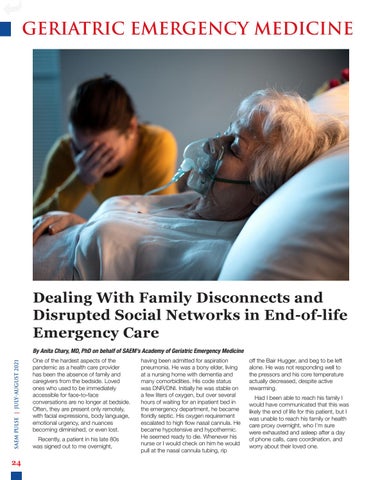
Dealing With Family Disconnects and Disrupted Social Networks in End-of-life Emergency Care SAEM PULSE | JULY-AUGUST 2021
By Anita Chary, MD, PhD on behalf of SAEM’s Academy of Geriatric Emergency Medicine
24
One of the hardest aspects of the pandemic as a health care provider has been the absence of family and caregivers from the bedside. Loved ones who used to be immediately accessible for face-to-face conversations are no longer at bedside. Often, they are present only remotely, with facial expressions, body language, emotional urgency, and nuances becoming diminished, or even lost. Recently, a patient in his late 80s was signed out to me overnight,
having been admitted for aspiration pneumonia. He was a bony elder, living at a nursing home with dementia and many comorbidities. His code status was DNR/DNI. Initially he was stable on a few liters of oxygen, but over several hours of waiting for an inpatient bed in the emergency department, he became floridly septic. His oxygen requirement escalated to high flow nasal cannula. He became hypotensive and hypothermic. He seemed ready to die. Whenever his nurse or I would check on him he would pull at the nasal cannula tubing, rip
off the Bair Hugger, and beg to be left alone. He was not responding well to the pressors and his core temperature actually decreased, despite active rewarming. Had I been able to reach his family I would have communicated that this was likely the end of life for this patient, but I was unable to reach his family or health care proxy overnight, who I’m sure were exhausted and asleep after a day of phone calls, care coordination, and worry about their loved one.
“My mere presence in the room seemed to be undoing the interventions that were keeping him alive. That’s when I made the decision to let him be.” In the meantime, I was left in an ethical gray area. The patient was fluctuating between two to three pressors peripherally. I had to presume his family wanted aggressive measures to be taken because that is our standard of care — our default in medicine when we don’t know what to do otherwise. But putting a central line in this man who was begging me to leave him alone — to make him spend the last hours of his life getting poked, lying delirious underneath a sterile blue drape, being sedated for a procedure he certainly didn’t want — seemed morally inappropriate and even cruel. I was also in a bind in that inaction seemed logistically inappropriate. I work at a large tertiary hospital where there can be long wait times for inpatient beds. My patient had deteriorated to the point that he was too sick for the floor, but there were no ICU beds available. The admitting teams were hesitant to even accept him to the ICU, given that I didn’t have a definitive answer from his family about whether ICU-level care was within their goals. They wanted to wait until I had that information before allocating him a precious bed, which would require shuffling multiple patients to make room and which everyone wanted to avoid if it wasn’t absolutely necessary. Over these nighttime hours, it was up to me to advance his care. I just didn’t know how to do that. I took a deep breath and against my moral sensibilities, prepared myself for the default, i.e., the standard measures. I wheeled an ultrasound to his room. He immediately begged me to leave him alone. I apologized and stepped closer. He grew agitated and again ripped away the warming device, thrashed against the high flow tubing, and tried unsuccessfully to lower his railing, presumably in an attempt to get out of the bed. I stood
at the foot of the bed, briefly paralyzed behind my gown and respirator. My mere presence in the room seemed to be undoing the interventions that were keeping him alive. That’s when I made the decision to let him be. It did not feel good. But once I left him alone, he settled back into stillness and let the oxygen flow into his nares. His room was next to my workstation, so I could hear him groaning as he grew more uncomfortable through the night as his hold on life unraveled. This did not feel good either. I signed out to the day team apologetically, feeling guilty and morally unsure if I had done right by my patient. I went home and lay awake in bed, checking into his chart periodically from my mobile EMR app and watching him deteriorate remotely. Eventually, I fell asleep, phone in hand. When I woke up and accessed the chart hours later, I got the standard notice: “You are entering the chart of a deceased patient. Would you like to proceed?” When the day team were finally able to reach his family it was very difficult to convey to them how critically ill he was. His family wanted to keep going with the resuscitation. They wanted to place the central line and get him to the ICU, to an unbeknownst-to-them nonexistent bed. They hadn’t seen him regularly for months due to social distancing. They could not appreciate how much his baseline cognition and functional status had declined, how frail he had become since their last interaction. They weren’t at bedside to see how sick he had become. They remembered their dad from prepandemic, when he had good days where he could have a conversation and intermittently make a joke. Of course they wanted him to keep going. Of course they wanted the line and the intensive care. From outside the hospital,
there was no way for them to fathom this cachectic shell of a man whose only words were agonal pleas to ward off his health care team. The day team had the same moral reservations as I’d had and did not place the central line. They let him be until his children could physically see him and consider for themselves what placing a central line might entail. Our nursing supervisors had invoked an exception to our visitor policy to allow family members to see patients at the end of life and the day team had convinced the patient’s children to come to the hospital to be with their father. When they arrived, they saw how truly sick and miserable he was. It was a terrible and surprising experience for them. They decided to transition their father to comfort measures and he died shortly thereafter. This case haunted me. It also unsettled me that this was not the first time I’d grappled with these dynamics of family disconnects and disrupted social networks in end-of-life emergency care, and I knew it would not be the last. Even as vaccination rates increase and as social distancing loosens, until families are reunited outside of the hospital and caregivers are back at the bedside, we will face these same scenarios and similar deaths in emergency medicine.
ABOUT THE AUTHOR Dr. Chary served as chief resident at the Harvard Affiliated Emergency Medicine Residency in Boston at the time of this writing. She is now emergency medicine faculty at Baylor College of Medicine.
About AGEM The Academy of Geriatric Emergency Medicine (AGEM) works to improve the clinical care of older patients, prepare trainees to care for older patients, and advance the geriatric EM research agenda. Joining AGEM is free! Just log into your member profile. Click “My Account” in the upper right navigation bar. Click the “Update (+/-) Academies and Interest Groups” button on the left side. Select the box next to the academy you wish to join. Click “save.”
25
GLOBAL EMERGENCY MEDICINE
Rethinking Global Health: Actions for a Decolonized Future of Global Emergency Medicine By Monalisa Muchatuta, MD, MS; Sindhya Rajeev, MD, MPH; Shama Patel, MD, MPH; Sanjukta Dutta, MBBS, PGFEM, MEM, MBA; Stephanie C. Garbern, MD, MPH, DTMH; and Catalina González Marqués, MD, MPH on behalf of SAEM’s Global Emergency Medicine Academy
SAEM PULSE | JULY-AUGUST 2021
Tropical Medicine to Colonial Medicine to Global Health Today
26
There is an uncomfortable, and seldom acknowledged dark history to global health. The field has deepseated roots in colonialism and racism in which mainly European colonizing powers dominated, exploited, and controlled colonized populations across Africa, Asia, and the Americas. Colonial medicine was primarily concerned with protecting the health and economic interests of European colonists and was a critical element of colonialism and imperialism. From its origins as colonial medicine, the field of “tropical medicine’’
arose in the 19th Century. Tropical medicine focused on finding solutions to infectious diseases in tropical regions that affected the health of colonists and soldiers, and to a lesser extent, colonized people (primarily only when diseases affected their labor potential). As simply stated by Richard Smith, former editor of The BMJ, “tropical medicine was primarily concerned with keeping white men alive in the tropics.” Subsequently, tropical medicine developed into “international medicine” and thereafter into what is now called “global health,” which is still largely defined by individuals/ institutions from rich countries “giving aid” to those in poor countries. This history perpetuates underpinnings
which employ a “savior mentality” of colonists towards colonized people. Unfortunately, this history and narrative is still omnipresent in the field of global health today, including its subdivisions such as global emergency medicine (EM). This approach concentrates power, resources, and research in highincome country (HIC) institutions at the expense of low- and middle-income country (LMIC) partners, often with little or no acknowledgement of the voices, expertise, resources, and human capital provided by LMIC partners. Recent calls to “decolonize global health” seek to challenge persistent power imbalances, to undo colonial notions of supremacy, and to build true equity and bidirectional exchanges
Colonization: To settle among and establish control over a group of people, usually based on notions of superiority to other groups of people. Involves the removal of power from colonized groups and the transfer of knowledge, language and resources from the colonized to colonizers, often in the name of “civility” or “progress.”
De-colonization: To acknowledge the origins of colonial practices and dismantle the continued influence of colonial principles and power structures today. To restore power to formerly colonized people and in the context of global health, to promote equitable leadership and representation, distribution of healthcare resources, and the bi-directional flow of knowledge and expertise. in global partnerships. Decolonization may seem like a foreign concept for many U.S.-based academic emergency physicians, as colonization was not a lived experience for them; however, one needs to look no further than the stark health disparities present within the U.S. and other countries to see how marginalization of groups of people, notions of superiority, and continued inequity persist. Decolonization not only refers to changes in practices that involve nationals of other countries, but also changes in local institutions to remove colonial barriers in all of medicine, as well as changes within individuals (as described by Seye Abimbola, “decolonizing our minds”) that challenge persistent biases. Decolonization is not a political agenda, but rather a call for critical reflection and meaningful changes to be made in collaborative global health practices for a just and equitable future.
Steps towards the Decolonization of Global Emergency Medicine As an academic EM community, it is time to work towards a decolonized future for global EM. Here we provide some suggested action steps for a path forward. This is not meant to be an exhaustive list and the actions listed are not presented in order of importance. The authors acknowledge that this list may also display their own implicit biases.
Approach Change the narrative.
The language used to describe work in LMICs (e.g., “helping,” “missions,” “third world,” “resource-poor,” “beneficiaries” in the “Global South”) is often rooted in notions of northern/western supremacy
and assumptions of LMIC homogeneity. It perpetuates the myth that LMIC communities are helpless and in need of external aid. Instead of this type of language, use your voice to redistribute power and replace the language of “helping” with the language of solidarity and partnership.
Lean out.
Recognize and amplify the voices and work of colleagues from LMIC institutions in collaborative projects. LMIC partners should have a significant stake in developing project agendas. In addition, many of us have become aware during the COVID-19 pandemic that global health work can be done with reduced travel. Limiting travel to only the essential also avoids the additional burden placed on local country faculty, such as the pressure to host external visitors. Utilization of novel technologies and strengthening of partnerships is paramount.
Challenge notions of ownership. Question and challenge current practices around who receives the grant funding and how it is distributed, who owns the data, where the opportunities lie, and who is benefiting from the opportunities.
Decolonize yourself.
Reflect on areas in which your work or the power structures in which you operate have not been truly equitable. Build your awareness of how colonial histories have shaped your way of thinking and seeing the world. Be introspective and work to address your own personal biases and assumptions as an individual and within your institution(s).
of global health journals, organizations, and academic institutions. It is often said that global health is delivered by women and led by men. The same can be said for governing bodies of nongovernmental organizations and other global health institutions that lack the diversity representative of the communities they serve.
Education Respect local expertise.
Challenge the notions of where true expertise lies. Discontinue common current practices of sending trainees or students from HICs to “teach” established and experienced physicians in LMICs on Western medicine. Invite LMIC faculty as speakers and elevate their voices and expertise. When didactics or educational activities are requested or desired from HIC partners, make sure to send training level appropriate providers who are familiar with the context and resources available.
Promote bidirectional learning.
Work to create bidirectional rotations for students, residents and fellows. Instead of a unidirectional flow of students/ trainees from HICs to LMICs, there should be equal opportunities for those from LMICs to visit HICs to gain new perspectives and experiences in health care settings that are different from their own and to contribute to projects.
Predeployment training requirement.
Training that acknowledges the colonial legacy and power structures existent in global health today should be normalized
Representation matters.
Global health leadership lacks diversity, equity and inclusion as seen in the boards
continued on Page 28
27
GLOBAL EM
continued from Page 27 and considered a fundamental step prior to embarking on any global health activities involving travel outside of one’s own local context. Dedicated training in decolonization should be provided for all levels of learners and providers participating in global health projects.
Research End authorship parasitism. HIC researchers often occupy higher authorship positions leaving LMIC colleagues “stuck in the middle.” Work toward authorship equity and building true research capacity and fair recognition.
Be a true partner.
Research priorities should be led and decided by local researchers. When designing collaborative projects, ensure equal engagement of local partners early and at all stages — from idea generation and planning to execution. Avoid inviting colleagues to collaborate only during implementation. Aim to build up local research capacity by including co-principal investigators, research assistants and collaborators from local universities and institutions.
Pay people for their work.
When designing project budgets, funding should include stipends for local staff (research assistants, co-principal investigators). Their time and effort should be valued and
ABOUT THE AUTHORS Dr. Muchatuta is an assistant professor of emergency medicine and the director of global emergency medicine mini fellowships at SUNY Downstate Medical Center. Her academic interests include advancement of quality, socioculturally competent emergency care and training locally in Brooklyn, NY and with her global health work abroad. @drmonamuch
SAEM PULSE | JULY-AUGUST 2021
Dr. Rajeev is a clinical instructor in the department of emergency medicine at Stanford and a Global Emergency Medicine fellow. She is committed to addressing health disparities through health systems strengthening at the hospital, community, and state levels. @SindhyaRajeev
28
Dr. Patel is an assistant professor of emergency medicine and University of Florida-Jacksonville. She is committed to emergency system development and equitable emergency research throughout the world.
compensated fairly. There must be shared decision-making in fund allocation.
Conclusion Understanding the colonial roots of global health and the ongoing forms of academic, economic, territorial and mental conquest of LMICs by HICs will not only allow us to look more critically at health disparities today, but also help us identify institutionalized practices within our profession that continue to uphold these misguided concepts. A decolonized future of global EM depends on our recognition and rectification of colonial era practices that shape structural determinants of healthcare delivery.
Suggested Reading List • Stuck in the middle: a systematic review of authorship in collaborative health research in Africa, 2014–2016 • Authorship in paediatric research conducted in low- and middle-income countries: parity or parasitism? • Decolonising global health in 2021: a roadmap to move from rhetoric to reform • Addressing power asymmetries in global health: Imperatives in the wake of the COVID-19 pandemic
Dr. Dutta is the consultant and head of the emergency medicine department of Fortis Hospital in Kolkata, India. Her vision is to work towards improvement of emergency care in her community and to develop EM super- and sub-specialty training development in India. Dr. Chow Garbern is an assistant professor of emergency medicine and research coordinator of the division of global emergency medicine at Alpert Medical School, Brown University. Her interests include global health education and mentorship, research capacity development, and the use of technology to overcome resource limitations to emergency care globally. @sgarbern Dr. González Marqués is an attending physician at Brigham and Women’s Hospital emergency department within their division of global emergency care and humanitarian response and a clinical instructor of emergency medicine at Harvard Medical School. @c_gonzmarq
About GEMA The Global Emergency Medicine Academy (GEMA) focuses on improvement of the worldwide delivery of emergency medical care. Joining GEMA is free! Just log in to your member profile. Click “My Account” in the upper right navigation bar. Click the “Update (+/-) Academies and Interest Groups” button on the left side. Select the box next to the academy you wish to join. Click “save.”
continuously face. I am hopeful that post-pandemic life may compel the distillation of American ideals and the restructuring of systems of power that have abandoned our communities at their most vulnerable. As we emerge into a
Latinx (predominantly Catholic) and African (predominantly of strong faith backgrounds) community members defer this decision to religious leaders because of historical mistrust of medicine in American underserved communities. Just
SGEM: DID YOU KNOW?
ABOUT THE AUTHORS Headache: Not Just Migraine
brave new world of our own devising, may we always remember la familia.
as we began to see hope on the horizon with the release of vaccines distrust has Dr. Shafer is an assistant been leaders claiming Byinitial Soumitri Barua and Alyson McGregor, MD, onfueled behalfby of religiousDifferentiating possible strokes from stroke is only The stages of mandatory professormimics of emergency “mark of one the knows how to identify symptoms SAEM’sare Sexwhere and Gender Interest Group the vaccines are “anti-Christ”, possible when quarantine I first noted despair medicine physician and devil” or unethical. All untrue assertions by and social disconnect brewing in my from red herrings. medical toxicology at Baylor A seemingly simple headache may mask a more trusted sources in immigrant communities. community. People were glued to their College of Medicine. sinister process such as ischemic stroke, especially communityMigraine and stroke have some overlapping Well-informed and health televisions and struggling to decipher in women. While women have a higher leaders lifetimecommitted risk presentations that warrant keeping both on the list of to evidence have large a barrage of information. They were of primary headache syndromes like migraines and differential diagnoses at initial evaluation. Forisexample, roles in rebuilding trust while showing Dr. Bicette an assistant severely isolated, especially young adults empathy to address misinformation for the tension headaches, chronic headache syndromes put a hemiplegic migraine, a rare type of migraine, involves professor of emergency and recent immigrants who had not yet sake ofevents, public health weakness on one side of the body (face, at higherorrisk for major cardiovascular arm, and/or leg) medicine at Baylor College built people family structures robust support including ischemic stroke, myocardial and and can resolve spontaneously before presenting at an of Medicine and a medical systems. Without such networks in place, infarction, Duty Calls cardiovascular deaths. A study found emergency department. Resolved weakness stay-at-home orders disease-related became challenging, director in themay Bayloralso St. Luke's As physicians, our voices have to be that women with migraine with aura had double the be a sign of transient ischemic attack, and persistent and those with relatives abroad were healthcare system. @DrRichiMD louder than the megaphones of those prevalence an ischemic women weakness would warrant a stroke workup. forced to weatherrate the of pandemic alone.stroke than who are spreading misinformation or
without a migraine disorder; however, adisinformation. similar Dr. Turner isand an education Women are more likely to have a migraine report In the best of times, mental health It is our duty to ensure association was not found in male participants. administration often receives little attention in immigrant people make informed longer decisions rooted and have a higher and headaches lifetime risk offellow an at communities. When compounded with evidence. to seek to compared to womenBaylor College of Medicine. It is important to have a low thresholdinto evaluateIt is imperative ischemic event without migraines the pandemic, healthavulnerabilities understand the communities weinserve for stroke,mental even when patient presents with a nonor men general. Women also haveanisha.turner@bcm.edu a higher lifetime werespecific exacerbated. New immigrants tend — underserved and immigrant alike —Emergency to @DestinedDocshould neurologic complaint such as headache. A risk of stroke. medicine physicians to have limited support, better equitablecontinue care which be prior diagnosis of ainsufficient migraine health syndromeprovide does not mean to will be aware that headache can be an important care the access and cultural barriers that the beginning steps to address the health patient is having another episode. On the contrary, sign of stroke, especially for women. limit a them from developing disparities that have long plagued medical migraine that “feelsmental like thehealth other ones” could mean ABOUT THEfrom AUTHORS coping skills. As a result, many suffered communities with distrust and fear a woman is in the early hours of a stroke. As in acute Soumitri Barua is an MS4 at The Warren Alpert Medical School of Brown from unrecognized health issues ranging our patients coronary syndrome, women with underlying ischemic University. from depression to panic attacks and . symptoms stroke are more likely to have nontraditional major psychotic breaks. Dr. McGregor is an associate professor of emergency medicine, The Warren such as pain (including headache), change in level of
Alpert Medical School of Brown University. Mass vaccination is or nearly reach consciousness, evenwithin non-neurologic symptoms. to help mitigate this crisis, yet health providers must now find empathetic SGEM "Did You is a recurring SAEM Pulse submission designed to represent concise facts that demonstrate how patient sex and gender effect ways to tackle a Know?" new challenge: emergency care. We welcome submissions. Please send contributions to the coeditors Lauren Walter and Alyson J. McGregor at sgem@lifespan.org. vaccine hesitancy. I have witnessed
29
SAEM PULSE | JULY-AUGUST 2021
MEETING AT THE CROSSROADS
30
Telehealth + Education: Identifying the Needs and Building the Programs Meeting at the Crossroads is a column dedicated to bringing members of various SAEM interest groups and academies together to explore the areas where they intersect. In this column, Erica Olsen, MD, director of virtual health services in the department of emergency medicine at Columbia University Irving Medical Center and immediate past chair of the SAEM Telehealth Interest Group talks with Peter Greenwald, MD, director of telemedicine in the department of emergency medicine at Weill Cornell Medicine; Thomas Bennett, MD, senior resident, New York Presbyterian Emergency Medicine Residency; and Neel Naik, MD, director of emergency medicine simulation education, associate medical director at the WCM NYP Simulation Center and simulation fellowship director for emergency medicine at NewYork-Presbyterian Hospital/ /Weill Cornell Medicine. Dr. Olsen: Thanks for taking some time out today to talk about telehealth education. This is an exciting time for this topic. Just last fall, as part of the SAEM20 consensus conference, an agenda was set for research priorities in telehealth education; more recently the AAMC proposed clinical competencies in telehealth medical education. On a personal level, based on the experience that we have all had over the past several years as physicians working telehealth shifts, administering telehealth programs and using telehealth to assist in the recent public health emergency, we are at a point where we can identify the major needs, gaps, and pitfalls in telehealth training and then build educational programs to target those needs. Dr. Greenwald: When we started doing telemedicine in 2016, we wanted to get our providers educated in how to conduct a visit virtually, at the time there weren’t many resources dedicated to telehealth. We ended up hiring a media consultant to help us with “telepresence,” but that was the extent of it. In subsequent years, our idea that education is important in this space has been reinforced. Especially in the last year we have all picked up examples of suboptimal telehealth visits — for example someone on screen with an unmade bed behind them, or someone failing to do a physical exam when that exam would provide valuable information for the patient’s care, and so on. I think it is very important that providers be trained in how to project a professional appearance in telemedicine, how to conduct virtual exams, including in some cases informing providers that exams are possible, and the basics of medical-legal awareness, especially the non-intuitive stuff like location and controlled substance considerations. As
educators, it’s really our job to build that necessary education and set the agenda. Dr. Bennett: Dr. Greenwald and I have discussed telemedicine in the past, but I don’t think it was really until the COVID-19 pandemic hit that it piqued my interest because the emergency department (ED) patient volume didn’t return to pre-COVID levels after the surge was over. I knew that these patients were going somewhere, but they weren’t walking into the ED. Then I had the realization that many were being seen through telehealth (a space where the residents weren’t getting much experience). I knew that we had a robust telemedicine program within our own system and that as residents we would likely need these skills someday as the landscape of medicine changed, yet we weren’t yet exposed to this in training. Dr. Olsen: That’s a great observation you made and you’re right — we were very busy with one of our programs, the Virtual Urgent Care program, which is
a direct-to-consumer platform whereby patients use their devices to connect with our emergency medicine (EM) providers directly from anywhere. For patients with non-COVID-19 concerns, there was tremendous trepidation about returning to the physical ED for fear of contracting the virus, and for those who did have COVID19-related concerns, there was fear of being admitted to the hospital without having any family support, as no-visitor policies were enforced to limit spread. Having a program in place where patients could call from the comfort of their own homes proved to be a preferred model of patient care for many. To your point about formal education, when we faced a surge and the need to onboard more providers to meet volume demands, we did provide expedited education to many providers around things like professional presence and physical exam skills, including a dedicated module to assess respiratory status virtually for those with
continued on Page 32
31
CROSSROADS
continued from Page 31
SAEM PULSE | JULY-AUGUST 2021
COVID illness. Dr. Naik can elaborate on the educational programs at the NYP Center for Virtual Care.
32
Dr. Naik: I think one of the things we need to keep in mind about education is that as telemedicine was becoming a way of taking care of patients out of necessity, a lot of people were trying to take the skills they had from years of experience in person and apply it to the telemedicine. If we consider how much time we spend working on bedside manner and learning the art of medicine, both in medical school and then in residency and later in our own practice, those sets of skills over telemedicine are different and that’s what we focused our education on. How do we provide good medical care over telemedicine? It dives into some of the things Dr. Greenwald mentioned earlier: How do you do a good physical exam? How do you get the information you need? How do you set up your space so that your patient
“As we embark on doing telemedicine we need to make sure we are training our current providers as well as future providers on how to do this well.” feels comfortable and keeping in mind some of the medical-legal things like patient privacy and confidentiality, how do we incorporate that into your visit in a seamless way? Ultimately it comes down to this: if we are not comfortable in that space and communicating and caring for our patients, then we can’t make our patients comfortable in that virtual exam room. We need to know those basics, along with some troubleshooting tips and dos and don’ts to navigate it. The approach that we use is the hybrid model; we provide some knowledge content, such as what kind
of bandwidth you need to get started to some of the medical-legal pitfalls, and we provide them in an online module. So first, we provide basic knowledge, but this is the point where a lot of telemedicine education stops. As we know from education in general, experiential learning is a great way to develop skills, so in our training program we include a simulation component as well. We have our learners go through a telemedicine case with standardized patients, so they must put these skills into practice. We record it so that we can play it back for the learners and so they can see what they look like on camera as uncomfortable as that is.
“I think it is very important that providers be trained in how to project a professional appearance in telemedicine, how to conduct virtual exams, including in some cases informing providers that exams are possible, and the basics of medical-legal awareness, especially the non-intuitive stuff like location and controlled substance considerations.” But by seeing themselves on camera and seeing what their facial expressions are and how they communicate over camera, they started to feel more comfortable and understood how they could practice that art of medicine in the telemedicine space. One of the greatest aspects of using simulation, as we are doing now at the center, is that the program evolves as learners improve, and as learners improve, we can move into more advanced topics such as how bias plays a role in our decisions over telemedicine. I think this simulation system is a model for how we should develop medical education for telehealth going forward. Dr. Greenwald: One of the things we noticed during the pandemic is the value of having a learner and a supervisor on the same visit. Having video platforms with the ability for multiple people to join the video lets us do that. A learner could start by observing a case, then do a case with supervision and ultimately see their own cases alone. A similar program for residents could be conceived where the resident learner can receive feedback. Dr. Bennett, you and I have done some work in that way, I’m curious about your thoughts on that. Dr. Bennett: I thought that it was one of the best ways to learn because doing the video visit myself with the attending in the background, observing and then interjecting when needed, allowed me to use all the skills from the module with guardrails around me to make sure I was doing things correctly. Dr. Naik: I think one of the things to keep in mind in that resident supervision model is really making sure you take that into account when you’re introducing yourself to the patient, and how the
visit is going to be conducted, making sure that everyone in the virtual room is comfortable with that arrangement. We want to make sure that these resident supervisory visits are still a safe space in which to provide medical care, and that includes knowing everyone who is in the room both on the provider end and patient end. Dr. Greenwald: Neel, I totally agree, one thing that is very important when teaching people to do visits in this space is build the “room” and know who’s in it. If the patient finds out there is someone else in the room that they did not know about, you will lose all trust; if the provider doesn’t know who’s in the room, you set the stage for privacy violations or potentially even threatening someone’s safety. Dr. Naik: To take that a step further, this is the beginning of telemedicine becoming an integral part of medical care; if we lose that kind of trust with our patients early on we could lose trust for all future telemedicine visits going forward; it’s a field we don’t want to sow with patients. As we embark on doing telemedicine we need to make sure we are training our current providers as well as future providers on how to do this well; what we teach will evolve as telemedicine itself evolves and we use it in new ways we haven’t even thought of yet, so we need to make sure that our educational systems for teaching telemedicine have that ability to evolve. Creating systems that have both a knowledge education component and then experiential learning component are key. Dr. Bennett: I’m happy to say that our residency program will be starting to incorporate telehealth in the resident curriculum starting this year. All PGY
years will have exposure and education each year. I think the publication of the AAMC competencies in telehealth medical education helped to facilitate that decision. I think it is really going to help our residents in their future careers. Dr. Olsen: I agree, and I think that emphasizes the need for our involvement at all levels including regulatory bodies. As Dr. Greenwald mentioned earlier — it is up to us to set the agenda.
BIOGRAPHIES r. Olsen is the director of D virtual health services, in the department of emergency medicine at Columbia University Irving Medical Center. r. Greenwald is the director of D telemedicine in the department of emergency medicine at Weill Cornell Medicine.
Dr. Bennett is a senior resident at New York Presbyterian Emergency Medicine Residency.
Dr. Naik is the director of emergency medicine simulation education, associate medical director at the WCM NYP Simulation Center and simulation fellowship director for emergency medicine at NewYork-Presbyterian Hospital/Weill Cornell Medicine.
33
e n i c i d e M y genc r e m E c i m e Acad
n o ti a Educ g n i n i a r and T A GLOBAL
JO
EMERGE URN A L OF
NC Y C ARE
SAEM PULSE | JULY-AUGUST 2021
dition n o c n a m u eh Elevating th of emergency s during time
34
Vol.1 No. 1 April 2021 563 ISSN 1069-6
My Year on the AEM Education & Training Editorial Board By Danielle T. Miller, MD, 2020-2021 AEM E&T Fellow Editor in Training When reflecting on this past year as the Academic Emergency Medicine Education & Training (AEM E&T) Fellow Editor in Training, this experience has highlighted three important topic areas: the benefit and need for longitudinal mentorship in the peer review process, the skill of turning meaningful education projects into education scholarship, and the effectiveness of collaborating with experts on journal initiatives. First, the cornerstone of this fellowship is to learn to be a better peer reviewer. While mentorship and coaching have been shown to be integral to trainee clinical and career advancement, these models have rarely been implemented in peer review. Peer review, like any clinical or professional skill, is a skill that must be developed through practice and targeted feedback — similar to Anders Ericsson’s concept of deliberate practice — in order to achieve mastery. Additionally, this mentorship model must be longitudinal, as the few studies on developing peer review skills have shown no effect in improving quality of reviews when mentorship is limited. Other fields in science have started to develop longitudinal “co-reviewing” models for mentoring in peer review of post-doctoral students. This longitudinal peer review mentorship model has been successfully implemented by AEM E&T in this editor-in-training position, and I want to specifically thank Dr. Esther Chen, University of California San Francisco, who has created the framework for this mentorship and provided hours of focused feedback on my peer reviews throughout the year in order to help me improve my peer review skills. This year has also allowed me to develop the skill of turning small, meaningful education projects into education scholarship. For example, during an early goal exploration discussion with my journal mentor, I discussed my interest in resident education, including leading a recent workshop on recognizing and managing microaggressions in the clinical environment. Just a
“This experience in creating an ‘educational primer’ for specific educational methods has enabled me to develop the skill in learning to create scholarship that is beneficial to journal readers and relationships with colleagues with similar educational interest outside of emergency medicine.” few weeks into this fellowship I learned that there was a gap in the emergency medicine literature on training providers on how to manage microaggressions and that the journal was thinking about publishing a special issue on dismantling racism in the next generation of learners. I was able to turn my educational session into a commentary which will appear in an upcoming AEM E&T special issue and collaborate on a multiinstitutional workshop that was presented at the 2021 Society for Academic Emergency Medicine annual meeting on how to support trainees in managing microaggressions. Being on the editorial board helped me to better understand the role of educational journals in shaping the conversation of education scholarship. Finally, through this fellowship position, I had the opportunity to collaborate with content experts on a journal initiative to educate its readers on education research methodology. This experience in creating an “educational primer” for specific educational methods has enabled me to develop the skill in learning to create scholarship that is beneficial to journal readers and relationships
with colleagues with similar educational interest outside of emergency medicine. Overall, the experience provided by the AEM E&T Fellow Editor in Training program offered insight into the critical need for longitudinal mentors and coaches in peer review, fostered the skills in turning small, meaningful education projects into meaningful education scholarship, and inspired me to continue to collaborate with experts to shape and define the conversation surrounding medical education scholarship. For more information on the AEM Education and Training Fellow Editor in Training program, contact the director of the program, Dr. Esther Chen, at manneporte@gmail.com.
ABOUT THE AUTHORS Dr. Miller is a medical education scholarship fellow in the department of emergency medicine at Stanford University School of Medicine. @DTMILLERMD
35
SAEMF Announces New Enhancements to Grant Portfolio: Apply by August 1, 2021 We’re pleased to announce several enhancements to our grant programs for the current application cycle. If you are planning to apply for an SAEM Foundation grant this summer, make sure to review the information below and, if applicable, adjust your proposal..
Making Wellness Research a Priority We’re pleased to introduce a new Notice of Special Interest (NOSI) for Wellness. Research topics of interest include but are not limited to: •
Awareness and recognition of the prevalence of emergency medicine (EM) physician burnout
•
Risks of mental health problems, including depression and suicide
•
Strategies to mitigate risks of mental health problems
Research supporting wellness in diversity, equity, and inclusion is also encouraged. Applications to this NOSI are encouraged in the Research Training Grant, Research Large Project Grant, Education Research Grant and Education Project Grant categories.
Flexibility for Research Training Grant Budget Allowances The flagship Research Training Grant (RTG) provides $300,000 to one recipient per year for career development. In an effort to give grant recipients and institutions more flexibility with the RTG, funds may now be used for salary support or project expenses. We are pleased to share the following new Research Training Grant budget allowances: •
The Research Training Grant will provide a total of up to $150,000 per year for two years as support for the awardee. Detailed budgets will be required.
•
Funds may be used for applicant salary or research support costs, but no administrative costs (secretarial support, laboratory space, etc.) will be permitted.
•
Research coordinator(s) and research support are allowable expenses if they are a direct cost of the project.
•
Fringe benefits for the applicant are permissible in addition to applicant salary. Funds may not be used to support the salaries or fringe benefits of mentors or co-investigators.
Contact Grants@saem.org with any questions about this change.
36
Opportunities for More Team Science Applicants with multiple principal investigators (PIs) may now submit a multiple PI plan for consideration in select grant categories. The SAEMF research community has requested opportunities to allow for multiple principal investigators to submit a single proposal that supports team science. This enhancement opens new opportunities for funding multiple PI projects through three of our high-impact funding mechanisms: •
Effective with the current application cycle that ends August 1, 2021, applicants for the Research Large Project Grant, Education Project Grant, and RAMS Research Grants are welcome to submit multiple PI proposals.
•
Applications that use multiple PIs must have a defined, distinct role for each PI, with strong justification for why a multiple PI application is necessary. A one-page multiple PI project leadership plan is required for multiple PI applications.
•
In order to be considered, each PI must individually meet the criteria for eligibility (including SAEM membership).
See the grant funding criteria for these funding opportunities that allow multiple PI plans: Research Large Project Grant, Education Project Grant, and RAMS Research Grants.
Grant Funding Available for EM Education, Research and Training All grant applications for this cycle are due by 5 p.m. CT on August 1, 2021. Check out our Grant Submission Tutorial to get started. The SAEMF is accepting applications for the following funding mechanisms: •
Education Research Grant - $100,000
•
Education Project Grant - $20,000
•
Research Training Grant - $300,000 (updated budget allowances as of May 2021)
•
Research Large Project Grant - $150,000
•
Emerging Infectious Disease and Preparedness Grant - $100,000
•
MTF/SAEMF Toxicology Research Grant - $10,000
•
SAEMF/Clerkship Directors in Emergency Medicine Innovations in Undergraduate Emergency Medicine Education Grant - $5,000
•
SAEMF/Academy Grants - Funding varies
•
And many more!
To view a full list of grant offerings through the SAEMF, visit What We Fund.
Join
The Annual
Alliance
Consider a Gift to Help Fund More Research and Education Our enhancements to the grants initiative and our continued investment during future grant cycles illustrates our commitment to building the pipeline of talented researchers and educators who will become EM’s future leaders. This is only possible through the partnership of the Annual Alliance Donors who generously support our initiatives. Donate now — a gift of any amount truly does make a difference 37
Support SAEMF’s Investment in Emergency Medicine Research The lifesaving importance of emergency medicine (EM) has never been more widely understood, yet less than one percent of National Institutes of Health (NIH) funding supports research in the specialty. The COVID-19 pandemic shines a light on the need for expert, evidence driven care in medical crises from the everyday to the epidemic, and the quality of that care depends on the strength of the research that supports it. The SAEM Foundation (SAEMF) is our specialty’s largest Foundation that empowers emergency physicians, saves lives, and improves outcomes for patients everywhere. At a time of great need, we’re ready to make a large research investment in our specialty’s future.
“There’s No Better Time to Join the Growing Number of SAEM Members Supporting Research and Education!"
Join the Annual Alliance The Annual Alliance, a cohort of dedicated SAEM members, is forging a philanthropic coalition to launch the careers of future research leaders who will carry the specialty forward. Browse the new Donor Impact section of our website and the SAEMF Donor Guide to learn how you can join your colleagues in supporting a bold vision for EM research by joining the Annual Alliance.
Remembering Dr. Paul Auerbach In life we meet people each day who take small steps to improve the world in which they live. Dr. Paul Auerbach’s legacy is that each of those small steps he took — whether through educating, advocating, or donating — cumulatively led to monumental impact for his colleagues, patients, and the causes to which he was so dedicated. Paul S. Auerbach, MD, MS, was the world’s leading expert on wilderness emergency medicine, founder of the Wilderness Medical Society, a pioneer for the impact of climate change on human health, and a longtime friend of SAEM. An ardent supporter of emergency medicine research, Dr. Auerbach was a steadfast donor to the SAEM Foundation and member of SAEMF’s Legacy Society. See more tributes to Paul on SAEM’s FaceBook page. 38
Thank You to Our 2021 Annual Alliance Donors! As of June 26, 2021.
Enduring Donors • • • • • • • • • • •
Steven L. Bernstein, MD Michelle Blanda, MD Gail D'Onofrio, MD James F. Holmes, Jr., MD, MPH James J. McCarthy, MD Angela M. Mills, MD Ali S. Raja, MD Megan N. Schagrin, MBA, CAE, CFRE Joseph Adrian Tyndall, MD, MPH Gregory A. Volturo, MD Richard E. Wolfe, MD, in memory of Peter Rosen, MD • Brian J. Zink, MD, in memory of Audrey Zink
Sustaining Donors • • • • • • • • • • • • • • • • • • • • • • •
• •
Anonymous (1) Thomas C. Arnold, MD Steven B. Bird, MD Andra L. Blomkalns, MD, MBA David F.M. Brown, MD James E. Brown, Jr., MD Charles B. Cairns, MD Brian Hiestand, MD, MPH Robert S. Hockberger, MD James W. Hoekstra, MD Amy H. Kaji, MD, PhD Nathan Kuppermann, MD, MPH Michelle Lall, MD, MHS Louis J. Ling, MD Ian B.K. Martin, MD, MBA Roland Clayton Merchant, MD Andrew S. Nugent, MD Susan B. Promes, MD, MBA Niels K. Rathlev, MD Kirsten L. Rounds, RN, MS Michael S. Runyon, MD, MPH, in memory of John A. Marx, MD Manish N. Shah, MD, MPH David P. Sklar, MD, in memory of Lou Binder, MD and John Marx, MD Benjamin C. Sun, MD, MPP J. Scott VanEpps, MD, PhD
Advocate Donors • • • •
Srikar R. Adhikari, MD, MS Harrison J. Alter, MD, MS Brian J. Browne, MD Chris Carpenter, MD, MSc and
• •
• • • • • • • • • • • • • • • • • • • • • • •
Panechanh Carpenter Anna Marie Chang, MD Carl Chudnofsky, MD and the Keck School of Medicine of the University of Southern California Wendy C. Coates, MD Jim Comes, MD Deborah B. Diercks, MD, MSc Gregory J. Fermann, MD Nina Gentile, MD Charles J. Gerardo, MD, MHS Kevin Kotkowski, MD, MBA Robert F. McCormack, MD Zachary F. Meisel, MD, MPH, MSc Lawrence A. Melniker, MD, MS, MBA Joseph Miller, MD Nicholas M. Mohr, MD Robert W. Neumar, MD, PhD David T. Overton, MD Edward A. Panacek, MD, MPH Arthur M. Pancioli, MD Peter S. Pang, MD, in honor of Yung-soo and Jungsook Pang Ralph Riviello, MD Elizabeth M. Schoenfeld, MD, MS David C. Seaberg, MD Peter E. Sokolove, MD Jody A. Vogel, MD, MSc, MSW David W. Wright, MD
Mentor Donors • • • • • • • • • • • • • • • • • • • • • • •
James G. Adams, MD Opeolu M. Adeoye, MD Christine A. Babcock, MD, MSC Michael R. Baumann, MD Michael D. Brown, MD, MSc Yvette Calderon, MD, MS Michael Callaham, MD Chad M. Cannon, MD Brendan G. Carr, MD Jeffrey M. Caterino, MD, MPH Theodore Chan, MD Andrew K. Chang, MD, MS Theodore A. Christopher, MD Francis L. Counselman, MD Elizabeth Datner, MD Daniel J. Egan, MD Robert Eisenstein, MD Marie-Carmelle Elie, MD Rollin J. Fairbanks, MD, MS David A. Farcy, MD Robert Femia, MD Chris Fox, MD Andy A. Godwin, MD
• • • • • • • • • • • • • • • • • • • • • • • • • • • • • • • • • • • • • • • •
Prasanthi (Prasha) Govindarajan, MD, MAS Azita G. Hamedani, MD, MPH, MBA Richard J. Hamilton, MD Mark C. Henry, MD Erik P. Hess, MD Nicholas J. Jouriles, MD Michael F. Kamali, MD Gabor D. Kelen, MD Babak Khazaeni, MD Terry Kowalenko, MD Dick C. Kuo, MD Lilly Lee, MD Eric L. Legome, MD Christopher McDowell, MD, MBA, MEd L Kendall McKenzie, MD James R. Miner, MD Bryn Mumma, MD, MAS Paul I. Musey, Jr., MD, MS Lewis S. Nelson, MD Robert E. O'Connor, MD, MPH Brian J. O'Neil, MD Jonathan S. Olshaker, MD Denis Pauze, MD Scott W. Rodi, MD, MPH Robert W. Schafermeyer, MD Jay Schuur, MD, MHS Rawle Anthony Seupaul, MD Rahul Sharma, MD, MBA Robert Shesser, MD Leslie V. Simon, DO Susan A. Stern, MD Jeffrey Stowell, MD Mary E. Tanski, MD, MBA J. Jeremy Thomas, MD, MBA Terry L. Vanden Hoek, MD Michael J. VanRooyen, MD, MPH Michael C. Wadman, MD Elizabeth Lea Walters, MD Richard D. Zane, MD James M. Ziadeh, MD
Although we take great care in compiling our list of donors, there is always the possibility of error. See the full SAEMF donor list online at www.saemfoundation.org. If we omitted your name, or if it is incorrect, we apologize and ask that you contact jwolfe@saem.org.
It's Easy to Participate You can make your donation online; pledge to give by emailing jwolfe@saem.org. 39
RESIDENT GUIDE TO ABEM CERTIFICATION By the ABEM Resident Ambassador Panel: Haig K. Aintablian, MD; Alaa M. Aldalati, MD; and William Spinosi, DO American Board of Emergency Medicine (ABEM) Resident Ambassador Panel members serve two-year terms during their residency training and provide a resident perspective to ABEM activities. Working with ABEM over the past year, the 2020-2022 ABEM Resident Ambassador Panel has gained insights into the process of becoming ABEM-certified and have outlined those steps from their perspective. We hope this helps residents in preparing for the certification process. Becoming board certified in emergency medicine by the American Board of Emergency Medicine (ABEM) is a simple process requiring three steps for residents who are in their final years of training.
Step 1: Applying for Certification
During the last year of a resident’s emergency medicine (EM) training, graduating residents destined to finish residency by October 31 can access application information by signing into the ABEM initial certification page. ABEM will also send application information to the program director of the residency program, usually around April. Those graduating later than October 31, will apply in the next application cycle. For EM residents who graduate between November 1 and October 31, it’s important to apply in the current application period. If you delay this, you may need additional certification requirements, including a state medical license, if you do not have one already. The entire application and fee payment process is online. Applications are processed as soon as they are completed. Board eligible means that a resident graduated from a ACGME or RCPSC accredited emergency medicine program
40
or an ABEM approved combined program. Additionally, you must fulfill all medical licensure per ABEM policy. If you are applying right out of residency, you do not need to hold a state medical license. This starts on the day you graduate from residency and extends to December 31, five years after your graduation date.
Step 2: Passing the Qualifying Exam
The second step in becoming ABEM board certified is to pass the qualifying examination — a “written examination” that is actually a computerized test with 305 multiple choice questions (with only single best answer choices). The qualifying examination is offered in about 200 Pearson testing centers across the U.S., making it easy to take the exam in the state from which you graduated or in which you plan to practice. The exam itself is offered during one six-day period, typically in the fall. In order to take the exam during this time, you must schedule yourself during one eight-hour block in this five-day period. Should you be unable to attend the exam, you can cancel the exam before 24 hours from the start of the exam. Please arrive 30 minutes before your exam time and bring a valid
form of identification. This process is similar to many of the other examinations you have taken to get to this point in your career as a physician. The exam appointment is a total of eight hours long, but divided into two testing sections, each about three hours and 10 minutes long, with a one-hour break in-between. The question topics are based on the EM Model, similar in makeup to the in-training exams, which you have likely already experienced during your residency training. You can expect your score within 90 days of completion of this qualifying exam.
Step 3: Passing the Oral Board Exam
The third and final step in completing board certification is to pass the oral board examination. To be eligible for this section of board certification you must have passed the qualifying examination as well as have a state medical license. Once you pass your qualifying examination you must take the oral board exam the next calendar year. Given the Covid-19 pandemic, there have been some changes to the implementation of this section of board certification. Notably, for the safety of test takers and testing staff, the examination has been offered on a virtual platform, as opposed to in-person. The oral board examination comprises six single patient cases, each 15-minutes long. The examiner will provide pertinent history and offer answers to the examinee’s questions. The examiner will track eight specific markers during these patient cases. These markers include:
"BECOMING BOARD CERTIFIED IN EMERGENCY MEDICINE BY THE AMERICAN BOARD OF EMERGENCY MEDICINE (ABEM) IS A SIMPLE PROCESS REQUIRING THREE STEPS FOR RESIDENTS WHO ARE IN THEIR FINAL YEARS OF TRAINING."
• Final diagnosis • Disposition
• Data acquisition
• Transitions of care
• Problem solving
Once you are done with the oral board examination, typically within 45-60 days (and definitely within 90 days) ABEM will let you know if you passed or failed. ABEM does not use quotas or percentages to determine a passing score; instead, after each examination, ABEM testers meet to determine the standard of care for each case and whether testers passed or failed. The final passing score is then sent to the ABEM board to determine performance expectations for a pass or fail score. ABEM does not allow for rescoring or second scoring any examinations.
• Patient management • Resource utilization • Healthcare provided or outcome • Interpersonal relations and communication skills • Comprehension of pathophysiology • Clinical competence Examiners assign a score of from one to eight, with one being very unacceptable and eight being very acceptable. In addition to the six single patient cases, a discussion on your approach to patient care will evaluate your thought processes. Structured interviews are scored as 25 points spread across eight stages of a typical patient interaction. These include: • History • Physical exam • Differential diagnosis • Testing • Treatment
Once you have passed the Oral Board Examination, congratulations! You are now an ABEM board-certified EM physician! ABEM-certified physicians serve a valuable and irreplaceable clinical role in the care of the critically ill and injured. The delivery of emergency care is best led by physicians with EM training, experience, and ABEM certification. ABEM will support you throughout your career in continuing certification activities and promoting the important and valuable role ABEM-certified physicians bring to emergency care in the ED. Do you have questions about the certification process? Reach out to your program director or contact ABEM at abem@abem.org.
41
COUNSELING THE FAMILY: AN INTERN'S PERSPECTIVE By Ali Maher Hassan On a busy nightshift I was the only intern available, as my supervising physician was deposed with other critical patients. I was immediately called to the triage area for a 48-year-old woman brought in by an ambulance and accompanied by her family. The patient was in acute distress and unable to speak. As soon as her children identified themselves, a panicked question arose: “What’s going on?” I inquired about their mother’s initial presentation and learned that her daughters had found her on the bathroom floor, but no one was sure of what occurred. Once the hospital staff helped shift the patient into the resuscitation bay, I immediately proceeded to check her vitals and assess her level of consciousness while asking a series of questions. In the midst of doing this, her son interrupted me to state, “there is no point in your questions.” Then, in a disgruntled done, he said something about me “being useless” and demanded that I “just give her medication.”
42
How many of us interns have encountered an angry or fearful family member or multiple disgruntled family members accompanying a sick relative? Physicians can sometimes be so mired into their work caring for patients that they forget to care for families, thus leaving them feeling unattended to. Family members sometimes attend the emergency department in a state of panic and/or with other strong emotions, which puts a strain on the relationship between family and physician. As we spend more and more time in the emergency department, we eventually realize that this is all too common and recurrent of a theme for which preparation and training is necessary. My encounter with this family in the ED was a steppingstone in my career during which I learned the importance of attending to the families of patients. A family’s disposition in a situation like this one may greatly influence a physician’s professional judgment. Physicians may
"PHYSICIANS CAN SOMETIMES BE SO MIRED INTO THEIR WORK CARING FOR PATIENTS THAT THEY FORGET TO CARE FOR FAMILIES, THUS LEAVING THEM FEELING UNATTENDED TO." feel disheartened due to negative feedback they receive during these crucial moments. On the other hand, such thoughtless comments may enhance empathy as it reminds us that the relationship between these individuals is a very personal one. As an intern, it is especially easy to put behind the oaths we took at the beginning and end of our medical school journey – to prioritize patient health, practicing beneficence, maintaining professionalism and abiding by the laws of ethics. Patient health encompasses physical, mental, emotional and psychosocial care. Although their mother lay on the bed, her children needed tending to, as well. While one may reflect on these principles with a clear mind, will you be able to put them into practice in that very instant? Although looking up to the patient’s son took all of a second, it felt much longer when you deliberate how to best respond. How can I focus on the task at hand while being reprimanded simultaneously? I remind myself to remain patient, polite and as professional as possible. Her family is fearful of the situation at hand, and are not troubled by me, personally. It is never easy to witness your ill mother on a hospital bed. I then proceed to empathize with the patients’ relations, share their frustration, and gently emphasize my intention to do the best I can to help their mother. This seemed to calm them down, albeit temporarily, but it gives me just enough room to think clearly and manage the patient’s condition to the best of my ability. It is already difficult as an intern to take care of such patients by ourselves due to the lack of experience, let alone counsel the family too. These encounters are going to be innumerable over the span of our careers, and my attending, Dr. Bradley, whom possessed over 30 years of experience as an emergency medicine specialist, mentions some things we can do to defuse such situations and excel while in practice: • Lend an ear; truly listen to and decipher their concerns. • Understand their relation to the patient and be as empathetic towards him/her as possible.
• If the scenario warrants it, do what is best for the patient. If this means asking family to evacuate a room, then ask them to do so politely. An insightful review virtually accessible further consolidated these concepts. Dr. Thomas Baudendistel MD, FACP is an associate program director at Sutter Health’s California Pacific Medical Center, and chair of Sutter Health’s Ethics Committee. He encourages physicians to, first, avoid describing such family members as “difficult”, and instead consider them as “someone with lots of worries.” Secondly, when dealing with worried patients or family members, he advised building trust, being transparent, to “stay on the same page” by inquiring about and responding to any immediate concerns they may have, employing team resources, enhancing communication skills, avoiding assumptions and last, but not least, doing the very best you can. I applied Dr. Bradley's and Dr. Baudendistel's advice in the weeks to come and found that a number of similar scenarios were handled in an overall improved manner due to an increased level of co-operation of patients. I also had a plan to lean back on when things didn’t go too well. Subsequently, I no longer found myself in a state of “what do I do now?” which only improved my confidence and directive approach when facing these situations. Counseling is an integral part of practicing medicine. It requires plenty of practice and, if mindful, will only improve with time. ABOUT THE AUTHOR: Ali Maher Hassan is an emergency medicine intern at Bellin Health, Green Bay, Wisconsin.
• Even if they may appear angry at you, they are not. A family member, more often than not, does not understand what is going on and is merely afraid of what may follow.
43
FROM MATCH TO FIRST PROMOTION WEBINAR SERIES: ENSURING A SEAT AT THE VIRTUAL TABLE By Taylor Stavely, MD and Wendy Sun, MD on behalf of SAEM Residents and Medical Students and the SAEM Academy for Women in Academic Emergency Medicine The second installment of the AWAEM and RAMS collaborative webinar From Match to First Promotion focused upon the new landscape of virtual academic conferencing and promotion during the pandemic. There was particular attention paid to how to get the most of virtual conferences, mentee best practices, Twitter usage, and how to battle the tenure clock in the pandemic. The webinar panelists were Dr. Devjani Das (Columbia University Medical Center), Dr. Alexandra “Lexie” Mannix (University of Florida Jacksonville), Dr. Taylor Stavely (Emory University), and Dr. Wendy Sun (Yale-New Haven Health). The increasing entry of women in medicine has revealed much about the gendered politics of having a seat at the table, but what if the table is now virtual?
2. Women, especially mothers, are disproportionately affected by pandemic driven changes in childcare and schooling, altering their household responsibilities.2
Top 10 Pearls From the Webinar
5. Annotate your CV to describe your frontline clinical responsibilities, COVID-19-related community service, and any pandemic-related disruptions in research, education, or speaking opportunities. (See reference 1 for examples)
1. Pre-existing racial and gender disparities have been amplified by the pandemic, with women and underrepresented minorities in medicine being the most vulnerable for career disruption.1
44
3. You should take advantage of the improved accessibility of virtual conferencing but be wary of the distractions at home (clinical or otherwise) that may diminish your focus on the conference. 4. Consider the use of an email away message while attending conferences such as: “My engagement with [conference] until [date] requires that I divert my attention from email and other administrative tasks. Please contact [X] for any urgent matters, or to schedule a meeting after I return.”
6. Mentors are like mirrors to help you see yourself clearly and offer guidance. Sponsors provide endorsement and identify opportunities for career advancement. A mentor and sponsor may or may not be the same person. 7. Come to your mentor prepared with questions, commitment, and actions completed. The mentor is not there to do the work for you! 8. Extensions of the tenure clock only partially address gender inequity in promotion — a disparity even more pronounced by the pandemic. Promotions committees should adjust benchmarks to consider innovative contributions to community service, advocacy, media, and teaching.3 9. Twitter is an excellent tool for engaging with others in medicine and developing mentors! 10. If using Twitter during a conference, take screenshots of presentations to share information and use @mentions and conference #hashtags. You’ll be surprised at the activity you generate! ABOUT THE AUTHORS: Dr. Stavely is an emergency medicine resident at Emory University School of Medicine.
Dr. Sun is an emergency medicine resident at Yale University. She is the 2021-2022 RAMS Board president.
45
WHEN A RESIDENCY PROGRAM SHUTS DOWN By Aaron R. Kuzel, DO, MBA
Background
Hilary Davenport, DO, is currently at PGY-3 resident at the University of Louisville and will be starting an ultrasound fellowship at The Ohio State University Wexner School of Medicine in July. Dr. Davenport was a PGY-2 emergency resident at Hahnemann University Hospital prior to its closure August 16, 2019. Jordan Miller, DO, is the chief resident at Summa Health. Dr. Miller was a PGY-1 emergency medicine resident at Adena Health System in Chillicothe, Ohio prior to its loss of accreditation in 2020.
Hilary Davenport
Jordan Miller
Scott Poland
46
Scott Poland, MD, is the emergency medicine ultrasound director and core faculty at Summa Health. Dr. Poland was a PGY-3 emergency resident at Summa Health prior to its closure in 2017.
Imagine, you are at the height of your residency. For four years you’ve dreamed of nothing but being able to practice emergency medicine at this residency. You’ve developed new relationships, have a new home, and you’re thriving and coming into your own as an emergency medicine physician. Suddenly, the rug is pulled out from under you, and you find yourself scrambling to find a new job, a new home, and calling every contact in your phone trying to find somewhere to complete your residency. This is a nightmare scenario for any resident; however, for these three emergency medicine physicians —Drs. Davenport, Miller, and Poland — it became a horrible reality. These residents were involved in the closure of Hahnemann University Hospital, Summa Health’s contract dispute and closure, and Adena Health’s accreditation loss. Yet despite these challenges, these three physicians overcame this adversity and are thriving in their careers as emergency physicians. Here they share their experience and insight on coping through career setbacks and their advice for other residents who may share similar experiences.
What were your initial thoughts/reactions about the news of your residency program shutdowns? Dr. Poland: I went through the stages of grief: Initially denial, then anger, bargaining, depression, and eventually acceptance. Dr. Miller: Initially I was devastated and didn’t know exactly what to think. I had to excuse myself from the room and went into the hallway to start sobbing. Dr. Davenport: I was actually on a plane on my way to vacation when I woke up from a nap to over 400 text messages and “group me” messages. I found out sitting on a window seat of a plane! I was in shock, and a slurry of cuss words came to my mind — specifically ones that started with the letter “F.” I had a panic attack with nowhere to go and I couldn’t contact anyone. Of course, my natural instinct was to wonder, “What could be the worst possible outcome?” All I could think about was It had taken me so long to get to this point in my career, and it was all crashing down around me.
How did this experience impact your overall life? Dr. Poland: It was an unexpected bump in the road, but overall I have still been able to accomplish my personal and life goals. Dr. Miller: Initially my program closure was devastating. I had recently bought a house, which put a lot of stress on my family. For about 10 months I was extremely angry about the situation and went through all the stages of grief until I finally accepted my new life. Ultimately my program closure opened new doors that wouldn’t have been possible otherwise. Dr. Davenport: Through this experience I have learned a lot about malpractice insurance, what it’s like to work at a multitude of hospitals, and how to make friends quickly. The good news for my social life is that it meant I got to move closer to my then boyfriend, now fiancé. But I will say that I miss Philadelphia and my coresidents from Drexel EVERY. SINGLE. DAY. We were such a close-knit group of people. They were my family and I still think of them that way. I’m not sure if I became a better physician by going to a different program, and the world may never know, but I think it did change how I practice medicine. I have now worked with and learned from double or triple the number of attendings during residency.
Did the closure of your program have an impact on your career trajectory? Dr. Poland: At the time I felt devastated and unsure of my future. In retrospect, I look at it as a beneficial time of adversity. It allowed me to see multiple ways of practicing that I may not have otherwise seen. It made me aware of the challenges and current culture that emergency medicine is facing. Dr. Miller: I went from a small community center to a large level one trauma center. I always wanted to be a community doctor and had thought about fellowship as an intern, but I wasn’t at a big program. I also really didn’t enjoy the idea of being in a big city and it’s still sometimes very stressful for me to be in a large city. It did, however, give me the opportunity to see a larger volume of critically ill patients and ultimately was the reason I decided to apply and match to fellowship for critical care.
Dr. Davenport: I matched in an ultrasound fellowship at Ohio State and go, to move to Columbus to be with my fiancé. I’m not sure if any of that would have happened if I had stayed in Philadelphia. I think the goals of my career would have been the same. The plan was always to apply for an ultrasound fellowship— it just depended on where I was.
What was the hardest adjustment you had to make because of the closure? Dr. Poland: I was fortunate to relocate at the beginning of my third year which meant I had all of my off-service intern year rotations done and had gained experience in the emergency department already. Dr. Miller: I didn’t realize how difficult that would be for me to live in a big city. It was also extremely difficult for me to essentially feel like I was an intern again while going into my third year of residency. Dr. Davenport: Each hospital and residency program has a different culture, and I would say that was the hardest adjustment. I came from a program where everyone was really close knit and all of the classes hung out with each other. I had a very hard time feeling like I fit in at my new hospital. Not only was I learning an entire new hospital system, I also felt like I had to “prove” myself to my fellow residents, attendings, nurses, and other staff. Everyone wondered who I was and it was very difficult at first. Trying to make friends and learning a new hospital system were the most difficult.
Were there any positives to the experience as you reflect back on that time? Dr. Poland: The opportunity to train under three cohorts of emergency medicine providers. I was able to see that residents can be trained under small groups, larger groups, and hospitalemployed physicians. It was also great to meet all of the new residents and make new friendships. Dr. Miller: It made me a more resilient person in many aspects of my life, not just in medicine. I’ve also met some of the most amazing friends I’ve ever had in my life, which I wouldn’t have done if I hadn’t gone through this experience. Dr. Davenport: The biggest positive of all was more social than anything. I moved much closer to my then boyfriend, now fiancé. If I still lived in Philadelphia, I’m not sure if our relationship would be as strong as it is now. Another positive is that I feel very independent. The University of Louisville values the autonomy they give to residents, so I have been able to moonlight at other emergency departments in the city and have really grown as an emergency physician. I feel much more confident in my skills and my ability to carry multiple patients at a time. I’ve also been able to teach interns and medical students more at the University of Louisville, which helped me decide I wanted to continue my career in academics.
continued on Page 49
47
48
DISPLACED RESIDENTS continued from Page 47
Dr. Miller: Yes. I didn’t realize how small the community was and how willing people were to help. I was trying not to fall apart for months while going through this process and felt like I had an amazing support system to help me come to terms with my situation.
Do you have any advice for finding a new program? Did your program director and/or the Accreditation Council for Graduate Medical Education (ACGME) Dr. Davenport: This process had nothing to do with my love help place you? for emergency medicine, which was ingrained in me since I Dr. Poland: Reach out to the programs you were interested in when first applying to residency. Analyze what factors are important to you and evaluate the programs based on that criteria. For me geography and location were an important factor. My old and new program directors both offered to assist but I had a lack of trust at the time and decided to pursue my own offers. The ACGME unfortunately takes a hands-off approach and only decides on program accreditation. Dr. Miller: I met my current program director at a lecture about the American Board of Emergency Medicine (ABEM) and told him about my situation. My old program director helped me look into programs that I felt would be a good fit for me. Ultimately it was a combination of effort from multiple people to get me to my new program. Dr. Davenport: The cold honest truth: just start emailing the program directors of the programs that you interviewed at. That was the first step I took. When I found out about the news I immediately reached out to a longtime friend/ boss. Every day, the ACGME would release new residency programs that were willing to take “orphaned” residents. It was a list that would say how many residents (per PGY year) they would take and then you would have to contact them. It sounds easy but it was not. Before they would accept you there were interviews and they would need to see your application. Imagine doing all of this while still working your normal residency shifts. I was working in the MICU doing q4 call while trying to manage this. There isn’t a book of rules; you just wing it the entire time. We also did “speed dating” interviews with all of the programs in and near Philadelphia. It was the weirdest feeling competing with your friends for a spot at another program. You sat down with associate program directors, program directors, and chairs for 10 minutes to answer interview type questions and then you would find out two days later if they liked you enough to want you at their program. It was the devastating watching Drexel attendings as they saw this happening. For them it was as if they were losing their children. Our program directors helped as much as possible. If we found a program that we liked they would provide that program with our information, but as I said, there were no rules and it was an “every man for himself mentality.”
Did your opinion on emergency medicine change throughout this process?
was a scribe 10 years ago. I still think it is a great specialty. I think the experience just changed the way I think of hospital systems and residencies in general.
How do you think our national organizations should intervene to prevent this from happening? Dr. Poland: First, by having high standards that emergency residencies are expected to uphold; second, by having guidelines for preventing untimely contract disputes and hospital closures; third, by encouraging the gradual closing of underperforming programs to prevent relocation of residents. Finally, by facilitating relocation discussions, interviewing, and financial assistance for those residents facing the challenge of relocation. Dr. Miller: This is a hard question to answer but I think if a program shuts down, maybe let all the residents finish? My seniors were allowed to graduate. It was only the interns who were displaced. Also, relocation shouldn’t financially be on the resident. It cost me thousands of dollars I didn’t have to move, interview, and make a down payment on a house. Plus, I couldn’t sell my house for months because of the COVID pandemic. There has to be a better way. Dr. Davenport: I think it is the duty of national organizations to take an active role in assuming ownership for displaced residents and ensuring they achieve their goals in emergency medicine. Further, I believe that national organizations should take a firm stance in evaluating residencies that are started by “for-profit” or private equity institutions. Those programs that view residents as cheap labor and do not prioritize their educational needs should be removed. I believe it is the duty of our national organizations to protect residents and ensure that residents are not treated as commodities, but rather as future board-certified emergency physicians. Hahnemann was a clear example of when a for-profit entity chooses profit over patients and future physicians, physicians, nurses, and staff. I think our organizational bodies can 100 percent prevent these types of tragedies from happening. ABOUT THE AUTHOR: Dr. Kuzel is an emergency medicine resident at the University of Louisville School of Medicine. He is the associate editor of the RAMS Section of SAEM Pulse and is a member-at-large on the SAEM RAMS Board.
Dr. Poland: It reaffirmed for me that emergency medicine is a large family willing to help those in need; however my personal experience opened my eyes to the enormous amount of business in medicine.
49
BRIEFS AND BULLET POINTS Announcing an Exciting New Digital Experience From SAEM! We have a shiny new website for you to explore and enjoy. Introducing the refreshed and redesigned SAEM.ORG! Crafted to reflect a more accessible format with expanded search capabilities, our new site offers streamlined menu options, simpler navigation, and easy, direct access to the information you need. Start exploring now!
SAEM21 Claim CME Through July 31 for Sessions You Attended at SAEM21 July 31 is the last day to claim CME credit for all live education sessions you attended during the SAEM21 Virtual Meeting. Log in to your Juno account at https://saem.junolive.co/live. Go to the “Claim CME” tab at the top and follow the instructions. View sessions you missed and earn additional credit (260+ credits in all!) by viewing presentations “On Demand” through October 31, 2021.
Congratulations to SAEM’s 2021 Award Winners Meet our 2021 SAEM Award Winners! SAEM awards are given each year in recognition of exceptional contributions to emergency medicine and patient care through leadership, research, education, and compassion. Congratulations to all of our 2021 award recipients.
SAEM22 Submission Deadlines • Advanced EM Workshops: Aug 2–Sep 15, 2021 • Didactics: Aug 16–Oct 1, 2021 • Call for Keynotes: Sep 7–Nov 1, 2021 • Abstracts: Nov 1, 2020–Jan 4, 2022 • Innovations/IGNITE!: Nov 1, 2021–Jan 11, 2022 50
Save the Date for SAEM22! Save the date for next year’s SAEM Annual Meeting in New Orleans. We’ll be back in person and presenting the latest research and educational topics in academic emergency medicine. It’s going to be a great reunion and we hope to see everyone there.
SAEM NEWS & INFORMATION Residents and Program Directors: Register for the Upcoming Residency & Fellowship Fair Residents: Sign up for the Virtual Residency & Fellowship Fair and meet online with representatives from coveted residency and fellowship programs at NO COST to you! Program Directors: The RFF is your opportunity to showcase your residency and fellowship programs to medical students and emergency medicine residents looking to find their perfect residency or fellowship. Register now!
Let SAEM’s Expert Consultants Help You With Teaching, Research, and Other EM Practice Issues SAEM committee and academy members possess expertise in teaching, research and other aspects of academic emergency medicine (EM) practice. Through SAEM Consultation Services, these experts, in consultation with Association of Academic Chairs of Emergency Medicine (AACEM), are available to assist individuals, departments, and institutions with developing, evaluating, and/or improving various services; developing departmental status for EM divisions; subspecialty
expertise (research, ultrasound, etc.); and billing, patient safety, etc.
Accepting Proposals for 2023 Consensus Conference Proposals are now being accepted for the 2023 SAEM Consensus Conference, May 16, 2023, in Austin, TX. For more than 20 years, the SAEM Consensus Conference has gathered junior and senior researchers, thought leaders, and other stakeholders in emergency medicine to generate research agendas for the important, unanswered questions facing emergency care, leading to high-quality, funded research projects of varying scopes from a variety of funding sources. Proposals must be submitted by 5 p.m. CT, September 2, 2021 to consensus@ saem.org. For details, guidelines, and a list of previous topics, visit the webpage.
SAEM FOUNDATION Together We Can Do More! Show your support of research in emergency medicine and help your academy, committee, and/or interest group receive special recognition as a leader in giving by participating in the SAEM Foundation (SAEMF) Academy, Committee, and Interest Group Challenge. Just make a charitable gift before August 31, 2021. For every $1 donated during the Challenge, SAEM will donate $1 to the SAEMF (up to $10,000 on gifts/pledges committed between May 1 and August 31). If you’ve already donated in 2021, we’re counting that toward the academies, committees, and interest groups to which you belong. Your gift will help to fund more and larger grants. Donate today!
Grant Funding Available for EM Research and Training
To view a full list of grant offerings through the SAEMF, including the new Emerging Infectious Disease and Preparedness Grant, visit What We Fund. All applications are due by 5 p.m. CT on August 1, 2021. Take a look at our Grant Writing Resources before you apply. View the Grant Submission Tutorial to learn how to submit your proposal. Check out our 2021 Grantees and their work.
SAEM RAMS URiM Medical Education Award Recipients
SAEM Residents and Medical Students (RAMS) is committed to promoting the next generation of diverse emergency physicians. With the rising costs of medical education, the purpose of the URiM Medical Education Award is to provide financial assistance, in the form of $500, to underrepresented medical students who demonstrate a strong commitment to and leadership skills in emergency medicine. Specifically, the scholarship aims to alleviate the financial strains associated with national licensing exams (often not included in tuition costs). Here are the recipients of the most recent URiM Medical Education Awards:
SAEM JOURNALS Call for Papers: AEM E&T 2021 Virtual Meeting Proceedings Issue! AEM Education and Training (AEM E&T) invites submissions from SAEM academies, committees, and interest groups for a special issue of the journal that will publish in early 2022 and highlight the proceedings from the SAEM21 Virtual Meeting relevant to education and training. Details and submission instructions can be found online. Deadline is October 15, 2021.
AEM E&T Names 2021-2022 Fellow Editor in Training
Academic Emergency Medicine Education and Training (AEM E&T) is pleased to announce that Carolyn Commissaris, MD, a medical education Carolyn Commissaris fellow at University of Michigan Department of Emergency Medicine has been selected as the 20212022 AEM E&T Fellow Editor-in-Training. The fellow appointment to the editorial board of AEM E&T is intended to mentor a medical education fellow in the process of peer review, editing, and publishing of education research manuscripts.
Caurice Wynter, MS4, Frank H. Netter, MD School of Medicine at Quinnipiac University, North Haven, CT
Joseph Rojo, MS2, St. Louis University School of Medicine, St. Louis, MO
Spencer Seballos, MS4, Cleveland Clinic Lerner College of Medicine of Case Western Reserve University, Cleveland, OH
Danielle CharlesChauvet, MS4, Warren Alpert Medical School of Brown University, Providence, RI
Check Out the Latest RAMS Podcasts! Who’s Who in Academic EM
Al’ai Alvarez, MD, Linda A. Regan, Stanford Emergency MD, Johns Hopkins Medicine University School of Medicine
Ask a Chair
Michael J. VanRooyen, MD, MPH, Brigham & Womens Hospital/ Harvard Medical School
Elizabeth Lea Walters, MD, Loma Linda University School of Medicine
SEE YOU IN NEW ORLEANS may 10-13, 2022
New Orleans 51
SAEM REPORTS ACADEMIES Simulation Academy Announces Award Winners; Launches Consulting Service The SAEM Simulation Academy is pleased to announce that Dr. Julie Gesch is the 2021 SAEM Simulation Research Grant recipient for her work Julie Gesch using in-situ simulation to improve stroke care. The academy congratulates the following Simulation Academy members who received 2021 awards: • Dr. Alise Frallicciardi, Distinguished Educator Award • Dr. Charles Lei, Early Career Educator of the Year Award • Dr. Kevin Ching, SIM Innovation Award • Dr. Ambrose Wong, Change Agent Award • Dr. John Elue, Virtual Meeting Attendance Scholarship In conjunction with the CORD simulation community, the SAEM Simulation Academy is excited to offer a simulation consulting service to help troubleshoot simulation education and curricular challenges. To request a consult, visit the Advisor Consult Service webpage. For Simulation Academy updates, including future events, follow our Twitter account @SAEMSimAcademy.
COMMITTEES Virtual Presence Committee FOAMed Competition a Big Success Free Open Access Medical Education (FOAMed) is an asset uniquely created by and made for the EM community. Each year, at the SAEM annual meeting, the SAEM Virtual Presence Committee organizes a competition of new and upcoming FOAMed projects. Below is an overview of the four contestants that faced off in this year’s competition.
The Winner: Skin Deep by Don’t Forget the Bubbles (DFTB)
52
Patients with darker skin tones have been grossly underrepresented in dermatologic online images. The Skin Deep team have developed “a free, open-access bank of high-quality photographs of medical conditions in a range of skin tones for use by both health care professionals and the public.” The team has a detailed submission process to ensure full consent has been obtained for all images. The Skin Deep team also includes an impressive number of dermatologists that review all the images to ensure they are appropriately indexed. This project has expanded and is now a multinational effort to increase the education of dermatologic presentations on all skin tones.
COVID, she decided to spend that time helping nurses up their game. The Up My Nursing Game podcast was born during the pandemic but has persisted and developed a strong following. Tackling topics from atrial fibrillation to homelessness, Annie delivers a consistently high-quality education. She involves physicians, respiratory therapists, speech therapists, and other nurses in the discussion to provide truly interdisciplinary education. Annie continues to publish her podcast monthly on all major podcasting platforms.
INTEREST GROUPS
Second Place: The Virtual Resus Room
When in-person education was halted by the pandemic, Dr. Sarah Foohey realized there was no effective way to run simulations online. To solve this problem, Sarah launched the Virtual Resus Room, using Google Slides and Zoom to create an engaging, collaborative online simulation experience. Learners simultaneously drag and drop monitors, medications, and equipment. Gifs, videos, and images are used to show exam findings and to allow learners to “work through” procedures. The VRR has been used by more than 20 programs in nine different countries. The VRR is entirely open access, with cases and instructions posted on the website.
Third Place: CriticalCareNow.com
Consistency in high-quality FOAMed can be difficult for busy physicians and medical staff. Haney Mallemat has solved this problem by assembling a team of critical care physicians, emergency medicine physicians, pharmacists, prehospital physicians, and respiratory therapists. CriticalCareNow.com delivers daily unique content in the form of written articles, videos, and infographics. With over 40 contributors and editors, CriticalCareNow.com has consistently published high-quality educational content daily since the site launched in July of 2020. The collective efforts of this team have resulted in the site receiving over 2000 views every day.
Fourth Place: UpMyNursingGame.com
When Annie Fulton was forced to cancel an Italian vacation because of
Evidence-Based Healthcare and Implementation Interest Group Announces Award in Honor of Rakesh Engineer The Evidence-Based Healthcare and Implementation Interest Group is announcing the Rakesh Engineer Award in honor of the late Dr. Rakesh Engineer (1970 - 2019), whose commitment to implementation science inspired many. This award recognizes a high-quality implementation study. Submissions to the SAEM Annual Meeting will be considered starting in 2022 if they are accepted by the program committee and the study focuses on implementation or de-implementation methods leading to evidence-based improvements in care. Researchers may apply at the time they submit their abstracts. Eligible entries will be scored in two stages, including the full presentation at the annual meeting, using modified RE-AIM criteria. For information contact Carly Eastin, MD, cdeastin@uams.edu.
53
ACADEMIC ANNOUNCEMENTS Dr. Junaid Razzak is New Vice Chair of Research Dr. Marc Probst Joins NYP–Columbia EM at NewYork-Presbyterian/Weill Cornell Research Division Junaid Razzak, MD has been appointed as the new vice chair of research for the Department of Emergency Medicine at New York Presbyterian Weill Cornell Medicine, effective July 1, 2021. He joins the Department from Johns Hopkins University where he currently serves as the director of Dr. Junaid Razzak the Center for Global Emergency Care and as a tenured professor of Emergency Medicine and International Health. In his new role, Dr. Razzak will provide leadership, mentorship and strategic oversight. He will also oversee the research mission of the Department and its academic affiliates including New York-Presbyterian Queens and New York Presbyterian Brooklyn Methodist Hospitals.
Dr. Edward Boyer Promoted to Professor of EM at Harvard Edward W. Boyer, MD, PhD, was promoted to the rank of professor of emergency medicine at Harvard Medical School. Before being recruited to Brigham and Women’s Hospital in 2016, he was chief of the division of medical toxicology at the University of Massachusetts Medical School. Dr. Boyer has been Dr. Edward W. Boyer continuously funded by NIH for over 20 years and has mentored over 20 junior faculty to NIH funding success. Dr. Boyer is a 2018 Fulbright Scholar and has been the recipient of several national research awards.
Dr. Jeremy Simon Promoted to Professor at Columbia University Jeremy Simon, MD, PhD, has been promoted to the rank of professor at Columbia University Vagelos College of Physicians and Surgeons. Dr. Simon received his MD and PhD in philosophy from New York University. His professional focus is on bioethics. Dr. Simon is a founding member and international Dr. Jeremy Simon leader in the subspecialty field of philosophy of medicine. He served as the chair of the SAEM ethics committee from 2009–2014.
Shannon Hughen-Giger is UAMS Dean’s Honor Day Honoree
Shannon Hughen-Giger
54
Shannon Hughen-Giger, MHA, service line administrator and academic department administrator in the department of emergency medicine, UAMS College of Medicine, Little Rock, AR, has received the UAMS College of Medicine 2021 Dean’s Honor Day Award for Staff Excellence in the “Administration” category.
Marc A. Probst, MD, MS, joins Columbia University as the director of general emergency medicine research and assistant professor of emergency medicine. He received his MD from McGill University, then completed residency at LA-County USC Medical Center, a research fellowship at the Dr. Marc A. Probst UCLA Medical Center, and MS in health policy and management from the UCLA School of Public Health. His research focuses on shared decision-making and syncope and is funded by the National Heart Lung and Blood Institute.
Dr. Angela Lumba-Brown Appointed to CDC Board Angela Lumba-Brown, MD, an associate professor in the department of emergency medicine and an associate professor of neurosurgery and pediatrics, Stanford University School of Medicine, has been appointed by the U.S. Secretary of Health to the CDC National Center for Injury Prevention Dr. Angela Lumba-Brown and Control's Board of Scientific Counselors, a federal advisory committee.
Dr. Edwin Boudreaux Receives of Award from American Foundation for Suicide Prevention Edwin Boudreaux, PhD, a professor of emergency medicine, psychiatry and quantitative health sciences and vIce chair of research for the department of emergency medicine at UMass Medical School, has been awarded the American Foundation for Suicide Prevention’s 2021 Research Dr. Edwin Boudreaux Award recognizing the role he has played in pioneering best practices related to suicide risk screening and suicide prevention in the emergency department and other healthcare settings.
Dr. Ali Raja is Inaugural Mooney-Reed Chair at Massachusetts General Hospital Ali Raja, MD, MBA, MPH, has been named the inaugural Mooney-Reed Endowed Chair in Emergency Medicine at Massachusetts General Hospital (MGH). A professor of emergency medicine at Harvard Medical School and executive vice chair for the department of emergency medicine at MGH, Dr. Ali Raja Dr. Raja serves on the boards of SAEM and Boston MedFlight and is currently president-elect of the Massachusetts chapter of the American College of Healthcare Executives.
Department of Emergency Medicine at Indiana University School of Medicine Announces Faculty Promotions
Dr. Daren Beam
Daren Beam, MD, MS, has been promoted to associate professor of emergency medicine with tenure with Indiana University School of Medicine. He has shown consistent leadership centering around the treatment of pulmonary embolism and he has been involved in the creation of emergency department QI/QA committee.
Steve Cico, MD, MEd, has been promoted to full professor of clinical emergency medicine at Indiana University School of Medicine. He has made a significant impact in medical education and scholarship as the assistant dean for graduate medical education for statewide expansion, scholarship, and faculty Dr. Steve Cico development. He also serves as the fellowship director for the pediatric emergency medicine program.
Dr. Melanie Heniff
Melanie Heniff, MD, JD, has been promoted to associate professor of clinical emergency medicine at Indiana University School of Medicine. She serves on multiple editorial boards for legal and medical journals nationwide and her contributions around patient safety and medicolegal concepts and issues have been significant.
Jessica Kanis, MD, has been promoted to associate professor of clinical emergency medicine at Indiana University School of Medicine. Jessica serves as the medical director of clinical informatics at Riley Children’s Hospital in Indianapolis. She is author on a publication that includes the Dr. Jessica Kanis largest study to date describing the clinical characteristics of pulmonary embolism (PE) in children. Sarah Kennedy, MD, has been promoted to associate professor of clinical emergency medicine at Indiana University School of Medicine. She helped lead the department in hands on ultrasound instruction including technical ultrasound scanning workshops and simulation helped lead the integration of Dr. Sarah Kennedy emergency ultrasound into medical education and faculty development to advance training and patient care. Paul Musey, MD, MS, has been promoted to associate professor of emergency medicine with tenure at Indiana University School of Medicine. Paul was recently appointed division chief of research in the department of emergency medicine. He has produced eight publications in 2020 alone and he is Dr. Paul Musey now nearly 100 percent funded by extramural grants, including an R01 equivalent from PCORI—the Patient Centered Outcomes and Research Institute founded through Affordable Care Act.
Steve Roumpf, MD, has been promoted to associate professor of clinical emergency medicine at Indiana University School of Medicine. Steve serves as the medical director for Indiana University Health Emergency Medicine and Trauma Center as well as the IUH intensive diagnostic and Dr. Steve Roumpf treatment unit/observation unit. He has been involved in several initiatives that have had significant impact on the care of patients at IUH and across the state, including the opioid prescribing work and multiple rapid improvement events (RIEs). Brian Sloan, MD, has been promoted to associate professor of clinical emergency medicine at Indiana University School of Medicine. Brian’s largest impact comes from his clinical teaching, sports medicine, and entrepreneurship. His research includes a prototype development for a device used Dr. Brian Sloan to irrigate open traumatic wounds. He also started the emergency department Threads program, providing gender neutral clothing for patients in need. Brian Wagers, MD, has been promoted to associate professor of clinical emergency medicine at Indiana University School of Medicine. Brian is an emerging leader in patient care quality and safety and serves as physician director of maternal and pediatric quality and safety at Riley Hospital. In addition, he serves Dr. Brian Wagers as the quality improvement committee chair for the department of emergency medicine. Elizabeth Weinstein, MD, has been promoted to full professor of clinical emergency medicine at Indiana University School of Medicine. Elizabeth serves as division chief of pediatric emergency medicine and deputy medical director for pediatrics at Indianapolis EMS, division of out of hospital care. She Dr. Elizabeth Weinstein shows excellence in her work with improving prehospital and emergency care for children through education, outreach, and impactful scholarship. Greg Zahn, MD, has been promoted to associate professor of clinical emergency medicine at Indiana University School of Medicine. Greg serves as the assistant director of clinical point of care ultrasound education for the department of emergency medicine. His work has focused on expanding Dr. Greg Zahn the educational footprint of emergency medicine ultrasound in school’s EM department and regionally for learners and faculty.
Academic Announcements continued on Page 56
55
ACADEMIC ANNOUNCEMENTS continued from Page 55
Dr. Timothy Tan Appointed Medical Director for NYP–Columbia University Allen Hospital ED
Dr. Joseph A. Tyndall Appointed Dean and EVP of Health Affairs at Morehouse
Timothy Tan, MD, MPH, an assistant professor of emergency medicine, has been appointed as the medical director of the New York Presbyterian–Columbia University Allen emergency department. He completed medical school at the Columbia University Vagelos College of Physicians & Surgeons, Dr. Timothy Tan the Harvard Affiliated Emergency Medicine residency at Massachusetts General Hospital and Brigham & Women’s Hospital, and a global emergency medicine fellowship at NYP–Columbia. He has extensive leadership experience in international disaster medicine.
Joseph A. Tyndall, MD, MPH, has been appointed executive vice president for health affairs and dean of Morehouse School of Medicine (MSM). Dr. Tyndall will be responsible for the day-to-day operations of the academic programs, as well as executing on the institution’s strategic plan. He will also Dr. Joseph A. Tyndall assume leadership of Morehouse Healthcare. Dr. Tyndall joins Morehouse School of Medicine from the University of Florida College of Medicine where he is a professor of emergency medicine and has served as the chair of the department of emergency medicine since 2008. In 2018, he was appointed interim dean of the medical school.
Dr. Kevin Ching Promoted to Associate Professor at Weill Cornell Medicine Kevin Ching, MD, has been promoted to the rank of associate professor of emergency medicine at Weill Cornell Medicine. Dr. Ching is nationally and internationally recognized for his contributions to medical education, specifically in the field of Simulation. He joined the faculty of Weill Cornell Medicine (WCM) Dr. Kevin Ching as assistant professor of pediatrics in 2011 and serves as medical director of the Simulation Center at New York-Presbyterian/Weill Cornell Medicine where he oversees the development and implementation of multidisciplinary teaching programs in simulation for residents, faculty, and medical students. He is actively engaged in simulation research on the role of human factors in pediatric emergencies and the effect of simulation education on patient outcomes. Dr. Ching is the recipient of several national awards including the 2021 SAEM Simulation Innovation Award.
Dr. Michael Hocker Named Dean of University of Texas Rio Grande Valley School of Medicine Michael B. Hocker, MD, is the new dean of the University of Texas Rio Grande Valley School of Medicine. Dr. Hocker holds the J. Harold Harrison M.D. Distinguished Chair in Emergency Medicine and currently serves as the senior associate dean and designated institutional official (DIO) for graduate medical Dr. Michael B. Hocker education at the Medical College of Georgia (MCG) at Augusta University. In that role, he oversees 51 residency and fellowship programs. Previously, he served as the vice-chair of operations for emergency medicine and assistant designated institutional official for graduate medical education.
SUBMIT YOUR ANNOUNCEMENT! The SAEM Pulse Academic Announcements section publishes academic appointments, promotions, retirements, grant awards, research announcements, published papers, etc. Send your content (50-75 words max) to newsletter@saem.org. The next content deadline is August 1, 2021 for the September/October 2021 issue. 56
University of Florida Health Jacksonville Receives SAMHSA Grant to Implement ED Alternatives to Opioids Program The University of Florida College of Medicine – Jacksonville has received a $1.46 million grant from the Substance Abuse and Mental Health Services Administration (SAMHSA) to research and implement alternatives to opioids for pain management in emergency settings. The team leading the research (Pain Assessment and Management Initiative—PAMI) hopes it will allow for patients and doctors to choose an appropriate pain treatment solution from a “menu” of available options. Options will include, aromatherapy, lidocaine patches, menthol gel and more. Dr. Phyllis Hendry
Dr. Sophia Sheikh
Funding for the program comes from the SAMHSA Emergency Department Alternatives to Opioids Demonstration Program and will be used by PAMI to create a new patient and provider focused pain management model through the support of a collaborative and multidisciplinary team. The PAMI ED-ALT program includes implementation of new comprehensive EMR order panels offering pharmacologic and non-pharmacologic pain management options along with discharge planning education materials. PAMI ED-ALT is the newest addition to the PAMI program founded in 2014 by SAEM members Phyllis Hendry, MD, a professor and associate chair for research in the department of emergency medicine and Sophia Sheikh, MD an assistant professor of emergency medicine, medical toxicologist and medical director of the Florida/USVI Poison Information Center – Jacksonville. Dr. Sheikh is the principal investigator for the SAMHSA PAMI ED-ALT program.
The UF Pain Assessment and Management Initiative, a multidisciplinary team, led by Phyllis Hendry, MD, FAAP, FACEP and Sophia Sheikh, MD, FACEP (Principal Investigators) – University of Florida College of Medicine – Jacksonville, Fla.
Pain Assessment and Management Initiative Team Recognized with 2021 Robert L. Wears Patient Safety Leadership Award The Pain Assessment and Management Initiative team, or PAMI, at the University of Florida College of Medicine–Jacksonville is the 2021 recipient of the Robert L. Wears Patient Safety Leadership award for the team category. The award recognizes health care professionals and teams who work to advance the field of patient safety, develop, and mentor future leaders and demonstrate excellence in leading interprofessional initiatives designed to improve quality and safety education and practice. PAMI is a multidisciplinary program based in the department of emergency medicine and includes members from various specialties across the university and multiple state-level stakeholder organizations. The award is named in honor of Robert L. Wears, MD, MS, PhD, for his pioneering work in patient safety. Dr. Wears was an emergency medicine physician who transformed the way investigators approach patient safety research. An active researcher, he was a professor of emergency medicine at the University of Florida College of Medicine–Jacksonville where he worked for more than 20 years.
57
2021 Academy, Committee, Interest Group Challenge
Competition Period May 1 – August 31
Donations Deadline August 31
Winners Announced October 2021
Visit www.saem.org/challenge for details or to donate
Winning the Challenge
Goal 1:
Be the first group to reach 100% participation in your group’s Challenge category
Goal 2:
Be the group that donates the most money to SAEMF in your group’s Challenge category
Bragging Rights: When your group succeeds, it will have bragging rights as a winner of this year’s Challenge. Winners will be celebrated beginning in Fall 2021 at ACEP’s annual meeting, on social media, in SAEM Pulse, and via online communications.
3 Ways You Can Help Your Group Win
Who’s In the Lead?
1 Donate online at www.saem.org/donate 2 Pledge now and pay later by emailing jwolfe@saem.org 3 Or, send a check to SAEMF, 1111 East Touhy Ave, Suite 540, Des Plaines, IL 60018 (reference Committee Challenge) If you are a group leader, email jwolfe@saem.org for a copy of your Challenge Leader Toolkit SAEM is doubling gifts! SAEM will match all donations received during this Challenge period, dollar for dollar, up to $10,000. See www.saem.org/challenge for more information.
58
See the latest leaderboards, donor lists, and learn about how the Challenge impacts EM
NOW HIRING POST YOUR OPEN JOBS IN FRONT OF OUR QUALIFIED CANDIDATES! Accepting ads for our “Now Hiring” section! Deadline for the next issue of SAEM Pulse is August 1. For specs and pricing, visit the SAEM Pulse advertising webpage.
Yale University School of Medicine Department of Emergency Medicine NIDA K12 Fellowship Seeking qualified applicants for the Yale Drug Use, Addiction and HIV Research Scholars (DAHRS) program, a three year post-doctoral program preparing investigators for careers focusing on patients with drug use, addiction and HIV in general medical settings. Scholars will earn a Masters in Health Sciences that combines vigorous research methodology, statistics and design didactics in small group sessions and seminars covering topics related to drug use, addiction, HIV, leadership, grant writing and responsible conduct of research. Candidates complete mentored research project(s), manuscripts, and apply for independent funding. Additional information and application instructions: http://medicine.yale.edu/dahrs. Applicants may also contact Gail D’Onofrio, MD, MS via email at: dahrs@yale.edu Yale University and Yale-New Haven Hospital are affirmative action, equal opportunity employers, women, persons with disabilities, protected veterans, and members of minority groups are encouraged to apply.
59
60
Penn State Health Emergency Medicine About Us: Penn State Health is a multi-hospital health system serving patients and communities across 29 counties in central Pennsylvania. The system includes Penn State Health Milton S. Hershey Medical Center, Penn State Children’s Hospital, and Penn State Cancer Institute based in Hershey, PA; Penn State Health Holy Spirit Medical Center in Camp Hill, PA; Penn State Health St. Joseph Medical Center in Reading, PA; and more than 2,300 physicians and direct care providers at more than 125 medical office locations. Additionally, the system jointly operates various health care providers, including Penn State JOIN OUR TEAM Health Rehabilitation Hospital, Hershey Outpatient Surgery Center, Hershey Endoscopy Center, Horizon Home Healthcare and Pennsylvania Psychiatric Institute. EMERGENCY MEDICINE OPPORTUNITIES In December 2017, Penn State Health partnered with Highmark Health to facilitate creation of a value-based, AVAILABLE community care network in the region. Penn State Health shares an integrated strategic plan and operations with Penn State College of Medicine, the university’s medical school. We foster a collaborative environment rich with diversity, share a passion for patient care, and have a space for those who share our spark of innovative research interests. Our health system is expanding and we have opportunities in both an academic hospital as well community hospital settings.
Benefit highlights include: • Competitive salary with sign-on bonus • Comprehensive benefits and retirement package • Relocation assistance & CME allowance • Attractive neighborhoods in scenic Central Pennsylvania
FOR MORE INFORMATION PLEASE CONTACT: Heather Peffley, PHR CPRP - Penn State Health Physician Recruiter
hpeffley@pennstatehealth.psu.edu
Penn State Health is fundamentally committed to the diversity of our faculty and staff. We believe diversity is unapologetically expressing itself through every person’s perspectives and lived experiences. We are an equal opportunity and affirmative action employer. All qualified applicants will receive consideration for employment without regard to age, color, disability, gender identity or expression, marital status, national or ethnic origin, political affiliation, race, religion, sex (including pregnancy), sexual orientation, veteran status, and family medical or genetic information.
61
NEW CAREER OPPORTUNITIES IN ACADEMIC MEDICINE
We’re focused on shaping the future of emergency medicine and we need strong Academic Physicians to lead-the-way. Join the team at one of our academic medical centers across the nation!
Join our team
teamhealth.com/join or call 877.650.1218
62
New Fellowship in Medical Toxicology We are excited to announce a new ACGME-accredited fellowship in Medical Toxicology sponsored by the Medical College of Wisconsin and Children’s Wisconsin. • • • • • • •
Located in Milwaukee, WI – high quality of life, lower cost of living. FULLY FUNDED 7 Medical Toxicology faculty, 2 Pharmacy Toxicology faculty all in one department and including national leaders in the field Inpatient and outpatient consultation service to three hospitals Open to graduates of ACGME approved residencies in Emergency Medicine and Pediatrics. Not EM or Peds but interested? Let us know and we can find a way. Be a member of one of the only expanding Departments of Emergency Medicine with a mix of academic and community practice moonlighting opportunities Work with a stable and well-established poison center
Send inquiries to: Mark Kostic, MD Fellowship Director mkostic@mcw.edu
Janice Hinze Fellowship Coordinator jhinze@mcw.edu
Employers, are your recruiting efforts effective? Specific targeted career websites, like EM Job Link, deliver the most highly qualified talent and have the best return on investment. Our candidates are made up of the specific professionals you want to reach. If you want the best and brightest candidates, you need to go where they job search – EM Job Link. Along with posting your jobs in front of qualified candidates at EM Job Link, you can search our resume bank for talent as well. Post today or speak to an expert who can help create a customized recruiting solution to get you great candidates.
63
Department of Emergency Medicine Northwestern University Feinberg School of Medicine Department of Emergency Medicine is currently recruiting for several different fellowship positions for 2022-2023 Visit us online at: https://www.feinberg.northwestern.edu/sites/emergencymed/
Clinical Operations & Administration Fellowship The two-year Admin Fellowship seeks emergency medicine residency trained physicians who wish to develop a career as operational and administrative leaders within EM. Fellows will work closely with departmental, hospital, and health system leaders as part of an immersive experience that provides practical skills in all aspects of clinical operations. Fellows will complete the MBA program at the prestigious Kellogg School of Management as part of their fellowship. The fellow will assume a leadership role within the operations team and participate in several projects supporting clinical operations.
Research Fellowship The two-year, SAEM-approved Research Fellowship seeks emergency medicine residency trained physicians who wish to become independent investigators and academic leaders with expertise in health services research. Each trainee will have an individualized career development plan for the two years of fellowship and beyond. The training tasks of the program include research training leading to a Masters of Science in Health Services Research or equivalent and mentored research projects guided by methodologic and content experts. Fellows will work closely with established EM investigators to develop their own research program, complete publishable projects, and submit a grant application during fellowship.
Medical Education Scholarship Fellowship The two-year, SAEM-approved Emergency Medicine Education Scholarship Fellowship provides comprehensive formal training in medical education scholarship and ample experiential opportunities to assimilate practical skills necessary for effective medical education leadership and administration. Program graduates will be thought leaders in the field of medical education. Meet our current Medical Education Fellow by visiting the website here.
Follow Us:
64
For more information please contact:
Chelsea Harrison chelsea.harrison@northwestern.edu
New York Presbyterian-Weill Cornell Medicine Emergency Medicine Fellowships
New York Presbyterian-Weill Cornell Medicine is pleased to offer fellowship opportunities for graduating Emergency Medicine residents and junior faculty.
The New York Presbyterian-Weill Cornell Emergency Department is an academic, high volume, Level I Trauma Center, Burn Center, and Stroke Center, caring for over 90,000 adult and pediatric patients annually. New York Presbyterian-Lower Manhattan is our busy culturally diverse community hospital, caring for over 45,000 patients annually. New York Presbyterian and Weill Cornell Medicine are national leaders in healthcare and are ranked in the top 10 of US News & World Report Best Hospitals and Medical Schools in the nation.
$0
Healthcare Leadership & Management Fellowship Healthcare Leadership and Management Fellowship is an administrative fellowship with one or two year options. Two year option includes a combined Executive MBA/MS in Healthcare Leadership offered through Weill Cornell Medicine and the Cornell University SC Johnson College of Business.
Simulation Education Fellowship The Simulation Education Fellowship is a unique one year, non-ACGME fellowship designed to provide qualified healthcare professionals with the experiential learning opportunities to become leaders in simulation education. The fellow will work with expert in medical education, develop simulation curricula, design a research project, become technically proficient in simulation operations, and learn to manage a simulation program.
Global Health Research Fellowship This unique fellowship training program is specifically designed to prepare Physicians for academic careers in global health research. This three-year fellowship includes field based research at an established Weill Cornell international research site, formal instructions in research methods, interdisciplinary mentorship from NIHfunded faculty members, and clinical service at New York Presbyterian-Weill Cornell Medicine’s Emergency Department.
For more information or to apply for these exciting opportunities please email: EMJOBS@MED.CORNELL.EDU 65
Emergency Medicine Residency Program Director Penn State Health Milton S. Hershey Medical Center is seeking an Emergency Medicine Residency Program Director to join our exceptional academic team located in Hershey, PA. This is an excellent opportunity to join an outstanding academic program with a national reputation and inpact the lives of our future Emergency Medicine physicians. What We’re Offering: • Competitive salary and benefits • Sign-On Bonus • Relocation Assistance • Leadership for Emergency Medicine Residency Program • Comprehensive benefit and retirement options
FOR MORE INFORMATION PLEASE CONTACT:
Heather Peffley, PHR CPRP Physician Recruiter Penn State Health
Email: hpeffley@pennstatehealth.psu.edu Website: careers.pennstatehealth.org
What We’re Seeking: • MD, DO, or foreign equivalent • BC/BE by ABEM or ABOEM • Leadership experience • Outstanding patient care qualities • Ability to work collaboratively within a diverse academic and clinical environment
What the Area Offers: Located in a safe family-friendly setting, Hershey, PA, our local neighborhoods boast a reasonable cost of living whether you prefer a more suburban setting or thriving city rich in theater, arts, and culture. Known as the home of the Hershey chocolate bar, Hershey’s community is rich in history and offers an abundant range of outdoor activities, arts, and diverse experiences. We’re conveniently located within a short distance to major cities such as Philadelphia, Pittsburgh, NYC, Baltimore, and Washington DC.
Penn State Health is fundamentally committed to the diversity of our faculty and staff. We believe diversity is unapologetically expressing itself through every person's perspectives and lived experiences. We are an equal opportunity and affirmative action employer. All qualified applicants will receive consideration for employment without regard to age, color, disability, gender identity or expression, marital status, national or ethnic origin, political affiliation, race, religion, sex (including pregnancy), sexual orientation, veteran status, and family medical or genetic information.
66
THANK YOU To our brave and dedicated emergency physicians, nurses, and other medical staff who are on the front lines answering the call to care for the most vulnerable in our society during this time of great need.