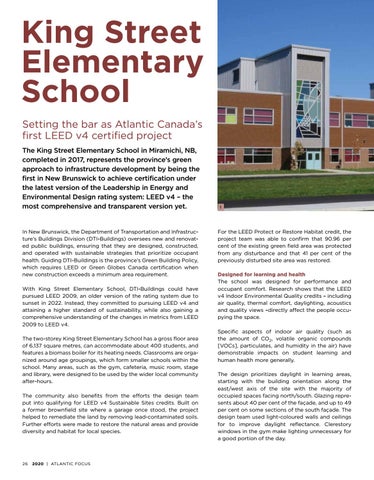
King Street Elementary School Setting the bar as Atlantic Canada’s first LEED v4 certified project The King Street Elementary School in Miramichi, NB, completed in 2017, represents the province’s green approach to infrastructure development by being the first in New Brunswick to achieve certification under the latest version of the Leadership in Energy and Environmental Design rating system: LEED v4 – the most comprehensive and transparent version yet.
In New Brunswick, the Department of Transportation and Infrastructure’s Buildings Division (DTI-Buildings) oversees new and renovated public buildings, ensuring that they are designed, constructed, and operated with sustainable strategies that prioritize occupant health. Guiding DTI-Buildings is the province’s Green Building Policy, which requires LEED or Green Globes Canada certification when new construction exceeds a minimum area requirement. With King Street Elementary School, DTI-Buildings could have pursued LEED 2009, an older version of the rating system due to sunset in 2022. Instead, they committed to pursuing LEED v4 and attaining a higher standard of sustainability, while also gaining a comprehensive understanding of the changes in metrics from LEED 2009 to LEED v4. The two-storey King Street Elementary School has a gross floor area of 6,137 square metres, can accommodate about 400 students, and features a biomass boiler for its heating needs. Classrooms are organized around age groupings, which form smaller schools within the school. Many areas, such as the gym, cafeteria, music room, stage and library, were designed to be used by the wider local community after-hours. The community also benefits from the efforts the design team put into qualifying for LEED v4 Sustainable Sites credits. Built on a former brownfield site where a garage once stood, the project helped to remediate the land by removing lead-contaminated soils. Further efforts were made to restore the natural areas and provide diversity and habitat for local species.
26
2020 | ATLANTIC FOCUS
1
For the LEED Protect or Restore Habitat credit, the project team was able to confirm that 90.96 per cent of the existing green field area was protected from any disturbance and that 41 per cent of the previously disturbed site area was restored. Designed for learning and health The school was designed for performance and occupant comfort. Research shows that the LEED v4 Indoor Environmental Quality credits – including air quality, thermal comfort, daylighting, acoustics and quality views –directly affect the people occupying the space. Specific aspects of indoor air quality (such as the amount of CO2, volatile organic compounds [VOCs], particulates, and humidity in the air) have demonstrable impacts on student learning and human health more generally. The design prioritizes daylight in learning areas, starting with the building orientation along the east/west axis of the site with the majority of occupied spaces facing north/south. Glazing represents about 40 per cent of the façade, and up to 49 per cent on some sections of the south façade. The design team used light-coloured walls and ceilings for to improve daylight reflectance. Clerestory windows in the gym make lighting unnecessary for a good portion of the day.