February 2013
Golden Temple, Dambulla, Sri Lanka
In this issue: America’s Drone War India Takes Tougher Stance on China
arvind Mahajan of
Live! Spectrum Entertainment Presents
March 29 8:15PM Raleigh Memorial Auditorium Rakesh Maini Indian Idol
Tickets:
$59/$109 only
Taal Pe Taal Dance Competition
posponed until Dec 2013. Check website for details.
Call 855-660-LIVE (5483) www.LiveSpectrum.com Supporters - AKM Realty, Geet Bazaar, Farmah Family, Goddard School, ITDF, Saathee Magazine & Nazar Television
Hello Readers! India drew a line in the sand in 2012. Look for New Delhi to take a tougher stance against China in 2013. Story on pg. 8. Ravi Shankar died in December. Now many Indian musicians are bringing varied versions of Indian music to the world outside. Read about India’s new music ambassadors in the article on pg. 14. As the rich get richer and everyone else is left behind, how can the US return to the American Dream? Read the analysis on America’s income inequality on pg. 32. The drone wars, America’s secret war against terrorism, continues. Read about the strikes by these high-tech unmanned machines in the story on pg. 36. How can we help our children succeed in taking the SAT’s? Read the essay in our new column “Thinking about Thinking” on pg. 54. Catch up on what all the local and regional community organizations are up to as well as their upcoming events in our Community Organizations section on pg. 90. Festivals and holidays are listed on pg. 118. Find your astrological predictions for the month in the AstroScope on pg. 120. Get daily updates about our community as well as news and videos at our website: Saathee.com.
Quote: “Whoever fights monsters should see to it that in the process he doesn't become a monster.” - Friedrich Nietzsche
February 2013 – Issue # 178 Editor: Samir Shukla (saatheemag@hotmail.com) Publisher: Divakar Shukla (rakavid@aol.com) Community Editor: Rajesh Ganatra Ad Design / Layout: Nate “Nageshwar” Andrews Executive Assistant: Suzie Tanis Contributors: Kirit Shukla, Rajesh Ganatra, Judith L. Bergman, Chandan Sen, Gail Z. Martin, Smitha Prasad, Dr. Maha Gingrich, Sneha Shah, Anjana Agarwal, Anita Kulkarni, Jay Cohen, Ananya Mallavarapu, Balaji Prasad, Lakshmi Challa, Sumeet P. Shah, A.J. Shah, Neal Patel, Dipika Kohli, Krutika Chheda, and Jalendu Vaidya.
All contents © 2013 Shukla Entertainment, Inc.
In This Issue India-China 2013 . . . . . . . . . . . . . . . . . . . . . . . . . . . . . . . . . .pg. 08 India’s New Music Ambassadors . . . . . . . . . . . . . . . . . . . .pg. 14 Entertainment . . . . . . . . . . . . . . . . . . . . . . . . . . . . . . . . . . . .pg. 18 Film Clips . . . . . . . . . . . . . . . . . . . . . . . . . . . . . . . . . . . . . . . .pg. 22 Sangeet and Evergreen Film Lyrics . . . . . . . . . . . . . . . . . .pg. 24 Indian Classical Music . . . . . . . . . . . . . . . . . . . . . . . . . . . . .pg. 28 Dances of India . . . . . . . . . . . . . . . . . . . . . . . . . . . . . . . . . . .pg. 30 America’s Income Inequality . . . . . . . . . . . . . . . . . . . . . . .pg. 32 Drone Wars . . . . . . . . . . . . . . . . . . . . . . . . . . . . . . . . . . . . . .pg. 36 Edit Notes . . . . . . . . . . . . . . . . . . . . . . . . . . . . . . . . . . . . . . . .pg. 40 Children’s Corner . . . . . . . . . . . . . . . . . . . . . . . . . . . . . . . . .pg. 44 Mastering Meaning . . . . . . . . . . . . . . . . . . . . . . . . . . . . . . . .pg. 46 Astride three Continents . . . . . . . . . . . . . . . . . . . . . . . . . . .pg. 48 Behind the Congressional Curtain . . . . . . . . . . . . . . . . . . .pg. 50 REAListically . . . . . . . . . . . . . . . . . . . . . . . . . . . . . . . . . . . . .pg. 52 Thinking About Thinking . . . . . . . . . . . . . . . . . . . . . . . . . .pg. 54 Business Matters . . . . . . . . . . . . . . . . . . . . . . . . . . . . . . . . . .pg. 56 Peronal Finance . . . . . . . . . . . . . . . . . . . . . . . . . . . . . . . . . . .pg. 60 Marketing Turnaround . . . . . . . . . . . . . . . . . . . . . . . . . . . . .pg. 62 Healthwise . . . . . . . . . . . . . . . . . . . . . . . . . . . . . . . . . . . . . . .pg. 66 Just Being Honest . . . . . . . . . . . . . . . . . . . . . . . . . . . . . . . . .pg. 68 Cricket Forum . . . . . . . . . . . . . . . . . . . . . . . . . . . . . . . . . . . .pg. 70 Tax Matters . . . . . . . . . . . . . . . . . . . . . . . . . . . . . . . . . . . . . . .pg. 74 Immigration Matters . . . . . . . . . . . . . . . . . . . . . . . . . . . . . . .pg. 78 Recipes of the Month . . . . . . . . . . . . . . . . . . . . . . . . . . . . . .pg. 80 Community Focus . . . . . . . . . . . . . . . . . . . . . . . . . . . . . . . . .pg. 82 Community Organizations . . . . . . . . . . . . . . . . . . . . . . . . .pg. 90 Pop’s Puzzles and Jokes . . . . . . . . . . . . . . . . . . . . . . . . . . .pg. 116 Festivals and Holidays . . . . . . . . . . . . . . . . . . . . . . . . . . . .pg. 118 AstroScope . . . . . . . . . . . . . . . . . . . . . . . . . . . . . . . . . . . . .pg. 120 Classifieds . . . . . . . . . . . . . . . . . . . . . . . . . . . . . . . . . . . . .pg. 122 Puzzle Solutions . . . . . . . . . . . . . . . . . . . . . . . . . . . . . . . .pg. 124 Index of Advertisers . . . . . . . . . . . . . . . . . . . . . . . . . . . . .pg. 124 Saathee.com
A features magazine for the South Asian Community of the Carolinas
4
Opinions expressed herein are those of the writers and advertisers and not necessarily of the publisher or editor. Please contact us prior to submitting articles or photographs. Saathee is published monthly. Deadlines for advertisement, submissions and events information is 15th of the month. Mission: Our goal is to be a valuable source of information for the South Asian community and to be a vital advertising tool for businesses.
- Founded 1998 -
Saathee Magazine
P.O. Box 11468 Charlotte, NC 28220 Phone: (704) 527-7570 - Fax: (704) 527-7590 E-mail: saatheemag@hotmail.com
www.saathee.com Cover: Golden Temple, Dambulla, Sri Lanka
Golden Temple of Dambulla is a World Heritage Site in Sri Lanka, situated in the central part of the country. This site is situated 148 km east of Colombo and 72 km north of Kandy. It is the largest and best-preserved cave temple complex in Sri Lanka.. This photo is the monastery located near the cave temples. Photo: Dreamstime.com
Saathee, USPS 021-116, is a free subscription magazine published monthly by Shukla Entertainment Inc. POSTMASTER: Send address corrections to Saathee, P.O. Box 11468, Charlotte, NC 28220-1468. Postage paid at Charlotte, NC. (ISSN: 1543-8147) February 2013
Happy Valentine’s Day!
Open 7 Days a Week! Rajbhog Cafe of Morrisville 3607 Davis Drive, Suite 111 Morrisville, NC 27560 Tel: 919.585.5333 Fax: 866.509.1536 morrisville@rajbhog.com
Rajbhog of Charlotte, NC Pinnacle Point 9539 Pinnacle Drive #100 Charlotte, NC 28262 (3 Miles from Ikea)
Tel: 704.909.7783 Fax: 704.248.7705 charlotte@rajbhog.com
North Carolina
Charlotte, Morrisville
New York
Jackson Heights, Hicksville, Flushing
New Jersey
Jersey City, Iselin, Cherryhill GIFT IDEAS ALSO AVAILABLE ON THE WEB:
WWW.RAJBHOG.COM
Georgia Atlanta
Worldwide Travel Inc. Call us for all your travel needs within the u.s. or around the world
toll free
Expert Travel Agents Cheap Fares
1-800-290-9048
Best Fares to India! Since 1976
Email: info@wwt-usa.com www.wwt-usa.com/India
1026 16th Street, NW, Suite 104, Washington, DC 22036
(consolidator for all major airlines)
Saathee.com
7
February 2013
India-China 2013:
India to take tougher stance argue is intended to encircle India with Chinese naval installations — by stepping up its engagement with the Association of Southeast Asian Nations (ASEAN) and working on its relationships with South Korea, Japan, Australia, Vietnam, Indonesia and Myanmar (Burma). All for one reason. “There’s little question that [the war] continues to shape the Sino-Indian relationship, for the simple reason that it was such a humiliating defeat,” said Ganguly. “This is an issue that will simply fester, and the [Indian] military is not about to let its guard down anytime soon.” In the 1950s, China and India might have seen themselves as allies fighting the lingering remnants of Western imperialism. But today, despite many reasons for cooperation in areas like climate change negotiations and the removal of trade barriers, New Delhi will never see Beijing as anything but an adversary. “[The war] left a legacy of deep distrust in China’s attitude and policies toward India,” said India’s former foreign secretary, Kanwal Sibal. Following years of negotiations and an ill-considered Indian move to advance its military border posts, China launched a blitzkrieg across the Himalayas on the night of Oct. 19, 1962, historian Ram Guha writes in “India After Gandhi.” Attacking in waves, the Chinese soon overwhelmed the Indians, using five times as many soldiers, and eventually occupied both of the disputed border regions before inexplicably packing up to retreat. Soon after, then-Prime Minister Jawaharlal Nehru moved a resolution in parliament claiming that China had “betrayed” India’s “uniform gestures of goodwill and friendship” with the “massive invasion.” Nehru and Chinese Premier Zhou Enlai had for several years been hashing out the dispute over the borders in the Aksai Chin
India drew a line in the sand in 2012. Look for New Delhi to take a tougher stance in 2013. By Jason Overdorf NEW DELHI, India — New Delhi stopped backpedaling and drew a line in the sand for Beijing in 2012, bolstered by support from Southeast Asia and America’s pivot toward the Pacific. Look for more tough talk from India in 2013 — but don’t expect much of a result. “I simply cannot visualize a breakthrough of any sort,” said Indiana University professor Sumit Ganguly. “The changes will be incremental, neither side will make significant concessions and the PRC (People’s Republic of China) will keep a close watch on Indo-US relations. While professing friendship and goodwill it will compete actively in India in third areas such as Burma, Afghanistan and Sri Lanka. Of course, if India continues its maladroit policies it will lose out to the PRC in every sphere.” India’s relatively new Foreign Minister Salman Khurshid met with his Chinese counterpart Yang Jiechi for the first time at the end of December, 2012. Indian National Security Adviser Shivshankar Menon met again meet with outgoing state councilor Dai Bingguo in January 2013. But even though the two countries have started a dialogue on West Asia and Africa, and plan talks on Central Asia and issues like the dispute over the South China Sea, according to the Times of India, more talk isn’t likely to translate into more action. The problem? The year 2012 might have been earmarked as a “year of friendship” for the two would-be superpowers. But it also marked the 50-year anniversary of India’s defeat in its 1962 war with China over the disputed borders of Indian-administered Kashmir and Arunachal Pradesh. India’s continued obsession with China’s “betrayal” and India’s “humiliation” makes an Asian arms race appear to be inevitable — even if Asia’s two giants manage to avoid a shooting war over territory or vital resources. In 2012, New Delhi resisted Beijing’s attempts to bully India out of the South China Sea — inking an energy accord with Vietnam that flew in the face of Chinese opposition to Indo-Vietnamese oil exploration in the disputed waters. India matched China man-for-man as Beijing stepped up its activities on the countries’ disputed borders in the Himalayas. And New Delhi fought to counter China’s so-called “string of pearls” strategy — which observers Saathee.com
8
February 2013
AAPI Governing Body Meeting C.I.P.S. Convention
March 22-24, 2013
Renaissance Suites Hotel 2800 Coliseum Centre Dr. Charlotte, North Carolina ORGANIZED BY Carolinas Indian American Physicians www.carolinasips.org TO REGISTER OR SPONSOR CONTACT: www.carolinasips.org Amit Shah, MD ● Nimish Patel, MD ● Sarjoo Bhagia,MD Dhruv Vyas,MD ● Praful Mehta, MD
Phone: 803-412-2360 ● Fax: 803-802-2015 SPONSORSHIPS: Platinum ($10,000) ● Diamond ($5,000) ● Gold ($ 2,000) ● Silver ($1000) C.I.P.S. CONvENTION C.I.P.S. (Carolinas Indian Physicians Society) convention 2013 is a meeting of the minds. It is a celebration of Medical Excellence, Professional achievements, Business successes and rich cultural heritage.
COME JOIN YOUR PEERS Experience the 2013 C.I.P.S. Convention in the city that puts the “Up” in Uptown, that’s Charlotte, North Carolina. Enjoy entertaining cultural programs, CME sessions and gratifying cuisine with all of your fellow colleagues.
WHAT TO EXPECT ● THOUGHT PROVOKING CME’S ● EXHIBITS ● MEDITATION (YOGA) ● WOMEN’S FORUM Asha Parekh - Bollywood Actress ● FASHION SHOW Posh Pari – NY Designer ● GUEST SPEAKERS Swadesh Chatterjee ● ENTERTAINMENT Shivani Thakkar - Dance Soor Taal Group-Karaoke Anish Shah – Comedian Jonita Gandhi- Band ● NETWORKING ● CULTURAL EVENTS ● EXCITING CUISINES
PRICING Premium Package Physician Friday, Saturday & Sunday Includes meals & all activities. Adults (375) 6-16 ($125) Under 6 (FREE)
One Day Physician Package Saturday only Includes meals and all activities. Adults ($225) 6-16 ($75) Under 6 (FREE)
Non Physician Package Adults ($250) 6-16 ($75) Under 6 (FREE)
One Day Non Physician Package Adults ($200) 6-16 ($50) Under 6 (FREE)
region, which lies between Tibet and Xinjiang, and the Tawang region of Arunachal Pradesh, which once paid a yearly tribute to the king of Tibet. From Beijing’s perspective, Nehru’s embrace of the Dalai Lama and thousands of Tibetan refugees was an equal betrayal. India’s success in casting the war as a “betrayal,” however, has had dramatic effects, according to Srikanth Kondapalli, professor of Chinese studies at Jawaharlal Nehru University. Not only does India distrust China, but also the military is intent on avoiding another humiliation. Moreover, the Indian media — which once propagated a rose-colored fantasy of “Hindi Chini bhai bhai” (India and China, brother and brother) — now views every Chinese maneuver as part of a dastardly plot. The dispute over the borders of Arunachal Pradesh and the Aksai Chin — from which China retreated despite routing India’s troops — remains unresolved. Every few months there are reports in the Indian media of “provocations” or “incursions” by the Chinese army, and India has responded to its 1962 defeat by dramatically increasing its defense budget and militarizing its Himalayan borders. The focus of India’s forces is gradually shifting from Pakistan — which it already has outgunned — to China. And both the Indian air force and Indian army have huge acquisitions planned for the near future. India now demands reciprocity from the Chinese on almost every issue — requiring Beijing’s recognition of India’s claim to Kashmir in exchange for New Delhi’s acceptance of China’s claim to Tibet, for instance. And even though India, as another poor, populous and rapidly developing country, naturally shares many of the same interests in negotiations with the US and Europe, Beijing continues to oppose New Delhi’s advance to prominence in international bodies such as the United Nations Security Council at every turn. Meanwhile, the border dispute has now become both China’s greatest asset in constraining India’s influence outside of South Asia and the most dangerous potential flashpoint between the two rising powers, say experts. “China essentially wants to contain us without use of military force, so they have fostered Pakistan and at the same time they have engaged us or agreed with us in 1993 and 1996 on certain confidence building measures to maintain peace and tranquility on the border and avoid any chance of a direct military conflict,” said Sibal. The two nations’ nuclear capabilities make all-out war virtually impossible. But the cost of militarization on both sides — much like the Cold War for the Soviet Union and the US — threatens to bankrupt projects that are vital to bringing the huge populations of both countries out of poverty. And the incessant saber-rattling leaves Asia’s two largest armies always just one misunderstanding away from a deadly skirmish like the fighting that occurred in 1962 — when nearly 3,000 Indian soldiers were killed. “There is always that chance that something could go amiss,” said Ganguly. “The Chinese decide to probe along the border and they happen to make an incursion wider or deeper than previously, and the Indians decide they cannot simply let this pass, and they decide to respond, and the Chinese say we’ll teach you a real lesson now, and the next thing you know you’re in a real shooting war.”
Saathee.com
10
Access One Realty
Paving Your Access to the Future Customer Satisfaction & Confidentiality is our goal! Listing Code (CG) (SL) (SK) (SA) (RZ) (AG) (PR) (NM) (LV) (RI) (ND) (ES) (FH) (SS) (MV) (TH) (UH) (FN) (EH) (KK) (PH) (RB)
BuSIneSSeS AvAIlABle FoR SAle Business
Location near
Price ‘000 Motel, 60-rm, Ind. Charlotte, NC 990 C-store, Deli, RE Sanford, NC 750 U-Haul, C-Store Apex, NC 485 C-store, Rest., RE Asheville, NC 399 Mini-Super Mkt Plymouth, NC 259 C-store Leased Angier, NC 225 C-store Leased Raleigh, NC 170 C-store, Gas, Deli Danville, VA 149 C-store leased Louisburg, NC 120 C-store leased Raleigh, NC 105 C-store, Grill, RE Henderson, NC 100 C-store leased Reidsville, NC 100 C-store with RE Holly Sprng, NC 89 C-store,Grill,lease Morganton, NC 89 C-store Mebane, NC 50 U-Haul, C-Store Henderson, NC 50 C-store Leased Rocky Mnt, NC 49 C-store, Gas, Deli Danville, VA 35 C-store Leased Claremont, NC 10 C-store Leased Pittsboro, NC 5 C-store Leased Taylorsville, NC 0 Laundromat w/RE Durham, NC 200
Gross ‘000 336 2,281 347 608 1,398 1,726 1,376 3,412 1,421 2,206 596 2,304 307 1,415 336 1,197 431 1,000 144 632 223 106
Cash Change ‘000 85 174 X 91 96 205 204 X 216 X 137 149 X 67 X 69 94 106 84 65 81 50
X
X X X
Business Broker & Loan Broker - One-Stop Shop Motel, Convenience Stores, Gas Stations, Dry Cleaning, Laundromat, Office, Land, Retail, Apartments, Foreclosures, Homes, etc.
Chandravadan Shah Broker-In-Charge
919-439-5483 cs.real@gmail.com
W hi te H orse W eddi ng s
704-213-7076 www.whitehorseweddings.co WHiTe HoRse available for weddings in the Carolinas. Booking now for 2013 & 2014 February 2013
Washington, DC 601 Pennsylvania Ave. NW, Suite 900 Washington, DC 20004
Richmond office 8501 Mayland Dr. Suite 103 Richmond, VA 23294
Durham, nC 5310 NC Hwy 55 Suite 101 Durham, NC 27713
Falls Church office 5657 Columbia Pike Suite 101 Falls Church, VA 22041
Immigration
Attorney Nash Fayad, Ph.D
• Family based petitions • Business Immigration: Nonimmigrant Visas: H1B, H2B, H2A, TN, O, P Immigrant Visas:Perm, I-140, EB-1, EB-2, EB-3, EB-4 Investment Visas: EB-5, L1, E2 • Removal Proceedings/Immigration Bond • Adjustment of Status/Permanent Residence • Citizenship, U Visa, VAWA & All Immigration Needs • Deferred Action
Criminal
Heather Dunn
Tamar L. Jones
Yesenia L. Polanco-Galdamez
• All Traffic matters • Misdemeanors/Felonies • Domestic Violence, Probation Violations
Family Lindsey Goehring
• Uncontested Divorce, • Domestic Violence Protective Orders
Allison Lukanich
5310 NC Hwy 55, Suite 101 Durham, NC 27713
(919) 294-8032
WWW. FAYADLAW. COM
• M EMBER
OF
AILA
Additional Locations: Richmond, VA • Falls Church, VA • Washington, DC
Joe can meet you at your home or office or anywhere in the Triangle area on any day. Just give him a call and have a no-obligation discussion about home buying! Please call Joe for best deals on used or new homes! Joe finds out about new developments ahead of others!
31 years in nC 22 years as nC Realtor!
Joe is a local Relocation expert! Approved by all Relo companies! Relocating employees, please call Joe before you sign-up!
new single family and townhome developments opening in the Triangle! Please contact Joe for the latest updates and opportunities
Jhansi Kolla Broker (919) 454-6774
A&V SAtelliteS
704.469.5688 1.877.589.9384 www.anvsat.com
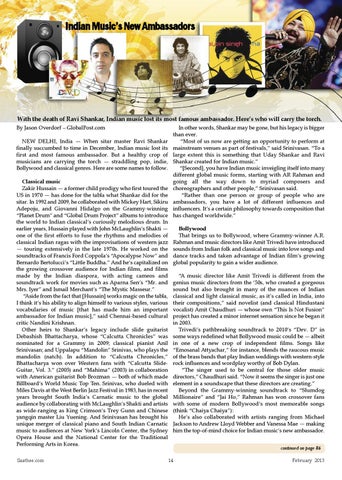
Indian Music’s New Ambassadors
With the death of Ravi Shankar, Indian music lost its most famous ambassador. Here’s who will carry the torch. By Jason Overdorf – GlobalPost.com NEW DELHI, India — When sitar master Ravi Shankar finally succumbed to time in December, Indian music lost its first and most famous ambassador. But a healthy crop of musicians are carrying the torch — straddling pop, indie, Bollywood and classical genres. Here are some names to follow. Classical music Zakir Hussain — a former child prodigy who first toured the US in 1970 — has done for the tabla what Shankar did for the sitar. In 1992 and 2009, he collaborated with Mickey Hart, Sikiru Adepoju, and Giovanni Hidalgo on the Grammy-winning “Planet Drum” and “Global Drum Project” albums to introduce the world to Indian classical’s curiously melodious drum. In earlier years, Hussain played with John McLaughlin’s Shakti — one of the first efforts to fuse the rhythms and melodies of classical Indian ragas with the improvisations of western jazz — touring extensively in the late 1970s. He worked on the soundtracks of Francis Ford Coppola’s “Apocalypse Now” and Bernardo Bertolucci’s “Little Buddha.” And he’s capitalized on the growing crossover audience for Indian films, and films made by the Indian diaspora, with acting cameos and soundtrack work for movies such as Aparna Sen’s “Mr. and Mrs. Iyer” and Ismail Merchant’s “The Mystic Masseur.” “Aside from the fact that [Hussain] works magic on the tabla, I think it’s his ability to align himself to various styles, various vocabularies of music [that has made him an important ambassador for Indian music],” said Chennai-based cultural critic Nandini Krishnan. Other heirs to Shankar’s legacy include slide guitarist Debashish Bhattacharya, whose “Calcutta Chronicles” was nominated for a Grammy in 2009; classical pianist Anil Srinivasan; and Uppalapu “Mandolin” Srinivas, who plays the mandolin (natch). In addition to “Calcutta Chronicles,” Bhattacharya won over Western fans with “Calcutta SlideGuitar, Vol. 3.” (2005) and “Mahima” (2003) in collaboration with American guitarist Bob Brozman — both of which made Billboard’s World Music Top Ten. Srinivas, who dueled with Miles Davis at the West Berlin Jazz Festival in 1983, has in recent years brought South India’s Carnatic music to the global audience by collaborating with McLaughlin’s Shakti and artists as wide-ranging as King Crimson’s Trey Gunn and Chinese yangqin master Liu Yuening. And Srinivasan has brought his unique merger of classical piano and South Indian Carnatic music to audiences at New York’s Lincoln Center, the Sydney Opera House and the National Center for the Traditional Performing Arts in Korea. Saathee.com
In other words, Shankar may be gone, but his legacy is bigger than ever. “Most of us now are getting an opportunity to perform at mainstream venues as part of festivals,” said Srinivasan. “To a large extent this is something that Uday Shankar and Ravi Shankar created for Indian music.” “[Second], you have Indian music inveigling itself into many different global music forms, starting with AR Rahman and going all the way down to myriad composers and choreographers and other people,” Srinivasan said. “Rather than one person or group of people who are ambassadors, you have a lot of different influences and influencers. It’s a certain philosophy towards composition that has changed worldwide.” Bollywood That brings us to Bollywood, where Grammy-winner A.R. Rahman and music directors like Amit Trivedi have introduced sounds from Indian folk and classical music into love songs and dance tracks and taken advantage of Indian film’s growing global popularity to gain a wider audience. “A music director like Amit Trivedi is different from the genius music directors from the ‘50s, who created a gorgeous sound but also brought in many of the nuances of Indian classical and light classical music, as it’s called in India, into their compositions,” said novelist (and classical Hindustani vocalist) Amit Chaudhuri — whose own “This Is Not Fusion” project has created a minor internet sensation since he began it in 2003. Trivedi’s pathbreaking soundtrack to 2010’s “Dev. D” in some ways redefined what Bollywood music could be — albeit in one of a new crop of independent films. Songs like “Emosanal Attyachar,” for instance, blends the raucous music of the brass bands that play Indian weddings with western-style rock influences and wordplay worthy of Bob Dylan. “The singer used to be central for those older music directors,” Chaudhuri said. “Now it seems the singer is just one element in a soundscape that these directors are creating.” Beyond the Grammy-winning soundtrack to “Slumdog Millionaire” and “Jai Ho,” Rahman has won crossover fans with some of modern Bollywood’s most memorable songs (think “Chaiya Chaiya”): He’s also collaborated with artists ranging from Michael Jackson to Andrew Lloyd Webber and Vanessa Mae — making him the top-of-mind choice for Indian music’s new ambassador. continued on page 86 14
February 2013
Flower Accent FIRST EVER WEDDING STUDIO IN CHARLOTTE Wedding Planning & Decor Specializing in South Asian Weddings FuLL WEDDiNG PLANNiNG SErviCES oNSiTE CoorDiNATioN
Our Full Range of Services Include
MANDAPS & STAGES FLOWER DECOR SANGEET MEHNDI PREFERRED VENDORS Contact Ayesha Mian 704-644-5363 visit our showroom (By appointment only)136 E. 36th St Charlotte NC, 28206 (Studio 1)
www.FlowerAccent.net
Eshaan Jewelers Valentine Special
Valentine Special
Diamond Jewelry
1 gm. Gold Jewelry*
40% OFF
10% OFF
Mon. to Sat. (10 to 6) Sunday by appointment Saathee.com
*(selected styles)
3581 Andrew L Tucker Rd Fort Mill SC 29715 15
877 -Eshaan-1 (374-2261) EshaanJewelers.com February 2013
We bring light to your lives, We make your dreams come true!
EVERSHINE PROPERTIES, INC.
919.818.3233 We assist you to:
• Find the best location • Get the best deals • Choose the right upgrades • Find the best lender and choosing the right loan • Get the best home inspectors • Attend all appointments and home orientations, AND finally, GET YOUR DREAM HOME!!!
BABU THOMAS, M.S. Managing Broker
Exceptional Full Time Home Buying & Selling Service, Real Rebates and Great Savings!!! FULL SERVICE LISTING AT A TOTAL OF 3.5%
S. ISSAC Broker 919-645-7243
SUNNY SEBASTIAN (Sunny) Broker 919.805.4444
Call us today for all your real estate needs in NC
919.818.3233 or email: evershineproperties@gmail.com www.evershineproperties.com
Happy Valentine’s!
20 to 30 % Off Selected Items* Gift Certificates Available!
open seven days a week 11 am - 7 pm *See store for details
w w w. k ay a d e s i g n s . n e t
Entertainment Upcoming Movie Releases
Top Five Movies - Feb. 2013
(Bollywood films slated to be released in the next 4-6 weeks) David (Director: Bejoy Nambiar) Cast: Neil Nitin Mukesh, Chiyaan Vikram, Vinay Virmani, Lara Dutta, Tabu, Isha Sharwani, and Rohini Hattangadi
1. Table No. 21 Rajeev Khandelwal, Tena Desae, and Paresh Rawal 2. Inkaar Arjun Rampal, Chitrangda Singh, Gaurav Dwivedi, Sandeep Sanchdev, Deepti Naval, and Vipin Sharma
Pyar Ka Jalwa (Director: Aarin Mehta) Cast: Bill Gentry, Daniel Jenkins, Robert Jenkin, Vishakha, Supriya Shukla & Sunila Karambelekar Mai... (Director: Mahesh Kodial) Cast: Asha Bhosle, Padmini Kolhapure, Shivani Joshi, Ram Kapoor, Navin Kaushik, and Anupam Kher
3. Matru Ki Bijlee Ka Mandola Imran Khan, Anushka Sharma, Pankaj Kapoor, Shabana Azmi & Aarya Babbar 4. Race 2 Saif Ali Khan, Anil Kapoor, John Abraham, Deepika Padukone, Jacqueline Fernandez & Ameesha Patel
The Unsound (Director: Alok Shrivastava) Cast: Shadab Khan, Anurita Jha, Sapna Thakur, Nilesh Lalwani, and Tinu Anand
5. Dabangg 2 Salman Khan, Sonakshi Sinha, Arbaaz Khan, Sonu Sood, Vinod Khanna, and Prakash Raj
Listen... Amaya (Director: Avinash Kumar Singh) Cast: Farooq Sheikh, Deepti Naval, Swara Bhaskar, Siddhant Karnick, Vidya Bhushan, and Shadab khan
Top Five Songs - Feb. 2013
ABCD - Any Body Can Dance (Director: Remo Dsouza) Cast: Kay Kay Menon, Prabhu Dheva, Salman Yusuf Khan, Lauren Gottlieb, Prince Gupta, Dharmesh Yelande, and Mayuresh Wadkar
1. David “Tere Mere Pyaar Ki” Music: Prashant P:illai Singers: Naresh Iyer & Shweta Pandit
Midnight’s Children (Director: Deepa Mehta) Cast: Ronit Roy, Soha Ali Khan, Kangna Ranaut, Shriya Saran, Shabana Azmi, Nandita Das, Seema Biswas, Darsheel Safary, and Anupam Kher
2. Special 26 “Mujh Mein Tu Music: MM Kreem Singer: Keerthi Sagathia 3. Bandook “Tu Jaldi Bata De” Music: Nikhil Kamath Singers: Bandana Sharma and Siddharth Hazarika
Rise of the Zombie (Director: Devaki Singh) Cast: Luke Kenny, Kirti Kulhari, Ashwin Mushran, and Benjamin Gilani
4. Meri Shadi Karao “Dil Ne Mana” Music: Surdeep Mehndi & Nikki Mehndi Singer: Gurdeep Mehndi
Vishwaroop (Director: Kamal Haasan) Cast: Kamal Haasan, Pooja Kumar, Shekhar Kapur, Rahul Bose, Andrea Jeremiah, Jaideep Ahlawat, Nasser, and Zarina Wahab
5. Race 2 “Be Intehaan” Music: Pritam Singers: Atif Aslam & Sunidhi Chauhan (note: This top five is based on the following non-scientific research: your feedback, video rental, box office from India and United States, internet opinions & our opinion) Saathee.com
18
February 2013
Anil Bedi & Associates, PC CPAs and Business Consultants Member: AICPA, IIA & ICAI
1.800.313.1921 or 678.779.3475 (cell) e-mail: anil@abacconsulting.com
www.abacconsulting.com
25% OFF
(with this ad. Exp 3.5.13) Serving Medical offices, Motels, Gas-Stations, Restaurants and all other businesses.
Serving North Carolina & South Carolina We Specialize in: Individual & Business taxes • Accounting & Payroll • FBAr Filing New company incorporations • Tax filing for all - including H-1 & L-1 visa holders W-7's and Tax ID's for IT consultants • Internal audit & SOX Compliance • Business set-up and support in India • Filing Available for All 50 States • Free e-Filing
C-Corp., S-Corp. & LLCs
Anil Bedi FCA, CPA Over 20 years of experience Serving the entire Southeast
Free, no obligation consultation!
Saathee.com
19
February 2013
Entertainment Upcoming Movie Releases Continued (Bollywood films slated to be released in the next 4-6 weeks) Special 26 (Director: Neeraj Pandey) Cast: Akshay Kumar, Kajal Aggarwal, Manoj Bajpayee, Anupam Kher, Jimmy Sheirgill, and Rajesh Sharma Beehad - The Ravines (Director: Krishna Mishra) Cast: Maan Singh Deep, Mangal Singh, Sunil Sawara, Anamika Pandey, Deepa Singh, Rajesh Tiwari, and Piyush Sahane Jayanta Bhai Ki Luv Story (Director: Vinnil Markan) Cast: Vivek Oberoi, Neha Sharma, Nasser, and Shishir Sharma
Elegant Designz
Kai Po Che! (Director: Abhishek Kapoor) Cast: Sushant Singh Rajput, Amit Sadh, Raj Kumar Yadav, Amrita Puri, Ajay Jadejaj, and Gaurav Kapoor Murder 3 (Director: Vishesh Bhatt) Cast: Randeep Hooda, Sara Loren, Aditi Rao Hydari, Shekher Shukla, and Rajesh Shringapure
DJ LaLit Entertainment For All Occasions
Aatma (Director: Abhishek Pathak) Cast: Bipasha Basu and Nawazuddin Siddiqui
WIde SeLeCtIon oF MuSIC Hindi, Bhangra, Hip Hop, dance, disco, Pop, & More State of the Art Sound System & Lighting nationally & Internationally Acclaimed entertainer
Zila Ghaziabad (Director: Anand Kumar) Cast: Sanjay Dutt, Arshad Warsi, Vivek Oberoi, Paresh Rawal, Minissha Lamba, and Ravi Kissen
Any CeLeBrAtIon BIG or SMALL
Weddings • Anniversaries• Birthdays • Graduations Bridal/Baby showers • House Parties • Corporate Parties
Ankur Arora Murder Case (Director: Suhail Tatari) Cast: Kay Kay Menon, Paoli Dam, Arjun Mathur, Vishakha Singh, Harsh Chhaya, Tisca Chopra, and Manish Choudhary
Looking to rent equipment for your next event? Call to inquire about rental options
For Bookings or Inquires Contact
I, Me Aur Main (Director: Kapil Sharma) Cast: John Abraham, Chitrangda Singh, Prachi Desai, Zarina Wahab, Mini Mathur, and Raima Sen
704.299.3610 LHemnani@Gmail.com
Saare Jahaan Se Mehnga (Anshul Sharma) Cast: Sanjay Mishra, Vishwa Mohan Badola, Pragati Pandey, Zakir Hussain and Sitaram Panchal,
(Release Dates Subject To Change) Saathee.com
20
February 2013
Save Money
On Insurance
"You work hard for everything you have, it’s nice to know you have an insurance company that works just as hard to protect your things; home-auto-life, complete coverage for complete peace of mind"
Protecting customers in North Carolina, South Carolina, Georgia, Virginia & West Virginia
We offer a variety of insurance
Home • Auto • Condo • Boat • Business Property • Business Liability • Worker’s Comp Renter’s Insurance • Hotels/Motels • Taxi Insurance • Life Insurance
Maqsood Khan
Khan and Associates Inc. 349 South Swing Road Greensboro, NC 27409
Principle Agent khanm5@nationwide.com
336-510-0568 Cell: 336-508-4702 Toll Free: 1-877-510-KHAN Fax: 336-510-0825 Nationwide Mutual Insurance Comany and Affilliated companies. Nationwide Life Insurance Company. Home Office: Columbus, Ohio 43215-2220. Nationwide, the Nationwide Framemark and On Your Side are service marks of Nationwide Mutual Insurance Company.
FOR COURTEOUS, RELIABLE AND PERSONAL SERVICE
For Luxurious, Memorable Vacations And Business Trip Ticketing
The Carolina’s Link To Wholesale Airline Tickets Serving the Carolina's for 22 years. Your most Trusted & Reliable Travel Source in the Carolina's. Consolidator for all MAjoR AIRLINES to India, Europe, Pakistan, Bangladesh, Sri Lanka, Middle East, Africa, Asia, the Far East, Australia, New Zealand, Fiji & any World Wide destination.
Amtrak, Eurail, Britrail & Indian Rail Reservations Tour Packages to india, Europe, Africa, Asia, Australia including New Zealand & Fiji, Hawaii, Bahamas, Mexico, Jamaica and many more places.
NEW CONVENIENT LOCATION Near RTP, Durham, Cary & Morrisville. 2530 Meridian Parkway, Ste 300, Durham, NC 27713 (Exit 278 off I-40 for Hwy 55) Mon - Fri: 10am - 6 pm ● Sat: 11am - 2 pm. ● Sun: By Appointment
919. 380.9191
Fax: 919.460.9292 E-mail: travelinks@gmail.com
We do Cruises to All Destinations! Saathee.com
For Emergency & After Hour Service 919.868.9000 Cell 21
February 2013
Celebs Come Together for “Save the girl child” Campaign
Film Clips
Director/producer Rakeysh Omprakash Mehra and other Bollywood personalities like Sonakshi Sinha, Raveena Tandon, Hema Malini, and Sushmita Sen will appear in a music video. But this is not just any music video. A government initiated video was shot recently for “Save the Girl Child Program.” The song “Betiyaan” is sung by Shankar Mahadevan and Sunidhi Chauhan. The program and the video address the problem of female infanticide and hopes to create greater awareness. The video will release in February and also stars Shilpa Shetty, Shamita Shetty, Nagarjuna and many more stars.
Kai Po Che to Premiere at Berlin Film Festival
Prabhu Deva’s Next Titled Ramaiya Vastavaiya
Abhishek Kapoor’s Kai Po Che has been selected for a world premiere at the prestigious Berlinale aka Berlin Film Festival. The film starring Sushant Singh Rajput, Rajkumar Yadav, Amit Sadh and Amrita Puri is a story of friendship and is based on Chetan Bhagat’s best-selling novel “3 Mistakes of My Life.” While the Berlin Film Festival kick-starts on February 7, Kai Po Che is slated to release worldwide on February 22.
His first Bollywood directorial venture Wanted starring Salman Khan was a huge success. After that Prabhu Devadirected Akshay Kumar in the hit film Rowdy Rathore. Deva is now set to tackle a musical love story titled Ramaiya Vastavaiya. The film will feature Kumar Taurani’s son Girish Kumar making his bigscreen debut opposite Shruti Haasan. The film is slated for release on June 7, 2013.
Mickey Virus to Star Newcomers
Big B,Vidya Balan named hottest Vegetarian Celebs
Manish Paul, the popular television anchor and VJ, is making his debut in the movies with the upcoming film Mickey Virus directed by Saurabh Varma. The female lead is Elli Avram, who is from Greece and is the daughter of Swedish actress Maria Granlund. Director Varma told Bollywood Hungma, “We had approached few known female actors for the lead opposite Manish, but later we decided to cast a new face. We chose Elli through auditions because she fitted the bill perfectly. Later we got to know her identity when we met her mother. I am not surprised we found her so comfortable in front of camera while doing rehearsals.” Mickey Virus is a comic thriller set in Delhi around the life of a Punjabi computer geek Mickey (played by Paul) who plans a con of a lifetime. The film is slated to release in May.
Amitabh Bachchan and Vidya Balan were named as PETA’s hottest celebrity vegetarians of the year 2012. Others include Neha Dhupia, Shahid Kapoor, Kareena Kapoor, Sonu Sood, Dhanush and Hema Malini. While Bachchan has won this title thrice in the past, this is Balan’s second occasion being voted hottest vegetarian celeb by PETA.
Ram Leela Release Postponed Sanjay Leela Bhansali, who is currently working on his film Ram Leela starring Ranveer Singh and Deepika Padukone, has decided on postponing the release of the film. The reason is that Bhansali, who had earlier had problems when the release of his film Saawariya clashed with SRK’s Om Shanti Om, doesn’t want a repeat of the same. Ram Leela which was slated for a Dusshera release has been pushed to avoid a clash with Rohit Shetty’s Chennai Express starring Shah Rukh Khan. According to reports, Ram Leela will hit theatres not before November 29, weeks after the release of yet another biggie Krrish 3.
Bipasha Basu in Vikram Bhatt’s Creature
Joy Mukherjee’s 1971 Film to Release
Director-producer Vikram Bhatt, who seems to have become the face of horror films in Bollywood, will now venture into a genre that is still an Indian novelty. Bhatt is working on the country’s first ever creature film. Bhatt confirmed in an interview, “Creature will be India’s first ever film that will be made on the lines of Predator and Jurassic Park. The film is tentatively titled, well, Creature. It will star Bipasha Basu and will begin filming in May. Saathee.com
Monojoy Mukherjee, the son of (late) Joy Mukherjee, recently discovered his illustrious father’s unreleased film titled Love in Bombay. Even though the film was ready in 1971, it was never released. The film stars Joy Mukherjee, Waheeda Rehman, Kishore Kumar and Ashok Kumar. Shankar-Jaikishen composed the music. Talking about the film’s restoration, Monojoy said that they have gone for restoration in high definition. The film is slated for release on February 24 under the original Joy Mukherjee banner. 22
February 2013
Trusted Quality, Professional Service & Best Prices In The Triangle 22k Gold, Diamond, Gemstone & New Antique Gold Jewelry We now carry Astrological Stones
Happy Valentine’s Day! Up to
30% OFF Diamond Jewelry!
No Making Charges On Selected Gold Sets!
Join our new Jewelry Saving Scheme!
Khanna & Sons Jewelers “Redefining the Beauty of Diamonds” 800A E. Chatham Street, Cary, NC 27511
Inside the New Patel Brothers Tuesday - Sunday 12 to 8. (Closed on Monday) B: (919) 388-3838, C: (704) 770-5397, E-mail: khannasonsjewelers@gmail.com
EvERGREEN ClASSIC
Sangeet
Film Lyrics
POPUlAR MUSIC OF INDIA
A tribute to Past Hindustani Singers
By Kirit Shukla
Khursheed (1914-2001) Khursheed Bano, a Pakistani singing actress and a pioneer of Indian cinema, was born as Irshad Begum in Lahore on April 14, 1914. Her career ran through the 1930s and 1940s. She started her acting in the silent film Eye for an Eye (1931) the year when the first talkie Hindi film Alamara was released. She acted in a number of movies for Ranjeet Movietone and her leading men included Saigal, Motilal, Isharilal and Jairaj. Some of her famous films and songs include, Mumtaz Mahal (“Jo Hum Pay Guzarti Hai”, “Dil Kee Dharkan Bana Liya”), Shahenshah Babar (“Mohabbat Mein Sara Jahan Jal Raha Hai”,”Bulbul Aa Tu Bhi Ga”) in 1944, Prabhu ka Ghar and Moorti (“Ambwa Pay Koyal Boley”, “Baderia baras gayee uss paar”) with music composition by Bilo. C. Rani in 1945, Aagey Barho and Mitti ("Chahi Kali Ghata More Balam") in 1947, Aap Beetee (“Meree Bintee Suno Bhagwan”) in 1948. Her last film was Papeeha in 1948, after which she migrated to Pakistan after partition of India. She settled in Karachi with her husband Lala Yakub but later divorced him due to personal problems. She remarried in 1956 to Yusuf Bhamia, her admirer and a businessman in the shipping business. Once she shifted to Pakistan she didn’t do much work in films. The Pakistani singer Noor Jehan and others overtook her in popularity. Khursheed Bano died on April 18, 2001 in Karachi, Pakistan, four days after her 87th birth day.
Song: Bara so re, Bara so re... Film: Tansen Year: 1943 Music: Khemchand Prakāsh Singer: Khursheed Lyric: Pundit Indra Chandrā Based on Indian Classical Rāgā: Megh Malhār Taal/Rhythm: Teen Tāl Starring: Khursheed, Mubārak, K. L. Sāigal Bara so re, Bara so re... Lyrics in English: Bara so re, Bara so re, kāre bādaravā, jiyā pe bara so, bara so Jaise mori akhiyān barasāe; Bara so re, Bara so re, 2 Kāre bādaravā jiyā pe bara so, bara so Jaise mori akhiyān barasāe, Bara so re, Bara so re. Meaning (Summary): Shower, shower on me O black clouds, shower on me. Just as my eyes shed tears; shower, shower on me. Lyrics in Hindi:
Awards: Stellar award with Singer K. L. Saigal. Some of her popular movies: In 1930s: Chatra Bakavli, Hatili Dulhan, Muflis Aashiq, Radheshyam, Naklee Doctor, Suarag ki Serhi, Bomb Shell, Chiragh-e-Husn, and Mirza Sahiban. Ailan-e-Jang, Kimiagar, Iman Farosh, Madhur Milan, Murad, Kaun kisi ka, Sitara etc. In 1940s: Musafir, Holi, Pardesi, Beti, Shaadi, Bhakta Surdas ( Her famous song “Panchee Bawra” in Raga Kedar is my favorite one), Chandani, Tansen, Mumtaz Mahal, Prabhu ka ghar, Mitti and so on. Her hit Hindi song’s lyrics: “Bara so re, Bara so re...” is given on this page in the segment of Evergreen Classic Lyrics. (Note: The contents of this article are compiled from news, books, internet and my knowledge and love for Hindustani music.) Kirit Shukla Contact him at kiritsshukla@hotmail.com
See this song on Nazar Television in February. Visit saathee.com for Nazar Television local listings. Saathee.com
24
February 2013
BuyINg or SEllINg ANy rEAl EStAtE?
One Stop Shopping for all indian and Asian Groceries
lEt ME hElP you.
• Fresh vegetables & fruits Fresh Vegetables • Fresh Samosa Every Thursday! • Halal meats • Fish (cutting available) • Ready to eat items and home cooked, fresh indian dishes • Utensils (Hawkins, premier, prestige) • Special discount for students We ACCePT • Gift certificates eBT • Home delivery available
AkShAt PAtEl MANAgINg BrokEr
NC REAl EstAtE BROkER siNCE 2006. NC REsidENt siNCE 1991.
Cell: 919.455.5949 office: 919.787.4076 Email: yourprimesource@aol.com
PrIME SourCE ProPErtIES 6619 glenwood Avenue, raleigh, NC 27612
FoR SAle
* Indian Restaurant in Triangle * 86 Room Days Inn in Raleigh * 60 +/- Room Franchise Motel Triad
Wishing you a very Happy Valentine’s Day!
FoR RenT * Home in Cary 5Br, 4Ba, 3350 sq. ft. * Townhouse Morrisville 3BR, 2.5BA
919.490.3747
SpiceBazaarNC.com 4125 Durham Chapel Hill Blvd. (15-501 Business) Durham, NC 27707
SPECIAlIzES IN trIANglE ANd trIAd ArEA "your Prime Source for... ANy real Estate"
Saathee.com
(Situated at South Square, Across from Rooms To Go and next to Spartacus Restaurant)
GReAT SeleCTiON AT THe BeST pRiCeS.
25
February 2013
CARYMED PRIMARY CARE BIndIt PateL, M.d.
Board Certified Internal Medicine (U.S.A)
OUR PeRSOnaLIZed CaRe InCLUdeS: 1. After hours 24/7 telephone guidance by Physician 2. Admission Privilege to WakeMed Hospital, Cary, NC 3. Continuous care during hospitalization. 4. We see our own patients in hospital. SPeCIaL InteReSt: oFFICE (outpatient) PRACTICE • Hypertension • Diabetes • Asthma/CoPD • Thyroid Disorder • Migraine • High Cholesterol • Back Pain • GERD • obesity & Weight Loss • Annual Physical • Women's Health • Anemia
Board Certified Internal Medicine (INDIA) WHat We OFFeR: • Convenient Location: We are located in Cary, near Morrisville, Apex and West Raleigh. • After hours: We are open 7 days a week. . More than 10 years of experience in Internal Medicine. • Multilingual: We speak Gujarati, Hindi & English.
HoSPITAL MEDICINE • Acute Respiratory Failure • Heart Failure, Endocarditis • Hypertensive crisis • Stroke/Transient Ischemia • Meningitis, Encephalitis • Acid-Base, Electrolytes disturbances • Kidney Disease • Urinary Tract Infections • jaundice / Liver Disease • Diverticulitis, Colitis • Peptic Ulcer Disease • Pneumonia, Bronchospasm
oFFICE oPEN 7 DAYS A WEEK Monday - Friday: 9AM - 6PM Saturday: 10AM - 4PM Sunday: Available upon request office closed on 2nd Saturday of each month.
401 HIGH HoUSE RoAD, SUITE 120 CARY, NC 27513 FoR APPoINTMENTS, PLEASE CALL: 919-462-9100
We accept most major medical insurance including Medicare
B I P I N PA R E k H R E A LT y, L L C CLOSING COORDINATOR
Bipin Parekh
Owner / Broker / Realtor. Licensed in NC / SC / Georgia 704.841.9318(H)
Smita Parekh
704.608.8469 (cell)
E-Mail: bparekh@carolina.rr.com
* Realtor with 25+ years of experience
TOP PRODUCER FOR BUILDERS*** *** Shea, Pulte, Centex, Ryland, Ryan, John Weiland, True Home Can build any home on your lot, or help you find one!
HOMEBUYER
2%4
PrICe
1%, 1.5%, 2%
Broker / Manager CHARLOTTE, NC
Sridhar Janakiraman
Broker / Realtor; Licensed in NC/SC 978.590.7768 (Cell) / 704.771.1811 (Fax) SJIyer.NC@gmail.com
Catherine E. Janakiraman
*
*ReBATe* up to
Rebate Towards:
704.608.2191 (cell) smt_parekh@yahoo.com
P. Broker / Realtor Phone: 704.771.1811 / Fax: 704.771.1811 Email: CESIyer@gmail.com
• Price Reduction • Closing Costs • Prepaid • Home Owner Assoc./Fees • Taxes
Gopal Kasarla Broker (PV) / Realtor; Licensed in NC/SC 980.297.9827 (cell) / 704.909.6557 (Fax) grkasarla@gmail.com
*buyer must take lenders approval to use “rebate” (in HuD1)
RALEIGH, CARY, NC
HIrING reALTOrS/BrOKerS (NC, SC, GA)
*** 100% COMMISSION PAID ***
Dharmesh J. Patel Broker / Realtor 919.302.0821 (cell) / 919.238.3965 (fax) DharmeshPatel.Realtor@gmail.com
We PAY BONuSeS
Only $400.00 per transaction $10 per month fee / $120 per year
w w w . R e b a t e F o r H o m e B u y e r. c o m
Special Low Fares to India! Book Now and Save Huge! Call us today for details.
Call: 919-655-5443 e-mail: apnatravelsnc@gmail.com
Saathee.com
27
February 2013
Shankarrao Vyas. Paluskar started an ashram in Nasik and moved there in 1924. He travelled widely in India and Nepal but his poor health prompted his patrons to shift him to Miraj, where he passed away in 1931.
Indian Classical Music
Anita kulkarni
Hindustani Music - Pandit Vishnu Digambar Paluskar
is a Hindustani music vocalist and teacher based in Raleigh, NC Email:anitakul@gmail.com
By Anita Kulkarni
Today people can simply enroll themselves in any school of classical music and obtain degrees. This has been possible because of the foresight and untiring efforts of pioneers in the field like Vishnu Digambar Paluskar. Bringing it out of royal patronage, Paluskarji made Hindustani music available to everyone. A commemorative stamp was issued in his name in 1973. It is unfortunate that there are no recordings of this great man’s music. It is to his life and times that we should turn to fully understand and appreciate the great work done by him. Vishnu, the son of a Keertankar named Digambar Gopal Paluskar, was born in 1872 at Kurundwad. From his childhood, Vishnu learned singing and accompanied his father during concerts. During Datta Jayanti festivities, a bursting cracker blinded him permanently. Dr. Bhadbhade, who had tried in vain to save the boy’s eyes, arranged for music lessons with Balakrishna Bua Ichalkaranjikar, a teacher trained at Gwalior. It was hard and strenuous instruction under the old taskmaster until 1896. With no regular courses or lessons, everything depended on the moods of the teacher. Vishnu’s success, in spite of these difficulties, as well as his closeness to his patron, the Raja of Miraj caused jealousy among the other students. They created a rift between the teacher and Vishnu, who had to leave Miraj. After performing successfully at the Maharaja’s court in Baroda, he toured Saurashtra, Gwalior, Mathura, Bharatpur, Delhi and the Punjab. For the public concert in Saurashtra, he charged a nominal fee, departing from tradition. The activities of the school expanded as Paluskar founded a branch of the Mahavidyalaya in Bombay in 1908. “Gandharva Mahavidyalayas” all over Northern India, are monuments to his great work. His prediction about Akhil Bhartiya Gandharva Mahavidyala was true. He said that the school will create a group of Kansen (a good understanding classical audience) though not an artist like Tansen (a great maestro). His “Swara Sadhana” was a combination of Yogic and Vocal exercises. Panditji believed that music had a divine origin, and that by persistent and systematic practice of this musical Yoga, one could have the Divine Revelation of the “Naad-Brahman.” Pandit Vishnu Digambar was a saintly musician. He preached the Gospel of Music through the devotional aspect of his activity. He had for his pattern distinguished predecessors like Tulsidas, Surdas, Haridas Swami and Mirabai, who shed refulgent glory in their respective periods by their devotional music. Panditji drew his spiritual inspiration from them and ably carried on their tradition. His Ram dhun, “Raghupati Raghava” was sung at the Dandi march in 1930. His “Vande mataram” was sung at every Congress session. Most of these disciples have been zealously conducting the music academies established by their “Gurudev.” Pandit Vinayakbuwa Patwardhan, Waman Rao Padhye (Kolhapur), V. N. Thakar (Allahabad), Sangeet Martand Pandit Omkarnath Thakur, and D. V. Paluskar (Panditji’s son) are known to the music world of today. Among his other disciples may be mentioned Prof. B. R. Deodhar, Narayanrao Vyas and Saathee.com
Carnatic Music- Readers Questions Answered By Smitha K. Prasad Dear readers, I am answering more questions from readers. It is indeed heartening to note that so many of our readers have a deep-rooted interest in Indian classical music. I am also very happy to hear that many of you read the columns with your children, who learn classical music. In our family, many a time, we have animated dinner-table conversations revolving around some topic or the other pertaining to classical music! One of our readers from Virginia brought up the fact that both Carnatic and Hindustani music have swarams (musical notes) of the same name; yet they refer to different notes on a musical scale. For instance, the note- “Shuddha Ga” means different swarams in Hindustani and Carnatic music. This is because in Hindustani music, the reference scale is “Bilawal” thaat (parent scale) - all the swarams that occur here are classified as Shuddha- the other swarams are either komal (flat) or tivra (sharp) with reference to the “Bilawal” scale. In Carnatic music, the term Shuddha is used to denote the lowest possible position that a swaram can occupy on the scale. Hence “Shuddha Rishabha,” “Shuddha Gandhara,” “Shuddha Madhyama,” etc. are the lowest possible positions that these swarams can occupy. Conversely, the same swaram on a musical scale has different names in Carnatic and Hindustani music. For instance, “Shuddha Rishabha” (Carnatic) and “Komal Re” (Hindustani) refer to the same note even though they have different names! On another note, while it is important to know the different swarams on the musical scale, classical music also has the concept of gamakas (oscillations). With regard to Carnatic music, even though many ragas have the same swaram (e.g.: Chatushruthi Rishabha), the way the swaram is rendered in each raga is different since it takes different gamakas in different ragas. The gamakas associated with each ragam unfortunately cannot be derived from notation. One has to be familiar with the gamakas for the particular ragam- this comes by learning from a guru as well as listening to many different renditions of the ragam. Sometimes, there are very subtle variations in the way that the same swaram in a single ragam is sung! That is what makes classical music so challenging! Till we meet next time, I look forward to more of your questions, comments and suggestions for topics that you would like to see covered through this column.
smitha Prasad is a Carnatic vocalist based in Cary, NC Email: smithakprasad@outlook.com www.facebook.com/smitha.k.prasad
28
February 2013
Online tickets available at ekAl.ORG www.ekal.org
ekAl VIdYAlAYA FOuNdATION OF uSA Proudly Presents
ekal Charity Concert 2013
Swar Sanjeevani Artists
Sanjeevani Bhilande: The Soulful singer Chirag Panchal: Sa Re Ga Ma winner
with
Mohit Shastry: Keyboard and flute, Amit Mehta: Tabla, dholak, Rupesh Rane: Percussion
RAleIGh, NC
ChARlOTTe, NC
COluMBIA, SC
Friday, March 8th,
Saturday, March 9th
Sunday, March 10th
Dinner at 6:30 pm, Program at 7:30pm
Social hour from 5.00 pm to 6.30 pm. Music Program from 6.30 pm –10.00 pm.
Music Program: 4 pm
Venue: Hindu Bhavan,
Venue: TBD
309 Aviation Parkway, Morrisville
Tickets (including dinner):
Tickets:
Sponsor ekal schools and get FRee TICkeTS!
General Admission - $25 Students - $10 Children under 12 admitted free Sponsor a school for $365 & get TwO GeNeRAl AdMISSION TICkeTS FOR FRee.
Food:
Food: Buffet Dinner during social hour
Discounted online tickets $20 and $40 before 6th March at www.Ekal.org ($25 and $50 - 6th March onwards).
Available for purchase starting at 6:30 pm
To Reserve tickets or additional info email: ekalrtp.info@gmail.com Pooja Advani 919-677-8458 Bina Thakkar 919-995-4999
from 5.00 pm to 6.30 pm.
Contacts: Neena @ 704-962-4367 Prashant @ 980-254-0730
Venue: lexington Middle School 702 North lake Dr, lexington SC
Tickets: Discounted On-line Tickets $15, $20, $40 vIP $10 Stuends & Children (5-12) before Mar. 8 at ekal.org ( $2.00 extra after Mar 8) (Sponsor 1 school for $365 and get TWO FREE vIP tickets)
Food: Sold Separately Contact: Parul Dalal 803-261-0595 Baiju BK: 803-873-5010
CHARlESTON, SC: Friday, March 15th. Details To Be Announced! ekal’s Mission: To eradicate Illiteracy from Rural and Tribal India with Holistic empowerment ekal vidyalaya Foundation of uSA is a 501(c)3 Charitable organization – Tax ID 77-0554248
to achieve a long-term goal. Student has to meet many expectations and it is not easy for them. Help the student to relax and enjoy this event. ● Take some time off for the event. Do not do what I did by working all the way to the arangetram day. You will be guaranteed to stress out. Make sure you take at least a week or two off before the event and take a couple of days off after the event to recoup and get your house back together. It is also the time for a huge family gathering. Your house will be full of guests with different needs. Couple of days before the event, you cannot cook and clean or even let them cook as they do not know your house. Make sure you understand their needs and plan ahead to arrange for food either by catering or by asking your friends to send a major dish or two to help you. ● Parents have to seek help from close friends and delegate the work. I was blessed with many good friends who literally taught me to seek and accept help. Assign tasks to friends and delegate clearly and reaffirm the duties a week before the event. ● Most important of all, enjoy the arangetram. It will NEVER come back again!
Dances of India By Dr. Maha Gingrich
Planning a Bharatha Natyam Arangetram
Our daughter Pavani had just completed her classical dance graduation called arangetram. It sure was a monumental task as I was the teacher and the mother. Many say it is same as doing a wedding. They are not exaggerating! It is true. I thought I will share 10 most important planning tips with all the readers, just in case you are also thinking of planning an arangetram or know of someone who may be planning. In my opinion, the key to a successful arangetram is planning, planning and planning. This planning includes many things such as dance practices, setting the date, finding a venue, invitation cards, budgets, ordering costumes, planning lunches and dinners etc. I suggest you talk to people who have gone through such planning. If you are anything like me, I am not good at asking for help from anyone. Here are my ten major suggestions:
For questions or comments contact dr. Maha Gingrich via e-mail at: msgingrich@juno.com
● Plan for the event in advance and have a budget limit in mind. Start saving as soon as you can. Do not postpone anything for later, as Murphy’s Law may take over. ● Anything can go wrong, will go wrong. It is a major event in the student’s life and the parent’s life. There is a lot of pressure for the parents to perfect this event. ● Do not compete with others. Find the level that is good for you and do your best. ● Set the date and book the venue first. After you book the venue, plan ahead on invitations, costumes, decorations, guest list, menu for the reception etc. ● Number of attendees should match your venue. Make sure you know the capacity of the auditorium and match it with your guest list. Cut down or add to the guest list as needed. Remember to gather the addresses of your guests well in advance. ● Book your photographer and the videographer in advance. Write up a contract if needed.It is a stressful time not only for parents but also for the student. An arangetram is the culmination of many years of training, investment and hard work. ● Let the student focus on the dance. The student rises to a new level of performance, and moreover, develops the discipline Saathee.com
30
February 2013
GoelsPlaza rty Book your pa ! E V early and SA
Largest privately owned facility in Eastern Carolina Rated am ong
Weddings, Receptions, Social, Business, Religious, Cultural & Family Celebrations for 50 to 999 People
Top-5
the
facilities by TBJ
Prices Further Reduced for 2013
Goels Plaza 117 International drive, Morrisville, nC 27560 Contact: Samantha Mills tel 919-469-8777, contact@goelsplaza.com, www.goelsplaza.com For Special Rates call Vibha Goel at 919-801-2600
Happy Valentine’s Day! Try our South Indian, Indo chinese and North Indian variety along with delicious Finger foods.
• • • •
We now Serve Halal Meat!
Dine-in restaurant Catering for all occasions Patio seating Open for Lunch, Dinner and Weekend Brunch
tuesday-thursday Lunch 11:30 am to 2:30 pm ● Dinner 5:30pm to 9:30 pm Friday Lunch 11:30am to 2:30 pm ● Dinner 5:30pm to 10:00pm Saturday & Sunday Brunch 9:30am to 11:00 am ● Lunch 11:30 am to 3:00pm Saturday Dinner 5:30pm to 10:00pm ● Sunday Dinner 5:30pm to 9:00pm Monday Closed
Saathee.com
located in Grace Park 6105 Grace Park Drive Morrisville, NC 27560
www.5HotChillies.com 31
February 2013
Prescriptions for Improving American Income Inequality By Michael Moran - GlobalPost.com
As the rich get richer and everyone else is left behind, how can the US return to the American Dream?
How to Address the Problem The Obama administration has promised to make tax reform and other measures to level the playing field a priority. But Obama’s team has been engaged in almost non-stop brinksmanship with the Republican-controlled House, prompting incremental horse-trading. To date, a comprehensive “grand bargain” that includes changes to the tax code has not emerged, though the president has said he favors restoring tax rates that were in effect back in the late 1990s, when President Bill Clinton’s government ran a budget surplus. During various stages of the so-called fiscal cliff debate, Obama has asserted the need to close corporate loopholes, reform capital gains taxes to ensure a minimum increase in the percentage is paid by the wealthy. Obama has also said he wants to reinstate taxes on inherited wealth and provide more money for middle class college loans. In exchange, he would “reform” entitlement programs and cut defense spending, but, again, a comprehensive proposal that could substantively impact existing levels of income inequality remains to be seen. Outside political circles, many economists have weighed in. Paraphrasing complex economic prescriptions is dangerous of course, but here is a look at what several prominent thinkers recommend. Nouriel Roubini, who gained notoriety after predicting with considerable accuracy the financial crisis three years before it occurred, has consistently said the US needs to invest in infrastructure and education “to avoid an acute human capital crisis” — in effect, a future with a population unable to compete in the global economy. To pay for all this, Roubini would propose raising tax rates across the board, particularly from the upper middle class onward. He would suggest cutting defense and entitlement spending, and making sure corporations and individuals whose income is derived from investments pay taxes commensurate with the benefits they get from the US citizenship. Nobel Prize-winning economist Joseph Stiglitz, in his book “The Price of Inequality,” lays out a similar program, putting more emphasis on curbing “corporate welfare” in the form of subsidies and tax breaks to drug, energy and agri-business companies. He would eliminate all together the lower rate people who earn money on investments pay, treating such gains as income. There are others who reject supply-side solutions but also doubt that tax policy alone can address the issue, Kenneth Rogoff, a prominent Harvard economist and co-author of one of the seminal books on the 2008 crisis, “This Time is Different,” emphasizes the combination of globalization and technology as a job-destroying mix that has had a terrible effect on the middle and lower rungs of US society.
NEW YORK — Contrary to promises that lower tax rates for the rich would “raise all boats,” the tide went out for most Americans over the past three decades as most of the wealth created by the US economy was absorbed by those at the top. Households in the middle three bands or “quintiles” of US earners — roughly equating to lower middle, middle and upper middle class — all lost ground to the top fifth (20 percent). And the distance between the top and bottom 20 percent is pulling further and further apart. This even as Americans worked longer hours with greater productivity and as their wives joined the workforce en masse. Compounding the problem, American workers found themselves facing global rather than just local competitive pressures. Indeed, the richer you are, the better the story of the past three decades has been. The non-partisan Congressional Budget Office reports that the share of US national income going to the richest 1 percent of Americans has doubled since 1980, from 10 percent to 20 percent, about where it was in 1910. For the super-rich, about 16,000 families with an average annual income of $24 million representing to 0.01 percent, has quadrupled, from just over 1 percent to almost 5 percent. A Congressional Research Service report affirmed that view last year, stating that “US income distribution appears to be among the most unequal of all major industrialized countries and the United States appears to be among the nations experiencing the greatest increases in measures of income dispersion.” Ranked against peer economies — the world’s BRICS and other giants — only in the developing markets of South Africa, Brazil and China was the economic playing field as unbalanced. How did this happen? And what can or should be done about it? There is broad agreement on the first question of how three decades of robust US GDP growth and wealth creations wound up in the pockets of society’s wealthiest people. But there is far less agreement among leading economists and government officials about what can be done in the US and what can be done globally to address a steady rise in income inequality across all 34 of the most industrialized countries that are grouped together by the Paris-based economic agency known as the Organization for Economic Cooperation and Development, or OECD. As President Obama prepares to take the oath for his second term Monday, he and his economic advisers intend to set out a path that will seek to convince congress to revise the tax code and call upon the richest households in America to step up and do more in an effort to restore a “more level playing field,” as Obama consistently puts it, for the country as a whole. Saathee.com
continued on page 76 32
February 2013
SINGH CPA PLLC ACCOUNTING & TAX SERVICES 4925 W. Market Street, Suite 1123 Fanta City Shopping Center Greensboro, NC 27407 Ph: 336-542-3297 Cell: 336-542-8151 Fax: 336-542-3035 Email: singhaccounting@live.com
We Offer: n Tax Preparation – Individual & Business Taxes n Bookkeeping & Write Up Services n Compilation Services n Payroll Services n Set Up New Business n Financial Statement Review and Analysis n Sales & Use Tax Free Electronic Filling | Receive Rapid Tax Refunds
Free Consultation No Obligation
Individual, S-Corporation, C-Corporation, LLC & Partnership.
Arvinder Singh
CPA, FCA Licensed in North Carolina & West Virginia BOA Member: NCACPA and ICAI
7 Open s Day
Indu Convenient Store Fanta City international
Fr Ve esh Thur getables sd Sund ay 6pm ay 10 & am
4925 W. Market Street (Ste 1104) • Greensboro, NC 27407 ph: (336) 235-2700 • (336) 456.4178 (cell) Open 7 Days A Week: 10 am to 9 pm
Carrying Fresh Indian Groceries and Vegetables Now Accepting Food Stamps and EBT Fresh Vegetables every thurs & Sun • Frozen Foods & Ice Creams Freshly made loose snacks & Sweets • Lentils • Beans • Flour Ready Mixes • Frozen and Chef Style Heat & eat Parathas naan & Fresh Chapati • Ready & Whole Spices • Incense • Pickles Utensils • nuts and Much More!
Udipi • National • Hesh • Haldiram • badsha • Everst
Fiza • Bcmbay Kitchen • Pieryar • Parle g • ITC Maaza
• Swad • Laxmi • Deep • Knorr • Laziza • Samrath • Nanak • hem • Kantos • Ashoka •
• Nirav • Maggi • Britania • MTR • Mirch Masala • MDH • Gits • Parmpara • Shan • Bansi • Saathee.com
33
February 2013
Wishing You A Happy Diwali!
Wishing You A Happy Diwali!
Cary internal Medicine & The Diabetes Center, pA
103 Baines Court, Suite 200 Cary, NC 27511 phone (919) 467-6125
www.caryinternalmedicine.com or www.thediabetescenter.net Diabetes Management Heart problems Stroke
High Cholesterol High Blood pressure Digestive Disorders
Thyroid Disease Cough and Colds Arthritis
Board Certified internists New patients Welcome. Same Day Appointments Available. Accepting Most insurances. Dr. Patel and Dr. Juneja are both recognized by the National Committee for Quality Assurance (NCQA) for excellence in diabetes management and for providing high-quality healthcare for heart/stroke patients. Please visit ncqa.org for both recognitions.
Saathee.com
34
Prashant K. Patel, MD Board Certified Internist Diabetologist
vijay K. Juneja, MD Board Certified Internist Diabetologist
February 2013
919-342-6761 3603 Davis Drive, #113, Morrisville, NC 27560
America’s Secret War Everything We Know So Far About Drone Strikes By Cora Currier, ProPublica
Several profiles have highlighted Brennan’s powerful and controversial role in shaping the trajectory of the targeted killing program. This week, Obama nominated Brennan to head the CIA. At least some CIA strikes don’t have to get White House signoff. The director of the CIA can reportedly green-light strikes in Pakistan. In a 2011 interview, John Rizzo, previously the CIA’s top lawyer, said agency attorneys did an exhaustive review of each target.
You might have heard about the “kill list.” You’ve certainly heard about drones. But the details of the U.S. campaign against militants in Pakistan, Yemen, and Somalia — a centerpiece of the Obama administration’s national security approach – remain shrouded in secrecy. Here’s our guide to what we know—and what we don’t know. Where is the drone war? Who carries it out? Drones have been the Obama administration’s tool of choice for taking out militants outside of Iraq and Afghanistan. Drones aren’t the exclusive weapon – traditional airstrikes and other attacks have also been reported. But by one estimate, 95 percent of targeted killings since 9/11 have been conducted by drones. Among the benefits of drones: they don’t put American troops in harm’s way. The first reported drone strike against Al Qaeda happened in Yemen in 2002. The CIA ramped up secret drone strikes in Pakistan under President George W. Bush in 2008. Under Obama, they have expanded drastically there and in Yemen in 2011. The CIA isn’t alone in conducting drone strikes. The military has acknowledged “direct action” in Yemen and Somalia. Strikes in those countries are reportedly carried out by the secretive, elite Joint Special Operations Command. Since 9/11, JSOC has grown more than tenfold, taking on intelligence-gathering as well as combat roles. (For example, JSOC was responsible for the operation that killed Osama Bin Laden.) The drone war is carried out remotely, from the U.S. and a network of secret bases around the world. The Washington Post got a glimpse – through examining construction contracts and showing up uninvited – at the base in the tiny African nation of Djibouti from which many of the strikes on Yemen and Somalia are carried out. Earlier this year, Wired pieced together an account of the war against Somalia’s al-Shabaab militant group and the U.S.’s expanded military presence throughout Africa. The number of strikes in Pakistan has ebbed in recent years, from a peak of more than 100 in 2010, to an estimated 46 last year. Meanwhile, the pace in Yemen picked up, with more than 40 last year. But there have been seven strikes in Pakistan in the first ten days of 2013.
Doesn’t the U.S. sometimes target people whose names they don’t know? Yes. While administration officials often have frequently framed drone strikes as going after “high-level al Qaeda leaders who are planning attacks” against the U.S., many strikes go after apparent militants whose identities the U.S. doesn’t know. The so-called “signature strikes” began under Bush in early 2008 and were expanded by Obama. Exactly what portion of strikes are signature strikes isn’t clear. At various points the CIA’s use of signature strikes in Pakistan in particular have caused tensions with the White House and State Department. One official told the New York Times about a joke that for the CIA, “three guys doing jumping jacks,” was a terrorist training camp. In Yemen and Somalia, there is debate about whether the militants targeted by the U.S. are in fact plotting against the U.S. or instead fighting against their own country. Micah Zenko, a fellow at the Council on Foreign Relations who has been critical of the drone program, toldProPublica that the U.S. is essentially running “a counterinsurgency air force” for allied countries. At times, strikes have relied on local intelligence that later proves faulty. The Los Angeles Times recently examined the case of a Yemeni man killed by a U.S. drone and the complex web of allegiances and politics surrounding his death. How many people have been killed in strikes? The precise number isn’t known, but some estimates peg the total around 3,000. A number of groups are tracking strikes and estimating casualties: ● The Long War Journal covers Pakistan and Yemen. ● The New America Foundation covers Pakistan. ● The London Bureau of Investigative Journalism covers Yemen, Somalia, and Pakistan, as well as statistics from on drone strikes carried out in Afghanistan.
How are targets chosen? A series of articles based largely on anonymous comments from administration officials have given partial picture of how the U.S. picks targets and carries out strikes. Two recent reports – from researchers at Columbia Law School and from the Council on Foreign Relations– also give detailed overviews of what’s known about the process. The CIA and the military have reportedly long maintained overlapping “kill lists.” According to news reports last spring, the military’s list was hashed out in Pentagon-run interagency meetings, with the White House approving proposed targets. Obama would authorize particularly sensitive missions himself. This year, the process reportedly changed, to concentrate the review of individuals and targeting criteria in the White House. According to the Washington Post, the reviews now happen at regular interagency meetings at the National Counterterrorism Center. Recommendations are sent to a panel of National Security Council officials. Final revisions go through White House counterterror adviser John Brennan to the president. Saathee.com
How many of those killed have been civilians? It’s impossible to know. There has been considerable back-and-forth about the tally of civilian casualties. For instance, the New America Foundation estimates between 261 and 305 civilians have been killed in Pakistan; The Bureau of Investigative Journalism gives a range of 475 - 891. All of the counts are much higher than the very low numbers of deaths the administration claims. Some analyses show that civilian deaths have dropped proportionally in recent years. The estimates are largely compiled by interpreting news reports relying on anonymous officials or accounts from local media, whose credibility may vary. (For example, the Washington Post reported last month that the Yemeni government often tries to conceal the U.S.’ role in airstrikes that kill civilians.) The controversy has been compounded by the fact that the U.S. reportedly counts any military-age male killed in a drone strike 36
February 2013
NUNNA REALTY
State Auto Center
Shiv Shankar Nunna, Realtor®, Broker * Single point source for all your real estate needs, whether buying, selling or renting. * Helping secure loans * Helping you Buy, Manage Investment and Rental Properties
• NC iNSPECTioN STATioN • A/C AND ELECTriCAL SPECiALiST • CHECK ENGiNE LiGHT oN, • WE CAN FiX iT • MAJor & MiNor WorK PErForMED HErE
Helping You Buy or Sell Homes... THE RIgHT WAY!
Please contact: Tanveer Bhatti
919-859-2107 www.stateautocenter.com
Fonville Morisey Realty, Inc. 1903 High House Rd., Cary, NC 27519 Direct Phone: 919.469.6313 Mobile: 919.824.0252 | Fax: 919.595.9304 email: snunna@fmrealty.com www.fmrealty.com or www.nunnarealty.com
MON -FRI: 8:30 AM TO 6:30PM
SAT 8:30AM TO 5PM
1005-A Trinity rd raleigh NC 27607 Conveniently located minutes away from Chatham St. Between NC 54 Chapel Hill Rd. and E Chatham St (Railroad crossing) off I-40 exit 290
Paramount Montessori “Where a child’s passion for learning begins” Half Da F ul l d y & a prog rams y optio with 2/3/5 nal d per w ays eek
! Soon g n i Com ccepting A Now lication App es 3-6 g for a
Please visit us at : paramountmontessori.com 128 Morrisville Square Way, Morrisville, NC 27560
919.460.6851 | 919.271.3182 admin@paramountmontessori.com
Saathee.com
37
February 2013
as a militant. An administration official told ProPublica, “If a group of fighting age males are in a home where we know they are constructing explosives or plotting an attack, it’s assumed that all of them are in on that effort.” It’s not clear what if any investigation occurs after the fact. Columbia Law School conducted an in-depth analysis of what we know about the U.S.’s efforts to mitigate and calculate civilian casualties. It concluded that the drone war’s covert nature hampered accountability measures taken in traditional military actions. Another report from Stanford and NYU documented “anxiety and psychological trauma” among Pakistani villagers. This fall, the U.N. announced an investigation into the civilian impact – in particular, allegations of “double-tap” strikes, in which a second strike targets rescuers.
Just last week, a federal judge ruled that the government did not have to release a secret legal memo making the case for the killing of Anwar al-Awlaki, a U.S. citizen. The judge also ruled the government did not have to respond to other requests seeking more information about targeted killing in general. (In making the ruling, the judge acknowledged a “Catch-22,” saying that the government claimed “as perfectly lawful certain actions that seem on their face incompatible with our Constitution and laws while keeping the reasons for their conclusion a secret.”) The U.S. has also sought to dismiss a lawsuit brought by family members over Awlaki’s death and that of his 16-year-old son – also a U.S. citizen — who was killed in a drone strike. When does the drone war end? The administration has reportedly discussed scaling back the drone war, but by other accounts, it is formalizing the targeted killing program for the long haul. The U.S. estimates there Al Qaeda in the Arabian Peninsula has a “few thousand” members; but officials have also said the U.S. cannot “capture or kill every last terrorist who claims an affiliation with al Qaeda.” Jeh Johnson, who just stepped down as general counsel for the Pentagon, gave a speech last month entitled, “The Conflict Against Al Qaeda and its Affiliates: How Will It End?” He didn’t give a date. John Brennan has reportedly said the CIA should return to its focus on intelligence-gathering. But Brennan’s key role in running the drone war from the White House has led to debate about how much he would actually curtail the agency’s involvement if he is confirmed as CIA chief.
Why just kill? What about capture? Administration officials have said in speeches that militants are targeted for killing when they pose an imminent threat to the U.S. and capture isn’t feasible. But killing appears to be is far more common than capture, and accounts of strikes don’t generally shed light on “imminent” or “feasible.” Cases involving secret, overseas captures under Obama show the political and diplomatic quandaries in deciding how and where a suspect could be picked up. This fall, the Washington Post described something called the “disposition matrix” – a process that has contingency plans for what to do with terrorists depending where they are. The Atlantic mapped out how that decision-making might happen in the case of a U.S. citizen, based on known examples. But of course, the details of the disposition matrix, like the “kill lists” it reportedly supplants, aren’t known.
What about backlash abroad? There appears to be plenty of it. Drone strikes are deeply unpopular in the countries where they occur, sparking frequent protests. Despite that, Brennan said last August that the U.S. saw,“little evidence that these actions are generating widespread anti-American sentiment or recruits.” General Stanley McChrystal, who led the military in Afghanistan, recently contradicted that, saying, “The resentment created by American use of unmanned strikes ... is much greater than the average American appreciates. They are hated on a visceral level, even by people who’ve never seen one or seen the effects of one.” The New York Times recently reported that Pakistani militants have carried out a campaign of brutal reprisals against locals, accusing them of spying for the U.S. As for international governments: Top U.S. allies have mostly kept silent. A 2010 U.N. report raised concerns about the precedent of a covert, boundary-less war. The President of Yemen, Abdu Hadi, supports the U.S. campaign, while Pakistan maintains an uneasy combination of public protest and apparent acquiescence.
What’s the legal rationale for all this? Obama administration officials have given a series of speeches broadly outlining the legal underpinning for strikes, but they never talk about specific cases. In fact, they don’t officially acknowledge the drone war at all. The White House argues that Congress’ 2001 Authorization for Use of Military Force as well as international law on nations’ right to self-defense provides sound legal basis for targeting individuals affiliated with Al Qaeda or “associated forces,” even outside Afghanistan. That can include U.S. citizens. “Due process,” said Attorney General Eric Holder said in a speech last March, “takes into account the realities of combat.” What form that “due process” takes hasn’t been detailed. And, as we’ve reported, the government frequently clams up when it comes to specific questions – like civilian casualties, or the reasons specific individuals were killed. drone war Jargon aUMF The Authorization for Use of Military Force, an act of Congress passed days after the 9/11 attacks, giving the president authority to take “all necessary and appropriate force” against anyone involved in the attack or harboring those who were. Both Bush and obama have claimed broad authorities to detain and kill terror suspects based on the AUMF. aQaP Al Qaeda in the Arabian Peninsula is the Yemenbased al Qaeda affiliate tied to the attempted Christmas Day airplane bombing in 2009. over the past year, the U.S. has ramped up strikes against AQAP, targeting leaders as well as unspecified militants. disposition Matrix A system for tracking terror targets and assessing when – and where – they could be killed or captured. The Washington Post reported this fall that the Disposition Matrix is an attempt to codify for the long haul the administration’s “kill lists.”
Saathee.com
Glomar A response rejecting a request for information on a classified program asserting that the information’s mere existence can neither be confirmed nor denied. The name comes from 1968, when the CIA told journalists it could neither “confirm nor deny” the existence of a ship called the Glomar Explorer. The CIA has responded to information requests about its drone program with Glomar responses. JSOC joint Special operations Command is a secretive, elite segment of the military. jSoC squads carried out the Bin Laden raid and run the military’s drone programs in Yemen and Somalia and also conduct intelligence gathering.
Signature Strike A strike against someone believed to be a militant whose identity isn’t necessarily known. Such strikes are reportedly based on a “pattern of life” analysis – intelligence on their behavior suggesting that an individual is a militant. The policy, reportedly begun by Bush in Pakistan in 2008, is now allowed in Yemen. tadS Terror Attack Disruption Strikes, sometimes used to refer to some strikes when the identity of the target is not known. Administration officials have said that the criteria for TADS are different from signature strikes, but it is not clear how.
Personality Strike A targeted attack on a particular individual identified as a terrorist leader.
38
February 2013
“THE CAROLINA’S HOTTEST DJ”
Desi Rhythm Productions
The SouthEast’s
DJ
DeSI
TAX ADVISORY TAX COMPLIANCE TAX PLANNING BOOKKEEPING IRS REPRESENTATION
Hindi Film Songs • Bhangra • remixes • Hip-Hop • Top 40 • Disco Sangeets / Garba-raas / Bharats / Weddings / receptions Birthdays / Baby Showers / Anniversaries
The Ultimate in LIGHTS, SOUND & STYLE
Over 40 Events in 2011
Intelligent Lighting, Uplighting, Complete Sound System, Plasma Screens, dhol Players, & emcee.
YOUR TAXES, OUR FOCUS CONTACT US FOR A FREE CONSULTATION
For Bookings or info call
DJ DeSI (Amit) (704) 737-0930
13850 BALLANTYNE CORPORATE PLACE SUITE 500 CHARLOTTE, NC 28226
s1357@msn.com
PH (704) 654-1878 NPATEL@CPANC.NET WWW.CPANC.NET
The Name to Remember for the celebration you will never forget!
• Fixed rates for loans < $417k are at all time lows • Jumbo ARMs (> $417k) APR’s in the mid 3% range • Competitive and transparent pricing
Maneesh Pathak (Loan Officer NMLS # 69811)
Work: 704-644-3697 Mobile: 704-661-4904 maneesh@goFHM.com
Saathee.com
www.FairviewHomeMortgage.com 521 East Blvd., Ste.100, Charlotte, NC 28203 (Fairview Home Mortgage NMLS # 40551)
39
February 2013
descriptions, so disposing the word great is not a dilemma. A song cannot be great, but it can be inspiring, cathartic, relaxing, aggravating, romantic, or simply catchy. The same goes for films, books, live performances. Attach a proper word to anything or anyone that is exclaimed “great” by someone. The result will be a more meaningful and appropriate perspective.
Edit Notes By Samir Shukla
Workforce We have been creating and evolving a planet that will require fewer people to run it. I’ve been thinking about this for the past quarter century and now that fear is rapidly becoming reality. It’s about technical advancements. It’s about productivity advancements in all sectors, service, manufacturing, farming, healthcare, and communications. Corporations have laid off millions in the American economic downturn, but they are making record profits and realizing they don’t need to rehire a lot of the people they let go. One person can do the job of five workers with high-tech gadgets and advancements in communications. The situation will be even worse in rapidly growing countries. Imagine a construction site in India. For decades we’ve seen laborers carrying bricks on their heads or tubs of dirt or cement to build a building. One truck, one bulldozer and skilled drivers can replace a couple dozen workers overnight. It would be more efficient. That is one of the quandaries of countries like India, where the increasing population can never be supported with enough well-paying jobs. The younger demographic is a positive for India and other developing countries in the short run, but in the long run, the massive population will have difficulty obtaining gainful employment. Fewer people will be required to run the country, work in its manufacturing as well as other sectors, especially as it advances technologically and improves the infrastructure. Millions will always remain idle, many will remain dirt poor, because there won’t be enough work for them. Or I should say there won’t be work that builds steady wealth for them. It is impossible now to offer gainful employment to people seeking it today. There are seven billion people on the planet now. In about four decades, a timespan within reach of most people reading this, some nine billion people are expected to inhabit this planet. Adding two billion people to a planet that can’t possibly employ the current population will create generations of folks with little or nothing to do. There is no way to gainfully employ all the primary breadwinners of these families. What can they do? Technology will keep advancing, increasing ease, but more importantly productivity. These advances, where one person can perform multiple tasks, will in turn require employers, even the governments around the world to hire fewer people, because fewer people will be able to do the job of the many more people that were required for similar jobs just a couple of decades ago. The arguments can be made that many workers will be needed to sustain the high-tech growth, but such advancements are necessarily designed to increase productivity with fewer workers. And these workers will require high degrees of skill and education. Who knows, the positive side to this maybe that workers will be able to work fewer hours, spend more time with their families, but somehow that seems a pipe dream.
The grayness of great Great is overrated. I don’t mean deeds or actions that approach the meaning of the word “great.” I mean the overuse of this once useful word. The word “great” is so overused in everyday conversation, that it has lost all meaning. It has lost its stature. In the world of entertainment, media and politics, the word is used too often, too easily, even to describe everyday mediocrity. One person’s mediocrity is another’s self-perceived or self-crowned greatness. Ho hum daily occurrences are met with exclamations of “oh that’s great.” Decipher the word great and its meaning and connotations. The idea of great is to reach the apex, highest plateau, or the perfectness of something, a person, or an act. What’s more important than labeling something great is to strive for the idea of greatness, instead of attaching the word great to casual deeds or people. Too often we tag the word great to everything from candy to presidents. While the word “great” is overused, the word “effective” is underused. Effectiveness is more important than greatness. Effectiveness is the end result of action, planning, and effort, while greatness is a mythical endpoint. Something is great only in the eye or ear of the beholder. That something may mean nothing to someone else. There is no such thing as the perfect “great.” It cannot be. Because that would mean there is nothing beyond great. Great personifies a level of perfection and there’s no such thing as perfection, especially among humans, because we are by nature, as proven by the continuing forces of social and physical evolution, imperfect. And will forever remain so. We are imperfect in our thoughts, actions, attitudes, and feelings. But that doesn’t mean we can’t be effective in tasks simple or complex, or more importantly, effective in dealing with our emotions. To be effective is to move things forward. This effectiveness is very individual and personal, of course, for no one can be effective at everything. But coming back to the discussion of the word at hand, I’ve come to the conclusion that there is no such thing as a great leader. There’s no such thing as a great president. There never have been and there never will be. There are only effective leaders. There are only effective presidents. Or to be more precise, there are leaders, there are presidents who are or were more effective than others. How effective people in authority are in dealing with crises elevates them to that specific level of effectiveness. The idea of “great” should be, of course, a constant pursuit, at all times, even though it is an unachievable mark. This is so because there is nothing beyond great. What is better than great? Greater? Greatest? These are simply inconsequential terms, unless used in mathematics or science. The pursuit of greatness is something to strive for, even though it can never be achieved. Because to strive and work for greatness, is to strive for the best possible effectiveness. Alas, the world needs not more so-called great people, but more effective people. Let’s stop using the word great and instead strive to achieve the word’s meaning in all endeavors. Of course this creates a dilemma for describing songs, books, films. But there are countless adjectives at our disposal for such Saathee.com
Samir Shukla is the editor of Saathee magazine. contact - saatheemag@hotmail.com
40
February 2013
Your Real Estate "Concierge"
Bina Jariwala 919-656-7175
smile
MORE
binaj@kw.com binajariwala.kwrealty.com
● Orthodontic treatment for kids and adults ● Braces and Invisalign ● Free consultations ● We accept most insurance ● Convenient evening and Saturday hours
201 Shannon Oaks Circle Suite 101 Cary, NC 27511 919-882-3200 Fax: 919-459-6955
ravi K. Sawhney, ddS, MSd, Phd
A great Realtor has all the tools you need to realize your dream. After all, you are looking for more than just a house. You're investing in your future, because your future matters!
orthodontist
1505 SW Cary Parkway Suite 207 (in the Rex Cary Medical Office Building)
919-249-4900
Heritage India Association of North Carolina A 501(c)(3) Non-Profit Organization PRESENTS
HERITAgE INDIA FESTIVAL 2013 A Joyous celebration of Indian Heritage S AT U R D Ay,
A P R I L
6 ,
2 0 1 3 ,
5 P M
-
9 P M
Showcasing Regional Indian Dances, Arts & Culture VENUE: HSNC Cultural Hall, Admission: $10.00; Presale: Save $2.00 per ticket if purchased by March 31st; All Participants, Choreographers, Volunteers & Children under 6 are Free. Catered Dinner will be available at a nominal cost. For General Inquiries & ticket information Contact: yashcgarg@gmail.com
WE INVITE yOUR ITEMS FOR THE CULTURAL PROGRAM by March 1. BOLLYWOOD GROUP DANCE COMPETITION– Open to Ages 16 and above. A GROUP MUST HAVE AT LEAST 5 PERFORMERS. Awards: A Trophy and $100.00 for the best Group dance. Contact: To participate email or call Harsha Shah: Harsha.p.shah@gmail.com, phone 919-362-0520 2. HERITAGE INDIA REGIONAL COSTUMES / FASHIONS Show brought to you with special Commentary on the history of Indian Costumes covering different regional fashions. To participate, Contact: Jashi Abhirajan at jabhirajan@gmail.com, 919-371-2800 3. MUSICAL PRESENTATIONS as well as FOLK & CLASSICAL DANCES For participation, Contact Yash Garg at yashcgarg@gmail.com 4. Vendors & volunteers please contact the following for participation: vidyaravapalli@yahho.com or p_tapiawala@yahoo.com Other special features include an Eye Camp for free eye exams. Pre- registration required. And, a Ceremony Recognizing Honorees selected by HIANC. Saathee.com
41
February 2013
Prime Internal Medicine
ACCEPTINg NEW PATIENTS NoW AT 2 LoCATIoNS oPEN SATURDAYS
Dr. E. N. Reddy, M.D.
Board Certified in Internal Medicine (Caring, Compassionate and Personal) Following services provided:
Management of all Medical problems including: • Hypertension, diabetes, cholesterol, thyroid problems,
• • • •
respiratory problems, kidney problems, digestive problems, neurological conditions, allergies, coughs and colds, etc. Yearly physicals In house labs available Flexible and same day appointments Most health care insurance plans accepted
Main office 550 New Waverly Place Suite 120 Cary, NC 27518 919.233.6614 Satellite office 3528 Davis Drive Morrisville, NC 27560 919.233.6614 www.primeinternalmedicine.com
Come See the Difference! formerly Eye Care Center Apex
We also offer the following services: Comprehensive eye examinations Spectacle Prescriptions Contact Lens Fittings diagnosis & treatment of eye disease We accept most insurance providers, including Spectera, vSP, BCBS, and more!
Sanjay Patel, OD FAAO Apex location 800 W. Williams St, Suite 164, Apex, NC 27502 919-362-0332
Morrisville location 3603 Davis Dr. Suite 100, Morrisville NC 27560 (919)-234-4888
www.tei2020.com
Saathee.com
42
February 2013
specials at l i a e-m p by the Stor y l e ek to e s w r r Sign up fo o m o c www.patelbros. We Now Carry • Finest Indian & Pakistani Groceries Halal Meat and • Frozen Foods & Ice Cream Assorted Fish • Stainless Steel Utensils and Latest DVDs • Fresh Sweets & Snacks • Clean & Organized • 8000 sq ft Super Store!
Accepting eBT Cards
Fresh Vegetables: Every Tues.,Thurs., & Sun. Khanna & Son Jewelers Now Open inside Patel Bros.
Now at our new location
802 E. Chatham Street, Cary, NC 27511 (across the street from old location)
919.380.0113
Patelbros.com
Mahesh and Pravina Patel
OPEN 7 DAyS WEEk (10:30 AM - 9 PM)
“After a week of searching the Prince was about to give up his quest when he saw a lovely maiden, with hair that shone like marigolds and a smile that showed all the kindness she had. Now this maiden was a farmer’s daughter by the name of Sylvia but we can call her Sylvie too.” Vani rolled her eyes when her grandfather wasn’t looking but a sharp reprimand from her mother had her apologizing as her grandfather continued the story. “The Prince quickly fell in love with Sylvia and asked her to marry him. But she refused. The Prince asked her why and she told him: ‘I will not marry but the one who gives me the gift I have long awaited for my name.’ Now the Prince was confused but he had fallen in love with her and so he vowed to try to woo his fair maiden. Day and night, he worked to find the perfect gift. He gave her jewels and precious scrolls, but nothing seemed to sway Sylvia’s heart. Finally, the Prince left and went to the edge of the forest where a lone oak tree stood.” “This tree was named Caledon and unlike ordinary oak trees- the tree had magic in it. It was where the kingdom’s rulers, villagers, and elderly went for advice much as Prince Cameron did. Prince Cameron upon arriving begged the wizened oak to help and the tree agreed for it could see that the Prince was really in love with Sylvia and he would do what he could to make him happy. Plus, he knew that the Prince would make a just ruler one day and would protect him like he needed. Caledon listened to the Prince’s story and then thought about it. Finally, Caledon solved the riddle the Princess had given him and told the Prince what he had found.” A loud yawn suddenly sounded and Vani squirmed when she was caught. She was tired but this was her favorite story and so she asked her grandfather if he pretty please with a cherry on top wouldn’t mind finishing the story. “All right. Now where was I again?” “Caledon solved the riddle.” Vani piped up trying to fight her drowsiness. “Ah yes that’s right. Caledon upon solving the riddle asked the Prince to think long and hard about his beloved’s name and see what the kingdom was missing. The Prince thought for a moment before he realized what Caledon meant. Sylvia was named for forests but in their kingdom, there was nary a forest in sight. And so the Prince despaired. How was he to get his beloved what she wanted? Dejected, the Prince was about to walk away in defeat when Caledon shook its leaves and let loose a torrent of acorns. Caledon told the Prince to plant the seeds around him so that he could use his own magic and help the young saplings grow. Thanking him, Prince Cameron set about doing what he was told working all through the night to finish his task.” Another yawn escaped Vani and her eyes were becoming drowsier. Seeing this, her grandfather smiled and rushed to finish it before his granddaughter closed her eyes for the night. “The next morning, as the villagers woke up they noticed that a forest had sprung up on its border’s overnight. As the villagers asked each other what was happening, Sylvia who finally saw the forest knew that the Prince had answered her riddle and given her the one and only gift she wanted. She walked to the forest, ignoring all the villagers’ protests and found the tired prince waiting for her. When she reached him, she thanked him for his gift and asked him how he ever made it happen. The Prince told Sylvia about how the old oak tree
Children’s Corner “Little Forest Girl” By Ananya Mallavarapu Wide doe-eyes peeked out from the tightly wrapped bundle in the bed. Vani was all snuggled up ready to go to bed and she was really excited today. Instead of the usual bedtime ritual, Vani was getting a treat today. Her grandfather, who had come to visit her for her upcoming birthday was going to tell her a bedtime story. Vani didn’t know much about her grandfather but she just knew that he spoke kind of funny- her mother called it an accent but Vani just thought it sounded pretty and wished she could speak like that. Her grandfather had all the best stories and she could not wait to see what the new stories he was going to tell her today. Or maybe he’d tell her, her favorite story- the one about Sylvie and Prince Cameron from the elves! Her grandfather actually had other names for them but she couldn’t say them so she had been given alternate names to call them by. “Vani dear, if you don’t calm down I can’t tell you the story lassie.” Vani made a face- she hated being called lassie but it was okay, she was going to get a good story anyway. “Okay, can you tell the Sylvie story?” She knew she didn’t really have to but just in case her grandfather refused Vani pulled out the puppy eyes-, he never could resist those. Her grandfather laughed and she reveled in it. It sounded like Santa Claus’ laugh and it made her feel happy. “I will now lass. You know what’s funny; you’re quite different from your mother. All she wanted to hear were stories from India.” Vani made a face and sighed- she was getting impatient. But it was interesting to note that she was different from her mommy. “All right then, here we go.” Her grandfather began sensing her impatience. “A long time ago, when the land was dotted with small grasslands, flowering fields, and tiny villages there was an elven king. The king was a nice man; his kingdom respected him and he in turn treated them fairly. This king had a son named Daeron who like his father was all set to become a kind and just ruler.” “It’s Cameron Grandpa!” The little girl huffed. Muffled laughter sounded after her statement and she turned curious eyes to her half-Scottish, half-Indian mother. Her mother just shook her head motioning with one hand for the story to continue. “Well then lass- Prince Cameron it is. Good thing you picked a Scottish name, though I wonder if this Prince should have a crooked nose too.”* Vani’s eyes opened comically clearly expressing her dislike of the subject. She really didn’t like the crooked nose story as she called it and her grandfather seeing her expression laughed before continuing. “Well then, Prince Cameron was all set to rule the land but first he had to find a wife and marry her. So, one day, the Prince set off to find his future bride. He arrived in one of the neighboring villages near his father’s castle and tried to find a woman who he could fall in love with and who would make a good queen. Saathee.com
continued on page 70 44
February 2013
lunch Buffet Seven Days A Week Dinner: Taaza special fresh live lobster cooked for your taste
Catering Available Including Dosa cooked on location Call for details and catering specials.
Burlington, NC Serving South and north Indian Cuisine
Free Private Party Hall NOW AVAILABLE
Can accomodate up to 150! Call for details.
Follow us on Facebook to get updates and discount coupons
336 524 0488
579 Huffman Mill Road • Burlington, nC 27215
email: info@taazabistro.com • www.taazabistro.com • facebook.com/taazabistro
nOW aCCePtInG aPPLICatIOnS PROSPeCtIVe FaMILy tOURS every Wednesday @ 9 a.m.
Saathee.com
45
February 2013
Resources Here are two excellent resources to help non-native speakers of English increase their understanding of idioms: 1. The Idioms Workbook 2nd Edition by Myra Shulman Auslin, Austin, TX, Pro-Ed, www.proedinc.com 2003 2. Slangman Guide To Biz Speak I: Slang, Idioms & Jargon Used in Business English by David Slangman Burke, Studio City, CA, Slangman Publishing, 2001.
Mastering Meaning HARNESSING THE POWER OF AMERICAN ENGlISH
By Judith L. Bergman M.A. CCC What you don’t know can hurt you! What you don’t understand OR what you misinterpret about American English idioms can really put you at a disadvantage at work and in social situations. Can you interpret the correct meaning of these idioms? 1 1. If John was called on the carpet can he expect to be (a) praised and promoted or (b) scolded and criticized by his manager? _____ 2. If you learn that several important matters will be on the carpet at your team meeting will they be (a) under discussion and consideration or (b) eliminated from the agenda? ____ 3. If you are instructed to give some consultants the red carpet treatment do you need to (a) have a red rug put down in their office or (b) make sure that no expense is spared in making them feel comfortable and appreciated. ____ 4. If a coworker is accused of trying to sweep a problem under the carpet is he trying to (a) hide or ignore the problem or (b) present the issue in a neat and organized way? _____ 5. Does, “As far as that branch of the company is concerned, it’s curtains,” mean that (a) they are getting new curtains and decor or (b) it’s over and they are being closed? ____ 6. If the manager announces that the company is ringing up the curtain on a new product line is he (a) giving a warning or (b) announcing something new and exciting? _____ 7. When the businessman says, “Let me lay my cards on the table,” is he claiming that he will be (a) honest and open about his offer and position or (b) about to walk away from the negotiations? ____
Suggested strategies to increase your mastery of meaning this month: When you hear an expression you don’t understand, write it down and as soon as possible, check the meaning with the online reference below. If you are asked a question containing an idiom that makes the question’s meaning unclear, say, “Let me get back to you on that,” and immediately check out the idiom before you respond with your answer. References: 1, 2 http://www.idioms.thefreedictionary.com/
Answers: 1-b, 2-a, 3-b, 4-a, 5-b, 6-b, 7-a, 8-c, 9-a, 10-e, 11-b, 12-d, 13-g, 14f, 15-h. Judith L. Bergman M.A CCC is the director of Triangle Speech Services specializing in foreign accent modification. Contact: jlbergman@mindspring.com or 919-489-5464 www.trianglespeech.com
These idioms incorporate the names of objects found in your home. Match them with their meanings: 8. Can your daughter help me set the table? ____ 9. We need to table this motion. _____ 10. In that depressed urban area some people try to make a few dollars under the table. ____ 11. We cleared the table so that we could play cards. ____ 12. A representative from each department needs to come to the table.____ 13. After the companies merged we were afraid they would turn the tables on us and eliminate our positions. _____ 14. Those marketing methods run counter to our company traditions. ____ 15. I wonder how much they had to fork over to join that country club. ____ a. Postpone the discussion of something. b. Brought the dinner dishes, silverware etc. into the kitchen. c. Put the dishes, silverware, napkins etc. on the table to prepare for a meal. d. Meet to discuss how to solve a problem. e. Work for cash not declared as income. f. Move towards an opposite direction. g. Cause a reversal in our plans or situation. h. How much money they had to spend. Saathee.com
46
February 2013
Coming soon to Raleigh, greensboro & Columbia Franchises available.
Indian Cuisine Curry Special occasion Cakes Eggless and Sugar-free cakes
r fo rs g ne h, ia in rt ig b ok pa ale lum lo ss o R Co ne t d si nd an bu pa ro ex bo to ns e re G
Now open In Charlotte!
CATERINg FoR ALL oCCASIoNS CALL FoR WEDDINg CAkE DETAILS Coming soon:
Ice Cream Cakes and Indian Ice Creams
704.688.5972 atewari@curryncake.com 2015 E. Arbors Drive, Suite 270, Charlotte, NC 28262 www.curryncake.com
Not associated with Cakes n Flakes'
Saathee.com
47
February 2013
Ten Tenets from Sri Aurobindo, with Comments
Astride
3Continents
By Chanden Sen
Sadhana through Work It is generally well-known that the Integral Yoga of Sri Aurobindo involves the Synthesis of Knowledge, Work and Devotion. In his Letters on Yoga, Volume 2, Sri Aurobindo devotes an entire chapter to “Sadhana through Work.” For the sadhak, or aspirant drawn to the yogic life, the first step in doing work is the difference in motivation from ordinary work. For the ordinary person, work fulfills a vital function, and men normally work to meet their needs, (i.e. paying bills!!), or desire for wealth, success, position, power, or fame. When one takes up the yoga, these ordinary motives no longer retain their importance, because after all, the Gita enjoins us to do desire-less work without attachment to the fruits. The yogic motives for doing work – as a consecration to the Divine – are mainly psychic and spiritual. In Sri Aurobindo’s Integral Yoga, there is a need to combine an inner consciousness with the outward consciousness. Of course, in some other yogas – those followed by the Shankarites, for example – doing work makes the consciousness outward-facing, and hence Shankarites considered work to be in its own nature an operation of the Ignorance and incompatible with a condition of realization. But Integral Yoga sees three stages in the development of the sadhak’s consciousness: First Stage: in which the work brings you to a lower as well as outer consciousness so that you have, afterwards, to recover the realization. Second Stage: in which the work brings you out, but the realization remains behind, or above, not felt while you work, but as soon as the work ceases you find it there just as it was. Third Stage: in which the work makes no difference, for the realization or spiritual condition remains through the work itself. Furthermore, during the course of the sadhana one can learn to draw upon the universal Life-Force and replenish the energies from it. It is a Force that comes and pushes to work and is as legitimately a part of the spiritual life as others. It is a special Energy that takes hold of the worker in the being and fulfills itself through him. To work with a full energy like this is quite salutary. The only thing is not to overdo it; that is to avoid exhaustion or recoil to a physical inertia. Finally, Sri Aurobindo urges us to think of our work only when it is being done, not before and not after. Do not let your mind go back on a work that is finished. It belongs to the past and all re-handling of it is a waste of power. Do not let your mind labor on anticipation on a work that has to be done. The Power that acts in you will see to it at its own time. These two habits of the mind belong to a past functioning that the transforming Force is pressing to remove. One can see how different Sri Aurobindo’s ideas of work are, as related to sadhana, but that is the way the supramental evolutionary power is taking mankind. Saathee.com
In trying to follow and practice Sri Aurobindo’s Integral Yoga, I’m taking stock as of today, and writing down ten thoughts: 1) The DIVINE cannot be understood by the mind alone, but by faculties higher than the mind. That’s why Sri Aurobindo writes that, in trying to find the supermind, the mind can only go in circles, and something from above, call it grace if you will, is needed for further progress. 2) Without wishing to boast, I can honestly say that I’m doing all that can be done, in my opinion. I’m trying to avoid all pitfalls and self-deception, and I’m communicating with other people, through the kind offices of Saathee magazine, because I feel that I was “chosen” because of my propensity to write. 3) As an analogy, consider two ants having a conversation about humans: Ant One: Did you know there is something, or someone, called human, who’s vastly bigger in all respects? Ant Two: What rubbish! Ant One: See this huge thing here? It’s part of the human shoe. The human is so much bigger that we ants can’t even conceive of it, much less see it. Yet we can feel His force and power. 4) A mere mental understanding of Integral Yoga, even if it’s accompanied by surprising siddhis, is not enough. According to Sri Aurobindo, the soul must be brought to the forefront, or nothing significant has been achieved. 5) Spiritual experiences can be had in this Yoga, and if they are genuine, cause the human evolution to take place, gradually or fast. The danger is that the other world has negative, or evil, forces also, so the experience might be negative or false. 6) The DIVINE’s work of transforming the world, and forwarding evolution in humans, will proceed irrespective of our individual help. We can help through right action, but must not delude ourselves that we are indispensable. 7) My own personal experience, and interest in Sri Aurobindo, started when I met my guru, who’s a very powerful Yogi and probably a disciple of Sri Aurobindo’s. I’m not sure, because my Guru is so much above me that I cannot possibly know anything about him, at least, nothing that he does not wish me to know. At the age of 43, my Guru had attained Samadhi, but at 61, except for some fairly regular spiritual experiences, I’ve not made much progress. It could be because of some fundamental flaw in my Yoga, or because the DIVINE wants me to go on writing and giving… 8) I was watching the film, Haridas Chaudhury and Integral Yoga, and once again decided that words cannot be used to adequately advance in this Yoga. Most of my advance, for whatever they are worth, happened spontaneously, as it were, without my thinking or doing. 9) It’s as if God does the difficult work for me, but I have to make the necessary sacrifice, have faith, courage and patience, and be willing to show Divine qualities, such as sharing. 10) My motto is: Have faith in the DIVINE and it will do everything for you. The DIVINE’s help is there for all those who need it. continued on page 86
Chandan Sen Contact: chandansen33@hotmail.com
48
February 2013
Staggering the election in this manner preserves continuity and allows for cohesion to form within the body while enhancing the “deliberative” demeanor it was designed to epitomize (You can read more on this by researching the Great Compromise of 1787.). Why does all this matter? Now, you can somewhat understand what Speaker John has to deal with on a consistent basis in the House of Representatives. You can also see where Leader Harry is at an advantage right out the gate in the Senate. Speaker John has colleagues in his chamber agonizing over every vote since these colleagues face the electoral fire every two years, whereas Leader Harry only has one-third of his chamber doing the same. Even then, not all of them are on Leader Harry’s side. Many times, both chambers pass separate measures, then take up the bill passed by the other, attach their language as an amendment, and send the bill back to the originating chamber hoping the attached language will be agreed upon. If the new language is in fact agreed upon, it heads to the President’s desk. Sometimes, the back and forth results in legislative ping pong where attached language keeps getting shuttled back and forth chambers. It would never end. Therefore, if it is an important measure, a Conference Committee is called into action. This Committee’s sole purpose is to consider a specific piece of legislation. It is only brought into action if the House and Senate pass different versions of the same bill and cannot reconcile the differences. Speaker John and Leader Harry pick the conferees (elected Members of each chamber). These conferees would only be allowed to address the issues or matters in disagreement between the House and Senate. Once those disagreements and details are ironed out, the conferees issue a Conference Report outlining the agreement. From there, each chamber must vote to pass the Report. If any amendments are made, then both chambers must agree to them. After all that maneuvering, hopefully, a bill will be agreed upon and passed by both chambers. At long last, the moment has arrived to send the bill to 1600 Pennsylvania Avenue for the President’s signature. The next time you hear of an “impending Washington crisis,” keep an eye on what side the Speaker of the House and the Leader of the Senate are on. They each play pivotal roles in their respective causes. While they may share the same end goal (i.e. avoiding the fiscal cliff), they sometimes differ greatly on which path to navigate to victory (i.e. raising taxes versus cutting spending to avoid the fiscal cliff).
BEHIND THE
Congressional Curtain By Neal Patel “I’m just a bill...and I’m sitting here on Capitol Hill.” Ask most high school Civics and Government class students, and they will tell you the process for a bill to become a law requires both the House of Representatives and Senate to approve the same legislation. Thereafter, it goes to the President’s desk to be signed into law. Pretty simple. Right? What happens when there is gridlock in the United States Capitol and the House of Representatives and Senate cannot seem to reach common ground? For instance, what if one political party has a clear majority in the House and the other political party has a clear majority in the Senate? In essence, that creates a fundamental gridlock. As the Schoolhouse Rock! lyrics this column was named after imply, the bill will sit on Capitol Hill. There won’t be any legislation to send to the White House. For arguments sake, let’s assign leaders to these different points of view in The U. S. House of each chamber. Representatives is designed Let’s say “John” is the to reflect the wills and leader of the House of wants of the nation’s Representatives. He is population. recognized for his great skills of finding compromises, his ability to be a powerful orator, and his ability to stay calm under pressure. I will refer to him now as “Speaker John.” Likewise, his counterpart in the Senate is a wily, old veteran by the name of “Harry.” Harry is recognized as a leader within the body and has proven time and time again his knowledge is only matched by his incredible work ethic. I will now call him “Leader Harry.” Speaker John and Leader Harry enjoy the luxuries of being in the majority party of their respective chambers with both having a direct line to the President. Unfortunately, in this example, John and Harry do not share the same political thoughts and viewpoints. The House of Representatives is designed to reflect the wills and wants of the nation’s population. Therefore, its Members run for reelection every two years with the number of Representatives from a state reflecting its population. California, a state with a large population, has a total of 53 seats in the House of Representatives. Alternatively, South Carolina with a smaller population has 7. Out of 435 total seats, you can see where states with smaller populations may be on the short end of the proverbial stick when it comes to having their voices heard. That’s where the United States Senate provides the equalizer. Regardless of a state’s population, each state has two United States Senators. California and South Carolina (Senators Lindsey Graham and Tim Scott) each have two. Hence, you only have 100 senators. However, each Senator must face reelection every six years. Only one-third of the chamber is up for reelection every two years. Saathee.com
Find more details on the House of Representatives at the website www.house.gov. Find more details on the United States Senate at their website www.senate.gov.
Neal Patel Neal Patel is the Communications Director for Congressman Charles Boustany, Jr., M.D. neal.patel@mail.house.gov
50
February 2013
’s tine n e l Va Sale
Saathee.com
51
February 2013
3. The Touch and Control Factor: Enhancement and enrichment of the value of our investment lies in our own hands. For the control freaks, and there are not too few of us out there, we can directly influence the value of our own asset by cosmetic changes such as new updated flooring, fresh paint, and various design touches. Say you have a unit that you want to rent quickly. You have direct control as you can enhance the By Sneha Shah unit, decrease the rent, market more creatively, or offer REAL Estate Investing incentives to potential renters. With stocks you are at the mercy of a board of directors, corporate executives, and portfolio The recovery of the job market, and in turn, the real estate managers, and have ne’er a say! market has been sure. It is measured, but sure. With measured optimism palpitating, and getting ready to 4. Option to Extend, End or Commit: With a real estate leap into full-blown hope, buyers, sellers and investors turn purchase, you have a ton of options. The top three here would be: their visions to real estate once again. And with good reason. a. Buy a property that is cheap enough to wholesale. Buyers can benefit from the low interest rates, sellers from the b. If I cannot wholesale it, rehab it for a flip it. low inventory and renewed vigor from buyers, and investors c. If the flip takes too long, put a renter in the unit. from all of the aforesaid, casting a safe, secure net to hold and With stocks, I do have options. Let’s see, buy or sell, or sell or grow their wealth. buy? This choice has to be made within the dictates of a daily Our focus this month is on this last group – real estate stock price, which can be set by some far-flung pricing strategist investors! Active or passive, veterans or novices, risk takers or or subject to the whims of the markets. conservatives, real estate investors are a breed apart. From the plethora of investment options available to them, they have 5. The Long Term Relationship: With a rental unit, the owner chosen real estate investing. And why not? Statistics suggest can choose to save himself the day-to-day grind of petty that 98 percent of the world’s millionaires have made their management issue by hiring a property manager. But, even wealth from real estate. And great minds do think, and dream with a property manager, there is still control. The decision to alike. Right? hire or even fire managers or caretakers is in control of the To dig in a little deeper, this is the first of a multi-part series property owner. Can we do this with stocks? How would we that focuses on the reasoning and logic of real estate investing, go about firing the CEO, or even renegotiate terms with the and why this is the chosen path for so many investors. Is it the board members of the stock company we owned shares of? abatement of risk, more local, tangible asset acquisition, or is it the realization of an innate passion in each of us, - to own a part In conclusion, Real Estate provides real control - of the of the earth? Whatever maybe the path that brought them here, investment, by the investors, for the long-term investment gain. Other obvious advantages which we will cover in the following this much is true - “They ain’t making any more land!” months are the understanding of gains to be made through positive cash-flow, capital gains deferrals, depreciation, Stocks vs. Real Estate leverage, re-amortization and the dream world of tax free Real Estate ownership is likened to a courtship, from the first refinancing. meeting to the final decision of culminating the long-term relationship, or the decision to part ways. Top five Reasons why REAListically covers topical interests on investing and understanding the environment of real estate, both for personal acquisition and longReal Estate trumps (pardon the pun!) stocks. term investing. 1. The First Meeting: To touch, to hold, to feel – the very real Sneha Shah is an architect by education, pride in physical ownership of an asset. Say I buy stocks for G pursuing a real estate career. Contact her at & P. I will need to read and understand fancy acronyms, sneha.s2@gmail.com research micro-texts and study graphs (for a novice, the
REAListically...
equivalent of a child’s etch-a-doodles), know the market share of the product, try to predict the future strategies and trust the ethics of a company and its owners, board members and managing staff. All read and done, it would be a tough and remote due diligence to conduct. Not so for real estate. The land and building are tangible. A prospective owner can walk through the building, drive around the neighborhood, double check area crime records, do or get a rent analysis and bring in a professional inspector to verify the physical condition. In a few hours an investor can get the feel of the built space and decipher the viability of owning it for investment purposes. 2. The Land Next Door: Or across town, or even if across the country. Real estate is local in nature and unshaken by the tsunamis and ash spills of foreign lands. Stocks on the other hand, lie in the fault lines of shaky government politics and tense global environments, shaken and likely crushed, by the foreign and global markets that directly affect the national stock market and all its components. Saathee.com
52
February 2013
American Beads & Jewelry Shows Beads | Jewelry | gemstones | gift and Craft Supplies UPCoMINg SHoWS
greensboro, NC: March 9 & 10, 2013
Clarion Hotel, Greensboro Airport, 415 Swing Rd. Greensboro, NC 27409
oVER 40 SHoWS A YEAR
Atlanta, gA: Mar 16 & 17, 2013 Visit our website for venue and time:
www.AmericanBeadShows.com 770.739.0057
HAND REHABILITATION CENTER
Saathee.com
53
February 2013
THINKING
About Thinking By Balaji Prasad Does how you think matter, for the SAT? In one word: yes. Thinking is critical. Critical Thinking is critical. A Framework for Enhanced Test Performance. The three short sentences above may well be the punchy start from a winning SAT essay. A harried, time-pressured SAT essay scorer may, in the blink of an eye, see this as a demonstration of Critical Thinking. As Malcolm Gladwell eloquently articulates in his book, Blink, the human brain makes snap decisions, literally in the blink of an eye. So, if you are looking to make a good first impression, getting to the point in a pointed manner is the shortest road into a crowded cognitive space. Speed rules. Speed is important, but critical thinking and reasoning are the real measures that the SAT designers are after. In fact, the SAT is more formally known as the SAT Reasoning Test, an attestation to the fact that reasoning is at the core of this test. So, what is critical thinking? There are varied definitions, but in essence, it is the ability to use reasoning as a powerful tool to question latent assumptions, take balanced perspectives across multiple concerns, stay open to alternative interpretations, and see hidden patterns. Critical thinking is recognized by academic institutions as a foundational capability, and as a predictor of college performance. So, SAT and ACT scores have become important criteria in colleges’ admissions decisions. However, it is not obvious how to assess what goes on inside brains. The organizations who design the SAT and ACT apply diligence to this task of indirect measurement. There is care and craft behind the design of these tests. The only thing that can be measured in multiple-choice questions is accuracy – you have to find the correct answer. And the only constraint that is placed on the test-taker is time. These aptitude tests don’t expect more than a basic level of knowledge of any subject. However, they do expect speed and accuracy. You not only need to find the right answer, but you need to do so with alacrity. I use “SAT” as a helpful acronym to coach my students on the three important aspects to keep in mind, while preparing for the SAT test: Speed, Accuracy and Thinking. Let us examine how to sharpen these three edges on the whetstone of practice. Speed – Raw and Refined The human brain has limits with regard to raw speed. The speed with which sensory organs capture and transmit signals, the latency inherent in the axons and dendrites that make up our nervous systems and the capacity of our brains to synthesize, rationalize and judge are limited by our biology. Articulating and executing decisions based on our judgments involves motor skills, and these, too, are constrained by our genetic make-up. Certainly, exercising these capabilities can sharpen them, and boost mental performance. However, it takes time and the formation of new habits of thinking – not an easy task. Saathee.com
We can, however, finesse the issue of speed, by employing powerful patterns of reasoning that make certain problems simpler. For instance, there is an easy way to see “dangling participles” in the SAT Writing section – something that is tested very frequently. Some questions yield to rote memory, too. For example, in the SAT Math section, there are problems that require the application of the Pythagorean Theorem. Known patterns in the relative sides of triangles can be committed to memory. Such patterns save time and mental bandwidth that can be redeployed to other aspects of solving the problem. In the SAT Reading section, too, speed is important. Passages are designed to be long enough to punish a slow reader, and challenge even good readers. Some questions are finely nuanced. Knowing what subtle cues to look for in the wording of questions can make the difference. Additional techniques include appropriate use of annotation, and cuesearching to enable selective reading with deeper understanding. Accuracy Powered By Speed Increasing speed in the right manner, as discussed, can have the side-effect of improved accuracy. Brute force methods can yield answers, but involve multiple steps, each of which progressively increases the possibility of error. If the right patterns are discerned, the answer can literally pop out of the page. Speed can be a double-edge sword, though. In certain parts of the problem-solving process, haste can be detrimental to accuracy. Some test-takers can rush through, and miss parts of the question, leading to the wrong answer, in spite of having discovered the right approach. Thinking At the Right Level As discussed, critical thinking is what these tests seek to assess. Critical thinking is inferred, based on speed and accuracy. Higher levels of abstraction can improve critical thinking. Problems can be reframed in a more general way to avoid the syndrome of “can’t see the forest for the trees.” One Size Does Not Fit All High school students are different in terms of their strengths and weaknesses. In the end, improving performance has more to do with understanding a test-taker’s specific strengths and weaknesses, devising customized rules and principles, and filling in gaps that are unique to the student. One size does not fit all. Group sessions can provide overviews, but Individualized coaching that considers the student as a unique individual makes the crucial difference. Good coaching provides such an advantage, that a few academic institutions are protesting that tests such as the SAT and the ACT are unfair toward those who cannot afford such specialized coaching. A few pioneers, such as Wake Forest University, have even made standardized tests optional for these reasons. However, for the majority of colleges, test scores are critical in admission and scholarship decisions. A prepared student stands the best chance. Balaji Prasad is an IIT/IIM graduate, a published author, and an experienced SAT Coach at NewCranium. He can be reached at balaji.prasad@newcranium.com or 704-746-9779.
54
February 2013
ZAykA INDIA CUISINE
Spec Va l e i a l n We e t i n e ke n Fe b : d 14 t Th h
hu r to 1 s d ay to S 7th und ay
Upscale Restaurant with Full Bar
Separate Party Hall, Meeting & Conference Room
Lunch Buffet Mon - Fri: 11am - 2:30 pm Sat & Sun: 12 noon - 3 pm
Dinner: Sun - Thurs: 5 pm - 10 pm Fri & Sat: 5 pm - 10:30 pm
Phone: 919.361.5370 Cell: 919.641.3488 (Gursharen Singh)
10410 Moncreiffe Rd, Ste 103, Raleigh, NC 27617 Brierdale Shopping Center at Brier Creek
See better, Feel better, Live well • Largest Selection of Fashion Eyewear For Your Whole Family • Complete Comprehensive Eye Health Evaluations • Contact Lens Specialist • Laser Vision Correction Specialist • Diagnosis and Treatment of Eye Diseases 1216 Village Market Place, Morrisville, nC 27560 (Inside Park West Village at the Intersection of Cary Pkwy & 54) Dr. Hiten prajapati
Saathee.com
Phone: 919-459-5995 Fax: 877-719-7690 office Hours: M-F, 9-6; Sat 9-1 www.trieyecare.com
55
February 2013
Business Matters Is your Vacant Property Actually Insured? By A.J. Shah In a period when so many homes and commercial buildings are for sale or rent, you should make sure that if you are a seller or landlord, you notify your insurance agent. Insurance companies have long recognized that they are assuming a greater risk by covering any vacant property. Unfortunately, many property owners do not realize their insurance policy contains a “vacancy clause” that limits or eliminates coverage under those conditions and in some cases, cause a claim to be denied. It is important to understand when an insurance company considers a home or commercial building to be vacant. The answer usually depends on the type property to be covered and the particular policy issued. While each company’s policy is a bit different, it is standard that after 60 Vacant Property consecutive days of vacancy Insurance is needed where (30 days for some companies) there are no possessions the policy either cancels pertaining to activity or altogether so that there is no occupancy in the structure. insurance in place, or if the policy does remain in force, it is for limited coverage. Insurance policies generally do not have a specific policy condition or exclusion for vacancy. Instead, there are usually several references to specific types of losses that could be restricted or denied because of a vacant property condition. This combination of exclusions is referred to as the “vacancy clause.” For a commercial policy, once a building has met the 30 or 60-day standard, a policy’s before mentioned “vacancy clause” is automatically triggered. A vacancy clause removes coverage occurring from the following perils:
Insurance companies do not insure vacant structures because often times they are a target for thieves and vandals, and a haven for vagrants and criminals. The most common losses resulting from this situation is theft of copper wiring and pipes, air conditioners, heaters, and other valuable items, as well as fire. This is easy to understand. If the property is unoccupied there is no one there to minimize or deter these hazards by making a quick call to the police or fire department. Vacant Property Insurance is needed where there are no possessions pertaining to activity or occupancy in a structure, and the property is not being used for any other purpose. Vacant Property Insurance may be purchased based on the length of time the owner thinks the property will remain vacant. Coverage can be purchased for one month, three months, six months, or one year. Some policies will allow some sort of vacancy coverage, but only with proper notification and information. In most cases, the money paid for a vacant insurance policy is only partially refundable, even though the coverage automatically cancels when the property is once again occupied, or it is sold. The options available for a vacant dwelling or vacant building consist of the following coverage: Vacant Building Insurance Coverage This insurance coverage protects the building structure; this coverage limit should be the cost to replace the building only. Many insurers offer this coverage in Actual Cash Value only. Other Structures Insurance Coverage This optional insurance coverage protects other structures on the property. This may include pools, decks, sheds, and wells. Liability Insurance Coverage This optional insurance coverage protects the owner of the property against suits arising out of injury that is sustained on the property or even damage to the property of others that arise from your property. Vacant structures are considered attractive nuisances and the liability exposure and premium is considered greater.
When insuring a vacant property you need to be realistic. As mentioned earlier, a vacant structure is an attractive nuisance. It is a potential haven for kids, the homeless, squatters and Vandalism vagrants. As such, it is more expensive to insure than a home Building glass breakage or an occupied building. Most times, a vacant structure policy Water damage is more than double the premium of a standard property or Theft or attempted theft homeowner policy. Sprinkler leakage Coverage and clauses vary state to state and insurance carrier to insurance carrier. If you have a vacant structure of any kind, In addition to the removal of those perils, any other covered whether it is a home for a sale or an empty commercial space, cause of loss (fire, wind, collapse, etc.) can be penalized by 15 please contact your insurance agent or broker and make you percent. For example, a total loss due to are on a building understand your coverage. valued at $100,000 would be paid at $70,000. For a Homeowners Policy, when a home becomes vacant, a standard homeowner policy may give the carrier the right to cancel mid-term, lower coverage levels, or even deny a claim. Companies and homeowners that have faced reduced A.J. Shah settlements from an insurance carrier often ask why they were is a Principal at JAG Insurance Group, in not noticed that coverage would be restricted. Since insurance Charlotte, NC. JAG specializes in Property & carriers often only discover a vacancy after a loss has occurred, Casualty Business Insurance and Personal no notice is required from them. In addition, since the vacancy Lines Insurance. A.J. can be reached at clause is part of the original policy form, there is no premium ajshah@jaginsurancegroup.com or reduction associated with the restriction in coverage. 704.981.1011. Saathee.com
56
February 2013
THE BeST OF JUDITH BERGMAN’S
SAATHEE ARTIClES SINCE 2008 & MORE!
Order NOW from
lulu.com ONlY
$19.99
"Mastering Meaning was fun to read through and is a great resource for the advanced English language learner." Cyndy Fettig m.a. TESOL, ESL Specialist Judith l. Bergman M.A., CCC-SlP of Triangle Speech Services in NC is a corporate speech trainer and licensed Speech and language Pathologist specializing in foreign accent reduction. www.TriangleSpeech.com jlbergman@mindspring.com or 919-489-5464
Law Offices of
MRUGES H S . PAT EL Member of American Immigration Lawyers Association
(888)549-0030 Family Petition Fiance Visa H-1, L-1, & Student Visa Visitor Visa Labor Certification North Carolina Office:* 1913-204 J. N. Pease Place University Ridge Office Center Charlotte, NC 28262
Citizenship Removal/Deportation Re-entry Permit Adoption Consular Processing New Jersey Office: 1941 Oak Tree Road Suite 101 Edison, NJ 08820
* Practice in North Carolina limited to immigration only (Office visit by appointment only) Saathee.com
57
February 2013
Come see why we are YOUR preferred dentist in North Raleigh! COMPReHenSIVe exaMS, dIGItaL x-RayS, State OF tHe aRt FaCILIty, GentLe tOUCH
Chintan Patel DMD
• • • • • • •
Cosmetic and Family Dentistry Periodontal Therapy Teeth Whitening Root Canal Therapy Tooth Extractions Crown and Bridge veneers, Implants and Dental Bonding.
Address: 8470 Falls of Neuse Road, Suite 200 • Raleigh, NC 27615
CAll TODAY FOR AN APPOINTMENT
919-322-0390
ACCEPTING NEW PATIENTS • MOST DENTAl INSURANCES ACCEPTED Speak Hindi and Gujrati
The Cornerstone of care for infants, children, & young adults Fluent in Hindi, Gujarati, Tamil, Kannada, Konkani & Marathi Travel Consults for travel to india / pakistan
on-site lab testing • immunizations and Well visits Ear Piercing • Lactation Consultant on staff Walk-in Clinic every weekday morning • Late Appointments • Saturday Sick Clinic 24-Hour oN-CALL SErviCE • MAJor iNSurANCES ACCEPTED Brett Wilson, MD Karen Todd, MD Jeff rutledge, MD
Mary Wedegaertner, MD richard Gelber, MD Shefali Parmar, MD
vandana Nayal, MD Kristin Donoghue, MD Sherill Steen, rPAC
All Providers are Board Certified
97 Cornerstone Drive Cary, NC 27519 www.cornerstonepediatrics.org
919.460.0993 Saathee.com
58
February 2013
Valentine’s Special Buy One entrÊe get 2nd at 50% OFF Equal or lesser value. Rrestrictions may apply. With this coupon. See store for details. Exp 3.5.13
New at Royal india Arabian Entertainment WiTH DJ AND Belly DANCiNG Friday & Saturday 10 to midnight. Heavy appetizers available: Samosa, Shish Kabob, Chaat... plus Full Bar Service!
Watch Sports on the Big Screen!
Award Winning Cuisine
your death. Assets in a trust can be transferred quickly to the people who inherit them, a big advantage if you want a business to keep running smoothly.
Personal Finance
Asset Protection There are basic legal documents that should be considered by business owners to protect business value including a noncompete and confidentiality agreement, buy-sell agreement, and perhaps even a deferred compensation or bonus plan for key employees or associates. There are very few events that can severely affect the value of a small business such as a key employee or associate leaving the business and starting a similar business, an employee departing with trade secrets, confidential information or even customer lists. All business owners should require their employees to sign non-compete and confidentiality agreements to prevent an event like this from occurring. If the terms of such an agreement are considered reasonable under state law, the agreement should be valid and enforceable. A buy-sell agreement accompanied by proper planning should provide the exiting owner a fair value for his or her ownership interest while providing the remaining owner a means to purchase the exiting owner’s interest without depleting the business of cash flow and its value. It is crucial that planning be done to ensure there are sufficient funds available to implement the buy-sell provisions when triggered. Funding at an owner’s death with life insurance may be the easy part. More problematic may be how to buy-out a departing owner’s interest in the event of disability, retirement or voluntary termination, especially if a portion of the business’ cash flow must be devoted to that purpose. Further, once in place, a buy-sell agreement should periodically be updated to reflect changes in the business value and the owners’ objectives. Finally, business owners should consider putting into place a deferred compensation or bonus plan designed to reward key employees or associates who meet certain performance targets. This in turn serves as a valuable tool for asset protection. A wellplanned deferred compensation arrangement can serve two purposes. First, the plan can be designed so that employees are rewarded for achieving benchmarks that not only protect but increase the business value. Second, such agreements, for example through gradual vesting schedules, can place so called “golden handcuffs” on valuable employees or associates by making it extremely difficult for them to leave the business without forfeiting very important benefits.
Succession Considerations and Asset Protection for Business Owners By Sumeet Shah Business owners devote much of their time to building their business and improving their profitability; however, they often neglect to devote time to protecting their business by addressing succession considerations and asset protection. Business owners should consider the following: 1) Preparing for business succession in the event of death, and, 2) How to implement business agreements designed to protect and enhance business value while providing for seamless succession in the event of incapacity, retirement or departure from the business. Succession Considerations If you co-own a business with others, such as a partnership, LLC or corporation, you will want to sign a buy-sell agreement, or buyout agreement, with your co-owners, that will control what happens to your ownership interest when you die. Some owners agree that the business should have the opportunity to buy your share of the business back from whoever inherits They often neglect to it. A buyout agreement can even call for the company to devote time to protecting purchase life insurance on their business by the owners so that it can be addressing succession used to fund the purchase of considerations and asset a deceased owner’s interest, protection. turning the buyout agreement into a business continuation plan. Other business owners want to keep the business in the family, and in that case the buyout agreement can be turned into a succession plan. Business owners should also consider preparing a will or trust to dictate what happens to your business interests in the event of a death. Through a will, a business owner states their wishes about who you want to inherit the business, and dividing the business assets up however you see fit. If you don’t leave a will with directions about who you want to own the business, state law does it for you and usually close family members will receive everything. The rules vary from state to state, but generally surviving spouses and children share the estate. If you’re not married and don’t have offspring, assets will go to your parents or siblings. Writing a will gives you the chance to name someone to serve as executor, to carry out the terms of your will. That person will be in charge of gathering your assets, paying debts, filing tax returns, and eventually distributing your property in the way you directed. That can be a big job, particularly if you leave a business behind. Although a will is a great start for anyone who’s decided it’s time to do some business succession planning, a trust can also be a very effective succession tool. A trust lets your family avoid lengthy and expensive probate court proceedings after Saathee.com
As important as it is for a business owner to develop their business and increase their bottom line, succession planning and asset protection are also very important considerations in protecting your business value. Consult a business attorney to help you plan for the future of your business and your family.
Disclaimer: The information presented in this article is for general information only, and does not constitute legal, tax or other professional advice.
Sumeet P. Shah is Principal Attorney at Shah Legal Group, LLC in Atlanta, Georgia. His areas of practice include franchise, corporate, real estate, and estate planning and business litigation. He can be reached at sumeet.shah@shahlegalgroup.com or (678) 274-9335.
60
February 2013
&Desai
Desai
C e R T I F I e D P u B l I C A C C o u n TA n T S • accounting & Payroll Services • Individual / Business tax Serv. • accounting Software Consulting • Business & Financial Consulting • estate Planning
• Personal Financial Statements • Compilations • Business Venture Financing • Business Valuation Consulting • Specialize in filing W7’s & getting tIn #s for It Consultants
New Location: 2423-B Plantation Center Dr. Matthews, NC 28105 Ph. 704.845.0918 or 704.845.0915 Fax. 704.845.0928 E-mail: anup@desaillp.com www.desaillp.com
BEST DEALS ON FARES TO INDIA • Air Tickets • Travel Insurance • Vacation Packages
Come Experience Our Excellent Service Business Hours: M-F: 9am-6pm Sat: 10am-2pm
1-866-FLY MAHA Email: travel@mahabazaar.com Tel: 240.454.8954 www.mahabazaartravels.com 101 Chestnut St. Suite 220 Gaithersburg MD 20877 Saathee.com
61
February 2013
Marketing Turnaround By Gail Z. Martin
11 Important Reasons to Move to the Big Storage Unit in the Sky No, this isn’t about the afterlife. It’s about how you can store files someplace that never runs out of room, and back up your important data in a safe place outside your home or office. Corporations store their data backup in salt mines and high security off-site locations. That’s a little extreme (and expensive) for most small businesses, but the need for secure storage and backup isn’t limited to large corporations. A flood, fire or natural disaster could wipe out your computer and your locally-stored flash drives and portable hard drives. Frequent back-ups to a storage location reduce your risk of a catastrophic data loss. Storage capacity is another challenge for many users. While storage costs have decreased tremendously, making terabytes of capacity reasonably priced, some users rapidly exceed their on-site storage capability. Fortunately, Cloud computing offers alternatives for both data security and data storage. Carbonite, Mozy, MyOtherDrive, iBackup, Dropbox, GoogleDocs, GoDaddy, Sugarsync, ElephantDrive, LiveDrive, MyPCBackup and other sites offer Cloud-based data backup and storage capabilities. Most sites provide automated backup, making it less likely that you’ll forget to update files. In addition, files stored on the Cloud can be accessed from any location, giving you portability. When looking into Cloud-based data storage, remember that you’re entrusting your sensitive files to a third party. Here are some questions to consider as you weigh your alternatives. • What happens to my data if the provider is sold, merged or goes out of business? • How does the provider assure site security? • What precautions are taken against hackers? • How does the provider do its own back-up to assure my data is safe if the provider has a catastrophic event at their location? • What do other users say about the ease of use, security and customer support?
take notes, work on or read documents, store and retrieve files, and access the tools you usually have close at hand in an office or on your laptop. Fortunately, there are apps for all these needs, and on your smart phone or tablet PC, they’re truly at your fingertips. Smart phones and tablet PCs are desirable because they’re smaller and lighter than a laptop and easier to carry around. But that same portability comes with a price: they can’t carry all of the files stored so conveniently on your laptop. Good news: an ever-increasing array of apps bridges that gap between laptop and mobile device, making it easier than ever to work on the go. Quick note taking is essential to keep your thoughts organized, especially when you’re constantly in motion. iPhones and iPads come with a basic Notes app, which while not perfect, is quite suitable for the kinds of things you’d jot on a cocktail napkin. While it doesn’t sync with other apps and it doesn’t have any security beyond that of your phone’s keypad, Notes is perfect for jotting down something you don’t want to forget and assuring that you won’t lose the scrap of paper you wrote it on. Not perfect, but it’s free, and there’s a lot of basic function that goes a long way. Evernote, which I’ve discussed earlier, also has a mobile app. So if you love it on your other devices, you can bring it along in your pocket with your phone or tablet PC. A few other note taking apps include Awesome Note, WriteRoom, Simplenote and RememberTheMilk make it easy to jot down what you need to remember, and come with varying additional capabilities, such as being able to sync to other devices or store data in the Cloud. Pages is a very good, basic app for reading and writing documents. Documents you create in Pages can be emailed in RTF or Word format, and you can email yourself (small) documents in those formats and edit using Pages. While I find it cumbersome to type documents of any length with the onscreen keyboard or a phone or tablet PC, when you pair Pages with a wireless keyboard, the result is pretty efficient. For those who want to access their Microsoft Office files from their iPad or iPhone, Quickoffice Pro HD bridges the gap between Microsoft and Apple. There’s also a scaled down version, Quickoffice Connect Suite. With Quickoffice, you can open a Word document, access a PowerPoint presentation, or edit, save and share other types of Office-based files. Office2 HD is a similar program, offering a few more capabilities for word processing than some of the more basic apps. Documents To Go Premium Office Suite not only handles Word and PowerPoint, but it will also access Excel spreadsheets, and it syncs with storage programs including Dropbox, SugarSync and Box.net.
Cloud-based storage and back-up can be valuable and affordable services. Having your files saved from just one onsite disaster could well be worth the investment in monthly fees. As always, be sure to check out provider options to find Excerpted from 30 Days to Virtual Productivity Success by Gail the service that is the best fit for your business. Martin. Order here: http://amzn.com/1601632266 10 Mobile Apps for Business You Can’t Live Without Whether you’re a true road warrior or you just seem to be on the go all the time, mobile apps from your tablet PC or smart phone can make your life much more productive. Even better: many great apps are free, and others are very inexpensive, so productivity seems sweeter than ever. What are the basics you need to get work done when you’re not in the office? At a minimum, you need some good ways to Saathee.com
Gail Z. Martin owns DreamSpinner Communications. Contact her at Gail@GailMartinMarketing.com
62
February 2013
TH EL
E gL
IAN STORE IN TH D N I ET RIA ST E g N AR
Two Locations in the Triangle Area! We Accept EBT Card
· · Stop by for WEEKLy SPECIALS!
great Low Prices on Vegetables Every Day!
We also carry British, African, Thai & Mexican products. Come and see our new selection and checkout weekend specials EVERy WEEK!
We ship groceries by UPS to anywhere in the country. Please call 919.572.5599 or email atwapex@gmail.com to place an order.
Rajbhog Sweets
always fresh!
AROUND THE WORLD MARKET PLAZA Kashish Collection Maya Beauty Parlour Jubba Halal market (coming soon)
6715 Hillsborough Street RaLeIGH, nC 27606 919-859-5403 • Fax: 919-859-5404 Open 7 days a Week: 10am - 10pm
2nd Location 1708 e. nC 54 dURHaM, nC 27713 919-572-5599 • Fax: 919-882-8386 Open 7 days a Week: 11am - 9pm
Serving the Triangle Area.
Excellence in Pediatric Healthcare
For Appointments Call
919-462-6206
Same day appointments for Sick and Well visits. Sports Physical • Camp Physical Day Care Physical • Walk Ins Welcome Providing all Immunizations including the Newer Vaccines like Pediarix, Rotateq, Gardisil, and Menactra
Office Hours: Mon - Fri, 9am to 6pm
Dr. Badri Donthi
Physician on-call 24/7
Board Certified Pediatrician since 1998
ALL MAJOR INSURANCES ACCEPTED
Providing comprehensive Pediatric care
Maruthi Pediatrics is located in Morrisville Market, Between Inchin Bamboo Garden and Kadhambam Groceries with easy access from I-540, I-40, Hwy 55 and Hwy 54
3528 Davis Drive, Morrisville, NC 27560
cosmetic dentistr y
SHAILESH C. PATEL, D. D. S. Cosmetic and General Dentistry
"WE GIVE YOU SOMETHING TO SMILE ABOUT" New Patients Welcome • State of the Art Hygiene Care • Mercury Free Fillings Digital X-Rays (90% less radiation) • Intra Oral Camera • The Latest in Bleaching Technology (one hour) Now Offering Vizilite (oral cancer screening)
New! CEREC (1 hour crowns/onlays/inlays) Come and experience our friendly atmosphere!
Call today for your appointment 2401 Weston Parkway Suite 201 • Cary NC 27513 Office (919) 678 - 9990 / Fax (919) 678 - 9993 Saathee.com
64
February 2013
Palika
Bazaar & Jewelers
Happy Valentine’s Day Huge Selection of Diamond Jewelry just arrived! Contemporary, Classic & Fine 22k Gold Diamond Jewelry & Hand Crafted Jewelry Plus Outfits for women, men, and children Low Price Guarantee*
We will meet or beat the price of any national jeweler
Call Anand: (919) 463-0338 740-F East Chatham St. Chatham Square Shopping Center Cary, NC 27511, nimmy@att.net
STORE HOURS Tuesday-Sunday 11 AM to 8 PM Closed on Monday
products. They advise that right now consumers should eat a well balanced diet that includes wide variety of grains, rather consuming only one particular grain. Many of us would admit that our children were raised on iron-fortified rice cereal and they are fine, but a report like this makes us stop and think. The evidence is still coming out and decisions will be made on scientific evidence. For now infants who are breastfed and rely on a good source of iron to prevent anemia, make sure that you choose a variety of iron-fortified grains. Pureed meat as a first food can help to get adequate iron and for vegetarians a doctor can recommend iron drops if needed. There are also many iron-rich plant foods. Babies who drink iron-fortified formula will get enough iron without supplementation. For children under the age of five, if they are allergic to regular or soy milk, rather than giving them rice milk, discuss with your doctor or a registered dietitian for an alternative nondairy milk source. Variety is the key to get maximum and health-optimal nutrients while minimizing exposure to unhealthy chemicals in our food.
Healthwise Arsenic in Rice? By Anjana Agarwal
Consumer report recently reported about arsenic levels in different variety of rice and rice products. Arsenic is a semimetallic chemical found in water, soil and some foods. It comes in two forms; organic and inorganic. Organic arsenic is less toxic and inorganic. Inorganic arsenic is a human carcinogen, linked to the development of lung, bladder, and skin cancer along with other medical conditions. There are also studies that link to lower IQ scores and reduced long-term memory in children. The standard limit of arsenic in drinking water is 10 parts per billion. There are no set limits for food at present, though there is a growing demand for that. Consumer report states that they reviewed total of 223 products including baby cereals, ready to eat cereals, rice milk, rice cakes, gluten free products made with rice, and different variety of rice. The report summarizes:
Reference: http://www.consumerreports.org/cro/magazine/2012/11/arsenic-inyour-food.html
Try this colorful low calorie healthy salad: Ingredients: 1 cup quinoa, washed and cooked according to package direction. ¾ tsp salt or to taste 2 tbsp lemon juice ½ tsp red pepper flakes ¼ tsp crushed black pepper 8 oz extra firm tofu pieces, marinade in vinegar dressing for three minutes 1 yellow bell pepper chopped 1 cup halves cherry tomatoes ½ cup chopped cilantro ¼ cup chopped mint (optional) 1 cup chopped cucumber 1 tbsp olive oil
● There were measurable levels of total arsenic – both organic and inorganic – in almost every rice product. ● Brown rice had higher levels than white rice. Processing white rice, stripping the outer bran layer and hull of brown rice strips away some of the arsenic, making the arsenic content potentially lower. ● People who ate one serving of rice in past 24 hours had 44 percent higher levels in urine than non-rice eaters, and those who ate two servings had 70 percent higher levels. ● Ethnic group who consumed a rice-based diet (Mexicans, Hispanics and Asians) were more affected.
Method: Mix all together. You can add any chopped vegetable of your choice. Add some low calorie dressing of your choice.
They have made recommendations to minimize arsenic consumption and have urged FDA to set limits on arsenic in rice. Consumer reports stated that there are methods to reduce arsenic in soil, such as modification of agricultural practices and the development of arsenic-resistant strains of rice. Consumer Reports recommends: Babies eat no more than one serving of infant rice cereal per day; rotate infant cereals made of wheat, oatmeal, corn grits. Children under age of five avoid rice milk and rice drinks.
For individual nutrition counseling, see a registered dietitian. Many insurance companies now pay for the consults.
The FDA is currently investigating arsenic in rice and rice products and should come out with its recommendation sometimes soon. So far, their investigation reports that research does not have an adequate scientific basis to recommend changes by consumers regarding their consumption of rice and rice Saathee.com
Anjana Agarwal, MS, RD, LDN, CDE Registered Dietitian Phone: 704-890-3162 Carolina Nutrition (Adult & Pediatric) www.carolinanutrition.com
66
February 2013
Cary Magazine: “Best Indian Restaurant” n & O Restaurant Critic, Greg Cox: "Best South Indian Cuisine in the triangle" Rated as One of the tOP ten Restaurants.
UDUPI CAFE
tHe HOMe FOR VeGetaRIan FaMILIeS
Happy Valentine’s Day!
LUNCH BUFFET Tues - Fri: 11:30 am - 3 pm DINNER: Tues -Thurs: 5 pm - 9:30 pm Fri: 5 pm - 10 pm WEEkEND: Sat: 11:30 am - 10 pm Sun: 11:30 am - 9:30 pm NOW OPEN ON MONDAy Mon Menu: Idly, Vada, Dosa, Uthapam & Desserts
Pure Vegetarian South Indian Cuisine Catering Available For All Occasions Delivery Available via www.Udupi.Rmeals.com
(919) 465-0898 590 East Chatham St. Suite 112 & 114, Cary, NC 27511 enjoy a virtual masala of exotic dishes at Udupi Cafe.
Serving the Triangle Community Since 1995! We Match Our Competitor’s Prices
y Happ’s Day! Triangle tine n e l a V Indian Market
Quality indian and pakistani Groceries
Fresh Halal Meat • Spices, Sweets, Snacks & Frozen Foods Fresh Vegetables & Exotic Fruits Every Wednesday & Sunday
BEST PRICES!
DVD Rentals From $1.00 Hindi, Telugu, Tamil, Kannada & Malayalm Movies Best Quality Video Conversion from Any Format
One Stop Shop for all your Grocery and entertainment Needs! 740 East Chatham St. Cary, NC 27511 - Phone/Fax: 919-380-0350 Video: 919-380-7024
Store Hours: 10 AM - 9 PM (7 Days a Week) We Accept EBT Cards & Food Stamps Saathee.com
67
February 2013
spent my early teen years in Wayne County. When you live in New York and Tokyo and Seattle later in life, you try to brush this kind of detail under the rug. But then, sitting there watching basketball, I recalled with sharp clarity RHS and our away games, those times when the girls’ basketball team would dribble in for warm-ups, with me wearing a “#15” jersey in purple and gold, and maybe getting a few stray comments from the crowd. Number fifteeeeeen. Looking back, I’ll bet it was strange, this Indian-American girl who grew up outside Detroit and still carried, sometimes, that flat “a” accent, pretending to be a basketball player down South, taking a free throw shot at the line, hoping for a swish. The teammates and me, we’d watch the whole game like our lives depended on it, me on the bench chewing my nails when we were down, wearing my still-fresh, still squeaky white Converse. Coach would tell us to close our eyes before each game, say the Lord’s Prayer, which was also new, and then, break! Eyes trained on the unfolding narrative of each basketball drama, we’d watch intently for a slipup, maybe a turnover, a stray foul, and then, something exciting could happen way on the other end of the court. When the guys played, it got even more interesting. Baskets and hoops, layups and alley-oops. The dream. I switched high schools when I got into N.C. School of Science and Math, but had I stayed on in Rosewood, would I have moved past the position of bench? Would I still have gone to N.C. State and met Akira Morita, my husband, there? Would my Southernspeak have come into full bloom? “You don’t have any kind of accent or anything,” said one of two ample women who joined me in the YMCA’s steam room last weekend, where I retreated with my nostalgia after the pickup game. The women struck up casual conversation, and asked where I’m from, and I’d said, “Goldsboro.” When they asked me, I was in the middle of a daydream about Japan. It was about a hot spring, which the Japanese call the onsen. I went to one in Tsukuba with Akira and his family right after our elopement. There was a men’s side and a women’s separated with a bamboo wall. My mother-in-law and I melted into relaxation, sometimes talking through the wall, but mostly sitting and soaking, letting tensions free. Now, I was jolted to the present. “I’ve lived in different places,” I replied to the steam room women, a little defensively. They were from New York City. They wore their sneakers into the room, and one of them checked her phone. I don’t know what kind of phone; the glow got blurred through the steam. You don’t have an accent, she’d said. But am I not from here? Isn’t North Carolina my home, too? “Fromness” is something I’ve been thinking about a lot. I wanted to come back to North Carolina after the 10 years away; partly because I was misty-eyed. I thought Durham would be this magical place where everything would revert to the way it was before, when I lived here with Akira and his foster cat Ringo.
Just Being Honest By Dipika Kohli Blue Skies If you’ve been following “Just Being Honest” for a little while, you’ll know already that I’ve written of: eloping, family-oforigin relationships that are tough to manage, and even pregnancy loss. Well, that’s a bit heavy for the first couple of conversations, isn’t it? I was feeling like sharing what was going on as I was compiling some very difficult stories, writing them as eBook chapters for a memoir that’s in the works, called Kismuth. All kinds of things to say about that, but for now, I’d like to back up a bit and introduce myself a bit more, ahem, normally. Let’s start from the beginning, shall we? How y’all doing? (Yes, I said “y’all.” I’m a North Carolina girl, after all, at heart.) I’m from Wayne County, to be more specific. But I’ll tell you how I got there in a minute. A couple of days ago I was hanging out at the Y, and got distracted on my way to the pool by a bunch of kids playing pickup basketball in the gym. All different ages, they segmented themselves accordingly, in the easygoing way that only kids who just want to play ball on a Sunday afternoon can do. I grabbed a seat on one of the bleachers to watch for a bit. Someone set the clock, and the teams were off. The ones nearest to me, I’m guessing, were probably about 15 or 17, maybe juniors and seniors in high school. They had a beauty and grace I couldn’t help but watch, and admire. Back in 10th grade, I’d played basketball, too. Well, I’d watched. I was on the team, but sat on the bench, mostly, and here I was again, watching from the same vantage. Back in the ’90s, I was at Rosewood High School, which is on the outskirts of Goldsboro, in Wayne County. (That’s where my parents moved in 1985, the year of an international terrorist attack that pivoted our lives, and is the main event of my memoir, Kismuth.) Growing up in the Midwest, I wasn’t accustomed to the call of ACC basketball, so when I got to high school and actually made the team, I didn’t mind so much that I wasn’t playing as often as my peers. They lived and breathed basketball. Up in Michigan, outside of Detroit, most kids I knew were into baseball. And that’s where I gravitated, too. I still adore baseball, but I stopped following it closely after the Expos, my favorite team, became the Nationals instead. (The ’94 strike, too—that was a real downer.) It still puzzles me how I made the high school basketball team, even at a 1A school like Rosewood. I’d thought it was crazy to even try out, but I did at the urging of a friend who said she would if I did. I wasn’t an athlete, though, until then I was just your regular Indian-American math whiz. Of course linear algebra and Euclid’s geometry were easy. Later, with the non-Euclidean stuff, that’s where it would get super interesting. But that would be later. College. But the basketball experience widened the image of what I could do, besides math. The kids at the Y last weekend reminded me of my Rosewood years, and I just let myself sink into the mood. After all, that’s a part of this story of being candid, too, isn’t it? I’d Saathee.com
continued on page 118 Dipika Kohli Contact email: dipika@designkompany.com
68
February 2013
Ph: 919.465.2326 www.towernc.com
BeST pRiCe FOR CATeRiNG ORDeRS WiTH exCepTiONAl QUAliTy
Saathee.com
69
February 2013
Children Corner
continued from page 44
The Cricket Forum By Rajesh Ganatra Hello crikcet fans. The Indian Premier League (IPL) is all set and geared up to begin the 2013 season. The new season begins on April 3, 2013 and runs through the finals on May 26, 2013. The opening match is between Kolkata Knight Riders and Delhi Daredevils on April 3 at Eden Gardens, Kolkata. The final match, between winner of qualifier 1 vs. winner of qualifier 2 will take place on Sunday, May 26 at the Eden Gardens, Kolkata. Keep up with all the scores online at our Cricket Forum section at Saathee.com. Here’s some upcoming cricket action: Pakistan visits South Africa Fri Feb 1 - Tue Feb 5 - 1st Test - South Africa v Pakistan - New Wanderers Stadium, johannesburg Thu Feb 14 - Mon Feb 18 - 2nd Test - South Africa v Pakistan - Newlands, Cape Town Fri Feb 22 - Tue Feb 26 - 3rd Test - South Africa v Pakistan - SuperSport Park, Centurion Fri Mar 1 - 1st T20I - South Africa v Pakistan - Kingsmead, Durban Sun Mar 3 - 2nd T20I - South Africa v Pakistan - Buffalo Park, East London Sun Mar 10 - 1st oDI - South Africa v Pakistan - Chevrolet Park, Bloemfontein Fri Mar 15 - 2nd oDI - South Africa v Pakistan - SuperSport Park, Centurion Sun Mar 17 - 3rd oDI - South Africa v Pakistan - New Wanderers Stadium, johannesburg Thu Mar 21 - 4th oDI - South Africa v Pakistan - Kingsmead, Durban Sun Mar 24 - 5th oDI - South Africa v Pakistan - Willowmoore Park, Benoni
Zimbabwe visits West Indies Fri Feb 22 - 1st oDI - West Indies v Zimbabwe - National Cricket Stadium, St George’s, Grenada Sun Feb 24 - 2nd oDI - West Indies v Zimbabwe - National Cricket Stadium, St George’s, Grenada Tue Feb 26 - 3rd oDI - West Indies v Zimbabwe - National Cricket Stadium, St George’s, Grenada Sat Mar 2 - 1st T20I - West Indies v Zimbabwe - Sir Vivian Richards Stadium, North Sound, Antigua Sun Mar 3 - 2nd T20I - West Indies v Zimbabwe - Sir Vivian Richards Stadium, North Sound, Antigua Tue Mar 12 - Sat Mar 16 - 1st Test - West Indies v Zimbabwe - Kensington oval, Bridgetown, Barbados Wed Mar 20 - Sun Mar 24 - 2nd Test - West Indies v Zimbabwe - Windsor Park, Roseau, Dominica
Find more cricket action at Saathee.com
Rajesh T. Ganatra Contact him at rajeshtganatra@rocketmail.com
helped him and how he worked through the night to make her gift. Sylvia, feeling a little guilty told the Prince that she was immensely grateful and would give him a gift in return. Sylvia was really a Princess in hiding; she came from the isles and was the last of her people. She agreed to marry him and in turn gave him the isles to make as his and place it within his rule. The Prince was elated at the news and took her to his castle immediately. They were married a few days later and lived happily ever after.” When there was no sound indicating his granddaughter’s happiness at the ending, he looked down at her girl. Vani’s eyes were now closed but she wasn’t breathing deeply yet and so her grandfather whispered the last part even if she might not hear or remember it in the morning. “And Caledon watched them as the forest grew, he watched them grow old, he watched their children grow old, and now he watches their descendants. Good night dear child and may Sylvia always live within you.” Leaning down he kissed his granddaughter on the forehead and stood up off the bed watching his daughter come into the room and repeat the same actions. They watched Vani until she was in a deep sleep and soon found themselves downstairs in the kitchen. “When are you going to tell her that of all the legends you tell this is the only unreal one?” “Why I remember a certain young girl prancing around wishing she was Sylvia.” Her father answered with a twinkle in his eye. His daughter laughed. She loved her father and the story that he had made a long time ago when she was Vani’s age. It had become the staple favorite story and she was quite engrossed in it. “That young girl grew up to pass the story on daddy.” The daughter stated washing the glass of water that he gave her. “I’m glad you’re teaching Vani all of this. I don’t want her to forget that she’s Scottish.” “I’m more than glad to teach her Sheena. You’re bonnie ole lass.” Sheena merely rolled her eyes in a near perfect imitation of her daughter as her husband walked back into the kitchen. He had cleaned up the dishes and had just come in from taking the trash out. “Is Vani asleep?” He asked washing his hands. “Considering the fact that my father told her the story of Sylvia again I would say yes.” He laughed and his wife hissed at him seeing him about to mock her. “Anish!” She yelled out indignantly. He only smirked before turning to his father in law. “I swear, sometimes I don’t even have to wonder where Vani gets it from.” The old man laughed and shook his head. “They’re more alike than they’ll ever admit eh?” He asked slowly. Sheena just shook her head as she began ushering everyone out of the room. “Come on, come on. I know it’s still early but Vani’s already asleep so we can’t wake her. Let’s all call it a night.” The men nodded and disappeared leaving her to check in on her daughter alone. Peering from the door Sheena was glad to see her daughter sleeping peacefully. “Good night my little forest girl.” *Reference to a Scottish legend about the origins of the name Cameron.
Saathee.com
70
February 2013
INDIAN FOOD & SPICeS
Dave & Dave Inc.
2417 Hope Mills Rd. # 104 Fayetteville, NC 28304
Accounting, Tax planning & Tax Services Specializing in Business & Individual Tax Consulting
ONE STOP SHOP FOR ALL Indian / Pakistani Groceries
Do Not Face Tax Audits Alone
vegetables • Frozen Foods Bulk Spices • Halal Meats • utensils
We can represent you before IRS, State, ESC & County Tax Audits or any other Tax Examinations and Inquiries
We ACCePT eBT / SnAP We Sell New Movies & Music Videos
Call Dipak Dave: 919.463.0500 dipak_dave@bellsouth.net 130 Iowa Ln. - Ste 101 Cary, NC 27511 4001 Buffaloe Rd. Raleigh, NC
Open: Mon-Sat (10 am-8:30 pm) Sunday (Noon - 6 pm) Phone: (910) 229-2263 Fax: (910) 339-2136
FINDINg THE PERFECT HoME HAS NEVER BEEN EASIER
AAPkA RALEIgH REALTY EE CALL & S THE CE DIFFEREN
EMMANUEL VARgHESE ABR,SFR,CDPE Managing Broker/owner aapkarealty@gmail.com
www.aapkarealty.com
FULL T IM AND E BES REBATT ES
When it comes to your dream home, leave nothing to chance!
919.691.1177
SAVE! SAVE! SAVE! • PRoVEN RESULTS • THE BEST BUYER REBATE CoMMITTED To BEST SERVICE • DEDICATIoN To CLIENTS TRIANgLE EXPERT FoRECLoSURES | SHoRT SALES | BANk oWNED | NEW HoME | SPECIALIST Saathee.com
71
February 2013
Color page
S&S Accounting And Tax Services, Inc. Frustrated with your taxes? Come to people you can trust to do your taxes right the first time!
Free estimate and Free last year tax return review! Free first month accounting oR 10% off on first service!
See the difference a reliable accountant can make! • Accounting & Bookkeeping Services (monthly and annual) • Low Cost Payroll Services • Tax Planning & Preparation Services (Corporate, Partnership, and Individual) • QuickBook Consulting
Starting rates
$70 Individual $400 Business
Farah Rashid, eA 919.228.8296
Your partner in success Call us to set up an appointment.
contact@ssacctax.com
1000 Goblet Lane, Morrisville, NC 27560
www.ssacctax.com *** Visit our website for more details ***
LUCKY SALON & SPA
N C STATE L ISEN C ED C OSM ETOL OGIST WITH 1 0 + YEAR S OF EXPER IEN C E
Threading
waxing (hard & soft wax)
EYEBROW SHAPING $4 uPPERLIP $2
SIDEBuNS / CHEEkS $4 CHIN $2 FuLL FACE $13
FuLL ARMS $15 FuLL LEGS $25 uNDER ARMS $6
facials: (all facials done along with clarisonic back Treatment):
prodUcT line: shahnaz hussian, Kaya Kalp, dermalogica, cloverTree, & clarisonic ORGANIC FRuIT FACIAL $15
BIOIONIC PERMANENT STRAIGHTENING $50 & uP
SHAHNAz HERBAL $25
PERMANENT WAVING $40 & uP
SHAHNAz PEARL $30
HOT OIL TREATMENT $10
SHAHNAz GOLD $35
kIDS HAIR CuT $5
SHAHNAz DIAMOND $40
HAIR SETTING (BLOW DRY / CuRLS) $10 & uP
HERBAL/AROMA $15
HAIR CuTS $10 & uP
CLASSIC ORGANIC FACIAL $35 EYE LASH EXTENSIONS $10 & uP HENNA FOR HANDS $5 & uP
HAIR COLOR/HENNA $10 & uP
SPA MANI & PEDI $10 & uP
FACE BLEACH $6
*noTe: no doUble dipping* BRAzILIAN $25 BIkINI $8 FuLL BODY WAX $50
shahnaz herbal facial eyebrows, lip, Underarms, fUll arms
$20
E x p i r e s 3 /5 /1 3
$15
E x p i r e s 3 /5 /1 3
Don’t forget to ask about HEAD 2 TOE DEAL | ALL SERVICES DONE BY APPOINTMENT ONLY
Contact: Prasanna: 732-986-7679 or Email: Prasanna84@live.com 760 Newstead Way, MORRISVILLE, NC -27560 Saathee.com
73
February 2013
Tax Matters By Krutika Chheda H1, L1 Visa Holder Special Tax Situation and Deductions Last month we discussed tax changes in general tax situations. Among the different tax situations we covered, H1, L1 visa holder tax situation stands out as a special tax situation. Several H1, L1 taxpayers have reached out with questions around the uniqueness of the H1, L1 visa holder tax situation. There are major changes in the ITIN application process in 2013 as well that will affect the H1 visa worker community. Does H1, L1 Tax Situation require Special Treatment? First, let us discuss if H1, L1 visa worker tax situation can be treated like ordinary Tax Payers filing 1040 Tax Return or does it require any special treatment? Most of the popular tax software and tax consultants may treat H1, L1 tax returns no different than ordinary US citizen Tax Returns. However, IRS regulation may allow for special treatment in case of temporary workers in the US. There are specific guidelines in the IRS code to determine the tax status as well as calculate deductions based on special conditions due to temporary work status. Since H1, L1 tax payers account for less than 1 percent of all taxpayers, most popular tax software and tax consultants may not pay specific attention to the regulations that govern US temporary worker taxes. Perhaps it is not cost effective for the big tax software companies to invest in programming code that covers H1, L1 special tax situation. Often H1, L1 tax payers are surprised when they find out the benefits offered in the tax code, especially during the initial year of their assignments in the US. Unfortunately, most of them miss out on these benefits without the help of a qualified tax professional that focuses on H1, L1 related tax issues. H1, L1 Visa Workers may be considered US Resident for Tax Purposes Most H1, L1 consultants may be waiting for years for their US resident card (Green Card), but IRS may already consider them as US Resident for tax purposes. The first tax distinction IRS makes is between a Non Resident Alien and a Resident Alien from a tax code perspective. IRS has specific guidelines to determine Resident Status for tax purposes through the “Substantial Presence Test.” Once it is established that you are a US Resident (for tax purposes only, your immigration status may still be H1, L1 or other temporary work visa), you are subject to US taxes on your global income, including income in your home country. Incomes from different sources such as passive investment income as opposed to active income through a job are also treated differently. For more detailed information on how to determine your tax status, visit online http://www.h1bvisataxes.com.
in case of temporary US worker. A word of caution, itemized deductions may not always be suitable. You must review your overall tax situation before deciding on itemized deductions. H1 Dependent Tax Deductions, ITIN Once your tax residency has been established, H1, L1 workers may be able to take full deductions for their spouses and dependent family members. In case dependents do not qualify for a social security number, they may be eligible to get an ITIN (Individual Taxpayer Identification Number). ITIN Application is a paper process along with the tax return. Unfortunately you may not be able to e-file your taxes in many states in the first year that you apply for ITIN. Recently IRS has made several changes in the ITIN application process. They have made the process more stringent in order to weed out any misuse of the ITIN. Refer to our site for more detail on how to apply for ITIN: http://h1bvisataxes.com/itinapplication.htm Earlier the ITIN could be applied in three simple steps. Now IRS requires several additional steps including reviewing the original passport of the applicants in some cases. The new process will increase the administrative burden and in some cases also increase the cost of applying for the ITIN. However, genuine applicants should not be deterred from applying for ITIN, as there are several advantages of having ITIN for a H1 visa holder’s dependent spouse and children. Immigration and Taxes Matters Together Many H1, L1 workers may be in the immigration process for their Green Card and eventually their Citizenship. During approval for the Green Card as well as Citizenship, having your tax status clear with the IRS is critical. Pending tax audits, penalties or tax dues, may negatively impact your immigration case as well as your potential to sponsor others. Having a good immigration lawyer and a reliable tax accountant may provide some peace of mind as you go through the immigration and tax matters together. Another emerging risk that IRS and tax community is observing is the trend in getting taxes filed by preparers outside the country. Many small and large sized tax service companies have outsourced tax preparation with tax preparers outside the US filing taxes on behalf of their clients. In most cases, all is well until an IRS audit gets triggered. You will definitely need someone that is authorized to represent you in front of the IRS and based in the US. Putting at risk your entire immigration process to save a few dollars in tax preparation fees may not be a wise decision in the long term. Keep in mind this column and the articles published here are only meant to provide you with high level information about tax and business matters and in no way should you consider this as tax, financial or legal advice. Consult your tax accountant, financial advisor and legal advisor regarding your specific individual tax and financial situation. This Article provides only an overview to the complex Tax Laws. It is not exhaustive nor a substitute for Independent Tax Advice provided by a Tax Accountant or a Tax Attorney familiar with your case. Krutika Chheda K&M Accounting and Tax Services www.kmaccountant.com You can Contact her at kmchheda@kmaccountant.com (704) 502 3960
Top Tax Deductions for H1, L1 Consultants Once the tax resident status is determined, H1 L1 consultants may be eligible for certain itemized tax deductions in addition to all of the tax deductions that US citizens are normally eligible. Here are the top itemized deductions that can be used Saathee.com
74
February 2013
SHIVA DANCE CENTER ● KATHAK DANCe ClASSeS for all age groups (females only) ● TABlA ClASSeS from age 5 years and above, male and female. Students must have own tabla ● yOGA ClASSeS for women above the age of 25. ● SeMi-ClASSiCAl DANCe classes for females of age 9 and above.
• Deciple of Guru Natraj Shri Shanker Dev jha, she is proficient in the jaipur & Lucknow Gharana of this art form. • owned and operated by Neena jha who has been teaching the authentic form of Classical Kathak dance since 1982. • Neena's discipline & devotion to this art form is to preserve the authenticity of Classical Kathak. Classes now in session. Registration open for ages 4 and above
Shiva Dance Center at 112-C Pheasant Wood Court, Morrisville, NC 27560 Tabla Classes at Hindu Society of NC mini hall. 309 Aviation Pkwy, Morrisville 27560
please contact Neena for details of classes, performances & choreography 919-272-1030 e-mail: shivadancecenter@gmail.com
“voted a the Best s Indian Cuisine in the Triangle ” - by n & o
VALeNTINeS DAy eXCLUSIVe DINNeR SPeCIAL
Come With your loved Ones For a Royal Treat!! Complementary Wine or Champagne & Chocolates
(With Dinner Specials) Reservations Strongly Suggested. Call 919-490-1326
All You CAn eAT BuFFeT lunch Buffet: Monday - Friday, 11 am - 2:30 pm ONLY $9.99 Saturday & Sunday, 12 pm - 3 pm ONLY $11.99 Dinner Buffet: Friday & Saturday, 5:00 pm - 10 pm ONLY $17.99 A’la Carte Dinner: Monday - Thursday, 5:30 pm - 9:30 pm Sunday, 5:00 - 9:00 pm
a’La Carte Lunch and dinner available everyday of the week. Special Discounts for students!
elegant Private Dining Hall Available (up to 50 guests) projector and screen available.
e c y Liv enjo bla Musi a T d & n Sitar ry Weeke eve Saathee.com
919.490.1326
www.Sitar-IndianCuisine.com 3630 Durham-Chapel Hill Blvd., Durham, NC 27707
Savor the Best indian Cuisine at Sitar 75
February 2013
America’s Income Inequality continued from page 32
Perhaps the leading, living embodiment of Friedman’s views is 1995 Nobel economics laureate Robert Lucas. “Of the tendencies that are harmful to sound economics, the most seductive and … poisonous is to focus on questions of distribution,” he wrote in 2003. Lucas has since revised his views slightly. For instance, he is full of praise for Ben Bernanke’s performance during the crisis, and voted for Barack Obama in 2008, albeit for civil rights rather than economic reasons. Nonetheless, Lucas remains unconvinced that redistributive policies can do anything but destroy economic growth. He cites the experience of social welfare states like Japan and Europe, where government spending typically accounts for more than 50 percent of GDP, as opposed to about 40 percent in the US. In Europe and Japan, he said in a rare interview with the Wall Street Journal, “The welfare state is so expensive, it just breaks the link between work effort and what you get out of it, your living standard. And it’s really hurting them.” This focus on growth over equality is as old as Left and Right. And nothing that happened in 2008 — or between 1980 and 2013 — has deterred those who believe it. A study last year led by Harvard’s Alberto Alesina concluded that tax cuts and spending reductions would have a greater impact on national debt and promote faster GDP growth than anything else the government can do. This was the position embraced by Mitt Romney’s chief economic advisor, R. Glenn Hubbard. But Romney and his argument for restoring economic growth lost the election, and Obama and his vision of redistributing wealth to restore that ‘level playing field’ won the election. The question now is whether Obama can successfully govern with an unruly congress and an increasingly combative culture of lobbyists that define modern Washington. When he takes the podium and places his hand on the bible to take the presidential oath, the hour glass turns on his second term and the impact it will — or will not — have on rising income inequality.
He warns that the effects — so far mostly focused on those who lost labor-intensive manufacturing jobs — may spread to in medicine, law, finance and even entertainment. Rogoff writes: “Given these developments, there is every reason to believe that technological innovation will lead ultimately to commoditization of many skills that now seem very precious and unique.” Failure to act, he says, is not an option. Eventually, such trends lead to political unrest. “Across Europe, Asia, and the Americas, corporations are bulging with cash,” Rogoff argued in The Guardian last year. “Yet workers’ share of the pie is falling with inequality reaching levels similar to 100 years ago, the status quo has to be vulnerable.” How This Happened So how did the United States, the land of opportunity for generations of immigrants, the home of the American Dream, allow its middle class to stagnate so dramatically over the past three decades? Changes in government policy — from taxes to social welfare spending — explain a good deal of the historic shift that accounts for this growing inequality. In a 2011 research report, the OECD traced a disturbing pattern in which the world’s richest economies were growing increasingly unequal in income distribution. This included four European countries and Japan, though in each case social welfare nets cushion the human costs in those societies. But the numbers were particularly jarring for the United States, showing that over the past several decades, as taxation in the United States far less progressive, wealth began flowing to the top. In other words, the great experiment launched in the 1980s that promised tax cuts for the richest Americans would trickle down simply has not worked. While this remains controversial in US political circles, the OECD data — and studies by economist and think tanks around the world — articulate a consensus that is supported by Stiglitz and other internationally respected economists with many different political stripes. In effect, flattening out income tax rates, while it meant all Americans paid less income tax, did not mean less tax in general. In fact, state, local and federal taxes and fees on real estate, retail sales, gasoline, highways and other user fees rose to make up for the shortfall — and there are no loopholes or minimum income protections for avoiding these kinds of taxes. At the same time, the erosion of some of the programs and economic levers that once augmented income and social mobility in the lower rungs has exacerbated the problem. These include government programs funding college loans, vocational training or child care and nutrition, and the decline of labor unions, depriving workers of leverage to win wage increases to keep pace. Not everyone agrees on the severity of the problem that income inequality presents. A number of economists, roughly equating to those who promote supply-side policies, argue that such inequality is the price the United States must pay for having the world’s most dynamic, innovative economy. In effect, these Chicago School adherents, so named for their admiration for the late University of Chicago economist Milton Friedman, believe that economic (GDP) growth, not redistribution on income, is what will benefit the broadest swath of society. Saathee.com
Michael Moran is a GlobalPost columnist as well as the director and editor-in-chief of Renaissance Insights, at the investment bank Renaissance Capital. His book, “The Reckoning: Debt, Democracy, and the Future of American Power” is published by Palgrave Macmillan.
Welcome To The Wonderful World Of Travel At
Ttravel Guru Shakoon Panjwani 704-542-5315 Fax: 704-841-0748
E-mail: ttravelguru@hotmail.com
Consolidated Fares On Major Airlines Asia, Africa, Middle East, Europe and more. Tour Packages and Cruises • Taj Tours Within Europe Visa and Passport services 8714 Darcy Hopkins Dr. Charlotte, NC 28277
76
February 2013
RAJDEEP VIDEO & PHOTOGRAPHY
We do any occasion at very affor dable rates We shoot in hi-def & provide your event on blu-ray or dvd. Weddings • Receptions • Birthdays Graduations • Social Gatherings 5 O ve r 2 o f s r a ye ence! Experi
Call RAMesH PANJABi
336 847 0254
Email: Rickycrazy@aol.com Other services available :
Sound System, DJ , Live Band, Karaoke, Tabla, Dhol, Drum Players...
Saathee.com
77
February 2013
the employee is not subject to the H-1B cap, they can be filed at any point in the year. So, employers who have recruited a potential employee who already has a valid H-1B visa do not need to worry about the timing restrictions associated with capsubject petitions. They can file the H-1B transfer petition when they are ready to hire the employee, and the employee will be able to begin working immediately, a great benefit compared to a cap-subject petition. Some types of employers are not subject to the cap either. Educational and research institutions, for example, may file H1B petitions for employees at any time of the year, since they are exempted from the cap by statute. This is good news for potential H-1B employees with degrees in medical and scientific research fields who are seeking employment with these sorts of organizations. Foreign students who have been working in OPT are usually cap-subject, however, these individuals are eligible to benefit from an exemption known as “cap-gap”. Foreign students who have reached the end of their OPT or STEM OPT periods are generally sponsored by their employer in H-1B status. For students whose OPT status expires prior to their October 1 start date, Congress has authorized a grace period which allows them to remain in the U.S. and work while their H-1B petition is pending. For any employer planning to sponsor a foreign student in OPT status, they should verify the date the student’s OPT expires. If the student’s OPT expires after April 1, 2013, then the student will be eligible for “cap-gap” as long as the H1B petition is filed prior to the expiration date of his OPT status.
Immigration Matters Getting Ready for H-1B Season
Now that 2013 is upon us, the time has come for business owners to begin evaluating their need for H-1B employees. Most employers who have workers on H-1B visas are familiar with the H-1B Cap. New (“cap-subject”) applicants for H-1B visas are issued one of a limited number of H-1B visas authorized yearly by Congress. Every year, only 85,000 H-1B visas are available to foreign nationals who wish to work in the United States. Due to the limited number of visas available, and the high demand, USCIS only accepts H-1B petitions for “capsubject” workers for a limited period of time each year, beginning on the first business day in April. Last year, over 93,000 petitions were submitted to the U.S. Citizenship and Immigration Service, and the CIS stopped accepting “cap-subject” petitions on June 11, 2012. The other consequence of this timing restriction is that the beneficiaries of “cap-subject” petitions cannot begin working until October 1 at the earliest. This leaves the employer with a six-month gap between hiring and the date the employee can actually begin work. In fact, in 2012 this gap was even longer for many employers, as the CIS experienced severe processing delays leaving some applications still pending in December. What’s new for 2013? Evaluating your need for H-1B employees and initiating their In 2013, the first day to submit a cap-subject H-1B petition H-1B applications early in the year is a smart move for employers because it maximizes the chances that your petitions will be April 1, 2013. This means that the first day the will be accepted for processing and approved in a timely beneficiary of an approved cap-subject petition will be able to start work is October 1, 2013. However, due to the exceptional manner. processing delays which were seen at both service centers in 2012, employers should consider participating in the premium Is an H-1B really necessary? Many employers already have foreign workers at their processing program for any critical or time-sensitive petitions. businesses. A lot of these workers may be in student status, The U.S. Citizenship and Immigration Services have established working in a program called OPT—Optional Practical Training. a fast-track petition process for certain visa categories including Students authorized to work in the OPT program can work for H-1B for an additional filing fee of $1,225. Employers should begin evaluating their personnel needs an employer in their field of study for up to twelve months now, in order to adequately plan and prepare for H-1B season. post-graduation. If the employer wishes to keep their foreign The earlier the process is started, the better positioned you will employee after that time, then the usual strategy is to sponsor the foreign student on an H-1B visa. More and more foreign be to submit your cap-subject petitions on April 1, 2013. students, however, are eligible to extend their participation in the OPT program for another 17 months through a process known as a STEM extension. STEM extensions are available for students who earned a degree in a science, technology, engineering, or math field. They are also a great way for an employer to maximize the amount of time they are able to employ a foreign national before sponsoring them on an H-1B visa. Any employers with foreign student workers should verify with the worker whether they are eligible for a STEM extension first, before applying for an H-1B. A STEM extension will save the employer money in immigration and legal fees, and help them gain an additional 17 months of service from their employee. What is ‘cap-subject’ anyway? Only a portion of the total H-1B petitions filed in any given year are subject to the cap of 85,000 H-1B visas. Most notably, employees who are already in the U.S. on a valid H-1B visa are not subject to the H-1B cap if a new employer wants to sponsor them. This is known as an H-1B transfer petition and, because Saathee.com
78
Courtesy of Challa Immigration Law Office. Contact Lakshmi Challa at info@challalaw.com or 919.380.4044 or visit www.challalaw.com.
Vyas Travels
DEAL WITH SOMEONE YOU TRUST!!! or pF Re URS s ina O rol S T C a IN G l ia K fic Of OX & C
• Tours, Cruises & More • Rates from India Available • Great Service and Rates • ARC & IATAN approved agency • Tours to Europe, India, Asia, & United States.
3322 Daniel Place Dr., Charlotte NC 28213 e-mail: vyastrav@gmail.com 704.569.8220 or 704.724.5981 Ahmadabad Office: Vyas Travels Devashish, Near Klassic Gold Hotel Navrangpura, Ahmadabad Phone: 26561422, 26444422
February 2013
Challa Immigration Law Office 5105 Grace Park Drive Morrisville, NC 27560 919.380.4044 | Fax: 919.380.4474 We speak Hindi, Telugu, Gujarati, Spanish & Portuguese Perm/Green Cards 路 Sports Visas Family Cases 路 Work Visas 路 Citizenship uSCIS & DOL Audits 路 Fiancee Visas Business & Visitor Visas
Lakshmi Challa
Challa legal Services (P) ltd 401, Flora Building, Road no. 3, Banjara Hills Hyderabad, India 500 034 Phone: 91-40-23352295
www.challalaw.com Saathee.com
79
Challa Law Offices, PLC 5040 Sadler Place Ste 200 GLeN ALLeN, VA 23060 804.360.8482 5105 Grace Park Drive; MOrrISVILLe, NC 27560 919.380.4044 | Fax: 919.380.4474
info@challalaw.com February 2013
1 medium Yukon Gold potato (8 ounces), diced 1 small onion, roughly chopped (to yield 1 cup) 1/2 teaspoon salt or to taste Generous pinch red pepper flakes 1 1/2 cups simmering vegetable stock Sour cream for garnish 4 small sprigs fresh dill weed
Recipes & More Bell Peppers Stuffed With Coconut Rice and Mangoes
Method: In a heavy stockpot, heat the oil over medium-high heat. Add the peppers, potato, onion, salt, and red pepper flakes. Cook, stirring for about 1 to 2 minutes. Reduce the heat to low, cover and simmer, stirring occasionally, until the vegetables are tender, about 1 hour. Remove from heat. Transfer to a blender or food processor and puree in batches, or puree thoroughly with a hand immersion blender. Force the pulp through a coarse sieve or a food mill. Transfer to a saucepan and stir in the vegetable stock, adding a bit more if you like a thinner soup. Taste and adjust the seasonings. Serve warm or cold, garnished with a dab of sour cream and a sprig of dill. Makes 4 servings.
Ingredients: 4 large green bell peppers (or red) 2 tablespoons peanut oil 1 large red onion, chopped 2 cups cooked long-grain rice 1/2 cup unsweetened dried shredded coconut 1/2 cup unsalted dry-roasted cashews or peanuts, chopped 1/2 cup fresh basil or cilantro, chopped 2 teaspoons fresh lime juice 1 teaspoon sugar Salt and black pepper 1 ripe mango, peeled, halved and cut away from the seed
Three Pepper Salad Method: Slice off the tops of the peppers and remove and discard the seeds and membranes. Removing the stems, chop the pepper tops and set aside. Arrange the peppers upright in a slow cooker. Heat one tablespoons of the oil in a large skillet over medium heat. Add the onion and chopped pepper tops, cover and cook until softened, about five minutes. In a medium-size bowl, combine the onion mixture, rice, coconut, cashews, basil, lime juice and sugar and season with salt and pepper to taste. Chop one half of the mango and add to the stuffing. Mix well and spoon into the pepper cavities, packing it lightly. Cover and cook on low for four hours, until the peppers are tender but still hold their shape. Cut remaining mango half into thin slices and use to garnish the peppers when they are ready to serve. Serves 4.
Ingredients: 1 red sweet pepper, cored and seeded 1 yellow sweet pepper, cored and seeded 1 orange sweet pepper, cored and seeded 1 small sweet onion, peeled 1/4 cup chopped fresh parsley or fresh basil leaves Coarse salt and freshly-ground black pepper 1 tablespoon rice vinegar 1 tablespoon sesame oil 1/4 cup (2 ounces) crumbled feta cheese Method: Slice sweet peppers into matchstick-size pieces and place in a large bowl. Slice onion into matchstick-size pieces and add to the bowl. Add parsley or basil. Sprinkle with coarse salt and pepper. Add rice vinegar and sesame oil, stirring to mix well. Cover and refrigerate approximately one hour before serving. To serve, toss salad again and sprinkle with crumbled feta cheese. Makes 6 to 8 servings.
Jalapeno Poppers Ingredients: 12 ounces cream cheese, softened 1 (8 ounce) package shredded Monterey jack pepper cheese 25 jalapeno peppers, seeded and halved 1 cup milk 1 cup all-purpose flour 1 cup dry breadcrumbs Oil (for frying)
Hot Italian Giardiniera Ingredients: 2 green bell peppers, diced 2 red bell peppers, diced 8 fresh jalapeno peppers, sliced 1 celery stalk, diced 1 medium carrot, diced 1 small onion, chopped 1/2 cup cauliflower florets 1/2 cup salt water to cover 2 cloves garlic, finely chopped 1 tablespoon dried oregano 1 teaspoon red pepper flakes 1/2 teaspoon black pepper 1 (5 ounce) jar pimento-stuffed green olives, chopped 1 cup white vinegar 1 cup olive oil
Method: In a medium bowl, mix the cream cheese, and pepper jack cheese. In a pot of barely simmering water, blanch the pepper halves for 2 minutes, drain and dry thoroughly. Spoon mixture into the jalapeno pepper halves. Put the milk and flour into two separate small bowls. Dip the stuffed jalapenos first into the milk then into the flour, making sure they are well coated with each. Allow the coated jalapenos to dry for about 10 minutes. Dip the jalapenos in milk again and roll them through the breadcrumbs. Allow them to dry, and then repeat to ensure the entire surface of the jalapeno is coated. In a medium skillet, heat the oil to 365°F. Deep fry the coated jalapenos 2 to 3 minutes each, until golden brown. Remove and let drain on a paper towel. Yields 50 poppers. Bell Pepper Soup with Sour Cream and Dill
Method: Place into a bowl the green and red peppers, jalapenos, celery, carrots, onion, and cauliflower. Stir in salt, and fill with
Ingredients: 1/4 cup extra-virgin olive oil 4 large red bell peppers (2 pounds), stem, ribs and seeds removed and discarded; flesh diced Saathee.com
continued on page 84 80
February 2013
g Caterin le Availab
Two Locatio ns
3601 Groometown Rd. 7945 N Tryon St. GReenSBoRo NC 27407 CHARloTTe NC 28262 336-554-7229 awesomevegan2go.com www.zizisgreensboro.com 704-595-9170
MISHRA ARCHITECTURE PLLC ASHISH MISHRA NCARB, AIA, LEED AP LICENSED IN SEVERAL STATES
6800 South Creek Rd. CHARLOTTE, NC 28277
704.248.6252 • emishra@gmail.com MishraArch.com
Saathee.com
81
February 2013
Community Focus Events of Note
cultural shows, arts, performances, and food. Admission is free. For more details on the event visit www.humsub.net.
Virsa Punjab Da 2013 The Virsa Punjab Da Executive Committee of North Carolina State University in Raleigh has announced the sixth annual bhangra competition to be held on February 9, 2013. Virsa Punjab Da is a non-profit organization that is focused on dancing for a cause, showcasing some of the nation’s top bhangra dance teams to compete and help spread the energy and excitement of the dance, awareness of cultural and religious diversity, and most importantly contribute to local communities. Since its establishment six years ago, Virsa Punjab Da has grown in its presence, reach, and popularity. It is currently the only bhangra competition in the Southeastern United States. Traditionally Virsa Punjab Da has made donations to Nishkam Seva, a charity organization that provides support for widows and orphans in Southern Asia, but this year, in light of more recent events, Virsa Punjab Da will donate all proceeds to support the victims and families of the Wisconsin Temple Shooting. For further details on VPD 2013, write to vpdncsu@gmail.com.
India Fest 2013 Nuv Yug’s annual cultural celebration “India Fest” will take place on Sat-Sun, March 23 – 24, 2013 at the Dorton Arena, State Fairgrounds, Raleigh, NC. The Nuv Yug Cultural Organization organizes this popular weekend that features dazzling performances, arts, crafts, vendors, and of course delicious food. It is an exposition of India’s ancient and colorful culture. The festival will include various performances by local dance groups, vocalists and musicians of all ages as well as professional performances. For more details visit www.nuvyug.net.
Ekal Vidyalaya Charity Concerts 2013 A grand musical evening of Bollywood hits will be presented by Carolinas’ Ekal chapters during shows in Morrisville, Columbia, and Charlotte. Sanjeevani Bhelande (Sa Re Ga Ma Winner and Playback Singer) and Chiraag Panchal (Sa Re Ga Ma Winner and the voice of Mohd. Rafi) will be the main singers. The back-up musicians include Mohit Shastry (Flute and Keyboard), Amit Mehta (Tabla and dholak player and vocalist), and Rupesh Rane (Percussion). The Shows are as follows: - Friday March 8, 2013: Dinner at 6:30 pm, Program at 7:30 pm. The venue is Hindu Bhavan, 309 Aviation Parkway, Morrisville, NC. Tickets range from $20 and $40 before March 6 and $25 and $50 after that. For more details write to: ekalrtp.info@gmail.com or call Pooja Advani (919-677-8458) or Bina Thakkar (919-9954999). - Saturday, March 9, 2013: The show will take place at a venue tbd beginning at 5pm with dinner followed by the show at 6:30pm. Tickets (including dinner) are $25, students $10, and children under 12 admitted free. For more details call Neena (704-962-4367) or Prashant (980-254-0730). - Sunday, March 10, 2013: The show will take place at Lexington Middle School, 702 North Lake Dr., Lexington, SC. The show begins at 4pm and tickets range from $15 - $40. For more details call Parul Dalal (803-261-0595) or Baiju BK (803-873-5010).
Sunidhi Chauhan in Concert Live Spectrum Entertainment presents a fundraiser for NCIAP featuring Sunidhi Chauhan on Friday, March 29, 2013 at 8 pm in Raleigh Memorial Auditorium. Chauhan is an Indian playback singer, best known for her Hindi film songs in Bollywood. She has recorded songs for Oriya, Punjabi, Marathi, Kannada, Tamil, Telugu, Bhojpuri, Bengali, Assamese, Gujarati and Nepali films as well. She won recognition through the televised singing contest Meri Awaz Suno, which she won, and made her entrance into playback singing with the Hindi film Shastra. Her breakthrough was Ram Gopal Varma’s film Mast, in which she sang the hit song “Ruki Ruki Si Zindagi.” She has been nominated for fourteen Filmfare Awards, winning it on two occasions as well as a Filmfare RD Burman Award for New Music Talent. She has won two Star Screen Awards, two IIFA Awards and one Zee Cine Award. Tickets for the concert range from $49 - $129. For further details call 919-323-4024 or visit the website www.livespectrum.com. Hum the Band Live in Concert The Pakistani-American Anjuman will feature a concert by “Hum the Band” performing famous Pakistani songs. The concert will follow PAA elections on Sunday, Feb 17 and is free for PAA members who renew their membership for 2013. A potluck dinner will follow the event. The event is from 5:3010:30 pm at Fedex Global Education Center, 301 Pittsboro St., UNC Chapel Hill. For more details visit www.ncpaa.org.
Community News
Basant Bahar 2013 NC South Asian Indians Documentary in the Works The annual Basant Bahar celebration, presented by Hum Sub, Leaders in the North Carolina Indian community are working will take place on Sunday, March 17, 2013 at the Cary Arts with Emmy Award-winning filmmaker Dr. Steve Channing to Center, 100 Dry Ave., Cary NC 27511. The event features create a new documentary film for statewide broadcast and for Saathee.com
82
February 2013
CARY MEDICAL CLINIC W W W. C A R Y C l I N I C . C O M
SPECIALIZING IN THE FOLLOWING SERVICES:
Dr. Abhay Agarwal, MD
• • • • • • • • •
Dr. Neelu Agarwal, MD
Wednesday Evening and Sunday Hours available
Board Certified Physicians Providing Primary Care & Internal Medicine Services
TwO lOCATIONS
ALSO PROVIDING COSMETIC LASER TREATMENTS
NCQA Certified in Diabetes Management Saathee.com
Physical Exams and Sick visits Women's Health Issues and Pap Smear Thyroid, Diabetes and Endocrine BP, Heart Diseases and Cholesterol Acne, Skin and Hair Problems Arthritis, Bone and Joint Diseases Fever, Cough and Cold, Migraine Acid Reflux,Gas and Stomach Diseases vaccinations and Travel Medicine
550 New waverly Place, Suite 105 Cary, NC 27518 | 919.233.2022
6402 McCrimmon Pkwy., Suite 200 Morrisville, NC 27560 | 919.655.0202
83
February 2013
all the schools in the state, called Remarkable Journey: The Voices of South Asian Indians. This documentary and educational video will also be shown in theaters and museums, in temples, mosques, churches and community centers across North Carolina and beyond, and will also be available on DVD. The story of Indian Americans in NC includes thousands of unique tales spanning more than three generations, not just in the urban areas but in many rural communities across the state. Success and effort come in many forms, from world-class computer engineers, scientist and doctors to motel owners, gas station operators, all working hard to bring more opportunities to their family and children. Here is an opportunity to share your story with friends, family, neighbors, and the community. Help North Carolina better understand India’s amazing culture and diversity. Help your children growing up in the USA better appreciate the depth and uniqueness of their heritage Each Indian-American has a unique story. You can contribute yours by sending it to shareyourstories@remarkable-journey.com. A panel will review every story, and yours could make it to the documentary. Other stories will be catalogued and made accessible on the web and blog sites. Remarkable Journey will be on statewide television broadcast and the educational video and guide will be distributed to schools in North Carolina. Find out more at http://remarkable-journey.com/
Community Reports Dr. Narendra Kumar Honored with Pravasi Bharatiya Samman
Recipes
continued from page 80
enough cold water to cover. Place plastic wrap or aluminum foil over the bowl, and refrigerate overnight. The next day, drain salty water, and rinse vegetables. In a bowl, mix together garlic, oregano, red pepper flakes, black pepper, and olives. Pour in vinegar and olive oil, and mix well. Combine with vegetable mixture, cover, and refrigerate for 2 days before using. Use it in sandwiches, pasta or as pizza toppings. Makes 10 servings. Red Pepper Pesto Ingredients: 8 ounces roasted red bell peppers 5 tablespoons olive oil, extra virgin 1/2 teaspoon balsamic vinegar 1/2 cup fresh basil 5 tablespoons Parmesan cheese 3 cloves garlic, quartered lengthwise 2/3 cup roasted pine nuts 1/8 teaspoon pepper 1/8 teaspoon salt, or to taste Method: In a blender or food processor, purée peppers until they are smooth and well blended. Shred cheese and chop nuts into bits, blending thoroughly and add to peppers. Chop basil into tiny pieces and combine with peppers, cheese and nuts. Add oil and vinegar to combined ingredients. Press garlic and combine with other ingredients. Add salt and pepper to taste. Refrigerate and use within several days or freeze to keep longer.
Buying or Selling a House? Call me!
Smruti Patel Broker/Realtor
919-656-1511 spatelhomes@yahoo.com
“I am humbled and honored by this great honor bestowed on me today,” Dr. Narendra Kumar, President of American Association of Physicians of Indian Origin (AAPI) said, soon after receiving the Pravasi Bharatiya Samman, the Government of India’s highest civilian honor for non-resident Indians. The honor was awarded to Dr. Kumar in Kochi, India on January 9, 2013 during the 11th annual Parvasi Bharatiya Diwas. “I consider this award as the recognition of the achievements and contributions of 100,000 physicians of Indian origin in the United States, whom I represent as its sitting president,” Dr. Kumar added. Pranab Mukherjee, President of India, conferred this highest honor on Dr. Kumar and eight others from the Resident Indians from across the globe. Dr. Kumar received the award for his achievements in the field of medicine, community service, global leadership and contributions to building bridges between India and the United States. Dr. Narendra Kumar became AAPI’s president in June 2012, during its 30th annual Convention in Long Beach, CA. AAPI currently has over 100,000 members. The Global Healthcare Summit 2013 in Kochi, India had over 1,200 delegates from around the world. Saathee.com
Residential real estate
Dedicated SeRViCe & best ReBATeS...
We will help you with: Finding the house Negotiating the price Selecting the
living/working in upgrades North Carolina since 1984
Home inspectionS
Knowledge & experience at your service Smarter way to buy and sell homes
84
Finding the best mortgage Reviewing closing documents and more!
February 2013
Bay Leaf Restaurant Authentic Indian Cuisine
W no n e oP
Bay leaf Restaurant: Dine In, Take Out, Catering, Delivery M o n -T h u r s : 1 1 - 2 : 3 0 p m
•
Friday & Saturday:5:30-10 pm • Sunday Brunch:11-3
309 Middle Street Unit 6 (Historic Downtown), New Bern NC 28561 252-638-5323 info@bayleafnc.com www.bayleafnc.com
Get 10% off your next visit when you refer the coupon code: STM-0213
Saathee.com
85
February 2013
India’s Music Ambassadors
Astride
continued from page 14
continued from page 48
The Posthumous Birth of Evariste Galois Truth, it is said, is stranger than fiction, and in the field of mathematics it certainly appears to be so. Most Indians are familiar with the name of Ramanujan, who proved 3000 theorems, died in England while still in his thirties, and is generally considered to be a mathematical genius. Less well-known, except perhaps to Europeans, is the Frenchman Evariste Galois, who died in a pistol duel before his twenty-first birthday, and is credited with discovering Group Theory, which led mathematics in an entirely new direction. Galois, like most teenagers, was impetuous and strongwilled, given to dabbling in revolutionary politics and living unwisely. This led to a nine-month imprisonment, specifically for wearing an outlawed uniform and carrying a loaded pistol and dagger in a political rally. Sir Peter Neumann, mathematical historian, in a talk on Galois at Gresham College last year, describes Galois as rather a horrid person who stumbled on mathematics when bored in his early teens, and soon mastered the works of luminaries like Lagrange. Indeed, nineteenth century France was almost like a who’s who of mathematical savants like Cauchy, Liouville, Chevalier, Poisson and Lagrange. Galois had already published two papers on the theory of equations and been refused admission to the Ecole Polytechnique when he submitted his best work for possible publication in a prestigious French academy. Even though the learned Poisson was one of the judges, the paper was found incomprehensible, and why not asks Sir Peter. Galois, in working on the theory of equations, had used a new term, “groupe” which is French for “group.” He had thus started work on what is now known as Group Theory. If you use the search term “Galois” in Amazon, you’ll see a number of tomes on Galois Groups, Galois Theory and such like, since it is a fertile field of research today. Group theory is used extensively in quantum mechanics, quantum chemistry, particle physics, Raman spectroscopy and the like. On the night before the pistol duel, Galois, mindful of the dangerous encounter set to occur at dawn, put down the gist of all his mathematical findings on six and a half sheets of paper. Sir Peter comments, in his talk on Galois, that these six-odd sheets contained brilliant mathematics which was “harsh” yet deeply moving, coming as it does from the brains of an 18-year old, soon to die tragically. Next day, sure enough, Galois was shot in the abdomen and soon afterwards died in hospital, telling his grieving brother Alfred, to stop crying because it was bad enough that he was going to die at twenty. His mathematical manuscripts, which he left to his friend Chevalier, were printed by Liouville almost twelve years later, in 1842, giving Evariste Galois a place in the hall of mathematics, so to say, and a recognition that had eluded him in his own lifetime.
“What Rahman is basing his music on is a few [elements] picked up from Indian folk music, a few picked up from classical and a few picked up from Western music,” said Delhi University music professor Deepti Bhalla. “You cannot say it has a classical base or a folk base. It is a mix of everything.” Still, not everybody is convinced that Bollywood’s role as ambassador of Indian music is a good thing. “The biggest influence on the West, or what the West understands as Indian music, is the sound of Bollywood,” said Krishnan. “This amuses me, because several Bollywood composers have stolen popular Western tracks. Try ‘Dil Mera Churaya Kyon’ from Akele Hum Akele Tum and George Michael’s ‘Last Christmas’, or ‘Haseena Gori Gori’ and Shaggy’s ‘In the Summertime.’”
Pop, indie and “new” fusion The post-Shankar era is also bristling with Indian and Indianorigin pop, indie and fusion artists, who transcend borders and boundaries in ways that the sitar master couldn’t have dreamed possible when he was teaching George Harrison to play. In India, artists like singer-songwriter Raghu Dixit of the Raghu Dixit Project are starting to gain an international audience for Indian “indie” music, while non-Bollywood popstars like Daler Mehndi have caught the ear of international artists such as the UK’s Rajinder Singh Rai (aka Panjabi MC) and Jay-Z — making so-called “bhangra nights” a fixture at clubs in London, New York and beyond. In the UK, indie artists like Talvin Singh and Nitin Sawhney have in recent years popularized a sub-genre of electronica known as “Asian Underground” that incorporates Indian instruments and melodies, while Cornershop’s Tjinder and Avtar Singh brought Indian instruments and sampling to Britpop in songs like “Brimful of Asha.” And the late-blooming US diaspora is now getting into the game, with Brooklyn-based Himanshu Suri and Ashok Kondabolu of Das Racist bringing an Indian vibe to hip hop and Brooklyn-based Rudresh Mahan Thapar and Vijay Iyer combining Indian sounds with Western jazz. “[The UK’s] Arun Ghosh, Vijay Iyer, and Rudresh Mahan Thapar all started out as westernstyle jazz players and they began to explore their cultural origins,” said Chaudhuri, who counts his own “This Is Not Fusion” as part of the same musical movement. “It’s a move away from the kind of Shakti-idea of fusion, where you had western harmonies and Indian instruments and raga and you brought the two together,” Chaudhuri explained. “This new music was done by people who were not looking at either Western or Eastern music from the outside.” In other words: Maybe Indian music doesn’t really need This is the final Astride Three Continents column. Go to Saathee.com to read past and archived editions of this column. Click “ambassadors” any more. on the Articles link on the pull-down menu. Saathee.com
86
February 2013
Indian Restaurant
*,,
,
,
!,, ,
! , *,,
,
*,, *,,
, ,
,
,
,
,
" ,
,
, +
,
',,
,
,
, "
,
, ,
, , , (
,
,
" &
" &
,
&,$&%&#$) ,
,
919-924-0503
Saathee.com
87
February 2013
every sunday at 3 pm... since 1998.
ON TIME WARNER CABLE - Every Sunday Charlotte - TWC Channel 9 (3-4pm) Raleigh/Dur./Triangle - TWC Channel 24 (3-4pm) Gastonia - TWC Channel 9 (3-4pm) Concord/Kannapolis - TWC Ch. 9 or 19 (3-4pm) Monroe & Waxhaw - TWC Channel 9 (3-4pm) Salisbury - TWC Channel 9 or 19 (3-4pm) Albemarle - TWC Channel 9 or 19 (3-4pm)
Complete Listings at Saathee.com
Hosted by Divakar Shukla
For details or advertising information call 704-527-7570
We are Here… We Care…
West Cary Medicine Primary Care Practice in Morrisville, NC
Prevention: Physical exam, Pap smear, School/Sport exams, Depression/Anxiety
Treatment: Heart Problems, Diabetes, High Blood Pressure, Thyroid Problems
Procedures: Mole Removal,
Warts Treatment, Cyst Removal, Allergy testing, cosmetic procedures, weight loss treatment, Botox and fillers In Office Labs. Saturday Appointments Available
Mrs. Farhath Abdul Kareem M.D.
10300 Chapel Hill Rd. Ste.500, Morrisville, NC 27560
919.468.0911 www.westcarymedicine.com Saathee.com
89
Next to Sangam Mart February 2013
Community Organizations various Indian languages are used in the Sunday services. Contact for further details Rev. Dr. K.C. Paul (704.771.1414), Rajan Mathew (704.756.4969), Jose Varughese (704.453.6177), Varughese K. Thomas (803.322.9549).
Charlotte Art of Living (Healing with the Breath) Art of Living is dedicated to serving society by strengthening the individual. This is done through self development programs that recharge the body, mind and spirit and allow people to function at their optimum potential. People from all backgrounds, religions and cultural traditions come together in service and celebration. For Further Details: 980-216-8732 charlotte@us.artofliving.org www.artofliving.org or www.artofliving.org/charlotte
Charlotte Gita Study Group Beginners and advanced students of the Gita are welcome. The group meets the second and fourth Sunday of each month from 3 - 5 pm. This course is based on the Home Study Course of the Arsha Vidya Gurukulam, Saylorsburg, PA. Each session starts with a meditation followed by a recorded lecture in English, supplemented by discussion among the group. For further details: Rishi and Shikha Bhatnagar, rishi@solveron.com, 513.518.5300 Shridhar and Kruti Dave, skdave@hotmail.com, 704.844.9567 Naras and Beena Eechambadi, narasee@gmail.com www.freewebs.com/gitastudy
Association for India’s Development - Charlotte A volunteer movement committed to promoting sustainable, equitable and just-development. AID Charlotte supports grassroots organizations in India and initiates efforts in various interconnected spheres such as education, livelihoods, natural resources, health, women’s empowerment and social justice. For further details: Kiran Uppalapati 704.307.6450; Venkata Ramana Duddu 662.231.2350.
Charlotte Hindu Center Table Tennis The group meets every Monday and Wednesday from 6.30 - 10 pm. New players come after 7.30 pm for orientation. The TT action takes place at the Vihar Hall of Charlotte’s Hindu Center, 7400 City View Drive, Charlotte, NC 28134. All levels and types of play. Free coaching and lessons. For further details: s_jan@yahoo.com or visit www.ttclt.com.
BAPS Shri Swaminarayan Mandir Regularly scheduled activities include a daily Aarti at 6:30 am and 7 pm. Darshan: Mon-Fri 6:30 am-12:30 pm and 4 - 8:30 pm, Sat/Sun 6:30 am-8:30 pm. Gujarati classes are held every Sunday from 3 - 4 pm and “Satsang Sabha” is held every Sunday at 4:30 p.m. The Swaminarayan Temple is located at 4100 Margaret Wallace Rd, Charlotte, NC, 28105. For Further Details: 704.573.0805 704.573.0820 (fax)
Charlotte Indian Christian Fellowship Meets on the third Saturday of every month at 6:30 PM for Prayer, Bible Study and Fellowship. Anyone who is interested to spend an evening with us is welcome to come with your family and friends. For Further Details: Hema at 704.841.7060 hadhopper@hotmail.com Charlotte Indian Karaoke Group CIKG invites karaoke lovers to come and sing Hindi songs on karaoke. It does not matter whether you are a beginner or experienced. The most important thing is to get together and have fun. The event is held once a month, usually on Friday or Saturday. Entry and participation is free. For Further Details: Dinesh Patel at cikgrocks@yahoo.com
Bethel Christian Fellowship Bethel Christian Fellowship offers services in various Indian languages (i.e. Hindi, Tamil, Telugu, Malayalam, etc.) .Sunday School Time - 11:15 - 11:45 am; Sunday Worship Service time : 11:45 - 1:15 pm. Sunday Service Location: Fort Mill Church of God, Student Life Center Building, 216 Academy Street, Room 102. Fort Mill, South Carolina 29715. Saturday Service Location: Life Builders Church - 730 Oak Dale Rd, Charlotte NC 28216. For further details: 803.792.7223; pastorofbcf@gmail.com (Pastor: Rajan Samuel). Carolina Sanskrutik Maharashtra Mandal CSMM promotes Maharashtrian culture and language. Maharashtra mandal is committed to serve Carolina Marathi community with various cultural, social and traditional Marathi programs and events. For Further Details: Sangeeta Korde, sangeet_k@yahoo.com, 704.421.4279 Sonali Tamhane, sonali_tamhane21@yahoo.com, 704.364.8605 www.charlottemarathimandal.com
Charlotte Kriya Yoga Group Charlotte Kriya Yoga Group Promotes Kriya Yoga Meditation practices as taught by lineage of realized masters such as Mahaavatar Baba Ji, Lahri Mahasaya, Sri Yukteshwar Giri, Paramahamsa Yogananda, Hariharananda, and Prajanananada. A sincere seeker who follows the path of Kriya Yoga with love and devotion and a desire for spiritual growth can attain Self-realization- even in one lifetime.Center hosts two annual initiation programs and a weekly Sunday meditation for initiates. For Further Details: Agupta1@Carolina.rr.com www.kriya.org
Carolinas Christian Assembly - Charlotte Everyone is cordially invited to join for Sunday worship, Bible class, Sunday school: Sundays from 9 am - 12 pm. English and
Charlotte Tamil Sangam Charlotte Tamil Sangam works to bring together the vibrant Tamil community in the Charlotte area and strives to promote
Saathee.com
90
February 2013
Dr. (Mrs.) Nanda M. Shah, M.D. Obstetrician & Gynecologist
WAKe OB/GYN. P.A. Accepting new patients and all major insurances For Appointments call
(919) 233-8183
519 keisler drive, lower level - Suite 104 Cary, NC 27518 PROVIdInG One On One CaRe In tHe FOLLOWInG aReaS: • oB/GYN & PRIMARY CARE • RoUTINE PHYSICAL EXAMS • FAMILY PLANNING AND oFFICE ULTRASoUND • PREGNANCY AND DELIVERY
• GYNECoLoGICAL PRoBLEMS • MENoPAUSAL PRoBLEMS AND INFERTILITY • ALL oTHER WoMEN’S HEALTH ISSUES
Special evening hours: Mon - Thurs: 12 - 8 Fri: 9 - 1
Largest Selection & Latest Designs in North Carolina
Great Gift Ideas! SHOP FOR INe’S VALeNT ! DAy
Since 1989
Valentine’s Day Sale! Kurti & Chania Choli on Sale. Cotton Salwar Kameez Reg $55 now $29* latest Cholis Sets Reg $200 now $99* Sarees (Made in india) Reduced! $35ea* Shiffon pallu - Now $15* Men’s Outfits 20% OFF* DVDs $3.99 ea / CDs $2.99 ea *Exp.: 3.5.13. Restrictions may apply. See store for details.
WeDDING HeADQUARTeRS!
COMe See OUR NeW STyLeS AND HUGe SeLeCTION! SOMeTHING UNIQUe FOR eVeRy BRIDe! See More at Roopkala.com Saathee.com
91
Huge selection of Costume Jewelry and Bhindi large Selection of CDs, DvDs Phone Cards luggage Ready made Blouses Petticoat / Falls open: Tue-Sun, 11am-7pm
5107 Western Blvd. Raleigh, nC 27606
(919) 851-1111 www.roopkala.com oFFICE SPACE FoR LEASE: 2nd Floor, 1500 sq. ft. $1055/month Call Gita For Details: 919-851-1111
February 2013
Community Organizations ceremonies. The temple library is stocked with books, CDs, DVDs and other materials on varied genre such as religion, culture, history, philosophy, yoga and health. Upcoming Events: Sun, March 10: Maha Shivratri Tue, March 26: Holika Dahan The Hindu Center is located at 7400 City View Drive, Charlotte, NC 28212. For Further Details: 704.607.8412 admin@hcclt.org or www.hcclt.org
the Tamil language, arts and culture. For Further Details: Lakshmanan Krishnan (lakshmanank@hotmail.com) or visit www.cltts.org Charlotte Vipassana Meditation Group Vipassana, which means to see things as they really are, is one of India’s most ancient techniques of meditation. It was taught in India more than 2500 years ago as a universal remedy for universal ills. The Charlotte Vipassana Meditation Group holds weekly group sits and monthly all day sits for established students (those who have taken at least one ten day course from S. N. Goenka or one of his assistant teachers). Ten-day courses are also available for all students. There is never a charge for a course. New center now open in Jesup, GA. To apply for a 10 day retreat visit www.patapa.dhamma.org For Further Details: 704.277.5013, rbddesai@gmail.com 704.563.5440, dspranger@gmail.com www.dhamma.org
IAMC (Indian American Muslim Council) Charlotte Chapter IAMC formerly known as IMC-USA (Indian Muslim Council – USA) is an Independent not for profit, tax exempt organization committed to promoting peace, pluralism and social justice for all through advocacy. The organization is also committed to promote and protect human rights and human dignity in India as they are the foundation of freedom, justice and peace. IAMC-Charlotte, seeks to reach out to Indian Muslims living in and around Charlotte to join our efforts as we are dedicated to promote Peace, Human Rights and Social Justice for all in India, to strive for Inter-Faith, InterCommunity understanding in the United States with particular focus on Indian Diaspora and to build alliances and relationships with individuals and groups who share our basic values. The IAMC-Charlotte chapter is supported by donations from its members. For Further Details: Ashfaq Mehdi 704.904.5778 Afzal Syed 704.770.1103 iamc-charlotte@yahoogroups.com
Classical Music Association of Charlotte (CMAC) CMAC sponsors many classical concerts during the year in Charlotte. Membership forms are available at concerts. For Further Details: 704.541.3361 (Rama Rachakonda), 704.814.9355 (Lakshmi Muthukrishnan) lakshmi7778@yahoo.com cmacmusic@yahoo.com www.onlinecmac.com Ekal Vidyalaya Foundation Ekal Vidyalaya Foundation of India (EVFI) was established to help in the overall development of the remote tribal and rural villages in India. Ekal Vidyalaya Foundation of USA along with EVFI is committed to the cause of eradicating illiteracy from tribal areas. Education is the key to self-esteem, self-sustenance, economic well being and happiness. The Carolinas Region of the EVFUSA conducts fund raising and awareness programs in North and South Carolina. For Further Details: Ekal Charlotte Chapter: Neena Narumanchi neena.narumanchi@gmail.com Ekal Columbia: Janak Dalal / jaydalalcolumbia@gmail.com
India Association of Charlotte (Festival of India) The organization works to foster fostering better understanding of the rich diversity of Indian culture by the larger community in and around Charlotte. A key activity is the annual Festival of India, which will is held in September in uptown Charlotte. For Further Details: Toni Sawhney 704-604-2133 Lal Vishin 704-545-3727 www.indiafestival.net
Gurdwara Sahib - Charlotte The Sikh Heritage Society strives to unite and enrich the lives of the Sikh & Punjabi communities of Charlotte and surrounding areas. “Gurdwara” address: 1760 Stoney Creek Lane, Charlotte, NC 28262. Regular Program: Every Sunday: 10 - 11am, Asa Di War by Bhai Satnam Singh Jee, 11:00 am – 12:00 pm, Keertan by Children, 12:00 pm – 1:15 pm, Keertan by Bhai Satnam Singh Jee, 1:15 pm - 1:30 pm, Ardaas, followed by Guru Ka Langar. For Further Details: Gurdwara: 704.509.2828 704.541.0350 (Sajjan Dhaliwal), sajjan@carolina.rr.com, 704.948.8091 (Inderjeet Rajpal), irajpal@aol.com
Indian Performing Arts Association of Charlotte (IPAAC) IPAAC (Indian Performing Arts Association of Charlotte) promotes classical Hindustani music by inviting well-known artists from India. For Further Details: Sarla Kumar 704.846.4423 Chaula Jain 704.364.0984 contact@ipaac.org www.ipaac.org Jain Center of Greater Charlotte (JCGC) The JCGC serves the spiritual, cultural, social, and community needs of Jain families in and around metropolitan Charlotte area. JCGC is dedicated to the practice, understanding, promotion, and preservation of the Jain faith. The members of
Hindu Center of Charlotte The temple holds many regular events and religious Saathee.com
92
February 2013
MAADHURYA PHOTOGRAPHY
Mo m the g n i tur Cap
ent
Photos for All Occasions at reasonable rates by professional photographers serving Triangle area
• Birthday parties • Graduation Parties • Corporate events
• Baby Showers • Baby pictures • Arangetrams
• Cultural events & Parties Member of Professional Photographers of America (PPA) and Wedding & Portrait Photographers International (WPPI) in good standing Portfolio will be shown if required, due to privacy not displayed on website for public viewing
For further information on booking and rates,
Please contact Ravinder at 919-523-4254; Email: customerservice@maadhuryaphotography.com
www.maadhuryaphotography.com
Grand India Mart
Indian Groceries at its Best * FreSh VegetABLeS * eVery thurSDAy BeSt VAriety! BeSt SerViCe! BeSt PriCeS! We accept eBt/ Food stamps
hALAL MeAtS
Open 7 Days a Week Sun. - Wed. 11am-8:30pm thurs. - Sat. 11am-9:30pm 919.303.1800 | 919.924.4806
KerALA FiSh
www.GrandIndiaMart.com
544 e. Williams St., APex, nC 27502 Directions: From 55/64 intersection, go east on 55 for 2.5 miles and the store is on your right, near Ace Hardware. From uS1/440 South, take the Apex exit (#95). turn right onto uS55, cross James Street and the store is on the left, near Ace Hardware. Saathee.com
93
February 2013
Community Organizations 622-0125) and Shubhra Chakraborty email at: (shubhra.chakraborty1@gmail.com) or call 704-942-4798. www.prathamusa.org.
JCGC meet regularly for worship, ceremonies, and festivals throughout the year. The Jain Center is located at 7631 Mallard Creek Rd., Charlotte, NC 28262 and will coordinate and carry out numerous religious activities year-round. All Other Weekdays: 9:30am - Mon-Friday - Prakshal and Pooja, 7:30pm - Chaityavandan, Aarti and Mangal Divo. Weekends: 10:30am - Prakshal and Pooja, 7:30pm – Chaityavandan, Aarti and Mangal Divo Street Address: 7631 Mallard Creek Road, Charlotte, NC 28262 For Further Details: JCGC President – Suresh Shah: 704.717.8481 info@jaincenter.us www.jaincenter.us
Probasi of Charlotte Probasi’s goal is to organize cultural and educational program related to Bengal in the Charlotte area, to increase Bengali cultural awareness, and to provide community service in the area. For Further Details: www.probasi.org Sahaj Marg Meditation - Charlotte Area Sahaj Marg, which means Simple or Natural path, is a Raj Yoga system of spiritual training based on the heart centered meditation. The features of this meditation include transmission of divine energy into the heart of the practitioner and cleaning of deep impressions, thereby regulating the mind. Regular practice of this system of meditation integrates the physical, mental and spiritual aspects of human being, while still encouraging people to maintain a normal family and working life. In the Charlotte area, group meditation is held at the Unity of Charlotte on Sundays and Wednesdays. For Further Details: Arun and Promila Sehra 704.844.0147 Srikanth Katakam 704.496.4411 naturalpath.nc@gmail.com www.srcm.org
Kiran KIRAN is a community based, South Asian organization promoting the self-reliance and empowerment of South Asian women who are in crisis through outreach, peer support, and referrals in a confidential manner. The group spreads awareness of South Asian women’s issues in the community and cooperates and collaborate with organizations in the USA and elsewhere with similar objectives. Though there are differences in language, customs, and religions across these countries, these regions share many basic cultural and historical similarities. KIRAN operates a crisis phone line Monday- Friday from 9:00 am – 9:00 pm. For help or information regarding domestic violence call an advocate. Services offered are confidential and free of charge: Information in a culture- and context-sensitive manner, referrals to professional and community services regarding legal issues, health care, short-term child care, psychological counseling, and temporary shelter and housing. KIRAN’s services are completely confidential. For Further Details: Crisis Hotline: 1877- NC-KIRAN or 1-877-625-4726 Kiran@Kiraninc.org www.kiraninc.org
Sangamithra Foundation Sangamithra Foundation was formed by a group of people who strive to make a difference in society and has taken the path of identifying the needs of underprivileged communities in India and provide support to meet those needs. For Futher Details: www.sangamithra.org; www.facebook.com/SangamithraFoundation; email: info@sangamithra.org
Net IP Charlotte NetIP Charlotte is the only official Carolinas chapter of North America’s Largest Network of Indian Professionals. NetIP Charlotte provides a forum for on-going Career Developmental and Professional Networking activities. It arranges various events and maintains deeper ties with Businesses & the community. It provides various effective ways for Carolinas’ Indian Professionals to connect with other successful professionals. For Further Details: www.netIPnc.org
Shree Swaminarayan Satsang Mandal Vadtal On the 1st Saturday of every month, Shree Swaminarayan Satsang Mandal Vadtal has kirtans and bhajans at the Hindu Center of Charlotte at 5 pm. After the bhajans, there is Aarti and Mahaprasad. In addition, on the 3rd Sunday of every month, an additional Satsang Sabha is held at sponsor’s house at 3 - 5 pm. For Further Details: 704.392.4488 - Ramesh Dhanani admin@issvcharlotte.org Shri Rang Avadhut Parivar (Parspar Devo Bhav) The group meets Thursdays from 6 - 8 pm in Charlotte. The group recites Datta-Bavani, singing devotional Dattatraya Bhajans and reading Guru-Lilamrut. Detailed information about Charlotte meetings, literature, Videos, Nareshwar Ashram and Shri Avadhut’s life is available. For Further Details: Bharat Shah - 704.724.6247 Nagesh Patel - 704.399.7805
Pratham - Charlotte Area Pratham organizes grassroots programs in the area of primary education. Pratham has made an impact on the learning levels of several million children through its Read India campaign. Pratham has developed an accelerated learning technique which helps children to read and write in two months. With nearly half the children in India who attend schools are not learning to read and write at the required level, Pratham is trying to fill an important gap in the area of primary education. For Further Details: Anju Desai (ajdesai66@gmail.com or 980Saathee.com
94
February 2013
AMS ACCReDITeD SCHool
now Accepting Applications 18 months through 6th grade
Please call to schedule a visit and classroom observation.
919.489.9045 I www.mchdurham.org I 2800 Pickett Rd. Durham, nC 27705 Saathee.com
95
February 2013
Community Organizations SouthPark Cricket Club South Park Cricket Club is based in Charlotte, North Carolina and it has been an active member of the Mid Atlantic Cricket Conference since 2002. The club’s home ground is located at the Reedy Creek Park, 2900 Rocky River Road, Charlotte, NC. For Further Details: 847.722.9865 (Baseet Ahmed), baseer_11@yahoo.com www.southparkcc.org
Greensboro Cricket Club (GCC) Good news for cricket lovers! There are several teams that play cricket in Greensboro. The goals of GCC are fun, fitness, and friendship. For info on play and location contact below players. For Further Details: 336.501.3566 (9:00 am - 9:00 pm, S&S) Dev, Greensboro Warriors, happy4mehta@yahoo.com; Venky, Triad Tigers, venkyhot@hotmail.com.
Srishti of Charlotte Srishti works to fulfill the NC community’s need for togetherness and the desire to showcase Bengali culture, heritage, literature, theatre, music and popular arts. Literally, the word Srishti means an act of creation. Though established and coordinated by a group of Bengali families, Srishti welcomes and brings together people of varied cultures, ethnicity, languages, background and nationalities who are interested in East Indian traditions. For Further Details: Samiksha Bose: 704-321-1964 Santanu Sarkar : 704-541-3451 http://srishticharlotte.org/
Gujarati Cultural Association of Piedmont (GCAP) The Gujarati Cultural Association of Piedmont serves the Asian Indian community through sponsored events, cultural, educational and social programs. GCAP, 127 Landmark Drive, Greensboro, NC 27410 For Further Details: Jack Dhekar: 336.254.1727 Manubhai Patel: 336.253.7182 www.gcap.us India Association of the Triad (IATNC) Greensboro The objective of the Association is to promote social, cultural and educational interests of its members, develop understanding between members of the Indian community and other residents of the Triad, and make the latter aware of issues of concern to the Indian community. For Further Details: Ruby Singh - 336.430.9068, rs7227@gmail.com Krishna Balu - 336.292.9462, balu3103@triad.rr.com www.iatnc.org
Telugu Association of Greater Charlotte Area (TAGCA) The organization’s mission is to bring together Telugu speaking people and to promote Telugu Culture. TAGCA organizes regular events and programs. For Further Details: www.tagca.org
Indo-US Cultural Association of Winston-Salem The Indo-US Cultural Association’s primary mission is to increase awareness of the cultural heritage of India which is tremendously rich in its diversity and history. The Association seeks to reach out to the thriving Indian-American community within the Piedmont and Triad areas to share the vibrant Indian culture and promote cross-cultural understanding. For Further Details: Manjunath C Shamanna, 336.413.5090 http://indouswinston.org/contact.aspx
United Cricket Club Forming a team this March of experienced as well as beginners that love cricket. Team will play in the Atlantic League. Practice is every Sunday at Reedy Creek Park (11 to 4pm). Sunday and Monday evenings for ages 15 and up. Join the fun. For Further Details: 704.905.9127(Captain-Syed) 704.493.7629(Vice Captain-Mohsan)
Greensboro
Life Bliss Foundation The NC Chapter offers workshops, books, CD’s, and DVD’s on spirituality and enlightenment from living enlightened master Paramahamsa Nithyananda. Many videos are available on YouTube. Satsang in Greensboro is held the first Wednesday of each month. The meeting includes meditation, video discourse, and Q&A. Satsang Location: First Wednesday of the month, 6:30 pm to 8:00 pm, Integrative Therapies, 7-E Oak Branch Drive, Greensboro NC 27407. Meditation workshops are taught on a regular basis. For Further Details: 336.644.1111 http://www.lifebliss.org
Art of Living (Greensboro) The Art of Living Foundation offers programs to uncover the strength, peace, and joy that lie at the core of every human being. Part I courses are offered regularly in Chapel Hill, Raleigh, Charlotte and now Greensboro. The Part I course covers breathing techniques to eliminate stress & tension; skills for improving relationships at home & at work; practical wisdom to get the most out of life; insight into the laws that govern the mind & emotions; low-impact yoga and the masterpiece of the Art of Living Course is a powerful breathing-based technique called Sudarshan Kriya, or the healing breath. For Further Details: Nirupama Shankar @ shankar.nirupama@gmail.com Puja Verma @ puja_usa@yahoo.com http://us.artofliving.org/greensboro Saathee.com
Life Mission, USA This ashram has been established to provide helpful benefits for all - physical, mental, emotional and spiritual. All these benefits can be achieved through the natural remedies of yoga therapy, ayurveda, naturopathy and diet. The mission is 96
February 2013
Saathee.com
97
February 2013
Community Organizations and Language. AANC celebrates Assamese festivals and organizes cultural activities like Bihu Dance, music, songs and social get-togethers with essential touch of Assamese culture. Everyone from Assam as well as anyone with any connection to or interest in Assam or Assamese culture is most welcomed. For Further Details: 919.200.4020 assameseassociation.nc@gmail.com
located at 8136 NC Highway 119 South Mebane, NC 27302. For Further Details: 336.421.0690 / 848.459.7401 (Dr. Manoj) lifemissionusa@gmail.com www.lifemissionusa.com Sri Sathya Sai Baba Center of Greensboro, NC The Center regularly conducting Sai Bhajans, Study Circle, various service activities and SSE class (for students) in Greensboro, NC all Sundays — 9:45 am to 12:15 pm For Further Details: Swami Rajendran 908-875-6964 Dr. Varatharajah 336-851-9150
Academic Foundation for International Cultural Exchange (AFICE) Interested in exploring the diverse cultures of the world? Become a host family for a high school exchange student! All the students will come from various countries around the world, and all students speak fluent English. They are of high school age (15-18) and will attend local high school in their respective communities. Each student will live as member of their American host family, sharing household duties and responsibilities. AFICE is a non-profit educational organization dedicated to bringing cultural gaps by allowing foreign students the opportunity to live as part of an American community. For Further Details: lathapamarthi@earthlink.net www.afice.org
Temple of the Holy Name Prabhupada Village is a rural Hare Krishna community situated in the beautiful foothills of the Blue Ridge Mountains. Puja/Worship of Sri Sri Gaura Nitai/Sri Pancha Tattva starts at 5:00 am every day. Every Sunday at 3 pm there is chanting, dancing, feasting and philosophy. The temple is located at 1283 Prabhupada Rd, Sandy Ridge, NC 27046. For Further Details: 336.593.9888 or 336.593.9888 madhuhadasa@gmail.com www.prabhupadavillage.com
Art of Living (Raleigh-Durham-Chapel Hill) The Art of Living Foundation offers “Art of Living” Course that teaches you practical tools to better handle the stresses of daily life, to unlock their deepest potential and bring fullness to life. In the Art of Living course participants will learn and experience: Breathing techniques that heal and harmonize the body, mind, and spirit, eliminate stress & tension; Skills for handling negative emotions and situations; Practical wisdom for improving work and relationships; Insight into the laws that govern the mind & emotions; Low-impact yoga. The masterpiece of the Art of Living Course is a powerful breathing-based technique called Sudarshan Kriya, or the healing breath. It is immensely powerful and incorporates specific natural rhythms of breath to release stress and purify the entire system by releasing toxins at the deepest cellular level. Ongoing research has shown that the rhythmic breathing technique Sudarshan Kriya, and its accompanying practices (SK&P) can lead to improved physical, mental and emotional health. For Further Details: http://us.artofliving.org
Triad Hindu Temple The Triad Hindu Temple is located at 2424 Huffine Mill Rd., Greensboro. Its mission is to serve the Hindu Community and promote Hindu Culture through religious, social and educational activities. Regularly scheduled events include Puja, bhajans, children’s programs, celebration of holidays and community service. For Further Details: www.triadhindutemple.org Triad Nepalese Community Center (TNCC) TNCC is an association of Nepalese and friends living in the Piedmont Triad area of North Carolina. The Piedmont Triad region encompasses the cities of Greensboro, High Point and Winston-Salem, and the surrounding areas. TNCC was established with a view to: Bring together Nepalese residents of this region and their friends to work cohesively toward preserving and promoting Nepalese ethnicity, culture and arts; Promote friendship, cooperation and mutual respect among the Nepalese people and the diverse Triad community; Provide direct and supportive services to the community; Empower community members to achieve skills and confidence in order to contribute to the well being of the Triad community; Collaborate closely with local organizations and agencies to fulfill our mission to address any challenges of the community. For further details: info@nctncc.org www.nctncc.org/portal/home.html
Association for India’s Development (AID) Duke University Chapter AID’s mission is effect social change in India, by supporting projects with grassroots non-governmental organization in India in the areas of literacy, health care, rural credit, women’s empowerment etc. For Further Details: http://www.duke.edu/web/aid/
Raleigh
Atlantic Coast Sikh Association This is one of the oldest Sikh associations in the Southeastern USA. It meets every Sunday from 11:30 AM to 1:30 PM at its gurdwara, located at 3108 Sparger Road, Durham, NC 27705.
AANC - Assamese Association of North Carolina AANC is a Socio Cultural organization with the objective of promoting and providing understanding of Assamese Culture Saathee.com
98
February 2013
Blooming Buds
Fly Worry Free For All Your Travel Needs
18 Exclusive Mandaps to offer!! Decorations and Flowers for All Occasions
1.800.631.9796 | www.flyworryfree.com
$10.00 OFF on AnY TICKeT PuRCHASe, DoMeSTIC oR InTeRnATIonAl. Offer expires 2.28.13 30 YEARS EXPERIENCE AND EXCEPTIONAL CUSTOMER SERVICE
THINKING OF A TrIP TO eurOPe? SAVe $300 Per COuPLe on All 2013 Departure Dates. Some of the available dates are:
CALL FO DISC R OUN TS
* 15 DAYS HEART OF EUROPE from $2490/person March to November departures.
* 16 DAYS HEART OF THE BRITISH ISLES from $2840/person
Extravagant Mandap Decorator
May 8, Jun 19, Jul 31, Sep, 11 & 18 2013
WE PROVIDE
Prices include: Tour Escort, Hotels, Many Meals, Transportation in Europe. Please Call for information, other dates and Itineraries.
• Mandaps, domes, backdrops, torans & entrance gates • Ganesh murtis & elaborate hand-carved furniture • Bridal chairs & chair covers • Decorations for stages, garbas, weddings and all other occasions! • Masala DJs Entertainment professional sound & LED lighting
** Happy Valentine’s Day ** February Special:
Up to 60% discount on All Major Airlines to: INDIA | PAKISTAN | BANGLADESH | ASIA, EUROPE | AUSTRALIA | MIDDLE EAST | AFRICA We Specialize in Last Minute Bookings
Best Service with Competitive prices! Call Manju Nigam
OPEN SEVEN DAYS A WEEK!
919.465.7265
10612 Providence Rd., #D-252 Charlotte, NC 28277
Book with us and let us help you
www.bloomingbudsnc.com
Fly Worry Free
FrEE HoT BrEAKFAST • FrEE WirELESS iNTErNET SEASoNAL HEATED PooL • NEWLy rENovATED
UNIVERSITy PLACE 8525 N. Tryon St. Charlotte, NC
Minutes from oasis Temple & Hindu Center, uNCC & i-85 / i-77
704.549.4544 Ask for Rashmi or Sam Weddings • Graduations • Family Reunions & Other Events Saathee.com
99
February 2013
Community Organizations Kirtan is done by Bhai Dyal Singh Jatha. Classes for Punjabi and religious studies are held for children at the same time. For Further Details: 919.309.1045 - Bhai Dyal Singh www.acsagurdwara.org Balagokulam Gokulam is where Lord Krishna’s magical childhood days were spent. It was here that his divine powers came to light. Every child has that spark of divinity within. Balagokulam is a forum for children (4-15 years age) to discover and manifest that divinity. It will enable Hindu children in the US to appreciate their cultural roots and learn values. This is done through games, yoga, stories, songs, shlokas, arts/crafts, and Seva (selfless service) in the community. Balagokulam sessions are free for all and are held on Saturdays. For Further Details: balagokulam.rtp@gmail.com hss.charlotte@hssus.org (Charlotte region) www.balagokulam.org BAPS Shri Swaminarayan Mandir BAPS Shree Swaminarayan Hindu Mandir invites everyone to the regularly scheduled events: Ravi sabha - every Sunday at 4 - 6 pm followed by Aarti and Maha Prasad. Mahapuja – every Purnima at 7 pm. Many classes are conducted. Fresh Indian snacks and sweets available at Shayona. 1020 Aviation Parkway, Morrisville, NC 27560. For Further Details: 919.469.6605 www.swaminarayan.org Bengali Association of North Carolina (BANC) BANC seeks to promote Bengali culture, language, music, arts and social activities by offering varieties of programs for members of INDO-American community within North Carolina and adjacent states. The association is organized for charitable, cultural, social and educational purposes. For Further Details: 919.461.2386 (Ratan Ray), ratanray@hotmail.com 919.510.7943 (Swaty Sen), swaty_sen@yahoo.com banc_members@googlegroups.com www.banc-online.org Bharatiya Senior Citizens of North Carolina (BSCNC) BSCNC is a nonprofit organization for senior citizens of Indian origin that are age of 60 years and above. The BSCNC members meet on the second Saturday of each month at Cary Senior Center in Bond Park in Cary NC from 10am to 3pm. The next meeting will be on Sat, February 9. For Further Details: Mahendra Patel 919.793.6588 Raojibhai Patel 252.236.4391 Carolina Rajasthani Association The group organizes several events throughout the year. For Further Details: Sushma Maheshwari - 919-880-8529, sushmaofnc@yahoo.com Shruti Singhi - 919-412-4819, mshruti@yahoo.com www.carolinarajasthanis.org Saathee.com
Chinmaya Mission Chinmaya Mission is a worldwide non-profit organization promoting spiritual growth, started by Pujya Gurudev Swami Chinmayananda. The Chinmaya Mission Raleigh Durham (CMRDU) chapter conducts Balavihar classes from 3 year old to youth on Sunday from 10 am to 11:30 am at Reedy Creek Middle School, Cary. The classes are tailored to each age group by special curriculum created by experienced Swamijis and Acharyas exclusively for CM Balavihar. Trained teachers conduct the classes. Curriculum includes learning to chant the Bhagavad-Gita verses, shlokas, singing devotional bhajans, stories from scriptures, family pujas, meditation, and fun activities like overnight lock-ins, picnics, and competitions. Introduction to Hindi and Sanskrit is also included. This year’s theme being Rama - My Brother, the children will learn to incorporate helpful virtues throughout their life. All festivals are celebrated with families and Prasad. Parents wishing to enroll their children in Balavihar can register through the website. A regular adult study group is conducted for adults on Sunday mornings at Reedy Creek Middle School, as well as other locations in the Triangle. For Further Details: www.chinmaya-RDU.org Srinivas Andhavarapu 608.759.3047 Venkat Mandavilli 919.523.9926 Dada Bhagwan Foundation The Foundation was formed with the goal of spreading peace and harmony to the world through the science of Akram Vignan - the science of Self Realization as expounded by the Shree A.M. Patel, known as Dadashri or Dada Bhagwan. DBF organizes Spiritual Satsangs /Gnanvidhi (2 hour scientific process of self-realization) of Pujya Deepakbhai around the world. There are no formal lectures here, but it’s in the format of questions and answers on various topics. This is a practical spiritual science. Dada Bhagwan Satsang on Harmony in Life: VCD Satsang of Pujya Deepakbhai and Pujya Dr. Niruma, various character building activities for Kids and Youth. Every 1st, 3rd and 5th Saturday of each month from 5 to 7 pm followed by Prasad at the HSNC Hall, 309 Aviation Pkwy, Morrisville, NC. For Further Details: 877.505.3232 ext 1003 rabhatt@yahoo.com www.dadabhagwan.org | www.kids.dadabhagwan.org Datta Yoga Center - Raleigh Mission: Spread the teachings of Sadguru Sri Sri Sri Ganapathi Sachchidananda Swamiji of Mysore. Activities: Namasankeertana - Bhajans written, composed and sung by Pujya Sri Swamiji. Future projects: Kriya yoga classes by Pujya Sri Swamiji-trained teachers from India. The group meets on the first Saturday of every month and every major festival day for Satsang and Namasankeertana (divine singing). Everyone is invited to attend the satsang with family and friends and receive divine blessings. For Further Details: 919.484.1993 (Srinivas Chittineni) 919.461.0843 (Suresh Kota)
100
February 2013
KashishCollection Valentine’s Sale! 25% OFF on all Clothing and Jewelry Come visit the shop for more unique and specials
1 & 2 Gram Jewelry, Vilandi Sets, Silver Jewelry, Temple Jewelry, Kundan Sets, Antique Sets, Victorian Jewelry, Anklets & more…. Men’s Wear, Kids Wear, Home Décor & Wedding Décor, Ethnic Gifts, Designer Costume Jewelry 6715 Hillsborough Street, Suite 106, Raleigh, NC 27606 (Around the World Market Plaza) Hours: Tue – Sun: 11 am - 8 pm Monday: Appointments Only
919-521-4450 / 919-200-3408 kashishcollectionofnc@gmail.com *We Accept Credit Cards*
Wishing You A Happy Valentine’s Day!
Saathee.com
101
February 2013
Community Organizations Duke Diya Duke Diya is a Duke University student organization that is committed to providing a forum for interaction through political, cultural, community service, and social events relating to South Asian Americans. For Further Details: 732.865.3173 www.dukediya.com
cultural experience through performing arts, cultural arts, fine arts & crafts of India. Its mission is “to preserve and promote Indian heritage and culture.” During the year, Heritage India Association of North Carolina presents several events and also coordinates Indian dances for the main stage performances for the Raleigh International Festival. For Further Details: yashcgarg@gmail.com
Ekal Vidyalaya Foundation RTP Chapter Ekal Vidyalaya Foundation of India (EVFI) was established to help in the overall development of the remote tribal and rural villages in India. Ekal Vidyalaya Foundation of USA along with EVFI is committed to the cause of eradicating illiteracy from tribal areas. Education is the key to self-esteem, self-sustenance, economic well being and happiness. The Raleigh Chapter EVFUSA conducts fund raising and awareness programs in the Triangle area. For further details: Ekal/RTP: raginiusa@yahoo.com
Hindi Vikas Mandal of NC Hindi Vikas Mandal (HVM), based in the RTP area, promotes study and appreciation of Hindi language and strives to foster Indian culture and traditions through Hindi. HVM has a special focus on the youths for the preservation of Indian Culture and heritage. For Further Details: Saroj Sharma 919.851.0225 V.P. Tiwari 919.423.0365
EKTAA South Asian Student Organization EKTAA (meaning unity) is the South Asian Student Organization at North Carolina State University (NCSU). The organization was founded in 1970. The motto is “unity within diversity.” EKTAA strives to spread culture and heritage of South Asia all over the campus as well as the local community and the organization works hand-in-hand with many organizations on and off the NCSU campus, as well as South Asian organizations from area universities. For Further Details: www.ektaa.org Geet Bazaar Radio Program Every Sunday morning from 10 am - 12 noon on WKNC 88.1 FM, join hosts Afroz Taj and John Caldwell, for a wide variety of music from India, Pakistan, and other countries and languages of South Asia. Geet Bazaar will also publicize community events free of charge. For Further Details: 919.851.1119 (Dr. Afroj Taj) taj@unity.ncsu.edu GEM - Raleigh Church of God Attend worship services, prayer meetings or Sunday School. For Further Details: 919.395.6208 (Pastor Thankachan M.) globalem@gmail.com Gokul Bhajan and Vedic Studies Weekly meeting of parents and children singing bhajan and glorifying past times of Sri Krishna. The group holds programs every Friday 7 to 9 pm in the Traingle area. Children are assigned with projects like book distribution, charity for cow protection, food for poor, and more. Classes are conducted with two semesters per year with tests and scores. For Further Details: www.gokulbhajan.com Heritage India Association of North Carolina (HIANC) Heritage India Association of NC aims at providing Indian Saathee.com
Hindu Society of North Carolina - Morrisville, NC The Hindu Society of North Carolina, located at 309 Aviation Parkway, Morrisville, N.C. serves the Indian community in the Triangle areay. Temple timings are: Mon. - Fri. 8 - 11 am and 5 - 9 pm, Sat. - Sun. 8 am - 7 pm. Daily Aarti and Puja is also conducted by the Priest. Other regular religious and cultural programs: Monthly Vedic Havan, Tuesday Hauman Chalisa recitation, Sri Ramakrishna Study Group, Sri Sai Baba Group, Gita Study Group, Devi Puja, Vaishnav Bhajan Group, Akhand Ramayana Recitation, Weekend Language and Spiritual Knowledge Classes, and Sloka classes for Children. Yoga classes are also offered twice a week (Sunday at 8:00 a.m. and Wednesday at 6:30 p.m.) at the Cultural Hall. Priest services are available at your home and/or at the Temple at a nominal charge. For Further Details: Saroj Sharma at 919.654.5224 or 919.851.1225 Arvind Shah 919.434.8021 hsnc@hsncweb.org www.hsncweb.org Hindu Students Council (HSC) - NC State University HSC-NCSU is a chapter of the national organization Hindu Students Council (HSC). HSC-NCSU is a cultural and religious student organization. It aims to provide opportunities to learn about Hindu philosophy, spirituality and cultural heritage through various activities, events and projects and is dedicated to provide “seva” (service) to the community. For Further Details: 919.676.0298 (Mrinmoyee Sanyal) msanyal@ncsu.edu www.hsc-ncsu.org Hindu Swayamsevak Sangh (HSS) The HSS conducts weekly activities to develop character and leadership skills in participants, emphasizing values such as self-discipline, self-confidence and a spirit of selfless service (seva) for humanity while maintaining Hindu cultural identity in harmony with the larger society. HSS is inspired by the idea that the whole world is one family. HSS started in 1989 in the United States and currently has over 100 chapters (shakhas) 102
February 2013
Visit our website for more details Programs run weekly June 10th - Aug 16th Ages 18 months to 6 years Enriching weekly camps led by experienced and caring staff members
“...thanks for an utterly fantastic summer. I didn’t think it would be possible to top last year’s LH summer camp experience, but somehow you managed to do it...she made new friends and learned some amazing facts about the world. Thank you for all of your hard work — the staff selected, the activities you planned, the crafts — everything was just excellent...we will remember this summer for a very long time.” MCHD admits students of any race, color, creed, family structure, national and ethnic origin to all rights, privileges, programs, and activities.
919-489-9045 www.mchdurham.org 2800 Pickett Road, Durham, NC 27705
We Beat All Rebates For Residential Sales!!
Saathee.com
103
February 2013
Community Organizations across the country. The Research Triangle Park chapter meets every Saturday. Activities are tailored to include yoga, games, songs, lectures and discussions on Hindu dharma and culture. For Further Details: hss.rtp@hssus.org - Triangle area hss.charlotte@hssus.org - Charlotte region. Hum Sub Hum Sub is dedicated to sharing the social and cultural traditions of India with the residents of the Research Triangle Park and North Carolina. Upcoming Events: March 17, 2013: Basant Bahar, Cary Arts Center, Cary. For Further Details: 919.931.3572 - President (Meena Jeyakumar) 919.757.6666 - Vice President (Sunny Surana) www.humsub.net Indian American Forum for Political Education (IAFPE) IAFPE, known as the FORUM, is the oldest and largest Indian American organization for political education in the country. This is a non-profit organization with numerous chapters throughout the United States. The North Carolina Chapter is in Raleigh and has just established a new committee for a 2year term. IAFPE is excited and motivated to educate the community on political issues and help the community with various services. Support is needed from the community and members to help us grow and provide relevant services and informative events. For Further Details: Nilesh - 919.656.4361 / www.forum-nc.org Indian Classical Music & Dance Society (ICMDS) ICMDS is dedicated to the task of promoting Indian classical music and dance in the Triangle area. ICMDS invites the top artists from all over the world to perform in the Triangle area. For Further Details: www.icmds.org Indo-American Friendship Foundation Did you know that about 90 percent of rural orphans are female and most of them are abandoned at birth due to their gender? Not one of them gets the opportunity to become a doctor, engineer, or even receive basic education. Because they cannot live in the orphanage when they turn 18, many of them fall victim to different types of exploitation, including sex trade. IAFF has created an orphanage education fund to help qualified orphans to rise as high as they can climb in the educational/professional ladder. For Further Details: 919.362.7653 (Dr. Subhas C. Mohapatra) www.iaff1.org International Community Church CC is a worship center for people from India and neighboring countries. The pastor is Joseph B. Jesudason and the church office is located at 1215 Franklin Jones Road, Suite #204, Raleigh, NC 27606. For Further Details: 919.233.2900 www.internationalcommunitychurch.org Saathee.com
International Hindi Association International Hindi Association (IHA) promotes Hindi language and literature and has chapters all over the United States. The Raleigh Chapter periodically organizes Kavi Sammelans with local and indigenous talents. Open to those interested in listening to poetry or in reciting poetry. For Further Details: 919.656.5224 (Saroj Sharma) 919.678.9056 (Sudha Om Dhingra) www.hindi.org International Swaminarayan Satsang Organization (ISSO) Primary objective of ISSO is “To advance the Sanatan Dharma in accordance with the principles and teachings of Shree Swaminarayan Sampradaya, founded and ordained by Lord Shree Swaminarayan (Shree Sahajanand Swami),” enabling His devotees from both the Nar Narayan Dev Gadi (Amdavad) and Laxmi Narayan Dev Gadi (Vadtal) to practice their religious duties in harmony. The Raleigh-Durham chapter organizes a “Satsang Sabha” every two weeks, typically on Friday or Saturday evenings, which includes Kirtan bhakti, Katha, Aarti and Mahaprasad. For Further Details: 919.363.2356 (Niraj Joshi) niraj_joshi@yahoo.com www.swaminarayan.info ISKCON of North Carolina The Sri-Sri Radha Golokananda Temple - Iskcon of NC is situated on 16 acres of field and forest with the historic Eno River flowing behind the temple property. The temple is just a few miles off of Routes I-40 & I-85 and located at 1032 Dimmocks Mill Road, Hillsborough, NC 27278. Daily aarti- 4:30 am, 7:15 am, 12:30 pm, 4:15 pm, 7 pm. Darsana: Monday through Friday 7:30-11:30 am and 4:15-5:45 pm, Saturday all day until 5:45 pm, Sunday all day until 7:30 pm. Sunday Festival begins at 4:00 p.m. and it includes kirtan, aarti, Bhagavad Gita discourse, vegetarian feast, and Sunday school for children. For Further Details: 919.593.6827, golokanandapriya@hotmail.com Yoga classes - Krishna Priya at krsnapriyahg@yahoo.com Kiran KIRAN is a community based, South Asian organization promoting the self-reliance and empowerment of South Asian women who are in crisis through outreach, peer support, and referrals in a confidential manner. The group spreads awareness of South Asian women’s issues in the community and cooperates and collaborate with organizations in the USA and elsewhere with similar objectives. Though there are differences in language, customs, and religions across these countries, these regions share many basic cultural and historical similarities. KIRAN operates a crisis phone line Monday- Friday from 9:00 am – 9:00 pm. For help or information regarding domestic violence call an advocate. Services offered are confidential and free of charge: Information in a culture- and context-sensitive manner, referrals to professional and community services regarding legal issues, health care, short-term child care, psychological 104
February 2013
AY
RB InD SuPe IAn To ne ISI Cu
GAT eW
The Carolinas’ Premier Caterer
INDIAN CUISINE
Your Catering Specialists • Preferred Caterers for Hyatt, Sheraton, Marriott, Embassy Suites, Washington Duke Inn, Westin Hotels and more. • Business/Corporate functions Weddings, Birthdays, Holiday Functions, Community Gatherings, etc. • Full Service Catering in North Carolina, South Carolina, Georgia & Virginia
Catering Hotlines: Naval Sethi: 919.260.8588 Nishal Sethi: 704.542.3933
1.877.266.2296 919.544.6967 www.bombaygrille.com Established 1989
PRIVATE PARTy HALLS AVAILABLE
e lenac l e c "Exwith al on perosuch" t
“Best of the Best”
Bombaygrille1@gmail.com
- News & Observer
“Chicken Tikka Masala Rated in Top 10 dishes in the Triangle” - News & Observer
Cary: 300+ North Raleigh: 300 Durham: 300
Carolina Heart Center, PA Dr. Pankaj N. Parikh, MD Cardiology | Board Certified . Prevention & Treatment of Heart Diseases . Risk Assessment for Heart Attack . Stress Tests - Echo - Pacemaker Check and Angiogram . Admitting Privileges at WakeMed, Rex and Duke Raleigh Hospitals
Near North Hills Mall, 3406 Six Forks Rd, Raleigh, NC 27609 919.881.7770
www.carolinaheartcenter.com We Accept Most Insurances and Medicare Saathee.com
105
February 2013
Community Organizations counseling, and temporary shelter and housing. KIRAN’s services are completely confidential. For Further Details: Crisis Hotline: 1877- NC-KIRAN or 1-877-625-4726 Kiran@Kiraninc.org www.kiraninc.org Lakulish Yoga and Health Retreat Lakulish Yoga and Health Retreat is a secluded resort in Caswell County, located at 8136 N.C. Highway 119 South, Mebane, NC 27302. It is a place of natural beauty that stimulates a spirit of detachment and inspires and uplifts visitors. This resort is hallowed by a Yogi, a Sannyasi who ensures that the true practice of Dharm and Yoga flourishes here, offering the North Carolina community and visitors an ongoing program of free Yoga Classes. The classes are offered each Wednesday from 6 - 8 pm, and each Saturday from 11 am - 1 pm. For Further Details: 336.421.0690 lifemisionusa@gmail.com www.lifemissionusa.org Nuv Yug Nuv Yug is a cultural organization with a mission to promote awareness of Indian cultural arts and heritage. Striving to create synergy among various cultural groups from the South Asian region. Upcoming Event: March 24-25, 2013: India Fest, Dorton Arena, Raleigh. For Further Details: www.nuvyug.net Pakistani American Association The Pakistani-American Association (NCPAA) is a nonpolitical, non-sectarian, cultural and social organization that promotes Pakistani culture to all the communities in the Triangle Area of NC. Several events are presented during the year including a family dinner on the second Friday of every month. For Further Details: payamber@ncpaa.org http://ncpaa.org Pratham - Triangle Area Pratham is a grass-roots organization that works towards universalizing primary education in India. With a goal of reaching 20 million children, Pratham is one of the largest NGOs in field of literacy movement in India. Pratham continues to evolve, grow and works to meet the continually changing needs of the children it educates. Pratham’s North Carolina chapter actively aims to collaborate with individuals, local organizations and community associations and seeks ideas, volunteers and resources to deliver the vision of “Every Child in School and Learning Well.” For Further Details: Rajeev Thalla - rajeev.thalla@gmail.com Monica Awasthi - awasthimonica@yahoo.com www.prathamusa.org
Saathee.com
106
Professional Indians’ Association [PIA] PIA is a meetup that serves young South Asian professionals in the Triangle Community. The group is made of Indian professionals and grad students interested in cultural events, socializing and meeting/making friends with like-minded people around the Triangle. Monthly events include meeting at bars/restaurants, Bollywood movie nights, potlucks, Indian concerts/performances, outdoor activities, community service and volunteering. This will also be an opportunity for professionals to share their thoughts on respective industries, social causes, the economy and politics. For Further Details: http://www.meetup.com/PIATriangle/ Punjabi Unlimited Punjabi Unlimited is dedicated to promotion/creation of a public awareness and education about Punjabi Arts, Culture, Sports, Language, Music, Dance etc. All welcome who are “Punjabi at Heart.” For Further Details: Gurpreet Burmi president@punjabiunlimited,org; Arvinder Singh vicepresident@punjabiunlimited.org www.punjabiunlimited.org Raleigh Karaoke Group Raleigh Karaoke Group meets once a month for the South Asian community of the Triangle area to showcase their talent and lose themselves in nostalgia through song. Events are free and open to the entire music loving community for singing or listening to friends sing so bring your fans along if you wish and pass the word. Choose from over 15,000 Hindi Film, NonFilm, Ghazals, Guajarati, Punjabi, Kanada, Koli, Konkani, Malayalam, Malayalam Muslim, Marathi, Oriya, and English Songs including holiday favorites. Sessions are held at Zayka Indian Cuisine in the Brier Creek area of North Raleigh (919.361.5370) on the third Friday of the month from 7:30 PM to 11:30 PM but please call or e-mail for a confirmed date. For Further Details: Shafi Parekh at (919) 413-3924, Email at shafi@pdiagnostics.com Raleigh Sai Center Parthi Sai devotees of Triangle area meet every Sunday from 4:00 pm to 6:00 pm in the Mini-Hall of Hindu Bhavan in Morrisville. There will be Study circle, Bhajan Practice, Veda Chanting etc. during the 4-5 pm slot depending on the week, followed by bhajans from 5:00 - 6:00. The center carries out several service activities as well. The Human Values Education (SSE) classes for the children of different age group will be from 3:30 - 5:00. All are invited to participate in the Satsangh and service activities. For Further Details: Ganesh Kumar, President, Raleigh Sai Center at (919) 413 0579 or (919) 833-7523 E-mail rsc.president@yahoo.com. Ramakrishna Vedanta Society of North Carolina The Ramakrishna Vedanta Society of NC draws inspiration from the timeless, philosophical wisdom of the Vedanta as practiced and preached in the modern day by Sri Ramakrishna, Sri Sarada Devi and Swami Vivekananda. Perhaps you know February 2013
www.Saathee.com
If you like Saathee Magazine, You’ll love Saathee.com.
your Web Connection to the Community Digitial Edition • Videos • Photos • Archives News • Web Extras • Bollywood News Complete Community Events and More! Sign up for our weekly e-mail service at www.saathee.com
Business owners Ask us about how your business can benefit with advertising on Saathee.com! call (704) 527-7570 or e-mail: saatheemag@hotmail.com
Community Organizations a great deal about Practical Vedanta and the message of the harmony of religions and the spiritual oneness of Existence or perhaps you are just curious and want to learn more. Regardless of background and/or knowledge the organization welcomes participants. For Further Details: www.vedantanc.org RTP Maharashtra Mandal RTP Maharashtra Mandal promotes Maharashtrian culture and language. Maharashtra mandal is committed to serve RTP community with various cultural, social and traditional Marathi programs and events. For Further Details: 919.468.8824 (Jayant Yete) 919.757.7300 (Neeraj Shikarkhane) www.rtpmm.org S. V. Temple of North Carolina S.V. Temple of North Carolina is built on over nine acres of centrally connected triangle area. This grand tribute to Lord Venkateswara and his consorts is designed to exacting standards of shilpa shasthra and features the only shrine in North America to incorporate abodes to Lord Viswaksena and Lord Sudarshana/Lord Narasimha as part of Srinivasa Parivaram. The temple rituals are performed in accordance with Pancharathra Agama Shastra. Upcoming Events: March 9, Maha Shivratri For Further Details: 919.468.0040 / comm@svtemplenc.org www.svtemplenc.org Sahaj Marg Meditation - Triangle Area Sahaj Marg translates to “The Natural Path.” It is a natural, simple system of Raja Yoga meditation and spiritual practice that helps one realize the ultimate potential within oneself. Regular spiritual practice under capable guidance enables aspirants to progressively experience the sublime presence of the divine in their daily lives. Sahaj Marg system of meditation is freely offered to seekers worldwide through Shri Ram Chandra Mission. In Triangle area, group meditations are held on Sundays and Wednesdays. For Further Details: (919) 303-7447 (Raj Solanki) (919) 493-6180 (Devi Sekar) raleigh.center@gmail.com> www.srcm.org, www.sahajmarg.org Sahaja Meditation Ongoing meetings, seminars and workshops are available in Raleigh. There is never any charge for Sahaja Meditation instruction or for receiving one’s self realization which is the birthright of every human being. Anyone can do it. Sahaja Mediation is free and without obligation. RSVP in meetup: Sahaja-Meditation-Triangle-Group Thursdays at 7:30 p.m. 9308 Fairbanks Drive Raleigh, NC, 27613. For Further Details: balaram.krishna@gmail.com www.sahajamediation.com / www.coolcheck.org 919.757.3135 Saathee.com
Sikh Gurdwara of North Carolina The Sikh Gurudwara of North Carolina welcomes visitors of all backgrounds regardless of race, religion, ethnicity or gender. All peoples, regardless of their origin or orientation, are welcome to attend our services and share in the blessings of God. Religious services are held every Saturday evening and Sunday morning, followed by a community meal (langar). In addition to religious services, we offer educational programs for children and young adults. Adults participate in religious discourse during monthly study circles. Members of the Sangat (congregation) regularly participate in community service projects in the Triangle area. The Sikh Gurdwara at North Carolina is located at 3214 Banner Street in Durham, NC 27704. For Further Details: 919.220.9917 www.sgncweb.org Tamil Cultural Association of North Carolina (TCA NC) TCA NC is a non-profit organization formed for the purpose of providing youths with exposure to Tamil culture. Everyone is invited to join TCA and become part of a wonderful organization promoting Tamil culture in the Triangle area.. For Further Details: tca_nc@yahoo.com www.tcanc.org Tamil Sangam of Carolina The Tamil Sangam is an organization that promotes understanding of Tamil culture and provides a medium for people of Tamil culture to get together. The activities include music, drama, lectures, Tamil movies, etc. For Further Details: 919.461.3057 - Alli Dass (President) www.tamilsangamofcarolina.org Telugu Christian Fellowship of NC (TCFNC) The Telugu Christian Fellowship of North Carolina (TCFNC) is a non-profit organization whose mission is to reach out to Telugu Christians living in North Carolina, to be united and bonded together as a Telugu Christian family of God and encourage and pray for each other. TCFNC provides a place for Telugu Christians for time of worship, prayer and fellowship. They also provide a forum for kids to grow in the knowledge of the Lord and to equip them to be ambassadors of Jesus Christ. The group organizes, each year, an Annual Telugu Christian Family Conference. For further details: www.tcfnc.org Phone: 919-43-TCFNC (82362) Triangle Area Telugu Association (TATA) The Triangle Area Telugu Association (TATA) is a non-profit organization (started in 1983) committed to building a vibrant Telugu Community and promoting Telugu culture and language in the Triangle area of North Carolina. For Further Details: committee@tataonline.org www.tataonline.org
108
February 2013
Saathee.com
109
February 2013
Community Organizations Triangle Bangladesh Society (TBSNC) TBSNC strives to arrange musical programs by artists who have captured the hearts and minds of millions of Bengali-, Urdu- and Hindi-speaking music fans all around the globe. For Further Details: 919.741.9343 (Ishtiaque Mohiuddin) Ishtiaquem@gmail.com www.tbsnc.org Triangle Chapter-India Development & Relief Fund (IDRF) IDRF is a registered, tax-exempt non-profit organization that supports volunteer-based, honest and highly experienced nongovernmental organizations (NGOs) in India in serving their populations’ critical needs around education, childcare, healthcare, women empowerment and tribal welfare, as well as relief and rehabilitation in times of natural disasters. For Further Details: www.idrf.org. Triangle Gujarati Association (TGA) TGA’ s mission is to promote and serve Gujarati culture in the Triangle area by organizing various events throughout the year and impart Gujarati culture and language on the youth. President: Nimiksha Patel Vice President: Vicky Gandhi Treasurer: Jiten Sura Cultural Secretary: Hemal ( Angu) Desai, Upcoming events: Holi Program - March 23rd @ HSNC Hall For Further Details: www.nctga.org Triangle Rang Mandal Devotees of Pujya Sri Rang Avdhoot Maharaj meet every Saturday in Cary or Raleigh from 8:30 - 10:30 pm to sing devotional Dattatreya Bhajans and Datta-Bavani in a spiritual atmosphere. Special programs organized on Guru Purnima and Rang Jayanti and on the occasion of Pujya Sri Prem Avdhoot Bapji’s annual visit to the US. For Further Details: rangmandal@gmail.com Triangle Vegetarian Society (TVS) The mission of TVS is to build a sense of community between current vegetarians and people who are interested in vegetarianism and have a forum for a discussion of issues. Check the website for upcoming events, pot lucks, and more. For Further Details: barman@cs.unc.edu www.trianglevegsociety.org Triangle Vipassana Vipassana which means to see things as they are. Vipassana is one of India’s most ancient techniques and was taught 2500 years ago as a universal remedy for universal ills. The Triangle Vipassana meditation group holds weekly group sittings in Cary, Raleigh on Thursday, Saturday, and Monday and 3-hour sitting on 3rd Sunday each month, and one day sitting once every few months for established students. (Those who have taken at least one ten day course from S.N.Goenka or one of his Assistant teachers) Ten day courses are available for all. Saathee.com
There is no charge for the course. To apply for a retreat visit www.patapa.dhamma.org. For Further Details: 732-213-9660 carync.sittings@gmail.com Hitesh & Vaibhavi Parekh www.dhamma.org Two Cents of Hope (TCH) Two Cents of Hope was started by a group of Indian students at NC State University with the belief in empowering youth via education. The goal is to uplift the weaker sections of the society through education. The foundation lies in the power of cents giving TCH its name. As J. Carney put it, “Little drops of water, little grains of sand, make the mighty ocean, and the pleasant land.” By using coin boxes to collect loose change, the total donations result in a collection that yields considerable amount of money, enough to give education to a poor student - indeed a firm footing for the rest of his or her life. Apart from the coin collection other sources of funding includes fundraising events (Trishna, Crescendo, and Booth in Cary Diwali) and sponsors. In the last three years TCH has funded $21,689, which includes 77 projects benefitting 270 students and two schools in India. To keep a coin box at your place or to know more about Two Cents of Hope, email coordinator@nc.twocentsofhope.com. www.twocentsofhope.com Urdu Majlis Urdu Majlis is a literary organization for the promotion of Urdu language and literature and has no political, national or religious affiliations. The group has regularly scheduled monthly meetings in which enthusiasts and scholars of Urdu literature meet to discuss the life and works of a selected literary figure. For Further Details: 919.851.1119 (Dr. Afroz Taj) 919.596.4792 (Ashraf and Seema Faruqi) taj@unity.ncsu.edu Vaishnav Samaj of Triangle Area The Vaishnav Samaj is a group of like-minded devotees who meet for religious worship and understand Pushti Marg Principles at large. Recently, a sub-chapter of Vallabh Youth Organization (VYO) was formed under the leadership of Mrs. Harsha Shah. Regular Bhajan recitations are held 2nd Sunday of the month from 4-6 pm and Seniors are requested to encourage youngsters to participate in the activities. For Further Details: Arvindbhai Shah 919.233.7677 Vithalbhai Shah 919.467.4254 Navinbhai Parikh 919.387.8808 Vibha Vibha is a volunteer driven non-profit organization dedicated to creating a brighter future for underprivileged children. The Raleigh Action Center has a group of energetic and enthusiastic volunteers from varied backgrounds, including working professionals and students. This group came together through
110
February 2013
N
ow Open
PARk weST VIllAGe 3057 Market Center drive, Morrisville Corner of 54 & Cary Pkwy., Next to TJ Maxx
919.425.9798
Monday - Friday 10am - 8pm Saturday 9am - 7pm Sunday 10am - 6pm KiD’S Cut
MEn’S DESignER Cut
COLOR, Cut, StYLE
Shampoo & Professional Cut
Shampoo & Professional Cut
Shampoo & Professional Cut
9
$ 95 Coupons only valid at this location. Long or thick hair extra. 11 years and under. Style not included. EXPIRES 3/5/2013
CAKES, PASTRIES, BREADS CHAAT & MORE !
1295 $4995
$
Coupons only valid at this location. Long or thick hair extra. Style not included.
EXPIRES 3/5/2013
Coupons only valid at this location. Long or thick hair extra.
EXPIRES 3/5/2013
Hap py V alen tine ’s D ay!
Order now for your next party!
Indian Style
Hot Breads Cafe 1901 N. W. Cary Pkwy. Morrisville, NC 27560 919.677.1331 www.hotbreadscafe.com Saathee.com
111
February 2013
Community Organizations a strong belief in Vibha’s mission and a resolve that we can create a positive societal impact in India – even from half way around the world. The group works to organize social events that spread awareness and raise funds to further the organization’s mission. For Further Details: hetal.patel@vibha.org http://raleigh.vibha.org.
Regional Hindu Bhavan of Fayetteville, NC Hindu Bhavan of Fayetteville, NC is a nonprofit organization. Ceremonies and events take place regularly. Temple Address: 907 Cedar Creek Road, Fayetteville, NC 28302. For further details: 910.485.4626 910.484.8956 hindubhavan@yahoo.com www.hindubhavan.org Hindu Society of Eastern NC (Greenville, NC) The temple celebrates major festivals and holds regular bhajan seesions and Geeta study. For Further Details: Temple 252.752.2670 B.S. Srivatsa 508.654.0360 Hindutemplenc@gmail.com
South Carolina American South Asian Cultural Association of Columbia, SC The American South Asian Cultural Association of Columbia’s fundamental goal is to increase cultural awareness and develop cultural understanding among American Southeast Asian Community in Columbia area. A monthly Lunch meeting will be held on the Second Sunday of every month between 1 to 3 pm. There will be $7.00 Per Person charge for Lunch (Kids Ages 6-10 pay half price) at Delhi Palace, 542 Saint Andrew Road, Columbia, 29210. Contact in the evenings: (803) 233-7042 OR (803) 233-3995. Bethel Christian Fellowship Bethel Christian Fellowship offers services in various Indian languages (i.e. Hindi, Tamil, Telugu, Malayalam, etc.) and Sunday Worship services are at 11:30 a.m. Address: Fort Mill Church of God, Student Life Center Building, 216 Academy Street, Room 102. Fort Mill, South Carolina 29715 For Further Details: 803.792.7223 Pastor Rajan Samuel @ pastorofbcf@gmail.com www.bethelchristianfellowship.org Carolina Buddhist Vihara (Greenville, SC) Regular beginner meditation program conducted by a Buddhist Monk. Activities are held Monday, Tuesday and Wednesday evenings: 6:30 pm (puja), 7 pm (meditation), and 8 Saathee.com
pm (“Dhamma” talk or discussion). A “youth program” is also held once a month. For Further Details: dhammasc@hotmail.com Hindu Society of Greater Spartanburg The daily Aarti is at 7:00 p.m., Balvihar classes are conducted from 10 - 11:45 am on scheduled Sundays, and Satsang is on second Sunday every month from 5 - 7 pm. Temple is located on 1130 Fairview Church Road in Boiling Springs, SC 29303. For Further Details: 864.599.7048 Hindu Temple and Center (Columbia, SC) The temple is located at 5704 Kiawah Road, Columbia, South Carolina 29212. It is open on weekdays between 8:30 am to 12 noon and between 5 pm and 8:30 pm. On weekends, the temple is open between 8:30 am to 1:00 pm and 5 pm to 8:30 pm. Bal Gokulam (Sunday School) classes are held every Sunday from 10:30 am to 12:00 noon. Classes are designed to help children build physical, mental, cultural, social & spiritual lives. Contact: 803.772.6940 www.hindutemplesc.org Hindu Temple of South Carolina The Hindu Temple and Cultural Center of South Carolina was established with an objective to fill the need for thousands of Hindus in the State of South Carolina to worship and pray together, perform sacraments and rituals, to observe and celebrate festivals, and to perform and engage in humanitarian and educational activities. For Further Details: http://www.hindutemplesc.org/index.php India Assoc. of Greater Charleston (IAGC) The IAGC was founded in Charleston to bring together people who were interested in India and to provide a forum to increase the understanding of the heritage of India in US. For Further Details: 803.884.0859 iagcfolks@yahoo.com International Fellowship Church of Greenville, SC International Fellowship Church offers Sunday worship services and other weekly activities for people of Indian origin. For Further Details: 864.234.1256 (Pastor Suhas Raiborde) www.internationalfellowshipchurch.org Kannada Association of Greater Greenville (KAGG) An organization devoted to the awareness and promotion of Kannada culture in the Greater Greenville area of South Carolina. KAGG is a primarily run by volunteers and invites Kannadigas living in and around Greater Greenville area to participate in the organization. Kannada classes for children are being organized to meet at the Vedic Center in Mauldin every other Sunday morning. For Further Details: 864.430.4973 www.kagg-sc.org 112
February 2013
Realtor with a Difference
Saranga Comprehensive Psychiatry, PLLC
The power of a trusted real estate agency - brought to you with personal care and dedication.
Vinay Saranga, MD Board Certified Child, Adolescent, Adult Psychiatrist
Give me a call to find out how I can help you with your real-estate needs in the Triangle area.
Please call, (919) 695-5194 to schedule an appointment (Accepting new patients of all ages)
Specializing in the diagnosis and treatment of:
Chitra M. Abbi
ADHD, Depression, Bipolar Disorder, Anxiety, Autism Spectrum Disorders
Broker
Direct: (919) 388-5434 Mobile: (919) 649-6479 Office Address:
Fax: (919) 653-4846 e-mail: AbbiC@hpw.com
8520 Six Forks Road, Suite 204 Raleigh, NC 27615
web: AbbiC.hpw.com
Email: administrator@sarangacomprehensivepsychiatry.com Website: www.sarangacomprehensivepsychiatry.com
100 Connemara Dr, Cary, NC 27519
Freshness, Choice, Value & Best Service Quality Indian & Pakistani Groceries
Apna Bazar FRESH Vegetables & Exotic Fruits, Frozen Foods & Vegetables, Fresh Sweets & Wide Variety of Snacks, Kitchen Gadgets, Tools, Cooking Utensils & Accessories for an Indian Kitchen, We Carry Chowdary Halal Meat We carry products from all major brands including lakshmi, Swad, Deep, Kohinoor, Reliance, Durbar, Ramdev
We accept EBT
FRESH VEGETABLES Thursday & Sunday 3607 Davis Drive, Morrisville, nC 27560 Phone 919.461.3969 • open 7 Days a Week For more information visit www.ncapnabazar.com
Saathee.com
113
February 2013
Community Organizations Masjid Noor-UL-Huda The Mosque is located at 517 Winmet Drive, Columbia, S.C. On the first Saturday and third Saturday of every month from 6 PM to 8 PM, Islamic session is held by Hafiz Mohammed Basheer. Quranic Reading classes are conducted daily, and everyone is encouraged to send their children to these sessions. For Further Details: 803.749.0827 (Dr. Shami) 803.740.5127 (Qari Abdul Khader Multani) 803.754.2632 (Mosque main number)
1.888.811.6173 614.216.9094
Sirigannada Sirigannada, the Kannada Association of South Carolina, a nonprofit organization was created on July 18, 2004 by the interested Kannada speaking people of South Carolina. It is a voluntary organization primarily run by memberships and donations from Kannadigas of the State of South Carolina. For Further Details: www.sirigannada.org Telugu Association of Greater Greenville, SC Telugu Association of Greater Greenville, SC, serves the Telugu community of the Greenville/Spartanburg area of South Carolina. The group sponsors several events throughout the year. For Further Details: www.taggsc.org Triad Avatar Meher Baba Group The Meher Center is a spiritual retreat/ashram located on SC Highway 17 immediately North of the Highway 22 connection 8 miles from Myrtle Beach, SC. Meher Baba visited this place 3 times and considered it His home in the West. A small brick house built especially for Him is open for “Darshan� on Fridays and Sunday (11:00 am.) / Meher Center: (843) 272-5777. For Further Details: 336.299.9683 runderwood@webtv.net www.avatarmeherbaba.org
A sure way to get your baby
Boy or Girl!
To get a boy, conceive in a boy cycle. To get a girl, conceive in a girl cycle. We discovered that women have alternating boy/girl/boy/girl menstrual cycles. In one cycle they are ready to conceive a boy and in the next a girl. We have special urine tests to find which cycle is good for conceiving your dream baby thru our PreGender preconception test*
Vedic Center of Greenville The Center is located at 499 Bethel Road in Mauldin, S.C. 29662. Daily Aarti is conducted Monday to Friday at 8 pm. Bal Vihar classes are conducted Sundays from 11:15 am - 12:30 pm. Sri Venkateshwara Suprabhatam is held on the 2nd Sat of every month beginning at 9 am. For Further Details: 864.967.2852
By testing two consecutive mid-cycle urine samples, we find the pattern in your case and provide full guidance thereafter. Your success is our success. 4 out of 5 couples are getting their boy or girl simply by conceiving in proper cycle, suggested by us. No medicines, No gender diet scams, No pH Hoax, No calendars to watch, No astrological guessing, No books to read, No o +/- stress, No need to travel, No hassle.
If you are a member of an organization, club, or non-profit group keep us updated with any events or activities. Also keep us updated with any contact info or listing change in the organizations already listed in this section.
We can also find the gender of your baby as soon as you confirm pregnancy with 95% accuracy thru our FirstGender post-conception test. Fee is refunded, if inaccurate.
Send listing info to saatheemag@hotmail.com. Saathee.com
all tests require urine samples sent by mail to us from most countries. No travel.
toll Free: 1.877.He.OR.SHe (436.7743) or 313.574.7500 in the U.S.a. www.urobiologics.com* 114
February 2013
Sepa Consulting
Kirti H. Shah Certified Public Accountant
Doing business in the Carolinas since 2001. • Year round accounting and book-keeping services. • Payroll & sales tax along with quaterly & yearly payroll services. • Tax preparation and planning for individuals and business. • Financial statements review, compilation and audit. • Assistance in new business setup.
Phone: (704) 588.0011
Fax: (704) 588.0022
kirtihshahcpa@bellsouth.net
10960 Winds Crossing dr. Suite 400, Charlotte, NC 28273
Serving Buyers and Sellers Since 1989 Our experienced and talented agents can speak English, Hindi & Gujarati Let Us Help You Buy or Sell A Business County South Realty & Business Brokers 303 Indian Trail Road South Indian Trail, NC 28079
704-821-8888 www.countysouth.biz
Offering Motels, Restaurants, Dry Cleaners, Laundromats, Convenience Stores, Land and more C-STORES:
Forest City, nC, $549K + Inv., Store Closed Clinton, SC, $685K + Inv., GR $2.1M Dobson, nC, $349K + Inv., GR $1.1M Denver, nC, $499K + Inv., Store Closed leland, nC, $369K + Inv., GR $7.2M
DRy CLEANERS: Charlotte, nC, $599K + Inv., GR $476K
STORAGE UNITS: Bessemer City, nC, $475K + Inv., GR $45K
FUEL JOBBER: lexington, nC, $589K + Inv., GR $1.6M More listings available at our website: www.CountySouth.biz Saathee.com
115
February 2013
Pop’s Puzzles & Jokes By Kirit Shukla
Clues Down:
Note: * denotes abbreviation of the word or phrase Clues Across: 1. The Asian country. Capital: Kabul. 11. Chief Executive Officer. (*) 12. A Spanish term of address to miss or unmarried woman. 14. Hemoglobin. (*) 15. The airtight pits used to store and preserve green fodder. 16. Formerly Persia. 17. One of the great lakes between Lakes Huron & Ontario. 19. Vitality; active or healthy growth. 21. Ambiguous; poorly stated. 23. Past tense of “Eat.” 25. A core group of political activists; Military unit. 26. The point opposite to Zenith; the lowest point. 28. A state of being behind or late in paying debt. 30. A low-mounting toilet used for bathing crotch. 31. Chatter continuously; Idle talk. 33. General Services Administration. (*) 34. Interstate. (*) 35. A Muslim orthodox sect strictly adhering to Koran. 37. In the direction of. 39. Actually; In fact. (Idiom) 41. Registered Nurse. (*) 42. Years. (*) 43. The mother-in-law of Ruth. (Bible) 45. Finish; Ceasing to exist. 46.The National Hockey League. (*) 47. Intense desire to gratify the senses; bodily appetite. Saathee.com
1. A dull, continuous pain. 2. The second month of the calendar year. 3. Proceed; to move along. 4. The volcanic dust. 5. A fist or hand. (Scot). 6. Native American. 7. As stated or described. 8. Any group of three persons or things. 9. Attacks by aircraft, esp. bombers on land targets. 10. Nitro Triacetic Acid. (*) 13. The stake each player must put into the pot before receiving cards. (Poker). 15. An official in charge of a department of Government. 18. Introspective. . 20. To seize or snatch suddenly. 22. Made or consisting of tanned animal skin. 24. To give medical or surgical care to. 25. California. (*) 27. Radio/TV transmission sent as groups of electronic bits. 29. To work up again or go over again. 32. Rutherford Appleton Laboratory. (*) (UK) 34. See Clues #34 Across. 36. A box or an enclosed space to store foods etc. for a time. 38. To fail to include; leave out. 39. A motel or a dwelling place along the highway. 40. The person to whom one is speaking. (Plural of ‘Thou’.) 41. Rupee. (*) 44. Master of Science. (*) (Puzzle solutions are on page 124. NO peeking!)
Hee Hee Mafatlal: “My wife always demands $50 from me everyday I go home from work in the evening.” Booddhoo: “Wow! What does she do with that money?” Mafatlal: “Well, how could I know unless I give her $50!” •••••••••••••• Surprisingly, one day it was raining money. Two people were there. Booddhoo drew a big circle and said: “Whatever money falls inside this circle is mine.”Mafatlal drew a dot and said: “Whatever money falls outside this dot is mine.” •••••••••••••• Son: “Why do couples hold hands during their wedding?” Father: “It’s a formality just like two boxers shaking hands before the fight begins.” •••••••••••••• 116
February 2013
YOUTH CORNER
Word World
(Created By Kirit Shukla) (Find & circle the words in the puzzle). (Subject: “Winter” )
V R
G
A A
E S
Make words using 4 or more letters. The central letter must be used in each word. Use all letters for the subject word. 26 + words = Excellent; 20 to 25 words = Good; 24 or less needs to improve. (Solution below) Word World (Solution): AGAR, AGAVE, AREA, ARES, ARSE, ASEA, AVER, EARS, GARS, GAVE, GEAR, GRAVE, RAGA, RAGE, RAGS, RASE, RAVAGE, RAVE, SAGA, SAGE, SARGE, SAVAGE, SAVAGER, SAVE, SAVER, SEAR, VARA, VASE, VEGAS
BLIZZARD BOOTS CAP CHRISTMAS COLD DRIFT EGGNOG FIREPLACE FIREWOOD FOG FREEZE FROST GLOVES ICE MESS SALT
SEASON SEW SHAWL SKATES SKIING SLED SLEET SLIPPERY SNOW SOLSTICE SOUP STEW STORM SWEATSHIRT WIND WOOLSOCKS
The unused 7 letters spell the word that means “Negative temperature.”
eZ-BZ TEST YOUR OWN IQ The common letters are “PS” - Fill in the blanks 1. A cosmetic paste set in a case to color lips. _ _ PS _ _ _ _ 2. A hymn in the Bible. PS _ _ _ 3. Cave in; shrink together suddenly. _ _ _ _ _ PS _ 4. The removal of living tissue from the body for diagnostic examination. _ _ _ PS _ 5. Used to attract attention. (Interjection). PS _ _ 6. An eject able airplane cockpit. _ _ PS _ _ _ 7. A situation in which there is only one buyer for a particular commodity or service. _ _ _ _ PS _ _ _ 8. A pigment protein found in rod cells of the eye. _ PS _ _ 9. Passed: said of time. _ _ _ PS _ _ 10. Psychological Warfare. (*) PS _ _ _ _ 11. The surface layer of dirt or earth. _ _ PS _ _ _ 12. Summary. _ _ _ _ PS _ _ 13. The upper part or side. _ PS _ _ _ 14. One’s stepparent’s daughter. _ _ _ PS _ _ _ _ _ 15. Pounds per square inch. (*) PS _ 16. A slip of the tongue, pen or memory. _ _ PS _ 17. A muscle having three points of origin. _ _ _ _ _ PS 18. A fictitious name; Pen name. PS _ _ _ _ _ _ _ 19. Someone who has a nomadic lifestyle. _ _ PS _ 20. Obscuring of one celestial body by another. _ _ _ _ PS _ 21. The twentieth letter of Greek alphabet. (Υ) _ PS _ _ _ _ 22. Mounds; piles. _ _ _ PS 23. A semi-circular projection of a building. _ PS _ 24. Any conglomerate rock. PS _ _ _ _ _ _ 25. Mountain system in Europe, extending from France to Serbia; Highest peak: Mont Blanc. _ _ PS (Puzzle solutions are on page 124. NO peeking!) Kirit Shukla Contact him at kiritsshukla@hotmail.com
Saathee.com
117
February 2013
FYI: Festivals & Holidays
February 2013 February 2 - Groundhog Day February 6 - Shatatilā Ekādasi February 10 - Mauni Amās (No Moon) February 12 - Lincoln’s Birthday February 14 - Valentine’s Day February 14 - Vasant Panchami February 18 - Presidents Day February 19 - Shivāji Jayanti February 21 - Jayā Ekādasi February 23 - Vishvakarmā Jayanti February 25 - Māghi Purnimā (Full Moon) March 2013 March 4 - Shrināthaji Pātotsav March 7 - Vijayā Ekādasi March 10 - Mahāshivarātri March 10 - Daylight saving Time begins March 11 - Darsh/ Somavati Amās (No Moon) March 13 - Ramakrishna Paramhansa Jayanti March 17 - St. Patrick’s Day March 23 - Āmalaki Ekādasi March 26 - Holi (Full Moon) March 27 - Dhuleti March 29 - Good Friday March 31 - Rang Panchami March 31 - Easter Sunday April - June 2013 April 1 - April Fool’s Day April 6 - Pāpamochini Ekādasi April 9 - Darsha Amās (No Moon) April 15 - File Income Tax April 20 - Rama Navami April 23 - Mahāvir Jayanti April 25 - Hanuman Jayanti May 12 - Mother's Day May 18 - Armed Forces Day (U.S.) May 27 - Memorial Day June 14 - Flag Day June 16 - Father's Day June 21 - First Day of Summer July 4 - Independence Day Saathee.com
Vasant Panchami Vasant Panchami marks the end of winter and beginning of the spring season in India. It is welcomed due to its blossoming and blooming nature after the harsh winter. It falls on the fifth day of Maagh (the Indian month) and this year that happens on February 14, 2013. In the Hindi language the word “Basant or Vasant” means spring and “Panchami” means the fifth day. It is purely a festival of nature. In Hindustani music the Raga “Basant” was created for this occasion. You will see the pure, bright and sunny yellow color dominating the whole country on this day. The fields are loaded with yellow mustard and decorated in different shades of yellow flowers and ribbons. Hindus traditionally wear yellow clothes and use yellow flowers in worship also. The color Yellow symbolizes prosperity and love. Although this festival is celebrated all over India, it is unique in North India and is worth attending. This tradition includes cooking sweet saffron rice and visiting friends to distribute sweets and gifts. This year, it also happens to be on Valentine’s Day. The day has become universal in expressing love. On Vasant Panchami the god of love in Hinduism, Kama Deva (cupid) is also worshipped. The day is also known as the birthday of Goddess Saraswati. According to Hindu traditions, Goddess Saraswati symbolizes the constant flow of knowledge, wisdom and learning. The celebrations also comprise the pooja of Goddess Saraswati, who is worshipped with full dedication. This dedication to Sarswati helps people to increase their mind power; to find their real interests and aptitude. It also makes them aware and attentive about everything in life. And helps create self-esteem. Some people pay homage to the ancestors on the day and “Pitru Tarpan” is performed. The occasion of Vasant Panchami is also celebrated by flying kites and merrymaking.
Just Being Honest continued from page 68
Cozy. But then we left, in a huff, eloping. The next years brought splashing greens of Ireland and, later, all the shimmer of Seattle when it’s not raining (rare). It was lovely to be in these places, but I was always homesick, too. Even the clothing I’d left at my parents’ house, during all those years away, is the best fit for this climate. Cotton tees for summer, long-sleeves, high school sweatshirts, ’90s flannel, and Christmas socks that have those sticky things on the bottom, so you wear them about the apartment on days that are a little dreary and wet. The nice thing is the wet won’t stick around for too long, like it did in the Emerald City and the Emerald Isle. Ten years away, in Seattle and Ireland, and I know what I’ve missed most. Blue skies. The bright, beautiful, billow of a cloudless Carolina day. I look up, and know I’m home. Join Dipika’s mailing list for exclusive Kismuth updates at http://www.kismuth.com/saathee 118
February 2013
www.RBRealtyGroup.com Professional, Reliable, and Assured Service beyond the Sale!
Ravi Bheemarao
One stop shop for your REAL ESTATE & MORTGAGE needs. Real Estate Agent
·Providing the highest quality of service to customers – GUARANTEED! ·Working diligently to achieve your needs and goals ·Buyer/Seller incentives ·One stop for buying and selling needs Mortgage Loan Specialist RE-FINANCE your current mortgage or get a NEW LOAN for your primary residence. ZERO CLOSING COST (WITH SELECTED INTEREST RATES)
· ·Offering the best interest rate from multiple lenders - GUARANTEED! ·Helping customers to buy their 1st, 2nd or 5th home or investment property with best interest rates
·Helping customers to RE-FINANCE existing homes Call Ravi Bheemarao
[NMLS #68969] P. 713.376.7483 | C. 919.656.0146 RBRealty@Gmail.com
CrossOver Lending Group [NMLS #80928] 8801 Fast Park Dr, Suite 207 Raleigh, NC 27617 RBLending@Gmail.com
may break your trust. Your opponent will be successful in damaging your business and reputation. LIBRA (Sep 23 - Oct 23) Try to be practical in this month. Even though your income will be on the rise, unexpected health problem or dispute with partner could be there. Speculation can be beneficial for you during this month. Others will appreciate your written work. You may be interested in philosophy or metaphysics. Businessrelated travel might not produce good results. Be careful while driving.
General Predictions for February 2013 ARIES (Mar 20- Apr 20) The process of destruction and other major problems will continue till you reach the middle of the month. The last week will be even better and more comfortable. Remember that there won’t be any major financial problems, but family, health and partnership might get a big bad hit. Don’t act hyper or aggressive. Business-related travels would prove to be favorable.
SCORPIO (Oct 23 - Nov 22) Your religious or spiritual inclination will intensify during this month. A sense of relaxation will prevail in the last week of the month. Rise in income is clearly indicated. Short distance travels will bring good luck and will be very fruitful and pleasant. You might get involved in new business deals, although you will experience hard time on the family front, particularly with your spouse.
TAURUS (Apr 20 - May 21) A big cloud of illusion will be around you. It may be very negative or very positive, but it is sure that you won’t have any control over the situation. Use your intelligence and confidence to pass this wave of illusion. Don’t dispute with your spouse. Time is not good for entering in to new venture. Unexpected break in career or financial loss is also possible. Use the power of prayer to get out of this illusion.
SAGITTARIUS (Nov 22 - Dec 21) You will be quite happy during this month. Your efforts will start giving good results. Long distance travel shall be rewarding, but short distance travel must be avoided. Time is also good for love and romance. Increase in family is possible. You may, however, face bitter experience with your sibling or friends. Sudden health-related problems are also possible.
GEMINI (May 21 - Jun 21) The happiness of mind and steady flow of income will be there, but unexpected expenses or legal problems may disturb everything. Very sincerely try to curb your expenses. Risk-taking tendency must be controlled. You must watch your health, too. A minor improvement will be there after middle of the month. This month can be described in one word i.e. “caution.”
CAPRICORN (Dec 21 - Jan 20) You will feel like a puppet during this month. The fortune may play cruel game with you. Try to control yourself inwardly. Heavy financial losses are also possible during this month. Try to surrender yourself to the mighty powers. You may have to be cautious in your day-to-day pursuits. Risk-taking tendencies must be curbed. Please try to pass the time quietly.
CANCER (Jun 21 - Jul 22) This is going to be a good period. There are chances of getting involved in more responsibilities. You will overcome your enemies or competitors and might get recognition of your inventive work. On the whole your reputation and respect will increase. But you might get discouraging news through communication. Try to act with courage and confidence.
AQUARIUS (Jan 20 - Feb 19) You will get mixed results during this month. You may have to work hard, but will be rewarded for your efforts. You will experience a lack of confidence but still will be successful in getting increase in your financial returns. Some unexpected heavy expenses are also possible. Your subordinates shall extend their full support towards you. Minor stomach ailment is also possible during this month.
LEO (Jul 22 - Aug 23) This month will relieve you of your tensions and anxiety. You will act more self-centered and selfish. An accident is possible at your place of business or job. You may spend some money on worthless family issues. Don’t get involved in any new venture. Somebody may cheat with you and you may lose money. Minor health ailment is also possible.
PISCES (Feb 19 - Mar 20) This month will make you comfortable. There will be a rise in status as well as happiness in family life. You must avoid travel and disputes with your siblings. Your associates may not fulfill their responsibilities towards you. Time is good for getting involved into new ventures. Your efforts will give you good results. Try to take full advantage of this month.
VIRGO (Aug 23 - Sep 23) During this month you might face major financial problems. The flow of income will not be normal. You may not react seriously about the problems. The health of your parents is likely to suffer. Please do not sign any important documents. Your associates and friends Saathee.com
By Jalendu Vaidya Contact: 908-638-6388 / hindusvision.com 120
February 2013
The SouthEast's Hardest Working & Most Creative Indian DJ
Rajdeep Mandap
Wedding Services
International DJ & Hit Music Producer
Kenz Desai FA M I LY D J N U M B E R O N E !
Featured in the world's leading media
Decorations for • Weddings • Receptions • Garba • Engagements • Anniversaries • Birthday Parties • other events
Exclusive Full Services
Mehndi, Raas-Garba, Baraat,Weddings, Receptions, Graduations, Parties. Very Reasonable rates.
Specializing In Traditional • Elegant Customized Unique Designs
Phone: (919) 559-4294
Yogini or Dilip Purohit: 704.847.3917 Panna or Raju Patel: 704.542.7627 www.rajdeepmandap.com
Saathee.com
thekenz@hotmail.com
121
February 2013
Saathee
Classifieds BUSINESS OPPORTUNITIES:
Convenience Store/Gas Station for Sale: Mocksville, NC Great Location, Low Rent. Excellent neighborhood with Major busy Hwy. Good running business with growing opportunity. Serious buyers call 919-600-2196.
Retail Shop available immediately near Chatham Square shopping area in Cary. Dry Cleaner For Sale: Excellent profit Excellent location. 1275 square feet. Rent making business in Triangle. Free standing building with drive-through $1450 per month. 919-649-1485. facility option. Asking $515,000. Huge BP Branded Gas Station For Sale: with plant facility also for sale. Broker : Latesh car wash. Lake Norman Area (near Patel, 919-342-9625. Charlotte). Excellent neighborhood and busy Interstate exit. Good revenue. Call 704-222-8998. Convenience Store For Sale: Located in Bulington, NC. Volume: 22K/Month. Rent: $1500/month. Price: $40K+Inventory (about 25K). Please call 336-380-6884. Motel For Sale: Near Greensboro, NC. 34 Unit Interior Corridor + 4 Bed Room House + Restaurant. Asking Price 750K. Please call for more info. 704-989-0653 Liquor and conv. stores for Sale: Clover, SC. Gross sales $380,000-$400,000 from both stores, monthly expenses only $1,000 + $1600 rent; Asking $95,000 plus inv ($45-$60k). Not negotiable. Call Rocky : 803-810-5105 C-Store for Lease: Mocksville, NC. Highway location. Potential to grow. Inside sale is $20k-$30k, gas $50k-$60k. Pizza-Deli. Asking $25k plus inv. Rent is $2500/month. Call Mike (704) 682-8841. C-Stores: Shallotte, NC, $599K + Inv., GR $2.5M; Lenoir, NC, $549K + Inv., GR $1.2M; Taylorsville, NC, $479K + Inv., GR $1.4M; $384K; 704-821-8888 or www.Countysouth.biz Looking for partner / investor for my cstore. Silent or Active partner. I am dependable, hard working and experienced. I guarantee high rate of return. call M. Mistry 704-576-1371. Gas-Station / C-Store for sale near Charlotte. Inside sale 40,000. Gallons 35,000 plus lottery commission and ATM. rent only 3500. Call 704-724-9342. Convenience Store & Gas Station for Lease/Sale: Florence, SC Great Location, heart of the city with Major busy Hwy. Extra incentives: Bill payment, check cashing, Lottery, Hot food.Call 843-610-3137. Motel for Sale: Hamptonville, NC (26 Rooms). Gross $120,000. Contact: Harry Patel 336-468-2622 or 336-428-7557. Gas Station For Lease: Aiken County, SC. Rent 2600, inside 45k, lotto comm; 1500, gas comm 1500. Call Junior 978-549-1017. Saathee.com
Hotel Management Firm Now Hiring: House keepers, front desk (must speak fluent English), and General Manager/s of franchise hotels. Experience required. E-mail resumes to abcone@abcinns.com OR call 704-649-6833 (M-F, 9AM-5PM). Nanny needed for infant son in Raleigh. Gujarati, English and Hindi speaking preferable however any caring, gentle qualified person may apply. Please call 919-376-5503.
Nanny Needed: Live In/Out nanny needed in Cary, NC. M-F. Hindi Citgo Gas Station For Sale: In Charlotte. Great location. For Details call Mr. Song speaking preferred. Should have own transport arrangements. Please call 919at 704-806-0425. 267-9478 or email cakenovice@gmail.com India / Master Franchises: America’s #1 trusted all natural nutrition brand for 50+ Threading job in Winston Salem. Hair years is opening India. Revolutionary Threading female position open for anti-aging & Green Products. Help us IMMEDIATE HIRE. Full-time or Partexpand while supporting IAC. $84,000 Time, for long term. Call 980-622-4386. Additional bonus incentive. Franchise Motel in Brooklyn Center, Expansion@TeamGreenIndia.com Minneapolis, MN: Experienced Couple/ Single Front Desk Clerk, Night Auditor, Maintenance and housekeeping. Call EMPLOYMENT OPPORTUNITIES: 540-303-1518 Urgent Nanny/Help Wanted: Live-out nanny/help wanted near Concord Mills Help Wanted: Full or part-time. Good Mall area. Prefer part-time & can drive. pay for threading practitioners and Please call 803-233-3741 or 408-781-1882. esthetician with experience & good English skills. Charlotte, Raleigh, & Front Desk Clerk wanted: Franchised Richmond areas. Please call 980-322-1110. hotel in Charlotte area. Must be fluent in English and have computer skills. Looking for part-time, weekend Accommodations provided. e-mail convenience store clerk. Rock Hill, SC near Winthrop University. Contact resume to: bwhospitality78@gmail.com Hasmukhbhai at 704-907-5884. Restaurant Help Wanted in NC. Wait Full/Part time sales staff, kitchen help, and tandoor chef. Call Now Hiring: positions. Ambitious and hard working 704. 877.7345 person needed in mens clothing store. Help Wanted: Indian Restaurant in Located in Columbia & Orangeburg, SC. Charlotte, NC is looking for a waiter. Handsome salary & commission. Please contact 704-512-9177 Contact Mr. Manoj 803-427-1681.
Live-in nanny needed in N.Charlotte, NC for help with child care, cooking and light house keeping. M-F. Call 704-8377271 or email hwunnava@gmail.com
Manager Wanted: Energetic, smart, hard working person(s) to operate franchise fast food restaurant in SC. Training provided. Reasonable salary and bonus Office Administrator: Position available options. Call 980-428-9113. in a growing Real Estate and Mortgage Babysitter Needed in South Charlotte, firm in charlotte. Real Estate experience live in /live out. Please call 980-254-6861 a plus. Email resume to Help Wanted: Office - Warehouse charlotte@kdmortgages.com Assistant and Position open for Refulgent Technologies Inc.: IT staffing convenience store distribution, company is currently recruiting Java, Greensboro, NC. C-store experience and .Net, SQL Server and QA candidates. We fluent Gujarati-English must. Contact also do Training & Placement. Contact Umesh: 336 324 7670 OR Anu: e-mail: recruiter@refulgent- clt.balmandal@yahoo.com tech.com or 704-405-4238 Gas station help wanted: Looking for Gas Station Help Wanted: Looking for a couple or single, part-time or full time. Couple or single. Full-Time for Experience preferred, must speak convenience store / gas station / restaurant English and have legal status. Contact: near Charlotte, Accommodations 864-487-4939 Provided! 704-701-9975 122
February 2013
Nanny Needed: Hindi speaking livein/live-out nanny needed in Mooresville, NC. Vegetarian Cooking and light housekeeping. Call 312-523-3068
Babysitter / Nanny Available: Mooresville / Huntersville area (near Lowes) Exit 33on I-77. Experienced. References available. Please call
Drop-off Babysitting Available: In South Charlotte area home (Steel Creek.) Fluent in Gujarati, Hindi, English. Call 732-534-1255 for more information.
Sales and Marketing position for Desi Media company in Charlottte. Must have experience. send resume to rakavid@aol.com
Tutoring Available: Private Indian tutor for the Basic Core Subjects as well as All Formalized Testing. Contact Mr. Singh at
Computer Consulting: Assistance with software installation, set-up, formatting, back-up, troubleshooting and more. Very reasonable rates. 704-619-7072.
SERVICES: Tutor Available: Experienced Math, Physics, Chemistry tutor for middle, high school, IB, AP courses (including AP Statistics). Cary, Raleigh, Durham area. Call 704-497-2639
Full scale “Hotel Renovations” for all major Franchises. Services include Design, Labor & FF/E Installations. Crews can travel anywhere in the Country. Please call 704-906-9899. Eyebrow Threading, UNCC area, Charlotte. Waxing, Facial, Mani/pedicure & Mehandi for any occasion. Call Nirali 704-699-2833. Child Care Academy in Raleigh for 6 month to 12 years. All day, before and after school and summer camps. Academics emphasized. Introductory discounts. Experienced staff. Call 919-239-4687. Fresh home made rotis and parathas available for pick up in the Morrisville/ Cary/ RTP area. Please call 919.244.0593 Priest Available for the following services: Shree Satya narayan katha, Shanti hawan, Vastu shanty, Weddings, Baby shower, Bhumi pujan, Mata ki chowki pujan, Funeral, all types of karmakand. Please call Viral Bhatt 704438-6334. Ami's Beauty in Matthews near I-485 exit 49. Eyebrows, Waxing, Facial 20 years experience. Call for Appointment. 704-882-3300(H) 704-877-9021(C). Astrologer With Gold Medals - Jayanti Lad- Contact for Health, Wealth, Relationship, Child, Enemies, Court Cases, Marriage, Job, Business, Vastu Problems, Preparing & Matching Horoscope. Call 919-463-5180 or Jayantinlad@yahoo.com Gujarati Priest: Devendra Dave Independent priest. Ganesh, Randal, Navratri, Diwali’s Laxmi & Sharda Pujas, Satyanarayan Katha, Weddings, Vastu, Baby Shower, Funeral Seva. Call Daveji 704-780-3563. God Blessings to All. Ribald Farms Nursery & Florist: Specializes in Indian wedding reception design and floral arrangements. For more information contact Shawna Turner at 803-328-2266 or www.rockhillflowers.com Saathee.com
646-261-4887. Tax Returns: Federal & State Tax Preparation with e-filing, Forms 1040NR & FW-7 for Individuals, Selfemployed, Partnerships and S-corporations. Call Mahesh Patel, EA at (704) 799-6377, e-mail: masupatel4@yahoo.com South Indian Priest: Sastriji is an independent priest Call for Pujas, Gruhapravesh, Weddings, Multi-lingual, Vedic traditional priestly services, etc. Call 704-625-7578 or 704-231-0751. Email: sastrigal2003@yahoo.com Drop-off Babysitting Available in South Charlotte area home (Steele Creek.) Fluent in Gujarati, Hindi, and English. Call 732-534-1255 for more information. Dholi For Hire: Plays the Dhol (drum) for any occasion! Classes Available! Barat, Doli, Graduation, Birthdays, Baby Showers & any other festivity. Affordable rates! Call Arpan Bhandari 704-843-7202 or email: arpandholi@yahoo.com Mehandi (Henna): Award-winning artist from Jaipur, India specializes in mehandi (henna) parties. Perfect for weddings, birthdays & get-togethers. Creative & beautiful art! Krishna Priya Dasi 919-824-7734 e-mail: krsnapriyad@hotmail.com website: www.lotuslyrics.com Gujarati Priest in NC & SC for Ganesh, Randal, Laxmi, Sharda Pujan, Satyanarayan Katha, Wedding, Vastu, Baby Shower, Hawan, Grah Shanti. Kishor Trivedi Home: 336-774-0597 Cell: 336-486-7925 E-Mail: kishor7@juno.com Fresh Food Available: In South Charlotte area. Pure Gujarati style vegetarian food. Everyday meals for tiffin like subji, roti, Dal, rice, pickle and farsan. Please call 704-607-7806. Pari Beauty In Matthews, NC: Threading, Waxing, Facials, Bleaching & Much More! 20 years of experience. Special Deals & Great Service. For Appointment Call: 704-846-7912. Computer Expert: Website Development, Custom software development, computer setup, software installation, upgrades, backups. Reasonable rates 704.729-4430 123
Neeta’s Beauty Parlor: Charlotte area open 7 days a week. Full service. Please call for appointment. 704-968-0270
Saathee Classifieds: Business ads are $25 & personal ads are $15 up to 25 words. Ask about upgrades to color and box. Submit classifieds online at saathee.com Deadline is the 20th. We accept credit cards and checks. Ads are posted on saathee.com at no extra charge with paid print listing. Feel free to call us with any questions.
704.527.7570 Fax: 704.527.7590 Saatheemag@hotmail.com www.saathee.com PO Box 11468, Charlotte, NC 28220
Professional Editing and Writing Services Press releases, marketing materials, proofreading, brochures, newsletters, and special event programs for corporations, small businesses, and motels. Reasonable Rates Quick turnaround
704-534-5931 cometriderx@yahoo.com February 2013
Nationwide Ins. (Maqsood Khan) . . . . . . . . . . . . . . . . . . . . . . .21 Nazar Television . . . . . . . . . . . . . . . . . . . . . . . . . . . . . . . . . . . . . .88 NC Dermatology Associates . . . . . . . . . . . . . . . . . . . . . . . . . . . .72 N-Digilabs Videography & Photography . . . . . . . . . . . . . . . . .79 Nikhil Patel CPA PLLC . . . . . . . . . . . . . . . . . . . . . . . . . . . . . . . .39 Nunna Realty (Shiv Shankar Nunna) . . . . . . . . . . . . . . . . . . . .37 Oxford Learning . . . . . . . . . . . . . . . . . . . . . . . . . . . . . . . . . . . . . .91 Oza, Rishi (Immigration Legal Services) . . . . . . . . . . . . . . . . .47 Palika Bazaar & Jewelers . . . . . . . . . . . . . . . . . . . . . . . . . . . . . . .65 Paramount Montessori . . . . . . . . . . . . . . . . . . . . . . . . . . . . . . . .37 Patel Brothers (Cary) . . . . . . . . . . . . . . . . . . . . . . . . . . . . . . . . . .43 Patel, Akshat (Real Estate) . . . . . . . . . . . . . . . . . . . . . . . . . . . . .25 Patel, Mrugesh (Law Offices) . . . . . . . . . . . . . . . . . . . . . . . . . . .57 Patel, Shailesh DDS . . . . . . . . . . . . . . . . . . . . . . . . . . . . . . . . . .64 Poornima S. Mathur, CPA, PC . . . . . . . . . . . . . . . . . . . . . . . . . .25 Prime Internal Medicine (E.N. Reddy, M.D.) . . . . . . . . . . . . . .42 Rajbhog Foods . . . . . . . . . . . . . . . . . . . . . . . . . . . . . . . . . . . . . . . .7 Rajdeep Mandap . . . . . . . . . . . . . . . . . . . . . . . . . . . . . . . . . . . .121 Rajdeep Video & Photography (Ramesh Panjabi) . . . . . . . . . .77 Ravi K. Sawhney, DDS, MSD, PhD (Orthodontist) . . . . . . . . .41 RB Realty Group (Ravi Bheemarao) . . . . . . . . . . . . . . . . . . . .119 Real Triangle Properties (Joe Mathews) . . . . . . . . . . . . . . . . . .12 Rinku Bhattacharya Das (Dance Instructor/Choreographer) 95 Roopkala Sarees . . . . . . . . . . . . . . . . . . . . . . . . . . . . . . . . . . . . .91 Royal India . . . . . . . . . . . . . . . . . . . . . . . . . . . . . . . . . . . . . . . . . .59 S&S Accounting & Tax Services, Inc. . . . . . . . . . . . . . . . . . . . . .73 Saathee.com . . . . . . . . . . . . . . . . . . . . . . . . . . . . . . . . . . . . . . . . .107 Sai Krishna Bhavan (Restaurant) . . . . . . . . . . . . . . . . . . . . . . . .97 Sangam Mart (Indian Groceries) . . . . . . . . . . . . . . . . . . . . . . . .97 Saranga Comprehensive Psychiatry, PLLC . . . . . . . . . . . . . .113 Sarvaga Studios . . . . . . . . . . . . . . . . . . . . . . . . . . . . . . . . . . . . .115 Shah, Kirti (CPA - Sepa Consulting) . . . . . . . . . . . . . . . . . . .115 Shiva Dance Center . . . . . . . . . . . . . . . . . . . . . . . . . . . . . . . . . . .75 Singh CPA PLLC (Accounting & Tax Services) . . . . . . . . . . . .33 Sitar Indian Cuisine (Durham) . . . . . . . . . . . . . . . . . . . . . . . . . .75 Skin All Natural . . . . . . . . . . . . . . . . . . . . . . . . . . . . . . . . . . . . . .77 Sleep Inn (Charlotte) . . . . . . . . . . . . . . . . . . . . . . . . . . . . . . . . . .99 Smart Properties (Real Estate - Smruti Patel) . . . . . . . . . . . . . .84 Spice Bazaar (Durham, NC) . . . . . . . . . . . . . . . . . . . . . . . . . . . .25 Sri Shirdi SaiBaba Mandir of NC (Cary, NC) . . . . . . . . . . . . . .89 State Auto Center . . . . . . . . . . . . . . . . . . . . . . . . . . . . . . . . . . . . .37 Taaza (Fresh) Indina Bistro . . . . . . . . . . . . . . . . . . . . . . . . . . . . .45 The Montessori School of Raleigh . . . . . . . . . . . . . . . . . . . . . . .45 TherAccess (Hand Rahablitation Center) . . . . . . . . . . . . . . . . .53 Tower Restauant (Morrisville) . . . . . . . . . . . . . . . . . . . . . . . . . .69 Travel Universe . . . . . . . . . . . . . . . . . . . . . . . . . . . . . . . . . . . . . . .49 Travelinks . . . . . . . . . . . . . . . . . . . . . . . . . . . . . . . . . . . . . . . . . . .21 Triangle Eye Institute (Formerly Eye Care Center Apex) . . .42 Triangle Family Eye Care (Dr. Hiten Prajapati) . . . . . . . . . . . .55 Triangle Indian Market (Cary) . . . . . . . . . . . . . . . . . . . . . . . . . .67 Triangle Speech Services (Judith L. Bergman) . . . . . . . . . . . . .57 Triangle Women's Center (Haritha Nadendla, MD FACOG)111 Ttravel Guru . . . . . . . . . . . . . . . . . . . . . . . . . . . . . . . . . . . . . . . . .76 Udupi Cafe (Cary) . . . . . . . . . . . . . . . . . . . . . . . . . . . . . . . . . . . .67 Urogender . . . . . . . . . . . . . . . . . . . . . . . . . . . . . . . . . . . . . . . . . .114 Usha Decor (Wedding Planning & Decor) . . . . . . . . . . . . . . . .47 Vyas Travels . . . . . . . . . . . . . . . . . . . . . . . . . . . . . . . . . . . . . . . . .78 Wake OB/Gyn (Dr. Nanda Shah) . . . . . . . . . . . . . . . . . . . . . . . .91 West Cary Medicine (Dr. Kareem M.D.) . . . . . . . . . . . . . . . . . .89 White Horse Weddings . . . . . . . . . . . . . . . . . . . . . . . . . . . . . . . .10 Worldwide travels . . . . . . . . . . . . . . . . . . . . . . . . . . . . . . . . . . . . .7 Zayka Restaurant . . . . . . . . . . . . . . . . . . . . . . . . . . . . . . . . . . . . .55 Zi Zi's Vegan Restaurant . . . . . . . . . . . . . . . . . . . . . . . . . . . . . . .81
Index of Advertisers A & V Satellites . . . . . . . . . . . . . . . . . . . . . . . . . . . . . . . . . . . . . . .13 Aapka Realty (Emmanuel Varghese) . . . . . . . . . . . . . . . . . . . . .71 Abbi, Chitra (Real Estate) . . . . . . . . . . . . . . . . . . . . . . . . . . . . .113 Access Realty & Funding (Chandravadan Shah) . . . . . . . . . .10 AKM Realty (Arvind Mahajan) . . . . . . . . . . . . . . . . . . . . . . . .103 Allstate (Ravi Reddy) . . . . . . . . . . . . . . . . . . . . . . . . . . . . . . . . .126 American Bead Shows . . . . . . . . . . . . . . . . . . . . . . . . . . . . . . . .53 Anil Bedi & Associates PC (CPA & Consultants) . . . . . . . . . .19 Apna Bazaar (Morrisville) . . . . . . . . . . . . . . . . . . . . . . . . . . . . .113 Apna Travels (Morrisville) . . . . . . . . . . . . . . . . . . . . . . . . . . . . .27 Around The World Market . . . . . . . . . . . . . . . . . . . . . . . . . . . .63 Bashyam & Spiro LLP (Immigration Law) . . . . . . . . . . . . . . . .19 Bay Leaf Restaurant (New Bern, NC) . . . . . . . . . . . . . . . . . . . .85 Bhindi Jewellers . . . . . . . . . . . . . . . . . . . . . . . . . . . . . . . . . . . . .2 Bhindi Plaza (Lease Space Available) . . . . . . . . . . . . . . . . . . . .81 Bipin & Smita Parekh (Real Estate) . . . . . . . . . . . . . . . . . . . . . .27 Blooming Buds . . . . . . . . . . . . . . . . . . . . . . . . . . . . . . . . . . . . . . .99 Blue Mango Indian Cuisine . . . . . . . . . . . . . . . . . . . . . . . . . . . .77 Bollywood Fashions (Greensboro) . . . . . . . . . . . . . . . . . . . . . .51 Bombay Grille Catering . . . . . . . . . . . . . . . . . . . . . . . . . . . . . . .105 Care First Physical Therapy & Rehab . . . . . . . . . . . . . . . . . . . .85 Carolina Heart Center (Dr. Pankaj Parikh) . . . . . . . . . . . . . . .105 Carolinas Indian Physicians Society (C.I.P.S.) . . . . . . . . . . . . . .9 Cary Internal Medicine & The Diabetes Center, PA . . . . . . . .34 Cary Medical Clinic . . . . . . . . . . . . . . . . . . . . . . . . . . . . . . . . . . .83 Carymed Primary Care (Bindit Patel, MD) . . . . . . . . . . . . . . .26 Chai Pani (Restaurant - Ashville, NC) . . . . . . . . . . . . . . . . . . .115 Challa Law Offices, PLC (Immigration) . . . . . . . . . . . . . . . . . .79 Chandni's Beauty Salon . . . . . . . . . . . . . . . . . . . . . . . . . . . . . . .83 Choksi, Viral (Northwestern Mutual) . . . . . . . . . . . . . . . . . . . . .6 Chuck Eaton Photography . . . . . . . . . . . . . . . . . . . . . . . . . . . . .81 Cornerstone Pediatric & Adolescent Medicine . . . . . . . . . . . .58 County South Realty & Business Brokers . . . . . . . . . . . . . . . .115 Crescent Dental (Dr. Kavita Ghai) . . . . . . . . . . . . . . . . . . . . . . .34 Curry and Cakes . . . . . . . . . . . . . . . . . . . . . . . . . . . . . . . . . . . . . .47 Darji, Iyer, Joshi & Patel (Accounting & Tax Services) . . . . . .51 Dave & Dave Inc. (Accounting) . . . . . . . . . . . . . . . . . . . . . . . . .71 Dawat Indian Restaurant . . . . . . . . . . . . . . . . . . . . . . . . . . . . . .87 Desai Desai Accounting . . . . . . . . . . . . . . . . . . . . . . . . . . . . . . . .61 DJ Kenz (Kenz Desai) . . . . . . . . . . . . . . . . . . . . . . . . . . . . . . . .121 DJ Desi (Amit Vasi) . . . . . . . . . . . . . . . . . . . . . . . . . . . . . . . . . . .39 DJ Don (David Pandoria) . . . . . . . . . . . . . . . . . . . . . . . . . . . . . .46 DJ Lalit . . . . . . . . . . . . . . . . . . . . . . . . . . . . . . . . . . . . . . . . . . . . .20 Ekal Vidyalaya Foundation . . . . . . . . . . . . . . . . . . . . . . . . . . . .29 Elegant Designz . . . . . . . . . . . . . . . . . . . . . . . . . . . . . . . . . . . . . .20 Eshaan Jewelers . . . . . . . . . . . . . . . . . . . . . . . . . . . . . . . . . . . . . .15 Evershine Properties . . . . . . . . . . . . . . . . . . . . . . . . . . . . . . . . . .16 Eye Level (Formerly E-nopi) . . . . . . . . . . . . . . . . . . . . . . . . . . . .35 Fairview Home Mortgage . . . . . . . . . . . . . . . . . . . . . . . . . . . . . .39 Falls Lake Dental (Chintan Patel DMD) . . . . . . . . . . . . . . . . . .58 Fantastic Sams . . . . . . . . . . . . . . . . . . . . . . . . . . . . . . . . . . . . . . .111 Fayad Law P.C. . . . . . . . . . . . . . . . . . . . . . . . . . . . . . . . . . . . . . .11 Five Hot Chillies (Morrisville) . . . . . . . . . . . . . . . . . . . . . . . . . .31 Flower Accent (Wedding Planning and DĂŠcor) . . . . . . . . . . . .15 Fly Worry Free (Travel Agent) . . . . . . . . . . . . . . . . . . . . . . . . .99 Friends Travel . . . . . . . . . . . . . . . . . . . . . . . . . . . . . . . . . . . . . . .125 Geological Resources, Inc. . . . . . . . . . . . . . . . . . . . . . . . . . . . . .125 Goels Plaza - Banquet & Conference Center . . . . . . . . . . . . . .31 Gold Leaf Carriage (Weddings & Special Events) . . . . . . . . . .30 Grand India Mart (Groceries) . . . . . . . . . . . . . . . . . . . . . . . . . . .93 Greater Triangle Realty (Thomas John) . . . . . . . . . . . . . . . . .109 Heritage India Festival . . . . . . . . . . . . . . . . . . . . . . . . . . . . . . . .41 Hotbreads Cafe (Nick Foods) . . . . . . . . . . . . . . . . . . . . . . . . . .111 Inchin's Bamboo Garden . . . . . . . . . . . . . . . . . . . . . . . . . . . . . .109 Indian Food & Spices (Fayetteville) . . . . . . . . . . . . . . . . . . . . . .71 Indu Conv. Store Greensboro . . . . . . . . . . . . . . . . . . . . . . . . . .33 International Comm Church . . . . . . . . . . . . . . . . . . . . . . . . . . .87 Jariwala, Bina (Real Estate) . . . . . . . . . . . . . . . . . . . . . . . . . . . . .41 K. Hovnanian Homes . . . . . . . . . . . . . . . . . . . . . . . . . . . . . . . . .79 K.B. Zaveree . . . . . . . . . . . . . . . . . . . . . . . . . . . . . . . . . . . . . . . . . .5 Kadhambam Spices . . . . . . . . . . . . . . . . . . . . . . . . . . . . . . . . . .101 Kashish Collection . . . . . . . . . . . . . . . . . . . . . . . . . . . . . . . . . . .101 Kaya Designs Boutique . . . . . . . . . . . . . . . . . . . . . . . . . . . . . . . .17 KD Photographics . . . . . . . . . . . . . . . . . . . . . . . . . . . . . . . . . . .121 Khanna & Sons Jewelers . . . . . . . . . . . . . . . . . . . . . . . . . . . . . . .23 Legacy Jewels / Global Mall . . . . . . . . . . . . . . . . . . . . . . . . . . .127 Live Spectrum (Taal Pe Taal & Sunidhi Chauhan) . . . . . . . . . .3 Lucky Salon & Spa . . . . . . . . . . . . . . . . . . . . . . . . . . . . . . . . . . . .73 Maadhurya Photography . . . . . . . . . . . . . . . . . . . . . . . . . . . . . .93 Mahabazar.com Travels Maha Travel . . . . . . . . . . . . . . . . . . . .61 Malani Jewelers . . . . . . . . . . . . . . . . . . . . . . . . . . . . . . . . . . . . . .128 Mantra Restaurant . . . . . . . . . . . . . . . . . . . . . . . . . . . . . . . . . . . .69 Maruthi Pediatrics (Dr. Badriprasad R. Donthi) . . . . . . . . . . .64 Mishra Architecture PLLC . . . . . . . . . . . . . . . . . . . . . . . . . . . . .81 Montessori Children's House of Durham . . . . . . . . . . . . . . . .95 Montessori Children's House of Dur (Summer Program) . .101 MyTripFare (Travel agent) . . . . . . . . . . . . . . . . . . . . . . . . . . . .114 Naach Masala . . . . . . . . . . . . . . . . . . . . . . . . . . . . . . . . . . . . . . . .52 Nagpal, Sunil (MetLife Financial Services) . . . . . . . . . . . . . . .57 Saathee.com
Puzzle Solutions
124
February 2013
Lowest Price Guaranteed
Book your ticket with Friends Travel and get paid commission!
FRieNDs Travel CUSTOMER SATISFACTON IS OUR PROFIT
THE BEST TrAvEL SErviCE iN THE CAroLiNAS For Friendly & Reliable Service Call Your Travel Agent Friend
Manish Hingoo Phone: 919.467.5084 Fax: 919.467.5823 E-Mail: FriendsTravelNC@yahoo.com Emergency Service: 919.455.5213
We speak Gujarati, Hindi, Marathi & English.
1200 S.E. Maynard rd. Suite 204 Cary, NC 27511 Saathee.com
125
Consolidated Fares to India, Pakistan, Bangladesh, Asia, Africa, Europe & the Middle East on All Major Airlines We provide Visa, Passport, Cruise & Tour Package Services. We can do tour packages & Railway Bookings in India February 2013