FILM 24
The Reykjavík Grapevine Issue 8— 2015
FILM REVIEW
Grímur Hákonarsson’s ‘Rams’
EBAT
APEV
D
IN E
E GR
Rams
Every day at 17:30
Háskólabíó
Words Mark Asch
Should There Be Intermissions During Movies? York Underwood vs. Hannah Jane Cohen Words York Underwood, Hannah Jane Cohen Photo Magnús Andersen
In Iceland, movies have intermissions. Some people love them; other people hate them. We have two Grapevine contributors weigh in. The format is simple. Each writer gets 250 words for an opening argument. The writers don’t know what the other person wrote until they hand in their opening argument. The writers then write a response and hand it in. They get to read each other’s responses before writing their closing statements. They are competing to be the most profound, persuasive, and polished. You decide who wins. Opening Statement York: My American opponent is going to attempt to persuade you that intermissions are either bad or unnecessary. She will talk about the moviegoing experience and she’ll reference some misery-porn movie, something mentioning the Holocaust most likely. Her arguments come from a corporate American lens: one that NOT ONLY belittles but is ALSO condescending to the non-American moviegoer. We don’t like to be rushed in and out—forced to power through movies of serious length without time for reflection or refreshments. Next she’ll be promoting inflated popcorn prices, a strategic cash grab when there is no intermission for refuelling. With an intermission, you can buy less and eat when you’re hungry—not incessantly for no reason like our American counterparts. The real issue is about respect for both the audience and the movie. The movie isn’t meant to be casually viewed while in a sugar coma. The movie isn’t meant to be sacrificed for urinary discomfort or muscle cramping. You’re a living person with
needs and a theatre with an intermission doesn’t aim to take those from you for economic benefit. We’ll keep our bathroom break… at least we’re less full of shit. The American dream is dead when a person can’t have a smoke break while watching 'Mad Max'. The factory-floor approach to business is fine for the American automobile industry (it’s doing SO WELL), but Henry Ford’s brainchild has no place in the arts. We’ll keep our break. Hannah: Last weekend I sat in the movie theatre, wholly engrossed in watching the bad bitches of ‘Mad Max’ drive through a post-apocalyptic wasteland. I was at the climax of my feminist voyeur fantasy, about to totally break free from the bonds of the patriarchy, when, without any warning, the screen went black and pop music started playing. I was like, “This is a weird directing choice.” But everyone started getting up. What the fuck? I then learned that Iceland’s movies have intermissions. As an articulate cinephile, all I can say is that this
is the worst idea ever. The film intermission completely takes you out of the moment. I’m going to start this argument with a hypothetical situation: take any movie, hm, for this example, let’s say ‘Schindler’s List’ or something. Now please tell me where you think the appropriate place for a little break in that is. You know —where’s the moment where it’s time to go buy some more M&Ms, giggle with your movie-date, and check your Facebook? C’mon! Think about it: would the moment when Oskar Schindler tearfully offers up his gold pin for another two to three Jews be so powerful if you had just sat back down in your seat after checking your exgirlfriend’s Snapchat story? The answer is no. You’d be like, “Wait, why is he crying? Oh yeah, the Holocaust, forgot about that. Shit, Sally is such a slut!” Case closed.
Next Argument: York: Predictably my American opponent will focus her energy on attacking me personally, ad hominem. In my opening statements, I mentioned respect for the audience and the freedom of choice the intermission gives. Another important factor is biology: you can’t focus intently for more than 45 minutes. The MIT Center for Academic Excellence states “that changing gears frequently increases the amount of information absorbed, 45-50 mins followed by a ten minute break for the best results.” Any argument that doesn’t take into ac-
count the science behind information absorption is merely conjecture. The facts don’t lie, unlike my opponent. Hannah: Ok, moving away from the Holocaust (but good prediction buddy)… My opponent argues that I am a “corporate American” looking for a “cash grab.” Cash grab? Movie tickets here are 1,300 ISK (10 USD), while the average movie ticket in the United States is 8 USD. Intermission = longer time in theatre = more $$. Also, eating less? Hell no. The person
next to me bought a large popcorn prefilm and a soda and candy at intermission. That’s 2,000+ kcal and like 2,000 ISK. If Icelanders want to remain svelte and rich, they need to 86 the intermission. And stop using the pronoun “we”— you are Canadian, not Icelandic. Who the hell are you speaking for?
Final Statement: York: The intermission increases the experience for the moviegoer. Going to the movies in America means sitting next to someone without speaking for two hours when it should be a chance to create memories. The type of movie should
dictate the intermission: some movies should have more than one. Hannah: You know what? I don’t care what MIT says. We (yes, WE) all know the feeling of being lost in a film for more
than 45 minutes and leaving a changed person. An intermission is like a fucking hatchet to that magic. Movies are vehicles for escapism and apotheosis. Don’t kill that beauty.
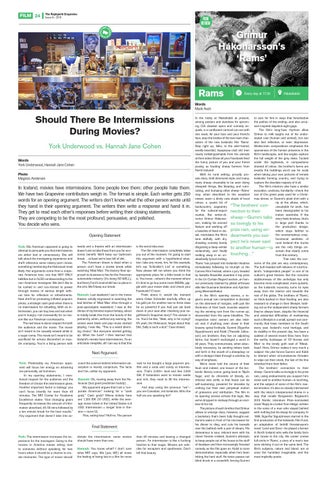
In the lobby at Háskólabíó at present, to care for him in ways that foreshadow among posters and standees for upcom- the pathos of the ending—and also occaing CGI disaster epics and comedy se- sion inspired slapstick sight gags. quels, is a cardboard carnival cut-out with The film's long-fuse rhythms allow two ovals, for your face and your friend's Grímur to milk laughs out of his underface, atop the bodies of the two main char- stated cast (human and animal), but can acters of the new Icelandic film 'Rams'. also feel reflective, or even depressive. Step right up, folks, to the wild-haired, Widescreen compositions emphasize the woolly-bearded, lopapeysa-clad old men sparseness of the human presence in the nearly indistinguishable from the animals film's landscapes, and low angles capture at their sides! Show all your Facebook feed the full weight of the grey skies. Tucked the funny picture of you and your friend under the highlands, in compositions posing as feuding sheep farmers from drained of colour, the brother's farms are North Iceland! exactly the buildings you'd use for scale With its rural setting, proudly pro- when taking your own pictures of remote saic story, droll directorial style, and many, Icelandic farming country, and trying to many sheep—invariably to be seen doing capture the desolate majesty of it all. sheepish things, like bleating, and rumiThe film's interiors also have a similar nating, and humping other sheep—'Rams' evocative, unshowy familiarity—check the may, when described to the sceptical can of Ora green peas used for a Christviewer, seem a direly cute shade of local mas dinner, or Gummi's plaid shirt with a colour, a quaint bit of rip at the elbow, which, backcountry pageantry “The brothers' conunsuitable for work, has for the cultural-export nection to their been downgraded to his market. But writer-diindoor wardrobe. If the rector Grímur Hákonar- sheep—Gummi talks story feels timeless, that's son, making his second so lovingly to his in large part thanks to feature and working off the production design, a baseline of lived-in de- prize ram, using enwhich stays faithful to tail, modulates the film's dearments you susthe unostentatious cosytone skilfully, with dry, functional aesthetic of drawling comedy barely pect he's never said rural Iceland—the trucks disguising a deep-winter to another human—is are the only things onmelancholy, and finally screen that clearly come melting away in an un- touching…” from this century. abashedly lyrical ending. That said, the con'Rams' has jumped into Icelandic theatres cerns of the plot are very contemporary. immediately following its triumph at the The bull-headed self-reliance of rural IceCannes Film Festival, where a jury headed land's “independent people” is one of its by Isabella Rossellini awarded it top prize culture's great themes. But the romantic in the Un Certain Regard section, an hon- stubbornness of this archetype has only our previously claimed by global arthouse become more complicated, more quixotic, elite like Ousmane Sembène and Apichat- as the Icelandic economy turns its eyes pong Weerasethakul. away from the interior and towards the In the film's opening scenes, a re- rest of the globe. The brothers of 'Rams', gion's annual ram competition is decided so thick-backed in their feuding, are also on the slimmest of margins, with just the resistant to change in their lifestyle, holdthickness of their back muscles separat- ing out as the independent sheep farmers ing the winning ram from the runner-up, they've always been, despite the financial descended from the same bloodline. The and existential difficulties of maintaining respective rams' owners are also relat- such a lifestyle in a small, spread-out comed, and, if anything, even closer in their munity that loses members to the South brawny spinal fortitude. Gummi (Sigurður every year. Iceland's rural heritage, and Sigurjónsson) and Kiddi (Theodór Júlíus- its viability in the present day, has been a son) are brothers; they live on adjoining subtext of several recent films here, from farms, but haven't exchanged a word in the earthy burlesque of ‘Of Horses and 40 years. They communicate, when abso- Men’ to the lonely goth wail of ‘Metallutely necessary, by sending letters back head’. Here, Grímur makes it very much a and forth in the mouth of a sheepdog—or subject: the plot forces Gummi and Kiddi with a shotgun blast through a window, by to interact when circumstances threaten way of emphasis. to wipe out their stock, the last of the line We're never told the source of their inherited from their father. feud—and indeed, one lesson of the IceThe brothers' connection to their landic literary canon, going back to 'Njal's sheep—Gummi talks so lovingly to his prize Saga', and its chronicle of bloody, at- ram, using endearments you suspect he's tritional clan strife, is that feuds can be never said to another human—is touching, self-sustaining, powered for decades by and the subject of some of the film's rawnothing but their own perpetual motion est emotion; it's also so closely intertwined of grievance and retribution. The film in with the story's interpersonal drama in a its opening scenes echoes this logic, like way that recalls Bergsveinn Birgisson's we've dropped in midway through an end- 2010 Nordic Literature Prize-nominated less tit-for-tat. novel 'Reply to a Letter from Helga', written The picture of each brother that Grímur in the voice of a man who stayed behind allows to emerge does, however, suggest with nothing but his sheep for company. In a backstory that's been fully thought-out. 1980, Sigurður Sigurjónsson starred in the Gummi waits in front of his microwave for first production of the Icelandic Film Fund, his dinner to ding, and cuts his toenails an adaptation of Indriði Þorsteinsson's over the bathtub with a pair of shears. His novel 'Land and Sons'—he played a farmer demeanour is sour, reticent even with his in North Iceland who sells the family farm closer friends—indeed, Gummi's attempts and moves to the city. His career comes to keep people out of his house is the stuff full circle in 'Rams', a story of a man's two of deadpan and then increasingly frenzied sons sticking it out on the same land. The comedy as the film goes on. Kiddi is more film's subjects, nature and blood, are at demonstrative, especially when he's been once the humblest imaginable, and the hitting the hard stuff. He twice passes out most implicitly poetic. blind drunk in a snowdrift, forcing Gummi