The Reykjavík Grapevine Issue 9 — 2012
18
Jennifer Karchmer is an independent journalist based in Seattle, Washington where she covers press freedom issues. She has served as a volunteer correspondent for Reporters Without Borders-USA since 2010.
Iceland | Media
Two Years Old: IMMI Inches Through Icelandic Parliament
When IMMI, the Icelandic Modern Media Initiative, turned two years old this month, supporters cheered a few accomplishments it has made toward protecting freedom of information. However, IMMI—a legislative proposal to re-position Iceland as an information safe haven—is still very much in the developmental stages and not yet a law on the books, despite some cases of international press embellishing its progress.
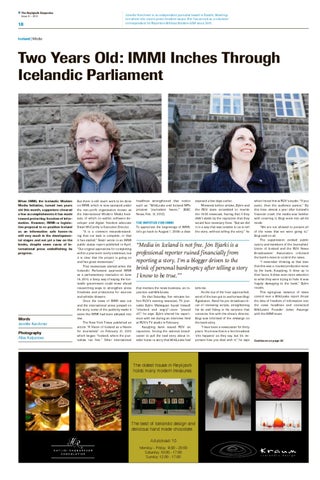
Words Jennifer Karchmer Photography Alísa Kalyanova
But there is still much work to be done on IMMI, which is now operated under the non-profit organisation known as the International Modern Media Institute, of which co-author, software developer and digital freedom advocate Smári McCarthy is Executive Director. “It is a common misunderstanding that our task is complete, or that it has stalled,” Smári wrote in an IMMI public status report published in April. “Our original aspirations for completing within a year were overly ambitious, but it is clear that the project is going on and has great momentum.” That momentum started when the Icelandic Parliament approved IMMI as a parliamentary resolution on June 16, 2010, a fancy way of saying the Icelandic government could move ahead researching ways to strengthen press freedoms and protections for sources and whistle-blowers. Once the news of IMMI was out and the international press jumped on the story, some of the publicity made it seem like IMMI had been adopted into law. The New York Times published an article “A Vision of Iceland as a Haven for Journalists” on February 21, 2010 which began: “Iceland, where the journalists run free.” Other international
headlines strengthened that notion such as: “WikiLeaks and Iceland MPs propose ‘journalism haven,’” (BBC News, Feb. 12, 2010). The impetus for IMMI To appreciate the beginnings of IMMI, let’s go back to August 1, 2009—a date
exposed a few days earlier. Moments before airtime, Björn and the RÚV team scrambled to rewrite the 19:00 newscast, fearing that if they didn’t abide by the injunction that they would face monetary fines. “But we did it in a way that was tenable to us to tell the story, without telling the story,” he
“Media in Iceland is not free. Jón Bjarki is a professional reporter ruined financially from reporting a story. I'm a blogger driven to the brink of personal bankruptcy after telling a story I know to be true.”” that involves the news business, an injunction and WikiLeaks. On that Saturday, five minutes before RÚV’s evening newscast, TV journalist Björn Malmquist found himself “shocked and angry”—even “pissed off,” he says. Björn shared his experience with me during an interview held at RÚV’s TV studio in February. Kaupþing bank issued RÚV an injunction, forcing the national broadcaster to pull the lead story about insider loans—a story that WikiLeaks had
tells me. As the top of the hour approached, word of the ban got to anchorman Bogi Ágústsson. Amid his pre-broadcast ritual of reviewing scripts, straightening his tie and fitting in his earpiece that connects him with the show’s director, Bogi was informed of the embargo on the bank story. “I have been a newscaster for thirty years. You know that in a live broadcast ‘shit happens’ as they say, but it’s important how you deal with it,” he says
when I meet him at RÚV’s studio. “If you panic, then the audience panics.” By this time, almost a year after Iceland’s financial crash, the media was familiar with covering it. Bogi went into ad-lib mode: “We are not allowed to present all of the news that we were going to,” Bogi said on air. The suppression evoked public outcry and members of the Journalists’ Union of Iceland and the RÚV News Broadcasters’ Association criticised the bank’s move to control the news. “I remember thinking at that time that this was a counterproductive move by the bank, Kaupþing. It blew up in their faces. It drew even more attention to what they were trying to hide. It was hugely damaging to the bank,” Björn recalls. This egregious instance of news control over a WikiLeaks report thrust the idea of freedom of information into the news headlines and connected WikiLeaks’ Founder Julian Assange with the IMMI team.
Continues on page 32
The oldest house in Reykjavík holds many modern treasures.
The best of Icelandic design and delicious hand made chocolate. Aðalstræti 10 Monday - Friday 9:00 - 20:00 Saturday 10:00 - 17:00 Sunday 12:00 - 17:00
i c e l a n d i c
d e s i g n