RURAL NEWS // OCTOBER 4, 2011
32 MANAGEMENT
Think yield not cost when drilling crops IF YOU ask a farmer harvesting a no-tillage crop how much the process costs he may not know or even care because he expects the crop return to more than cover the harvesting cost. But ask the same farmer when he’s drilling his crop how much that’s costing and he could probably tell you to the last cent.
TACKLING TILLAGE JOHN BAKER
At harvest, he is thinking about returns, at drilling he is thinking about costs. The reasons are understandable. At drilling, returns are at least three months away and yield is expected to be more affected by weather and things other than the drill. But is this really the case? In conventional tillage it nearly always is but in no-tillage it is another matter. Everyone knows poor tillage affects final yield but with no-tillage everything a range of tools would have done is now done by just two: the sprayer and drill. No-tillage drill openers have a big influence on the microenvironment seeds and seedlings experience, whereas in tillage, the cultivation tools rather than the drills have the most influence.
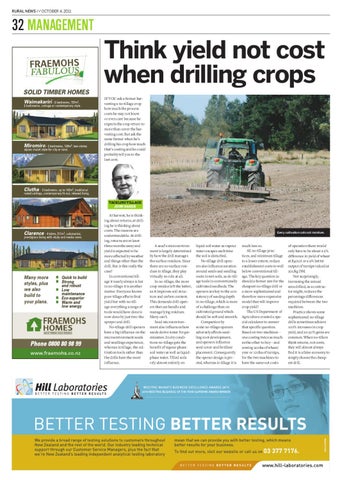
Every cultivation cuts soil moisture.
A seed’s microenvironment is largely determined by how the drill manages the surface residues. Since there are no surface residues in tillage, they play virtually no role at all. In no-tillage, the more crop residue left the better, as it improves soil structure and carbon content. This demands drill openers that can handle and manage lying residues. Many can’t. Seed microenvironment also influences how seeds derive water for germination. In dry conditions no-tillage gets the benefit of vapour-phase soil water as well as liquidphase water. Tilled soils rely almost entirely on
liquid soil water as vapour water escapes each time the soil is disturbed. No-tillage drill openers also influence aeration around seeds and seedling roots in wet soils, as do tillage tools in conventionally cultivated seedbeds. The openers are key to the consistency of seeding depth in no-tillage, which is more of a challenge than on cultivated ground which should be soft and smooth. Compaction by some no-tillage openers adversely affects seedling root development, and openers influence seed cover and fertiliser placement. Consequently the opener design is pivotal, whereas in tillage it is
much less so. All no-tillage practices, and minimum tillage to a lesser extent, reduce establishment costs to well below conventional tillage. The key question is: should a farmer aim for the cheapest no-tillage drill or a more sophisticated and therefore more expensive model that will improve crop yield? The US Department of Agriculture created a special calculator to answer that specific question. Based on two machines – one costing twice as much as the other to buy – and sowing 200ha of wheat/ year or 100ha of turnips, for the two machines to have the same net costs
of operation there would only have to be about a 2% difference in yield of wheat at $400/t or a 9% better output of turnips valued at 20c/kg DM. Not surprisingly, increasing the annual area drilled, as a contractor might, reduces the percentage differences required between the two machines. Practice shows some sophisticated no-tillage drills sometimes achieve 100% increases in crop yield, and 20-50% gains are common. When no-tillers think returns, not costs, they will almost always find it is a false economy to simply choose the cheapest drill.