A u t u m n 2 014
FORAGER
2
Germinal Seeds NZ Ltd
High weight gains prove hugely profitable
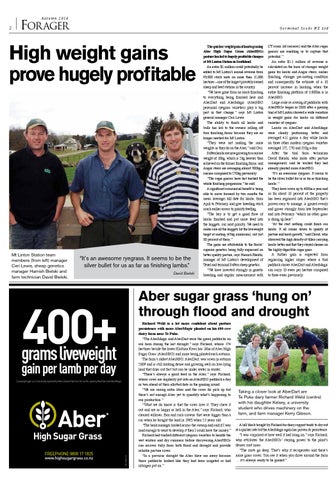
Mt Linton Station team members (from left) manager Ceri Lewis, sheep genetics manager Hamish Bielski and farm technician David Bielski.
“It’s an awesome ryegrass. It seems to be the silver bullet for us as far as finishing lambs.” David Bielski
grams liveweight gain per lamb per day
*
Liveweight gain as consistently reported by New Zealand farmers for lambs grazing AberDart and AberMagic.
GSL 0634-b10
*
www.highsugargrass.co.nz
CT scans (of carcases) and the Aber sugar grasses are enabling us to capture that potential.” An extra $1.1 million of revenue is calculated on the basis of stronger weight gains for lambs and Angus steers, earlier finishing, stronger pre-mating condition and consequently the estimate of a 10 percent increase in lambing when the entire finishing platform of 3,800ha is in AberHSG. Large scale re-sowing of paddocks with AberHSGs began in 2008 after a grazing trial at Mt Linton showed a wide variation in weight gains for lambs on different varieties of ryegrass. Lambs on AberDart and AberMagic were clearly performing better and averaged 411 grams a day while lambs on three other modern ryegrass varieties averaged 172, 270 and 320g a day. After the trial farm technician David Bielski, who looks after pasture management, said he wished they had already planted more AberHSG. “It’s an awesome ryegrass. It seems to be the silver bullet for us as far as finishing lambs.” They have sown up to 400ha a year and so far about 10 percent of the property has been regrassed into AberHSG that’s proven easy to manage, is grazed evenly and grows strongly from late September and into February “which no other grass is doing up here”. “At the start nothing could finish our lambs. It all comes down to quality of pasture and lamb growth,” said David, who observed the high density of tillers carrying lambs better and that they stayed cleaner on the highly digestible sugar grass. A further gain is expected from regrassing higher slopes where a trial paddock shows AberDart and AberMagic can carry 10 ewes per hectare compared to three ewes previously.
Aber sugar grass ‘hung on’ through flood and drought
400+ FREEPHONE 0800 17 1825
The quicker weight gain of lambs grazing Aber High Sugar Grass (AberHSG) pasture has led to hugely profitable changes at Mt Linton Station in Southland. An extra $1 million could potentially be added to Mt Linton’s annual revenue from 95,000 stock units on more than 12,000 hectares – one of the largest privately owned sheep and beef stations in the country. “We have gone from no lamb finishing to everything being finished here and AberDart and AberMagic (AberHSG perennial ryegrass varieties) play a big part in that change,” says Mt Linton general manager Ceri Lewis. The ability to finish all lambs and bulls has led to the owners selling off four finishing farms because they are no longer needed for Mt Linton. “They were not making the same weights as they do on the Aber,” said Ceri. Suftex lambs are now growing to a carcase weight of 18kg, which is 2kg heavier than achieved on the former finishing farms, and Angus steers are averaging almost 300kg a carcase compared to 270kg previously. “The sugar grasses have fast tracked the whole finishing programme,” he said. A significant commercial benefit is being able to move forward by two months the mean (average) kill date for lambs, from April to February, and give breeding stock much earlier access to priority feeding. “The key is to get a good flow of lambs finished and put more feed into the hoggets, our next priority. We need to make sure all the hoggets hit the liveweight target at mating (43kg minimum), not just 50 percent of them.” The gains are attributable to the flocks’ superior genetics being fully expressed on better quality pasture, says Hamish Bielski, manager of Mt Linton’s development of Texel and terminal Suftex sheep genetics. “We have invested strongly in genetic breeding and regular measurement with
Richard Weld is a lot more confident about pasture persistence with more AberMagic planted on his 600-cow dairy farm near Te Puke. “The AberMagic and AberDart were the green paddocks on our farm during the last drought,” says Richard, whose 174 hectares beside the lower Kaituna River has 18ha of Aber High Sugar Grass (AberHSG) and more being planted each autumn. The farm’s oldest AberHSG, AberDart, was sown in autumn 2009 and is still looking dense and growing well on low-lying land that dries out fast but can be under water in winter. “There’s always a good feed in the Aber,” says Richard, whose cows are regularly put into an AberHSG paddock a day or two ahead of their allotted date in the grazing round. “We are seeing extra litres and the cows do pick up but there’s not enough Aber yet to quantify what’s happening to our production.” “What we do know is that the cows love it. They chew it out and are as happy as hell in the Aber,” says Richard, who cleared willows, flax and rush crowns that were bigger than a car when he bought the land in 1985 when 23 years old. “The bank manager looked across the swamp and said if I was mad enough to want to develop it then I could have the money.” Richard had trialled different ryegrass varieties to handle the wet winters and dry summers before discovering AberHSGs can recover fully from both flood and drought and provide reliable pasture cover. “In a previous drought the Aber blew me away because those paddocks looked like they had been irrigated or had nitrogen put on.”
Taking a closer look at AberDart are Te Puke dairy farmer Richard Weld (centre) with his daughter Kelsey, a university student who drives machinery on the farm, and farm manager Kerry Gibson. A hill block bought by Richard for dairy support tends to dry out at a quicker rate but the AberMagic again has proven its persistence. “I was surprised at how well it had hung on,” says Richard, who attributes the AberHSGs’ staying power to the plant’s denser root mass. “The roots go deep. That’s why it recuperates and there’s more grass cover. You see it when you drive around the farm … it’s always ready to be grazed”.