74 | Black Swan
Opportunity in Chaos Graduation Thesis by Joanne Jimmink
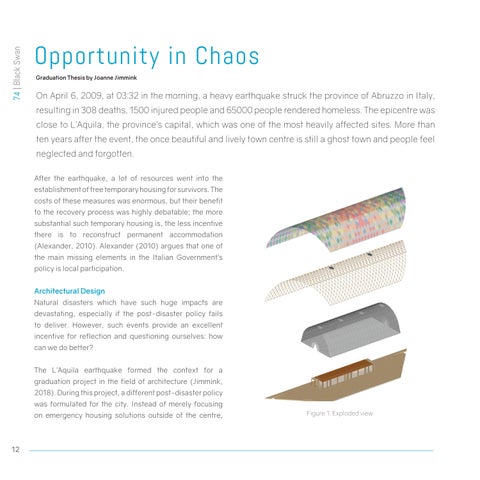
On April 6, 2009, at 03:32 in the morning, a heavy earthquake struck the province of Abruzzo in Italy, resulting in 308 deaths, 1500 injured people and 65000 people rendered homeless. The epicentre was close to L’Aquila, the province’s capital, which was one of the most heavily affected sites. More than ten years after the event, the once beautiful and lively town centre is still a ghost town and people feel neglected and forgotten. After the earthquake, a lot of resources went into the establishment of free temporary housing for survivors. The costs of these measures was enormous, but their benefit to the recovery process was highly debatable; the more substantial such temporary housing is, the less incentive there is to reconstruct permanent accommodation (Alexander, 2010). Alexander (2010) argues that one of the main missing elements in the Italian Government’s policy is local participation. Architectural Design Natural disasters which have such huge impacts are devastating, especially if the post-disaster policy fails to deliver. However, such events provide an excellent incentive for reflection and questioning ourselves: how can we do better? The L’Aquila earthquake formed the context for a graduation project in the field of architecture (Jimmink, 2018). During this project, a different post-disaster policy was formulated for the city. Instead of merely focusing on emergency housing solutions outside of the centre,
12
Figure 1. Exploded view