SolutionsEngineering 10 Gigabit Ethernet Solutions
10 Gigabit Ethernet: The Promise and the Challenge 10 Gigabit Ethernet technology has arrived; it is real, and has the potential to change real-time and embedded systems more dramatically than prior generations of Ethernet technology. by J ack Staub Critical I/O
E
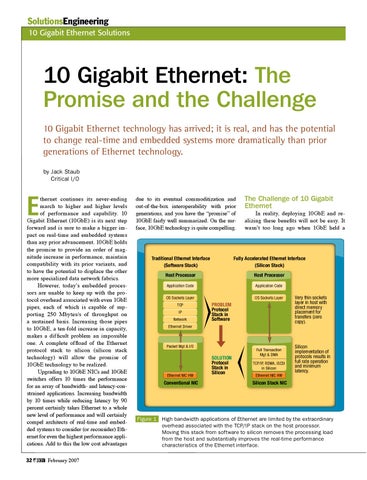
thernet continues its never-ending march to higher and higher levels of performance and capability. 10 Gigabit Ethernet (10GbE) is its next step forward and is sure to make a bigger impact on real-time and embedded systems than any prior advancement. 10GbE holds the promise to provide an order of magnitude increase in performance, maintain compatibility with its prior variants, and to have the potential to displace the other more specialized data network fabrics. However, today’s embedded processors are unable to keep up with the protocol overhead associated with even 1GbE pipes, each of which is capable of supporting 250 Mbytes/s of throughput on a sustained basis. Increasing those pipes to 10GbE, a ten-fold increase in capacity, makes a difficult problem an impossible one. A complete offload of the Ethernet protocol stack to silicon (silicon stack technology) will allow the promise of 10GbE technology to be realized. Upgrading to 10GbE NICs and 10GbE switches offers 10 times the performance for an array of bandwidth- and latency-constrained applications. Increasing bandwidth by 10 times while reducing latency by 90 percent certainly takes Ethernet to a whole new level of performance and will certainly compel architects of real-time and embedded systems to consider (or reconsider) Ethernet for even the highest performance applications. Add to this the low cost advantages 32
February 2007
due to its eventual commoditization and out-of-the-box interoperability with prior generations, and you have the “promise” of 10GbE fairly well summarized. On the surface, 10GbE technology is quite compelling.
The Challenge of 10 Gigabit Ethernet
In reality, deploying 10GbE and realizing these benefits will not be easy. It wasn’t too long ago when 1GbE held a
Traditional Ethernet Interface (Software Stack)
Fully Accelerated Ethernet Interface (Silicon Stack)
Host Processor
Host Processor
Application Code
Application Code
OS Sockets Layer TCP IP Network
OS Sockets Layer
PROBLEM Protocol Stack in Software
Ethernet Driver
Packet Mgt & I/O
Ethernet NIC HW
Conventional NIC
Figure 1
SOLUTION Protocol Stack in Silicon
Full Transaction Mgt & DMA TCP/IP, RDMA, iSCSI in Silicon Ethernet NIC HW
Very thin sockets layer in host with direct memory placement for transfers (zero copy).
Silicon implementation of protocols results in full rate operation and minimum latency.
Silicon Stack NIC
High bandwidth applications of Ethernet are limited by the extraordinary overhead associated with the TCP/IP stack on the host processor. Moving this stack from software to silicon removes the processing load from the host and substantially improves the real-time performance characteristics of the Ethernet interface.