COTS
FIND the products featured in this section and more at
PRODUCTS
intelligentsystemssource.com
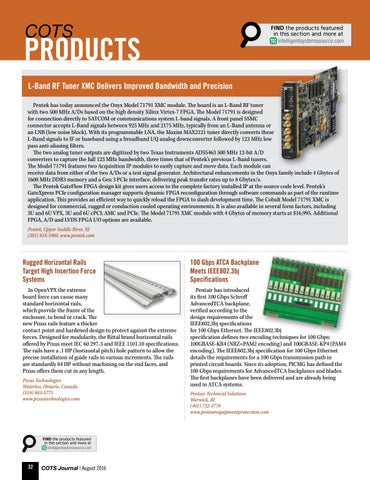
L-Band RF Tuner XMC Delivers Improved Bandwidth and Precision Pentek has today announced the Onyx Model 71791 XMC module. The board is an L-Band RF tuner with two 500 MHz A/Ds based on the high density Xilinx Virtex-7 FPGA. The Model 71791 is designed for connection directly to SATCOM or communications system L-band signals. A front panel SSMC connector accepts L-Band signals between 925 MHz and 2175 MHz, typically from an L-Band antenna or an LNB (low noise block). With its programmable LNA, the Maxim MAX2121 tuner directly converts these L-Band signals to IF or baseband using a broadband I/Q analog downconverter followed by 123 MHz low pass anti-aliasing filters. The two analog tuner outputs are digitized by two Texas Instruments ADS5463 500 MHz 12-bit A/D converters to capture the full 123 MHz bandwidth, three times that of Pentek’s previous L-Band tuners. The Model 71791 features two Acquisition IP modules to easily capture and move data. Each module can receive data from either of the two A/Ds or a test signal generator. Architectural enhancements in the Onyx family include 4 Gbytes of 1600 MHz DDR3 memory and a Gen 3 PCIe interface, delivering peak transfer rates up to 8 Gbytes/s. The Pentek GateFlow FPGA design kit gives users access to the complete factory installed IP at the source code level. Pentek’s GateXpress PCIe configuration manager supports dynamic FPGA reconfiguration through software commands as part of the runtime application. This provides an efficient way to quickly reload the FPGA to slash development time. The Cobalt Model 71791 XMC is designed for commercial, rugged or conduction cooled operating environments. It is also available in several form factors, including 3U and 6U VPX, 3U and 6U cPCI; AMC and PCIe. The Model 71791 XMC module with 4 Gbytes of memory starts at $16,995. Additional FPGA, A/D and LVDS FPGA I/O options are available. Pentek, Upper Saddle River, NJ (201) 818-5900. www.pentek.com
Rugged Horizontal Rails Target High Insertion Force Systems
100 Gbps ATCA Backplane Meets IEEE802.3bj Specifications
In OpenVPX the extreme board force can cause many standard horizontal rails, which provide the frame of the enclosure, to bend or crack. The new Pixus rails feature a thicker contact point and hardened design to protect against the extreme forces. Designed for modularity, the Rittal brand horizontal rails offered by Pixus meet IEC 60 297-3 and IEEE 1101.10 specifications. The rails have a .1 HP (horizontal pitch) hole pattern to allow the precise installation of guide rails in various increments. The rails are standardly 84 HP without machining on the end faces, and Pixus offers them cut in any length.
Pentair has introduced its first 100 Gbps Schroff AdvancedTCA backplane, verified according to the design requirements of the IEEE802.3bj specifications for 100 Gbps Ethernet. The IEEE802.3bj specification defines two encoding techniques for 100 Gbps: 100GBASE-KR4 (NRZ=PAM2 encoding) and 100GBASE-KP4 (PAM4 encoding). The IEEE802.3bj specification for 100 Gbps Ethernet details the requirements for a 100 Gbps transmission path in printed circuit boards. Since its adoption, PICMG has defined the 100 Gbps requirements for AdvancedTCA backplanes and blades. The first backplanes have been delivered and are already being used in ATCA systems.
Pixus Technologies Waterloo, Ontario, Canada (519) 885-5775 www.pixustechnologies.com
FIND the products featured in this section and more at
intelligentsystemssource.com
32
COTS Journal | August 2016
Pentair Technical Solutions Warwick, RI (401) 732-3770 www.pentairequipmentprotection.com