The
INSIDE TRACK Lockheed Martin Upgrades Tactical Tomahawk Weapons Control System The system that integrates the launch hardware and software to provide weapon control for the Tomahawk Land Attack Missile is being modernized by Lockheed Martin. As a member of the Tomahawk Weapons Control System Development Activity in partnership with the U.S. Navy Labs, Lockheed Martin is upgrading the Tactical Tomahawk Weapons Control System (TTWCS). TTWCS provides firing units the ability to prepare, control and launch Tomahawk missiles and is one of three major components that comprise the Tomahawk Weapons System. After an extensive five-year design, development and test program, the Program Executive Office, Strike Weapons and Unmanned Aviation, and PMA-280, Tomahawk Weapons System, authorized fleet release of the latest TTWCS system upgrade. This TTWCS hardware and software upgrade provides improvements for specific mission and launch timelines. The team is also implementing new processors that reduce run-times for several applications from minutes to seconds. It also serves as a stepping stone to the next upgrade scheduled in 2015. As part of an incremental approach, the present TTWCS upgrade will be installed on surface platforms only: Ticonderoga Class Cruisers (CG) and Arleigh Burke Class Destroyers (DDG). Lockheed Martin Bethesda, MD. (301) 897-6000. [www.lockheedmartin.com].
FAA Reaffirms Approval of LynuxWorks LynxOS-178 RSC RTOS LynuxWorks has received its second reusable software components (RSC) approval for the LynxOS-178 product family. The company was the first and only embedded operating system vendor to receive Advisory Circular AC 20-148 approval from the Federal Aviation Administration (FAA). With RSC approval, the LynxOS-178 Version 2.2.2 RTOS can be more extensively used by avionics systems integrators and embedded developers for the operating system portion of the safety-critical software code and supporting DO-178B artifacts for reuse in other system designs with other software components without the need for full recertification. LynxOS-178 was designed solely for safety-critical applications. The standards-based approach 8
COTS Journal | April 2012
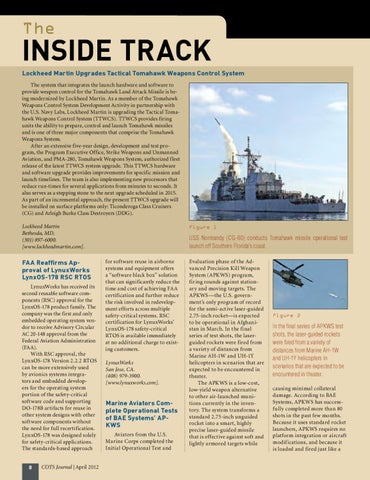
Figure 1
USS Normandy (CG-60) conducts Tomahawk missile operational test launch off Southern Florida’s coast. for software reuse in airborne systems and equipment offers a “software black box” solution that can significantly reduce the time and cost of achieving FAA certification and further reduce the risk involved in redevelopment efforts across multiple safety-critical systems. RSC certification for LynuxWorks’ LynxOS-178 safety-critical RTOS is available immediately at no additional charge to existing customers. LynuxWorks San Jose, CA. (408) 979-3900. [www.lynuxworks.com].
Marine Aviators Complete Operational Tests of BAE Systems’ APKWS Aviators from the U.S. Marine Corps completed the Initial Operational Test and
Evaluation phase of the Advanced Precision Kill Weapon System (APKWS) program, firing rounds against stationary and moving targets. The APKWS—the U.S. government’s only program of record for the semi-active laser-guided 2.75-inch rocket—is expected to be operational in Afghanistan in March. In the final series of test shots, the laserguided rockets were fired from a variety of distances from Marine AH-1W and UH-1Y helicopters in scenarios that are expected to be encountered in theater. The APKWS is a low-cost, low-yield weapon alternative to other air-launched munitions currently in the inventory. The system transforms a standard 2.75-inch unguided rocket into a smart, highly precise laser-guided missile that is effective against soft and lightly armored targets while
Figure 2
In the final series of APKWS test shots, the laser-guided rockets were fired from a variety of distances from Marine AH-1W and UH-1Y helicopters in scenarios that are expected to be encountered in theater. causing minimal collateral damage. According to BAE Systems, APKWS has successfully completed more than 80 shots in the past few months. Because it uses standard rocket launchers, APKWS requires no platform integration or aircraft modifications, and because it is loaded and fired just like a