System Development Power Supplies and Converters
Partitioning Rethink Enhances Military Power Designs In this era of multi-voltage electronics and distributed architectures, military power system design is getting tricky. A new approach to separating functions keeps those challenges in check.
Keith Nardone, Sr. Manager, Defense Products Vicor
The Intermediate Bus Architecture (IBA) was introduced to deal more cost-effectively with the growing need [ 30 ] COTS Journal December 2007
48 Vdc
Power
Bus (Typ)
Supply
48 Vdc Bus (Typ)
Brick
Load 1
Brick
Load 2
Brick
Load 3
Brick
Load 4
Brick
Load 5
Intermediate Bus Architecture (IBA)
Bulk AC/DC
48 Vdc
Power
Bus (Typ)
Supply
BACKPLANE
Handling Multiple Voltages
Bulk AC/DC
BACKPLANE
D
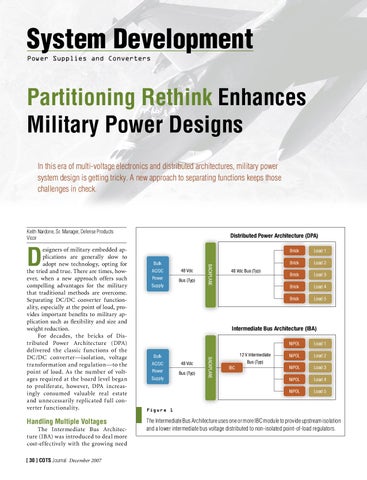
esigners of military embedded applications are generally slow to adopt new technology, opting for the tried and true. There are times, however, when a new approach offers such compelling advantages for the military that traditional methods are overcome. Separating DC/DC converter functionality, especially at the point of load, provides important benefits to military application such as flexibility and size and weight reduction. For decades, the bricks of Distributed Power Architecture (DPA) delivered the classic functions of the DC/DC converter—isolation, voltage transformation and regulation—to the point of load. As the number of voltages required at the board level began to proliferate, however, DPA increasingly consumed valuable real estate and unnecessarily replicated full converter functionality.
Distributed Power Architecture (DPA)
12 V Intermediate Bus (Typ) IBC
NiPOL
Load 1
NiPOL
Load 2
NiPOL
Load 3
NiPOL
Load 4
NiPOL
Load 5
Figure 1
The Intermediate Bus Architecture uses one or more IBC module to provide upstream isolation and a lower intermediate bus voltage distributed to non-isolated point-of-load regulators.