The
Inside Track TEAC Aerospace Outfits Airborne Mission Data Recorders for Apache Helicopter TEAC Aerospace Technologies, a provider of rugged airborne video and mission data recorders, has completed shipment of Mission Data Recorders for installation in the U.S. Army’s Apache helicopters (Figure 1). Developed by McDonnell Douglas (now Boeing), the U.S. Army has more than 800 of the twin-engine attack helicopters, and more than 1,000 have been exported. Under the contract, TEAC Aerospace will deliver additional production units through 2006. For the Apache, the solid-state digital MDR-80 is configured to record critical video source, with over 180 minutes of high-resolution digital recording capacity on solid-state Removable Memory Modules. The recorded video will be used for post-mission debrief and analysis. The new Arrowhead FLIR developed by the Army for the A Model Apache provides a significantly higher image resolution for the Apache pilot and mission analysts. When combined with the TEAC MDR-80C Mission Digital Data Recorder (MDDS), in-flight playback and in-cockpit image analysis will benefit from a video quality significantly superior in resolution and lack of scanning FLIR artifacts never before seen in the Apache cockpit. The new MDR is deployed on all models of Apache from A Models through the latest Lot 9 D Models with the new Arrowhead FLIR installed. After action review and target image analysis are also improved as
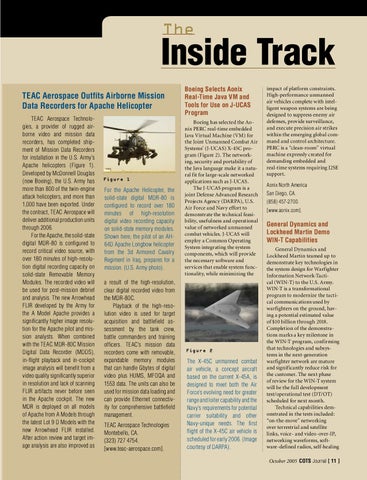
Figure 1
For the Apache Helicopter, the solid-state digital MDR-80 is configured to record over 180 minutes of high-resolution digital video recording capacity on solid-state memory modules. Shown here, the pilot of an AH64D Apache Longbow helicopter from the 3d Armored Cavalry Regiment in Iraq, prepares for a mission. (U.S. Army photo). a result of the high-resolution, clear digital recorded video from the MDR-80C. Playback of the high-resolution video is used for target acquisition and battlefield assessment by the tank crew, battle commanders and training officers. TEAC’s mission data recorders come with removable, expandable memory modules that can handle Gbytes of digital video plus HUMS, MFOQA and 1553 data. The units can also be used for mission data loading and can provide Ethernet connectivity for comprehensive battlefield management. TEAC Aerospace Technologies Montebello, CA. (323) 727 4754. [www.teac-aerospace.com].
Boeing Selects Aonix Real-Time Java VM and Tools for Use on J-UCAS Program Boeing has selected the Aonix PERC real-time embedded Java Virtual Machine (VM) for the Joint Unmanned Combat Air Systems’ (J-UCAS) X-45C program (Figure 2). The networking, security and portability of the Java language make it a natural fit for large-scale networked applications such as J-UCAS. The J-UCAS program is a joint Defense Advanced Research Projects Agency (DARPA), U.S. Air Force and Navy effort to demonstrate the technical feasibility, usefulness and operational value of networked unmanned combat vehicles. J-UCAS will employ a Common Operating System integrating the system components, which will provide the necessary software and services that enable system functionality, while minimizing the
Figure 2
The X-45C unmanned combat air vehicle, a concept aircraft based on the current X-45A, is designed to meet both the Air Force’s evolving need for greater range and loiter capability and the Navy’s requirements for potential carrier suitability and other Navy-unique needs. The first flight of the X-45C air vehicle is scheduled for early 2006. (Image courtesy of DARPA).
impact of platform constraints. High-performance unmanned air vehicles complete with intelligent weapon systems are being designed to suppress enemy air defenses, provide surveillance, and execute precision air strikes within the emerging global command and control architecture. PERC is a “clean-room” virtual machine expressly created for demanding embedded and real-time systems requiring J2SE support. Aonix North America San Diego, CA. (858) 457-2700. [www.aonix.com].
General Dynamics and Lockheed Martin Demo WIN-T Capabilities General Dynamics and Lockheed Martin teamed up to demonstrate key technologies in the system design for Warfighter Information Network-Tactical (WIN-T) to the U.S. Army. WIN-T is a transformational program to modernize the tactical communications used by warfighters on the ground, having a potential estimated value of $10 billion through 2018. Completion of the demonstrations marks a key milestone in the WIN-T program, confirming that technologies and subsystems in the next-generation warfighter network are mature and significantly reduce risk for the customer. The next phase of review for the WIN-T system will be the full development test/operational test (DT/OT) scheduled for next month. Technical capabilities demonstrated in the tests included: “on-the-move” networking over terrestrial and satellite links, voice- and video-over-IP, networking waveforms, software-defined radios, self-healing October 2005 COTS Journal [ 11 ]