Features
Removing the Technological Bottleneck: Crew Integration and the Lethality Chain Article by LT Alex Morgan,USN
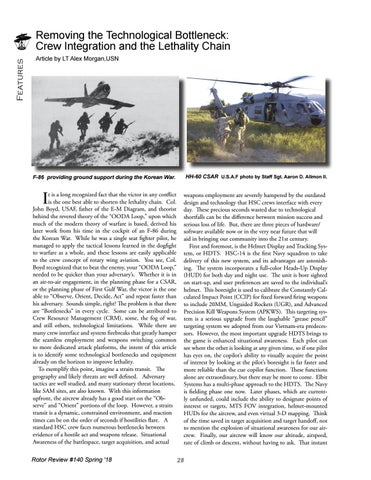
HH-60 CSAR U.S.A.F photo by Staff Sgt. Aaron D. Allmon II.
F-86 providing ground support during the Korean War.
I
t is a long recognized fact that the victor in any conflict is the one best able to shorten the lethality chain. Col. John Boyd, USAF, father of the E-M Diagram, and theorist behind the revered theory of the “OODA Loop,” upon which much of the modern theory of warfare is based, derived his later work from his time in the cockpit of an F-86 during the Korean War. While he was a single seat fighter pilot, he managed to apply the tactical lessons learned in the dogfight to warfare as a whole, and these lessons are easily applicable to the crew concept of rotary wing aviation. You see, Col. Boyd recognized that to beat the enemy, your “OODA Loop,” needed to be quicker than your adversary’s. Whether it is in an air-to-air engagement, in the planning phase for a CSAR, or the planning phase of First Gulf War, the victor is the one able to “Observe, Orient, Decide, Act” and repeat faster than his adversary. Sounds simple, right? The problem is that there are “Bottlenecks” in every cycle. Some can be attributed to Crew Resource Management (CRM), some, the fog of war, and still others, technological limitations. While there are many crew interface and system firebreaks that greatly hamper the seamless employment and weapons switching common to more dedicated attack platforms, the intent of this article is to identify some technological bottlenecks and equipment already on the horizon to improve lethality. To exemplify this point, imagine a straits transit. The geography and likely threats are well defined. Adversary tactics are well studied, and many stationary threat locations, like SAM sites, are also known. With this information upfront, the aircrew already has a good start on the “Observe” and “Orient” portions of the loop. However, a straits transit is a dynamic, constrained environment, and reaction times can be on the order of seconds if hostilities flare. A standard HSC crew faces numerous bottlenecks between evidence of a hostile act and weapons release. Situational Awareness of the battlespace, target acquisition, and actual Rotor Review #140 Spring '18
weapons employment are severely hampered by the outdated design and technology that HSC crews interface with every day. These precious seconds wasted due to technological shortfalls can be the difference between mission success and serious loss of life. But, there are three pieces of hardware/ software available now or in the very near future that will aid in bringing our community into the 21st century. First and foremost, is the Helmet Display and Tracking System, or HDTS. HSC-14 is the first Navy squadron to take delivery of this new system, and its advantages are astonishing. The system incorporates a full-color Heads-Up Display (HUD) for both day and night use. The unit is bore sighted on start-up, and user preferences are saved to the individual’s helmet. This boresight is used to calibrate the Constantly Calculated Impact Point (CCIP) for fixed forward firing weapons to include 20MM, Unguided Rockets (UGR), and Advanced Precision Kill Weapons System (APKWS). This targeting system is a serious upgrade from the laughable “grease pencil” targeting system we adopted from our Vietnam-era predecessors. However, the most important upgrade HDTS brings to the game is enhanced situational awareness. Each pilot can see where the other is looking at any given time, so if one pilot has eyes on, the copilot’s ability to visually acquire the point of interest by looking at the pilot’s boresight is far faster and more reliable than the cue copilot function. These functions alone are extraordinary, but there may be more to come. Elbit Systems has a multi-phase approach to the HDTS. The Navy is fielding phase one now. Later phases, which are currently unfunded, could include the ability to designate points of interest or targets, MTS FOV integration, helmet-mounted HUDs for the aircrew, and even virtual 3-D mapping. Think of the time saved in target acquisition and target handoff, not to mention the explosion of situational awareness for our aircrew. Finally, our aircrew will know our altitude, airspeed, rate of climb or descent, without having to ask. That instant 28