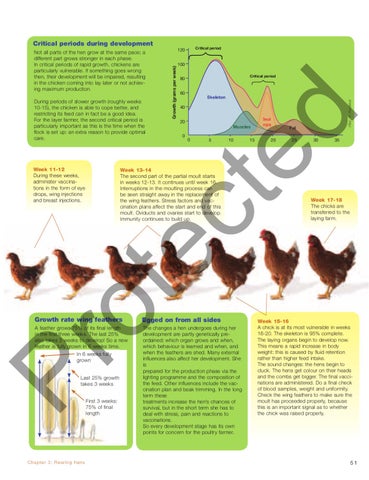
Critical periods during development
}
100 Critical period
}
80 60 40 20 0
Muscles
0
5
After: R. Kwakkel
Skeleton
d
During periods of slower growth (roughly weeks 10-15), the chicken is able to cope better, and restricting its feed can in fact be a good idea. For the layer farmer, the second critical period is particularly important as this is the time when the flock is set up: an extra reason to provide optimal care.
Critical period
120
Growth (grams per week)
Not all parts of the hen grow at the same pace; a different part grows stronger in each phase. In critical periods of rapid growth, chickens are particularly vulnerable. If something goes wrong then, their development will be impaired, resulting in the chicken coming into lay later or not achieving maximum production.
10
15
Sexual organs
20
Fat
25
30
35
ec te
Age (weeks)
Week 11-12 During these weeks, administer vaccinations in the form of eye drops, wing injections and breast injections.
ot
Week 13-14 The second part of the partial moult starts in weeks 12-13. It continues until week 16. Interruptions in the moulting process can be seen straight away in the replacement of the wing feathers. Stress factors and vaccination plans affect the start and end of this moult. Oviducts and ovaries start to develop. Immunity continues to build up.
egged on from all sides
A feather grows 75% of its final length in the first three weeks. The last 25% also takes 3 weeks to develop! So a new feather is fully grown in 6 weeks time. In 6 weeks fully grown
The changes a hen undergoes during her development are partly genetically preordained: which organ grows and when, which behaviour is learned and when, and when the feathers are shed. Many external influences also affect her development. She is prepared for the production phase via the lighting programme and the composition of the feed. Other influences include the vaccination plan and beak trimming. In the long term these treatments increase the hen’s chances of survival, but in the short term she has to deal with stress, pain and reactions to vaccinations. So every development stage has its own points for concern for the poultry farmer.
Pr
Growth rate wing feathers
Last 25% growth takes 3 weeks First 3 weeks: 75% of final length
C h a p t e r 3 : R e a r i n g h e ns
Week 17-18 The chicks are transferred to the laying farm.
Week 15-16 A chick is at its most vulnerable in weeks 16-20. The skeleton is 95% complete. The laying organs begin to develop now. This means a rapid increase in body weight: this is caused by fluid retention rather than higher feed intake. The sound changes: the hens begin to cluck. The hens get colour on their heads and the combs get bigger. The final vaccinations are administered. Do a final check of blood samples, weight and uniformity. Check the wing feathers to make sure the moult has proceeded properly, because this is an important signal as to whether the chick was raised properly.
51