Learning celestial navigation at Morehead Planetarium By Tony Rice You might not think a visit to a planetarium could save your life but that’s how at least seven astronauts see the Morehead Planetarium and Science Center in Chapel Hill, North Carolina. Nearly every astronaut in the Mercury, Gemini, Apollo, and Skylab programs made multiple visits to Morehead to learn celestial navigation. Each spent at least two days learning the basics of celestial mechanics and practicing star recognition. Astronaut training began at the NASA’s Langley Research Center in nearby Hampton, Va. Morehead’s location allowed astronauts to keep their six-day a week schedule by landing their T-33 and T-38 trainer jets at the university’s airport before moving on to Cape Canaveral, It all began in 1960 planetarium director Anthony Jenzano saw the facility’s potential in teaching America’s
simulator originally used to train pilots during World War II capsule’s thrusters. Simulators were also created for Gemini and Apollo capsules seating multiple astronauts. Materials used to ranged from plywood and paint to simple cardboard and tape to an old barber chair.
“You’ve got a wonderful view of the sky and it was a high altitude of 40,000 feet and would turn the lights completely down in the cockpit.” Neil Armstrong recalled. Armstrong spent the most time training at Morehead, 130 hours over 20 days. That knowledge gained under the planetarium dome was put to mission and life saving use at least three times.
Planetarium technicians put their experience building special effects to enhance public shows to work creating a training environment which replicated challenges astronauts might face in their capsules should something go wrong. And something did go wrong, more than once. “If all else fails, we will use the stars as our only reference,” said Gemini astronaut Walter Cunningham. The facility’s Zeiss Model II star projector was among to more accurately represent the 42 brightest stars. It was also capable of displaying stars visible from both the Northern and Southern hemispheres giving astronauts a much needed and unfamiliar view. introduction to the facility and the Zeiss projector. Astronauts quickly rolled up their sleeves as Doctoral candidate James Batten provided an introduction to the celestial coordinate system that would be used throughout the training to identify stars as they passed through view ports of their simulated spacecraft. The remainder of the day was spent learning to identify constellations of the zodiac and their stars in sequence. The second day course corrections along the planned orbital path of each astronaut’s mission. A “spin-the-world” game was developed where star positions were shifted with the projector lamp off to simulate a spacecraft off course. “I thought I knew a lot about the stars but I found there was more to know that I had anticipated” commented Mercury astronaut Gordon Cooper. Planetarium technicians created increasingly complex trainers to match the view and controls astronauts would www.RocketSTEM .org
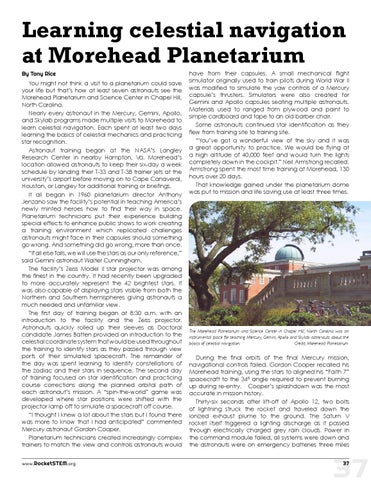
The Morehead Planetarium and Science Center in Chapel Hill, North Carolina was an instrumental place for teaching Mercury, Gemini, Apollo and Skylab astronauts about the basics of celestial navigation. Credit: Morehead Planetarium
navigational controls failed. Gordon Cooper recalled his Morehead training, using the stars to aligned his “Faith 7” spacecraft to the 34º angle required to prevent burning up during re-entry. Cooper’s splashdown was the most accurate in mission history. Thirty-six seconds after lift-off of Apollo 12, two bolts of lightning struck the rocket and traveled down the ionized exhaust plume to the ground. The Saturn V rocket itself triggered a lighting discharge as it passed through electrically charged grey rain clouds. Power in the command module failed, all systems were down and the astronauts were on emergency batteries three miles
37 37