POLITICS | BY JEREMY MOULE
Bye bye unions? By many accounts, the Wisconsin gubernatorial recall election was an omen for labor, indicating its future role in and influence on American politics. The state’s Republican governor, Scott Walker, angered unions by leading a legislative push that stripped most collective bargaining rights from some public employees. Unions and their supporters fought back by passing petitions to force the election, which became something of a proxy battle between pro- and antiunion forces. Walker won, and many commentators said the result was a dire sign for labor. “Labor is getting weaker,” the Washington Post’s Ezra Klein wrote the morning after the election. “And corporations, in part due to Citizens United, are getting much stronger.” (The Supreme Court’s Citizens United decision opened the door for corporations to spend unlimited sums to influence elections, as long as they don’t give directly to candidates.) For decades, labor unions have had significant influence on American politics and elections. They could help make or break a candidate, from the president and Congress members on down to your local town board candidates. But across the country, union membership has steadily declined, with a pronounced drop after 1980. In the 1950’s, one out of every three workers belonged to a union. In 2011, less than 12 percent did. In the 11-county area from Rochester to the Pennsylvania border, union membership has dropped from approximately 100,000 to 90,000 in the past decade, says Jim Bertolone, president of the Rochester and Genesee Valley Area Labor Federation. Approximately one-quarter of New York’s workforce is unionized, the highest rate of any state. The shrinking number of union members could ultimately mean a loss of political influence. To counter that, labor groups are reaching out to like-minded people City
june 20-26, 2012
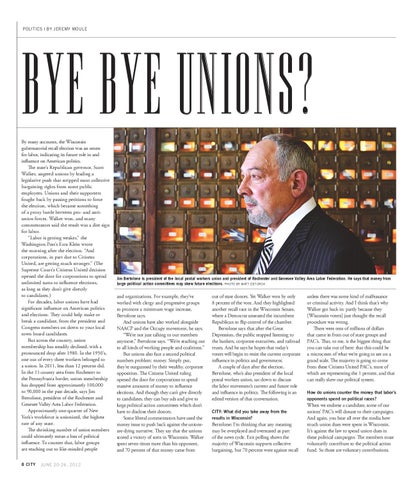
Jim Bertolone is president of the local postal workers union and president of Rochester and Genesee Valley Area Labor Federation. He says that money from large political action committees may skew future elections. PHOTO BY MATT DETURCK
and organizations. For example, they’ve worked with clergy and progressive groups to promote a minimum wage increase, Bertolone says. And unions have also worked alongside NAACP and the Occupy movement, he says. “We’re not just talking to our members anymore,” Bertolone says. “We’re reaching out to all kinds of working people and coalitions.” But unions also face a second political numbers problem: money. Simply put, they’re outgunned by their wealthy, corporate opposition. The Citizens United ruling opened the door for corporations to spend massive amounts of money to influence elections. And though they can’t give directly to candidates, they can buy ads and give to large political action committees which don’t have to disclose their donors. Some liberal commentators have used the money issue to push back against the unionsare-dying narrative. They say that the unions scored a victory of sorts in Wisconsin. Walker spent seven times more than his opponent, and 70 percent of that money came from
out of state donors. Yet Walker won by only 8 percent of the vote. And they highlighted another recall race in the Wisconsin Senate, where a Democrat unseated the incumbent Republican to flip control of the chamber. Bertolone says that after the Great Depression, the public stopped listening to the bankers, corporate executives, and railroad trusts. And he says he hopes that today’s voters will begin to resist the current corporate influence in politics and government. A couple of days after the election, Bertolone, who’s also president of the local postal workers union, sat down to discuss the labor movement’s current and future role and influence in politics. The following is an edited version of that conversation. CITY: What did you take away from the results in Wisconsin? Bertolone: I’m thinking that any meaning
may be overplayed and overstated as part of the news cycle. Exit polling shows the majority of Wisconsin supports collective bargaining, but 70 percent were against recall
unless there was some kind of malfeasance or criminal activity. And I think that’s why Walker got back in: partly because they [Wisconsin voters] just thought the recall procedure was wrong. There were tens of millions of dollars that came in from out of state groups and PAC’s. That, to me, is the biggest thing that you can take out of here: that this could be a microcosm of what we’re going to see on a grand scale. The majority is going to come from these Citizens United PAC’s, most of which are representing the 1 percent, and that can really skew our political system. How do unions counter the money that labor’s opponents spend on political races?
When we endorse a candidate, some of our unions’ PAC’s will donate to their campaigns. And again, you hear all over the media how much union dues were spent in Wisconsin. It’s against the law to spend union dues in these political campaigns. The members must voluntarily contribute to the political action fund. So those are voluntary contributions.