NEIGHBORHOODS | BY CHRISTINE CARRIE FIEN
Busy Maplewood library needs a new home Maplewood Community Library gets so busy that staff members sometimes have to clear the building, either because the fire code has been exceeded or just because they need to settle things down. “It’s not a situation where there are any problems going on,” says Rochester Library Director Patty Uttaro. “It’s just because it’s such a small space, and we get so many kids and young adults in there. It can sometimes get loud and very, very crowded.” The door count at Maplewood from January through April was 72,761, compared to 37,000 at the Winton Branch and 36,000 at Lincoln. Most of the other branch libraries were in the 20,000 range. All of the branch libraries are between 6,000 and 12,000 square feet in size, Uttaro says. “Maplewood is our busiest library, visit for visit,” she says. “It’s really quite amazing what they see over there.” Maplewood, which is on Dewey Avenue, is also a busy library for GED and English as a Second Language programs. “The branch manager, Shelley Matthews, has a waiting list for all of those programs because she can only accommodate about 10 to 12 people at a time there,” Uttaro says. Bill Collins, head of the Maplewood Neighborhood Association, says use of the library has grown gradually, and is largely
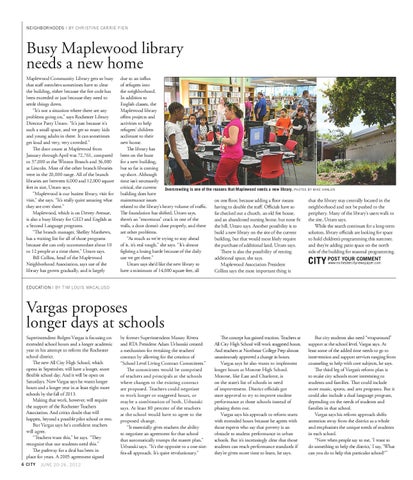
due to an influx of refugees into the neighborhood. In addition to English classes, the Maplewood library offers projects and activities to help refugees’ children acclimate to their new home. The library has been on the hunt for a new building, but so far is coming up short. Although time isn’t necessarily critical, the current Overcrowding is one of the reasons that Maplewood needs a new library. PHOTOS BY MIKE HANLON building does have maintenance issues on one floor, because adding a floor means that the library stay centrally located in the related to the library’s heavy volume of traffic. having to double the staff. Officials have so neighborhood and not be pushed to the The foundation has shifted, Uttaro says, far checked out a church, an old fire house, periphery. Many of the library’s users walk to there’s an “enormous” crack in one of the and an abandoned nursing home, but none fit the site, Uttaro says. walls, a door doesn’t close properly, and there the bill, Uttaro says. Another possibility is to While the search continues for a long-term are other problems. build a new library on the site of the current solution, library officials are looking for space “As much as we’re trying to stay ahead building, but that would most likely require to hold children’s programming this summer, of it, it’s real tough,” she says. “It’s almost the purchase of additional land, Uttaro says. and they’re adding patio space on the north fighting a losing battle because of the daily There is also the possibility of renting side of the building for seasonal programming. use we get there.” additional space, she says. Uttaro says she’d like the new library to Maplewood Association President have a minimum of 14,000 square feet, all Collins says the most important thing is
EDUCATION | BY TIM LOUIS MACALUSO
Vargas proposes longer days at schools Superintendent Bolgen Vargas is focusing on extended school hours and a longer academic year in his attempt to reform the Rochester school district. The new All City High School, which opens in September, will have a longer, more flexible school day. And it will be open on Saturdays. Now Vargas says he wants longer hours and a longer year in at least eight more schools by the fall of 2013. Making that work, however, will require the support of the Rochester Teachers Association. And critics doubt that will happen, beyond a possible pilot school or two. But Vargas says he’s confident teachers will agree. “Teachers want this,” he says. “They recognize that our students need this.” The pathway for a deal has been in place for years. A 2005 agreement signed City
june 20-26, 2012
by former Superintendent Manny Rivera and RTA President Adam Urbanski created a mechanism for tweaking the teachers’ contract by allowing for the creation of “School Level Living Contract Committees.” The committees would be comprised of teachers and principals at the schools where changes to the existing contract are proposed. Teachers could negotiate to work longer or staggered hours, or maybe a combination of both, Urbanski says. At least 80 percent of the teachers at the school would have to agree to the proposed change. “It essentially gives teachers the ability to negotiate an agreement for that school that automatically trumps the master plan,” Urbanski says. “It’s the opposite to a one-sizefits-all approach. It’s quite revolutionary.”
The concept has gained traction. Teachers at All City High School will work staggered hours. And teachers at Northeast College Prep almost unanimously approved a change in hours. Vargas says he also wants to implement longer hours at Monroe High School. Monroe, like East and Charlotte, is on the state’s list of schools in need of improvement. District officials got state approval to try to improve student performance at those schools instead of phasing them out. Vargas says his approach to reform starts with extended hours because he agrees with those experts who say that poverty is an obstacle to student performance in urban schools. But it’s increasingly clear that those students can reach performance standards if they’re given more time to learn, he says.
But city students also need “wraparound” support at the school level, Vargas says. At least some of the added time needs to go to intervention and support services ranging from counseling to help with core subjects, he says. The third leg of Vargas’s reform plan is to make city schools more interesting to students and families. That could include more music, sports, and arts programs. But it could also include a dual language program, depending on the needs of students and families in that school. Vargas says his reform approach shifts attention away from the district as a whole and emphasizes the unique needs of students in each school. “Now when people say to me, ‘I want to do something to help the district,’ I say, ‘What can you do to help this particular school?’”