RUPERT’S LAND NEWS
Se ptembe r 20 16
IN THIS ISSUE 6
Complex Trauma & Poverty
8
FARMING GOD'S WAY
10
1JUSTCITY
15
MLK on Sabbath
CO N N ECT I N G C H U R C H & CO M M U N I T Y
rln
rupert'slandnews
rln
rupert'slandnews
CONNECTING CHURCH & COMMUNITY
Publisher | Bishop Donald Phillips Editor | Allison Courey Accounting | Bernice Funk Advertising | Angela Rush Layout & design | cityfolkcreative.ca
Advertising: RLN accepts advertising in our monthly magazine and our weekly email. Our rate sheet is available at rupertslandnews.ca/ads. To discuss advertising call (905) 630-0390 or email: rlandnews.ads@gmail.com.
Rupert’s Land News - is published 10 times per year (September - June) by the Diocese of Rupert’s Land, in the Anglican Church in Canada. It connects churches and communities from Portage la Prairie, MB, to Atikokan, ON. by offering news, events, opinion, and ideas to 6,000 readers per month. RLN is available in a variety of formats:
Editorial offices: Anglican Lutheran Centre 935 Nesbitt Bay Winnipeg Manitoba R3T 1W6
• • • •
rupertslandnews.ca facebook.com/rlandnews twitter.com/rlandnews instagram.com/rlandnews
We also deliver timely news and information via a weekly email. Sign up at: rupertslandnews.ca/email RLN exists to explore issues at the intersections of faith and life. In doing so we solicit and publish a range of opinions, not all of which reflect the official positions of the Diocese.
RUPERT’S LAND NEWS
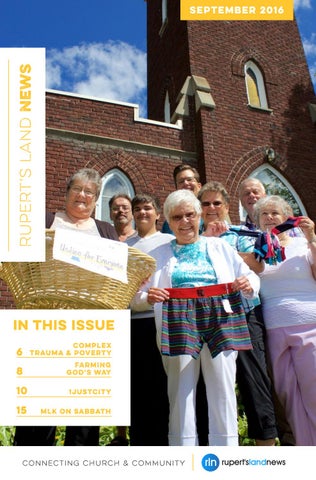
Subscription queries: Administrative Assistant for the Diocese (204) -4200 | general@rupertsland.ca RLN welcomes story ideas, news items, and other input. If you want to be involved in this media ministry, please be in touch with the editor. Contents copyright 2016 by Rupert’s Land News. All rights reserved. Cover: (L-R) Wilma, Mike, Brandon, Barb, Brian, Eileen, Victor, and Beverly stand in front of St. John's, Fort Frances, part of an "Undies for Everyone" campaign for children from low income families as they head back to school.
2
L et ter s
Summer Highlights
September is on us again, and you know what that means: new shoes, new classes, new bible studies. It all begins again. This fall, a new missional living conversation is starting
called ALiGN (Anglicans and Lutherans in God’s Neighbourhoods). You can read about that in the Parish News Roundup on page 10. You’ll also read about a new initiative of our inner city ministries to work in tandem for the first time through 1JustCity, on page 14. Plus, catch up on some of the new
initiatives coming out of this summer’s General Synod on page 11. But this isn’t a oneway street; we want to hear from you about the new beginnings happening in your church communities. What’s different this fall and what do you think? Send a letter to the Editor for the October magazine by September 14.
Building Bridges
w i t h Pa r i sh Day Camp s half of the 24 children who attended their program were members of the two churches. The other 12 were unchurched kids from the neighbourhood.
Social justice camp at St. John's College
Rupert’s Landers got creative this summer with a diversity of day camps hosted for dozens, if not hundreds, of children. No two camps were alike, with some following a familiar vacation bible school (VBS) model and others invented to meet the needs of a particular demographic. Helen Kennedy has spent some 20 summers involved in days camps, and despite the long hours and endless amounts of young energy,
RUPERT’S LAND NEWS
she continues to love it. The camps she now runs out of St. George’s, Transcona, are done in conjunction with Transcona Memorial United Church. She experiences the vacation bible schools like a shot of life and imagination into her yearround ministry, as well as being “a massively important community piece.” Kennedy cannot emphasize the importance of VBS as a community connector enough. This summer, just
While the younger kids are busy at the church with crafts and other activities, Kennedy takes the older ones out into the community, to volunteer with the food bank and play pickle ball with a group of seniors. The kids love the intergenerational engagement, and Kennedy loves seeing the Church in action. “It’s about fostering relationships for the long term” she explains. “I want to change some of the perceptions of the Church -that it’s stuffy, irrelevant, and has no bearing on ours lives. No, it’s fun! We translate bible stories into our own lives.”
3
SUMMER As for the two Transcona congregations, the bridge they’ve built for VBS over the past eight summers has led to a stronger relationship between their communities. The two now do joint special services and fundraisers together. By pooling their resources, they are able to draw from a greater diversity of talent and imagination, as well as sharing costs and volunteers for VBS. After several summers, they’ve also had family members of campers with no church connections getting involved. Other congregations share similar stories: a day camp can be a challenge to get going, but after a few years the relationships formed create a base on which to continue building. Sometimes, it takes a few experiments before settling on the right kind of day camp for the community. St. Paul’s, Middlechurch, and St. Andrew’s, St. Andrew’s, ran their fourth VBS this summer, accepting children as young as 3 years old. They followed a kit which came full of creative ideas and proved so successful that both parents and children have already asked to reserve their spots for next year.
VBS at St. Paul's, Middlechurch
The Plett family ran their ninth mountain bike camp in conjunction with st. benedict’s table, welcoming 26 kids to their acreage in Bird’s Hill. Many of the children were sponsored through St. Aiden’s Christian School’s Calvary Temple campus, comprised primarily of the children of refugees. St. John’s College hosted its first social justice day camp in July, with 12 campers aged 13-15 and three student mentors. The mix of indigenous, settler, and new Canadian youth
experienced an interactive week of immersion into systematic injustice in their own backyards. Is your community interested in trying a VBS or summer day camp, but not sure where to begin? Don’t worry, says Kennedy, there are many people in the Diocese who would be happy to share their ideas. Rachel Twigg Boyce, a warden at st. benedict’s table, even wrote her own guide on how to start a day camp. So go ahead — start building those bridges.
Emmanuel Mission ran its six week Dinka Bible camp again this summer, with a focus on teaching Bible and cultural integration to the children of former South Sudanese refugees.
RUPERT’S LAND NEWS
4
Pasto ral note
WHEN THE POWER OF POSITIVE THINKING JU ST ISN' T ENOUGH Donald Phillips
“Well, it's been a quiet week in Lake Wobegon, Minnesota, my hometown, out there on the edge of the prairie,” begins humorist Garrison Keillor as he spins one of his many all-too-trueto-life tales of this fictional community. But, as Keillor’s stories usually illustrate, life has been anything but quiet, both in Lake Wobegon and in our part of the world this summer. We seemed to learn of terrorist activity several times a week, and there were deadly encounters involving police officers across the USA. As the American presidential election approaches, the rhetoric of the political leaders causes many of us to wonder what kind of world we will wake up to come November 9. In our own Church, some of us directly, many more indirectly, experienced the five day meeting of our General Synod with its tensions, anxieties, and challenges. As we approach the fall, I have certainly become aware of my own rising sense of anxiety, wondering about what our future life together will be like. How do we handle the outcome of a summer like this one and the underlying sense of fear it has seeded for many of us? What is our response as disciples of Jesus Christ when it seems RUPERT’S LAND NEWS
that both the foundations of our world and of our Church have been shaken? The default can be to adopt a fear-motivated response. It’s tempting to deny what we’re experiencing and adopt an approach that exemplifies the Bobby McFerrin song: “Don’t worry. Be happy!” And whether we’re conscious of it or not, it is also easy to reach the conclusion that the world in which we live (and for some – even parts of Church they experience) is a hard and hostile place. We simply hope the grace of God will help us get through while we’re still here. In the Letter to the Hebrews, after the author finishes a horrific description of the tortures that many leaders of the people of God had to endure over the centuries before Christ’s time, chapter 12 begins with these words: “Therefore, since we are surrounded by so great a cloud of witnesses… let us run with perseverance that race that is set before us, looking to Jesus the pioneer and perfecter of our faith.” Sometimes, the truthful reality of passages like these is lost because the encouraging words are taken out of their challenging contexts. The Word of God is not simply the power of positive thinking meant to help get our mind
off the difficult circumstances in which we live. It is a testimony of the faithfulness of God’s grace, love, peace, and power to those who have gone before us. When we are faced with the kind of confidence-shaking challenges we’ve had over these last few months, the most important thing for us to remember is that this is God’s world and this is God’s Church. Even being able to acknowledge that reality begins to unlock the underlying fear and open us to see the potential of God at work in our present circumstances. Finally, we need to hold to the truth that God loves this world, and loves this Church. And we know that God’s love — perfect love — “casts out fear” (1 John 4:18).
Donald Phillips, Bishop of Rupert’s Land 5
MENTA L HEALTH
COMPLEX TRAUMA I N T H E I N NE R CI T Y Susan Titterington
Grief, loss, and trauma have a major impact on our life journeys. The effects of violence and chronic poverty contribute to the complex traumas often experienced by the people who access our inner city community ministries, such as West Broadway, St. Matthew’s Maryland, and Agape Table. In these spaces, the common experience of having lived through complex trauma walks like a dark pall over the people, and at times, the community. Addictions that are often in response to trauma provide a deflection and a way of self-regulating that, while ultimately unhelpful, are understandable. This is the reality of living with complex trauma for many people. Complex trauma occurs when individuals have experienced developmental trauma from poverty, parental addictions, experience of violence, abuse, personal addictions, and systematic oppression. Dr. Amy Bombay, who examines the concept of historical trauma at the University of Ottawa’s Institute of Mental Health Research, has defined the impact of indian residential schools (IRS) as epigenetic inheritance. Epigenetic inheritance is the RUPERT’S LAND NEWS
genetic damage that results from complex trauma experienced by an individual. This genetic damage affects Photo: Industrial Strength Tourist offspring for generations. First identified as changes in the DNA of Holocaust relationships. victims and their offspring, Specialized training is science now accepts this required to work with those cross-generational impact of who have been traumatized, trauma as a major challenge and wait lists are long. What in working with individuals can be done? How do we and communities of trauma help with healing? Moving survivors, including those from charity to models of who attended IRS. This, empowerment and walking alongside a community and with those who are on their family system that has also healing journey calls for a experienced this type of shift in thinking. In the short trauma, makes the process of term, we do need to ensure healing more challenging. that people are fed and Those children who were have housing. However, in taken into the schools often order to address the long experienced broken attachterm impact of complex traument. Returning home, they ma, much more is needed. did not develop appropriate Addressing poverty in parenting skills, and the the long term means advocycle of family breakdown, cating for such things as developmental trauma, and guaranteed income, stable major losses contributed funding for treatment proto the ever-evolving cycle grams, increased mental of multigenerational abuse health services, and safe, and trauma. Developmental affordable housing. Learning trauma and attachment issues more about the realities of impact future relationships complex trauma as experiand families. enced by many members of The work of Gabor our communities is another Mate proposes that the root important step, as no positive of addiction, often experichange can happen without enced by those with complex insight and awareness. As trauma, is found in the early followers of Jesus, we can childhood environment and then be equipped to partici6
MENTA L HEALTH pate in advocacy. A particprogram. ular need These for survivors ministries also of complex assist in healtrauma in ing by specifiRupert’s cally focusing Land is a on bringing program people tothat focuses gether to form on integraand nurture Artwork: Siloam Mission tive and acrelationships. cessible addictions treatment. This model is not unlike Jesus’ Long term counselling is also own healing ministry, which desperately needed. often created a place of There are many small belonging for those on the ways that we can work tomargins. gether as a diocese to comSupporting the diocese’s bat these challenges in our common mission and ministry communities, particularly in fund enables the diocese collaboration with our inner to continue to engage and city community ministries. For support such ministries. You example, West Broadway can get involved with the offers both individual and ministries directly by offering group counselling for those your gifts and talents, makwho are ready for it, focusing financial donations, or ing on both immediate crisis donating much-needed food resolution and long term caand toiletry items. pacity building for creating Recently, Bishop Donsafe relationships. ald, Lee Titterington, and I Another way of giving met with staff from the Aulvoice to pain is through art. neau Centre, who provide Several inner city ministries education and training for provide art programs, ofcaregivers, as well as direct ten selling cards made by programming for those affectmembers to help fund the ed by complex trauma. We
RUPERT’S LAND NEWS
are looking at ways that we can share information and possibly work together in the Diocese. Check out www. aulneau.com to learn more about Aulneau’s training and resources.
West Broadway's
• • • • •
Top Needs grocery • pasta bags • canned coffee tuna milk • peanut butter juice • pads & fresh tampons produce
Susan Titterington is the priest at St. Chad's, Winnipeg. She volunteers as a counsellor at an inner city ministry in Winnipeg.
7
PW R DF
FARMING GOD'S WAY IN KENYA Lori Stewart
When we arrived at Jane Manjiku’s farm in Kambiti, Kenya, she invited us to take a bit of soil in our hands and join her in prayer, giving thanks for God’s goodness on her land. Since 2014, Jane has seen dramatic changes on her three-quarter-of-anacre farm. Her yields have increased enough that her family went from being hungry for about three months of the year to eating their fill, as well as selling enough food to pay for school fees and finance a small business. Jane believes this is a result of a vision God gave members of her community about a new way of farming called “farming God’s way.” The group listened to staff from Anglican Development Service, a partner of Canadian Foodgrains Bank member World Renew, talk about the method and decided together to try this new conservation approach to agriculture. They hoped it would help them consistently grow more food and prevent the hunger months they were used to. And she says it has made a difference: “I’m happy to do the work I’ve been taught because I see the results.” This area of Kenya gets two seasons of rainfall, but climate change means the rains are not reliable or plentiful enough. Farming susRUPERT’S LAND NEWS
tainably in the dry Makuyu region requires finding ways to retain moisture in the soil between rains. Jane’s farm is on a gentle slope, with her house at the top of the rise. Before she had training in farming God’s way, rain and waste water from her home would run over the fields below the house, eroding the soil as it disappeared downhill. In order to harvest that water, she built a ditch between her house and the field so that water could collect there and slowly percolate through the soil in her field. She also mulched the field with dry grass so the soil stays cooler, there’s less evaporation, and the weeds are suppressed. “We farm with love,” Jane says. “We don’t get tired like we used to because we don’t have to
work so hard.” When our tour from the Canadian Foodgrains Bank visited in July, Jane had her field divided into three sections. One third had maize that she’d planted when it rained in April, six feet tall and drying in the field. She planted the other parts of the field with beans at that time, which she harvested in June. Normally, she’d wait until the fall rains to plant a new crop of maize, but Jane noticed that the soil was still moist, so she decided — as an experiment — to plant part of the available land with a new crop of maize. When the neighbours saw her planting maize so late, they laughed. Nobody plants in the dry season. But they aren’t laughing now; they see the tall, green stalks forming cobs, even though it 8
PW R DF hasn’t rained since May. Jane’s improved yields are a result of diversifying her crops, including fruit trees, rotating plants to replenish nitrogen in the soil, alternating rows of maize and beans, adding hedges to keep out wandering livestock, and mulching to hold moisture in the soil. She expects to harvest 180 kg of maize from one-third of her field compared to the 135 kg of maize she was producing on the whole plot before.
She’s already harvested 32 kg of beans and can expect more maize from her experimental field. Jane is feeding her family. And with the extra money from selling surplus crops, she’s been able to rent a small café to supplement her income. It’s also become a good place to tell her neighbours about Farming God’s Way. Jane is grateful: “We thank God for this direction for farming.” Lori Stewart was part
Thorvaldson Care Center
of a Canadian Foodgrains Bank Study Tour to Kenya in August as part of the Good Soil Campaign. Good Soil, supported by the Primate’s World Relief and Development Fund, is a way you can advocate for increased Canadian international aid for small scale agriculture. Send a postcard to Prime Minister Trudeau telling him you care about this issue. Postcards may be ordered by e-mailing PWRDF: pwrdf@pwrdf. org. Learn more at http:// foodgrainsbank.ca/campaigns/good-soil/
AN INTERMEDIATE CARE FACILITY FOR SENIORS 24 hr care and supervision Registered Nurse on site Assistance with medications, dressing, hygiene
All meals, laundry and housekeeping Recreation programs Private bed-sitting rooms
OVER 55 YEARS
caring for senio rs
495 Stradbrook Ave | Winnipeg, MB | R3L 0K2
ph (204) 452-4044 | fax (204) 452-4054 thorcare@shaw.ca | www.thorcare.ca
RUPERT’S LAND NEWS
Lori Stewart is the Development Coordinator for the Centre for Christian Studies.
9
C o mmunity
PARISH NEWS ROUND UP Anglicans and Lutherans in God's Neighbourhoods
St. John's College
Bible and Breakfast is hosting David Lappano on September 17, a new professor at the Centre for Christian Studies. Join him for a discussion of Matthew 20 with others from across the Diocese at 9:00 a.m. There is a $12 charge for breakfast; students are free. Please RSVP in advance.
Centre for Christian Studies
CCS is offering a new course this fall called “Ministering by Word and Example: formation for diaconal service in the Anglican tradition.” Suitable for discernment, formation, or continuing education in the diaconate, it will be offered on the first Saturday of the month from October to March. Find further details and registration information on the CCS website.
St.Stephen & St.Bede
The Winnipeg congregation is hiring an administrative assistant for 12 hours a week. Visit their website for details.
RUPERT’S LAND NEWS
The Holy Spirit keeps breaking the boundaries of our imagination. Just as the first disciples were continually being surprised at where Christ showed up, we too are being surprised to discover Christ “living and breathing” in the neighbourhoods we call home. Together, as Anglicans and Lutherans, we want to experiment with new practises that enable us to participate more fully with God among our neighbours. We will work with a particular process that includes dwelling in God’s word, listening, discerning, experimenting, and reflecting. We don’t know where the Spirit will surprise us, but we know that this journey will lead us into a deeper communion with God, our neighbours, and each other. We may stumble along the way, but God will pick us up and send us on. We need you to come with us. Come and find out more about this initiative, in person or online via Adobe Connect, September 14, 6:30—8:30 p.m. at Faith Lutheran Church in Winnipeg. We’ll explore the process with writer and missional leader Alan Roxburgh.
St. Bartholomew's, Winnipeg
A regular Sunday organist is needed at St. Bartholomew's. Details are available on their website.
St. Francis' Mission
The new Indigenous Ministry Developer is looking for a small table for the Mission, about 2.5 x 3 feet, and high enough to be used as an altar. If you can help, please contact Vince Solomon.
10
N ATION A L C H UR C H
RUPERT'S LAND aT GENERAL SYNOD
“You are my witnesses” (Isaiah 43:10)
Nine Rupert’s Landers had the opportunity to join Anglicans from across the country at the 2016 General Synod in Toronto over the past week. Our lay representatives were Tannis Webster of St. Mary Magdalene; June James of St. Paul’s, Fort
leaders from other faiths. A major highlight of that service was a performance done by a local dance troupe, half of whom live with intellectual disabilities. The schedule was packed from morning until evening with information
Garry; and Matthew Terlinski of St. Matthew’s, Weston. The clergy delegates were Paul Johnson of St. John’s Cathedral, Vincent Solomon of the Urban Indigenous Ministry, and Allison Courey, of St. John’s College. Connor Blaikie, of St. George’s, Crescentwood, was the youth delegate; Don Phillips was bishop; and Barbara Schoomski attended as a (non voting) member of the Anglican Council of Indigenous Peoples (ACIP). The week opened in worship with a wide variety of visitors from other Christian traditions and a few
about Anglican ministries nationally and worldwide, ecumenical partnerships, and opportunities to connect across dioceses. While there was a great diversity of Anglicans present, there was a tangible sense of being part of a common body committed to pursuing discipleship together across the country. Members of Synod from Fort McMurray gave an update on their city’s healing in the days after the devastating wildfire forced them to abandon their homes and church buildings. The Primate’s Fund was pleased to announce that Canadian
RUPERT’S LAND NEWS
Anglicans have donated well over $80,000 toward the relief efforts in the area, part of the Diocese of Athabasca. Fighting tears, Athabaskan delegate Jeremy Munn called the level of support from neighbours and strangers alike “a miracle.” Sunday was spent learning about Anglican indigenous self-determination in Canada. The Synod celebrated a Eucharist service filled with indigenous languages and traditional teachings in the morning and a traditional gospel jamboree in the evening. The afternoon was spent exploring the steps which have already been taken toward self-determination for indigenous Anglicans as well as recommendations for moving forward. Contrary to a common misunderstanding, indigenous leaders made it very clear that self-determination does not mean separation from the Canadian Church – it means walking alongside and together in a culturally appropriate way. A highlight on Sunday was a performance by two young indigenous women in honour of missing and murdered indigenous women. Both Leigh Kern and Danielle Black were named as members of the Council of Indigenous Elders and Youth.
11
N ATION A L C H UR C H As they sang and drummed, signs could be seen on the women’s backs which read, “#BlackLivesMatter” and “#LGBTQ+, Two-Spirit Solidarity.” During the afternoon, Tina Keeper, the daughter of Rupert’s Land priest Phyllis Keeper, spoke as an honorary witness to the Truth and Reconciliation Commission. Keeper urged the delegates to remember that reconciliation isn’t always about knowing where we’re going, but about choosing to embark on that journey together. “This is about how we’re going to move forward together as a country.” Phyllis would have undoubtedly been proud of her daughter’s witness as she quoted her mom’s favourite verse: “But the greatest of these is love” (1 Corinthians 13:13). Monday was a more difficult day as people grew tired. A highlight of the day was the presentation from the Anglican Foundation, which began with a fun presentation with staff dressed as flight attendants. They went on to say that the Foundation has disbursed $850,000 in 2015 to support “innovative, groundbreaking programs” across the Church. Delegates also heard on Monday that 1,750 refugees have been resettled by 14 dioceses in the past 10 months. This includes many sponsored by Anglicans in Rupert’s Land. A task force on social and ecological investment was also approved that afternoon.
RUPERT’S LAND NEWS
Many delegates reported positive conversations in their small groups of about 24 people, formed to encourage dialogue prior to the vote on the marriage canon. That evening, after two amendments and much heated discussion on the floor of Synod, the votes
the new electronic voting system showed that the vote passed in the bishop and lay houses, but fell .32% short of passing in the house of clergy. A motion was then passed to reaffirm the 2004 synod’s motion that affirm the “sanctity of committed, adult, same-sex relationships.”
were cast on whether or not to change the marriage canon to include same-sex marriages. In order for a change of doctrine to be made by Synod, the motion must pass by a two-thirds majority in all three houses: bishops, clergy, and laity. Initially,
The following day, the electronic voting list was made public and it was discovered that the General Secretary’s vote was accidentally recorded with the laity instead of the clergy. To the surprise of everyone in the house, this meant that the motion passed in favour
12
N ATION A L C H UR C H of changing the marriage canon after all - by a margin of just one vote. As with all doctrinal changes, the canons require that the change to the marriage canon be voted on again at the 2019 Synod before it becomes law. The repercussions of this for individual dioceses in the interim is much a matter of local discretion. The canon has not yet actually been changed and will not be until a passing vote in 2019. However, it was made clear that while the current canons do not allow for same-sex marriages, neither do they expressly forbid them. When the vote appeared to be in opposition on Monday
evening, several dioceses expressed their intentions to begin moving ahead with same-sex marriages anyway. The first of these were Niagara and Ottawa. Primate Fred Hiltz made it very clear that there were to be no “winners” and “losers” as a result of the vote, as we remain one family and are committed to valuing our unity across theological differences in Canada. He pleaded for grace and for prayers in the days ahead, days which will be difficult for many. ACIP and many of the northern dioceses expressed profound disappointment with the results of the vote on the change to the mar-
riage canon. The indigenous bishops - Mark MacDonald, Lydia Mamakwa, and Andrew Atagotaaluk — have reiterated their commitment to truly indigenous expressions of Anglicanism which are unencumbered by doctrinal changes which do not fit with their communities. To read more about the unfolding of General Synod, including a full list of the resolutions put forward throughout the week, please see the Anglican Journal’s comprehensive coverage of the gathering on their website, anglicanjournal.ca.
Hope Bear is a new partner with
The amended vote count (Anglican Journal).
to arrange free flights for Canadian young people in financial need to get the healthcare they need.
anglicanfoundation.org RUPERT’S LAND NEWS
13
O UTR EAC H
CHASING AFTER 1JUSTCITY You’ve heard the term “together is better” and you’ve likely read Ecclesiastes: “a three-strand chord cannot be broken”. Over the past two years, a group of ecumenical non-profits here in Rupert’s Land has taken these community-building concepts and created 1JustCity, an innovative development project. 1JustCity began with four Anglican and United Church inner city ministries realizing that they were doubling up on many resources they could be sharing: four volunteer administrative assistants, four tax returns, and most critically, four donation requests from the same donor bank. In 2014, West Broadway Community Ministry, St. Matthew’s Maryland Community Ministry, Oak Table, and North End Stella Community Ministry decided to take the first step toward better stewardship of their resources in a changing ecclesial landscape. The 1JustCity board then hired Tessa Blaikie Whitecloud as a fund developer. Blaikie Whitecloud’s work began with fundraising, but in conjunction with the board it has expanded into visionary consultant work, exploring new ways for the four ministries to RUPERT’S LAND NEWS
share resources and work together in pursuit of “a city founded on justice.” The immediate need for this comes from a surge in demand for the services offered by the ministries, even as their established funding base dries up. However, the longterm vision of the project runs deeper than immediate funding. “By collaborating, we can grow our impact on those we serve,” Blaikie Whitecloud explains. 1JustCity and the four community ministers share a commitment to carrying the work of Jesus beyond the walls of church buildings and into the streets. The work of 1JustCity has been able to spread the news of what God is up to in the four ministries with the wider community, including those who are not traditional church-goers. For example, Blaikie Whitecloud believes that this allows the ministries to take on a new cultural relevance and a prophetic voice. The problem, as she sees it, is, “We got used to not having to tell our story.” For 1JustCity, the solution is to learn to tell the stories of inner city connections and
the radical love of Jesus again in culturally connective ways. Blaikie Whitecloud has a particular gift for connecting with young people over issues of systematic injustice. She often leads the Kairos blanket exercise in conjunction with her partner, Hwanan Blaikie Whitecloud, a member of Sioux Valley Dakota Nation. The work of 1JustCity is the work of an entire people, connecting across denominational and socioeconomic lines. Blaikie Whitecloud and the board are unable to do this work without the involvement of parishioners across Rupert’s Land. Parishes are encouraged to connect with the new ministry by making a commitment to pray for them, and by inviting Blaikie Whitecloud to speak about the pressing needs of the inner city or having her lead a blanket exercise. Parishes can also get involved by volunteering with the board; hosting a towel, sock, or toiletry drive; or following them by email or social media.
14
Via Me dia
MARTIN LUTHER KING ON SABBATH & SACRIFICE Kirsten Pinto Gfroerer
On April 7th, 1968, Nina Simone, one of the most stunning voices and personas in the history of blues music, sang a concert at the Westbury Music Festival in New York. Nina sang the concert broken-hearted, questioning, and on the brink of hopelessness. Three days before, her friend and leader in the civil rights movement in the United States, Martin Luther King Jr., had been murdered in Memphis. The concert was on a Sunday. Simone dedicated the concert to King, and she sang two songs in his honour. The first was an angry elegy, one that would predict the rest of her career. In it, she cried out in full lament of the condition of the black community and she predicted that violence was coming; the “King of Love”, as she called him, was dead. It is an achingly frightening song, prophetic of our times, incisive, and painfully clear. The other song was very different. It was a sultry, peaceful song about Sunday
in Savannah. The concert was on Sunday after all, and Sunday, the Sabbath, was the day when King was always off the streets and in the pulpit. It was the day when the community was called to confess their sins, find inspiration, consolation, and rest, both in the churches and on their hot front porches afterward. Simone knew, despite her anger, that her friend King disagreed with her about violence and hope, and she knew that this had everything to do with where he spent his Sundays and what he believed. King did not believe he was the King of Love, but rather, he trusted in another. Despite her own fears, she honoured him and sang a song about Sunday, a song about rest. Whenever King ascended the pulpit in his home church, he stood beneath a coloured glass depicting the agony at Gethsemane. Below it was a neon cross, around him were choirs and elders, and before him was the word. King’s biographer, Richard Lischer, says that this sanc-
tuary where King preached symbolized the world in which King inhabited with his congregation. His world consisted of two dialectically opposed realities. The first was the heritage of suffering, which included enslavement, poverty, segregation, murder, and all the hopelessness inherent in this heritage. The second was the affirmation of God’s purpose for the whole world, especially for those who bear burdens imposed by others. King believed that God’s purpose takes the form of a divinely ruled order that will ultimately triumph over the chaos of suffering. Every Sunday, he brought those realities together in his person and in his pulpit. He brought his work as an offering and rested in the word and the congregation, beneath the cross and the picture of Gethsemane (Lischer, 1995). There are multitudes of audio recordings of King’s ministry in his home church. In them, he tells of the terrors of his week and asks his congrePhoto: Chris Tank
RUPERT’S LAND NEWS
15
Via Me dia Photo: Chris Tank
gation for prayer before offering thanks to God for allowing him to come home one more Sunday… the preaching ends, the singing begins, and then he bellows praise at the top of his lungs. The world seems to be saturated with darkness, and we often wonder what difference our worship makes. But when we come to worship, bringing the offering of our being and our goods to the altar, we change the nature of the way we understand our lives. Worship is not just something we do as part of our lives; it is how we frame our lives. We go to church on this day, reserved for this act, to be completed by the one who holds all of our lives and the life of the world within his grace. We do this in order thatour work may find worth and hope though its participation in the whole of God’s work. When we approach our work this way, whatever it is, it becomes a gift to God, and therefore a gift to the world. To do this is to trust that God takes our offerings and transforms them into a
rln
contribution to the common good of our fellow creatures. The non-violence of Martin Luther King Jr. was rooted in Sabbath rest. He knew the one who was to act, the only one who could save his people. As Lischer powerfully notes, one doesn’t sit down at a segregated lunch counter or face fire hoses and dogs because such action makes sense or is guaranteed; it is only because there is a greater logic at play. What civil rights activist and politician Walter Fauntroy says of Rosa Parks could be also said of King: “When [she] sat down in the front of the bus, she was making a statement as to whether or not God could be trusted” (Lischer, 1995). It is said of King that the more pessimistic he grew with regard to humanity, the more optimistic he became about God. Even in the darkest period of his own discouragement, he continues to say to African Americans, “Go ahead! God can be trusted” (Lischer, 1995). Trust in God comes from rest in God.
rupert'slandnews
RUPERT’S LAND NEWS
Sunday is for worship and for rest. We bring our whole lives before him, all our work, all our hopes and plans, and then we must go and lay about, nap and reflect. This part is also fundamental to the Sabbath. No matter how pressed and busy we are, we need this moment of worship and then rest to make sense of our lives. In this balance of the week, we learn to listen to the judgement of God in our lives and we learn the grace of God to carry us.
Kirsten Pinto Gfroerer is the Lay Pastoral Associate at St. Margaret's, Winnipeg.
CONNECTING CHURCH & COMMUNITY 16