October '18
Criminal Justice
5
Update on the Kasaka Water Project
9
An Interview with Julie Collings
7 15
Simple Actions Make Change Difficult Questions
CONNECTING CHURCH & COMMUNITY
rln
rupert'slandnews
Publisher | Bishop Donald Phillips Editor | Kyla Neufeld Accounting | Bernice Funk Advertising | Angela Rush Layout & design | cityfolkcreative.ca Rupert’s Land News is published 10 times per year (September - June) by the Diocese of Rupert’s Land, in the Anglican Church in Canada. It connects churches and communities from Portage la Prairie, MB, to Atikokan, ON, by offering news, events, opinion, and ideas to 6,000 readers per month. RLN is available in a variety of formats: Website • Facebook • Twitter • Instagram We also deliver timely news and information via a weekly email. Sign up here. Advertising - RLN accepts advertising in our monthly magazine and our weekly email. View our rate sheet. To discuss advertising call (905) 630-0390 or email us.
CONNECTING CHURCH & COMMUNITY
Editorial offices: Anglican Lutheran Centre 935 Nesbitt Bay Winnipeg Manitoba, R3T 1W6 RLN exists to explore issues at the intersections of faith and life. In doing so we solicit and publish a range of opinions, not all of which reflect the official positions of the Diocese. We acknowledge that we meet and work in Treaty 1 Land, the traditional land of the Anishinaabe, Cree, and Dakota people and the homeland of the Metis Nation. We are grateful for their stewardship of this land and their hospitality which allows us to live, work, and serve God the Creator here. RLN welcomes story ideas, news items, and other input. If you want to be involved in this media ministry, please email the editor. Contents copyright 2018 by Rupert’s Land News. All rights reserved.
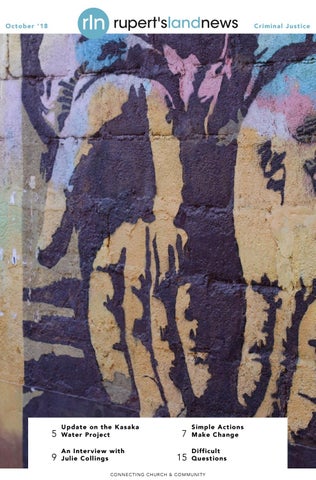
Cover: "Hands Tied" by Geraint Rowland
2
E di tor i a l
Out of Sight, Out of Mind
This past August, the inmates at the Burnside jail in Halifax staged a nonviolent protest. In a statement published by the Halifax Examiner, they said, “The organizers of this protest assert that we are being warehoused as inmates, not treated as human beings. We have tried through other means including complaint, conversation, negotiation, petitions, and other official and non-official means to improve our conditions. We now call upon our supporters outside these walls to stand with us in protesting our treatment.” Among their requests was better health care, nutritious food that would meet the needs of prisoners’ religious and cultural backgrounds, and rehabilitation programs. They weren’t asking for anything other than what was needed for their basic well-being. Burnside has been open for 18 years and has consistently been described as unsanitary and dangerous. One former corrections officer told the Halifax Examiner that “The moment you walk in the door at Burnside you are stripped of your dignity and humanity.... No matter your sex, religion, or creed. No matter if you are an inmate or staff member.” Seventeen days into the protest, Minister of Justice Mark Furey released an op-ed piece addressing the issues raised by the prisoners. He said, “Many offenders come from vulnerable environments and we need to be responsive to their lived experiences. Many are on remand waiting trial and have not been convicted of a crime. And some pose the highest risk, have the highest needs and are among the most dangerous in the province.” In response, an unnamed prisoner said, “Well then, why don’t you have any frigging rehabilitation programs? Why don’t you have Alcoholics or Narcotics Anonymous or something for people to do all day rather than being locked in a cell for the last seven days on 23-hour
lockdown?.... When rehabilitation should be the main focus of a correctional facility, they’re focused on security. Contraband is more important than families reuniting with their kids.” The prisoners’ protest ended after 20 days, with none of their requests met. In their final statement, they said: “We renew our calls for treatment of mental health, training, and programming. We ask the Minister of Justice: how many more people have to die in this facility until our cries for help are heard?.... We hope that our call for justice will be heard...” From the over incarceration of Indigenous and black men, and Indigenous women, to harsh environments that do little to address mental health issues, there is a problem with Canada’s criminal justice system. But Canadians tend to take an “out of sight, out of mind” mentality when it comes to prisoners. I’m hoping to bring some of those issues to light in this issue on Criminal Justice. We’ll hear from Hannah Foulger, who is part of a group working hard to have an inquest held into the death of Errol Greene at the Remand Centre. And, we also have an interview with Julie Collings, a retired priest who has spent several years volunteering as a spiritual care provider with both the Remand Centre and the Women’s Correction Centre. We’ll also feature two parishes – St. Aidan’s and St. Saviour’s – that have active and flourishing prison ministries. As the Church, we are called to take care of “the least of these” in our society. That includes inmates and ex-convicts. We must to better by Kyla Neufeld is the editor them. of Rupert's Land News.
3
Pa stor a l Not e
Justice, Mercy, and Faith Donald Phillips
In Matthew 23:23, Jesus challenges the scribes and Pharisees because they are so concerned about the minutiae of God’s law that they have “neglected the weightier matters of the law: justice and mercy and faith.” There are many references in the Scriptures to God being a God of justice, and there are also many references to God being a God of mercy. In Romans 12:19, St. Paul writes, “Beloved, never avenge yourselves, but leave room for the wrath of God; for it is written, ‘Vengeance is mine, I will repay, says the Lord,’” Paul continues by exhorting his readers to feed their enemies if they’re hungry and give them something to drink if they’re thirsty. And he concludes this section with this curious statement, “by doing this you will heap burning coals on their heads.” The Bible reveals that justice is one of God’s central attributes. It is clear that people need to be held accountable for their actions, particularly those that injure another person or their property. It seems important that the injured party is able to witness that the one who “wounded” them suffers some kind of consequence for their action. The consequence serves two purposes: to help the injured party to regain their God-given dignity, and to prompt the one who carried out the injury to realize their error, and to ask for and (hopefully) receive help to change their ways. At the same time, God is a God of mercy who freely forgives those who see the error of their ways and wish to change and live differently. In Matthew 25:31–40,Jesus describes the final judgment of humankind and lifts up those who carried out deeds of kindness toward others, claiming that when they did so it is as if they were doing it for Jesus himself. In that list of kind deeds Jesus includes, “I was in prison
and you visited me.” It is an interesting presentation of how God expects us to be. While we may occasionally feel sorry for those who are incarcerated, we are more likely to ignore them since we see them as simply bearing the consequences of their actions. But as Jesus teaches about God’s reign, it seems immaterial that some of us, created in the image of God, messed up and find ourselves behind bars. Even jailed criminals deserve to be visited. So what is operative in God’s justice? It is ultimately about healing, restoration, and transformation. Those who have been violated by criminal activity need to see their community – represented by law enforcement and the judiciary – taking what has happened seriously, thereby helping them heal and be restored. Likewise, the person who carried out the violation needs to take responsibility for their actions so that they realize their error, are motivated to change their attitudes and actions, and undergo a personal transformation. It is precisely this opportunity that becomes the expression of God’s mercy – people are convicted by God’s justice, but always given the opportunity to embrace a new and different future. And the whole community will need faith in the divine hand, working with both justice and mercy, to bring about the healing and restoration in all of those involved. These are God’s purposes in acting out both justice and mercy, and they ought to be ours as well.
Donald Phillips, Bishop of Rupert’s Land
4
m i ni st ry
Update on the Kasaka Water Project
Photo: Imleedh Ali
In June 2018, we ran a story about the Kasaka Water Project, a new program designed to provide clean water to our sister Dioecese of Central Buganda. Alvin Jacobs has reported that things are going well with this project. Phase One was to find and drill a well. So far, the well has exceeded expectations, supplying up to 4,000 litres of clean water per hour, with a replenishment rate of 45 minutes. Phase Two of the project is to pump the water, using solar power, up to the community into a seals 24,000 litre tank. This will save the community hours of hauling water from the river. $30,000 is budgeted for this second phase. Thanks to Alvin Jacobs for the photos.
Top: This is the pump house located by the well, where the control panels will be kept. Bottom: The well has been successfully capped. Standing here are Ginette Caillier, a water expert, Geofrey Wamala, the water engineer for the project, and Alvin Jacobs. 5
m i ni st ry
Clockwise: The water tested well. Here Bishop Michael Lubowa offers a prayer of thanksgiving for the quality and volume of water from the well. A local business provided the technology and expertise to locate, drill, and cap the well. They will continue the work of installing the pump, solar energy supply, piping, and a sealed water tank in the community. The drilling continues. Villagers have to walk two kilometres to fetch water in five-gallon jerrycans. Here jerrycans are lined up for their turn at the pump. This well has a slow recovery, so at times there is a wait for the well to replenish before people can pump their water. The new well and pump system will bring water closer to the village.
How you can help: 1. Pray. Give thanks for the ongoing success of the Kasaka Water Project and pray for safety as workers continue to drill and build the pump. 2. Donate. You can write a cheque through your parish, or donate through the Diocesan website (be sure to mention Kasaka). While any amount is welcome, donations $20 and over will receive a tax deductible receipt.
6
C r i m i na l Ju st ic e
Simple Actions Make Change Hannah Foulger
I remember exactly where I was when I heard the news of Errol Greene’s death in 2016. He was a 26-year-old inmate of the Winnipeg Remand Centre, who died of an epileptic seizure after the guards refused to give him his medication. I was sitting in my office at the Winnipeg Fringe Festival, killing time before lunch by checking the CBC. His death was everything I feared for myself. I was also 26. I also had epilepsy, and, despite being on some nasty medication that took all joy from my life, my seizures also weren’t controlled. Despite the fact that an inquiry should have been the automatic and legal response, the Manitoba General Employees’ Union (MGEU) blocked that inquiry. Justice for Errol Greene formed out of a desire to pressure MGEU and the government to have an inquiry. The opportunity fell into my lap to join the working group for Justice for Errol, and I jumped at the chance. I was not terribly experienced in activism. I had been to a couple rallies here and there, staged a sit-in, and ran a fundraising production of The Vagina Monologues with the Women and Trans Spectrum centre at the University of Winnipeg, but I could hardly call myself an activist. Activism is easier than you think. I offered to do things I already knew how to do. I created a Facebook page, I wrote a press release, and I wrote an article for the Winnipeg Free Press. Others created posters, distributed flyers, spoke to the press, and bought coffee, or just showed up. Others babysat Errol’s kids. Simple actions. We had a cause. We made a racket. We made sure that people knew who Errol Greene was and how he had died. As I wrote in the Winnipeg Free Press, the MGEU blocked an inquiry in order to protect the guards. One plucky internet commentator called me stupid and said that it was the union’s role to protect their workers and provide legal
representation; it was not, however, their role to block a legal inquiry entirely. Publicity can be quite embarrassing when you are doing something wrong. Justice for Errol held three rallies in 2016. Eventually, an inquiry was initiated. The first few hearings were held in early 2018 and will continue on in October. Simple actions. I felt like the representative of the disability community in the group. At the first rally, across from the Remand Centre, I read a few of my disability poems, and Indigenous drumming was offered as well. I came to the group understanding ableism, but working with them expanded my understanding of intersectionality. Errol’s cause is, at the centre, a racial issue of continued colonialism in Canada. Black Lives Matter blew up that year with stats around Black deaths in the U.S. and the number of black people in prison. Canadians often consider ourselves morally superior to Americans, but the institutional violence against Black Americans is mirrored in the institutional violence against Indigenous Canadians. Four prisoners had died in the Remand centre in 2016, including Errol Greene and Holly Hall, who were both Indigenous. The Remand Centre and Canada’s
7
C r i m i na l Ju st ic e
criminal justice system is overflowing with Indigenous people. In 2016–2017, Indigenous people counted for 27 percent of the prison population in Canada. In Manitoba, they formed as much as 75 percent of the prison population. That is an astronomical number considering only 4.9 percent of Canadians self-reported themselves as Indigenous to the Canadian census that year.
The intersections of privilege and oppression can be simple. While men hold privilege, a white man has more privilege than a black man. A man with a disability can have more privilege than a woman with a disability. A trans person of colour with a disability has a rougher time of it than a white woman. But we need to be loud, not just for our own communities, but for the iterations of our communities, especially the racial ones. Being loud counts, but so does being quiet. Justice for Errol has always centred the needs of Errol’s wife, Rochelle. While Errol’s story is one of Photo courtesy of Justice for Errol Greene. many of the injustices Indigenous people face in prison, the Twenty-four-hour vigil outside the Remand Centre, 2016. group prioritized babysitting her children, holding meetings close to where she lived, and seeking her Errol Greene died of an epileptic seizure, but, according to his roommate, guards permission and guidance on how to proceed. beat him up during previous seizures that day. Justice for Errol formed to intercede and make Guards ignored him when he asked for his med- Errol’s story known, but also to support a family ication. He died of a seizure, but he didn’t die in need. This is a common story, but this is also one because of his epilepsy. He died in a system that over incarcerated people like him because of man and one man’s family, supported by many the continued forces of racism and colonialism simple actions by a few people. We cannot in Canada. Theories around this include: racist bring justice alone. cops and the continued trauma of residential The provincial inquest school. His epilepsy was a factor in his death, into Errol Greene’s death but it was the weapon, not the aggressor. In June of 2017, a paramedic was arrested continues October 9–12, for fondling a teenage girl thought to be uncon- 15–16, and possibly the scious after she had a seizure. He was reported 25th. Please consider supas saying “Sorry, I had to” at the time. porting his family through Both of these victims were epileptic, but the inquest. they weren’t targeted because of their condition. Their condition was the means by which Hannah Foulger is a British they were victimized. Canadian theatre artist and writer from Winnipeg, Naming prejudice is hard. Many self-reManitoba. Her disability specting women who believe in equal rights shy poetry has been published in Matrix and performed away from the feminist label. It’s easier, espein Sick + Twisted theatre’s cially for white woman, to become complacent Lame Is... cabaret. Her plays Clinkand The Bar in the structures of oppression, or accept our Scene have been produced partly-privileged place, compared to less privat the Winnipeg Fringe ileged people. Festival.
8
C r i m i na l Ju st ic e
Interview with Julie Collings
Photo: Justin Gurbisz
Julie Collings is a retired priest who has served for many years as a volunteer in both the Remand Centre and the Women’s Correction Centre. She currently sits on the Manitoba Multifaith Council’s Justice and Corrections Committee as the representative for the diocese. I had the chance to ask her a few questions about her experiences in the correctional system. – Kyla Neufeld What work do you do with the Manitoba Multifaith Council’s Justice and Corrections Committee? I was appointed following the death of my first husband, Bishop Tom Collings, who worked
diligently in this area and on this committee. At present, the committee’s main project is enabling congregations to include and support people as they try to reintegrate into society. Support and inclusion is so important so that a new and healthier circle of contacts is made. The committee has organized information and networking meetings, drawing together interested congregations with “helping” agencies. The committee’s plan includes working with a provincial government corrections initiative: the Responsible Reintegration Program. I know that St. Matthew’s and St. Aidan’s parishes have so far sent people to the networking sessions. Others may be interested. What work did you do as a volunteer at the Remand Centre and at theWomen’s Correction Centre? As a volunteer at the Remand Centre, and later at the Women’s Correctional Centre at Headingley, I worked with other Anglican women to run what were loosely called “Bible studies” for women. We ran two circles, backto-back, twice a month, in which a gospel passage was a way to share about lives and struggles. Occasionally, I have also been asked to see a person individually for spiritual care.
9
C r i m i na l Ju st ic e
How do inmates interact/react to you as a spiritual care provider? I have found many people I met “inside” to be amazingly honest and open. I have always come away moved by their courage. How many inmates have past traumas or abuse? How do trauma and abuse affect women in prison? It is my own observation (so not based on anything but my conversations!) that almost all people who are incarcerated have suffered trauma. And most women “inside” have suffered physical and sexual abuse. For many women, there seems to be a common pattern of reaction to these traumatic experiences by a cycle of addiction, prostitution, more abuse, and the loss of children into care. The tragedies are overwhelming. How are mental health and Fetal alcohol spectrum disorder (FASD) issues handled in prison? Are inmates getting the care they need? The needs are so great. How could they be well met? Sometime accused people are put into the few spots in special courts: mental health courts and addictions courts. This is helpful because the whole process then is based on the person’s underlying problems. But the spaces for such referrals are very limited. There are also special units (at least in the women’s prison) for those who have diagnosable mental health problems. However, even for those diagnosed people, there is often a delay – for security reasons – in medications getting to them when they are first imprisoned. The youth justice system has been good about trying to get adolescents diagnosed where there is a suspicion of FASD. There seems to be less awareness of it in the adult system. And yet, because of my own family experience, I have to say I think it common there too. Sometimes the structured life of being imprisoned is comfortable – in the sense that it is predictable – for people who live with FASD. But the stigma and general punitive atmosphere are destructive. Remember, these are already people who
do not think well of themselves. So overall, no, needs are not met, in spite of some good intentions. How does race play into who gets sentenced and who does not? The disproportionate number of Indigenous people who spend time in prison is both shocking and well known. Our whole culture, not just sentencing, is what I would hold responsible: racial profiling; unequal legal representation; poverty; unequal opportunity; broken promises; a whole terrible history of ours. I noticed recently that more new Canadians are beginning to show up in prison. Many of them have also known trauma and abuse before, as well as being targets now of racism as described above. How do inmates interact with one another? I noticed many of the women were supportive of one another. Women who came to circle often prayed for each other and sometimes for us and even for the guards. I believe it is a harder for the men – who have to be tougher in order to survive the experience – but I have also witnessed men reaching out to try to support one another. You’ve done some work with Greg Dunwoody [one of the chaplains at Headingley Correctional Centre] facilitating Enneagram workshops. What kind of response have you had from inmates? I have to say the response has been enthusiastic each time. The Enneagram seems a good instrument for learning and reflecting on who one is, including what one’s own typical response under stress is... and what alternatives might be possible. It is always good when another takes an interest in who we are as unique human beings, God’s own children, in fact. And these are men who have frequently not had this experience previously. The men work really hard in the week and there are always some for whom there seems to be some real insight gained. The week usually also stimulates people to see out
10
C r i m i na l Ju st ic e
more individual counselling from the chaplain.
brothers and sisters.
Who else have you worked with at the Remand Centre and at the Women’s Correctional Centre? Several strong and competent Anglican women have volunteered beside me at those institutions: Ann Harwood, Ellen Cook, and Mary Lysecki came to the Remand Centre. Ellen brought a cultural and language piece, which was itself healing, as well as her strong faith. Ellen, Kay Stewart, and Barbara Haddow were with me at the Women’s Prison. In fact, Barbara still volunteers there and at Stony Mountain. I can’t say enough good things about all these women and the respect they have for others. But Anglicans are everywhere! There are Anglicans who are prisoners and who are their families (of which I have been one). There are Anglicans who are correctional staff, support program staff, and chaplains and volunteers. When we speak of prisoners or our Justice System, we are not speaking of those who are “other” than ourselves. We are concerned with
Is the Church doing enough to support inmates and ex-convicts? Because the need is so important and so great, I want to say, no! However, the reality is that many of our parishes are small, aging groups. I myself am now elderly and can do less. So instead of saying that emphatic “no, we must do more,” I want to suggest that people who feel they could do something, or that their parish could provide some level of support, should get in touch with me via the diocese for information about the committee’s work (at least I can provide an idea of another contact), or contact Open Circle (which links individuals with prisoners for visits) or COSA (Circles of Support and Accountability who work with released offenders more at risk to re-offend). Look up Initiatives for Just Communities on the internet for information on those programs. There is also the John Howard Society and Elizabeth Fry Society, who can use volunteers. Any closing remarks? While the Anglican Church In Rupert’s Land does not have resources to totally change society and solve all needs of those who have come into conflict with the law, we do still have the ability to make a difference in the lives of individuals and to use our democratic options to increase the emphasis on healing and Julie Collings is a retired reconciliation. And as we priest who has served in attempt this, we should the Dioceses of Keewatin, Qu’Appelle, and Rupert’s remember that we will be Land. In addition to the the ones to grow and that volunteer work she has done in corrections, Julie we may even encounter sits on theAdvisory Group the Divine, who said, “I for Touchstone, an agency that works with young was in prison and you visadults who live with FASD, ited me.”
and is an “Accompanier” for the L’Arche Community here in Winnipeg.
11
C r i m i na l Ju st ic e
Prison Ministry in Rupert's Land St. Saviour's Anglican Church One Saturday evening per month, a small group of us meet up near the North Main Perimeter, stop for a Tim Horton's coffee for the road and drive out beautiful Highway 7 to the chapel at Stony Mountain Institution. There, we share in a Roman Catholic service led by the chaplain and partake in a visit and coffee afterwards with the men who came to chapel. We have been enjoying this ministry since 2008. It does not matter that we are Anglicans and Mennonites who come to share in the worship. We are of one body in the eyes of the Lord and it is evident in the chapel worship we share together. We are in a space that is safe for the men to share their belief in something greater than themselves and the experience they are having in prison. It is an opportunity for them to talk and worship with volunteers who are not people they see every day. It is an opportunity to share their past, their mistakes, their worries and fears, and their hopes and dreams for a future outside the prison walls. It is an opportunity for us as volunteers to share the love we have for others in a non-judgmental way. It is an opportunity for us to experience the gift that is these men. It is an opportunity to live out the gospel and put into action what it asks us to do. We are blessed to be able to participate in this ministry and plan on continuing it for many years to come. It is in our care of each other that we share in God's love; prison ministry is one way we share this love of others. If you have any interest in joining us on a Saturday evening we would be happy to include you in our travel up Highway 7. Please contact St. Saviour's Anglican Church at 204-667-0336. –Kim McIntyre-Leighton
St. Aidan’s Anglican Church At St. Aidan’s we have a long history of prison ministry involving both our clergy and lay members. This would include ministry at varying facilities including the Stony Mountain Institution and the Manitoba Youth Centre. This has resulted in some long-time relationships between members of our church and those in Manitoba correctional facilities. Our current prison ministry involves a group of staff and congregates attending the Manitoba Youth Centre on Tuesday evenings for fellowship with an average of 30 youth each visit. These evenings include music, prayer, Bible reading, and a short message. For these evenings, we ask the Holy Spirit to guide us to offer friendship, love, a listening ear, life-changing prayer, and the ultimate hope that comes through our Lord and Savior Jesus Christ. Over the last nine months, we have been blessed to see many encouraging responses form the youth, including youth becoming open to prayer, asking deep questions about God’s love and mercy, and youth learning how to trust the Lord. As we move forward with this ministry, we lean on Christ our rock and foundation. We seek to fulfill our calling to preach the gospel to all people and help the marginalized and needy. It is extremely clear through this ministry that these two essential elements of our faith go hand-in-hand and are dependent on one another. We hope to be able to expand our ministry at the youth centre and ask our brothers and sisters in Christ for prayer that doors will be opened to extend God’s love and mercy to these children. –Chris Barnes, St. Aidan’s Mission Coordinator
12
COM M U NI T Y
Parish News Round Up St. Bartholomew’s
The Primate’s World Relief Fund
St. Bartholomew's Church is excited to share the news! The Canonical Team consisting of Wardens, Ken and June, and synod delegates Lynn, Val, and Susan have selected a new Incumbent: Rev. Andew Rampton. He began his ministry on September 16 and will be ordained on October 3 at St. John’s Cathedral.
PWRDF has seen significant improvements in Haiti since Hurricane Matthew tore through it in 2016. Together with Fondation Nationale Grand’Anse (FNGA), they have been working hard to ensure that families have they tools they need to rebuild their homes and communities. FNGA has distributed livestock and training on how to set up agroforestry plots to 208 beneficiaries so far, and this project will continue through 2018. After the hurricane struck, Canadian Anglicans responded with $90,000 in donations. Read more at PWRDF’s website.
Diocesan Synod The 116th Session of the Synod of the Diocese of Rupert’s Land will be held October 11, 12, and 13, 2018 at Douglas Mennonite Church (1517 Rothesay Street). Rupert’s Land News editor Kyla Neufeld will also be there with a display table. If you’re attending, feel free to stop by and say “hello!” During that time we will also be celebrating the Consecration of Geoffrey Woodcroft as Bishop Coadjutor on Friday, October 12 at the Cathedral Parish of St. John (135 Anderson Avenue), 7:00 p.m. A reception will follow at Holy Trinity Ukrainian Orthodox Metropolitan Cathedral (1175 Main Street). Everyone is welcome to attend.
Photo courtesy PWRDF
This page of the Parish News Round Up is sponsored by Richard Rosin. For more information, see his ad on page 9. 13
COM M U NI T Y
Canadian Foodgrains Bank Conflict and climate variability named key drivers of growing number of hungry people The number of hungry people in the world is on the rise for the third year in a row – and back to levels not seen for a decade. That’s according to a new report on global hunger from the Food and Agricultural Organization of the United Nations. The report notes that increased climate variability and extremes combined with conflict are the key drivers eroding and reversing the substantial gains that have been made in reducing the prevalence of hunger. It is estimated there are now about 821 million people, or one in nine people around the world who go to bed hungry each night. “We are deeply concerned that after decades of progress, we are now falling back in the fight against hunger,” says Canadian Foodgrains Bank executive director Jim Cornelius. “It is more important than ever that we continue to work toward the goal of a world without hunger. This means finding ways to reduce conflict and helping vulnerable people increase their resiliency to climate variability and extremes,” he says. “We need to equip people and communities to prepare for and adapt to climate-related emergencies and changes.”
In 2017–18, almost half of all Foodgrains Bank programming went toward responding to hunger emergencies caused by conflict in places like South Sudan, Syria, and Democratic Republic of Congo. The Foodgrains Bank also works to respond to the challenges of increasing climate variability by training small-scale farmers in adapting their farming to better withstand drought, erratic rain and other severe weather conditions. “In the face of rising hunger, it’s more important than ever for Canada to lend its support to its global neighbours, supporting peace-building efforts and helping to finance adaptation,” says Cornelius. “We know ending hunger is an achievable goal, and we invite Canadians to join with us in helping to reach that goal.” – Amanda Thorsteinsson, Communications Coordinator
Upcoming Issues In November we’ll follow up this issue with an issue on Restorative Justice. And December’s issue explores Sacred Space.
Thorvaldson Care Center AN INTERMEDIATE CARE FACILITY FOR SENIORS 24 hr care and supervision Registered Nurse on site Assistance with medications, dressing, hygiene
2018
All meals, laundry and housekeeping Recreation programs Private bed-sitting rooms
OVER 55 YEARS
Friday, Oct. 19, 6 - 9 p.m. Saturday, Oct. 20, 10 a.m. - 4 p.m. Sunday, Oct. 21, 12 - 4 p.m. We invite you to browse and buy at your leisure Wine and Cheese Friday evening Light refreshments available at the BrushWorks Café
Featuring the work of 36 Manitoba Artists
th
15 Annual BrushWorks • 2018
caring for senio rs
495 Stradbrook Ave | Winnipeg, MB | R3L 0K2
ph (204) 452-4044 | fax (204) 452-4054 thorcare@shaw.ca | www.thorcare.ca
14
vi a m e di a
Difficult Questions Bryan Neufeld
I first read Nietzsche's On the Genealogy of Morality as an undergrad. I return to that book every few years, as it remains for me the biggest challenge to my Christian faith. In this work, Nietzsche tells a story of how morality as we know it today came into being, and it is a story that is antithetical to Christianity. Nietzsche’s understanding of morality is centred around power: those with it and those without. The story begins with those in power, the “masters,” who were noble pagan warriors that exercised their will as they saw fit. Nietzsche calls the other group the “slaves,” made up notably of Jews and, later, the Christians, who are forced to follow the will of the masters. At this point, the “good” was what the masters valued (strength, nobility), and the “bad” was what the slaves had (weakness, humility). This was not a moral judgment, but a description of what was. There was no appeal in this judgment to some greater truth, only the reality of what existed and was observable. In Nietzsche's story, there was a moral rebellion of the slaves against the masters. The slaves could not defeat the masters through physical strength so they did so through cunning. They worked to invert the morality and introduce new concepts into it by introducing the idea of god and eternal punishment for going against divine desires. The slaves spread the idea that God desired their “bad” qualities. Weakness and humility were raised to be moral qualities that one should strive for, while the concept of evil was also introduced. Evil was different than bad; it was a religious judgment, that, when made against the moral quality of a person, bought with it divine displeasure. Into this category of evil went the qualities that the masters had. This story is mapped by Nietzsche onto
Roman pagans and Christians: the Romans being the masters with their noble pagan virtues and the Christians being the slaves who overthrew that system of thought with their new understanding of religious morality. Perhaps a crude understanding of history, but one that isn't in itself antithetical to Christianity... yet. What Nietzsche does next, however, is assign motives to this slave rebellion: hatred and the desire for power. In his story, it is not love that drives the spread of Christianity, but hatred of the masters and the desire to be in control. The slaves are tired of being powerless; they want what the masters have and will take it, not by force, but by changing how the world thinks. Once the slaves have convinced the nobles through fear of God to embrace the new understanding of morality, they gain the power. They seek vengeance and achieve it by laying out decrees against the nobles and in support of themselves. This is antithetical to the Christian story as it puts the pursuit of power and vengeance as the starting point of moral thought. It is no longer out of love that we follow Christ’s teachings, but so that we can use those teachings to bring those who would have power over us into submission. It is hard to argue with stories as they are less often about the individual facts and more about the overall impression they leave on the hearer. One can challenge particular aspects of Nietzsche's genealogy of morality – is his understanding of pagan Roman morality accurate? Is there as much difference between pagan and Christian morality as he makes there out to be? Is there any evidence to justify the motives he assigns? – but the impression of the story remains. There are really two effective ways to challenge a story: one can compare the story to what they see around them in the world to
15
vi a m e di a
deduce if the story matches their experience, or one can pit it against a competing story and see which one is more persuasive. We shall briefly do both here. Does Christianity have its own story that explains our experiences of power and vengeance? Can we agree with that these things occur, but disagree with Nietzsche that they are the root of the experience? We have two stories: the Fall to explain why we see what we do, and the Resurrection to begin the story of how God is fixing the world so power and vengeance do not need to be at the centre of our actions. The story of the Fall starts off with good humans, created by God in love, being tempted and then giving into temptation. It admits that there is power and vengeance, and all other kinds of immoral behaviours. But, unlike Nietzsche, it insists that it is not the natural order of things, and with the Resurrection holds out hope that
a return to the natural pre-Fall order can occur. Furthermore, the story of the Fall places the conflict of morality not between two groups of people, but within oneself. Temptations, although they can take the form of outward objects, are inward thoughts. Which of these stories fit better the world around us? It is difficult to look at the world as it is today and not see power playing out in a way similar to that of Nietzsche's story. The rise of Trump and the counter movements lend themselves to analyzing the enacting of one's will on the opponent in a vengeful zero-sum game. In this climate, morality is once again taking centre stage, but the concern, particularly through the unfiltered viral of the internet, is less about what is good, true, and beautiful, and more about “how can I use this to silence my opponent and bring them to submission?� The Church itself has a history of amassing power and enforcing its understanding of the truth on those outside of it through moralizing. At the same time, there are spectacular examples of people not giving into power and vengeance where we would expect them to if that was at the root of our actions. Which story matches experience best must be left to each person to decide. There is no doubt for me that I would rather the Christian story be true. A world where love came before hatred, and where God works through love to bring about the end of hatred and power games, is more appealing than the brutality of Nietzsche's story. On most days I embrace those stories, but there Bryan Neufeld has his are days, and they are Master of Arts in Theology growing in number, where from the University of Winnipeg. He currently all I can see are the stories worships at saint benedict's of conflicts of power and table, where he will discuss theology, philosophy, and despair that that may be other pedantic topics with all there truly is. anyone willing.
16