NOVEMBER 2014
RUPERT’S LAND NEWS
YOUTH ISSUE
CO N N ECT I N G C H U R C H & CO M M U N I T Y
rln
rupert'slandnews
rln
rupert'slandnews
Publisher | Bishop Donald Phillips Editor | Allison Chubb Accounting | Bernice Funk Layout & design | cityfolkcreative.ca Print & mail | Webnews Printing Inc., North York, ON. Rupert’s Land News - a section of the Anglican Journal - is published 10 times per year (September - June) by the Diocese of Rupert’s Land, Anglican Church of Canada. It connects churches and communities from Portage la Prairie to Fort Francis by offering news, events, opinion and ideas to 6,000 readers per month. RLN is available in print and online: • • • •
rupertslandnews.ca facebook.com/rlandnews twitter.com/rlandnews instagram.com/rlandnews
We also deliver timely news and information via a weekly email. Sign up at: rupertslandnews.ca/email Advertising: RLN accepts advertising in the print edition, online and in our weekly email. Our rate sheet is available at rupertslandnews.ca/ads.
2
CONNECTING CHURCH & COMMUNITY
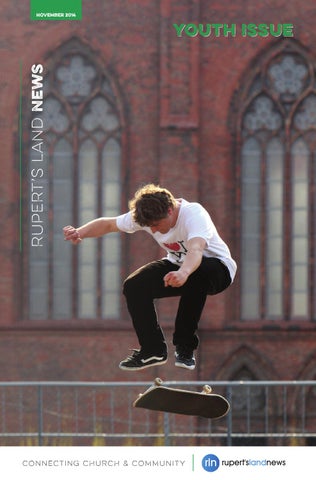
To discuss advertising call (204) 996-6172 or email rlnews@rupertsland.ca Editorial offices: Anglican Lutheran Centre 935 Nesbitt Bay Winnipeg Manitoba R3T 1W6 Subscription queries: Administrative Assistant for the Diocese (204) 992-4200 general@rupertsland.ca RLN welcomes story ideas, news items and other input. If you want to be involved in this media ministry, please be in touch with the editor. Contents copyright 2014 by Rupert’s Land News. All rights reserved. Cover: A young skateboarder does a trick outside a church. The Edge Skatepark, a ministry of YFC Winnipeg, is featured in this issue through the ministry of Caleb Elias and in the new book, Consuming Youth. Corrections: Oops! Margaret Clarke would rather leave the role of chairing Diocesan Council to the Bishop! At the time of publication, she was actually the Secretary of Synod, not the Chair of Diocesan Council.
RUPERT’S LAND NEWS
FROM THE EDITOR
SPOTLIGHT ON YOUTH
It feels like no mistake that the season of Thanksgiving leads into All Saints’, moving our communities from blessing and hospitality to focus on those who have walked the path of faith ahead of us. This issue is full of these people -- leaders, mentors, and dreamers who are excited about the future of young people in our Church.
November seems like a good time for a special youth edition of the paper, because it tends to be a bit of a “down” time. Advent doesn’t begin until the last day of the month, our gardens are long gone, and we have the feeling that winter will be with us for a long, long time! Sometimes, it is tempting to feel this way about the Church, too, as we experience a sort of “between-times” in Canadian religious life. But as our Primate, Fred Hiltz, encouraged the clergy during his visit at the end of September, he sees signs
of new life happening all over the country — even in November! You’ve all seen how teenagers can bring energy into a room, and you undoubtedly know the difficulties of keeping them engaged with the Church during those years of transition. What follows are some of the things already happening among us, some new ideas, and, hopefully, enough encouragement to get you through to Advent! May you and the youth in your midst be a blessing to one another this November.
BOOK REVIEW Consuming Youth: Leading Teens through Consumer Culture
A new book coauthored by John Berard, James Penner, and Rick Bartlett. Consuming Youth is a commentary on the close identification of youth with consumer culture. The authors contend that most young people are increasingly being shaped as consumers of material, cultural, ideological, ethical, and spiritual products of popular postmodern culture. They are primarily concerned with raising awareness of the (often uncritical) acceptance and absorption of identity-shaping influences – influences that often mesh with the already turbulent realities of adolescent life. This leaves RUPERT’S LAND NEWS
many adrift in confusion, sensing little direction toward a meaningful life beyond what they are able to accumulate. In fact, accumulation isn’t the goal as much as consumption, since mere accumulation is too static to meet the ongoing demands of a dynamic formation process. Consuming Youth contains an overview of the history of adolescent developmental theories and youth work among teens. The authors sketch out changes in the practices and emphases of youth ministry
needed if young people are to be reached with lifechanging challenges of the Gospel and equipped to live faithful, meaningful lives, shaped by an awareness of God’s call. Each chapter concludes with study questions to draw out and contextualise the ideas presented in the book. It is well worth the read. George Porter is a priest in the diocese of Algoma. 3
BURNING BUSH
Physician-assisted Dying
THE RIG H T TO D I E OR P L AY I N G G O D ? Part 1: Rodney A. Clifton
Part 2: Anonymous Submission
In Opposition to Physician-Assisted Dying
Canterbury, Justin Welby, said that the Church opposed the legislation. Nevertheless, on July 12, George Carey, the 103rd Archbishop of Canterbury, published an op-ed in the Daily Mail saying that he disagreed. Dr. Carey is a member of the House of Lords, and he could bring his objections forward in the House without undermining his Church and the presiding Archbishop. The reason Lord Carey gave is even more surprising. A friend, Tony Nicklinson, had died two years earlier, and Lord Carey said: “The old philosophical certainties have collapsed in the face of the reality of needless suffering… Here was a dignified man making a simple appeal for mercy, begging that the law allow him to die in peace… I began to reconsider how to interpret Christian theology on the subject. As I did so, I grew less and less certain of my opposition to the right to die.” Lord Carey curiously used “needless suffering” even though he knows that suffering has been an important theological theme from the time Christ suffered and died on the cross. Suffering is inevitable, but it can be overcome by remembering that Christ died for us.
Physician-assisted suicide is a hot topic — again! Steven Fletcher, the Winnipeg Conservative MP from Charleswood—St. James—Assiniboia, is determined to open this debate even though his Government objects. He is taking two supporting bills to the Senate, and if they pass, they will proceed to the House of Commons. In addition, the province of Quebec has passed a law supporting assisted suicide even though the law conflicts with the Federal Criminal Code. More significantly, in October, the Supreme Court of Canada will hear an appeal on assisted suicide from the British Columbia Civil Liberties Association. In the past, the Court has forced governments to amend laws. Consequently, Canadians will be debating assisted suicide soon. But, are Anglicans ready? For guidance, we may look to the Church of England, because a bill on “assisted dying” has passed through the Commons there, and is in the House of Lords. Unfortunately, the Church is conflicted. Earlier this spring, the 105th Archbishop of 4
Suppose Lord Carey was at Calvary during the crucifixion; would he have thrust a spear into our Lord’s heart to end His “needless suffering”? If he wouldn’t, then he is disingenuous, and Anglicans shouldn’t pay attention to his Daily Mail “sermon.” Obviously, the emeritus Archbishop has forgotten three lessons: one learned in Sunday school, “Thou shall not kill;” another learned in primary school, “Thou shalt not undermine your successor;” and the third learned in theological college, “Thou shalt not be disingenuous.” In the impending debate in Canada, it is time for the Anglican Church to set out its theological principles on assisted suicide to guide its members in this important debate.
RUPERT’S LAND NEWS
BURNING BUSH
In Proposition of New Legislation The argument used by many Christians to oppose physician-assisted dying is a simple one. It is the same made by those in opposition to birth control: in all matters of life, from pre-conception to death, we must not play God. Life and death are the sacred task of the Divine. Yet we crossed the line into “playing God” a long time ago. For decades and longer, most Anglicans have found it acceptable to grow a baby in a lab, transplant organs, and keep an accident victim alive artificially. Before we throw up our arms in shock and horror, we must take a step back and ask ourselves where the line of “playing God” is really crossed. A legal line has been drawn between what is and what is not permissible, but the debate needed now is an ethical one. Saying that physician-assisted dying is simply murder, and the buck stops there, is unduly simplistic and unhelpful, both in the Church and in the public sphere. Christians proclaim that each human is created in RUPERT’S LAND NEWS
the image of God and that life is very good. However, precisely because we bear God’s image, because we are called children of God, human suffering is particularly tragic. Unlike some faith traditions, Anglicans believe that medical advances are the result of God-given gifts. In countries where euthanasia has been legalized, it has been treated both as a medical gift and as an antidote to our limited ability to play God. Very often, when a person is in a position of immense and incurable suffering, he or she has already had his or her life extended by medical technologies. We have already begun the process of “playing God.” It is our curse, therefore, that we have gained the ability to extend life in such a way that it can sometimes end in increased and prolonged suffering. Subjecting our fellow image-bearers to such needless pain neither affirms their human worth nor glorifies God. It only proves our own pride in our unwillingness to acknowledge our scientific limits. It is true that Christ himself willingly suffered on the cross- but this was for a particular purpose. Only the most damaging theologies have suggested that suffering should be embraced for its own sake. Yes, pain is a necessary part of life this side of the Kingdom. But Christ suffers with us. He neither rejoices in nor condones our suffering. It is because of that which was accom-
plished on the cross that we will ultimately be freed of suffering and death itself. Some who fear the implementation of a new law are concerned about the exploitation of the weak and vulnerable. This, however, is why laws are necessary -- to ensure safeguards and careful documentation of the practice. University of Manitoba philosopher Arthur Schaffer explains for the Globe and Mail that when physician-assisted dying was legalized in the Netherlands, this was precisely what occurred. That which was previously secret was brought to light, and the vulnerable were given more rights, not fewer. In short, it is time for the Canadian Church to recognize that this discussion is more nuanced than we are accustomed to treating it. We must come to the table to discuss again what it means to be image-bearers in a changing world.
The “burning bush” is a new column featured in response to our readers’ concern that our Church engage the most pressing issues of our culture. To add your own thoughts to the conversation on physician-assisted dying, visit www. rupertslandnews.ca/ physician-assisted-dying. Positions expressed are those of the writers and not necessarily of Rupert’s Land News or the Diocese. 5
PASTORAL NOTE
RUNNING FOR J E SU S Donald Phillips
What is the first thing that comes to mind for you when you read a title like that? I think of some youth group trying to raise money for a worthy cause that their Church is supporting. I think that I am likely to be ‘hit up’ for a financial contribution. Maybe your thoughts turn to some examples of indigenous youth who have staged particular runs to highlight incidents in history that demand our attention and transformation in the present day. Or maybe your thoughts aren’t as lofty or ideal, and you’re thinking that it’s probably referring to a weight loss program being run by a local Church who, in doing so, tries to make a connection between good self-care and faithful discipleship. What we might not think about is saints! November 1 is All Saints Day – a time when we remember and
6
give thanks for the witness of the great spiritual leaders (some renowned, some known only to those they served) who have set an amazing example for us to learn from and imitate. In the eleventh chapter of the Letter to the Hebrews, the author spends almost the whole chapter recounting the great examples of faithful men and women whose trust in God, spiritual integrity and unswerving obedience to God’s way made them shining examples to emulate. The author begins the next chapter with these words, “Therefore, since we are surrounded by so great a cloud of witnesses… let us run with perseverance the race that is set before us.” We are called and equipped to live our lives in this world in the same way that these great saints who have gone before us lived theirs. The trouble is that, for many of us, we conjure up an image in our minds of ‘struggling to keep up’, of comparing ourselves negatively to our fellow-runners, and of seeing our race like a ‘test’
Donald Phillips Bishop of Rupert’s Land
that, unless we’re lucky, we might not ‘pass.’ But this is so far from the truth of what’s intended in that piece of Scripture! The very next verse continues, “looking to Jesus, the pioneer and perfecter of our faith.” The image that is portrayed is much more like that of a previous champion (Jesus) who has been patiently working with us in training, picking us up when we’ve fallen, encouraging us when we’re discouraged, and challenging us when he knows that we are capable of more. And, most importantly, he is waiting with a triumphant shout for us at the end of the race. The race that is our life is not designed for us to fail. It is designed for us to triumph in and through and, as a result, to join that great cloud of witnesses who, with integrity, can witness to the love and faithfulness of our God So run — with discipline, with courage, and with joy — confident in the one who delights in you!
RUPERT’S LAND NEWS
DIG DEEPER
TRAILBLAZING
A NE W RE S O U RC E FO R YOU T H L E A DE RS Written by the National Youth Initiatives Team iritual t more sp am in u p to t n “I wa progr our youth relate to.” in t n te n o c can t the kids ways tha
Across the country, there are many volunteer and part-time youth workers who don’t feel fully equipped for their vital ministry role. As a church, we share passion for working with young people. But how, without heading away to seminary, can we gain the skills to do that better? We often turn to our part-time youth workers and rely on them as ‘youth experts.’ But how often do we equip them to be just that? Responding to these concerns, the National Youth Initiatives Team, in collaboration with the Ask & Imagine youth theology program at Huron University College, Faculty of Theology created Trailblazing. Trailblazing (trailblazing.anglican.ca) is a new online theological formation and leadership development program for youth leaders, developed by Canadian Anglican youth leaders and theologians. “Many youth workers are dedicated volunteers” says Trailblazing coordinator Andrew Stephens-Rennie, from Vancouver. “And yet they don’t necessarily have much youth ministry formation beyond their own experience RUPERT’S LAND NEWS
aining “How do I get tr ?” ad as a youth le er
of youth group. Perhaps they have a degree in education, or a diploma as a child and youth worker in a secular setting.” Very few leaders have theological training, even though their task is to work with families and congregations to provide young people with Christian formation that will help them to navigate their spiritual lives and life choices. Trailblazing fills some of those gaps by providing an accessible, easy-to-use, do-at-you-own-pace kind of training for youth leaders. Through a collection of online learning modules (on computer or tablet), learners can explore such topics as Introduction to Theology, Worldview and the Gospel, Building Community, Faith and Film, Theology and Music, The power of Story, Youth Ministry Basics, and Mission and Formation. Each module takes between 2 and 3 hours to work through and builds on the others to form a thorough, theologically rigorous and engaging series of lessons. Online forums allow learners to interact with one another through conversation and
“I love working with youth in my congregation but sometimes I feel like I don’t know what I’m doing.”
reflection on the module content. Videos, articles, animations, and interactive content all serve to help learners learn and connect with the material. Trailblazing challenges learners to think about why they do what they do. Judy Steers, Trailblazing program director, notes that, “until we know how to think and reflect on our ministries, developing skills in theological refection, we will just be doing program for the sake of program.” Trailblazing aspires to ‘fill youth leaders’ toolbox,’ giving them skills and confidence in knowing what’s in that toolbox and how to use it. A $75 annual subscription gives a subscriber access to ALL current and future modules for a 365 day period. The price is set to make the program sustainable, while being absolutely accessible and affordable to part-time or volunteer leaders and their parishes. Visit www.trailblazing.anglican. ca to see a sample module or read what other youth leaders are saying.
7
NEW IDEAS
ON THE GROUND:
YOU TH MINISTRY FAVO URITE S We asked two youth leaders, one in Winnipeg and one in Ottawa, to give us a sketch of their best and favourite practices in youth ministry. Here's what the people on the ground are saying.
S pon tan eous Relationship: Zack's favou ri t e s It’s all about relationship – This is why many teens go to youth group in the first place. They desire relationship: real, tangible friendships with people who care deeply about them. Community is at the heart of Christianity and helps create an atmosphere where it’s okay to talk about tough questions, share personal stories, and support one another in their day to day lives. Plan your gatherings “loosely” – For detail-oriented people, this is a tough one. We care so much about having meaningful get-togethers that we will often plan out everything perfectly, but forget to leave space to breathe, for spontaneity to arise, and alternative paths to take shape. Don’t be afraid of the unplanned. I find that some of the most meaningful conversations our group has are ones I had no hand in creating. Youth ministry is youth doing ministry! – Allow the youth in your church to take ownership of their ministry. Strive to be a leader who helps develop and strengthen ideas that come from the
8
youth that you minister to. Be the support system that can make their ideas come alive. Give your youth opportunities to help plan and lead parts of your regular gatherings and activities. Encourage the natural leaders in your group to take initiative in leading their friends. An example of how to do this is simply breaking off into small groups to talk and pray with one another. Do all that you can to make it their group.
pieces on a plate, a handful of toothpicks, and some scotch tape. Set a time limit and appoint some judges (leaders are usually best for this). Have fun! Human Knot – Split up into groups of three or more. Stand in a circle with your team. Reach across the circle and grab the hand of two other teammates. The first team to fully untangle themselves without letting go of each other wins.
TOP 3 YOUTH GAMES Ultimate Ice Breaker – Get some T-shirts that you don’t mind getting ruined. Fill ice-cream buckets (same amount as the number of T-shirts you have) with water and put one T-shirt in each bucket. Put the buckets in the freezer and let them freeze solid. The goal of the game is simple: First team to put on their shirt wins. Add in other elements like tools to break the ice as desired. Fruit Puzzles – Most fruit works with this. Before you begin, cut up your fruit into medium size pieces that are not symmetrical. Present each team with their fruit in
Zack Ingles is the Youth & Young Adult Minister at St. Alban's Church (Anglican Church of Canada) in Ottawa, ON.
Caleb (hat and white t-shirt) has fun w
RUPERT’S LAND NEWS
NEW IDEAS
S kat el i fe: Caleb Serves Un c h u rc h ed Youth Relationships before programs - Youth ministry happens when relationships are prioritized over programs. When relationships are the focus, you can connect with young people over common interests and activities. To serve teenagers, we must go to them as Christ came to us. This looks like meeting them in their world, and committing to becoming friends, no strings attached. I love meeting young people at skateboard parks or in the streets and connecting by skateboarding together, quite simply because I am a skateboarder myself. This sets you up to care for a kid until he asks “why?” Invite kids into community - What follows is to invite youth into a caring com-
with a group of guys at the skate park.
RUPERT’S LAND NEWS
munity that meets together regularly. With the youth, we develop events, clubs, trips and camps specifically with skaters in mind. This is one way that the kids we have met feel known. We build a program together. When meeting regularly, I have found that if you want to care for a young person, you need to make space for them to think and discuss life and faith in a non-threatening way. Giving youth a place to speak their mind gives them a sense of ownership and creates genuine relationships. Making space to talk about life and God - One great way to make space is to prepare and eat food together as a “family”. Sharing a meal is natural, but it also allows for deeper conversations to be fostered. Another way to create meaningful space for conversation is to create a trip that you can take together. There is nothing better than being stuck in a vehicle with someone you are trying to get to know. Some of the best trips I have done are serving trips to other skateboard communities as well as skateboard road trips and camps. All these ideas are based on developing relationships with young people and creating
Nick Drummond-Truttman practices at The Edge Skatepark drop in, where Caleb Elias works. a space for a young person to be heard as well as to hear from us.
Caleb Elias has worked in youth ministry for eight years, including serving as a youth pastor at St. Margaret’s, Winnipeg. He spent three years working in outreach youth ministry with Skatelife in Ontario and is currently at The Edge Skatepark in Winnipeg. Both ministries focus primarily on reaching out to adolescents in skateboard culture. The majority of the young people involved in these ministries have no church background. You will find Caleb at his local skatepark at The Forks.
9
YOUNG FAITH
Art icu l at i n g Faith Across Generations Andrew Stephens-Rennie
Have you noticed how passionate and articulate teenagers can be about anything except their faith? Eavesdrop on a conversation amongst teenagers and you’ll hear them
adults can be about anything except their faith? Friends, Family, Work, and even Politics are all fair game. Yet try to engage many church-going adults in conversations about faith and you may
A group of young Anglicans and Lutherans from Winnipeg with their mentors at the Canadian Lutheran-Anglican Youth gathering (CLAY) in August.
talking passionately about many things: Friends. Video Games. Relationships. Celebrities. The Environment. School (well, scratch that). But try to engage many young people in a conversation about faith, and you may as well prepare yourself for blank stares. Have you noticed how passionate and articulate
10
as well prepare yourself for blank stares. Coincidence? In her challenging new book, Almost Christian, Princeton scholar Kenda Creasy Dean writes, “Since the religious and spiritual choices of teenagers echo, with astonishing clarity, the religious and spiritual choices of the adults who love them, lackadaisical faith is
not young people’s issue, but ours.” If youth ministry is struggling in our churches, we all have some work to do, together. Across the Anglican Church, we spend a great deal of time talking about the importance of youth ministry. For some of us, this is about the future of the church. We want our tradition to continue, our buildings to stand strong, and our community presence to last a long time. We remember the times when we were younger, the relationships we had, and the role the church played in our own youth. We recall large Sunday schools and church picnics. Sometimes, we focus on technique. What will keep young people interested? What will attract them? We’re concerned for the future of the Church, and rightly so. But sometimes we’re just spinning our wheels. Sometimes we spend far more time trying to find the latest tricks and techniques than we do remembering what brings us together in the first place. Sometimes we forget God’s story, into which we have all been invited. We are created in God’s own image. We are a
RUPERT’S LAND NEWS
YOUNG FAITH
called-out people who follow Jesus in proclaiming God’s upside-down kingdom to the world. This gospel is astounding good news. Yet we struggle to communicate that sense of awe and wonder with one another. Can we articulate what it means for us to be a part of God’s family? If we cannot, then how will we communicate the importance of our Christian faith and Anglican tradition to our children? Dean goes on to share four significant traits that teens committed to their Christian faith hold in common: 1) A personal story about God they can share, 2) A deep connection to a faith community, 3) A sense of purpose,
4) A sense of hope about their future. Yet these things are as important for adults as they are for teenagers. Dean continues: “If teenagers lack an articulate faith, it may be because the faith we show them is too spineless to merit much in the way of conversation.” As a Church, if we’re to get this youth ministry thing right, we too will need to develop the traits Dean speaks about. The research is nearly unanimous: parents matter most in shaping the religious lives of their children. If youth ministry is important to us, we will find the words and ways to articulate our own stories about God. We will connect more deeply with our faith communities. We will seek to understand
our purpose and God’s call on our lives, and we will place our hope in God’s future. Youth ministry is simpler than we might think, yet it does require something of us. It requires that we share our lives with young people, and that we model in thought, word, and deed what it is we believe. This is something we can do together. Will you join in?
Until recently, Andrew Stephens-Rennie was a member of the National Church’s youth initiatives team.
RUPERT’S LAND NEWS
11
COMMUNITY
PARISH NEWS ROUND UP St. Mary Magdalene’s
There will be a service of thanksgiving for the ministry of Cathy Mondor, Administrative Assistant for the diocese, on the occasion of her retirement on Saturday, November 29, 3:00 p.m., 3 St. Vital Rd., Winnipeg. Please note the date change from the Sunday.
St. John’s College
Bible & Breakfast with Old Testament scholar Lissa Wray Beal continues on November 15, 92 Dysart Rd., Winnipeg. 9:00-11:00 a.m. To register, please email allison.chubb@umanitoba.ca.
All Saints
The parish and choir are hosting an Advent precession November 30 at 4:30 p.m., 175 Colony St., Winnipeg.
St. Stephen’s
You’re invited to the Sisters of the Holy Rock, a concert at Bronx Park Community Centre, 720 Henderson Hwy., Winnipeg on November 7 at 7:30 p.m. Tickets are $15. To book, call (204) 661-2432.
St. Andrew’s on the Red
One of our oldest parishes is celebrating its 165th birthday! Celebrate with St. Andrew’s on the Red on Sunday, November 30, at 11:15 a.m., River Rd., St. Andrew’s.
St. Michael’s & All Angels
It is with joy, sadness, and thankfulness that the parish has said goodbye to Father Will and welcomed their new incumbent, Father Kevin, and his wife Mother Melissa. To read the letter from the parish, visit rupertslandnews.ca/st-michael-new-priest.
Ordinations Martin Allen, Chris Lea, and Al Thorleifson will be ordained to the diaconate at St. John’s Cathedral on Friday, November 14, at 7:30 p.m. They will serve with the Local Collaborate Ministry Team of Pembina Hills.
Synod Rupert’s Landers old and new had a mutually enriching weekend getting to know one another and dreaming of the future. A big thank-you to those who provided hospitality to folks from out of town and to all the others who helped make the weekend a success. To see the proceedings in pictures, visit rupertslandnews.ca/synod.
Advent We move into a new Church year beginning with the first Sunday of Advent on November 30! Happy New year Rupert’s Land! To include your announcement in the Parish News Roundup, please email it to the editor six weeks in advance of the paper’s publication (the first of each month). Other news and events are circulated on our website and through our weekly news email. 12
RUPERT’S LAND NEWS
COMMUNITY
NEW LIFE:
A CONSECRATION & ORDINATION AT ST.MATTHEW’S Pat Stewart
St. Matthew’s Maryland celebrated St. Matthew’s Day on September 22 with a flourish. The service was an ambitious one: bless a new sanctuary, confirm St. Matthew’s parishioner Natasha Bighetty, and ordain Gwen McAllister. Earlier in the year, the goal was made to celebrate on this date -and it felt somewhat miraculous that we did. The open concept worship space was filled to capacity with 140 people on the main floor and 25 upstairs in the mezzanine, looking through huge new
RUPERT’S LAND NEWS
windows. The worship space was a sanctuary amidst the drywall dust of 26 unfinished apartments surrounding it. Who would have thought this voluminous building could be repurposed into affordable family housing? Tribute was paid to Cathy
Campbell for providing the leadership to the inner-city congregation for the achievement and sustained applause followed. Participant guests were our Primate, Fred Hiltz, and our Bishop, Don Phillips. The diversity of the shared building was evident through the welcoming prayer by Cree elder Joe Keeper with daughter Tina, the Gospel in the Dinka language by Abraham Chuol of the Sudanese Emmanuel Mission, and in English by a Grain of Wheat partner, Roger Gateson. The mixture of pews, chairs, and people obscured the circle pattern carved into the linoleum floor to represent the healing tradition of the four coloured medicine wheel. To see the St. Matthew’s celebration in pictures, visit rupertslandnews.ca/gwen-mcallister-ordination
13
PROFILE
Nourished and Rooted:
Matthew Terlinski Joann White
Matthew grew up attending private Mennonite and Catholic schools while his parents attended St. Thomas’ Anglican Church. As his mother quoted him saying, “I don’t know whether I’m a Mennonite, a Catholic, or an Anglican but I know that I’m a Christian.” His earliest church memories come from Sunday School and the blessing of having a very academic clergy person in his life. (Thank you, Rev. Kenn Garrity). Matthew also reflects on having dedicated Christian parents who are phenomenal examples of how to grow within a community. Matthew’s personal passion for the Church flourished as he began to understand his own academic strengths: debate and political process. There is great room within Anglicanism for someone with a passion for the rules. We are well known as Anglicans, throughout our history and characterized by our literature, to care greatly about how things should be done, why things should be done and how it is that we see our theology in the process. While sometimes misunderstood, this is the discipleship Matthew has undertaken in many venues: Synod, National Church Council, 14
working with PWRDF, and penning fresh policy in the local collaborative evolution at St Thomas’. I applaud Matthew for courageously asking hard questions in sometimes conflicted environments. As daughters and sons of God we are called to be with the most broken of society, and Matthew takes up the increasingly important challenge of questioning those who already proclaim to believe. This is what attracts Matthew to Anglicanism particularly. How refreshing for us as Anglicans. The neighbourhood surrounding St Thomas Weston struggles economically. Matthew doesn’t deal with his own hunger, warmth, and shelter issues, but serves as a bridge between the have’s and have nots, not only in Weston but he globally. Without question, caring for others less fortunate
comes naturally to Matthew in long lasting ways. Matthew calls us all to be better Christians. There’s no doubt in his mind that through the Spirit all things are possible. He has no room in his heart for questioning anyone’s gift from God or to God. This is powerful in many ways. He says to his community, “we can do anything, you have us”. Why might young people be committed to Christian Community? It allows those who may not work together in any other venue an arena for prosperity. In a world that is plagued by hunger, disease, and economic crisis, Christian principles even the playing field. Young people often feel the pressure to achieve in a secular world of underemployment that can block their success; what’s attractive about our community is that none of that matters. We accept and encourage one another, saying, “You can do anything; you’ve got us!
Joann White grew up at St. Thomas’,Weston, and has served in youth ministry at several parishes. Matthew Terlinski RUPERT’S LAND NEWS
VIA MEDIA
When God was Young
Voices of Local Theologians Tapji Garba
I’m only 19, but my mind is old, and when things get for real, my warm heart turns cold. -Prodigy I heard these words at 1:00 a.m. on a Saturday night while sitting at home attempting to read my notes from psychology. These are the words of Prodigy (one half of rap duo Mobb Deep). Why do these words matter? What is Prodigy trying to say? These words of his come from what is easily the grittiest song on the entire album. From beginning to end, the song speaks of the reality of death and alienation built into the fabric of the Queen’s Bridge housing projects in New York City. Prodigy wrote his lyrics twenty years ago, when he was my age. The world of the young Prodigy and the world that I live in couldn’t more different. I don’t live with the horrifying reality of gunshot wounds. He did. Dead bodies aren’t a regular sight for me. They were a regular sight for him. Yet even with these differences, his expressions of pain and
torment have shaped my imagination over the years. And although I don’t share his context, I have seen the marks that the world can leave upon our bodies. When these marks break young flesh, it is sometimes fatal.
grow into our bodies. Why emphasize the body? We know of no other kind of life. A life that includes the warmth of our being together and the warmth of a bullet wound. Most importantly for the theologian , the body is the
When I was in high school, we had suicide and mental illness awareness day once a year. Why? Because some wounds cannot be hidden for a long time, or at all. While this particular problem may seem exceptional, it flows from the increasing fragility of youth. In youth, we have our world-constructing experiences, from learning to speak and walk to coming to terms with our bodies and the changes of our bodies. For some of us, this means coming to terms with the hostile space in which we must
place where God becomes speakable. God has a history. In Jesus Christ, God was young. In Jesus Christ, God is glorified and wounded. While the questions and the struggles of youth are a dilemma faced by everyone,
Tapji Garba is a second year student at the University of Winnipeg. He is also a parishioner at St. Margaret’s Church and an aspiring lay theologian and writer of great things.
RUPERT’S LAND NEWS
15
Via Media
different groups of people will deal with this in a number of different ways. How can those who have been gathered by the Gospel of the crucified and risen Jesus speak to the problem at hand? Does the “word of the cross” have something to say to those faced with growing pains? Is there space within the wounded and glorified flesh of Jesus Christ for those whose experience of youth has been marked by loss, displacement, and anxiety? In a lecture on the German Lutheran theologian, Rudolf Bultmann, the American theologian, Carl Michalson says we need, “to question and interrogate the scriptures with the questions of our historical existence and to hear
rln
the response of the text as the answer is called faith.” It is with the wounds of our lives open and salted that we can explore the body whose wounds will forever remain. It is in the transfiguration as told by St. Matthew that I find the key. “His face shone like the sun, and his clothes became dazzling white” (Matt 17:2). The transfiguration is the paradigmatic statement of the incarnation. In the God-man, Jesus Christ , we see humanity before God and God before humanity. The glory of Christ’s transfiguration is the statement of the unchanging goodness of his flesh and ours in his. There is no humanity prior to humanity in Jesus Christ, and so for
rupert'slandnews
those youth who find their bodies in spaces where their bodies are ‘out of place,’ where they are objects of maltreatment and hatred, the goodness of their bodies is never in question. This transfigured body is not the body of triumphalism. This Jesus who has been transfigured is the one who is crucified. Those youth who have been displaced and thrown outside the gates of the city will find him also outside the city at Golgotha. The glorified Jesus is nowhere to be found without his wounds. God’s history contains both life and death, and it is in this history that the young can grow. In Jesus Christ, God was young.
CONNECTING CHURCH & COMMUNITY
West Broadway Community Ministry
is looking for volunteers who would be interested in giving time (3 hours per week) to help with a variety of tasks. Take advantage of an opportunity to meet your neighbour from the inner city and grow in faith. Call Lynda 204-779-5402
16
RUPERT’S LAND NEWS