RUPERT’S LAND NEWS
FEBR UARY 2017
IN THIS ISSUE 5
The Art of Caroly n Mount
8
The Land Restores Identity
9
New Beginnings in stained glass
11
The Art of Garth Panting
CO N N ECT I N G C H U R C H & CO M M U N I T Y
rln
rupert'slandnews
Publisher | Bishop Donald Phillips Editor | Kyla Neufeld Accounting | Bernice Funk Advertising | Angela Rush Layout & design | cityfolkcreative.ca Rupert’s Land News - is published 10 times per year (September - June) by the Diocese of Rupert’s Land, in the Anglican Church in Canada. It connects churches and communities from Portage la Prairie, MB, to Atikokan, ON, by offering news, events, opinion, and ideas to 6,000 readers per month. RLN is available in a variety of formats: • • • •
rupertslandnews.ca facebook.com/rlandnews twitter.com/rlandnews instagram.com/rlandnews
We also deliver timely news and information via a weekly email. Sign up at: rupertslandnews.ca/email
CONNECTING CHURCH & COMMUNITY
Editorial offices: Anglican Lutheran Centre 935 Nesbitt Bay Winnipeg Manitoba R3T 1W6 RLN exists to explore issues at the intersections of faith and life. In doing so we solicit and publish a range of opinions, not all of which reflect the official positions of the Diocese. We acknowledge that we meet and work in the Treaty 1 Land, the traditional land of the Anishinaabe, Cree, and Dakota people and the homeland of the Metis Nation. We are grateful for their stewardship of this land and their hospitality which allows us to live, work, and serve God the Creator here. RLN welcomes story ideas, news items, and other input. If you want to be involved in this media ministry, please email the editor at: rlnews@rupertsland.ca.
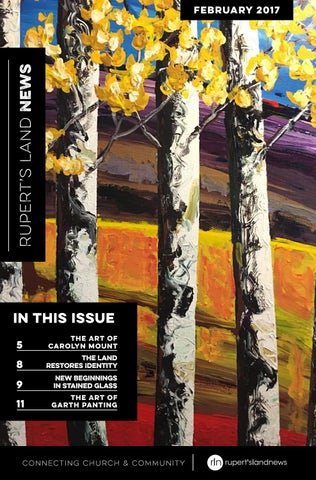
Advertising: RLN accepts advertising in our monthly magazine Contents copyright 2017 by Rupert’s Land News. and our weekly email. Our rate sheet is available All rights reserved. at rupertslandnews.ca/ads. To discuss advertising Cover: "Aspen Autumn" by Garth Panting. call (905) 630-0390 or email: rlandnews.ads@gmail.com.
RUPERT’S LAND NEWS
2
fr o m the edito r
I believe in artists. As a poet, I consider myself an artist of the written variety; I shape my poems like a sculptor molds clay. However, when it comes to the visual arts, for the most part I don't know what I'm doing, even though I've dabbled in watercolours and enjoy drawing. I don't know how to mix paints or create etchings, and I certainly don't know how to carve or quilt or make pottery. Still, art is something that speaks to me. I can see the brushstrokes when I look at a painting; I can feel the smooth edges of a wooden carving or the rough texture of a ceramic pot. Art is a tangible thing to experience. And, it's been around just as long as humans have
RUPERT’S LAND NEWS
been. For as long as we have been trying to answer the questions of our existence and the mystery of the divine, there has been art. There's a reason we're still intrigued by Mona Lisa's famous smile 500 years after Leonardo da Vinci painted her: Art has the capacity to capture the wealth and depth of human experience. It shows the ugliness and beauty of our histories, cultures, traditions, and beliefs. I'm doing something a little different with this issue of Rupert's Land News. Instead of publishing a half dozen articles like usual, I'm featuring work from two artists in the Diocese: Carolyn Mount from saint benedict's table, and Garth Panting from St. Peter’s Anglican. Carolyn works with sculpture, installations, and prints, and has a Master of Fine Arts from the University of Manitoba. Her project, Urns for Healing, explores how we express grief. Garth has been a visual artist for 30 years. He works with acrylic paints and attempts to capture the
beauty of God's creation on his canvases; that's his work on the cover. I encourage you to spend a few minutes with the images in this issue. Take a moment to study the shapes, textures, materials, and colours each artist presents. Art isn't something you have to necessarily “get” to appreciate the work and attention behind it. Along with the featured art, we have a follow-up to Deanna Zantingh's piece, “Uncovering the truth: land is central,” from January's issue, and we'll take a look at how a Mennonite church embraced the arts in its congregation. In via media, we'll learn how some Christian art from the 12th century displays theological truths. I want the artists of the Diocese to know that they are welcome in and supported by the Rupert's Land News. If you would like to send me some of your artwork, or have any questions, email me at rlnews@ rupertsland.ca.
3
Pasto ral note
The Essence of God i n A rt a n d Sci e n ce Donald Phillips
Is God an artist or a scientist? The Western world has wrestled with this question ever since the Enlightenment. Even in Scripture itself, the notion of the created order being a reflection of God’s creative power and beauty appears many times. St. Paul uses God’s creative handiwork as evidence in a theological indictment of humanity. After describing the world’s present situation as being evidence of God’s wrath, Paul writes, “Ever since the creation of the world God’s eternal power and divine nature, invisible though they are, have been understood and seen through the things he has made” (Romans 1:20).
handywork” – inspired the 18th century composer Josef Haydn to write “The Heavens are Telling” as part of The Creation oratorio – still much loved 250 years later. Yet, alongside this came the rise of an entirely rational view of the universe and, therefore, of God. The belief commonly referred to as Deism held that the created order was an entirely predictable system governed by natural law, which the Divine Being had designed and set into motion. This was the image of God as scientist par excellence. Even our own 16th century Anglican theologian, Richard Hooker, defined “theology” as “the science of things divine.”
God’s creative essence simply exists as an expression of God’s being. Hundreds of years before St. Paul, a Hebrew Psalmist wrote Psalm 19, which begins, “The heavens are telling the glory of God; and the firmament proclaims his handiwork.” Then there are the “spin-offs” from God’s work – more art created from God’s art. The King James Bible translation of Psalm 19 – “The heavens declare the glory of God; and the firmament sheweth his
RUPERT’S LAND NEWS
Maybe we should be asking the questions, “Can science be artistic?” and “Can art be scientific?” Surely the answer to both questions is a resounding “Yes.” Many great scientific discoveries resulted from an intuitive or artistic use of imagination (cf. double-helix structure of DNA) to solve the structural challenge. And ever since the ancient Greek philosophers, the strong
mathematical foundation of music has been articulated. In our human understanding of productivity, whether it be scientific or artistic, there is always a separation between our being, the act of creating, and the created work itself. But in Scripture, God’s creative essence, described as “the Word,” simply exists as an expression of God’s being, from which the created order exists in all of its beauty. There is an authentic truthfulness to genuine beauty – whether that be an exquisitely crafted sculpture, or an elegantly derived mathematical equation. And when we apply ourselves to this kind of creative work, we, too become a beautiful image of this God from whose handiwork all art and science spring forth.
Donald Phillips, Bishop of Rupert’s Land 4
Art
Urns for he a lin g Carolyn Mount
Our society no longer knows how to deal with death, grief, and mourning. No more do the grieving shroud themselves in black, indicating to those around them a loss has been suffered. So how, or where, does one hold that brokenness now? I have found that pain, and healing, is held
RUPERT’S LAND NEWS
in the deep recesses of my being. Urns for Healing is a collection of vessels that give form to those deep places of mourning and loss. Made from found materials, they invoke the memory of my mother, of her clothes, her presence, of her broken body.
The healing process is not a linear path. Nor are the places the body holds grief the same over time. Sometimes overwhelming, other times small and comforting, the body holds what it knows and misses in different ways. Urns for Healing hold within them both loss and the hope of wholeness once again.
5
Art
Materials used: copper wire, thread, and found fabric.
RUPERT’S LAND NEWS
6
Art
More work from Urns for Healing will be featured in a show at Mennonite Heritage Gallery late fall 2017.
RUPERT’S LAND NEWS
Carolyn Mount has an MFA from the University of Manitoba and has shown her work in many exhibitions. View more of her work at carolynmount.com 7
R ec o nc il iatio n
The Land Restores Identity Ellen Cook
This article is a follow up to Deanna Zantingh's piece in January's issue, “Uncovering the Truth: Land is Central.” I have a beautiful house by the Assiniboine River near Winnipeg, but when I say I am going “home,” I mean the place where I was born: Misipawistik Cree Nation in Grand Rapids. Among my people, there is a question we ask someone who cannot seem to stay still in one place, but moves about constantly; “What are you looking for? Your bellybutton?” I interpret this query as, “Are you missing the land on which you were born; do you feel lost when you are away from there?” Indigenous peoples lived on, from, and with the land. The traditional Indigenous peoples birthed their own children with the help of midwives. Upon the birth of a child, the mother’s placenta would be placed in the ground next to a tree near the birthplace, creating a strong connection to the land that the child would have. When the stub of the umbilical cord dried and came off the child, it, too would be placed in the ground near the tree. This area would become “home” for life for this person, sustaining the
RUPERT’S LAND NEWS
strong bond between person and land. Our people could predict weather by observing the sky and watching the behaviour of animals. Our people knew what medicines to use for various illnesses. Our languages and cultures evolved form our mutual relationship with the land. Our sense of belonging, our customs and beliefs, and our methods for policing, child bearing, and child rearing are all connected to the land. Many of our ways, traditions, and languages have been lost because we have been disconnected from the land by colonization and attempts at forced assimilation. In the past few years, there has been a move towards restoring our relationship with the land. “Land-based education” and “cultural literacy” are catchphrases which have circulated fervently throughout the world of Indigenous education in the past decade or so. It has been evident that the conventional colonial education systems were not producing large numbers of successful academics among our youth. We must reconnect Indigenous youth with the land so that they can find a sense of pride and identity. Learning the Indigenous way
For generations, Ellen's family has taken their children and grandchildren to their family camp on Lake Winnipeg, where they found these arrowheads that were once used by their ancestors. of life, the mino pimatisiwin (the good life) or askiwi-pimatisiwin (life on/with/ from the land), is rooted in the person’s relationships with the natural world, the people around them (all their relations), and the languages, traditions, and ceremonies of their nation.
Ellen Cook is a retired teacher and a member of Misipawistik First Nation.
8
Neighbo ur s
New Beginnings in S tained Gl as s Kyla Neufeld
When River East Mennonite Brethren Church decided to fill their 20 columns of ceiling-to-floor-windows with stained glass, the congregation immediately resolved to make it a community project. “Community is an important concept in the way we understand what God is doing in the world. God is in the business of gathering people together,” said Mary Anne Isaak, pastor of River East MB. A few years ago, a woman had left money in her will for River East to do a worship art project. With those funds available, the REMB Glass Project was born. For a year and a half, two teams from River East gathered together at Prairie Stained Glass — one group on Tuesday nights and the other on Thursday nights — to learn how to cut, grind, fit, solder, and lead glass for the new stained glass windows. The theme for the windows is “God is Light” and depicts the story from Creation to the Resurrection. The colours of the windows also progress in greater intensity and brightness from the back of the sanctuary to the front so that people will be drawn in. When the project was completed in 2015, there
RUPERT’S LAND NEWS
was an overall sense of celebration and accomplishment. “I imagine it was like a barn-raising or quilt-making party from long ago. People working on a common task, enjoying each other's company,” said Mary Anne. And Frieda Klippenstein, a volunteer who documented the whole process in a series of blog posts, said, “It was a privilege to be able to celebrate with those who were now at the stage where they could... say with a well-deserved measure of pride, 'I made this!'” For members of River East, it was important to embrace the arts as an expression of worship. At the dedication service for the new windows, member Lori Matties said, “Not all of us will make stained glass windows or beautiful music or other creations we know as art. Creativity is not only something made by the hands. It may be in found in computer software, a child well loved, or a moment fully and compassionately lived. We create beauty because we are the Creator's precious creatures. We create beauty in imitation of the One who through unending love makes beauty rise out of whatever ugliness our broken hearts devise.”
Two members of River East put the finishing touches on a window pane.
Photo: River East MB Church Added Mary Anne, “Everything God makes is full of beauty and wonder.” This community worked together to complete a project as an act of worship, and as a celebration of art and beauty. For them, these new windows symbolize the continuing story of God with God's people – for all generations.
9
Neighbo ur s
“We live in an age of too many words. We find we have left behind a valuable resource in the way in which visual arts can speak into our hearts in ways that words alone do not. The colours, the symbols, the light in these windows touches us in a place that no words can reach. They can also partner with and enrich the words that give us meaning... More than three thousand years ago, the scriptures tell us, Joseph told his brothers, 'You planned something bad for me, but God produced something good
RUPERT’S LAND NEWS
from it.' And last week, we celebrated the resurrection of Jesus Christ from death. The resurrection is God's continuing plan and production of good, for God's beloved creation. From ashes to beauty, God gives us hope. And so we create beauty not only in our living and working, but also in our worship, because worship, literally 'giving worth,' is giving back our best to the One who makes all things good.” — Lori Matties, Stained Glass Windows: Dedication Service, April 12, 2015
10
Art
Art for our eyes And hearts Garth Panting
Heaven is a Place on Earth. Materials used: canvas or wood panels, high-quality acrylic paints, brushes, pallet knives.
I have been a visual artist for over 30 years. I am inspired by the beauty of God's creation and aim to capture and reflect that through the use of vibrant colours, energy, and gentleyet-bold interpretation that encompasses a spirit-filled essence of love, faith, and hope. In 2007, my work "Welcoming, Widening World" was featured in the Anglican Church of Canada’s “Sacred
RUPERT’S LAND NEWS
Expressions” collection of Canadian art. My “Creation’s Colours” art shows and parish fundraisers celebrate the positive energy of the beauty around us. I approach my work through keen experiential moments, captured in time through photos, drawings, and thought. I take these building blocks and transform them into creations that come together into “touchable” pieces that evoke emotion
and reflection. I create colourful, energyfilled and encouraging original acrylic paintings for spaces where we live, worship, and work. I also conduct painting workshops to help others explore their God-given creative spirits. I seek to nurture faith through encouraging visual works – for our eyes, for our environment, for our minds, for our hearts, and for our souls.
11
Art
Lily Spirits
Great suites still available
If you would like to contact Garth about his art, email him at dgcart@shaw.ca.
204-989-5927 oldgracehousingcoop.ca RUPERT’S LAND NEWS
12
C o mmunity
PARISH NEWS ROUND UP St. John's College, Winnipeg
St. John's College turns 150 this year. As part of its anniversary celebrations, St. John’s College is sponsoring a series of organ concerts; the first is February 23 in the St. John's College chapel, 12:00 p.m. Donations accepted. Check out St. John's website for more anniversary events.
St. Philip’s, Winnipeg
Donald McKenzie, priest at St. Philip's Anglican Church, was recently featured in the Winnipeg Free Press in an article about his food blog, "Dining with Donald". Check out the article on the Winnipeg Free Press website and “Dining with Donald” for great restaurant reviews and food recommendations.
PWRDF
The Primate's Fund has responded to the crisis on Pikangikum First Nation by establishing a water project requested by their elders and school system. 90% of homes in the community do not have access to water or waste-water services. PWRDF is working with local leadership to equip homes with access. Find out how you can get involved at PWRDF's website.
PWRDF
PWRDF has new resources available for Lent. Sign up at pwrdf.org/seasonal for a daily email that includes a reading, prayer, or meditation specially chosen by the Reverend Susan Spicer of the Parish of Fenelon Falls and Coboconk, Ontario.
St. Luke's, Winnipeg
St. Luke's Book Club will be reading Traveling Mercies by Anne Lamott, starting February 11, 10:00 -11:30 a.m. Meet in St. Luke's library, just off the Parish Hall. All are welcome to attend.
Epiphany Anglican Indigenous Church, Winnipeg
Vince Solomon will be installed at Incumbent of the new Indigenous worshipping community of Epiphany Anglican Indigenous Church, located in St. Francis Mission Centre, 730 McPhilips Street. Come for the celebration on February 12 at 7:00 p.m. Bishop Don will preside and Bishop Mark MacDonald, National Indigenous Bishop, will preach.
Thorvaldson Care Center AN INTERMEDIATE CARE FACILITY FOR SENIORS 24 hr care and supervision Registered Nurse on site Assistance with medications, dressing, hygiene
All meals, laundry and housekeeping Recreation programs Private bed-sitting rooms
OVER 55 YEARS
caring for senio rs
495 Stradbrook Ave | Winnipeg, MB | R3L 0K2
ph (204) 452-4044 | fax (204) 452-4054 thorcare@shaw.ca | www.thorcare.ca
RUPERT’S LAND NEWS
13
C o mmunity House Blend Ministries
House Blend Ministries will be turning 10 years old this month. More information on celebration events to come.
Centre for Christian Studies
CCS is hiring a new principal. Applications will be accepted until February 15. More information can be found on the website.
Anglican Foundation of Canada
Twenty-six Rupert's Land parishes are now members of the Anglican Foundation of Canada, which benefits parishes with financial support. Members are asked to make an annual contribution so that it can respond generously to applications. Visit the website to join, donate, or apply for a ministry grant.
Upcoming Issues in RLN
In March we'll be exploring the theme of Disability: How parishes in Rupert's Land are becoming more accessible and how to respond to those whose disabilities are not obvious. April's theme is Contemplation: Christian practices for a calm, quiet mind and the importance of sitting still.
RUPERT’S LAND NEWS
14
Via Me dia
Art as theology: The Prüm Abbey Reliquary Graham MacFarlane
Typological Christian art reached a certain perfection in the Mosan enamelwork of the late 12th century. These plaques are a good example. They were part of a reliquary that was dismantled many centuries ago. The top plaque became separated from the other three and lost. It was later unearthed in excavations at Prüm Abbey in the Mosan region – the modern Belgian-German border area – but it was in terrible shape, with almost of all its enamel gone. It doesn’t look like much in photographs, so it’s represented here as a drawing that shows its basic design. The other three plaques eventually made their way into the British Museum. Each of the four plaques shows an Old Testament scene that is a “type” of the crucifixion, that is, an image that corresponds to the original, or “antitype.” This has led art historians to conclude that the reliquary likely housed a fragment of the true cross and that the middle field either showed this relic or contained an image of the crucifixion. The four enamel plaques, taken together, generate a typological program that expresses a whole complex of interlocking theological truths about the nature RUPERT’S LAND NEWS
of the Church, sacraments, election, salvation history, and the work of Christ. On the left plaque we see Moses directing the attention of the Israelites to the brazen serpent (Numbers 21). They’ve been struck with a plague of venomous snakes as a divine punishment, to which God has provided an antidote: Moses is to fashion a bronze serpent and to set it up on a pole, and whoever looks at it will live. The right plaque shows a vision of Ezekiel’s in which a man dressed in linen is marking the foreheads of those who “groan and sigh at the abominations of the city” (Ezekiel 9). In this vision, Ezekiel is taken to Jerusalem and shown the idolatry of its inhabitants. God sends six executioners to cut down those who do not have a mark on their forehead. The story bears an obvious resemblance to the Passover, and the inscription similis Aaron (“like Aaron”) is probably meant to establish this connection. Together, the left and right plaques, are about God providing means of deliverance from certain death, though in both cases, the means of death is also sent by God. Deliverance
comes through a divine sign that visually echoes the cross: the serpent is shown as a horizontal element set upon a vertical pole, and the foreheads are marked with a “T.” Moreover, the sign of the deliverance is ordained by God but carried out by men: Moses and the man dressed in linen. These signs operate something like the sacraments of eucharist and baptism. The top plaque portrays Jacob blessing his grandsons, Joseph’s sons Ephraim and Manasseh (Genesis 48). Manasseh, as the older brother, is seated to Jacob’s right, in order to receive the blessing from Jacob’s right hand. But to Joseph’s consternation, Jacob crosses his arms in order to bless the younger brother with his right hand. The crossed arms were taken by medievals as a visual echo of the cross. The bottom plaque portrays the binding of Isaac (Genesis 22) when God commanded Abraham to take his son up Mount Moriah and to sacrifice him. We see the moment the angel stops Abraham’s sword and tells him that God has provided a ram to replace Isaac. This episode has been taken to typologically refer to the crucifixion throughout the 15
Via Me dia
Plaque images belong to the British Museum Drawing from Neil Stratford, Catalogue of Medieval Enamels in the British Museum Volume II
history of the Church. The top and bottom plaques together show us the patriarchs of Israel, one family spanning five generations. The theme of the younger brother being greater than his older brother pertains not just to the blessing of Ephraim over Manasseh, but to every generation of the family: Isaac is preferred to Ishmael, Jacob to Esau, Joseph and Benjamin to their brothers, and Ephraim to Manasseh. The theological point being made here is that inclusion in the covenant community is a matter of divine grace rather than any human system of inheritance. Nobody belongs to God’s people by nature. The reliquary’s typological program, then, draws
rln
out particular dimensions of Christ’s work. The horizontal axis of the prophets and priests reminds us that we are delivered from death by the cross. The vertical axis of the patriarchs reminds us that we are adopted into God’s family as children of the promise, not through any merit or right, but purely through divine grace. The two axes intersect at the crux of salvation history, that decisive divine act which delivers us from death to life and from alienation to adoption. Christ is the constitutive centre of history, and for this reason he is also the hermeneutical centre, to which the scripture as a whole and in all of its parts refers. He is that to which the sacraments of eucharist and baptism
rupert'slandnews
RUPERT’S LAND NEWS
refer, and from which they derive their significance. In Christ all things cohere, the fullness of all, all things filling.
Graham MacFarlane is the office manager and boys camp director at Manitoba Pioneer Camp. He is a parishioner at St. Margaret's in Winnipeg.
CONNECTING CHURCH & COMMUNITY 16