RUPERT’S LAND NEWS
June 20 18
IN THIS ISSUE 5
Hold Texts Lightly
8
Connection and Repr esentation
13
DIY Compost Bin
15
Water for Kasaka
CO N N ECT I N G C H U R C H & CO M M U N I T Y
rln
rupert'slandnews
rln
rupert'slandnews
Publisher | Bishop Donald Phillips Editor | Kyla Neufeld Accounting | Bernice Funk Advertising | Angela Rush Layout & design | cityfolkcreative.ca Rupert’s Land News - is published 10 times per year (September - June) by the Diocese of Rupert’s Land, in the Anglican Church in Canada. It connects churches and communities from Portage la Prairie, MB, to Atikokan, ON, by offering news, events, opinion, and ideas to 6,000 readers per month. RLN is available in a variety of formats: • • • •
rupertslandnews.ca facebook.com/rlandnews twitter.com/rlandnews instagram.com/rlandnews
We also deliver timely news and information via a weekly email. Sign up at: rupertslandnews.ca/email
CONNECTING CHURCH & COMMUNITY
Editorial offices: Anglican Lutheran Centre 935 Nesbitt Bay Winnipeg Manitoba, R3T 1W6 RLN exists to explore issues at the intersections of faith and life. In doing so we solicit and publish a range of opinions, not all of which reflect the official positions of the Diocese. We acknowledge that we meet and work in Treaty 1 Land, the traditional land of the Anishinaabe, Cree, and Dakota people and the homeland of the Metis Nation. We are grateful for their stewardship of this land and their hospitality which allows us to live, work, and serve God the Creator here. RLN welcomes story ideas, news items, and other input. If you want to be involved in this media ministry, please email the editor. Contents copyright 2018 by Rupert’s Land News. All rights reserved.
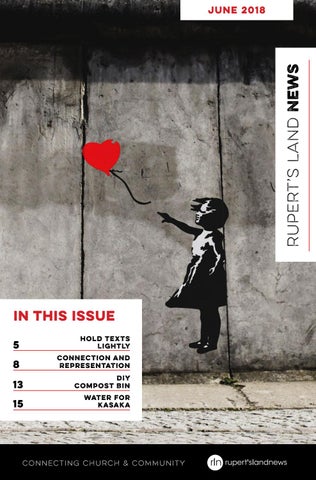
Advertising: RLN accepts advertising in our monthly magazine and our weekly email. Our rate sheet is available Cover: "Banksy on the Berlin Wall," Eric Ward at rupertslandnews.ca/ads. To discuss advertising call (905) 630-0390 or email: rlandnews.ads@gmail.com.
RUPERT’S LAND NEWS
2
E dito r ial
When it comes to TV shows or movies, I know my limits pretty well. I can’t handle horror, so I stay away from too much blood and gore. I enjoy most comedy, but there are certain episodes of The Office that I just can’t watch because they are so cringe-worthy. I’m always game to see a superhero movie, and I adore musicals. So much of our pop culture is made up of the media we consume. When I was growing up, my parents and church youth leaders spent a lot of time focusing on how we (my siblings and other members of youth group) were being influenced by all of it. Or, to quote an old adage: “Garbage in, garbage out.” One youth leader of mine handed out fliers that listed all of the things we should stay away from because they were evil, and I distinctly remember that it included Harry Potter and Dungeons & Dragons. Similarly, my mom got rid of a few much-beloved books when I was born because she was concerned I might read them before I was old enough – ironically, I read
RUPERT’S LAND NEWS
them for high school English. I appreciate that the adults in my life were just trying to protect me. But I think the urge to simply hide away the “unsavoury” (which is subjective) bits of pop culture can go too far, to the point where it becomes harmful rather than helpful; when we do that, we lose the opportunity and the ability to develop critical thinking skills about them. A few years ago, I started changing the way I thought about pop culture. Rather than simply viewing something on a surface level – i.e. judging if I liked it or not – I started asking critical questions. How are the female characters portrayed? Are there people of colour present and, if so, how are they represented? What about LGBTQ2A+ or disabled characters? In short, I started concerning myself with representation, and not just in the name of political correctness. If pop culture is a reflection of humanity, and I believe that it is, then
media that does not include women, people of colour, LGBTQ2A+ folks, or people with disabilities is not honest. What’s more, studies, like the UCLA Hollywood Diversity Report, have shown that a lack of representation perpetuates racism, misogyny, and bigotry. By asking myself questions surrounding representation, I become more aware of harmful stereotypes and how they have very real consequences. This issue explores the way we consume, and think about, pop culture, with articles by two media scholars: Mandy Elliot and Michael Boyce. This issue also has an article on how to make your own compost bin for the Fifth Mark of Mission and an introduction for a new Diocesan program: the Kasaka Water Project. When we learn how to think about media critically, our experiences become deeper and we become more engaged consumers. And that, I think, is a great starting point for a more compassionate humanity.
Photo: Diana Ludwig
3
Pasto ral note
Looking for god – Where? Donald Phillips
Depending on which decade you were born in, you may have reached the conclusion that some novel development in secular culture contributed to declining church attendance and the marginalization of Christianity in our society. You may attribute it to the opening of movie theatres on Sunday; the use of Sundays in amateur sport for games and practices; the proliferation of Sunday shopping; or the exponential growth of video games and social media. And, as a result, you deem popular culture to be the number-one enemy of practising the Christian faith.
Athenians were deeply devout. A few verses later we read that “all the Athenians and the foreigners living there would spend their time in nothing but telling or hearing something new.” The same could be said of our contemporary society today – just substitute Facebook, Twitter, and Instagram. But Paul is not intimidated by this. When he subsequently engages in public discourse, he comments positively on their many religious artifacts and then cites one with an inscription: “To an unknown god.” He uses this as leverage and launches into an explanation of the real God
Paul is confident that the Lord is present to his hearers even in their own ‘popular’ culture. But is “popular culture” only a late-20th-century reality? In the last 400 years, there have been periods when church attendance was very low and when committed membership in local Christian congregations was more of a cultural rather than spiritual habit. In Acts 17, we read that Paul visits the great cosmopolitan city of Athens where he “was deeply distressed to see that the city was full of idols.” And it is not that the
RUPERT’S LAND NEWS
that Paul knows in the person of Jesus Christ. Realizing the cultural context in which he is speaking, Paul intentionally uses common (secular) language in his explanation, avoiding references to his Jewish religious roots. And he even connects with the local culture when he quotes an ancient Greek poet: “‘For in him we live and move and have our being;’ as even some of your poets have said, ‘For we too are his offspring’” (Acts
17:28). Clearly, Paul is confident that the Lord is present to his hearers even in their own “popular” culture. This is not to say that the New Testament condones all of the aspects of “popular culture.” Paul’s letters contain many references to newly-baptized disciples needing to turn away from the habits and practices of their former lives and adopt different ethics, morals and attitudes. If we really believe that the Spirit is making the presence of the Risen Christ real throughout the world, then we need to not only be open to, but actively looking for, God’s truth and love being manifested in unsuspecting ways, by unsuspecting people, using unsuspecting media in our popular culture.
Donald Phillips, Bishop of Rupert’s Land
4
Po p C ultur e
Hold Texts Lightly Michael Boyce
I was recently invited to speak to a church group about pop culture and theology, using movies and television shows to explore matters of faith. In the course of our conversation, I realized that many audience members were looking for something much more directional from me, something to tell them what movies they could show others to start conversations about faith. I stressed that, while using movies and television can be fruitful ways to instigate dialogue, there is no set formula to follow for creating conversations about matters of faith and that some people won’t necessarily understand cultural texts the same. As a child of the 1980s, I sat through more than my fair share of youth groups and Bible studies that tried – usually badly – to explain the spiritual dimension of Star Wars or Star Trek.Usually these talks were given by well-intentioned youth leaders who sort of liked whatever bit of pop culture they were talking about, but thought they’d done their job if they shoehorned a Christian message. Occasionally, it was clear that the leader didn’t really know anything about the subject, but had picked up that the youth liked it. Almost all told us what to RUPERT’S LAND NEWS
think and didn’t encourage questions or critical engagement. But texts, like people, are nuanced and complicated. You have to be prepared for people’s reluctance or inability to see what you see. You have to respect people’s perspectives and experiences that affect their understanding of texts.
requires engaging subtext and treating the text critically. When it comes to using popular culture as a way to talk about God or faith, the goal is to get others to engage on this more critical level. However, sometimes the people who are trying to get others to see some “deeper level” cannot see
Texts, like people, are nuanced and complicated. Having taught English Literature and Media Studies for over a decade, one of the first things I tell my students is that I don’t really care if they like something we’re studying. In a broad sense, sure, I’d love it students feel deeply in love with every poem, novel, play, or movie I use in class, but expecting that is not realistic. What I need students to do is move past their own feelings about the text (what Roland Barthes would call the most indolent of readerly responses) and engage the work on a deeper level. Engaging texts on a theological level requires readers to move passed a superficial emotional response (I liked this, therefor it’s good) to see into a text, to draw connections that might not be immediately obvious. It
past their own readerly responses. They treat valid criticism of texts as personal, responding with knee-jerk defenses that attempt to shut down other people’s experiences. To illustrate, I brought up an experience I had a number of years ago as an example; this is where our conversation took an interesting turn. A few years ago, I taught a course on Fictional Apologetics of C.S. Lewis, and I had one student who didn’t have any previous experience with Lewis or the Narnia series. As we started discussing A Horse and his Boy, the student looked uncomfortable. When we went around and gave our initial impressions, he hesitated but said, “I know you all seem to really like this stuff, but I found this one 5
Po p C ultur e
Some illustrations from The Horse and His Boy.
a bit racist.” The student, who was Christian and of Middle Eastern heritage, went on to explain how he thought Lewis’s description of the Calormen, the Orientalized people who live in a neighbouring country, play on imperialist stereotypes of Muslims and project an idea of swarthy, evil outsiders. He respectfully, but earnestly, framed his concerns through his own experiences with being stereotyped. He never suggested that the stories shouldn’t be read, or that Lewis wasn’t doing other, important thing in the stories, or that the novels have no place in our modern world; he simply outlined something he saw as problematic and wished to discuss it.
RUPERT’S LAND NEWS
The group to whom I was telling this story almost immediately started in with the same awkward defences my students had used. Like most of my students, this group had grown up reading The Chronicles of Narnia and were not prepared to accept the troubling charge of racism against something that was so beloved: they questioned whether “culturism” (the prejudicial attitude towards a particular culture) might not be a better word to describe what Lewis is doing than the more troubling label “racism”; they pointed out that Lewis was a product of his time; they suggested that the student was being overly sensitive; and they concluded that because Lewis
has one “good” Calormen character who is ultimately redeemed, such accusations are pointless. All these defences – well-meaning as they could have been – undercut the student’s experience with the text while privileging their own readings. By attempting to shut down a line of inquiry they found objectionable, this group, like the students, prioritized their own positive experiences with Lewis’s stories at the expense of someone’s actual experience. After the group exhausted their defences and justifications, I tried to unpack the reason I used this example to illustrate my larger point about holding pop culture texts lightly. I explained
6
Po p C ultur e how the experience in that classroom changed that way I approached the novels and, more importantly, how I presented the novels when discussing them in class. Simply acknowledging that stories I grew up with and cherish could be problematic to others in ways that I didn’t see allowed me to be open to students’ concerns. Despite the initial awkwardness in the class, our conversation about The Horse and His Boy was much richer because one student brought his own lived experience to the text and the discussion. After the unhelpful justifications, we were able to discuss a wider range of topics than I had planned or that the book on its own would suggest – things like reconciling the abuse and violence
of the Church. I don’t know if everyone in that church was prepared to hear that we cannot assume our experience with a text, any text, is more authentic or important than someone else’s. Some people kept trying to get me to provide an easy-to-follow formula. But there are no easy answers. I continue to teach the whole Chronicles of Narnia, as their importance as influential works of fiction cannot be overstated. I tell classes how much these novels meant in shaping my thoughts and imagination and how they maintain a special place for me. But, I also teach these novels differently, given this particular student’s experience with the text. Now, whenever I use any
work of popular culture to explore matters of faith, I try to model the same kind of critical thinking I expect of my students. I hold these texts lightly, always aware that some people’s experiences will allow them to see different things. Some people might be unprepared to see what I’m trying to get them to see for superficial, readerly reasons: they don’t like sci-fi or fantasy, or they can’t stand an actor. But others won’t be able to see what I want them to see because of their lived experiences. And if I’m trying to persuade them of the validity of a spiritual reading, I have to be open to their reading as well.
[Grab your reader’s attention with a great quote from the document or use this space to emphasize a key point. To place this text box anywhere on the page, just drag it.]
It’s all about relationships… I believe that creating relationships under many circumstances is the essence of trust and a natural ability to rely up one another when needed. You may not need me for many years, but when you do, I’ll be here.
Richard. Richard Rosin Funeral Director Ltd. is a full-service funeral company, serving families and the community – providing funeral and cremation services and educational seminars. P: 204-219-1126
E-mail: info@richardrosin.ca Web: richardrosin.ca 196A Tache Avenue at Hanbury Street
RUPERT’S LAND NEWS
Michael Boyce teaches English Literature and Film Studies. He is Vice President Academic and Associate professor at Booth University College in Winnipeg and has been published on Hitchcock, Alec Guinness, and James Bond. He attends saint benedict's table.
7
Po p C ultur e
Connection a n d Rep res entation Mandy Elliot
Not long ago, my soonto-be father-in-law wanted to treat my partner and me to a movie that recently came out. He loves movies and, as a film scholar, I do too. However, as soon as I discovered that he had chosen a “Christian” movie, I began to think of ways to get out of going. But let’s put a pin in this for a second. Besides being highly critical of agenda-driven movies from an academic perspective, I am fairly new to the idea of so-called “Christian” products. I was certainly aware of them when I was growing up, but, while I was raised Christian, my parents were vehemently against the trend of making “Christian” versions of secular products. Church friends sported “Enjoy Jesus Christ” t-shirts that shamelessly stole the Coca Cola Company’s “Enjoy Coca Cola” slogan, and “Christ King” shirts that ripped off the iconic Calvin Klein branding of the mid1990s. Similarly, I didn’t listen to much Christian music or watch Christian movies. I was raised on '70s rock and Alfred Hitchcock films, and avoided the cozy Christian bubble that contained so many of my childhood friends and divided the
RUPERT’S LAND NEWS
world into a Christian = good, secular = bad binary. However, I was encouraged to look for God in what entertainment I consumed, so I read The Lord of the Rings and watched The Matrix accordingly. I loved the challenge, I suppose, of bending a secular product to meet my set of beliefs. I was, in effect, fashioning my own “Christian” product from a secular template as I read and watched and applied my very limited theology to what I consumed so that I felt
comfortable. Without realizing it, I was doing exactly what I believed those logo thieves were doing: forcing God into a product to justify my enjoyment of it. I have since explored issues of faith and how often consumerism ignores or rejects those who might also partake. My experience of faith – the way I understand God in my life – may differ from yours, but that does not give me the right to dismiss it. However, the practice of Christianity – how Christians apply God to the world – is
8
Po p C ultur e something else entirely. If your practice of Christianity enables you to judge, ignore, or “welcome, but not affirm,” that is not okay with me. So, I was dreading seeing this movie. While my upbringing certainly led to assumptions about the lacklustre quality of Christian entertainment, I also feared it would try too hard to appease consumers who didn’t want to think beyond a certain brand of Christianity and that it would assume a version of God I didn’t recognize. My fears were confirmed not only because of the movie’s gosh darned hokeyness (which definitely contributed to my dislike of it), but
RUPERT’S LAND NEWS
because of its assumption of a middle class suburban version of God and its unabashed, saccharine whiteness, staunch cis-hetero (as opposed to trans and/or LGBTQ2A+) representation, and blatant ableism. This movie does not represent the God I grapple with, and I was angry (though unsurprised) about it. I wanted more representation of non-white, non-heteronormative folks. I wanted more women and more characters moving through the world in ways adapted for their different abilities. I wanted to not be hit over the head with a Jesus-y message that seemed to apply only to straight, white, able-bodied cis-men. For me, the lack of these things occluded any kind of positive message the film might have been promoting. Other folks in the theatre, including my father-in-law, obviously enjoyed the film and recognized their idea of who God is. But, what struck me was that, even though I wasn’t expecting to find the God I sometimes
follow in that movie, I looked for God anyway. But why? Why do we try to find God in what we watch/read/wear in the first place? I wonder if it’s partly our fear of irrelevance. The glut of Christian films like the God’s Not Dead franchise suggest that Christians need to argue for our faith, and Jesuit priest Paul Lickteig, in his article “The case for (and problem with) Christian movies,” says that Christian movies “continue to be well received because many Christians perceive a threat: namely, that other voices in contemporary culture will overwhelm traditional expressions of Christian belief.” Of course, while such Christian consumer culture attempts to overtake secularity in their messages that argue the case for Jesus, it also has no problem using the secular to promote its message to the secular world (hence, those “Enjoy Jesus Christ” tees). Perhaps an even more crucial reason that Christians try to find God in popular culture is that we want to be reassured; to have elements of our faith reflected back at us is to have that faith affirmed. Many of us want to know that we believe in the right God, or that we follow God the right way. Most of the (conservative, white, heteronormative, cis-gendered, able-bodied) people in that movie theatre wanted to see themselves on that screen
9
and to feel safe and justified in who they are, even if I didn’t. I find it increasingly difficult to find what I’m looking for in what I consume. I’m
RUPERT’S LAND NEWS
not looking for redemption, but for connection. I want to see God in the unsteady, unsure places, in the emotional dregs where I so often find myself. I want to find the God that hangs around with trans folks and queer folks and people of colour and people who are unsure of God’s existence or favour. Christianity has never been for those in the centre, but rather exists for the marginalized. As a white woman, I have experienced some marginalization, and I rail against the gendered hierarchy that some Christians promote. But, as a friend and ally to those who are more marginalized than I am, I’m angry that Christian consumer culture not only silences those folks, but often offers them as exemplars of
sin. I’m angry that something meant to promote love is so often used to sell intolerance or, at the very least, ignorance. The type of Christian consumer culture that rides the coattails of popular culture is flawed because it is dishonest. It rebrands existing structures to fit narrow parameters that do not offer stories of faith so much as overly simplified narratives of Christian isolationism. While this might stem from the fear of contemporary culture overwhelming “traditional expressions of Christian belief,” as Lickteig says, it seems that the greater problem is that these products and their proponents overwhelm the basic Christian tenet that we are to love everyone fully and honestly, regardless of our comfort levels. Ironically, I see this dramatized most fully in secular facets of popular culture, and I’ll continue to look for connection there.
Mandy Elliot is a cinema scholar and adjunct lecturer in Winnipeg, Manitoba.
10
C o mmunity
PARISH NEWS ROUND UP Diocesan Search Committee
The Diocesan Search Committee is pleased to report that all of the information from the candidates for the Bishop Coadjutor Election has been received as of May 16 and their Curriculum Vitae, responses to questions, and a short videos are available on the Diocesan website. One of the 11 candidates has discerned that now is not the time to continue in this process and has withdrawn, so we currently have 10 candidates. During the week of May 27, seven town hall meetings took place, providing participants an opportunity to watch the videos of the candidates and to share reflections and perceptions with one another. None of the candidates were present at these meetings. The Electoral Synod will be held on Saturday, June 16 at St. John’s Cathedral, beginning with Holy Eucharist at 9:30 a.m. and chaired by the Metropolitan, The Most Rev. Greg Kerr-Wilson, Archbishop of Calgary. Additional nominations for the Electoral Synod may be received by the Search Committee any time prior to 72 hours of the start of Synod. Nominations must come from two Members of Synod, with the signed consent of the person being nominated, and that person’s Curriculum Vitae in the same format as that of the other candidates.
Candidates: The Ven. Dr. David John Anderson, Archdeacon of Hamilton-Haldimand; Rector of Church of St. John the Evangelist, Hamilton, Ontario The Ven. Elwin Wesley Cockett, Archdeacon of West Ham, Diocese of Chelmsford, United Kingdom The Very Rev. Paul Nathan Johnson, Dean of the Diocese of Rupert’s Land, Rector of St. John’s Cathedral, Winnipeg, Manitoba The Rev. Canon Donna Gail Joy, Incumbent, St. Peter’s, Winnipeg, Manitoba The Ven. Terry Alan Leer, Archdeacon for Mission Development, Diocese of Athabasca, Peace River, Alberta The Rev. Laura Marie Piotrowicz, Rector, St. John’s, Port Dalhousie, Diocese of Niagara The Rev. Vincent Neal Solomon, Urban Indigenous Ministry Developer, Priest at Epiphany Indigenous Anglican Church, Winnipeg, Manitoba The Rev. Canon Murray Leslie Still, Incumbent, St. James Anglican Church and at St. Stephen and St. Bede, Winnipeg, Manitoba LCol The Rev. Canon Marc Shawn Torchinsky, Command Chaplain, Royal Canadian Chaplain Service, Ottawa, Ontario The Ven. Geoffrey John Joseph Woodcroft, Archdeacon for Stewardship, Incumbent, St. Paul’s Fort Garry, Winnipeg, Manitoba
This page of the Parish News Round Up is sponsored by Richard Rosin. For more information, see his ad on page 7.
RUPERT’S LAND NEWS
11
C o mmunity Canadian Church Press Awards
Rupert’s Land News has won first place in the Original Art category for the 2018 Canadian Church Press Awards. The winning entry was Carolyn Mount’s Urns for Healing series in February 2017’s Art issue. "Urns for Healing is a collection of vessels that give form to those deep places of mourning and loss. The healing process is not a linear path. Nor are the places the body holds grief the same over time. Sometimes overwhelming, other times small and comforting, the body holds what it knows and misses in different ways."
Manitoba Marathon
Once again, there will be street closures and traffic restrictions during the Manitoba Marathon, Sunday June 17, 7:00 a.m. to 1:00 p.m. These may affect the following parishes: St. Mark’s Anglican St. Luke’s Anglican St. Margaret’s Anglican St. George’s, Crescentwood St. Paul’s, Fort Garry For a better look at the entire course, this link will take you to an interactive Google Map, which shows the locations of the churches (purple crosses). Other features on the map (blue/red bubbles, water spigots dotted circle with runners) show times when runners are expected in that area. Just click on any of the features to see those times. If you have any questions or concerns about the route, please contact Laurie Penton, Operations Manager, at 204415-4517 ext 25.
Thorvaldson Care Center AN INTERMEDIATE CARE FACILITY FOR SENIORS 24 hr care and supervision Registered Nurse on site Assistance with medications, dressing, hygiene
All meals, laundry and housekeeping Recreation programs Private bed-sitting rooms
Ange l a R ush
Advertising Manager
OVER 55 YEARS
caring for senio rs
rlandnews.ads@gmail.com 905-630-0390 rupertslandnews.ca 495 Stradbrook Ave | Winnipeg, MB | R3L 0K2
ph (204) 452-4044 | fax (204) 452-4054 thorcare@shaw.ca | www.thorcare.ca
RUPERT’S LAND NEWS
12
Fifth Ma r k
DIY W i r e Com post Bin Kyla Neufeld
Composting is a simple and effective way of reducing up to half of the waste in your home, as it takes care of produce scraps and other dry materials. Finished compost is a great natural fertilizer for flower and vegetable beds, and can be used as lawn top dressing.
1
Set up the perimeter
I used six feet of wire mesh, zip ties, and four wooden posts, which I found at the Habitat for Humanity ReStore. If you're unable to find zip ties (or you don't want to use them), you could also use bailing wire. Total cost for this compost bin: $15.
What to
c o mp os t Greens:
While you can buy compost bins from most hardware stores, it can be easy and cheaper to build your own. Below are the steps I took to make my bin from just a few materials and for minimal cost.
2
Set up the perimeter
Make a circle out of the wire mesh and secure the ends together with zip ties.
You need two materials to make compost: “greens,” which are rich in nitrogen, and “browns,” which are rich in carbon.
Grass clippings Garden waste, flower clippings and leaves Weeds (before they flower) Fruit and vegetable scraps Tea leaves, tea bags, coffee grounds, and filters
Browns:
Dried leaves Scraps of paper and napkins Bread Plain pasta Nutshells and eggshells
Do not compost meat, bones, eggs, dairy products, plants infected with disease, plastic, or synthetic materials. RUPERT’S LAND NEWS
13
Fifth Ma r k
3
Add the wooden posts
Stand up the wire mesh and mark where you want to put your wooden posts. Place the wire mesh to the side and hammer each post into the ground. Fit the wire mesh back over your posts and attach each one with zip ties. I used two for each post: one at the bottom and one at the top.
This bin is easy to dismantle and build again once it's time to harvest your mature compost. I keep my produce scraps in a container in my fridge and empty it about once a week; I’ve never had a problem with odours using this method. You can also keep your produce scraps in a closed bin under your sink.
taking care of your compost
When adding your materials, alternate layers of greens and browns. Start with a layer of browns, add your greens, and then cover with another layer of browns to prevent odours and pests. You do not have to add browns in winter, as your greens will freeze, but store some browns to add in spring. The micro-organisms in your compost need air; you can help them and, thus, speed up the decomposition process, by stirring your compost every two to three weeks. Stirring also helps eliminate unpleasant odours. Your compost should also maintain a level of moisture. You can check this by taking a handful of compost and squeezing. If the compost leaves your hand moist and a few drops drip out, your moisture levels will be good. If not, you can add more water. One sign that your compost is too dry is an over abundance of pests like wasps, which would not be attracted to your compost otherwise. For more information on composting, check out the Green Action Centre.
Kyla's compost bin after three years. RUPERT’S LAND NEWS
14
Ministry
Water for Kasaka Kyla Neufeld
On March 24, the Diocesan Council carried a new motion: “That the report of the Companion Diocese Committee on the Kasaka Water Project be received; that Diocesan Council commended this to parishes for their prayer and financial
Clean water will be available for homes and gardens.
support; and that the Diocese endorse the Water Project for Kasaka as a bona fide program of the Companion Diocese Covenant.” The Kasaka Water Project is now a new program through the Companion Diocese Covenant, spearheaded by Alvin Jacobs. The goal of the Water Project is to provide the village of Kasaka, in the Diocese of Central Buganda, with water to sustain them through the dry season. Water will be provided through a well that is run by a solar-powered pump, collected in a 24,000-litre tank, and shared by the community, two schools, health clinics, and the Kasaka Child Development Centre. Having
The Diocesan passion fruit orchard, which can provide an income of up to $75 per day. Small scale agriculture like this will help ensure a stable economy for the people of Kasaka.
water available through the dry season also means that crops will grow better, leading to economic stability for the Diocese. Solar Water Pumping System 1. Solar Module / Array 2. DC-Electrical Cable 3. Power Inverter / Pump Control Drive 4. AC-Electrical Cable 5. Submersible Water Pump 6. Electrical Motor 7. Low Level Water Sensor 8. Water Pipe 9. Storage Tank
RUPERT’S LAND NEWS
15
Ministry A word from the Bishops
H ow you ca n h e l p
It is hard for most of us in Rupert’s Land to imagine living and working on a daily basis without a readily accessible source of clean water. However, this is the case for the little village of Kasaka, where our sister Cathedral of St. John’s in the Diocese of Central Buganda is located. Over 1,000 children and youth gather on a regular basis at three educational institutions in the village. The need for clean, safe portable water is huge. And while the cost of this water project is well beyond the reach of the local congregation, we in Rupert’s Land would consider it quite modest and entirely do-able.
rln
I have visited Kasaka several times and am very pleased that this opportunity has been developed. I urge all of us to support this work and enable it to be completed as expeditiously as possible. – Bishop Donald Phillips, Rupert’s Land We feel that completion of this water project will reduce percentages of born diseases like cholera, dysentery, diarrhea, bilharzia, only to mention a few of them that are rampant in the area. Water will be used for personal hygiene, cooking, drinking, and nutrition. It will help our people in agriculture especially in dry season. Hence, fighting poverty among our communities. Like King David, Kasaka community is eagerly waiting
to receive good water. May the good Lord continue to bless those who are ready to support this water project. – Bishop Michael Lubowa, Central Buganda
Bishop Michael Lubowa, Alvin Jacobs, and Geofrey Wamala, the water engineer looking at a possible site for the well.
So far, $10,000 has been raised out of the goal of $45,000 in total. If you would like to support the Water Project, you can:
1
P ray.
2 d o n at e . You can write a cheque through your parish, or donate through the Diocesan website (be sure to mention Kasaka). While any amount is welcome, donations $20 and over will receive a tax deductible receipt.
If you have any questions about the Kasaka Water Project, please contact Alvin Jacobs at alvinfjacobs@gmail.com. You can also contact Sean Carlson of the Companion Diocese Committee through the Diocesan Office (204-992-4219).
rupert'slandnews
RUPERT’S LAND NEWS
CONNECTING CHURCH & COMMUNITY 16