RUPERT’S LAND NEWS
May 20 18
IN THIS ISSUE 5
True Myth: Why do We Tell Stories?
8
Story Creature
11
A Galaxy of Stories
15
I Believe... in the Communion of Saints
CO N N ECT I N G C H U R C H & CO M M U N I T Y
rln
rupert'slandnews
rln
rupert'slandnews
Publisher | Bishop Donald Phillips Editor | Kyla Neufeld Accounting | Bernice Funk Advertising | Angela Rush Layout & design | cityfolkcreative.ca Rupert’s Land News - is published 10 times per year (September - June) by the Diocese of Rupert’s Land, in the Anglican Church in Canada. It connects churches and communities from Portage la Prairie, MB, to Atikokan, ON, by offering news, events, opinion, and ideas to 6,000 readers per month. RLN is available in a variety of formats: • • • •
rupertslandnews.ca facebook.com/rlandnews twitter.com/rlandnews instagram.com/rlandnews
We also deliver timely news and information via a weekly email. Sign up at: rupertslandnews.ca/email Advertising: RLN accepts advertising in our monthly magazine and our weekly email. Our rate sheet is available at rupertslandnews.ca/ads. To discuss advertising call (905) 630-0390 or email: rlandnews.ads@gmail.com.
RUPERT’S LAND NEWS
CONNECTING CHURCH & COMMUNITY
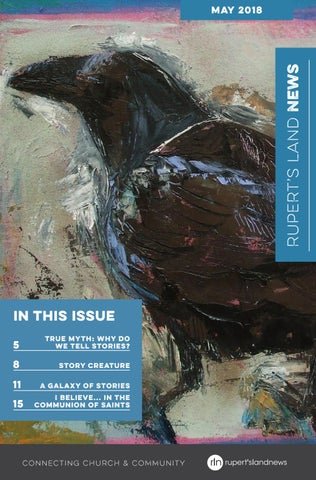
Editorial offices: Anglican Lutheran Centre 935 Nesbitt Bay Winnipeg Manitoba, R3T 1W6 RLN exists to explore issues at the intersections of faith and life. In doing so we solicit and publish a range of opinions, not all of which reflect the official positions of the Diocese. We acknowledge that we meet and work in Treaty 1 Land, the traditional land of the Anishinaabe, Cree, and Dakota people and the homeland of the Metis Nation. We are grateful for their stewardship of this land and their hospitality which allows us to live, work, and serve God the Creator here. RLN welcomes story ideas, news items, and other input. If you want to be involved in this media ministry, please email the editor. Contents copyright 2018 by Rupert’s Land News. All rights reserved. Cover: "Raven" by Clare Shepherd, creative commons. Ravens are featured in many mythologies, including Norse, Celtic, Greco-Roman, and, of course, Biblical. They are also found in the mythologies of the Haida, Coast Salish, Inuit, and other Indigenous Peoples of the Pacific Northwest Coast.
2
E dito r ial
C. S. Lewis once said that myths were lies and therefore worthless, even though "breathed through silver." It seems difficult to believe, given that Lewis wrote The Chronicles of Narnia, one of the most well known fantasy series to date. But, those books were written in the late 1940s and early ’50s, a decade after he spoke that ill-fated line to his friend, J. R. R. Tolkien. Tolkien didn’t agree with Lewis and, after their conversation, wrote his defence of myth-making in a poem called “Mythopoeia,” dedicated from “Philomythus to Misomythus” (which means “myth lover” to “myth hater”). I recommend reading the entire poem, but I’ll pull out a few lines below:
Myths are stories humans tell about ourselves. In the Western world, we’re most familiar with classical myths – the stories of Olympian gods and tragic heroes. Their stories have become cautionary tales, like that of Icarus, and his wings made of feathers and wax, or the Trojan horse. Today, while humanity doesn’t necessarily believe in Zeus anymore, we have a new pantheon in popular superheroes, like Superman and Wonder Woman. Their stories do the same thing as did the myths of the past: they explore human themes, like love, pain, and death, with super-human characters
Though all the crannies of the world we filled with elves and goblins, though we dared to build gods and their houses out of dark and light, and sow the seed of dragons, 'twas our right (used or misused). The right has not decayed. We make still by the law in which we're made.
RUPERT’S LAND NEWS
in extraordinary circumstances. And Christians, too, have our own myths. Our lives are marked by the stories of Jesus’ birth, life in ministry, death, and resurrection; we tell them season after season, year after year, because they are essential to who we are. This issue on Myth explores the “why” behind myth-making, with articles by Loralee Dyck and Matt Civico. And, Hannah Foulger takes us in another direction with her article about Star Wars and the quintessential Hero's Journey. Tolkien believed it was a human right to make myths and that God created us to do so. When we look at the myths of the past, we see a roadmap through human imagination full of markers that show from where we have come and where we are going. We see the deep cultural roots and identities of our ancestors. And, I think, we see a spark of the Divine working through all of us.
3
Pasto ral note
The Truth of Bi bl ical Myths Donald Phillips
In 1977, John Hicks wrote a book entitled, The Myth of God Incarnate. It caused quite a stir – and probably rightly so – as the book’s title seemed to imply that the notion of God being incarnate in Jesus Christ was mythical as opposed to real. Dictionary sources are always clear that a “myth” is something that cannot, in and of itself, be verified for historical accuracy. It may be true in its details, or it may not. However, a myth of any seriousness is intended to convey truth – unlike a fable or fairy tale. It may very well be that some of the incarnation stories in the four Gospels contain mythical material, meaning that the details cannot be verified – did shepherds really see and hear angels singing? Those stories may not be historically accurate, but their real truth and value lay in the reality they are trying to convey – that God came into our midst as the human being Jesus who would bring salvation to all people. But if the Bible is “the Word of God,” why would it contain mythical material? As disciples of Jesus Christ, don’t we believe the Scriptures to be true? Yes, we absolutely do, and that is precisely why they must
RUPERT’S LAND NEWS
contain mythical material. The Scripture writers (and we interpreters) are attempting to describe and explain things about the Divine that are simply beyond both our lived experience and intellectual understanding. So we employ myth to explain the truth of something we don’t completely grasp – that is only partly within our lived reality.
contain elements that cannot be historically verified. But they also all attempt to convey the truth that Jesus had overcome death and was once again alive; that he saw himself still very much in relationship with his followers; that he was going to continue that relationship forever; and that they should be filled with hope and joy as a result. Everything he
We employ myth to explain the truth of something we don’t completely grasp. For example, we have just been reading the stories of Jesus’ resurrection. Each Gospel account references Mary Magdalene as an initial and key witness to Jesus’ resurrection. But in Mark’s account, Mary doesn’t actually encounter Jesus initially. In Matthew’s version, Mary doesn’t encounter Jesus at the tomb, but meets the Risen Christ while she is running to tell the other disciples about her experience. Luke’s account has Mary explaining her experience at the tomb to some skeptical disciples. And in John’s Gospel, Mary doesn’t encounter Jesus until after Peter and another disciple inspect the tomb. So which story is true? They all are! Are they mythical stories? They all may
promised and taught about the Kingdom of God would now become fulfilled – especially for them. Sometimes using myth is the only way we can begin to adequately experience the truth of God and ourselves with God.
Donald Phillips, Bishop of Rupert’s Land
4
My th
True Myth:
Why do We Tell Stories? Loralee Dyck
Once upon a time… Sing in me Muse and through me tell the story… In a hole in the ground, there lived a hobbit… Perhaps you’ve heard these lines before. They are a signal. They tell us something is coming, something strange and beautiful, something wild and imaginative. But how often do they say anything new? You know how they’re going to end, and what things could happen, must happen. As myth, they echo what already exists within each of us – the bigger story, the “true myth,” as C. S. Lewis calls it. The story we all know: “In the beginning was the Word…” Why do we tell stories? As a writer of fantasy who’s studied medieval and classical myth, I’ve often heard Christians ask, “So what’s that good for?” Shouldn’t I be studying the Bible, or telling people about Jesus, or practising better financial stewardship? While these are noble pursuits, my answer is no. I do what I do because I’m convinced there’s nothing more essential to human nature than telling stories. We are created in the RUPERT’S LAND NEWS
image of Creator God; we narrow and selfish. Stories are God-breathed. It’s only that are about other people natural that we would long open our imaginations. to create. Our spirits are When I read of Helen in The not content with eating and Iliad, lamenting that “in all sleeping and reproducing, wide Troy / no one is left as the animals do. We are who will defend me, none,” made for more. We are I am moved to pity. Helen made for an eternal kingdom that never dies. Our imaginations are designed to connect with each other, and with God, in loving and holy communion. Every time I pray, I am speaking to God about my story – what I did or didn’t do, what I long for, the people I care about. Every time we open our mouths, we are weaving narratives from the endless minuscule events of our lives. Yet if we only spoke about ourselves, our "Helen on the Walls of Troy," by Frederic Leighton, vision would 1865. become 5
My th
"The Return of the Prodigcal Son," by Rembrandt, circa 1668.
becomes to me all mourners and exiles, all who are trapped in war and regret. I learn to see from another’s perspective, to feel another’s pain, to think as they do. A good story catches and holds us. Like Coleridge’s wedding guest in the Rime of the Ancient Mariner, our minds are compelled to sympathy, and we leave “sadder and wiser.” Stories teach us about each other, and, by stepping into them, our views are challenged. So far so good, you might think, but why not stick to true stories? Ones that actually happened? History, news, and biography can do the same thing – can’t they? All stories can be powerful, but myth goes further. Consider the ministry of
RUPERT’S LAND NEWS
Jesus. Much of his teaching was done through parables: stories that were made up, often fairy-tale-like in their
structure. Take, for example, the greatest parable of all, which begins, “There was a man who had two sons.” The story never happened. There was never an actual father who split his inheritance and watched his youngest son run off into ruin. And yet don’t we feel the truth in this story? Don’t we yearn with the father for the return of his son? Don’t we celebrate with the exuberance of the homecoming? This story is true because it echoes the greater Story. It speaks of sacrifice, death, and rebirth – redemption into new life. Likewise with myth. In his poem, “Mythopoeia,” J. R. R. Tolkien writes, “The heart of man is not compound of lies, / but draws some wisdom from the only Wise.” We all
[Grab your reader’s attention with a great quote from the document or use this space to emphasize a key point. To place this text box anywhere on the page, just drag it.]
It’s all about relationships… I believe that creating relationships under many circumstances is the essence of trust and a natural ability to rely up one another when needed. You may not need me for many years, but when you do, I’ll be here.
Richard. Richard Rosin Funeral Director Ltd. is a full-service funeral company, serving families and the community – providing funeral and cremation services and educational seminars. P: 204-219-1126
E-mail: info@richardrosin.ca Web: richardrosin.ca 196A Tache Avenue at Hanbury Street
6
My th have access to God’s revelation. We draw from eternal truths, stories that resonate in us deeper than facts. Odin, the All-Father of Norse mythology, sacrifices “himself to himself” upon Yggdrasil, the great gallows tree of the world. The Greek god Dionysius is killed and reborn. The Cree hero Wisakedjak, against all hope, remakes a flooded world with the muskrat’s tiny clod of earth. Time and again, myth tells the Great Story, if not in whole, then in part. By partaking of these myths, our spirits are stirred up towards God. Myth is necessary
because it calls us higher. In our world of flat consumerism and cheap entertainment, it’s easy to be drowned in mundanity and lose the spark of our calling. We are told to grow up, to be practical, to get a real job. In fact, we are trading the glories of reality for a lesser existence. When confronted by the derogatory accusation of “escapist” literature, Tolkien responds in “On Fairy Stories”: “Why should a man be scorned if, finding himself in prison, he tries to get out and go home?” Tolkien longed to reach beyond the horrors of war and human
"Wisakedjak" at the MosiaCanada 150 sculpture garden in Jacques Cartier Park in Gatineau, Quebec.
RUPERT’S LAND NEWS
“progress” to a place of true beauty, and so he did by writing stories of courage, redemption, and hope in the midst of anguish. These are the high qualities of humanity, and, as Lewis writes in “On Stories,” “by dipping them in myth we see them more clearly.” Myth reminds us of who we really are. This is the greatest calling of humanity: to press our spirits on towards God by whatever means possible. To reach, as Lewis said in The Last Battle, “further up and further in” towards the everlasting Kingdom.
Loralee Dyck is a writer of imaginative fiction and an English teacher at the Manitoba Institute of Trades and Technology, where she helps adult newcomers explore language and life in Canada.
7
My th
Story Cr e at u r e Matt Civico
God created Adam and Eve in God’s image and every human being who has ever lived reflects this – the imago dei. This means we create because our God is creative; we tell stories because God is a storyteller. Stories are a fitting medium for a God who is called the Word. Whether it’s written down in Scripture, incarnate in Jesus Christ, or eternally upholding the universe, God is telling a story. And God’s creatures, likewise, can’t seem to help themselves. Despite the distortion of the Fall, humanity continues to create stories within God’s grand narrative, yearning for resolution and restoration. People have been playing variations on the same themes for millennia: creation, fall, and redemption have been stamped all over our stories.
Our first stories were spoken aloud. The ancient Greeks, for example, told the story of Odysseus and his long road home from Troy over and over again until Homer wrote it down in the late 17th or early 18th century BC. In this epic poem, Odysseus eventually reunites with his family and defeats those who threaten to take everything from him. This isn’t what generations of hearers and readers remember, though. Odysseus lives on because of his longing. Today, an “odyssey” doesn’t refer to a triumphant return; it means “a long wandering or voyage usually marked by many changes of fortune.” Even if the ancient Greek experience is foreign, there is a deposit of truth: humanity longs for home. Eighteen hundred years later, a poet with one foot
Odysseus tied to the mast of his ship to keep from steering towards the sirens.
RUPERT’S LAND NEWS
in paganism and one in Christianity told a story of strength and heroism – the epic Beowulf. Yet, for all its grandeur and glory, Beowulf is a sad story. The hero triumphs over monsters, wins the love of his people, and even reaches a ripe old age, but something is wrong. For all his great deeds, Beowulf still succumbs to the final enemy: death. Human glory is extinguished and the reader is left wondering does it have to be this way, must death be the end? Some of the greatest moments in literature turn on the reversal of this curse, this darkness that has hung over us since the first sin. Our heroes rail against death because it ought not to be the rule of the world, not forever. There’s great continuity in storytelling. Just as we have been exploring the same themes, so too do we look for stories that echo – and anticipate – the biblical narrative. When J. R. R. Tolkien wrote The Lord of the Rings, he did so to reflect the creative nature of God. He created Middle-earth to reflect our Earth. Like ours, Middle-earth is a good world marred by evil – it is full of blessings and curses. It reminds us that the world is a dark place, “but still there is
8
My th much that is fair, and though in all lands love is now mingled with grief, it grows perhaps the greater.” When a crown-less king says “deeds will not be less valiant because they are unpraised” or an immortal elf lord declares that small hands move the wheels of the world, I believe it because I need to. And I can believe it because there is a power above the oppressive powers of the world. The story makes its case for this truth by elevating the good, the simple, and the small in ways reminiscent of Christ’s upside down kingdom. Jesus illustrates the nature of his kingdom in the parables of the prodigal son and the lost coin. God pursues those
RUPERT’S LAND NEWS
who are considered least worthy, like the single coin and the ungrateful runaway; God rejoices over them – not the righteous. God’s story climaxes in redemption and ends in restoration, the fruit of eucatastrophe, Tolkien’s word for the sudden and unexpected good turn in a story. The rule of the world is not death and death becomes an aberration. The gospel is a call to tell better stories that echo the greatest story. In the past we told these stories in part, and we continue to do so by weaving the threads of creation, fall, and redemption into stories for our time. Films like Mad Max: Fury Road trace an arc of redemption across a fallen world, while others like Ex Machina examine the costs of human creativity, and like all good stories they refuse to ignore the consequences of sin. For his part, Tolkien believed we will continue telling stories even after hearing God’s own: “Story, fantasy, still go on, and should go on. The Evangelium has not abrogated legends; it has
hallowed them, especially the ‘happy ending.’” The truth of the even the most unbelievable stories is apparent in the moment when the spell of a story is broken from outside, when the light of truth leaks through The first meeting of Aragorn and Arwen, characters from The Lord of the Rings, by Anke Eissmann.
the page or frame and offers hope. Our imaginary worlds are acquainted with the darkness of fear, loss, and death, just as we are, and this reality sets the stage for the great reversal of eucatasrophe. Life overcomes death; love overwhelms hate; light dispels darkness just in time. Good stories are true because they remind us there is light beyond the darkness; the best story reminds us that the light shines in the darkness.
Matt Civico is a freelance writer from Montreal, QC, where he and his wife do their best to prize food and cheer and song above hoarded gold. He blogs at mattcivico.com and is also a staff writer for Area of Effect magazine. 9
“Recreation” by the late Cree artist, Carl Ray An excerpt from The Truth About Stories,
2003 CBC Massey Lecture by Cherokee writer Thomas King “There is a story I know. It’s about the earth and how it floats in space on the back of a turtle. I’ve heard this story many times, and each time someone tells the story, it changes. Sometimes the change is simply in the voice of the storyteller. Sometimes the change is in the details. Sometimes in the order of events. Other times it’s the dialogue or the response of the audience. But in all the tellings of all the tellers, the world never leaves the turtle’s back. And the turtle never swims away. “One time, it was in Prince Rupert I think, a young girl in the audience asked RUPERT’S LAND NEWS
about the turtle and the earth. If the earth was on the back of a turtle, what as below the turtle? Another turtle. And below that? Another turtle. “The girl began to laugh, enjoying the game, I imagine. So how many turtles are there? she wanted to know. The storyteller shrugged. No one knows for sure, he told her, but it’s turtles all the way down. “The truth about stories is that’s all we are…. “… Give this a thought. What if the creation story in Genesis had featured a flawed deity who was understanding and sympathetic
rather than autocratic and rigid? Someone who, in the process of creation, found herself lost from time to time and in need of advice, someone who was willing to accept a little help with the more difficult decisions? “What if the animals had decided on their own names? What if Adam and Eve had simply been admonished for their foolishness? “I love you, God would have said, but I’m not happy with our behaviour. Let’s talk this over. Try to do better next time. “What kind of a world might we have created with that kind of story?” 10
my th
A Galaxy of Stories Hannah Foulger
A long time ago, in a galaxy far, far away… Any treatise of the history of filmmaking would be remiss to mention the influence of George Lucas. Director/creator of the Star Wars universe (which spans movies, TV shows, video games, comic books, toys, and more), Lucas initiated a world of storytelling with one screenplay about a hero named Luke Starkiller (before the fortunate revision to Luke Skywalker). Lucas was two drafts in when he discovered Joseph Campbell’s Hero of a Thousand Faces, which explained Joseph Campbell’s theory of the monomyth, also known as the Hero’s Journey. Simply put, Joseph Campbell analysed myths from around the world and concluded that they all had the same basic three-act structure of departure, initiation, and return. Lucas used the Hero’s Journey to structure Star Wars, which gave the film a sense of universal mythos
RUPERT’S LAND NEWS
and contributed to the film’s unprecedented success. In 1990, 13 years after the original release of Star Wars, Robert Mckee, a Disney employee, caught wind of Lucas’ plan and read Hero of a Thousand Faces. He realized that the value of Joseph Campbell’s monomyth and sent out a memo that said this was how all films should be written from then on. Not only did the Hero’s Journey become industry standard, but it launched
Robert Mckee’s career. His book Story is the screenwriting bible for the modern filmmaker and McKee has taught workshops and master classes on screenwriting and storytelling around the world, to writers of all types. One cannot deny the influence of Campbell, Lucas, and Mckee across the disciplines. I often refer back to the Hero’s Journey while in the initial stages of plot development and most films can be charted along the Hero’s Journey, as well as
11
my th many novels and plays. But there is a problem with the Hero’s Journey. The reason this form has been told again and again, all through the stages of humanity’s development, is that it conceptualizes the myth of achievement and endings. The Freytag’s pyramid structure – in which someone works hard, accomplishes their goal in a tense, conflicted climax, and things resolve, and to which the monomyth adheres – is wishful thinking. Things don’t operate like that in real life. One achievement begets another trial after another. There is rarely a throughline we can follow chapter to chapter in our lives for one specific goal. There are millions within one lifetime. Even love isn’t a finality. E.M. Forester, in his
RUPERT’S LAND NEWS
book Aspects of the Novel, writes: “Love, like death, is congenial to a novelist because it ends a book conveniently. He can make it a permanency and his readers easily acquiesce because one of the illusions of love and attachment to love is that it will be permanent.” Anyone who has been in a relationship knows that, when two people get together, it is hardly the end of a story. Even if you don’t subscribe to Forester’s pessimistic ideology, you understand that a relationship is hardly the end of conflict. This idea of a beginning, achievement, and end, is a myth in itself. A story like this is comforting because it gives us the illusion that our own lives have that kind of structure. The monomyth is especially useful in Western storytelling because it upholds the capitalist ideal that, as the main character of your own story, if you work hard, you will conquer your enemies and return home to the love and affection of your peers. However, we know that working hard is never a guarantee of success. As comforting as the monomyth is, it is, like every story, a comforting illusion of certainty in an uncertain world. Though Lucas relied on the Hero’s Journey, the Star Wars universe also supersedes it, containing multiple
journeys over much time and space. One story of three friends – Luke Skywalker, Leia Organa, and Han Solo – begat a universe of stories, often around the Jedi Order, the dangers of the Sith, and the mystery of the Force. The Hero’s Journey is repeated, expanded, and problematized by the loose structure defined by video games and hundreds of comic books and novels. The story continues in 1,000 ways. Lives, and the universe, expand. One trilogy of films cannot contain it all.
Hannah Foulger is a British Canadian theatre artist and writer from Winnipeg, Manitoba. Her disability poetry has been published in Matrix and performed in Sick + Twisted theatre’s Lame Is... cabaret. Her plays Clink and The Bar Scene have been produced at the Winnipeg Fringe Festival.
12
C o mmunity
PARISH NEWS ROUND UP St. Luke's Anglican
The St. Luke’s Columbarium is a ministry for parishioners, the wider communities of Osborne Village and Fort Rouge, and the city. We welcome people from all denominations who may wish to place the remains of their loved ones in this facility closer to their own neighbourhood. The Chapel is accessible weekdays and by appointment. The Columbarium is located in the Soldiers’ Chapel of the Parish Church of St. Luke, on the lower level of the Parish Hall. Constructed in 1914, the Chapel became a memorial to those parishioners who served in the First World War. Several memorials are contained within its walls, including a beautiful stained glass window and a memorial book containing photographs of servicemen from both
world wars. The Columbarium was built within the renovated Chapel as part of St. Luke’s Centennial celebrations in 1997. Burial niches for ashes are fronted with oak doors and are marked with a brass plaque. Each niche can hold two urns. Special doors are available to cover two burial niches and are intended for a family. A said Holy Eucharist is celebrated there every Thursday at 9:15 a.m. and all are welcome. The Columbarium and its niches are cared for and maintained by a trust fund and physically protected within the security systems of the church. If you would like more information about the Columbarium when making your own funeral arrangements, please call St. Luke's at 204-452-3609, between 9:00 a.m. and noon, Monday to Friday.
This page of the Parish News Round Up is sponsored by Richard Rosin. For more information, see his ad on page 6.
RUPERT’S LAND NEWS
13
C o mmunity Anglican Church of Canada
The ACC Resources for Mission Coordinating Committee has developed a Parish Giving program called “Giving our Thanks & Praise.” This multi-week approach includes Parish leadership and preachers, and involves rigorous preparation, worship, and conversation for and with the entire parish community. “Giving our Thanks & Praise” develops Generosity for Ministry and Mission. The program aids us in thinking beyond ourselves and building, and into the world God has made. Resources for Mission staff have offered their services to help you prepare to use this program. Email Geoff Woodcroft, the Diocese of Rupert’s Land Archdeacon for Stewardship Development, to order this program fro your parish and setup time with a national staff person, or call 204-475-7549.
Primate’s World and Relief Development Fund
PWRDF would like to thank all of its volunteers and parish representatives for their hard work and commitment. You can check out their thank you video here.
May Anglican Cycle of Prayer
The Anglian Cycle of Prayer for May is now available. You can download it at the Diocesan website.
Upcoming Issues
Thorvaldson Care Center AN INTERMEDIATE CARE FACILITY FOR SENIORS 24 hr care and supervision Registered Nurse on site Assistance with medications, dressing, hygiene
All meals, laundry and housekeeping Recreation programs Private bed-sitting rooms
OVER 55 YEARS
caring for senio rs
495 Stradbrook Ave | Winnipeg, MB | R3L 0K2
ph (204) 452-4044 | fax (204) 452-4054 thorcare@shaw.ca | www.thorcare.ca
RUPERT’S LAND NEWS
In June’s issue, our last before summer break, we’ll explore Pop Culture and how to be more thoughtful consumers of media.
Rupert's Land News is always looking for writers and artists! If you'd like to write for RLN or submit some artwork, please send me an email with your name and the topics on which you'd like to write, or samples of your artwork. In particular, I am looking for people who might be interested in writing reviews of books, movies, or CDs. You can also send me an email if there are any themes or topics you'd like to see in future issues of RLN. – Kyla Neufeld, Editor 14
Via Me dia
I Believe…
in the Communion of Saints Mary Holmen
In the Clinical Pastoral Education, one of the skills we teach is theological reflection. The method I use is based on Robert Kinast’s 1996 book Let Ministry Teach: A Guide to Theological Reflection and his subsequent book Making Faith Sense: Theological Reflection in Everyday Life. Theological reflection is not reserved for clergy or professional spiritual care practitioners. It is about connecting faith with activity and learning from our experiences. Its purpose is to heighten our sense of where and how God is present in our experiences and to encounter the living God in these experiences. It is a practical activity; it asks us to consider what difference God’s presence makes, and what God expects of us as a result. Anyone can do it. There are several “ingredients” in theological reflection: a meaningful experience, a faith perspective, the willingness to enter the experience and explore it as fully as possible, a reflection group, and the willingness to enact the changes that God seems to be asking of us. Theological reflection is best done in a group, which can see more than an individual. It keeps us honest and can
RUPERT’S LAND NEWS
prevent us from distorting or misreading an experience. Here are Kinast’s five steps for theological reflection: 1. Choose an experience that makes you ask questions or surprises you. 2. Describe the experience in detail. 3. Enter the experience. Who is involved? What issues or values are at stake? What themes emerge? 4. Learn from the experience. What insights do you discover? What is God asking of you? 5. Enact your learning. Plan concrete steps to put it into practice. This brief summary does not do justice to Kinast’s work, but I want to use it to share some thoughts about my recent trip to New Zealand. I’m breaking one of the rules of theological reflection by writing this alone. I have wanted to visit New Zealand since I was a child. Part of my “mission” was to find the burial place of my great-great-great uncle, Thomas Whytehead, who went from England as a missionary in the 19th century. He has been part of my family’s story ever since I can remember. Through
Thomas Whytehead's grave.
the Diocese of Auckland, I contacted the archivist at St. John’s College, the theological college for the Church of Aotearoa, New Zealand, and Polynesia. I spent several hours in the archives reading copies of his correspondence, as well as what others wrote about him. Thomas Whytehead received his BA and MA from St. John’s College, Cambridge. He wrote poetry from a young age, some of which was published. He was ordained and served a curacy on the Isle of Wight, eventually becoming the chaplain to George Selwyn, the newly appointed Bishop of New Zealand, and the intended head of the new theological college. Thomas sailed from England in late 1841 on a six-month voyage, during which he contracted tuberculosis. When
15
via me dia they reached Australia, he was so weak he had to stay behind while the rest of the party carried on. He eventually reached New Zealand in October 1842, settled into the mission house, and began tutoring candidates for ordination, but it became clear he was dying. His final letters home contain messages for his family and arrange for the disposition of those possessions he had not already designated. One of his last works was a translation of the evening hymn “Glory to thee, my God, this night,” into Maori, which he called “my legacy.” He died on March 19, 1843, at the age of 27 and was buried in the churchyard at St. John the Baptist, Waimate North, in the Bay of Islands region. The Maori inscription on his grave reads “Blessed are the pure in heart, for they shall see God.” Making what amounted to a personal pilgrimage was a highlight of my trip. Reading Thomas’s letters and the words of others gave me a sense of him as a person and of his faith. At the Mission House, now a museum, I saw the study he used and the bedroom where he died. The fact that I was there two days before the 205th anniversary of his death and on the third anniversary of my husband’s death added a layer of poignancy to my visit.
RUPERT’S LAND NEWS
In the weeks since my return home, I’ve reflected on why this experience made such an impact on me. At this point, I find myself being led toward a greater appreciation of the communion of saints. We affirm our belief in this holy community each time we say the Apostles’ Creed, but I wonder how much thought we give to our words. Do we, and I include myself, regard statements about God the creator and Jesus as the “important” parts of the Creed? Do we hurry through the rest as though it were just a conclusion? If we do, we miss something crucial. The Church, the communion of saints, the forgiveness of sins, the resurrection of the body, and the life everlasting flow from the creating, redeeming, and sanctifying love of God in Christ and through the Holy Spirit. This love unites the whole people of God, past, present, and future, in one body, with Christ as the head. Writing about resurrection, Paul asserts, “If Christ has not been raised, those who have died in Christ have perished,” and goes on to ask, “If the dead are not raised at all, why are people baptized on their behalf?” (1 Corinthians 15: 18, 29). While baptism on behalf of those who die unbaptized is not part of our practice today, I understand why someone would want to perform this loving action.
Paul’s point is that resurrection and new life are God’s gift for both the living and the dead. When we gather for worship, our prayers include both intercessions for the needs of the living and thanksgivings for those who have died. Through our statements of faith and our liturgies, we express our confidence that God’s goodness and faithfulness extend beyond the bounds of this life. The communion of saints is real, and through this experience I feel bound more tightly to all the saints across space and through time. I invite you to reflect on the saints who are part of your faith story. What better time than in this season of resurrection?
The Rev. Canon Mary Holmen is Pastor for Parish Caring Ministries in the new Collaborative Ministry Team at St. Peter’s, Winnipeg. She is also a certified Specialist in Spiritual Care and a certified Supervisor Educator of Clinical Pastoral Education with the Canadian Association for Spiritual Care.
16