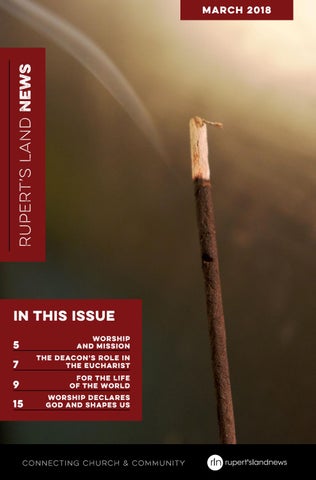
RUPERT’S LAND NEWS
Ma r c h 2018
IN THIS ISSUE 5
Worship and Mission
7
The Deacon's Role in the Eucharist
9
For the Life of the World
15
Worship Declares God and Shapes Us
CO N N ECT I N G C H U R C H & CO M M U N I T Y
rln
rupert'slandnews
rln
rupert'slandnews
Publisher | Bishop Donald Phillips Editor | Kyla Neufeld Accounting | Bernice Funk Advertising | Angela Rush Layout & design | cityfolkcreative.ca Rupert’s Land News - is published 10 times per year (September - June) by the Diocese of Rupert’s Land, in the Anglican Church in Canada. It connects churches and communities from Portage la Prairie, MB, to Atikokan, ON, by offering news, events, opinion, and ideas to 6,000 readers per month. RLN is available in a variety of formats: • • • •
rupertslandnews.ca facebook.com/rlandnews twitter.com/rlandnews instagram.com/rlandnews
We also deliver timely news and information via a weekly email. Sign up at: rupertslandnews.ca/email
CONNECTING CHURCH & COMMUNITY
Editorial offices: Anglican Lutheran Centre 935 Nesbitt Bay Winnipeg Manitoba R3T 1W6 RLN exists to explore issues at the intersections of faith and life. In doing so we solicit and publish a range of opinions, not all of which reflect the official positions of the Diocese. We acknowledge that we meet and work in Treaty 1 Land, the traditional land of the Anishinaabe, Cree, and Dakota people and the homeland of the Metis Nation. We are grateful for their stewardship of this land and their hospitality which allows us to live, work, and serve God the Creator here. RLN welcomes story ideas, news items, and other input. If you want to be involved in this media ministry, please email the editor at: rlnews@rupertsland.ca.
Advertising: RLN accepts advertising in our monthly magazine Contents copyright 2018 by Rupert’s Land News. and our weekly email. Our rate sheet is available All rights reserved. at rupertslandnews.ca/ads. To discuss advertising Cover: PxHere.ca. call (905) 630-0390 or email: rlandnews.ads@gmail.com.
RUPERT’S LAND NEWS
2
E dito r ial
The first time I attended an Anglican service, it was for evening prayers and I had never experienced anything like it. I stumbled through the liturgy, not knowing when to stand or when to sit, or how to follow the cadence of the prayers and responses. As I began to attend Anglican services more regularly, however, it was the liturgy that kept me coming back. In the liturgy I found poetry and deeper meaning, something I didn't know I'd been missing in my previous experiences of Evangelical services. I love how worship centres
around the Eucharist, how we extend the Peace to each other as a symbolic gesture of reconciliation in Christ. I love the rhythm of the Church calendar, how each season brings its own practices. I wanted to put together an issue on worship that didn't involve music. Unsurprisingly, this issue turned into one about the liturgy. In this issue, Donna Joy and Ruth Widdicombe offer reflections on liturgy as worship and mission. There is also a piece from Andrew Rampton about the deacon's role in the Eucharist. And, in via media, John Stafford explores the theology of worship. Fifth Mark of Mission
If you've been reading the Parish News Round Up section, you'll have noticed some updates from the
Creation Matters Working Group, which was formed to encourage Anglicans to live into the Fifth Mark of Mission: “to safeguard the integrity of creation and sustain and renew the life of the earth.” As such, I've been working with Beverley Eert, the Creation Matters representative from the Diocese of Brandon, to include some tangible ways Rupert's Landers can practice the Fifth Mark of Mission in their own homes; I'll be including these in the next few issues. This month, Beverley has provided instructions on proper food storage and tips on how to build a working cellar. What do you appreciate about liturgy? Or, how are you practising the Fifth Mark of Mission? Let me know by sending me an email.
Photo: Chuttershap
RUPERT’S LAND NEWS
3
Pasto ral note
We Need to Understand C h r i s t ia n Wor sh ip ! Donald Phillips
I am currently writing a review of the book, The Altars Where We Worship by Juan Floyd-Thomas, Stacey Floyd-Thomas, and Mark Toulouse, which makes a convincing argument that many people satisfy their religious needs by engaging in worship-like behaviour in so-called “secular” places including sports arenas and entertainment complexes. So, what defines worship, and particularly Christian worship? The word worship comes from Old and Middle English roots and essentially means to behave in such a way as to acknowledge (if not celebrate) the honour and worth of someone. Christians engage in activities (rituals, religious observance, etc.) that attempt to express the supreme honour and “worth” of God; it is important to note that the focus is on the “person” that is being worshipped more than the worshipper. On the other hand, The Altars Where We Worship focuses more on the religious activity of the worshipper and notes that, regarding these “secular” altars – “these altars combine aspects of religiosity that people experience as transformative, prescriptive, and inspiring.” The description of worship in this understanding focuses more on the worshipper and RUPERT’S LAND NEWS
how he/she uses the acts of worship to find a more transcendent meaning and purpose to life – and their life in particular.
seek to worship – to search for the truth about God as revealed in Jesus Christ, presented in the Scriptures, and continually expressed in
Christian worship is more than just an expression of heartfelt appreciation and adoration toward something or someone beyond ourselves.
In the story of Jesus and the woman at the well in chapter 4 of John’s Gospel, Jesus tells her not to focus on where God should be worshipped but more on how that should happen. He says, “the true worshippers will worship the Father in spirit and truth.” From the context of the remainder of John’s Gospel, this type of worship involves both a true understanding of God as well as a desire to express worship with deep passion and conviction. Christian worship is more than just an expression of heartfelt appreciation and adoration toward something or someone beyond ourselves. And it is more than simply a sincere effort to find a deeper and more profound understanding about the world and our place in it. It involves us actually coming to know the God whom we
the local context through the Church. All we can do is engage in enlightening study, reflection and prayer in such a way that we are able to express our adoration to the true God we are coming to know. And because of who God is, and God’s love for us, we are transformed as well.
Donald Phillips, Bishop of Rupert’s Land
4
Wo r ship
Worship and Mission:
Blessings Received and Given Donna Joy
As global, national, local atrocities are seemingly on the rise, humanitarian efforts abound. God’s work is flourishing as countless spokespersons and activists respond to the needs that exist throughout the world, inspiring others to do the same. For example, David Letterman’s recent Netflix series, My Next Guest Needs No Introduction, focuses on current needs, like sponsoring refugees, and historical events, such as the civil rights movement, which so desperately need to be remembered within this current political climate, particularly south of the border. So, what is the difference between this brand of reaching out and the missional work to which the Church is called? The answer is motivation. From what roots do these actions arise? It is often said that people respond in generous ways because it makes them feel good. Conversely, we – the Church – are called to live generously, because we recognize God’s generosity to us. Our roots for missional work begin with Abram to whom God said, “…I will bless you; I will make your name great; and you will be a blessing.” (Genesis 12:2). As we have been, and RUPERT’S LAND NEWS
continue to be, blessed, we are required to be a blessing to others. Worship and mission are inseparable. Our liturgy is the very presence of Jesus, the Servant of justice, found in the people gathered, the Word proclaimed, the Body and Blood shared. This is where we discover, and rediscover, our roots, week after week, year after year. This is where we are fed, informed, inspired; and this is from where we are sent. In The Liturgical Year: The Spiraling Adventure of the Spiritual Life, Joan Chittister makes the point, “To live the liturgical year is to keep our lives riveted on one beam of light called the death and Resurrection of Jesus and its meaning for us here and now.” For Christians, this is the springboard from which all mission occurs, and it is experienced within our liturgy in four parts. The Gathering of the Community
As we gather together for worship each week, we do so with the crucified and risen Christ as our unifying force. Though we are diverse, the liturgy promises to free us from all division so that we may discover and
embrace a light – the light – that can unleash us from all that separates us from God, ourselves, each other, and the world in which we live. As we acknowledge Jesus as the unifying force within the diversity of the church, we are called to be channels through which this unity is made known in the world. The Proclamation of the Word
The entire biblical narrative, from Genesis to Revelation, speaks of a God who, in love, is determined to make things right with humanity: to counter the fall and restore shalom. For now, however, the world is not as God intends it to be. Our reading of God’s Word is essential because it embraces the whole story of God’s unrelenting pursuit of a people and world set right at last, in God’s time and at God’s expense. Through this Sacred text we are reminded that God works through us in the unfolding of this plan. Once we have feasted at the table of God’s Word, the liturgy calls us to affirm our faith. We then pray for the needs of the Church and the world. We engage in the Confession and Absolution, during which we catch a 5
Wo r ship glimpse into a restored relationship with God and each other. Then we share the Peace, which is an outward and visible sign of our anticipation of the reign of God. The Celebration of the Eucharist
In the Eucharist, Jesus gives all and holds nothing back. According to Thomas Cranmer, bread and wine become the true presence of his body and blood, poured out for us in total, self-giving love. God’s relationship with us is a long history of ever-deepening communion. As God, through Jesus, holds
nothing back in the Eucharist, so we must hold nothing back. Sending Forth
Everything in liturgy leads to this. Perhaps instead of saying that we “go to church,” we need to say, “we go to worship so that we may become church.” As Anglicans, all missional work is rooted in gathering with others for liturgical worship so that we may be fed by the Proclamation of the Word, and the Celebration of the Eucharist. The purpose of the dismissal is not so much to
Donna Joy's Recommended Reading List
end the liturgy as it is the consummation: sending the whole community out into the world to love and serve others as we have been loved and served. As individuals, whatever our vocation(s) may be, all that we are and all that we do rises out of God’s selfless love for us; a love proclaimed and nurtured through our liturgy. As church, all our ministries rise from this same selfless love. All truth and reconciliation; acts of forgiveness; concerns for justice and kindness stem from the call to love as we have been loved. As we have been blessed, we are called to become a blessing to others. “As the Father has sent me, even so I send you.”
Liturgy and Justice: To Worship God in Spirit and Truth Edited by Anne Y. Koester Worship and Mission After Christendom by Alan Kreider and Eleanor Kreider Church After Christendom by Stuart Murray A Light to the Nations: The Missional Church and the Biblical Story by Michael W. Goheen The Mission of God’s People: A Biblical Theology of the Church’s Mission by Christopher J. H. Wright God’s Politics: A New Vision for Faith and Politics in America by Jim Wallis The Liturgical Year by Joan Chittister
RUPERT’S LAND NEWS
The Rev. Canon Donna Joy serves as Incumbent at St. Peter's. She is passionate about liturgy and its great potential to shape, inspire, and nurture Christian life. She has also offered liturgical leadership in numerous parishes, the Diocese, as well as the National Church.
6
Wo r ship
The Deacon’s Role in the Eucharist Andrew Rampton
Questions about who does what – and why – in Christian worship can, and have, filled books. Generally, the role of an order (baptized, deacons, priests, and bishops) in worship reflects the role of those people in the life of the Body of Christ outside of worship. Every community has different circumstances and resources when they gather to worship, though not every parish has a deacon present for their liturgy on a regular basis. When present, there are a number of traditional and historical roles that deacons have in a Christian community’s celebration of the Eucharist.
If this article was a single sentence, it would be: The deacon proclaims the Gospel, leads prayers, assists at the altar, gives directions to the people, and coordinates ministries. These duties are covered during a deacon’s
A deacon’s ministry in and out of worship is centred on helping others know the love of Christ, both in words and deeds. What better liturgical expression than to proclaim the Gospel during worship? ordination, in the examination. Deacons affirm that they will make Christ and his redemptive love known in the world, interpret to the Church the needs, concerns, and hopes of the world, and assist the bishop and priests in worship and the ministration of God’s word and sacraments. Deacons proclaim the Gospel in worship as a liturgical reflection of their promise to make Christ known in
RUPERT’S LAND NEWS
the world. A deacon’s ministry in and out of worship is centred on helping others know the love of Christ, both in words and deeds. What better liturgical expression than to proclaim the Gospel during worship?
Deacons prepare the altar for the celebration of the Eucharist: receiving the bread and wine, filling the chalice, and setting the bread and wine in place. Historically, it is the priest who shares the bread and the deacon who shares the chalice with the people during communion. Deacons also assist with ablutions after communion is shared and removes vessels and linens no longer needed from
7
Wo r ship the altar. These duties reflect the deacon’s call to assist in worship and the ministration of sacraments, but are also reflective of the deacon’s traditional, historical role as an organizer and administrator. For much of the Church’s history, deacons were the managers of ministries, such as visiting of the sick and imprisoned, distributing food and money to those in need, and administrating hospitals and hospices. These ministries of assistance and hospitality are reflected in the deacon’s traditional liturgical role of caring for the material details at the altar before and after the Eucharistic prayer, elevating the chalice at the end of the prayer, and carrying the chalice during communion. Also related to these ministries of service is the deacon’s traditional role as the leader of the prayers of the people. Deacons promise to interpret the needs of the world to the Church and is are, traditionally, on the front line of the Church’s ministry to the world during the week, working in hospitals, kitchens, orphanages, and similar places. Deacons were often also the first point of contact for families and members of a community who needed assistance. This daily experience means deacons have their fingers right on the pulse of what their community should be praying about in worship.
RUPERT’S LAND NEWS
Another way deacons assist in worship is by giving directions to the people. In many traditions it is the deacon who says “Let us pray,” before the presider prays the collect, prayer over the gifts, and prayer after communion. Similarly, when the priest has pronounced the peace, it is often the deacon who invites the people to greet one another in the name of the Lord. Deacons also often give directions regarding posture, inviting the congregation to sit, stand, or kneel. This role as organizers and direction-givers in the life of the Church is also why deacons are traditionally responsible for coordinating and supporting the liturgical ministries of the baptized. Historically, it is deacons who organize the rota of readers, servers, greeters and other lay ministries in worship. In many traditions, deacons do a great deal of singing. The Gospel and prayers of the people might be chanted, rather than spoken. Singing can be a beautiful means of sharing these important words with a community and, in many spaces, makes the words easier to hear. Deacons also serve as leaders of the congregation’s sung responses in dialogues with the presider and support the congregation in their singing of psalms and hymns. Lastly, it is deacons who
dismiss the people at the end of worship. The dismissal is a reminder to everyone, as they leave worship and return to the world, that it is their vocation to serve God and display the love of Christ in their lives, to “Go in peace, to love and serve the Lord.” Deacons’ traditional roles in the Eucharist reflects their roles in the life of the Body of Christ. They serve as an important bridge between the needs of the world and the work of the Church, they coordinate ministries, assist in prayer and worship, and proclaim the Gospel of Christ’s love in word and deed.
Andrew Rampton is a transitional deacon, the acting chaplain at Huron University College, and an MA student. The working title of his thesis is Sunday, Bloody Sunday: Theologies of Martyrdom in the Liturgies of the Anglican Church of Canada.
8
Wo r ship
For the Life of the World:
A Liturgical Theology for the Church Ruth Widdicombe
Christ as an infant was presented in the Temple and received by the very old Simeon and Anna as the revelation of God, as both “light to the Gentiles” and “glory to His people Israel.” The Feast of the Presentation of Christ in the Temple illuminates a fundamental principle of worship: the mystery of Christ coming to us makes possible our reception of and movement towards God. The Liturgy of the Church is the place where God has particularly chosen to make God known and contains five dimensions.
1. The Liturgy of the Church is Mystical. St. Paul says, “We impart a wisdom not of this age… But we speak the wisdom of God in a mystery, the hidden wisdom which God ordained before the ages for ourglory,” (I Corinthians 2:6–7). The liturgy of the church is mystical because it is the dwelling place of God and the extension and offering of Christ's body for the world. As Leo the Great so famously said: “Ever since Christ is no longer visible among us, the visible presence of our Redeemer passed over into the mysteries.” 2. The Liturgy of the Church is Public: It is for the life of the world. It is not a large semi-private domestic gathering; it proclaims to the world the One who made and redeems it. Because it is public, the liturgy of the Church is unapologetically formal, which ensures a true
RUPERT’S LAND NEWS
welcome to the stranger. Its repetitive nature, its poetic incantatory language, its dignified postures and movements, its use of silence and brief bursts of acclamation and its use of dialogue make it available to the non-literate, to children, and to those who might be considered marginal in society. The behavioral expectations of the liturgy are not in-house, bourgeois, composed for the moment, or spontaneous, but because they are formal and public they make room for those who need to both hide and participate. We should avoid all attempts to domesticate or “privatize” the liturgy, to make it comfortable. In Teaching a Stone to Talk, Annie Dillard reminds us that the liturgy is dangerous, and if it is not, it is not worship: “Does anyone have the foggiest idea what sort of power we so blithely invoke? Or… does no one believe a word of it?.... For the sleeping god may wake someday and take offense, or the waking god may draw us out to where we can never return.” We worship a God who is wholly Other. In fear and trembling we approach the One “who dwells in inaccessible light,” but who comes
9
Wo r ship to us as surely as the Sun rises in the east. 3. The Liturgy of the Church is Beautiful. It is beautiful “because it represents the Victory of Christ over the disfigurement of Sin and Death” saysBasil the Great. The art and architecture of the church building, the dignified performance, and the objective enactment of the liturgy proclaim and radiate the power of God to save and transform. 4. The Liturgy of the Church is Disciplined. It is not sentimental, mildly indulging the senses, not is it rationalistic or didactic. Rather it is vigorous and even strange, provoking a deep participation in the mystical work of Christ, his incarnation and death, and his resurrection and ascension. Alexander Schmeman, celebrated Eastern Orthodox priest and author of a short classic text on the liturgy For the Life of the World, warns the modern church to guard against rationalism. The truth of God in Christ is not irrational, but neither is it rational – it is a mystery. What we proclaim in the liturgy is not an explanation of the True, the Good, and the Beautiful. It is rather a witness to the splendor of that truth. In addition, Flannery O’Connor warns the contemporary church against sentimentality, which it
RUPERT’S LAND NEWS
Photo: Thomas Bormans
indulges when it refuses to acknowledge sin and sin’s only possible remedy, which is immersion in the suffering of Christ: “We lost our innocence in the fall of our first parents, and our return to it is through the redemption which was brought about by Christ’s death and by our slow participation in it. Sentimentality is a skipping of this process in its concrete reality and an early arrival at a mock state of innocence, which strongly suggests its opposite.” 5. The Liturgy of the Church is Organic. In the Liturgy we understand palpably that ‘we are surrounded by a cloud of witnesses’ whose prayers and ways of worshipping we enter into and re-engage. As Aidan Nichols reminds us: “Liturgies are not made, they grow in the devotion of centuries.” If we were to “make” them, they would be products of our rational minds. Instead what we enter into is the partial revelation of the mystery of God, which is the gift of God transmitted through the
prayer of the Church through time. The contemporary church needs to recover worship that is objective, solemn – even splendid on occasion, unabashedly public, worship that is not about us, but for us. For the Son of God has indeed come into the Temple, for the life of the World.
Ruth Widdicombe has been the Music Director at St. Margaret's Anglican Church for the past 26 years. She grew up in Nigeria, where she loved the vitality of worship in the African Church, and for most of her adult life in Canada, she has been a part of the liturgical leadership in the Anglican Church.
10
C o mmunity
PARISH NEWS ROUND UP The Search Committee for a Bishop Coadjutor
The Search Committee held its second meeting on Thursday, February 8 via a Zoom conference. Ted Henderson had to unfortunately resign the Committee after the first meeting and the Alternate, Norma Horrocks, was greeted at this second meeting. The Committee is in the process of gathering data for the Diocesan Profile. A very brief survey was taken at the last Clergy Day on January 30 and the same email questionnaire sent to lay members of Diocesan Council. Those responses were very helpful in preparing a diocesan wide survey. The Committee has put together a diocesan-wide survey for parishioners to complete. If you haven't had a chance to fill out the survey, you can find it here. Hard copies will be provided by your parish for those who prefer, or you can download them here. If you fill out the survey on the hard copy, please mail it to Anglican Lutheran Centre, 935 Nesbitt Bay, Winnipeg, MB, R3T 1W6, Attn: James Dugan. The survey will close for online submissions on March 8, 2018, and hard copies should be mailed to the Diocesan Office by March 5, 2018.
Sisterhood of St. John the Divine
Since the sixth century, St. Benedict’s Rule has guided individuals and communities to live prayerful lives of loving service. Today many Christians are seeking fresh ways to express ancient truths. The Sisters of St. John the Divine, an Anglican order based in Toronto, is planting new seeds of community life and mission, renewing the monastic life both in
the church and for the church. Companions on an Ancient Path, an initiative of the Sisters of St. John the Divine begun in 2016, invites women of any denomination, age 21 and up, to spend a year in spiritual formation, learning to pray, serve others, and study while living alongside the Sisters in intentional community. Those who become Companions will access “a unique expression of new monasticism within a traditional community that speaks to the next generation of Christians in North America in an innovative way, and is critical for the life of the ‘Ancient Future Church’ we are called to renew,” says Sr. Connie Gefvert, SSJD. The 2018-2019 cohort begins in September. Any women interested in exploring the Companions’ program may request a Program Description, application, and further information by emailing the Companions’ Coordinator, Sister Constance Joanna or phoning 416226-2201, ext. 316. Applications will be considered anytime before June 15. The Sisterhood of Saint John the Divine is a contemporary expression of religious life within the Anglican Church of Canada, founded in 1884. The SSJD is a prayer and gospel-centred monastic community bound together by the call to live out the baptismal covenant through the vows of poverty, chastity, and obedience. For more information about being a Companion, visit ssjdcompanions.org. In June 2017, RLN published a story by Sarah Moesker called “I Notice God in the Mundane” about her experiences as a SSJD Companion.
This page of the Parish News Round Up is sponsored by Richard Rosin. For more information, see his ad on page 9.
RUPERT’S LAND NEWS
11
C o mmunity Mothering Sunday
Mothering Sunday is March 11 at St. John's Cathedral (35 Anderson Ave), 7:00 p.m. The Cathedral is looking for people to bake Simnel Cakes; if you can, please let Carol Hargraves know. You can find the recipe here.
Invitation to join the choir for Mothering Sunday I would like to extend the invitation to choristers and singers to join the Diocesan Choir again this year. The rehearsal will take place Sunday March 11 from 5:45 p.m. until 6:45 p.m. If you could RSVP your attendance as soon as possible, I would appreciate it. You can reach me at sjcathedralmusic@ gmail.com, or give me a call at 204-5868385 ext. 13. Please bring your own choir robe if you have, as we have a few extra here, but not many. The anthem will be Mozart's “Ave Verum Corpus.” Once I hear from you regarding attendance, I will reply with a PDF attachment. Anyone who wishes to sing is more than welcome! – Sam Tidd, Music Director, The Cathedral Church of St. John the Evangelist
Upcoming Issues
In April we'll be exploring how to be good caretakers of faith and land in this issue on Stewardship. In May we'll be looking at Myths and how they can speak to a contemporary context and the Christian tradition.
Rupert's Land News is always looking for writers and artists! If you'd like to write for RLN or submit some artwork, please send me an email with your name and the topics on which you'd like to write, or samples of your artwork. In particular, I am looking for people who might be interested in writing reviews of books, movies, or CDs. You can also send me an email if there are any themes or topics you'd like to see in future issues of RLN. – Kyla Neufeld, Editor RUPERT’S LAND NEWS
12
fifth Ma r k
I Love My root cellar Beverley Eert
One particularly satisfying way to significantly reduce your carbon footprint is to create a natural cold storage room (aka a root cellar) in your home. There is no shortage of cold air in Canada in the winter, so it makes sense to use that gift for refrigeration. Save the planet and save money at the same time! My root cellar was designed to be part of our new earth-sheltered home. It is a concrete cube attached to the buried north foundation wall. Accessed from the pantry just off the kitchen, my cold storage room is really handy; I refuse to go outside in January just for a carrot!
Beverley's root cellar under construction. Size and Location
Ideally, a root cellar would be designed as a concrete enclosure included in your house (as mine is). A root cellar can also be easily
RUPERT’S LAND NEWS
retrofitted to any unfinished corner of your basement that has an existing window for vent openings. Venting is more difficult without the window, but not impossible. If you have the space, a cellar 8'x 8' (my own choice) will allow for adequate air movement and give you plenty of room for storage and moving about. Smaller will work, but you may find it tight. Insulation
Bare concrete walls are most desirable and will not require insulation. Wood-frame walls and ceilings, however, must be insulated as much as possible. Batts are commonly used between structural joists and studs, with vapour barrier on the warm (living area) side. A layer of foam board on the cellar interior will eliminate thermal breaks and provide an easy-to-clean surface. Seal joints with Tuck tape. Use an exterior-grade insulated door. I even added a layer of foam board to the cellar side.
cold air from the bottom of one side of the cellar to the top of the opposite side, so use two vents, about 10 cm in diameter (4-inch ABS pipe works great).
Upper vent and thermometer, with February tomatoes.
The upper vent will require only enough pipe to get through the wall/ceiling, but it does need an adjustable louvered cover for air flow control. The lower vent can be correctly positioned by using pipe down to the floor and then horizontally so that it ends up opposite the upper vent.
Venting
Your root cellar will not work properly without correct venting. The goal is to move
Lower vent and thermometer.
13
fifth Ma r k Be sure to cover outdoor vent openings with both screen for insects and wire mesh for rodents! Temperature
You will need two thermometers: one near the lower vent opening (intake) and another near the upper vent opening (exhaust). As cold weather sets in, adjust the upper vent until you can maintain the lower temperature just above freezing. This provides a range of ideal storage temperatures, for example: Lower Shelves: apple, beet, carrot, kohlrabi, parsnip, rutabaga Middle Shelves: cabbage, potato Upper Shelves: cucumber, eggplant, melon, pepper, tomato Use gaps for anything else normally kept in a refrigerator, such as dairy products, eggs, and beverages. Humidity
Your root cellar is a moist environment and therefore unsuitable for storing garlic, onion, pumpkin, squash, or anything that might rust, such as home canning. Instead, find a cool dry spot in your house for those items. Root vegetables and apples are happy in covered plastic bins, but veggies on
RUPERT’S LAND NEWS
the Upper Shelves list will store much longer if spread out on open shelves in a single layer, not touching. Stored this way, Mystery Keeper tomatoes regularly last until mid-February! Shelving
Untreated wood will work well enough, but inexpensive plastic shelving units are easy to install, widely available, and won't rot over time. For good air circulation, keep shelving a few centimeters away from the walls. Light
My Best Keepers
Apple: Honeycrisp
Beet: Detroit Dark Red
Cabbage: Mammoth Red Rock
Carrot: Royal Chantenay
Cucumber: Marketmore Eggplant: Black Beauty Kohlrabi: Kossak Parsnip: Hollow Crown Pepper: King of the North
Potato: Alta Blush, Purple Caribe, Yukon Gold
Rutabaga: Laurentian Tomato: Mystery Keeper
Melon: Sugar Baby
The root cellar should be pitch dark. You need to see what you're doing, however, so install a simple switched light fixture... and remember to turn it off when you're done! If you have questions about installing a root cellar in your own home – or if you live in an apartment or condo and would like to learn more about food storage in small spaces – send Beverley an email.
Beverley Eert is the Creation Matters Working Group representative in the Diocese of Brandon. She has a degree in Architecture from the University of British Columbia and ran her own design and building company in Vancouver before retiring to Manitoba. 14
Via Me dia
Worship Declares God and Shapes Us John Stafford
Whatever else believers do, they worship God. For some, that’s where the trouble starts. In an age of unreferenced spirituality, it’s much better to speak about God in non-specific ways so as not to privilege or offend. Thus, a person may affirm their spiritual nature without the risk of particularity. It fits the zeitgeist. A common enough response invokes the sometimes-sad history of conflict within churches and congregations over matters regarding the praxis of worship. Very strong opinions arise sometimes to the point of breaches in fellowship and, sadly, around central pivots in worship. The advice of St. Augustine is regularly forgotten: “When in Rome, we do what the Romans do.” Still, at the very least, this might alert us to the possibility that something is actually at stake even if, superficially, all that seems to be happening at such times is a struggle over whose opinions will prevail. Those not wishing to engage merely have their worst views of Christian commitment confirmed – who needs the grief? However, what this “something” is might be worth consideration. This requires us to take a couple of steps back. To RUPERT’S LAND NEWS
be sure, what we say and do in worship is vital and if, as many assert, the liturgy is “the work of the people” then presumably its theological construction(s) should speak into the core dimensions of Christian faith, who God is and what God says and does. Thus the Church is obligated to construct its worship imagination biblically and theologically in terms of description and declaration – the resources are immense – but some key ideas seem to me essential.
people. Worship is an act of obedience and is our life. It constitutes the bond or glue that holds and sustains the effectual mystical relationship and communion of the Body with the One who brought it into being. This is no mere invention nor abstract theological construction. The work of the people, be it liturgy, evangelism or mission, is completely contingent on both the One Who Is and his achievement in Christ. Insofar as worship is also proclamation, this constitutes
Worship is an act of obedience and is our life. It constitutes the bond or glue that holds and sustains the effectual mystical relationship and communion of the Body. Before our worship can be construed as the work of the people, the works of God should be understood as the centrepiece – our priority. We do not invite God into our presence – rather, God calls, even commands us into God's presence. The worship band, if you have one, does not invite us to join them in worship – they are ministers of music no doubt but share with each person in whom the Spirit dwells the charismatic identity (to put it that way) of the gathered community. Similarly, the prayers of the
its point of departure – there is nothing especially new in this. St. Augustine taught it; Richard Hooker affirmed it and so do we. Our problem is that we so often conceive of worship “from below” as somehow our achievement. This shows up when aesthetic and logistical considerations dominate what should really be theological discussions. Certainly, there should be no dichotomy between the theological mind and its appropriation of the arts, linguistic or visual but still, it is theological discourse that regularly takes a hit. When 15
Via Me dia we are thinking theologically and coherently, we are using the essential lens by which the work to which we are given receives it energy, not only in liturgy and worship. A key part of worship therefore is situating the various theological moves in correct relation to each other. Its descriptive dimensions ask, Who is this God whom we worship? Why does God call us? What is God's character and identity? These are central questions and can be found everywhere in Scripture. Responses range from “the One who can be known” to “the One who is deepest mystery.” How God can be known is both
a sympathetic human appreciation of the natural order, per Romans 1, and yet only beyond that by revelation. That God wills to be known is central to the theology of the Pentateuch, which establishes the antiphon (as it were) between knowing and not-knowing. Yet once established, the journey begins and what unfolds is what God does – the declarative aspects of worship. God creates, judges, forgives, warns, restores, brings into being, gives grace, gives wisdom, and saves and does so through the obedience of Jesus Christ. It may be said that all liturgy is a response to this – in places
that claim no liturgy, it is usually clear that they do, even if unacknowledged. Worship and liturgy understands itself to be a response to God’s Person in Christ and not our achievement – an act of joyful obedience to God’s call in Christ. Our worship is directed toward this end whether we like the hymns or not. Perhaps this might help when we bump heads over liturgical questions. Thinking theologically often helps and when all else fails, we take St. Augustine’s opinion that all being well, it’ll still be worship.
Thorvaldson Care Center AN INTERMEDIATE CARE FACILITY FOR SENIORS 24 hr care and supervision Registered Nurse on site Assistance with medications, dressing, hygiene
All meals, laundry and housekeeping Recreation programs Private bed-sitting rooms
OVER 55 YEARS
caring for senio rs
495 Stradbrook Ave | Winnipeg, MB | R3L 0K2
ph (204) 452-4044 | fax (204) 452-4054 thorcare@shaw.ca | www.thorcare.ca
rln
rupert'slandnews
RUPERT’S LAND NEWS
The Rev. Dr. John Stafford is an ordained Anglican clergyman who has served in various parishes in Manitoba. He also served as the Dean of Theology and Chaplain at St. John’s College for 16 years and an Associate Professor of Biblical Studies at Providence University College, Otterburne, Manitoba.
CONNECTING CHURCH & COMMUNITY 16