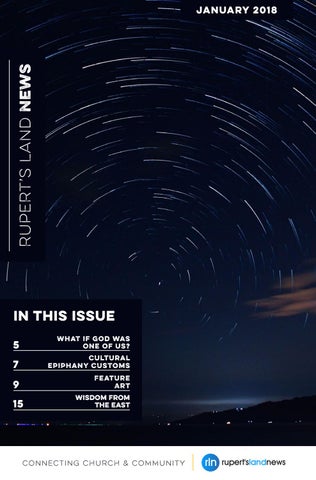
RUPERT’S LAND NEWS
JANUA RY 2018
IN THIS ISSUE 5
What if God was One of Us?
7
Cultural Epiphany Customs
9
Feature Art
15
Wisdom from the East
CO N N ECT I N G C H U R C H & CO M M U N I T Y
rln
rupert'slandnews
rln
rupert'slandnews
Publisher | Bishop Donald Phillips Editor | Kyla Neufeld Accounting | Bernice Funk Advertising | Angela Rush Layout & design | cityfolkcreative.ca Rupert’s Land News - is published 10 times per year (September - June) by the Diocese of Rupert’s Land, in the Anglican Church in Canada. It connects churches and communities from Portage la Prairie, MB, to Atikokan, ON, by offering news, events, opinion, and ideas to 6,000 readers per month. RLN is available in a variety of formats: • • • •
rupertslandnews.ca facebook.com/rlandnews twitter.com/rlandnews instagram.com/rlandnews
We also deliver timely news and information via a weekly email. Sign up at: rupertslandnews.ca/email Advertising: RLN accepts advertising in our monthly magazine and our weekly email. Our rate sheet is available at rupertslandnews.ca/ads. To discuss advertising call (905) 630-0390 or email: rlandnews.ads@gmail.com.
A n g e la Rush
Advertising Manager
CONNECTING CHURCH & COMMUNITY
Editorial offices: Anglican Lutheran Centre 935 Nesbitt Bay Winnipeg Manitoba R3T 1W6 RLN exists to explore issues at the intersections of faith and life. In doing so we solicit and publish a range of opinions, not all of which reflect the official positions of the Diocese. We acknowledge that we meet and work in Treaty 1 Land, the traditional land of the Anishinaabe, Cree, and Dakota people and the homeland of the Metis Nation. We are grateful for their stewardship of this land and their hospitality which allows us to live, work, and serve God the Creator here. RLN welcomes story ideas, news items, and other input. If you want to be involved in this media ministry, please email the editor at: rlnews@rupertsland.ca. Contents copyright 2018 by Rupert’s Land News. All rights reserved. Cover: "A Star Trail Sequence of Two Hours," John Reign Abarintos.
Thorvaldson Care Center AN INTERMEDIATE CARE FACILITY FOR SENIORS 24 hr care and supervision Registered Nurse on site Assistance with medications, dressing, hygiene
All meals, laundry and housekeeping Recreation programs Private bed-sitting rooms
OVER 55 YEARS
caring for senio rs
rlandnews.ads@gmail.com 905-630-0390 rupertslandnews.ca 495 Stradbrook Ave | Winnipeg, MB | R3L 0K2
ph (204) 452-4044 | fax (204) 452-4054 thorcare@shaw.ca | www.thorcare.ca
RUPERT’S LAND NEWS
2
E dito r ial
I didn't celebrate Epiphany when I was growing up in an Alliance church; the Three Wise Men were lumped in with the rest of the Christmas story. Of course, I learned about the deeper meanings of the Wise Men's gifts for Jesus – gold for divinity, frankincense for offering, and myrrh, an ingredient used in embalming, for suffering – but I didn't know that Epiphany had it's own section of the Church calendar. Nor did I know that Epiphany also stood for the Mystery of the Incarnation. Jesus came to us as a baby, lived a human life on Earth, died, and ascended into heaven. The Mystery of the Incarnation ponders the idea of God becoming human but remaining fully God. It is something that we will never wholly understand. Now when I think about Epiphany, I am reminded of this passage from Matthew 25: “Then the king will say to those at his right hand, 'Come, you that are blessed by my Father, inherit the kingdom prepared for you from the foundation of the world; for I was hungry and
RUPERT’S LAND NEWS
you gave me food, I was thirsty and you gave me something to drink, I was a stranger and you welcomed me, I was naked and you gave me clothing, I was sick and you took care of me, I was in prison and you visited me.' Then the righteous will answer him, 'Lord, when was it that we saw you hungry and gave you food, or thirsty and gave you something to drink? And when was it that we saw you a stranger and welcomed you, or naked and gave you clothing? And when was it that we saw you sick or in prison and visited you?' And the king will answer them, 'Truly I tell you, just as you did it to one of the least of these who are members of my family, you did it to me'.” Jesus is telling his
disciples that caring for those in need and acting with compassion for “the least of these” is the same as caring for him. We may not see Jesus in the flesh while we remain on Earth, but here is a guide for how we can live all the same: caring for the least of these among us. In this issue, we'll hear from Shelagh Balfour and Maylanne Maybee as they explore Epiphany in their own contexts, and I've put together some cultural traditions for celebrating Epiphany around the world. There is also some Feature Art by Tiffany Munro, and an explanation on how Bishop Don will transition to retirement. Peace to you all this Epiphany season.
3
Pasto ral note
Epiphany Light:
S e ei ng a n d R ecog nizing Donald Phillips
While the phrase “I’ve had an epiphany!” is not commonly heard, research scientists do tend to use such phrases when they suddenly have a breakthrough in their work and begin to grasp the essence – the real truth – of a solution they’ve been seeking. Some of us have had similar experiences when we have been grappling with a particularly challenging problem – whether at work or in personal relationships – and we suddenly see it differently, and a new way forward is revealed. People of faith frequently attribute this revelation to divine inspiration – something that is “God-breathed!” In my experience, “epiphanies” often don’t involve new pieces of information, but rather a new way of looking at something, a new recognition. One might use the cliché, “It shed a whole new light on the situation.” So it should come as no surprise that “light” is the primary symbol for the Church’s celebration of the Feast of the Epiphany of our Lord Jesus Christ. While in our contemporary western culture (church and secular) the emphasis is placed on the celebration of Christmas, it
RUPERT’S LAND NEWS
is Jesus’ epiphany that gives Christmas its meaning. If Jesus of Nazareth’s followers did not recognize that he was also the Messiah, the Christ, the story of the baby born to Mary and Joseph in
about Jesus. Each of us must have our own recognition about the truth of Jesus, the Christ. It may come upon us suddenly like blazing light, or it might be a gradual and deepening revelation that
While in our contemporary western culture (church and secular) the emphasis is placed on the celebration of Christmas, it is Jesus’ epiphany that gives Christmas its meaning. Bethlehem would have no significance and we certainly wouldn’t be reading of it in the 21st century. Each of the Gospels presents different characters to show their readers the epiphany about Jesus: that he is God come to us as a human being for the benefit of all of humanity. Matthew has foreign sages who are not part of Israel or its religion, who visit the newly-born Jesus to honour him as King. Luke has angel choirs announce Jesus’ birth to shepherds outside of Bethlehem who, visit the birthplace to share their “epiphany.” The whole purpose of the four Gospels is to lay fertile ground in each of us, so that we might be open to experiencing our own “epiphany”
builds over time. But we must come to the recognition that Jesus as God, our Saviour, is not only true but real for you and me. And when that happens, we too become part of the epiphany story – we are the reason God became one of us.
Donald Phillips, Bishop of Rupert’s Land
4
E piphany
What if God was One of Us? Shelagh Balfour
Along with thousands of others Winnipeggers, I rely on the bus to get around. More often than not, the ride is pleasant enough. Fellow passengers keep to themselves, are polite if interaction is required, give up their seats when needed – in short, they follow the rules that make sharing a small, crowded, space with strangers comfortable. There is a small subset of bus users, however, whose conduct can alter the atmosphere for everyone around them. Rightly or wrongly, most people have a private face and a public face. There are certain kinds of behaviour and certain types of conversation that are understood to be for public spaces. Boundaries exist that are not usually crossed. Care is taken to protect what is too personal to share with strangers. Of course, not everyone has the same idea of where the social boundaries lie and a few, for whatever reason, have difficulty discerning any boundaries at all. We have probably all experienced the awkwardness and discomfort of hearing “too much information." Not long ago, for example, I found myself sitting near a man who was loudly proclaiming a very personal story of injustice and unfair RUPERT’S LAND NEWS
treatment, of being cheated and deceived. This story, audible to everyone nearby, was directed at a woman, clearly a stranger, sitting across from him. The woman showed no sign she was aware of the man at all. Other passengers around them carefully avoided eye contact, not wanting to give the impression that they might listen to his complaints if she would not. The man himself seemed not to see the discomfort all around him.
maintain a public face and mask their need. Often, they challenge and unsettle us as they intrude upon our space, demanding some type of response. We find we don’t know how to respond, or even if we should. Is it possible that these fellow travellers, precisely because they challenge and unsettle, also help us perceive something about God? Is there an epiphany waiting for us in the stranger on the bus?
Is it possible that these fellow travellers, precisely because they challenge and unsettle, also help us perceive something about God? Is there an epiphany waiting for us in the stranger on the bus?
Some riders, like this man, bring their pain or sense of injustice onto the bus with them. Others bring their loneliness, pouring out the details of their lives to whoever will listen. Still others step on the bus reeking with addiction or hostility, bringing an air of unpredictability or even danger with them. Whatever the circumstances, these strangers on the bus are unable to
As we celebrate the Epiphany we are invited into a vision of God’s glory, the divine appearance. With the wise men, we experience awe at the revealed divinity of the Christ child. We kneel in homage, filled with humble gratitude at God’s inclusion of the nations in God’s mighty acts of salvation. But the definition of epiphany includes more than divine appearance. There is 5
E piphany also sudden perception or illuminating discovery – discovery that often comes to us in situations that challenge and unsettle and demand a response from us. A number of years ago, a popular song asked the question “What if God was one of us?” The song speaks of the awe-generating nature of divine appearance. Would we dare to call God by name, it asks, if we found ourselves face to face with his glory? Would we even want to see that glory, if seeing meant that we would have no choice but to believe? As Christians, we say with confidence that God is, in fact, one of us and, in being one of us, God identifies
RUPERT’S LAND NEWS
Photo: Michael Swan
Sculpture of "Homeless Jesus" by Timothy Schmalz with the poor, the vulnerable, and the broken. In his ministry, Jesus identified himself with the people whose neediness challenged and unsettled those around him. Today, Jesus calls us to see him in the poor and the vulnerable, in the ones among us who cannot hide their neediness, in the stranger on the bus. He calls us, not to avoid, but to look directly at the one who unsettles us, to see his or her humanity, and to respond to whatever need we find there. It
is, finally, in the responding, in acts of caring for the least of these in God’s family, that we will see Jesus himself.
Shelagh is Parish Administrator and Pastor of Christian Education at St. Peter's Anglican Church, Winnipeg. She spent most of her career providing support to vulnerable and marginalized adults. 6
E piphany
Cultural Epiphany Customs Epiphany is celebrated all over the world with different customs and traditions. In the Western Christian tradition, Epiphany commemorates the visit of the Magi. However, in the Eastern Orthodox tradition, Epiphany celebrates the moment of Jesus' baptism in the Jordan River; it is called Theophany (from the Greek meaning “"God shining forth" or
"divine manifestation") and it is the third of the Great Feasts of the liturgical year. Aside from putting away Christmas decorations, some of the more common traditions include eating Epiphany cake, giving and receiving gifts, and winter swimming. Below are explanations for these cultural traditions.
Winter swimming
A New Orleans King Cake.
This is common in the Eastern Orthodox tradition, in countries like Bulgaria, Greece, Cyprus, and Macedonia. Winter Swimming generally includes a priest throwing a cross into a body of water and young men racing to retrieve it. The first person to get to the cross usually receives a blessing, or is believed to have good health for the year. Russians cut holes into the ice of rivers or lakes in the shape of a cross and bathe in the freezing water. Participants dip themselves three times to symbolize the Holy Trinity, and Orthodox priests are on hand to bless the water. Rescuers are also on hand to monitor the health and safety of the swimmers.
Epiphany cake
Also known as King Cake, this cake is eaten in many different countries to mark the feast of Epiphany. The type of cake differs from country to country, but one commonality is that the cake generally has something hidden inside of it, like an almond, a ring, or a figurine of the Christ child, and whoever finds the object becomes king or queen of the festivities. Epiphany cakes are eaten in most Spanish-speaking countries, where it is called Rosca de Reyes or Roscón de reyes, France, Germany, Poland, Portugal, and the United States, where it is especially popular in New Orleans.
RUPERT’S LAND NEWS
Swimming on Epiphany in Minsk, Belarus.
7
E piphany
Befana brings toys to children at night. Painting by James Lewicki, from The Golden Book of Christmas Tales, 1956. Giving and receiving gifts
Twelfth Night
There are many traditions surrounding giving and receiving gifts during Epiphany. In Argentina, Paraguay, Uruguay, Mexico, the Philippines, and Spain, it is common for children to leave their shoes outside on the evening of January 5, in which they will find small gifts or candy the next morning. In Ireland, Epiphany is called “Little Christmas” or “Women's Christmas” (Nollaig na mBan) and it was tradition for women to rest and celebrate themselves after all the cooking and work of the Christmas season. Today, women visit a restaurant or a pub, and receive gifts from their children, grandchildren, or family members. In Italy, Epiphany is associated with legend of Befana (the name being a corruption of the word Epifania), an old woman who rides a broomstick and brings gifts to children or a lump of coal to bad children on the night of January 5. The legend says that she brings gifts to children because she missed her opportunity to bring a gift to Jesus with the Three Wise Men.
Epiphany Eve is known as Twelfth Night. In England and Wales, Twelfth Night customs include burning the yule log and keeping the ashes to kindle the next year's yule log, and wassailing, which is a traditional ceremony that involves singing and drinking to the health of trees. Wassail is hot mulled cider and the ceremony of wassailing is meant to ensure a good cider apple harvest the following year. Also in England, Twelfth Night is a popular day for plays to be performed. It is believed that Shakespeare's play Twelfth Night was written around 1601–02 specifically as Twelfth Night entertainment to close off the Christmas season.
Wassailing In Herefordshire, Huw S. Parsons, 1995. RUPERT’S LAND NEWS
8
Fe atur e A rt
The art of Tiffany Munro I'm a digital painter. For this piece, I used Manga Studio 5 and a Wacom Cintiq. Most of my art is done digitally. This painting of a deer was a quick sketch I made to challenge myself; I don't often draw animals. The mythical, dreamy sort of landscape surrounding is absolutely my style, though. I've always messed around with creating "soft" digital art. A lot of digital work is very crisp, edges, and neat lines, but when I digitally paint I want to focus on light, colour, and the scene's luminescence. I find inspiration in impressionist and romantic traditional works, the sky (why do you think I stay in Manitoba?), light interacting with objects, colour, and watching people. I bet if you poked most creatives, they'd fess up and say something like "I make art because I can't help myself." So there isn't a great story behind this painting. Sometimes things happen without me planning them out, and they turn out weirdly good. One day I felt like painting a deer, so I sat there and worked on it until it was done, and it just came together, all in one burst.
RUPERT’S LAND NEWS
9
Fe atur e A rt
RUPERT’S LAND NEWS
10
C o mmunity
PARISH NEWS ROUND UP Creation Matters Working Group
Beverley Eert, the Creation Matters representative from the Brandon Diocese, has offered to provide regular updates on the work Creation Matters is doing across the country. She wants to hear from you as well. If you or your parish is doing anything to live into the Fifth Mark of Mission – to safeguard the integrity of creation and sustain and renew the life of the earth – please send her an email.
Updates from Dioceses across the country In November, the Group developed and adopted a revised statement of mandate to more fully and accurately describe the structure, goals and activities of the CMWG. [See box.] The Nova Scotia Parish of French Village conducts “green burials” and is participating on a committee that is looking into developing “green cemeteries” throughout the province. The Rev. Canon Charles Bull “officiated” at the Funeral for the Forest in front of the legislature.
Anglican Foundation of Canada
The Anglican Foundation of Canada (AFC) has announced $303,000 in grants in support of new projects across Canada in its November cycle of awards. “The Anglican church is alive and well. Great things are happening from coast to coast to coast,” said the Rev. Canon Dr. Judy Rois, the AFC’s executive director. “Thanks to the generosity of Canadian Anglicans for making this possible!” Combined with those awarded in May, disbursements for an increasingly diverse range of creative projects total $707,000 in 2017, the AFC’s 60th anniversary year. Besides traditional infrastructure and restoration grants of $240,000, the AFC
RUPERT’S LAND NEWS
• To uphold our environmental covenant with the Creator (through Genesis 2:15), and our commitment to biblical principles of hospitality and community within the whole web of life. • To call upon Anglicans across Canada to recognize the urgency of the tasks involved in addressing ecological justice issues. • To honour Indigenous leadership as we strive to leave this fragile beautiful planet Earth intact for the future generations. • To raise up the United Nations Sustainable Development Goals, and any successive United Nations development goals, for all Anglicans across Canada. In the British Columbia Diocese of New Westminster, four faith communities in Nelson underwent energy audits of their buildings and are now working on implementation of the findings. Those needing heating upgrades have pledged to be on 100 percent renewable energy by 2035. provided $71,00 for innovative ministry and $52,000 for theological projects. It also disbursed $60,000 for special anniversaryyear projects for the transformation of parish ministry. This category included a lectionarybased curriculum for children’s spiritual formation, a liturgical resource for traumasensitive congregations, revitalization of rural ministry, and outdoor skateboarding facilities for youth. “We’ve developed a strategic plan to include engaging and creative projects that faith communities are undertaking to help grow the church,” Canon Rois said. Applications for the May 2018 award cycle must be submitted by April 1, 2018. – Scott Brubacher, Executive Administrator
11
C o mmunity St. Alban's Centennial Restoration
St. Alban's Cathedral in Kenora celebrated its centennial year in 2017. It’s the only Anglican parish serving the Kenora area of 15,000 people. One of the ways it does that is “Shelter from the Cold,” which operates year-round providing a hot meal every Friday, as well as a used clothing ministry. St. Alban's has committed to a number of upgrades to the physical facilities, including structural repairs, a newly installed lift, roof restoration, lots of paint, flooring, carpeting, a renovation to the
Upcoming Issues In February, we'll take a look at what makes the parishes of Rupert's Land unique in our issue on Expressions of Anglicanism. In March, we'll be looking at the non-musical aspects of Worship, like the theology behind worship, the sacraments, and the liturgy.
RUPERT’S LAND NEWS
narthex, entrance door and framing around the Alban stained-glass window. The Anglican Foundation, as part of its November cycle of awards, approved a grant of $15,000 for St. Alban's to help with the renovations. The hope is that the renovations will be completed sometime in the spring of 2018.
Rupert's Land News is always looking for writers and artists! If you'd like to write for RLN or submit some artwork, please send me an email with your name and the topics on which you'd like to write, or samples of your artwork. In particular, I am looking for people who might be interested in writing reviews of books, movies, or CDs. You can also send me an email if there are any themes or topics you'd like to see in future issues of RLN. – Kyla Neufeld, Editor
12
C o mmunity
The Path and Process for
Discerning and Electing a New Bishop At a diocesan Synod meeting on October 21, 2017, the Diocese of Rupert’s Land decided to elect a coadjutor bishop prior to the retirement of the current diocesan bishop, Donald Phillips. A coadjutor bishop, once elected and ordained, serves in episcopal ministry, subordinate to and alongside the current diocesan bishop. However, once the diocesan bishop retires, the coadjutor bishop automatically becomes the new diocesan bishop without any further process needed. To celebrate that transition, the new bishop will be installed at a service at St. John’s Cathedral. Most of the ministry and mission of our diocese falls under our own jurisdiction. However, the election of a bishop is governed by the Ecclesiastical Province of Rupert’s Land (made up of 10 dioceses in central, western, and northern Canada). Hence, on November 16, 2017, the Executive Council of the Province received and approved a request from our diocesan synod to move forward with the election of a coadjutor bishop. As outlined in Provincial Constitution and Canons, the first step is to determine the date for the Electoral Synod and to establish the Diocesan RUPERT’S LAND NEWS
Search Committee. The Search Committee consists of six members appointed by our Diocesan Council (three clergy and three lay members) along with three members – a lay person, a cleric, and a bishop – appointed by the Metropolitan of the Province (Greg Kerr-Wilson) from a panel elected at the last Provincial Synod. For the election of a coadjutor bishop, the Search Committee also includes the current diocesan bishop. However, in this case, Bishop Don has received permission to step back from this role and will instead act as a resource and consultant to the Search Committee. The Committee members from our diocese are Archdeacon James Dugan, The Rev. Helen Kennedy, Canon David Widdicombe, Mrs. Heather Birtles, Mr. Ted Henderson and Mr. Gary Russell. The appointed members from the Province are Bishop Rob Hardwick (Qu’Appelle), The Rev. Dr. Scott Sharman (Edmonton), and Ms. Karen Larsen (Calgary). The first meeting for this Search Committee will take place in mid-January, 2018. In consultation with the Metropolitan and our Diocesan Council Bishop Don has called the electoral Synod
for Saturday, June 16, 2018 at St. John’s Cathedral. This synod is chaired by the Metropolitan. The election of a new bishop is first and foremost an act of discernment. All of the processes, discussions, and prayers are aimed at helping the members of our Rupert’s Land Diocesan Synod discern whom they believe God is calling to this new ministry. The first step for the Search Committee is to arrange opportunities for members of our diocese to have input into the preparation of a diocesan profile. This written piece describes the current nature of our diocese and its mission and ministry, as well as its needs, concerns, hopes, and aspirations around what it believes God is calling our diocese to become in the future. As a result, the profile will outline some of the gifts, skills, and qualities we believe are necessary for the new bishop to possess in order to lead and support the present and future ministry of our Church. When complete, this profile is available publicly, mid-tolate April, 2018. Once the profile is complete, members of the Search Committee will begin receiving names for consideration to be nominated for the election. While only members of 13
C o mmunity our Diocesan Synod, bishops of the Province of Rupert’s Land, and members of the Search Committee are able to propose names for nomination, others are able to suggest names to the above persons. Any priest in good standing in any Church of the Anglican Communion, or in any other Church in Full Communion with the Anglican Church of Canada, is eligible for consideration. Therefore, rostered pastors (or bishops) of the Evangelical Lutheran Church in Canada are also eligible. The Search Committee will request a variety of material from those who have agreed to be nominated for the election. This might include a CV, responses to questions, a personal video clip, etc., with a deadline of
about a month before Synod. The Committee arranges the received materials into a standardized format (so each of the candidates can be easily compared), then distributes this material in a Convening Circular to the members of our Diocesan Synod. The timeline for these steps is governed by the Provincial Constitution and Canons. On June 16, 2018 (God-willing), the Synod will convene for the purpose of electing the coadjutor bishop. The Metropolitan is Chair of this Synod, which begins with a celebration of Holy Eucharist. Following some procedural resolutions, the Chair of the Search Committee will put forward for nomination those to be nominated for election.
While there is no provision for nominations from the floor, late nominations may be received up to 72 hours before the Synod convenes. Balloting continues until one candidate receives a simple majority of both the lay and the clergy vote. That candidate is then asked to consent to his/her election and becomes the bishop-elect. Because the bishop-elect will need to wrap up their present ministry, they will likely join our diocesan staff in early Fall – providing a 1–2 month overlap with Bishop Don before he retires. The intent is to have the new bishop’s consecration at the beginning of our regular diocesan Synod in October, 2018.
Donate to
If you would like to support the work of Rupert's Land News, please consider making a donation. Your donations help cover the costs for the Editor's work – which includes putting together each Monthly issue of RLN and Weekly newsletter, maintaining the website, and advertising parish events – and the costs for layout and design with Cityfolk Creative.
RUPERT’S LAND NEWS
Donate ONLINE
Donations of $20 or more will receive a tax deductible receipt.
14
Via Me dia
Wisdom from the East Maylanne Maybee
After the season of the Incarnation, the Church calendar turns to Epiphany, heralded on January 6 by the story of the Magi, wise ones from the East. It is a story of how Jesus comes to be perceived as One in whom the very nature of God is uniquely revealed, not only to those shaped by Judaism, but also to those shaped by other cultures and geographies. This November, for the second time in two years, I had the privilege of travelling to China, not as a tourist, but as a guest and pilgrim – perhaps a kind of reverse Epiphany journey, discovering the wisdom of the East and the light it casts on the human and divine nature of Christ. I went as part of a small, unofficial group of eight touring West China. The theme of our pilgrimage was “A Yangtze Journey: in the Footsteps of Katharine Hockin,” after a Canadian missionary who, with her widowed mother Lily Hockin, served in West China during the turbulent years between the Nationalist Revolution in 1911 and the departure of foreign missionaries in 1951 following the outbreak of the Korean War. Our journey began on November 20, 2017 in RUPERT’S LAND NEWS
Shanghai, continued by high-speed train to Yichang, then by cruise boat along the Yangtze River to Chongqing, and from there to Chengdu and Leshan in Sichuan Province. We were following the path taken by Canadian missionaries at the turn of the last century to an alien environment where language, culture, and geography were completely unfamiliar. The early success of the missionaries in making converts to Christianity was limited. Yet their commitment to the physical and spiritual well-being of the Chinese people in this isolated and poverty-stricken corner of China was unmistakeable, and over time, we learned, was deeply appreciated. In each of the three major cities we visited, our group received VIP treatment as a sign of gratitude for the pioneering work of Canadian missionaries more than a century ago: some as doctors and educators who founded hospitals, dental clinics, and universities, some as pastors who “walked the talk” when preaching and teaching the Christian message. In Chongqing, the #5 People’s Hospital displayed a striking mural in the front entrance with scenes of Canadian doctors and nurses
treating wounded soldiers during the 1911 revolution, or relieving the suffering of the citizens of Chongqing during the Japanese bombing of the late 1930s. In Leshan, the day’s program included a visit to the original homes, hospitals, and churches of the first missionaries from Canada, a guided tour of the newly constructed 17-storey People’s Hospital of Leshan, a gala lunch hosted by the Vice Mayor of Leshan, and a boat tour to view the Giant Buddha. In Chengdu, on the sidewalk in front of the Second People’s Hospital, we saw a larger than life sculpture with a sign: “More than a Century of Great Love.” It depicted Canadians like Dr. Omar Kilborn, who founded the Red Cross Society during the 1911 revolution, and was a founding member of the first hospital to provide western medical care in Chengdu, and the West China Union University, a flagship centre of medical education and dentistry. It showed his wife, Dr. Retta Omar, treating a peasant woman on a stretcher, a sign of her care for women’s health; and a graphic scene of someone in a dentist’s chair being treated by Dr. Lindsay Thompson, using an opium pipe as an 15
Via Me dia anaesthetic. What our group witnessed was the long-term fruit of the seeds that were sown by people like Katharine Hockin and the wider missionary movement of which she was part. It was also visible in a vibrant Church that continues to grow and be transformed. We worshipped in a congregation of 800, talked and sang with young students learning to become lay pastors, and met an elderly couple preparing to be baptized at Christmas with scores of others. Besides offering people the prospect of spiritual purpose and meaningful community in an increasingly anonymous society, the churches we visited also provide direct aid to people of low income, financial assistance to students in need, or hospitality to seniors and singles. I was struck by the diversity among local churches – one had a full-immersion font at the front, one had a congregational style with wonderful Methodist hymns, another was almost like being in an Anglican cathedral. Though to me these churches still seemed somewhat Western in style and appearance, I discovered, in one-to-one conversations, that their commitment to apply the good news of
rln
the gospel to the Chinese context was anything but. In particular, the Church in China has chosen to be “post-denominational” following the departure of foreign missionaries, giving higher priority to unity and practical ethics than to doctrinal distinctions. They are committed to cooperate with the positive initiatives of the People’s China in spite of significant ideological differences. And they are striving to articulate a “truly Chinese” theology that is not filtered through inherited missionary perspectives. Decade after decade, ordinary Chinese people have experienced oppression, civil war, invasion, revolution, and more recently, exponential economic expansion. Today, the role of the Communist Party in the People’s China is muddied and complex, yet given the challenge presented by the staggering dimensions and diversity of the Chinese population, it is a regime that appears to be relatively functional. Wherever we went, we experienced a spirit of resilience, openness, and warmth, and an unexpected degree of interest and gratitude among Christians and non-Christians alike for the legacy of Canadian missionaries. Something transformative
rupert'slandnews
RUPERT’S LAND NEWS
happens in the exchange of peoples from different geographies, histories, and culture. In the gospel of Matthew we read of wise men from the East who followed a star to find and worship the infant Christ, bringing what gifts they had to a place of encounter and vulnerability. In a sense, these early missionaries did the reverse – they had no star to follow, but nevertheless brought what gifts they had to a place of encounter and vulnerability, finding that, among the people of West China, Christ was both already present and yet to be born.
Maylanne Maybee has been a deacon in the Anglican Church of Canada for 39 years. She recently retired as principal of the Centre for Christian Studies, and is currently active as an honorary assistant at St. Luke’s and a visiting fellow at St. John’s College.
CONNECTING CHURCH & COMMUNITY 16