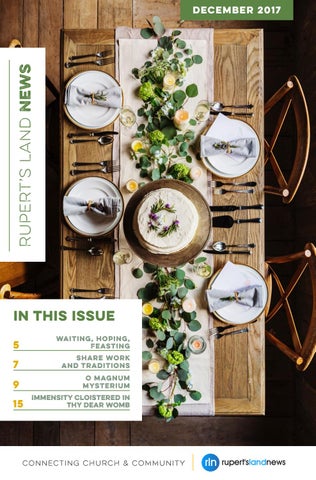
RUPERT’S LAND NEWS
DEC embe r 20 17
IN THIS ISSUE 5
Waiting, Hoping, Feasting
7
Share Work and Traditions
9
O Magnum Mysterium
15
Immensity Cloistered in Thy Dear Womb
CO N N ECT I N G C H U R C H & CO M M U N I T Y
rln
rupert'slandnews
rln
rupert'slandnews
Publisher | Bishop Donald Phillips Editor | Kyla Neufeld Accounting | Bernice Funk Advertising | Angela Rush Layout & design | cityfolkcreative.ca Rupert’s Land News - is published 10 times per year (September - June) by the Diocese of Rupert’s Land, in the Anglican Church in Canada. It connects churches and communities from Portage la Prairie, MB, to Atikokan, ON, by offering news, events, opinion, and ideas to 6,000 readers per month. RLN is available in a variety of formats: • • • •
rupertslandnews.ca facebook.com/rlandnews twitter.com/rlandnews instagram.com/rlandnews
We also deliver timely news and information via a weekly email. Sign up at: rupertslandnews.ca/email
CONNECTING CHURCH & COMMUNITY
Editorial offices: Anglican Lutheran Centre 935 Nesbitt Bay Winnipeg Manitoba R3T 1W6 RLN exists to explore issues at the intersections of faith and life. In doing so we solicit and publish a range of opinions, not all of which reflect the official positions of the Diocese. We acknowledge that we meet and work in Treaty 1 Land, the traditional land of the Anishinaabe, Cree, and Dakota people and the homeland of the Metis Nation. We are grateful for their stewardship of this land and their hospitality which allows us to live, work, and serve God the Creator here. RLN welcomes story ideas, news items, and other input. If you want to be involved in this media ministry, please email the editor at: rlnews@rupertsland.ca.
Advertising: RLN accepts advertising in our monthly magazine Contents copyright 2017 by Rupert’s Land News. and our weekly email. Our rate sheet is available All rights reserved. at rupertslandnews.ca/ads. To discuss advertising Cover: rawpixel. call (905) 630-0390 or email: rlandnews.ads@gmail.com.
A n g e la Rush
Advertising Manager
Thorvaldson Care Center AN INTERMEDIATE CARE FACILITY FOR SENIORS 24 hr care and supervision Registered Nurse on site Assistance with medications, dressing, hygiene
All meals, laundry and housekeeping Recreation programs Private bed-sitting rooms
OVER 55 YEARS
caring for senio rs
rlandnews.ads@gmail.com 905-630-0390 rupertslandnews.ca 495 Stradbrook Ave | Winnipeg, MB | R3L 0K2
ph (204) 452-4044 | fax (204) 452-4054 thorcare@shaw.ca | www.thorcare.ca
RUPERT’S LAND NEWS
2
E dito r ial
There's a traditional Norwegian dessert my family makes every year for Christmas called Hardanger Lefse, which is said to date back to the Vikings. The dough is made from a combination of flour, butter, buttermilk, and golden syrup, then chilled, and then rolled into thin 10-inch rounds and baked. Once they're cooled, we sandwich two rounds together with a mixture of butter, sugar, and cinnamon. Then we cut the lefse rounds into triangles; it's best eaten cold. It's one of my favourite desserts and something I always looked forward to when we visited my grandparents in Saskatchewan while I was growing up. I started making it four years ago, when I got the recipe from my grandma. Now, every December, I get together with my sister, mom, and sister-in-law and we spend the day making it – I'm usually in charge of rolling out the rounds – and everyone in the family gets to take some home when we finish. We always make sure to save some for Christmas dinner, but the rest gets eaten at home or shared amongst
RUPERT’S LAND NEWS
friends. What I love about lefse is not just about how delicious it is (our Norwegian word for it is fråtseri, which means “something so good it's almost too much), it's about the family history, identity, and community that comes with it. My favourite thing to do with lefse is share it while, at the same time, explaining where it comes from and the importance it has in my family. My grandma spent 50 years perfecting her recipe and she always sent us the latest tweaks for
newly-appointed principal of the Centre for Christian Studies, on her experience at Feast for Friends, held by the Sandy-Saulteaux Spiritual Centre. We'll also hear from James Kornelsen, from Canadian Foodgrains Bank, about feasting on a low income. Also included in this issue is a poem from Sally Ito and a reflection on Mary from Kirsten Pinto Gfroerer in via media. I know I'm not the only one who has a beloved family recipe. We are coming up on a busy sea-
Lefse rounds iced with butter, sugar, and cinnamon. us to try out; making it this year will be bittersweet, as she passed away in March. This month's issue is on Feasts, a fitting topic, I think, for the season. We'll hear from Donald McKenzie, priest at St. Philip's, on the spiritual aspects of feasts, and from Michelle Owens,
son of cooking, baking, shopping, and gathering as we prepare for the Feast of Christmas, even as we try to slow down and meditate for the season of Advent. I hope you will each find your tables full of good food and good cheer this season.
3
Pasto ral note
Party W it h god? Donald Phillips
This is definitely the season for parties; at work, school, or church; with our community groups, neighbourhoods, or families. From reading ancient texts, like our Hebrew Scriptures, festal gatherings have been around as long as humanity has been. And because of that, especially at this time of year, no one ever asks “why” a party is planned and invitations sent out. Sometimes its simply because people want to gather, eat, drink, and enjoy each other’s company. Other times there is a more formal reason and often these occasions are referred to as “feasts.” We probably think of Thanksgiving and Christmas dinners as feasts, when particular people are invited and the gathering has a very intentional purpose. Other than in the most venerated sense, we likely don’t think of partying with God. Yet, our Scriptures are full of descriptions of feasts with God. The prophet Isaiah, looking forward to the future restoration of Israel after being conquered by the Babylonians in sixth-century BC, wrote: “On this mountain the Lord of hosts will make for all peoples a feast of rich food, a feast of well-aged wines, of rich food filled with marrow, of
RUPERT’S LAND NEWS
well-aged wines strained clear” (Isaiah 25:6). That certainly sounds like a party to me! Then consider the ultimate person and purpose of our faith: Jesus Christ himself. While his cross and
not present – our “image of God” is not there. When we do engage we are enriched, but so is the gathered experience of others by our presence. This month especially, we will all have opportunities
When we gather intentionally to celebrate a common purpose with mutual respect and affection, God can do amazing and powerful things. resurrection are his defining moments, the central revelatory act that he performs with his followers is a meal. But it is not merely an occasion where food is consumed, it is a feast, where particular people are invited and the gathering has a very intentional purpose. The ultimate communal act of our faith is the Last Supper and its ongoing commemoration in the Holy Eucharist. So what does this say about human feasts? When we gather intentionally to celebrate a common purpose with mutual respect and affection, God can do amazing and powerful things. We are created in the image of God after all! These parties also reveal another truth about being in community. If we choose not to participate, whether or not we feel diminished, the gathering is lessened because we are
to come to feasts. Because we are there, God will be too. As we open ourselves to that reality, we may be surprised by what God is able to, do in and through us as we bond with those around and share our God-given experiences of life. So relax and party with God, the ultimate host of feasts!
Donald Phillips, Bishop of Rupert’s Land
4
Feasts
Waiting, Hoping, feasting Donald McKenzie
Early in November, there was a story going round the internet that Stove Top Stuffing was offering branded stretchy pants in time for American Thanksgiving. I don’t know if these really exist. They seemed to be off sale almost as soon as they were offered. However, this tells us something about one of the most common ideas surrounding feasting. When we talk about feasting it so often seems to be that we are talking about the greatest amount of food, or about the best of foods. We often think about dish after dish of our favourite foods – so much food that we eat until we are more stuffed than the traditional turkey. This is not surprising, as at one time feasts were associated with successful hunts or harvests, where the produce
needed to be consumed lest it go rotten. Feasts are often a mark of prestige. How can we display our wealth or our generosity? By throwing a big dinner with lots of the finest foods. As guests at such feasts, we mark ourselves out as connoisseurs by our ability to appreciate rare and/or expensive foods. Yet such attitudes to feasting can also demonstrate a sense of exclusion. Those who can’t contribute to the bounty or those whose tastes are not as refined as ours are, if not unwelcome at the feast, at the very least kept on the margins. Feasts are often associated with Saints days. In Advent, depending on the time at which it begins, we remember such Saints as Andrew, Nicholas, and
Lucy. When we look at and celebrate the lives of such saints, we find they were often people of privilege and wealth who gave up position, power, and wealth to serve the poorest and least. When we observe the great Eucharistic Feast, the apex of Christian feasting, it is generally celebrated with little more than a small piece of bread or wafer and a sip of wine. Yet, whenever we gather at the Lord’s Table, we are coming to a feast. More importantly, we are celebrating as a body brought together not by common interests or hobbies, but by the life-giving sacrifice of Christ. I find it interesting that the most spectacular of Jesus’s miracles, at least in terms of the number of people involved, was comprised of
"Miracle of the Bread and Fish" by Giovanni Lanfranco, 1620-23. RUPERT’S LAND NEWS
5
Feasts a little bread and some fish. Much like the Eucharist itself, to which the miracle points to some degree, it’s not about the lavishness of the food, but the lavishness of the God who provides the food. Matthew’s account of the feeding of the 5,000 in chapter 14 of his gospel can be instructive to us in our thinking about feasting. A few things stand out in this story. First, Jesus invites the people to sit down; the language used suggests reclining at the table as one did for a formal meal or a feast. Second, everyone receives enough to eat. No one goes home hungry. Third, everyone is fed. This may seem like a repetition of the last point, but it’s not. The story ends with the phrase, “And those who ate were about 5,000
men, besides women and children” (Matthew 14:21). According to feasting traditions of the time, women and children often ate only after the men had enjoyed their fill. Here the women and children eat, and as Matthew tells us, they ate their fill. There are even leftovers; God’s abundance is on full display. This feeding of the multitudes is so important to Matthew that we read of another feeding, this time of 4,000, in chapter 15 (sadly, the Lectionary skips over this second reading, seeing it as superfluous). Again, all have their fill, and women and children included. There is another element of feasting that relates to Advent: anticipation. Both the feeding of the 5,000 and the Eucharist anticipate the great heavenly banquet that
will occur when Jesus returns. Often, during Advent, we get caught up in the somber and frightening readings. Many of these readings can take our appetites away. We need to remember though, that Advent hails the promise of the New Heaven and New Earth that we read about in Revelation. Chapter 22 begins with a description of the City of God: “Then the angel showed me the river of the water of life, bright as crystal, flowing from the throne of God and of the Lamb through the middle of the street of the city. On either side of the river is the tree of life with its 12 kinds of fruit, producing its fruit each month; and the leaves of the tree are for the healing of the nations.” A tree with fruit and a feast without ending, all enjoyed in the presence of the Lamb. That is the promise of Advent and the hope we look to.
Donald McKenzie is the incumbent at St. Philip's Anglican Church. You can find more of his thoughts on food at his blog, Dining with Donald. RUPERT’S LAND NEWS
6
Feasts
Share Work and Traditions Michelle Owens
The initial year in a new city and new ministry sometimes feels like a series of “firsts” strung together: first meal in a new home, first day in a new office, first holiday away from community and family. One of the “firsts” I was looking forward to this fall was attending the Feast for Friends at the
Sandy-Saulteaux Spiritual Centre outside of Beausejour. This year the Feast took place at the end of the week long Mamawe Ota Askihk Festival – an inter-cultural and inter-generational event focusing on traditional food gathering and preparation. Those of us who came out for the Saturday Feast were
Photo: Michelle Owens
Michelle "dances" on wild rice. RUPERT’S LAND NEWS
able to see the projects and learn about hide tanning, processing wild rice, and gete okosomin squash (a huge indigenous varietal!). A sacred fire burned all day, and teachings were offered before we enjoyed a game of “Indian Baseball.” At the end of day, we gathered indoors for our feast – gathered around tables and with plates balanced on knees. Although the people and place and tastes were different, much of the day reminded me of family feasts shared over the holidays. Elders, adults and children gathered together. Conversations opened up to include someone passing by. People grabbed a chair, put a log on the fire, tried scraping hide. Food brings us together, but it is the togetherness that brings us a feast. The laughter and storytelling, pitching in to lend a hand, and learning traditions by participating in them – these are the ingredients of feasting. For all that I keep dogeared family recipe cards, it is the feeling of squeezing in elbow to elbow that I remember most about family feasts – the sound of simultaneous conversations and the washing up at the kitchen sink after supper and before cards – the togetherness. 7
Feasts Two feast parables in Luke 14:7-11 and 16-24 challenge us to consider what invitations we issue and to whom; which ones we accept and how we act once we arrive. The parable of the marriage feast asks us to imagine being invited, and instructs us to choose the lowest place, rather than the one of honour. When I read it, I am challenged to reflect on how I enter new communities and introduce myself. Do I use my name? A title? The parable of the banquet describes how the “A-List” guests offer excuses for declining an invitation, and how the householder instead invites poor strangers from the streets. When I read it, I think about who I
RUPERT’S LAND NEWS
want to eat with, and with whom I feel comfortable. Am I drawing near to people like me or people of influence? Can I imagine inviting in the people digging through the dumpster in the parking lot?
moccasins to loosen the husks and finished winnowing by hand, which reminded me of shelling peas with my own grandmother on a farm porch. One of the reflections shared that day was
These parables point to the way we negotiate relationships and status through eating together. Are our tables open and welcoming? These parables point to the way we negotiate relationships and status through eating together. Are our tables open and welcoming? Do we expect people to know and demonstrate a particular set of table manners? Are the table seating and place settings easy to navigate? How do we know where to sit? What utensils to use? Are children welcome? Are elders served? What about someone who needs assistance to eat? Or who can’t eat what is on offer? I was so blessed to be invited to the Feast for Friends. To share in a day that included teaching and stories and eating. I “danced” on wild rice in borrowed
that we can come together in new communities through the sharing of work and the sharing of our own traditions – particularly those involving the preparation of food. I left the feast well fed in body and soul. And in the car ride home through the dark, we talked about our day – about what we ate and with whom we shared labour and laughter. We carried the memories, new learnings, and relationships home, and feast on them still.
Michelle Owens is a diaconal minister and the Principal of the Centre for Christian Studies. 8
Po e try
O Magnum Mysterium Sally Ito
On 16th-century composer Tomas Luis de Victoria’s “O Magnum Mysterium” It is called “sacred polyphony” this — the true voice of God returned; the babble of praise, sung up in strains, a harmony that braids and twists its ropy voice back to heaven. What have we only but this? For the cord with its blood feeds us, too; its chorus of cells humming, breathing, singing with the pulse quickened in it by love. Alleluia, alleluia, alleluia! to the mysterious force that through a rope of flesh connects us to the dark, wide heaven aboveove. This poem is reprinted with permission from Alert to Glory (Turnstone Press).
Sally Ito is a poet and translator of poetry who lives in Winnipeg. Her latest book of poetry is Alert To Glory, published in 2011. She also translated a book of the children's poetry of Misuzu Kaneko, Are You an Echo: The Lost Poetry of Misuzu Kaneko, published in 2016. RUPERT’S LAND NEWS
9
po e try
The lyrics to O Magnum Mysterium say:
O magnum mysterium et admirabile sacramentum, ut animalia viderent Dominum natum jacentem in praesepio. O beata Virgo, cujus viscera meruerunt portare Dominum Jesum Christum. Alleluia!
O great mystery and wonderful sacrament, that the animals should see the new-born Lord lying in a manger. Blessed is the Virgin whose womb was worthy to bear Christ the Lord. Alleluia!
Take a listen here.
RUPERT’S LAND NEWS
10
Feasts
Making Room at the Feast Table James Kornelsen
"Parable of the Great Banquet" (detail), Eugene Burnard, 1900, Winterhur Museum of Art, Winterhur, Switzerland. When you think about it, a feast is not so much about the food that’s set at the table, as it is about who are the people gathered there. That’s what we learn from a story Jesus told conveyed in Luke’s gospel about a man who plans a great feast — a banquet — and invites the VIPs and important people as guests. But they all make excuses, don’t show up, and the repercussions were more severe than they ever imagined. “When you give a banquet, invite the poor.” — Luke 14
The story Jesus tells challenged conventions. How RUPERT’S LAND NEWS
often do we hear ourselves asking out loud, whether it’s dinner, a meeting, an outing or other event, “Whom should we invite?” As now, things were complicated back in first-century Palestine. When it came to social events like banquets, only those of similar wealth and social standing, only those deemed pure by the rigorous purity laws of the day, and only those who could afford to extend a return invitation were invited to be guests. The host in the story had prepared a banquet and invited his guests. Presumably, he had followed all the rules and codes. But when the time came, nobody showed up.
They all had excuses. However important those excuses seemed to be, the message was clear: “I’ve got better things to do.” This would normally be an occasion for great shame for the host. But he turns the tables on his guests. He tells his servant: “Make room at my table for the marginalized — for the poor, the disabled, the blind.” Those who have no economic status, those who are considered impure. By implication, he is saying to the guests who turned him down: You think you’re so great? These people are as good as you. Better, maybe, because they accepted my invitation.
11
Feasts There’s more than just food that gets shared around a table.
Jesus’s story was scandalous, challenging the social conventions and expectations of that time. This story of the rich man inviting the poor to his banquet tears down long-held and fiercely-supported walls of exclusion, animosity, convention, rules, customs, and beliefs. Why? Maybe it was about more than just giving people access to a feast with delicious food. It gave them a place to use their voice. Raising the importance of those people is like saying, “This person matters, and what this person has to say matters.” It also challenges the rule of reciprocity. Maybe these people can’t repay the host, at least for now. But what’s possible if they have a voice? What if marginalized
people are given a place at other tables, like the ones where decisions are made? The results can really shake up the status quo. Everyone eats at the feast of God’s table.
At a time when the world seems to be polarizing into us and them; when borders are closing; when people are living in fear of “the other”; when the new rule seems to be to look out for ourselves first — as a country, or as individuals; Canadian Foodgrains Bank takes the message of Jesus seriously: There is room at the table for all. Working with our 15-member agencies, with the generous and faithful support of thousands of Canadians, we make room every day for people who are poor, refugees and others displaced by conflict,
children who are malnourished, mothers and fathers worried for their children, farmers trying to make a living off a little plot of land — people who may never repay us. Through the Foodgrains Bank, Canadians are invited take action in a world of hunger — by being generous and supporting programs that provide food and assistance to people in the developing world; by advocating to the Canadian government for good policies that will benefit those who are poor and hungry; by praying for people who live in poverty and worry about where they will get their next meal, both overseas and here in Canada; and by learning more about the issue of hunger.
GP Complete Care Exceptional care since 1973 WORK WITHIN SENIORS’ BUDGETS
PROVIDING HELP WITH: Daily routines Housekeeping Meal prep Personal care Laundry Medication Reminders WE ARE ALWAYS HERE FOR YOU
(204) 869-1076 RUPERT’S LAND NEWS
gloribp55@gmail.com
James Kornelsen is Public Engagement Coordinator at Canadian Foodgrains Bank. This article was adapted from the Foodgrains Bank’s resource Room at the Table, which is available at no cost for congregations, families, and small groups. 12
C o mmunity
PARISH NEWS ROUND UP Companion Diocese Orphans Program
The Companion Diocese Team is low on funds for its Orphans Fund Program and is calling on Rupert's Land parishioners to help support this program. The following is an abridged version of an article from RLN's website. The Companion Diocese partnership between Rupert’s Land and Central Buganda Diocese in southern Uganda is entering its third decade of shared ministry. Since 2004, two instalments of $10,000 have been sent in September and February of every year. Once children graduate from their studies, new children enter the program. In this manner the program has been blessed with sustainability. Over the years it has been inspiring to hear from former children of the program who have moved on to post-secondary education, started their own families, and, in some cases, now themselves care for orphaned children. The Companion Diocese Committee, which facilitates the Parish Links Program and the Orphan’s Fund Program alongside the Diocese of Central Buganda, would very much like to see the Orphan’s Fund Program continue. The needs are many and local resources scarce as very few aid organizations operate in the region. It is our hope that this treasured program will continue to contribute to the lives of children through our shared partnership with our Ugandan friends in our sister diocese of Central Buganda. – Companion Diocese Committee
RUPERT’S LAND NEWS
Creation Matters Working Group
The Creation Matters Working Group is a program through the Anglican Church of Canada that is composed of diocesan representatives. They work towards encouraging Anglicans to live the Anglican Church's Fifth Mark of Mission: “To strive to safeguard the integrity of creation and sustain and renew the life of the earth.” Creation Matters representatives provide information on “greening” churches and programs, support the Bishop to provide leadership on environmental issues in the Diocese, track the environmental activities of other dioceses, and participate in the national Creation Matters initiative. Beverley Eert is the Creation Matters representative in our neighbouring Diocese of Brandon and she is willing to help out in Rupert's Land as well. If you would like help with an environmental initiative, like reducing the carbon footprint of your parish, please contact Beverley at baeert@ gmail.com or call 204-252-3469. She would be happy to talk to any parishes that are interested in “greening” their buildings.
Beverley Eert with her husband Will. Their home is earth-sheltered, passive solar, and powered by a photovoltaic (solar) array.
13
C o mmunity St. Matthew Maryland
St. Matthew Maryland is looking for help putting together their annual Christmas gift store. They are looking for donations of toys, books, games, warm winter clothes, candy, and other gifts for children, teenagers, and adults. Donations can be dropped off on December 11 and 12. They are also looking for volunteers to help with store setup on December 11 and 12, and to help run the store from December 13-15.
Upcoming Issues In January, we'll contemplate the mystery of Christ's incarnation in our issue on Epiphany. And, in February, we'll take a look at what makes the parishes of Rupert's Land unique in our issue on Expressions of Anglicanism.
RUPERT’S LAND NEWS
If you have any questions about the store, please contact minister@ stmatthewsmaryland.ca. Or, if you want to volunteer, contact volunteers@ stmatthewsmaryland.ca. Last year St. Matthew's provided gifts for nearly 250 children who would not have had anything to open on Christmas morning otherwise. Please help to make this event a success again this year.
Rupert's Land News is always looking for writers and artists! If you'd like to write for RLN or submit some artwork, please send me an email with your name and the topics on which you'd like to write, or samples of your artwork. In particular, I am looking for people who might be interested in writing reviews of books, movies, or CDs. You can also send me an email if there are any themes or topics you'd like to see in future issues of RLN. – Kyla Neufeld, Editor
14
Via Me dia
Immensity Cloistered in Thy Dear Womb Kirsten Pinto Gfroerer
There is a form of prayer, particularly fostered by the Spiritual Exercises of St. Ignatius, which encourages the exercise of the imagination. Supplicants are encouraged to pray by imagining themselves in the Gospel story. They are invited to step into the story with their minds in order to look, touch, smell, hear, and taste the Gospel. This form of prayer uses the senses to help the seeker be vividly present to the mysteries of faith. In Advent and through the Feast of Christmas, this form of prayer comes most naturally. History is replete with art that celebrates the annunciation, the incarnation, and the birth of Christ, and feeds the imagination. Almost every church has an Advent festival or a Christmas Nativity pageant where children and adults can physically and with their imaginations enact the story of their faith – a story so beautiful we want to hear, see, touch, and smell it. Imaginative prayer impacts us in ways we don’t even understand and this is Good. The purpose of this form of prayer is to strengthen our capacity to live within the world of the Gospel reality; as the story saturates our senses it saturates our RUPERT’S LAND NEWS
thinking and, therefore, effects our decision-making and our actions in day-to-day life. This is one way we are transformed by the Gospel: through our imagination. The great Anglican poet John Donne takes our imagination to a place we go more rarely in our Advent and Christmas contemplations. With one great earth-shattering line in his poem cycle La Corona, Donne takes us into the womb of Mary and makes us linger there in awe. Imaginative exercise may be helpful to deepen our prayers as we follow Donne and contemplate the mystery he articulates in hopes of exercising our capacity to think about being human made in the image of God.
all the way to the beginning of this thought. The Very God of Very God is in His mother, mute, with slow growing lips and unhurried, emerging brains cells. These will gradually make the electricity of memory, thought, and language, but for this moment He begins as a molecule, then two, then four; as a tadpole-like creature without ears, without tongue, without eyes; as the deaf, the mute, the blind. Yet, in this state, He exists as fully God because, if Mary conceived and bore one of the All Holy Trinity, then she had God in her womb from the beginning, and God can never be anything but fully God by definition. The God of all creation gave himself to humanity
If God is very God of very God in the womb of Mary, in this state of helpless unthinking dependence, what is it to be human? How does this question us, form us, and transform us? Here is Donne’s great line: “Immensity cloistered in thy dear womb.” Immensity cloistered in thy dear womb… let us go
by being conceived in the womb of a girl. God was not just born fully fleshed with the pinky loveliness of an infant. God did not come to us 15
Via Me dia ready made, he did not give himself only this way. He came to us microscopically, becoming almost nothing so that He might be human. The Very God of Very God existed as a molecule, an embryo, a fetus, an infant, a child, an adult, a tortured bleeding human, a dying human, a dead mortal, and a risen body. What does this state of Godness say about our human states? If God is very God of very God in the womb of Mary, in this state of helpless unthinking dependence, what is it to be human? How does this question us, form us, and transform us? By indwelling the extremities of being, God in Christ has filled them up. Our permissible definitions of humanity have expanded and narrowed. The essence of humanity cannot be misplaced within intellect or language. God, the infinite and complete, is willing to be human in the form of an embryo, thus this time of possibility is eternally appraised as worthy of his presence. Any derivative states in which the human exists in a latency of thought and language are now also enfolded into the life of God. Part of what the Gospel asks us to contemplate, to pray in, for the life of the world, is this reality of “Immensity
rln
cloistered in the womb.” We are the image of this God who submitted to the humble, vulnerable becoming of pregnancy and birth. How can this imagination impact our capacity to think, to act? In the last years I have been in an intimate encounter with the disease of dementia as it wreaks havoc in one I love. This encounter forces one to ask many questions. One of mine is: are we still “who we are,” are we still our “self” when our human brains don’t function in such a way as to remember our own capacities and our own character? I am not just asking whether we are valuable, I am asking: does the one I love exist in the fullness of his being even if he cannot remember who that person is? Is “the self” in the electrical impulse that is now cut off with dementia, is the essence of my loved one gone, or is it “held” in existence? In a contemplation of Christ being God, completely God, in a womb, before a brain, without eyes, without limbs, without thought and speech, somehow this question loses its sting. It isn’t directly answered but there is more room for it, more possibility in it. I can be with my loved one and imagine the patience of the Very God of Very God as a
rupert'slandnews
RUPERT’S LAND NEWS
molecule waiting to develop, to be known, and to enact salvation. In this perceived smallness there is absolute fullness of being. This fullness cannot be articulated and understood, especially by the mute embryo, but yet it exists and it is earth-shattering. We are in a time of history where the essence of what it is to be human, and the meaning and value of different states of our human existence, are being called into question in a variety of complicated and nuanced ways. Maybe this is the time to pray with our imaginations and wait through Advent with the “Immensity cloistered in thy dear womb.”
Kirsten Pinto Gfroerer is a lay theologian who has served as a pastor and a preacher at St. Margaret's Parish in Winnipeg. For further Advent contemplations and other thoughts see herfeatherslikegold. wordpress.com, a blog of Kirsten's work.
CONNECTING CHURCH & COMMUNITY 16