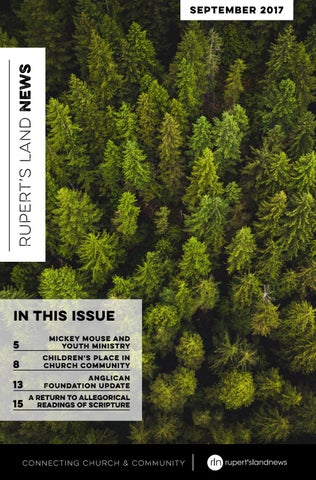
RUPERT’S LAND NEWS
Se ptembe r 20 17
IN THIS ISSUE 5
Mickey Mouse and Youth Ministry
8
Children's Place in Church Community
13
Anglican Foundation Update
15
A Return to Allegorical Readings of Scripture
CO N N ECT I N G C H U R C H & CO M M U N I T Y
rln
rupert'slandnews
Publisher | Bishop Donald Phillips Editor | Kyla Neufeld Accounting | Bernice Funk Advertising | Angela Rush Layout & design | cityfolkcreative.ca Rupert’s Land News - is published 10 times per year (September - June) by the Diocese of Rupert’s Land, in the Anglican Church in Canada. It connects churches and communities from Portage la Prairie, MB, to Atikokan, ON, by offering news, events, opinion, and ideas to 6,000 readers per month. RLN is available in a variety of formats: • • • •
rupertslandnews.ca facebook.com/rlandnews twitter.com/rlandnews instagram.com/rlandnews
We also deliver timely news and information via a weekly email. Sign up at: rupertslandnews.ca/email
CONNECTING CHURCH & COMMUNITY
Editorial offices: Anglican Lutheran Centre 935 Nesbitt Bay Winnipeg Manitoba R3T 1W6 RLN exists to explore issues at the intersections of faith and life. In doing so we solicit and publish a range of opinions, not all of which reflect the official positions of the Diocese. We acknowledge that we meet and work in Treaty 1 Land, the traditional land of the Anishinaabe, Cree, and Dakota people and the homeland of the Metis Nation. We are grateful for their stewardship of this land and their hospitality which allows us to live, work, and serve God the Creator here. RLN welcomes story ideas, news items, and other input. If you want to be involved in this media ministry, please email the editor at: rlnews@rupertsland.ca.
Advertising: RLN accepts advertising in our monthly magazine Contents copyright 2017 by Rupert’s Land News. and our weekly email. Our rate sheet is available All rights reserved. at rupertslandnews.ca/ads. To discuss advertising Cover: Photo by Spencer Watson on Unsplash. call (905) 630-0390 or email: rlandnews.ads@gmail.com.
A ng e la Rush
Advertising Manager
rlandnews.ads@gmail.com 905-630-0390 rupertslandnews.ca
RUPERT’S LAND NEWS
2017
Friday, Oct. 13, 6 - 9 p.m. Saturday, Oct. 14, 10 a.m. - 4 p.m. Sunday, Oct. 15, 12 - 4 p.m. We invite you to browse and buy at your leisure Wine and Cheese Friday evening
Light refreshments available at the BrushWorks Café
Featuring the work of 36 Manitoba Artists
th
14 Annual BrushWorks • 2017
2
E dito r ial
I had what I consider to be a fairly typical church experience when I was growing up. As I child, I attended Sunday School and then, as a middle-schooler, youth church and youth group. My dad was always heavily involved in children's ministry and I enjoyed helping him out. But my parents' church didn't have Sunday morning programming for teenagers, so I joined the “regular� service when I reached high school. This led to me eventually joining the worship team and I loved it. I appreciated music and the opportunity to sing, and it didn't matter that I was the youngest person on the team; I was accepted, included, and mentored by the adults in my church.
RUPERT’S LAND NEWS
I didn't grasp how important this was until years later, after I left my parents' church and started attending a new church with my now-husband. The youth in that church were absent. I knew there was a large group of them because the basement was designated as their space and youth events always featured in the church bulletins, but I never saw them in the service. A few years into attending that church, the lead pastor and leadership team started talking about adding a service to the Sunday morning lineup for 18-to-30year-olds. The reason, as the children's and youth pastor explained, was that the youth weren't feeling included in the church community and she was afraid that they would start looking for a new church or leave it altogether. The pastor's solution was to add a new service just for them, but that didn't reach the heart of what was wrong. I think it would have
made a difference if those youth had been incorporated more fully into the life of the church. They weren't feeling included in their church community because it was keeping them at a distance. This issue of Rupert's Land News is on the Inter-generational Church. We'll see how the children at St. Chad's have been brought into the service and how to better engage young people in the Church. We also have a longer Parish News Round Up section to showcase what's been going on in the Diocese over the summer months and an update on the Anglican Foundation for its 60th anniversary. And, in via media, we'll explore how to read scripture allegorically. The body of Christ is made up of all ages and generations. We all have something to contribute and learn from each other.
3
Pasto ral note
We Are T h e Chu rch Donald Phillips
“Your old ones shall dream dreams … your young ones shall see visions.” – Joel 2:28bc alt. The above quote is from the prophet Joel’s description of God’s coming Kingdom. Peter quotes it as well in his Pentecost Day sermon in Acts 2. Notice how it does not read “your old ones will be declared redundant and offered early retirement, and your young ones will garner all of society’s attention.” Yet, even in 2017 we in the Church continue to hold on to the mid-20th century metrics for labelling the vitality of our congregations. A blossoming Sunday School and an active youth group are indications of a successful congregation – the lack of these and a 60+ average age statistic are taken as sure signs of a congregation’s decline and death. However, in the Scriptures, old age is regarded as a sign of God’s blessing, and youth are deemed important by Jesus himself. Nancy and I spent several years in the 1980s pastoring a new congregation in Fort McMurray. At that time, the average age of the city’s population was 23 years. We were in our early 30s so this context provided
RUPERT’S LAND NEWS
us with lots of opportunities to develop friendships. But the lack of mature adults with considerable life experience left a void in the community. Elderly people provide local historical context – bringing a sense of stability and calm to society, something that was noticeably lacking in Fort McMurray in the 1980s. All this is to say that communities and congregations need the gifts that people of all different ages offer. I always affirm and encourage young people’s involvement in their church community. Not only does it help to form them as disciples of Jesus Christ, but their active involvement gives older members a tremendous sense of hope, that their years of faithful discipleship has born fruit in the lives of those following them. Likewise, for those of us over 60 who lack confidence in a social media world full of hashtags and tweets, we must never discount the fact that young people are constantly observing our speech and actions, looking for clues and cues as to how they wish to construct their lives and values. However, there is a reality that the nature of faith communities – the model of local church that we know
and love – is changing as numbers decline and average age climbs. Even in our fear and uncertainty the Holy Spirit is embracing us and calling us to remember God’s ever-present faithfulness. For we are the church – not the building, not the structures, not the age-old patterns we come to depend on. We are all on this spiritual journey together – whether we are 6, 16, or 86 years old. Each of us has a God-given ability to contribute to the health and vitality of our community and our Church – whatever form that “church” might take. God has given us the ability to dream – and those dreams contain the creative power to transform lives – even when they are 70, 80, 90 or more years old.
Donald Phillips, Bishop of Rupert’s Land
4
Inter-generational
Mickey Mouse and youth ministry John Berard
In a 1989 article for Youthworker Journal, Stuart Cummings-Bond declared, “Churches with strong youth programs have usually controlled adolescence by corralling it, by institutionalizing it — and not within the daily rhythm of the church, but outside of it, in a smaller circle that is tangent to the larger one, like a one-eared Mickey Mouse.”
shape of youth ministry in churches, morphing into what Sharon Ketcham, Professor at Gordon College, has called service-provider youth ministry. A service is work done to help, assist, or benefit another through implicit roles of provider and receiver – the church provides the youth group and youth are consumers of youth ministry. The promise of the model was that it was the way to form faith in youth, to keep youth in YOUTH MINISTRY the Church, to reach non-churched youth, and to revitalize the Church. Instead, we’ve CONGREGATION learned that the one-eared Mickey Mouse styles of youth ministry have generally made The short story is this: it more difficult for youth to someone saw adolescence form a sustained faith and and said, “It is good.” It remain connected to the needed to be directed and Church. channelled so church youth Isolating a youth group groups were formed. Beyond from congregational life creBible studies, it was crazy ates a barrier between, and games, relevant talks, and no clear path from, the small a rock 'n' roll sensibility. circle (the youth group) into These elements were eventhe larger circle (the adult tually codified into a model community of faith). When of effective youth ministry youth are segregated from to which missions trips and the community through more youth worship were added. and more programming their This well-intentioned connections to the broader model has dominated the church weaken. Teenagers RUPERT’S LAND NEWS
have neither exposure to nor engagement with the rest of the church, adults, and the practices of the community. But, some may wonder, is it really necessary for youth to be that connected to the Church? After all, conventional thinking suggests teenagers really don’t want that. And don’t most youth want to be around things most relevant to them? Well, the answer is both yes and no. Teenagers for a brief time live in the back-and-forth of two worlds where conventional wisdom is not always right and relevant is not always important. Frederick Buechner, in his book Whistling in the Dark, captured a sense of the in-between: “The ancient Druids are said to have taken a special interest in in-between things like mistletoe, which is neither quite a plant nor quite a tree, and mist, which is neither quite rain nor quite air, and dreams, which are neither quite waking nor quite sleep. They believed that in such things as those they were able to glimpse the mystery of two worlds at once. Adolescents can have the same glimpse by looking in the full-length mirror on the back of the bathroom door. The opaque glance and the pimples. The fancy 5
Inter-generational new nakedness they’re all dressed up in with no place to go. The eyes full of secrets they have a strong hunch everybody is on to. The shadowed brow. Being not quite a child and not quite a grown-up either is hard work, and they look it. Living in two worlds at once is no picnic.” Living in two worlds is never easy. We need to recognize that youth ministry is a both/and reality. It is true that instruction in the Christian faith should be age-appropriate and that there should be time spent in the company of peers. So, some kind of regular age group gathering is a good thing. But, it is equally true that programming that acts as a barrier between youth and other age groups in a congregation implicitly
RUPERT’S LAND NEWS
teaches youth that their role in the community is to receive a service – that they are objects of ministry rather than agents for ministry. Oneeared Mickey Mouse youth ministry not only denies youth the wisdom and experience of those older than they are, but the entire church misses out on the unique role youth can play in ministry and in the Church. How then should we understand the relationship between youth ministry and the rest of the Church? Think back to the Gospels and the Rabbi who demonstrated a new way of living and learning the faith, calling his disciples to practice it with him and then with one another. Scripture seems to consistently situate faith within the participation and practices of the community
of faith. One way to understand the relationship between youth ministry and the rest of the Church is to recall the informal way that youth learn in social contexts and to see the Church as a space where the social nature of learning is brought together with the community of faith. Like learning, faith formation for youth is informed and shaped by what they do with and for others. Understanding the relationship in this way would frame youth ministry through the paradigm of community of practice. Jean Lave and Etienne Wenger, in their research of communities of practice, found that exposure and engagement are central conditions of communities of practice. What we can learn from that is when youth experience both exposure to and engagement with adults and the larger purpose and practices of the Church, then learning and formation are more likely to occur in a way that invites youth into the life of the Church. What else did they find? Communities of practice endure from generation to generation when they realize that everyone teaches and everyone learns. For the Church this means that adults and youth can and do learn from one another. The Holy Spirit moves within and among the whole of the community. The big idea is that teenagers 6
Inter-generational
(in)finite: spiritual conversations in cloth: Songhees Arbutus (detail)
Terry Aske, New Westminster, B.C.
and knowledge, and address the whole person. For the Church this means understanding that youth ministry is not isolated to the Sunday school classroom or a youth group meeting. Youth ministry is at its best when we understand that the whole of the church experience and shared practices speaks to youth. What happens in and through the congregation speaks as loudly to youth as what happens in a youth group meeting. Kenda Creasy, Dean of Princeton, has said that youth ministry at its best is embedded into the everyday fabric of the congregation. Youth ministry and the Church is at its best when we do it together.
Cotton fabrics, cotton batting. Fusible appliqué, and free motion quilting. The arbutus tree was constructed separately, then stitched to the background. can’t learn the language of faith if they aren’t given an opportunity to practice speaking it within the whole community of faith (not just in the youth group). Youth ministry and the Church is at its best when thoughtful conversations are commonplace across generations. Communities of practice nurture newcomers toward maturity by helping them to find meaningful roles to play and by allowing them to develop new avenues for the fresh expression of the tradition. For the Church this RUPERT’S LAND NEWS
means that mentoring and apprenticeship are no longer optional – experience with a mentor is fundamental in moving youth to maturity in communities of practice. Youth ministry is at its best when teenagers are alongside adults finding new ways and testing new ideas for ministry and shared projects that both make a real difference and inch youth towards maturity, adulthood, and an adult faith. Communities of practice speak to the whole person. They make connections between identity, experience,
With more than 30 years experience in church and parachurch youth ministry, John Berard is currently a PhD candidate at Durham University (U.K.) and a member of saint benedict's table. 7
Inter-generational
Children's Place
in Church Community
Susan Titterington
Jesus said, “Let the little practised at home before with and assist in their minischildren come to me,” but hand. We developed activity try, such as ushering, taking how do we do that in these bags that include a colouring collection, sitting in the choir changing times? page, a book, some markloft, or standing beside the Our approach to chilers, and a plushy from our priest or lay reader. To see dren’s spiritual formation vast collection for our young- children engaged at this in the Church is changing, er congregants. Plushies and level gives such hope to the as we've seen through the puppets are big at St. Chad; future of our small community. “Killing Sunday School & our cat Ceadda has helped At St. Chad's, the Birthing Cross+Gen Comsmaller children assist in children are encouraged to munity” movement and other prepping our shared worship respectfully move about in conversations exploring ways space and, recently, Digthe sanctuary if they need. of including children in corger, a small church mouse While it is a bit of a distracporate worship. puppet, toured some of the tion in the beginning, the Faced with the challenge ruins in Ireland and will be children feel that the space is of fewer children and young sharing his stories this fall. theirs, something that being people on a Sunday at St. When the children sent away for part of the Chad's, we acknowledged transition from the front back service doesn’t signify. Their that we lacked the energy to their seats, having been energy and joy during the needed for a vibrant and blessed and prayed for, we sharing of the peace reveals varied Sunday school. After sing a hymn that was comso much. prayer and discussion, we posed by our music ministry Our focus on mentoring felt the call to include chilcoordinator. helps the children observe dren in corporate the postures that worship rather than many Anglicans St. Chad's Children's hymn, try to find ways of might adopt during sung to the tune of "You Call Us, sending them out the liturgy. EngagLord, to Be," no. 450 in Common to a facsimile of ing with another Praise. church in another adult helps parents space for part or focus on remaining Lord Jesus is my friend, all of service. children or aspects The greatest friend of all. As is the of worship that are He’ll guide me as I grow practice of most often be missed And save me if I fall. churches, we have while caring for a I’ll follow in his path each day, a children’s talk, child in service. It And when I need him by my side, where we incorreminds us of the I know he’ll hear me when I pray. porate stories and expression “it takes thoughts from the a village.” It takes children into a reflection on A while ago, we invita church to raise a Christian the readings. On occasion, ed the children to choose or, as we say in the liturgy a child might read from a mentor, or an adult with of Baptism in response to the a children’s bible, having whom they feel close, to sit question regarding nurturing RUPERT’S LAND NEWS
8
Inter-generational this person in the faith and all respond, “we will with God’s help.” In recent years, the bags haven’t always been used, as children are invited to engage in their own creative activities. One young person has created loom people for our model church, which was built by another young person with help from his father. The small church, reminiscent of doll houses, encourages play as we discuss the activities of the liturgy either before service or at fellowship. Our children are curious about their spiritual formation and, through this different approach, we have been pleased to see that they can name the different places within the sanctuary, as well as the purpose and reason
Photo: Susan Titterington
A child at St. Chad's helps prep for worship. for such things, connect with the scriptures through a comment or reflection, and of course comment on any errors and omissions made
Beautiful Carman, Manitoba Situated in a serene setting with tree lined streets, a recreational pathway and the Boyne River running through the town. Close to Downtown. Nearby amenities include a hospital, medical clinics, grocery store, bowling alley, golf course and a beautiful park. Residents of the building can access services such as the local handi-van or the meal program at Parkview Lodge. There is also a Seniors Centre nearby. -
Security system Mail service direct to the building Elevator Parking available
- Large balconies/patios - Laundry facilities on each floor - Multi-purpose rooms on 2nd and 3rd floors
For more information, please call (204) 751-0039
RUPERT’S LAND NEWS
by the priest in the liturgy. Something more has happened. As a community that embraces the ministry of all baptized, we now find that our children are comfortably moving deeper into roles and places within community. Thanks be to God.
Susan Titterington is currently the incumbent at St. Chad's Anglican Church. 9
C o mmunity
PARISH NEWS ROUND UP St. Aidan's, Winnipeg
In an effort to reach out to local newcomers in our surrounding community, we at St. Aidan’s recently hosted an event called “Canada Nights” for three consecutive Tuesday evenings, July 18 to August 1. The idea behind these evenings was to offer a setting where newcomers could feel welcomed to their new home while learning about Canada and making new friends in the process. The evenings consisted of games, English conversation, a short presentation on Canada and life in Canada, Canadian food, and a whole lot of love. While the evenings consisted of a lot of informative activities, the main purpose of the events was to bring people together and provide an environment to help build some new, promising relationships. As organizers, we tried to be flexible with our schedule and attempted to adapt to the needs of the visitors. Often when churches organize events, we try to plan everything based on what we think people need rather than what they are asking for. By being reactive and responsive to the needs of the newcomers, we feel we were able to offer a fun and desirable setting.
Afghanistan, and Ethiopia. Together we enjoyed many activities and food, like ice cream, cookies, bannock, fruit, and pancakes topped with maple syrup. We gave away prizes through raffle draws and sang the national anthem. Everything we organized had a Canadian theme to it. At St. Aidan’s, our faith and love for Jesus is a massive part of who we are and when we share ourselves, it is only appropriate that Jesus is known. We shared our live for Christ through our discussions, free literature, parable skits, and closing thoughts. Praise the Lord that many visitors were touched, many promising relationships were built, and our prayers to see many come toward the Kingdom were answered. — Chris Barnes, St. Aidan’s Mission Coordinator
The newcomers who attended came from many different countries which included India, China, Brazil, Eritrea, Russia,
St. John's Cathedral
In light of the loss of many trees over the years, St. John's Cathedral is in the process of replanting. They are asking anyone interested to donate $200 and, in return, the Cathedral will plant a tree in your honour or in memory of a person of your choice. For more details, call Carol in the office at 204-586-8385, or send her an email. RUPERT’S LAND NEWS
St. Jude, Grand Marais, and St. Michael, Victoria Beach
The Parishes of St. Jude, Grand Marais, and St. Michael, Victoria Beach, held a celebration to officially welcome Reverend John Girouxa at St. Michael's on August 13 with a luncheon and fellowship. Bishop Don officiated.
10
C o mmunity Diocese of Fredericton
To celebrate its 60-year anniversary, the Anglican Diocese of Fredericton’s Diocesan Choir School is holding a hymnwriting competition. This contest is open to people from any diocese. Here are the guidelines: Write an original hymn text and melody that is suited for a blend of child and adult choristers, performing in a festal worship service in the diocese. Submissions should include a musical score, with biographical information on the composer(s), and information on the liturgical significance of the hymn. The successful composer(s) will be awarded a prize of $1,500. The deadline is December 31 and the winner will be announced March 1, 2018. For more details, visit the Diocesan Choir School website.
St. Mary Magdalene
St. Mary Magdalene is home to 27 notfor-profit community groups that use the church facilities for their programs. A longtime goal for the parishioners was to pave a dirt lane beside the church to provide cleaner and safer access into the building. Two years ago, the rectory property was purchased by a daycare wanting to build a 48-space facility. This provided opportunity to develop an eight-space paved parking lot between the two buildings. The Anglican Foundation provided a grant to help with the project. The parish designed the parking so that parents of daycare children could use it for safe drop-off away from the busy St. Vital Road and seniors use it for parking when attending programs in the church building. The church retains ownership and uses it on Sundays. Both the parking area and daycare opened July 4 2017. — Brian Crow, People's Warden, St. Mary Magdalene
St. Peter's, Dynevor
The parish of St. Peter, Dynevor has received word that they will be approved for funding by the Province to repair the roof on the Old Stone Church.
Thorvaldson Care Center AN INTERMEDIATE CARE FACILITY FOR SENIORS 24 hr care and supervision Registered Nurse on site Assistance with medications, dressing, hygiene
All meals, laundry and housekeeping Recreation programs Private bed-sitting rooms
OVER 55 YEARS
caring for senio rs
495 Stradbrook Ave | Winnipeg, MB | R3L 0K2
ph (204) 452-4044 | fax (204) 452-4054 thorcare@shaw.ca | www.thorcare.ca
RUPERT’S LAND NEWS
11
C o mmunity Donate to Rupert's Land News
PWRDF
If you would like to support the work of Rupert's Land News, please consider making a donation. Your donations help cover the costs for the Editor's work – which includes putting together each Monthly issue of RLN and Weekly newsletter, maintaining the website, and advertising parish events – and the costs for layout and design with Cityfolk Creative.
To support those displaced by the rains of Hurricane Harvey, PWRDF has granted $5,000 to its sister relief agency, Episcopal Relief and Development. Episcopal Relief and Development is partnering with dioceses throughout the affected areas in Texas to assess how to best respond.
Donations of $20 or more will receive a tax deductible receipt.
October's issue will look at the continuing legacy of the Reformation for its 500th anniversary.
House Blend Ministries
After 10 years, House Blend Ministries has decided to close its doors after prayerful consideration. Visit House Blend's website to view the full announcement.
Upcoming Issues
In November we'll explore at the role of Music in church, liturgy, and scripture. If you have any themes or topics you'd like to see in future issues of Rupert's Land News, please email the Editor. Rupert's Land News is also looking for writers and artists! If you'd like to write for RLN or submit some artwork, email the Editor with your name and the topics on which you'd like to write, or samples of your artwork. In particular, we are looking for people who might be interested in writing reviews of books, movies, or CDs.
RUPERT’S LAND NEWS
12
Anglican Foundation
Update on the Anglican Foundation of Canada
on its 60th Anniversary It has been a year to rejoice in six decades of “wonderful deeds.” These are words embedded in I Will Give Thanks to the Lord, the choral anthem composed in honour of the Anglican Foundation of Canada’s 60th anniversary. The anthem is one of many commemorative projects developed in honour of this milestone in the Foundation’s history. Established in 1957 to ensure a generous flow of funding for infrastructure and ministry projects, the Foundation’s growing legacy of grants and bursaries have proved transformational in the lives of thousands of individuals, parishes, and faith communities. Some of these stories have been brought together in a book: Imagine That: Dreams, Hopes, and Realities — Celebrating 60 Years of the Anglican Foundation of Canada. “If you want to know how Canadian Anglicans have overcome challenges in pursuit of their dreams,” says Canon Judy Rois, Executive Director of the Foundation since 2011, “this book is filled with true stories of hope, imagination, and innovation.” Innovation, particularly the need for artistic
RUPERT’S LAND NEWS
exploration and the sharing of new perspectives, was the driving force behind (in) finite: spiritual conversations in cloth, the free exhibition at Christ Church Cathedral in Vancouver, featuring a number of Indigenous and other textile artists and their explorations into the realm of the sacred. The special exhibition coincided with the Foundation’s official 60th anniversary launch on May 25 and drew more than 3,000 visitors. It also reinforced the present-day reality that the Foundation is about much more than “steeples and roofs” and is “branching out in support of really interesting things.” Also part of this 60th anniversary year has been the publication of Children’s Prayers with Hope Bear, an illustrated book featuring prayers for seminal moments in a child’s life, everything from starting school to dealing with grief and loss. Canon Rois says “helping children find words for their prayers” is an important next step in the Hope Bear
ministry, which has gained in popularity as part of the Foundation’s “Kids Helping Kids” initiative. And there’s more! Click on "Anniversary" on the website and you’ll find a short video that highlights the diversity of ministries the Foundation supports across the country. There’s also now a beautiful neck tie and silk scarf available through the AFC store. Canon Rois wants parishes and individuals to see the Foundation as a “powerful resource pool” that grows and deepens alongside a sense of collective responsibility for ministry. “The best way to make a big difference from coast to coast to coast is for every parish to give something to the Foundation every year” she says. What’s next for the Foundation? To continue inspiring generosity and creativity within healthy, vibrant faith communities from coast to coast to coast, generation after generation, with the active engagement of all Canadian Anglicans. It’s safe to say that helping to bring more ministry
13
Anglican Foundation dreams to life will be job No. 1 for the Foundation for the foreseeable future — for the next 60 years at least. — Scott Brubacher, Executive
Administrator, The Anglican Foundation of Canada Please visit the Anglican Foundation's website or call 416-924-9199 ext. 244
for more information or to order copies of any of the Foundation 60th anniversary resources.
The following are photos from the (in)finite: spiritual conversations in cloth exhibit at Christ Church Cathedral in Vancouver. All photos by Judy Rois. Andromeda (detail)
Terry Aske, New Westminster, B.C.
Commercial cottons, batiks, cotton batting. Pieces are fused together. Machine quilting with variegated thread emphasizes the overlapping and intersecting curved lines and elliptical shapes.
Liquid Life
Melanie Delva, Vancouver, B.C.
Embroidery on recycled upholstery cotton, watercolour dyed raw edges.
One Rift, One Flaw
The Red Paddle (detail)
Katie Stein Sather, Maple Ridge, B.C.
India ink on cotton, hand-dyed background fabric, hand stitched. RUPERT’S LAND NEWS
Bryony Dunsmore, Nanaimo, B.C.
Hand dyed and commercially dyed cotton and silk, silk and synthetic organza, pottery beads made by artist. Raw-edge appliqué, free-motion quilting, thermofax printing, hand-stitching. 14
Via Me dia
A Return to Allegorical Readings of Scripture Bryan Neufeld
There are texts in scripture that present moral problems and, throughout history, the Church has found it difficult to come to terms with many of the teachings and stories in scripture. Today, the Church employs various approaches to these difficult texts: the more conservative voices usually place the importance of maintaining the integrity of scripture foremost and, therefore, find philosophical justifications for God acting the way God did, while the more liberal voices place the importance on maintaining a moral integrity and thereby find ways to exclude these texts from their working canon of scripture. There are merits to both these approaches, but ultimately I am unsatisfied by them. I want to continue to have a high view of all of scripture, but I also recognize that there are some parts with which I will have moral concerns, no matter how many philosophical back flips I do. Is there another way to deal with problematic texts? St. Gregory of Nyssa faced a problematic text when God killed all the firstborn children of the Egyptians. In his work The Life of Moses, he presents RUPERT’S LAND NEWS
the reader with the full force of his issue with this text: “The Egyptian acts unjustly, and in his place is punished his newborn child, who in his infancy cannot discern what is good and what is not. His life has no experience of evil, for infancy is not capable of passion.... If such a one now pays the penalty of his father's wickedness, where is justice? Where is piety? Where is holiness? Where is Ezekiel, who cries: The man who has sinned is the man who must die and a son is not to suffer for the sins of his father? How can the history so contradict reason?” St. Gregory refused to approach this text as a historic text. He could not believe God would act so unjustly, nor contradict other portions of scripture, but he also recognized that the text was part of scripture and therefore could not be easily tossed aside. Instead he looked for a different understanding of the text, what he called a spiritual meaning, and what we would called an allegorical interpretation. St. Gregory considered the firstborn Egyptians to correspond to the beginnings of sin, and that they needed to be cut off before it grew worse. He linked up that
idea with the gospel teachings that lust leads to adultery and anger to murder, so deal with lust and anger before they become full grown. Although this understanding of the text might seem far fetched to us, it establishes two important things. First, within the Church, there is a tradition of critically looking at scriptural texts to see if their plain meaning is morally acceptable, and second, if they are not deemed as such, searching for a deeper spiritual meaning beyond the literal. Although often maligned by proponents of interpretative methods that put the
15
Via Me dia grammar, historical context, or the origins of scriptural texts first, the allegorical method of interpretation has deep roots within Christian theology. One influential theologian from the early church who employed it, and wrote about how to use it, was Origen. In his work On First Principles, written sometime before 231 AD, Origen argues that error has found a place in the Church because a strict reading of the letter of scripture leads to absurd beliefs, such as imputing evil to God, or belief in two gods. Everyone who reads the text of scripture will eventually run into "impossibilities and incongruities," which, according to Origen, have actually been placed into the text through God's wisdom to cause the reader to move away from the literal text and have them attempt a deeper spiritual understanding. Origen believed that when we arrive at such passages, we should dig into other possible understandings that spiritualize the passage in question, following the pattern of what St. Paul did in 1 Corinthians 9:9-10 with Deuteronomy 25:4. Here Paul takes an Old Testament law regarding how to treat oxen and uses it as justification for how he should be treated in his own
rln
ministry. It is not that he applies a general principle to a specific circumstance, but that he claims this specific verse gives divine authority to his, on the surface, unrelated situation. However, it only makes sense for Paul to use the verse about oxen if we understand that it has a deeper spiritual meaning. Origen did not stop with this approach only when referring to the Old Testament law. He maintains that as there is one God who gave scripture, and therefore scripture operates the same way in the Old and the New Testaments. Although occurring less frequently in the Gospels and epistles, there are places where the historical narrative should drive us to search out a spiritual meaning as the literal is impossible to maintain. Even though Origen is a proponent of spiritual readings of scripture, he sees that there are limits to it. He recognizes that this kind of reading of scripture is difficult, that we can recognize the deeper spiritual meaning in a passage but be ignorant of what that meaning is even after meditation and study, and that mistakes can be made in spiritual interpretation. And, although he seeks to draw out spiritual meanings in scripture, he recognizes that, "the passages which
rupert'slandnews
RUPERT’S LAND NEWS
are historically true are far more numerous than those which contain a purely spiritual meaning." For Origen, the interpretation of scripture, like seeking out the will of God, is an ongoing struggle that often leaves us unsure of our conclusions. Such uncertain readings of difficult portions of scripture may be what the Church of today needs. The problems we currently face may seem new, and in some specifics they may be, but the Church has always struggled with making sense of morally, historically, and philosophically troubling scriptural texts. A return to an allegorical reading of scripture, rooted in church tradition, may offer new possibilities for how the Church of today can work through troublesome texts.
Bryan Neufeld recently completed a Master of Arts in Theology from the University of Winnipeg. He attends worship at saint benedict's table.
CONNECTING CHURCH & COMMUNITY 16