RUPERT’S LAND NEWS
O c to be r 20 17
IN THIS ISSUE 5
Changing the Legacy of the Reformation
7
Reformation and Renewal
9
The Persecution of the Anabaptists
15
Division and Unification
CO N N ECT I N G C H U R C H & CO M M U N I T Y
rln
rupert'slandnews
Publisher | Bishop Donald Phillips Editor | Kyla Neufeld Accounting | Bernice Funk Advertising | Angela Rush Layout & design | cityfolkcreative.ca Rupert’s Land News - is published 10 times per year (September - June) by the Diocese of Rupert’s Land, in the Anglican Church in Canada. It connects churches and communities from Portage la Prairie, MB, to Atikokan, ON, by offering news, events, opinion, and ideas to 6,000 readers per month. RLN is available in a variety of formats: • • • •
rupertslandnews.ca facebook.com/rlandnews twitter.com/rlandnews instagram.com/rlandnews
We also deliver timely news and information via a weekly email. Sign up at: rupertslandnews.ca/email Advertising: RLN accepts advertising in our monthly magazine and our weekly email. Our rate sheet is available at rupertslandnews.ca/ads. To discuss advertising call (905) 630-0390 or email: rlandnews.ads@gmail.com.
RUPERT’S LAND NEWS
CONNECTING CHURCH & COMMUNITY
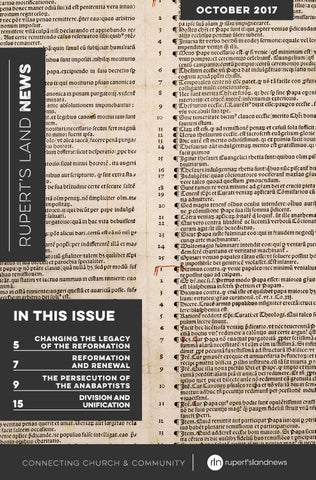
Editorial offices: Anglican Lutheran Centre 935 Nesbitt Bay Winnipeg Manitoba R3T 1W6 RLN exists to explore issues at the intersections of faith and life. In doing so we solicit and publish a range of opinions, not all of which reflect the official positions of the Diocese. We acknowledge that we meet and work in Treaty 1 Land, the traditional land of the Anishinaabe, Cree, and Dakota people and the homeland of the Metis Nation. We are grateful for their stewardship of this land and their hospitality which allows us to live, work, and serve God the Creator here. RLN welcomes story ideas, news items, and other input. If you want to be involved in this media ministry, please email the editor at: rlnews@rupertsland.ca. Contents copyright 2017 by Rupert’s Land News. All rights reserved. Cover: 1517 Nuremberg printing of the Ninetyfive Theses as a placard, now in the Berlin State Library, public domain.
2
E dito r ial
This year marks the 500th anniversary of the Reformation; it's been 500 years since Martin Luther so famously posted his Ninety-five Theses to the door of All Saints' Church in Wittenberg, Germany on October 31, 1517. The Church owes a lot to Martin Luther. He was instrumental in the spread of the Gospel, for example. In 1522, he published a German translation of the New Testament, which made scripture more easily accessible to those who couldn't speak or read Latin. Later, his German Bible would influence William Tyndale's English Bible of 1525, which was a precursor of the King James Bible. When Luther published his Ninety-five Theses, he was speaking out against what he believed were injustices in the Roman Catholic Church: mainly, the use of indulgences, certificates that supposedly reduced the temporal punishment for sins committed by the purchasers
RUPERT’S LAND NEWS
themselves or their loved ones in purgatory. Luther came to believe that Christians could not purchase forgiveness but that, rather, forgiveness was a gift freely bestowed by Christ through faith. This belief became central to the Protestant movement and is enshrined for Anglicans in “Article 11” of the Thirty-nine Articles. But, as much as Martin Luther affected the direction of the Church for the better, some wounds still linger. During the Reformation wrongs were committed on all sides: Catholics against Protestants, as well as Catholics, and Protestants against Anabaptists. In this issue on the legacy of the Reformation, a common thread throughout every article is that it is time to mend the rift between denominations. Bishop Linda Nicholls of the Diocese of Huron writes about the healing taking place between the Anglican and Roman Catholic Churches through the work of the Anglican Roman Catholic International Commission. Bishop Elaine Sauer of the Manitoba/Northwestern Synod in the Evangelical Lutheran Church in Canada calls for other Lutherans to continue the reconciliation efforts that have already been started. As well,
Conrad Stoesz writes about the persecution endured by Anabaptists at the hands of Reformers and Rev. Canon Dr. Murray Still shares a bit about how the community of St. Stephen and St. Bede has been studying the Reformation this year.
The first of Luther's Ninety-five Theses says that the life of the believer must be one of continual repentance. Reconciliation between denominations will take time, but if we take on the spirit of repentance, I believe it will be possible.
3
Pasto ral note
Essential To life Donald Phillips
What comes to mind when you hear the word “reformation?” In the context of politics or religion, if someone proclaims the need for a “reformation” the word conjures up bold images of something radical and threatening – unless, of course, you are sympathetic to the cause being promoted. This month, Lutheran churches around the world are commemorating the 500th anniversary of The Protestant Reformation. But they are not just recalling the past; emphasis is being placed on the need for a Church that is constantly being reformed by the living Christ in order to make its participation in God’s mission in the contemporary world more effective. Is our Anglican Church in need of reforming? Many of us would identify things we think should change. However, if we explore the thought behind those responses we often see that the changes we want are those that have the least impact on the aspects of “church” we hold most dear. We sound like the all too common response to innovation, “It’s a great idea – but not in my backyard!” Yet consider what motivates us to “reform” aspects of our own lives. Surely it is
RUPERT’S LAND NEWS
a conviction that an existing attitude or action is damaging or ineffective. This certainly was at the heart of Martin Luther's reformation. We resist re-formation when we are afraid that we will lose something of who we are – that our essential identity will be irreversibly changed. For example, substitute a modern language liturgy for the Book of Common Prayer and we’ve ceased to be real Anglicans. Take away the organ and the pews and it’s no longer “my Church.” But true re-formation does not change our essential nature. Rather, authentic reformation changes the outward form and structure precisely so the essential nature and purpose are preserved and made effective. Consider the changes in outward form and structure that take place as children move through puberty to become adults. Their physical appearance, motivations, and behaviour certainly change. But those changes happen precisely so their essential nature – their true values and who they are as persons – can effectively manifest itself in adulthood. The scriptural book of Jeremiah compares God’s people to clay in the hands of a
potter (i.e. God) which can be continually re-shaped (reformed) according to God’s purposes for them. The same is true for our Church today. We need to be in a continual state of being re-formed by the Holy Spirit in order for our essential nature as disciples of Jesus Christ to remain vital and effective. And how do we participate in that re-formation, trusting that it is indeed the work of the Spirit and not some misleading “fashion of the day”? We do it by focusing on God’s central purpose for the Church and ourselves as disciples of Jesus Christ – to proclaim and make real the saving, life-giving love, mercy, and justice of our God for the whole world. Continual reformation is essential to life.
Donald Phillips, Bishop of Rupert’s Land
4
R efo r matio n
Changing the Legacy of the Reformation Linda Nicholls
The year 1517 is the symbolic heart of the Reformation and has led to the commemorations of its 500th anniversary in 2017. It is the year in which Martin Luther was purported to have nailed his Ninety-five Theses for the reformation of the Roman Catholic Church to the door of the church in Wittenberg. Although this was a powerful and dramatic action, it was simply a symbol of a much larger movement of reform and transformation happening across Europe, England, and Scotland that resulted in schism from the Roman Catholic Church and led to the creation of what are now the Lutheran, Presbyterian, and Anglican Churches. The Anglican split from the Roman Catholic Church occurred for both political and religious reasons, often symbolized in the rejection of papal authority by King Henry VIII over his desire to divorce his wife, but containing elements of the other factors of reformation theology, including worship in the language of the people and translation of scripture among others. The early part of the 20th century saw strong commitments made towards the unity of the Church in the RUPERT’S LAND NEWS
Photo: A. Savin
The doors where Martin Luther posted his Ninety-five Theses. The original doorway was replaced over 100 years ago. face of increased fragmentation. The establishment of the World Council of Churches in 1948 is a result of this movement. Although the history of Anglican Roman Catholic relationships is littered with much antipathy and even outright persecution and martyrdom, the last 100 years has seen a move towards reconciliation. This was most clearly expressed after Vatican II stated a desire to work towards the unity of all churches in the
encyclical, Unitatis Redintegratio, which notes, “As a result of the Reformation, many Communions, national or confessional, were separated from the Roman See. Among those in which Catholic traditions and institutions in part continue to exist, the Anglican Communion occupies a special place.” Pope Paul VI and Archbishop Michael Ramsey met in 1966 and declared a desire to seek the visible unity of our Churches. They 5
R efo r matio n established the first Anglican Roman Catholic International Commission (ARCIC I). Within a decade that Commission had come to agreement on the nature of the eucharist, ministry, and the Church. What had seemed to be insurmountable differences were finding agreement through intentional dialogue, listening, and learning. The second ARCIC was established to continue the dialogue and produced five further texts between 1983-2006 on the nature of authority, salvation, the church as communion, moral teaching, and the role of Mary. However, changes in the Anglican Communion in this period led to obstacles that have tempered the original optimism of reaching full communion in the near future. The ordination of women and recent changes in parts of the Anglican Communion around human sexuality are new differences that require further dialogue. Even so, the third phase of ARCIC, established in 2011, collated the entire work of ARCIC II with commentaries (published in 2016) and continues work on the nature of the Church in decision-making and the discernment of right ethical teaching. While these have been the international level of dialogue that produces texts for study and consideration in our two churches the real RUPERT’S LAND NEWS
growth in Anglican Roman Catholic relationships has been on the ground where Anglicans and Roman Catholics share mission and ministry. Canada established a national Anglican Roman Catholic theological dialogue in 1971 and has contributed significantly to the international conversations through papers, reflections, and practical study materials. A dialogue of bishops also meets annually to discuss shared concerns and reflect together. These bishops developed a Guidelines for InterChurch Marriages that has sought to honour the expectations of both traditions in supporting marriages. We continue to seek ways to partner on issues of common concern. In 2000, 13 pairs of Anglican and Roman Catholic Bishops from around the world met in Mississauga to deepen relationships. That led to the creation of the International Anglican Roman Catholic Commission for Unity and Mission. This Commission has sought to encourage practical ways in which Anglican and Roman Catholics can – in spite of our continued differences – engage together in mission and ministry. Deepened friendships have led to sharing, like the covenant signed by the Bishop of Qu’Appelle and the Archbishop of Regina in 2011 that encourages prayer for one another, a
joint annual service, shared work in justice ministry, and shared consultation with Indigenous elders. Anglicans and Roman Catholics have moved beyond the stereotypes to see the high degree of unity we already enjoy. We share a common commitment to the creeds, scripture, sacramental life, and nature of the Church. We are siblings in the family of God seeking to deepen our bonds so that we can ultimately be at the table of Christ together with no barriers. The Reformation set us on a path of division that we are now seeking to heal and we are much closer than we may realize.
Linda Nicholls became the Bishop of Huron in late 2017 after eight years as Area Bishop of Trent-Durham, Diocese of Toronto. She holds degrees in music, education, and theology. Her ministry passions include ecumenical dialogue, congregational development, and the healing ministry of the Church. 6
R efo r matio n
Reformation And Renewal Elaine Sauer
When we start something new, we most often begin with good intentions. We want what is best for our communities, for our faith, for our families, and for our world. I believe Martin Luther fully intended to address the injustices he found in his faith community and in his context. He felt a call to renewal and reform, which he expressed through posting his Ninety-five Theses. I don't believe Luther meant to divide the body of Christ, but that is what happened as a result of his writings, actions, and collaborations, as well as the resultant reactions of others. Good intentions created fresh approaches to the scriptures, worship, and church leadership, but they also created divisions within the Church, which have had a lasting effect through 500 years. These divisions have perpetrated violence against other humans, mistrust within communities, and dysfunctional systems that continue to find their way into the church and leadership. We must acknowledge as Lutherans that we have initiated, nurtured, and imposed an ideology of mission and exclusiveness that grew out of dissent and division, power and influence. Lutherans and RUPERT’S LAND NEWS
Lutheranism lived under the power and influence of political and economic authority. It began with Martin Luther’s benefactor, Prince Frederick, who saw Luther’s conflict with the Catholic Church as an opportune time to gain power and influence for political leadership in tension with church leadership. It continued through the ages, to a time of great exploration where missionaries were sent to the African and Asian continents to colonize many people, all under the guise of conversion, and witness to God’s redeeming love. We must acknowledge this wrongdoing and tell our
story from a perspective of true care for humanity. We need to work even harder to build trust and accountability with our ecumenical and interfaith partners around the world. We need to raise up our brothers and sisters who are voiceless through the systems and structures that imprison them, to acknowledge that God loved the whole world and not just a certain segment of humanity. We lost our way as a result of the divisive aspects of the Reformation, but fortunately for us, God has the last word. God is calling us to a ministry of reconciliation and
Thorvaldson Care Center AN INTERMEDIATE CARE FACILITY FOR SENIORS 24 hr care and supervision Registered Nurse on site Assistance with medications, dressing, hygiene
All meals, laundry and housekeeping Recreation programs Private bed-sitting rooms
OVER 55 YEARS
caring for senio rs
495 Stradbrook Ave | Winnipeg, MB | R3L 0K2
ph (204) 452-4044 | fax (204) 452-4054 thorcare@shaw.ca | www.thorcare.ca
7
R efo r matio n healing, to be witnesses of God’s liberating grace. The Reformation may have begun as division but it must be upheld and commemorated now as a movement of healing and unity. Martin Junge, Secretary General of the Lutheran World Federation used the image of the body of Christ as “having different branches of the same vine.” The Reformation is now providing us opportunity to grow together in our witness of Christ’s redeeming love for the world. This will happen as we recognize the transformation within our faith communities, our ecumenical partnerships, our political structures, and our global body of Christ. This transformation has already begun as we learn from one another in our worship, our study of
God is calling us to a ministry of reconciliation and healing, to be witnesses of God’s liberating grace. God’s Word, our languages, our cultures, and our common witness to God’s saving grace for all. Reconciliation has already begun through our Waterloo Full Communion Agreement. As Anglicans and Lutherans located in Manitoba and Northwestern Ontario, we have been given a unique opportunity to work for a common witness, with our Indigenous
neighbours, our immigrant and refugee neighbours, and our rural and urban communities. Common witness means recognizing that God is our refuge, even in our own changing contexts and in our renewed relationships with one another. Common witness means recognizing that the living God is inviting us into reformation and renewal all the time.
2017
Friday, Oct. 13, 6 - 9 p.m. Saturday, Oct. 14, 10 a.m. - 4 p.m. Sunday, Oct. 15, 12 - 4 p.m. We invite you to browse and buy at your leisure Wine and Cheese Friday evening Light refreshments available at the BrushWorks Café
Featuring the work of 36 Manitoba Artists
th
14 Annual BrushWorks • 2017
RUPERT’S LAND NEWS
Elaine Sauer is the Bishop of the Manitoba/ Northwestern Synod in the Evangelical Lutheran Church in Canada. Contact her at esauer@elcic.ca. 8
R efo r matio n
The Persecution of the Anabaptists Conrad Stoesz
I pushed on the worn, stout, wooden door with oversized iron hardware and ducked as I stepped over the threshold and into the dim, stone-walled cell. A rough bed-like wooden frame, with iron chains, stocks, and shackles, took up most of the room. I tried to grasp what went on here at the Trachselwald Castle in Switzerland and why Anabaptists were imprisoned here. To commemorate the 500th anniversary of the Reformation, I had joined the TourMagination Anabaptist History Tour that wound through Southern Germany, Switzerland, and dipped into France.
RUPERT’S LAND NEWS
Martin Luther’s suggestions for church reforms in 1517 set in motion the wheels of religious and social change. Ulrich Zwingli in Zürich, Switzerland
weeks. His work provided the scriptures in everyday language for anyone who could read and they spread quickly thanks to Gutenberg’s printing press.
Anabaptists owe a great deal to these reformers and yet Anabaptists were also persecuted by the churches that Luther and Zwingli founded. agreed with many of Luther’s reforms, including the nature of salvation: that it was a gift; that the role of the Bible was central; that people did not need a priest to access God; and that and icons and relics held no power. Anabaptists owe a great deal to these reformers and yet Anabaptists were also persecuted by the churches that Luther and Zwingli founded. Luther was excommunicated from the Catholic Church for his views in 1521. He hid in the isolated Wartburg Castle, where he translated the New Testament into German in 11
In the city of Zürich, Zwingli renounced his position in the Church, but he continued as the leading cleric in the Gross Münster and lead the formation of the Reformed Church thanks to the support from the city council. He began to hold church services in German instead of Latin and people flocked to hear him preach. With Luther in Northern Germany and Zwingli in Switzerland, they managed the reforms and kept the link between Church and State. They were able to gauge how far the city officials would allow changes to be implemented. However,
9
R efo r matio n some of Zwingli's students grew frustrated at the mediocre and slow-paced reforms and pushed for more reforms faster. Conrad Grebel, Felix Manz, George Blaurock, and others began hold their own worship services in the country side. On January 21, 1525 the Anabaptist movement was officially founded with Conrad Grebel baptizing George Blaurock. They became known as the radical reformers and continued to preach and baptize.
The Anabaptists scattered and some gathered in the town of Schleitheim on February 24, 1527, where former Benedictine prior, Michael Sattler, took leadership in drawing up what became known as the Schleitheim Confession. The new believers agreed to seven points that built on some of the reforms implemented by Luther and Zwingli. This Anabaptist confession understood that baptism was for adults who repented of their sins and
Image: e-manuscripta
Manuscript page in Heinrich Bullinger's Kopienband zur zürcherischen depicting the drowning of Felix Manz in 1527. State officials deemed the radical reformers to be in error and ordered them to submit to the will of the city council. When they refused, city leaders felt threatened and were determined to keep control of the situation. On January 5, 1527 Felix Manz was executed by drowning in the Limmat River for his beliefs.
RUPERT’S LAND NEWS
committed to follow Jesus in everyday life; that church membership was voluntary; that violence had no place in the life of a Christian; and that communion was to commemorate the suffering and life of Jesus. Anabaptist nodes sprung up in the Netherlands, Northern Germany, and Moravia. With no official structure
there were many leaders with various beliefs. In 1536, the Dutch priest, Menno Simons, left the Catholic Church to give leadership to struggling Anabaptist groups. Simons was adamant that even in the face of persecution, disciples of Jesus were nonviolent. Through Simons’ role and his widely distributed writings, he became one of the best-known Anabaptist leaders. Many Anabaptists began to be known as followers of Menno – or Mennonites. Persecution of Anabaptist-Mennonites was heavy until the mid-1600s. Between 2,000-3,000 Anabaptists were executed and thousands more exiled, imprisoned, or tortured. I thought of this persecution as I stood in the dimly lit cave in a remote area of Switzerland, where Anabaptists would come secretly for worship, fellowship, and prayer. Four people from the nearby Reformed church welcomed us to the cave and worshiped with us. They invited us to their church for refreshments and explained that joining us in worship and hosting us was a small but important gesture of reconciliation for how the Anabaptists were treated in the past. There were other signs of a willingness to acknowledge this painful history. In 2004, a stone was placed along the Limmat River acknowledging the drowning
10
R efo r matio n
Photo: Conrad Stoesz
The memorial stone set up near Schleitheim to recognize the persecution endured by Anabaptists. of Felix Manz and other Anabaptists. In the same year, a memorial stone was placed near Schleitheim, along the newly created Anabaptist trail, in recognition of the inhumane way the Anabaptists had been treated. I was touched and moved by these gestures of reconciliation. Like some Reformed churches, the Lutheran World Federation has made significant strides towards reconciliation. After it was brought to their attention that the Augsburg Confession explicitly condemned Anabaptists, an interfaith dialogue was established. In 2010, an official apology was made by the Lutheran World Federation to Mennonites for the persecution their ancestors endured. At the Mennonite World Conference (MWC)
RUPERT’S LAND NEWS
in 2015, General Secretary of the Lutheran World Federation, Dr. Martin Junge, said “we cannot commemorate the 500th anniversary without remembering your forgiveness. We cannot commemorate without you. You have given us a gift – the gift of reconciliation.” He went on to say that the Lutherans learned that reconciliation is not the end – it is not the goal. Reconciliation is the beginning of repairing relationships so we can work together. He saw this in action when MWC donated funds to the Lutheran World Fellowship for refugee aid programs. Today, Mennonites join in marking the 500th anniversary of the Reformation and value many of the ideas brought forth. Today, our
memories about the persecution have been soothed by time and the reconciliation. Today, we can work for God's glory together.
Conrad Stoesz is the Archivist at the Mennonite Heritage Archives in Winnipeg. 11
C o mmunity
PARISH NEWS ROUND UP St. Alban's, Kenora
The community of St. Alban's was excited to host Archbishop Fred Hiltz September 23-24 as part of their continuing 100-year anniversary celebrations. The weekend included a gala dinner Saturday night and worship, with a potluck brunch, on Sunday.
CAPA Delegation Visit
Winnipeg received a visit from the Council of Anglican Provinces in Africa delegation over the September 23-24 weekend. Included in the delegation were the Rev. Canon Grace Kaiso, General Secretary of CAPA and Elizabeth Gichovi, Admin and Finance Officer of CAPA, accompanied by the Rev. Canon Dr. Isaac Kawuki Mukasa, Africa Relations Coordinator, Global Relations for Anglican Church of Canada. They shared experiences of their ministry in Africa and, in turn, learned about ministry in Rupert's Land.
Archbishop Fred Hiltz joined some children at St. Alban's to ring the church bell 100 times.
Winnipeg Women's Resource Centre in Bor, South Sudan
The Winnipeg Women’s Resource Centre in Bor, South Sudan, is a PWRDF Parishto-Parish project, from Emmanuel Mission at St. Matthew’s here in Winnipeg to St. Andrew’s Cathedral in Bor, South Sudan. They recently celebrated the resource centre's first year of helping women and children in South Sudan.
Upcoming Issues In November we'll explore at the role of Music in church, liturgy, and scripture. And, December is a time for Feasts; we'll look at the history behind feast days, feasting on a low income, and food sustainability.
Bishop Don recieves a gift from Elizabeth Gichovi (left) and Rev. Canon Kaiso.
Ange l a R ush
Advertising Manager
rlandnews.ads@gmail.com 905-630-0390 rupertslandnews.ca
If you have any themes or topics you'd like to see in future issues of Rupert's Land News, please email the Editor. RUPERT’S LAND NEWS
12
R efo r matio n
Reformation Studies at St. Stephen and St. Bede Murray Still
It's been 500 years since a monk named Martin Luther rose up in resistance to Roman Catholic church practices and nailed his Ninety-five Theses to the door of the cathedral in Wittenberg, Germany. That action started what is commonly referred to as the Reformation and birthed a movement of change that created many Christian denominations. In an act of reconciliation, Pope Francis declared 2017 a year of commemoration with the theme "From Conflict to Communion." Through the year, Lutherans and Roman Catholics have come together in study and fellowship to begin the journey of reconciliation. At St. Stephen and St. Bede, a faith community of Anglicans and Evangelical Lutheran Church in Canada Lutherans in the Manitoba/ Northwest Ontario Synod, we partnered with Roman Catholics to learn Martin Luther's music and host a Lenten Study. The study was led by Roman Catholic and Lutheran scholars, pointing out the history of the Reformation and pathways to reconciliation. On Sunday mornings throughout the year, we been learning Luther's music, RUPERT’S LAND NEWS
including and Luther's musical version of the Lord's Prayer and the Creed. We have also been using Lutheran Eucharistic prayers for Communion. In the fall, St. Stephen and St. Bede will be hosting a Luther Fest German social November 10. Plus, there will be two opportunities to engage the theme of Reformation and Reconciliation: Rev. Dr. Timothy Wengert will be speaking at Church of the Cross Lutheran on November 18 and the Rev. Dr. Dirk Lange will be speaking at St. Mary's Academy on November 25. Both of these guests will also preach a Sunday service at St. Stephen and St. Bede on November 19 and November 26. At the Church of St. Stephen and St. Bede, Anglicans and Lutherans have been worshipping as one community on Sunday for well over 10 years. We are truly ecumenical in that sense and function as a family using a blended liturgy. The public is invited to
join us in this time of learning, reflection, and fellowship. If you have questions, or need tickets to the social, contact the church at 204-837-9812 or visit our website at churchofststephenstbede-wpg.org.
Murray Still is the pastor of two faith communities, St. James Anglican and St. Stephen and St. Bede, as well as a member of Peguis First Nation. 13
Ministry
Introducing Heather McCance
At the beginning of September, I joined the diocesan staff as Diocesan Ministry Developer. As Ministry Developer I will be working with a number of groups and committees within the diocese as the primary resource for all in lay and ordained ministry leadership. Thus, I’ll be working with the Diocesan Discernment Group for Ordained Ministry and the Diocesan Diaconal Ministry Group to coordinate the academic and spiritual formation of those discerning a call to serve God, the Church, and the world as priests and deacons, respectively. I will be
working with the Diocesan Local Collaborative Ministry Group to support parishes already using the LCM model and to provide resources in parishes that are interested in exploring this model of ministry in their own congregations. I will also be providing resources for those currently engaged in ministry – lay and ordained – who assist us all in both practical and spiritual ways as we strive to be faithful to God’s call to us. As well, I will be working with Bishop Don Phillips in the formation and work of a Council for Theological Education this fall. This group will develop academic, practical, and spiritual standards for priests and deacons in the Diocese of Rupert’s Land. With my office at St. John’s College at the University of Manitoba, I am in a great position to draw on the resources and connections of
GP Complete Care Exceptional care since 1973 WORK WITHIN SENIORS’ BUDGETS
PROVIDING HELP WITH: Daily routines Housekeeping Meal prep Personal care Laundry Medication Reminders WE ARE ALWAYS HERE FOR YOU
(204) 869-1076 RUPERT’S LAND NEWS
the College in this regard. I have spent more than 20 years in parish ministry, having served in a small town multi-point parish for almost half that time. In addition to my seminary training, I have obtained a certificate in the management of volunteers and a Master of Theology degree. I am in the final months of a Doctor of Ministry degree with a specialization in ministry leadership; my thesis focus is on equipping mentors to work with postulants (those preparing for ordination) in developing their leadership skills. While I’ve always lived in southern Ontario, my family has roots here; my great-grandfather was born in Winnipeg and my great-grandmother in Kenora. So while I can’t honestly say that moving to Winnipeg from the Greater Toronto Area felt like “coming home,” I can say that it is starting to feel like home already. I am very much looking forward to getting to know the Diocese better. I hope to visit many churches in the coming weeks and months and would be glad to be invited to gatherings and even to preach from time to time. Contact me at mindev@ rupertsland.ca. – Heather McCance
gloribp55@gmail.com 14
Via Me dia
Division and Unification Christopher Trott
Anglicans tend to be ambivalent about the Reformation. Are we a reformed church or not? I can already see the letters to the editor answering this question vehemently from both sides – and that very disagreement tells us something about the Anglican Church. Certainly the Church in England was caught up in the political struggles of the time as the newly emerging nation-states centred on various monarchies asserted their independence from Rome, took control of their own taxation, and took control over their lands and laws. Following the Lutherans, we uphold the doctrine of “justification by faith alone,” but our Church has never made this a theological necessity. With Calvin we uphold the absolute sovereignty of God and the covenants that God has forged with God’s people, although we are decidedly ambivalent on
RUPERT’S LAND NEWS
predestination. Undoubtedly, one of the chief consequences of the Reformation is a divided church, which was no new thing at the time. As we read St. Paul in Galatians and Romans (the foundational New Testament texts for the Reformers), we see him battling a deeply divided young church in the apostolic era. New Testament scholars will dispute precisely what those divisions were, but generally they had to do with those who saw the emerging Christian faith as a sect entirely within Judaism, and those led by Paul who saw the Church expanding into the gentile world. From Paul’s correspondence we can tell that the disputes were not polite or pretty. By the second century the Greek-speaking churches and the Syriac-speaking churches had drifted apart theologically and liturgically. And of course there was the Great Schism of 1054
as the Western and Eastern churches finally parted company over a host of political and theological issues. The Reformation turned the division of the Church into an ongoing practice. Once Luther, Calvin, Zwingli, the Church of England, and the Anabaptists had made the break with Rome, it opened up the possibility for all kinds of splinters and divisions within the Church. Every time a group disagreed they broke off and formed a new church and we continue to see this process ongoing in the Anglican Church today. The Ecumenical movement of the 20th century sought to staunch the flow of blood from the wounds in the body of Christ. At the same time a new stirring of the Spirit blew through the churches in the Pentecostal movement. The United Church of Canada, the Uniting Churches in Australia, and the Churches of South India and North India all show us the possibilities that can emerge when churches reunite. More recently, there have been a fruitful number of agreements to share ministry and/ or communion, such as our own Church’s agreement with the Evangelical Lutheran Church in 15
Via Me dia Canada. We regularly pray, “that the Church might be one.” This comes from John 17 where similar phrases are used four times as Jesus prays that his followers may be one as he and the Father are one. This suggests the complex territory of the doctrine of the Trinity where the Father and the Son are distinct and separate while at the same time being one. This is the model for the Church that John proposes. I would like to suggest that perhaps a divided church is God’s will for the Church. It has certainly always been a historical fact in the life of the Church and
we are a faith that says our God acts in and through the messiness of history to achieve God’s will. One of the lessons the Church has learned is that humans respond to and live out the message of the Gospel in a variety of ways: from quiet contemplative solitude to social action on the streets. The diversity in churches reflects the very different ways that each of us receives God’s grace in the Gospel. When we gather together around the Lord’s Table for the Eucharist, our first action is to give thanks and then to break and divide Christ’s body among us. The breaking and dividing of
bread reflects the breaking and division of Christ’s body on earth into the church’s. Christ is finally broken on the Cross. Yet it is through that breaking, dividing, and sharing that ultimately the Spirit is let loose upon the earth to stir up, change, and transform. Broken and divided we all share in the one body: Christ’s body. And that for me is the lesson of the Reformation. We do not relate to each other as church to church. Our fallen world would never make that work. But each church and each member of each church relates to Christ in and of themselves. The World Council of Churches and the Canadian Council of Churches provide the institutional vehicles through which we relate, but it is only through that mediating relationship to Christ that we are in any way unified.
Beautiful Carman, Manitoba Situated in a serene setting with tree lined streets, a recreational pathway and the Boyne River running through the town. Close to Downtown. Nearby amenities include a hospital, medical clinics, grocery store, bowling alley, golf course and a beautiful park. Residents of the building can access services such as the local handi-van or the meal program at Parkview Lodge. There is also a Seniors Centre nearby. -
Security system Mail service direct to the building Elevator Parking available
- Large balconies/patios - Laundry facilities on each floor - Multi-purpose rooms on 2nd and 3rd floors
For more information, please call (204) 751-0039
rln
rupert'slandnews
RUPERT’S LAND NEWS
Christopher Trott is the Warden of St. John's College.
CONNECTING CHURCH & COMMUNITY 16