RUPERT’S LAND NEWS
JUNE 20 17
IN THIS ISSUE 6
Pilgrimage for Indigenous Rights
8
Finding Common Ground through Poetry
14
I Notice God in the Mundane
15
Confirmation Class and the Via Media
CO N N ECT I N G C H U R C H & CO M M U N I T Y
rln
rupert'slandnews
Publisher | Bishop Donald Phillips Editor | Kyla Neufeld Accounting | Bernice Funk Advertising | Angela Rush Layout & design | cityfolkcreative.ca Rupert’s Land News - is published 10 times per year (September - June) by the Diocese of Rupert’s Land, in the Anglican Church in Canada. It connects churches and communities from Portage la Prairie, MB, to Atikokan, ON, by offering news, events, opinion, and ideas to 6,000 readers per month. RLN is available in a variety of formats: • • • •
rupertslandnews.ca facebook.com/rlandnews twitter.com/rlandnews instagram.com/rlandnews
We also deliver timely news and information via a weekly email. Sign up at: rupertslandnews.ca/email Advertising: RLN accepts advertising in our monthly magazine and our weekly email. Our rate sheet is available at rupertslandnews.ca/ads. To discuss advertising call (905) 630-0390 or email: rlandnews.ads@gmail.com.
CONNECTING CHURCH & COMMUNITY
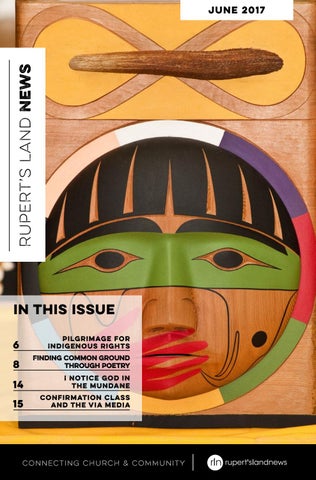
Editorial offices: Anglican Lutheran Centre 935 Nesbitt Bay Winnipeg Manitoba R3T 1W6 RLN exists to explore issues at the intersections of faith and life. In doing so we solicit and publish a range of opinions, not all of which reflect the official positions of the Diocese. We acknowledge that we meet and work in Treaty 1 Land, the traditional land of the Anishinaabe, Cree, and Dakota people and the homeland of the Metis Nation. We are grateful for their stewardship of this land and their hospitality which allows us to live, work, and serve God the Creator here. RLN welcomes story ideas, news items, and other input. If you want to be involved in this media ministry, please email the editor at: rlnews@rupertsland.ca. Contents copyright 2017 by Rupert’s Land News. All rights reserved. Cover: TRC Bentwood Box, Michael Swan. The Bentwood Box was carved for the Truth and Reconciliation Commission by Coast Salish artist Luke Marston. It was created to be a tribute to the survivors of Residential Schools and it travelled to each national event during the Commission.
A ng e la Rush
Advertising Manager
rlandnews.ads@gmail.com 905-630-0390 rupertslandnews.ca
Beautiful Carman, Manitoba Situated in a serene setting with tree lined streets, a recreational pathway and the Boyne River running through the town. Close to Downtown. Nearby amenities include a hospital, medical clinics, grocery store, bowling alley, golf course and a beautiful park. Residents of the building can access services such as the local handi-van or the meal program at Parkview Lodge. There is also a Seniors Centre nearby. -
Security system Mail service direct to the building Elevator Parking available
- Large balconies/patios - Laundry facilities on each floor - Multi-purpose rooms on 2nd and 3rd floors
For more information, please call (204) 751-0039
RUPERT’S LAND NEWS
2
E dito r ial
In Canada, June is National Aboriginal History Month, so I wanted this month's Rupert's Land News to touch on Indigenous issues in some way. In my planning stage, I hoped to cover a variety of topics, but what ended up happening was a lot of emphasis about one thing in particular: the United Nations Declaration on the Rights of Indigenous Peoples. Best laid plans, and all that. The United Nations Declaration on the Rights of Indigenous Peoples is a document of 46 articles that recognizes the inherent rights of Indigenous peoples around the world as both nations and individuals. Adopted in 2007 by the General Assembly, the Declaration is not legally binding under international law. However, it provides
RUPERT’S LAND NEWS
a framework for affirming Indigenous peoples' rights to culture, identity, language, employment, health, education, and worship. It lays out key principles, such as the right to self-determination, the right to be free from discrimination, and the right to free, prior, and informed consent. I've gotten to know the Declaration pretty well over the last couple years. As a freelance editor, I've worked with Mennonite Church Canada on a couple texts that unpack the articles of the Declaration in a coherent and tangible way. Most recently, I had the opportunity to edit a book of poems for MCC, in which two poets engage in a poetic conversation about the articles in the Declaration. That book is called Lifting Hearts off the Ground, and I've included an excerpt (with permission) on pages 8 and 9. Many see the Declaration as a guide for reconciliation between Indigenous and non-Indigenous peoples. In fact, when the Truth and Reconciliation Commission concluded in 2015, it
published a document of Calls to Action. Among them was a call for federal, provincial, and territorial governments, as well as churches and institutions of the law, to adopt the guidelines provided in the Declaration as a framework for reconciliation. Another article in this issue is from a member of the Pilgrimage for Indigenous Rights. From April 22 – May 14, a group of people walked from Kitchener-Waterloo to Ottawa. One of their goals was to draw attention to a new private member's bill that calls on the Canadian government to adopt and implement the Declaration. That story is on pages 6 and 7. Rupert's Land has already begun taking steps towards reconciliation with Indigenous peoples and I am really encouraged by that. There is a lot of healing that still needs to take place before Settlers can be in right relationship with Indigenous peoples. I believe adopting and implementing the Declaration is a step forward we all need to take.
3
Pasto ral note
Healing and Reconciliation: W e n e ed a r e boot! Donald Phillips
Sometimes we need to reboot. Whether it's the page on the computer screen that refuses to respond to any sequence of clicks; or the endlessly spinning wheel icon which leads you to believe that your computer is doing something – but probably isn’t; eventually we reach the conclusion that we need to force the machine to shut down and start again. All prior adjustments, settings, or specialized software are discarded and/or closed and new relationships are established between the operating system and the applications software. Once again everything is possible – all options are open.
non-indigenous societies in general, to “reboot” our way of thinking about, speaking with, and acting toward Indigenous peoples. Many of us have constructed images, assumptions, and conclusions that guide, limit, and determine how we view Indigenous People in Canada. And those constructions so limit and bias our ability to see and think clearly that the only way we are going to achieve a deeper, truer, more fully-human perception is to do a “reboot.” Have we been in this kind of place before? I believe that many of us (particularly men) were in a similar spot with the rise of feminism
Much of the Declaration simply affirms what those of us in the majority culture in Canada take for granted. In this issue on Indigenous issues, there are several references to the United Nations Declaration on the Rights of Indigenous Peoples. I believe that this document, provides the mechanism to enable each of us, and
RUPERT’S LAND NEWS
in the mid-20th century. Early in that era, it was not uncommon to hear phrases like, “What do they want now? Haven’t we already made them equal? Are they expecting some kind of special status?” made toward women.
It simply wasn’t possible to move from that way of thinking and acting to a place where the common, as well as unique, aspirations, skills, potential, and needs of women in society were respected, honoured, and treated as being completely analogous to those of the male gender. We had to start from a different “place” in how women and their subsequent experience of living in our societies were viewed. Much of the Declaration simply affirms what those of us in the majority culture in Canada take for granted. The 46 articles are aimed at laying down a firm a priori, foundation about the First Peoples of this land and their inherent rights as a result. For most of us whose ancestors arrived in the last few centuries, this is a new and important concept to grasp. But in so doing, it will help us view and encounter Indigenous people as a distinct and unique part of the many ethnic groups and cultures that make up this place we call Canada. Article 12 of the Declaration states “Indigenous peoples have the right to manifest, practise, develop, and teach their spiritual and religious traditions, customs
4
Pasto ral note and ceremonies.” This is equally true of the Indigenous members of our Anglican Church. To that end, Epiphany Indigenous Anglican Church was officially opened in February of this year, housed in the building of the former St. Barnabas Church and now part of St. Francis Parish. The Rev. Vincent Solomon was installed as Priest Missioner – part of his role as the Diocesan Urban Indigenous Ministry Developer. Epiphany Church has a forerunner in St. Helen’s Anglican Mission, which also ministered to Indigenous Anglicans (and others) in the 1980s and 1990s in a small church building on Main St. owned by St. John’s Cathedral. One of the priests who served St. Helen’s was the (late) Rev. Canon Dr. Phyllis Keeper. At a meeting of the Rupert’s Land Indigenous Circle, a few years before she died, Phyllis shared her desire and passion that we once again create a place where Indigenous Anglicans could worship and minister using their own language and cultural practices. Her dream resonated deeply with me and from there a development group, convened by Dean Paul Johnson, began the careful work of crafting a vision and job description for what would become the Urban Indigenous Ministry Developer. The position would have two primary thrusts: to
RUPERT’S LAND NEWS
Bishop Don and Rev. Vince Solomon serve communion at the opening service for Epiphany Anglican Indigenous Church. form an Anglican Indigenous worshipping community and, from there, an intentional ministry to and with urban Indigenous persons in, but not limited to, the city of Winnipeg. The Rev. Vincent Solomon began his work on May 1, 2016 and on Feb. 12, 2017, Epiphany Indigenous Anglican Church was born. The presence of Epiphany Church is key to helping Anglicans in Rupert’s Land to do this “re-boot” because we will be able to experience Indigenous Anglican Christianity in our midst. We will experience the same Gospel proclaimed and lived in a
distinct and beautiful culture and from that, we will have a deeper and richer understanding of the Risen Christ – the Lord of all peoples.
Donald Phillips, Bishop of Rupert’s Land
5
R ec o nc il iatio n
Pilgrimage For I ndigenous Rights Kelly Bernardin-Dvorak
Recently, I took part in the Pilgrimage for Indigenous Rights, organized by Mennonite Church Canada and Christian Peacemaker Teams – Indigenous Peoples’ Solidarity Project. Between April 22 and May 14, 30-60 people from diverse ages, stories, and backgrounds participated in this 600km walk. The majority of the walkers identified as Christian and as settlers in Canada, though there were Indigenous peoples and other faiths among us. “Pilgrimage” is common to many traditions, and the purpose of this walk was simultaneously personal, spiritual, and political. We began in KitchenerWaterloo, on the Haldimand Tract, and ended in Ottawa, on un-ceded Algonquin land, walking 25-35 kilometres daily. We opted for less busy roads when available, but often walked along busy highways, sometimes singlefile along narrow shoulders. We prayed and reflected on the land and history in each place. Local news reports covered the walk, making community members more aware. Each night, we slept in different churches (some Anglican!) or community centres. The Pilgrimage came together as a direct, active RUPERT’S LAND NEWS
response to Canada’s fiveyear Truth and Reconciliation Commission (TRC) process. Walkers were responding – personally, spiritually, and politically – to two calls to action issued by the TRC in their final report: Call to Action 43: We call upon federal, provincial, territorial, and municipal governments to fully adopt and implement the United Nations Declaration on the Rights of Indigenous Peoples as the framework for reconciliation. Call to Action 48: We call upon … faith groups and interfaith social justice groups in Canada … to formally adopt and comply with the principles, norms, and standards of the Declaration as a framework for reconciliation. This would include, but not be limited to: Engaging in ongoing public dialogue and actions to support the Declaration. Because the United Nations Declaration on the Rights of Indigenous Peoples is mentioned throughout the TRC’s final report, and because the TRC was created to facilitate the reconciliation and healing process in our country, it follows that the Canadian public should be educated about the Declaration's significance
Photo: Kelly Bernardin-Dvorak
Kelly (left) with Niki Ashton at the final rally. Niki holds the sacred birch-bark scroll. and history. Most notable is that the Declaration was collaboratively developed, over decades, by Indigenous Peoples all over the world; it is a global, Indigenousled response to the common realities in countries with colonial histories. Most evenings included a Teach-In (often by way of sharing circle), which was meant to raise awareness about the Declaration with our host communities. Teach-Ins included reading a sacred birch-bark scroll, which held a message for the House of Commons entrusted to us by elder Myeengun Henry of Chippewa-on-the-Thames. Receiving the scroll was part of the sending ceremony that began the Pilgrimage. By carrying an important message about long-term peace and well-being between communities, 6
R ec o nc il iatio n people to contact their MP in order to communicate public support for Bill C-262.
Photo: Pilgrimage for Indigenous Rights
The walkers rest outside of Marmora, Ontario, one week away from their destination of Ottawa, Ontario. were enacting an ancient tradition. The scroll implored the Canadian government and the Canadian public to not only adopt and implement the Declaration, but also to genuinely honour historic treaties and pursue real harmony between Indigenous and non-Indigenous communities. The scroll was ceremonially passed to Niki Ashton, Northern Manitoba MP, during the walk’s final rally near Parliament Hill in Ottawa. Teach-In discussions also included public education about Bill C-262, a private member’s bill introduced in Canada’s House of Commons by Quebec MP Romeo Saganash, whose life’s work includes participating in the decadeslong development of the Declaration. Bill C-262 calls on the Canadian government to do exactly what TRC in general, and RUPERT’S LAND NEWS
specifically Call To Action 43, requests: full adoption and implementation of the Declaration into Canadian law. Bill C-262 represents a turning point in Canadian legislative history. If passed, it would be the first Indigenous-led legislation that can withstand colonial policies. The bill will be voted on in the House of Commons in September 2017. Canada’s current government has demonstrated commitment to full adoption and implementation of the Declaration in the past, and it was one of their campaign promises. The next few months are an important time of continuing education and awareness-raising about the importance of adopting and implementing the Declaration into Canada’s legislative framework through Bill C-262. We encourage all
Learn more about the Pilgrimage for Indigenous Rights at our website: pfir. ca and Facebook page. All are welcome to attend a Winnipeg Teach-In event about the Declaration and Bill C-262 on June 29, 7 p.m., featuring Romeo Saganash and other speakers, including some of the walkers from the Pilgrimage. Location is TBD, so follow our Facebook page or RLN for more info.
Kelly BernardinDvorak lives in North Point Douglas, Winnipeg, Treaty 1 Territory. She is a therapist with Jonah Counselling and is active in community development work through Jonah Community Projects. Send her an email if you'd like more information about communicating with your friends, neighbours, and MP about the Declaration or Bill C-262. 7
r ec o nc il iatio n
Finding Common Ground through Poetry
The United Nations Declaration on the Rights of Indigenous People is a fairly short document, only consisting of 46 articles. However, some might find it difficult for some to read: “[it] sounds like Western legalese and it’s somewhat technical,” says Steve Heinrichs, Director of Indigenous Relations for Mennonite Church Canada. “The words don’t leap off the page; they don’t grab one’s heart and spirit. And that’s what I long for — to find ways to hear and speak and imagine these words so that they come alive.” Heinrichs is the editor of Lifting Hearts off the Ground, a new book that hopes to bring the Declaration into a new light. Two poets — Lyla June Johnston, who is of Diné (Navajo) and Tsétsêhéstâhese (Cheyenne) descent, and Joy De Vito, a Settler from the Haldimand Tract, Ontario — come together to contemplate and wrestle with the articles in a poetic conversation. The following is an excerpt from the new book. Lyla Johnston's poem, in response to Article 43 from an Indigenous perspective, appears first, followed by Joy De Vito's as she speaks from the role of the Settler. Lifting Hearts off the Ground will be published June 21, 2017 by Mennonite Church Canada.
Article 43: The rights recognized herein constitute the minimum standards for the survival, dignity, and well-being of the Indigenous peoples of the world. Please do not call this land America. If you listen you will hear her true name as the nighthawks dive at twilight. As the wolves howl at moonlight. As the waterfalls rage, cascading. As the avalanches fracture, breaking. She will tell you her true name with earthquakes that split states and break fences to remind you she does not belong to you. We cannot write your rights on a paper and you cannot write ours either. They are written into the bark of trees. They are written in the silence between you and me. Still we try like fumbling humans and, no matter its shortcomings, there is the honour we seek. The honour we need to breathe. — Lyla June Johnston
RUPERT’S LAND NEWS
8
r ec o nc il iatio n
It is disquieting: the basic requirements for dignity, the minimum standards for respect, need to be written down. What does a written word make true? Words become flesh when they are lived. — Joy De Vito
Photo: Pilgrimage for Indigenous Rights
Walkers arrive in Perth, Ontario, on May 9, Day 17 of the Pilgrimage for Indigenous Rights. RUPERT’S LAND NEWS
Lyla June Johnston was raised in Taos, New Mexico, and is a descendent of Diné (Navajo), Tsétsêhéstâhese (Cheyenne), and European lineages. She holds a degree in Environmental Anthropology with honours from Stanford University. Joy De Vito is a Settler Canadian living in the Haldimand Tract, Ontario, the traditional lands of the Neutral, Anishinaabe, and Haudenosaunee Nations. Currently a student in theology at Conrad Grebel University College, Joy is exploring ways in which institutions can engage decolonization through relationship.
9
R ec o nc il iatio n
Resources for Further Reading If you'd like to do some reading about Indigenous issues but aren't sure where to start, here are 10 books from various genres that can give you an idea.
the Blackfoot reservation for Sun Dance. Throughout, King weaves the tales of four elders and their companion, the trickster Coyote.
North End Love Songs by Katherena Vermette In this collection of poems, Katherena Vermette writes about her brother's disappearance and watching her daughters grow up in the North End of Winnipeg. Katherena Vermette is a Métis writer whose poetry and fiction have appeared in many literary magazines and compilations. A Native American Theology by Clara Sue Kidwell, Homer Noley, and George “Tink” Tinker This collaborative work re-imagines traditional categories of Christian theology through Native experience, values, and world-view. The authors also address issues Indigenous peoples face today, such as racism, poverty, stereotyping, cultural appropriation, and religious freedom.
RUPERT’S LAND NEWS
The Pemmican Eaters by Marilyn Dumont Métis poet Marilyn Dumont offers a picture of those who fought in the Riel Resistance in this collection of free verse and metered poems. The Pemmican Eaters derives its title from the name John A. Macdonald's name for the Métis people
Green Grass, Running Water by Thomas King In this novel about finding the middle ground between Indigenous tradition and the modern world, Thomas King tells the story of three characters – Alberta, Lionel, and Eli – as they return to
Kiss of the Fur Queen by Tomson Highway This novel tells the story of two Cree brothers, Champion and Ooneemeetoo Okimasis, who are taken from their home in northern Manitoba and sent to residential school, where their names are changed to Jeremiah and Gabriel. The story follows them from boyhood to adulthood as they navigate estrangement and alienation from their people and find identity in music and dance. Following Jesus in Invaded Space by Chris Budden Following Jesus in Invaded Space explores how theology reflects the social location
10
R ec o nc il iatio n of the theologian through privilege and prejudice. Though Budden writes about his own experiences with the Indigenous peoples of Australia, many of the questions about what, and whose, interests are protected when theology is part of a community that has invaded the land of Indigenous peoples, a context which is very applicable to Canadians.
Buffalo Shout, Salmon Cry, edited by Steve Heinrichs This collection of essays, poems, and reflections features Indigenous and non-Indigenous voices in conversation about land use, creation, history, and faith – all united with the common goal of working towards reconciliation.
RUPERT’S LAND NEWS
Watt-Cloutier, the former head of the international Inuit Circumpolar Council, writes from her own experience and argues that this environmental crisis is, in fact, a human rights issue.
In Search of April Raintree by Beatrice Culleton Mosionier This classic follows the story of two sisters, April and Cheryl, as they work through the break down of their family and the hardships of the social services system.
The Right to be Cold by Sheila Watt-Cloutier The Right to be Cold explores the impact of climate change on Canada's north and how it has specifically affected the communities who live there. Sheila
Islands of Decolonial Love by Leanne Simpson This short story collection explores the struggles faced by Canada's contemporary Indigenous population. Leanne Simpson is from the Anishinaabeg nation and her work often blends traditional Indigenous storytelling with drums, music, and a contemporary point of view.
11
C o mmunity
PARISH NEWS ROUND UP St. Paul's, MacGregor
The congregation of St. Paul's, MacGregor has been working on plans to install a 5.58 kilowatt grid-tied solar array on the church roof, which will generate more than enough electricity to meet the church's needs. The plans for this project have been in the works since summer 2016. To raise funds, donors were able to “purchase” individual panels. Some landscaping alterations will be necessary for the church to install the panels. A few old cedars that were in the way of the eaves have been removed already and the remaining diseased ash and dying poplar trees will be taken down as well. St. Paul's will replant with lowergrowing trees and shrubs. This April, to celebrate Earth Day, project organizers demonstrated a solar panel in action, walked visitors through a visual representation about the solar system, and displayed an oven that runs on solar power.
Thorvaldson Care Center AN INTERMEDIATE CARE FACILITY FOR SENIORS 24 hr care and supervision Registered Nurse on site Assistance with medications, dressing, hygiene
All meals, laundry and housekeeping Recreation programs Private bed-sitting rooms
Aboriginal History Month
June is Aboriginal History Month and, to commemorate, there are a few events happening in Rupert's Land.
1. A Learning Journey
The Parish of St. James Anglican Church, the Church of St. Stephen and St. Bede, and Epiphany Indigenous Anglican Church are teaming up to bring you a series of events exploring Indigenous identity and the Road to Reconciliation. Check out our website for a full list of events or download the poster for yourself.
2. Peguis Day
Every year, St. Peter Dynevor Church holds a celebration in honour of Chief Peguis, who is buried in the cemetery at the Old Stone Church. This year's event will be held on June 18, beginning with a church service at 10 a.m.
3. Assiniboia Residential School Reunion and Commemoration Event, June 23 – 24
This event is supported by both St. John's College and the Diocese of Rupert's Land. Assiniboia Residential School was the only residential school within Winnipeg; this weekend event will provide a good opportunity to work towards reconciliation and understanding residential schools. Visit our website for a full itinerary and for more information about volunteering.
OVER 55 YEARS
caring for senio rs
495 Stradbrook Ave | Winnipeg, MB | R3L 0K2
ph (204) 452-4044 | fax (204) 452-4054 thorcare@shaw.ca | www.thorcare.ca
RUPERT’S LAND NEWS
12
C o mmunity Sisters of St. John the Divine
Donate to Rupert's Land News
An opportunity for women in their 20s and 30s who have a passion for the gospel, who want to serve others, and who would like an experience of intentional community. The Sisters of St. John the Divine, an Anglican Monastic community in Toronto, are accepting applications for 2017-18 cohort program, “Companions on an Ancient Path” This is a free program with the opportunity to take spiritual formation courses at Wycliffe. The deadline for applications has been extended to July 1, 2017.
If you would like to support the work of Rupert's Land News, please consider making a donation. Your donations help cover the costs for the Editor's work – which includes putting together each Monthly issue of RLN and the Weekly newsletter, maintaining the website, and advertising parish events – and the costs for layout and design with Cityfolk Creative.
For more information about the program, visit the Companions website or the Sisterhood's website. Those who are interested can also contact the Rev. Canon Sr. Constance Joanna Gefvert, Companions Coordinator.
Upcoming Issues
You can also read a first-hand account of the program on page 14.
RUPERT’S LAND NEWS
Donations of $10 or more will receive a tax deductible receipt.
Rupert's Land News will be taking a break for July and August, so there will be no issues during those months. If you have any themes or topics you'd like to see in future issues of Rupert's Land News, please email the editor. Rupert's Land News is also looking for writers! If you'd like to write for RLN, email the editor with your name and the topics on which you'd like to write. And, as always, we're looking for artists as well. If you have some art you'd like to showcase, please let us know!
13
SSJD Companions
I Notice God in the Mundane Sarah Moesker
Sarah works in the kitchen at St. John's Convent. I heard about the Companions program at the Sisterhood of St. John the Divine in the bulletin at saint benedict's table, the Anglican church I was attending while working toward a degree at the Canadian Mennonite University in Winnipeg. Though intuition compelled me to apply, I spent a self-allotted two weeks in prayer about it for the purpose of discernment. When, at the end of that time, I was still moved to apply, I figured that was reason enough. The best thing about the program is the formative learning. I found university to be an excellent environment for a particular type of learning that cultivates intellectual knowledge. While I am grateful for that, I nonetheless began to sense that intellectual knowledge alone was
RUPERT’S LAND NEWS
insufficient for spiritual life. I did not know until coming to the SSJD that I was aching for tangible ways to act out my spiritual life in ordinary life. I think doing the disciplines of prayer and chapel, even work and meetings, on a daily basis, whether I felt like it or not, taught me something about the Christian journey that reading a book never could. The worst thing is being accountable to the community in all of my, and their, humanness – even when I don’t feel like it. It is difficult to unlearn my pattern of separating myself from the group, as well as my habit of doing things only if I feel like it. My spiritual pursuit has essentially involved an indefatigable striving toward understanding myself and who God is. This has mostly just involved an alternating pattern of reading and lying on the floor. And now here I am – a pseudo-nun and loving it. The Companions program has absolutely changed me. I have a proclivity to separate the spiritual from the daily, which in the past meant that I believed it necessary to dedicate large portions of my time to immobile and
distinctly “spiritual” activities. So when I came here and the days were structured and endlessly full of activity, I felt anxious. But I have found that my spirit just needed me to remove my hand from its pulse so it could move freely. It is as though the daily routine and communal worship – coupled with private prayer – actually draw out my spirituality. I notice God in the mundane and only now realize God has been there the whole time. This article is adapted from an interview that first appeared in The Anglican, the newspaper of the Diocese of Toronto, December 2016.
Sarah Moesker is in the first cohort of Companions on an Ancient Path (20162017) at St. John’s Convent in Toronto.
14
Via Me dia
Confirmation Class and the Via Media Bonnie Dowling
Are we allowed to talk about our favourite parts of Lent? Mine is the opportunity to try to teach some of the basics of Anglicanism to adults seeking Confirmation at St. Margaret’s. Every year I get to, I find my own sense of gratitude for, and delight in, the Anglican tradition deepened and magnified. Though it’s also a curious thing - as I sit with what is usually a group of Christians who have been raised in other traditions, I usually feel a little sheepish about praising the Anglican way too highly. This year, however, I found myself coming to a new appreciation of the idea of the via media (“the middle way”), so often attributed to the Anglican Church, and I didn’t feel sheepish at all about celebrating it. While the whole of the confirmation class is one of the highlights of the year, my favourite part is getting the chance to walk through Anglican history with folks who haven’t read or heard much about it. In my mind, it is absolutely one of the best “histories” to try to chart - it is so chalk full of drama, fascinating characters, and passionate ideas that your audience is almost always with you. So, as would happen to most teachers of Anglican RUPERT’S LAND NEWS
history, I found myself once more trying to explain Henry VIII (or at least my impression of him) to the confirmands. In particular, I was trying to explain Mark Chapman’s comment in his book Anglicanism: A Very Short Introduction, that Henry VIII “died... a Catholic, albeit a very singular one.” What I found myself saying was that already, from the very beginning, we have an indication that this church, this tradition, was going to be quite singular in its approach to the traditions that surrounded it. If we look at Henry, and the English reformers working with him, with the most charitable view possible, we could argue that they were trying to preserve what was good and right from both the Catholic tradition and the nascent Protestant vision. “Sounds like they wanted to have their cake and eat it too,” someone in the class piped up. Good point, I thought, but is that so bad? In my understanding, the work that jumps to many people’s minds as the essential articulation of the Anglican via media is Richard Hooker’s Law of Ecclesiastical Polity, based on his argument that the Church stands on a three-fold stool of Scripture, reason, and tradition. Though, I am under the
impression (not having not read it in its entirety) the term via media doesn’t appear anywhere in Hooker’s work. Rather, the over-arching concept of Anglicanism as a via media was an idea read back into his work by the Oxford Movement thinkers of the 19th century. Though Hooker’s concern was for the form of Protestant church government as an argument against ardent supporters of Puritanism, for the Tractarians, the term became a way of describing the English “route” of compromise between Rome and reform. As I tried to offer some such brief (and decidedly not comprehensive) sketch of how this idea captured the Anglican mind, it struck me that it seems the idea, the term, is so attractive because it is used to try to understand and explain the aims of many Anglican thinkers (though, not every) in vastly differing times and in conversation with different challengers. I began to see it, and tried to convince the class, that the term is dynamic, that it aims at describing a broad perspective, an ideal course to strive for. I found myself arguing further. It might seem like looking for the easy way out, for the broadest possible path through the world. 15
Via Me dia
Photo: Pilgrimage for Indigenous Rights Walkers on May 1, Day 9 of the Pilgrimage for Indigenous Rights.
But really, I think the history shows that the via media is often the narrow path - a path which is hard to find, winding and unpredictable. It demands often that we find ways to continue to walk together even while holding differing viewpoints, different understandings of the way things ought to be. It is the way that allows some churches to worship “high” and some “low,” but demands that each understands the other as valuable, as integral, as essential to the whole. It is an idea valuable not just for theologians or church historians but for neighbourhood parishes
rln
seeking to be transformed by our different gifts and perspectives; a way for trying to keep a mismatched people all in the same communion, worshipping God our Creator and Redeemer as a united chorus. It seemed to me, by the end of the class, it may even be an apt descriptor of our charge by St. Paul, to be “in the world, not of it;” perhaps the via media today describes the cruciform shape of the life of the Church, walking the middle way, the path between the already and the not yet, steadily looking forward to the City of God.
rupert'slandnews
RUPERT’S LAND NEWS
Bonnie Dowling is the Associate Priest at St. Margaret's Anglican Church. She happily resides in Wolseley with her husband and 2-yearold daughter, who keeps them on their toes.
CONNECTING CHURCH & COMMUNITY 16