RUPERT’S LAND NEWS
Ja nua ry 2017
IN THIS ISSUE 6
Christmas Traditions
8
Reconciliation and the Land
10
Islam Meets Winnipeg
14
Local Collaborative Ministry
CO N N ECT I N G C H U R C H & CO M M U N I T Y
rln
rupert'slandnews
rln
rupert'slandnews
CONNECTING CHURCH & COMMUNITY
Publisher | Bishop Donald Phillips Editor | Kyla Neufeld Accounting | Bernice Funk Advertising | Angela Rush Layout & design | cityfolkcreative.ca
Advertising: RLN accepts advertising in our monthly magazine and our weekly email. Our rate sheet is available at rupertslandnews.ca/ads. To discuss advertising call (905) 630-0390 or email: rlandnews.ads@gmail.com.
Rupert’s Land News - is published 10 times per year (September - June) by the Diocese of Rupert’s Land, in the Anglican Church in Canada. It connects churches and communities from Portage la Prairie, MB, to Atikokan, ON. by offering news, events, opinion, and ideas to 6,000 readers per month. RLN is available in a variety of formats:
Editorial offices: Anglican Lutheran Centre 935 Nesbitt Bay Winnipeg Manitoba R3T 1W6
• • • •
rupertslandnews.ca facebook.com/rlandnews twitter.com/rlandnews instagram.com/rlandnews
We also deliver timely news and information via a weekly email. Sign up at: rupertslandnews.ca/email RLN exists to explore issues at the intersections of faith and life. In doing so we solicit and publish a range of opinions, not all of which reflect the official positions of the Diocese.
RUPERT’S LAND NEWS
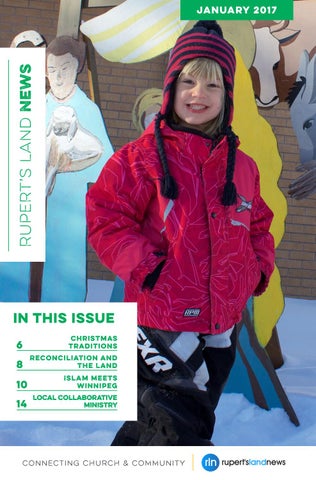
Subscription queries: Administrative Assistant for the Diocese (204) -4200 | general@rupertsland.ca RLN welcomes story ideas, news items, and other input. If you want to be involved in this media ministry, please be in touch with the editor. Contents copyright 2016 by Rupert’s Land News. All rights reserved. Cover: Myah plays with the manger scene in front of St. Peter's, Winnipeg.
2
fr o m the edito r
Hi, I'm Kyla Neufeld, your new editor for the Rupert's Land News. I'm not a cradle Anglican, but I've made saint benedict's table here in Winnipeg my home for the last five years and was confirmed in
2012. I'm a poet and a writer, and I've been working as an editor at Geez magazine since 2014. I have extensive editing experience and a passion for the written word. One thing I appreciate about the Rupert's Land News is its mandate to explore faith and the Church in relation to social justice issues and the wider context of our world. I hope to continue bringing you thoughtful articles about theology, community, and stories from the Diocese. I'm also looking forward to visiting different
parishes and getting to know Rupert's Land readers. In this issue we look at the history of Christmas, a piece on Indigeneity and the land, and an update from the parishes of Pembina Hills on their Local Collaborative Ministry initiative. Lastly, I'd like to thank Bishop Don and Allison Courey for their help during my transition to the position of editor. The Rupert's Land News is an exciting opportunity for me and I'm happy to be taking on the challenge.
I've been thinking about Christmas traditions. This year was my daughter's first Christmas and, while at 5 months old she won't remember it, my husband and I tried to include her in every aspect. We hung up a stocking for her, sang Christmas carols to her, and made an ornament with her godparents. Something we've been asked is what we're going to do about Santa Claus. Are we going to give our daughter gifts from Santa Claus? Are we going to leave out cookies and milk? Are we going to bring her to the mall and get the obligatory photo of her screaming on Santa's lap? Well... yes and no. Growing up, Santa was
RUPERT’S LAND NEWS
#
Stories of the Season
CHOCOLATE CHANGES
THIS
FARMERS’ LIVES not a part of my Christmases. My family lit the candles on the advent wreath, participated in our church's Christmas plays, and went to the Christmas Eve service. There are no pictures of my siblings and I sitting on Santa's lap, and not once did we read “Twas the Night
Learn how at fairtrade.ca
3
fr o m the edito r Before Christmas.” Around this time of year, I often hear “keep Christ in Christmas” or “remember the reason for the season.” And, that's fine. For Christians, the story of Christ's birth should be central to our celebration of the season. But I also think the stories behind Santa Claus hold a lot of value. Sitting on my bookshelf is a copy of J.R.R Tolkien's Letters from Father Christmas. From the years of 1920 to 1943, Tolkien wrote letters to his children as Father Christmas. He told them stories of Father Christmas's life in the North Pole, of his chief assistant, the North Polar Bear, and of the wars between the goblins and the Red Gnomes of Norway. Tolkien included drawings and messages from the North Polar Bear. And, over the years, the cast of characters grew to include Pasku and Valkotukka, the North Polar Bear's mischievous nephews, and an elf named Ilbereth, who Father Christmas employed as his secretary. All of these letters were
RUPERT’S LAND NEWS
postmarked and stamped so that Tolkien's children could receive them in the mail. As a devout Roman Catholic, Tolkien would have understood the importance of the Christmas season, but he also believed in the power of story and myth. He believed that, because our God creates, we emulate God when we also create, and that it is, in fact, our right as humans to tell stories. The origins of Santa Claus are varied, from Saint Nicholas to the Dutch Sinterklaas to several English
poems dating back to the 1400s. If Tolkien could find a way to bring a little magic to his children's Christmases by sending them letters from Father Christmas and observe the deeper meaning for the season at the same time, why can't I do the same? So, while my husband and I will probably not buy an Elf on the Shelf or even leave out cookies and milk, we will tell my daughter the stories of the season, of both Santa Claus and Jesus Christ.
4
Pasto ral note
GIFTs for t h e n e w year Donald Phillips
There is something both exciting and daunting about standing on the threshold of a new year, even though there is nothing particularly profound about the earth having completed one more 24-hour rotation (one day) as it completes one full orbit around the sun (one year). It is we who bring any kind of deeper, mystical meaning to this transition of what we call a “new year.”
change. And the entire sense of it is steeped in imposed discipline – of forcing ourselves to do something that is “good for us” and seeing how long we can stick at with it before we give up or give in. What if, as we stand at the threshold of 2017, we viewed the New Year as a gift – a real opportunity to begin again, to start with a clean slate? And since we
"The problem lies in how we perceive what we want to do differently" In our culture, it is quite common for people to set new goals for themselves – New Year’s resolutions – at the beginning of a new year. And it’s equally common for a degree of cynicism to surface around how serious we really are in fulfilling these intentions. I teach a weekly fitness class at the Downtown YMCA-YWCA in Winnipeg and we regularly refer to the expected influx of members into our classes in January each year – followed by the usual gradual decline in February. I think the problem lies in how we perceive what we want to do differently. We call these desired transformations resolutions – things we are resolved that we want to
RUPERT’S LAND NEWS
always make resolutions (at least any serious ones) based on better intentions for ourselves, what if we saw those intentions as gifts that we were giving to ourselves – and perhaps to others? In terms of our physical well-being – what if we chose to give ourselves the gift of the time and opportunity to engage in an exercise program that enabled us to become more healthy and whole? If we wish that our understanding and practice of our Christian faith was more real and vibrant, what if we were to give ourselves the gift of participation in a study course or discussion group to bring about that end? Then, rather than viewing the transformed behaviour
as a “battle to be won,” we would see it as a determination to continue receiving a good gift that we deserve! However, is this simply a psychological trick – a kind self-deception – like burying the awful tasting medicine in a bowl of Jell-O before administering it to a sick child? Not at all – at least not if we make one more connection: that if the gift we are trying to receive is something that will actually make us more whole, then it is something God would desire us to embrace and for which we will be given the grace (God-given potential freely given) to pursue. At the beginning of this New Year, spend some time discerning the gifts you want and need to receive and trust that you’ll be given the grace to receive them – all year long.
Donald Phillips, Bishop of Rupert’s Land 5
C hr istmas
Traditions across Canada, for b et t e r or for wors e Gerry Bowler
Here’s a little quiz appropriate for the season. 1. What country invented the department store Santa? 2. What country invented the Santa Claus parade? 3. In what country do young people go door-to-door at Christmas begging, threatening to torture the oldest daughter of the house if a donation is not made? 4. What country has magical gift-bringers such as Father Time, Queen Mab, Aunt Nancy, and Mother Goody? 5. Where can you find janneys, ownshooks, belsnicklers, and fools demanding entrance into a neighbour’s house at Christmas? The answer, of course, is Canada, which has celebrated Christmas for centuries with unique customs. Take, for example, the now-universal presence of Santa Claus figures in department stores and malls around the world. The very first of these appeared in Sampson’s Department Store in Fredericton, New Brunswick in 1869 where Santa filled stockings for customers. Three years later, the store RUPERT’S LAND NEWS
boasted that Santa himself would deliver gifts bought at their store and would be out to scout the houses on December 22 for chimney suitability. In 1905, Eaton’s department store in Toronto staged the very first Santa Claus parade. In Quebec, where groups go door-to-door at Christmas in a custom called la guignolée. They sing a medieval French song in which one verse goes: We will take the eldest girl, And roast her feet for her, The Ignolée, the Ignoloche, To grease our pockets, We do not ask for much For our visit. Twenty-five or 30 feet of pigs’ tails If you like. Today the jocular threats are meant to solicit charitable donations instead of food. Other Quebec customs include la tire (the toffee-pull), the revéillon (the post-midnight mass feast), and scary stories about werewolves and ghost-canoes. Atlantic Canada also has peculiar customs. There the excess candy of the holiday season is distributed in children’s stockings on New Year’s Eve by Mother Goody, Aunt Nancy, Mother
The Mother Goose float in the 1930 Eaton's Santa Claus Parade. Photo: City of Toronto Archives New Year, or Father Time. In Newfoundland, masked house visitors called mummers descend on homes demanding hospitality. Depending on their costumes, they might be called Fools, Ownshooks, or Janneys; in New Brunswick, they are called Belsnicklers after a shaggy German creature of folklore named Belsnickel. But Christmas has also produced dissident voices. In the period following World War II, one of the world’s most famous Canadians was Brock Chisholm, known as the “Man Who Killed Santa Claus.” A military general, high-ranking civil servant and the founding Director of the World Health Organization, Chisholm claimed 6
C hr istmas that, “Any child who believes in Santa Claus has had his ability to think permanently destroyed.” Chisholm announced in 1951 that he was going to bring the case of Santa Claus before the United Nations as a means of denouncing all such local and national fictions. He claimed that belief in Santa Claus sapped children of that universal spirit which was necessary for humanity to solve the planet’s problems. “Santa Claus,” he said, “is one of the worst offenders against clear thinking and so an offence against world peace.” In November 2000, a number of businesses in the Westmount district of Montreal found themselves trashed by splashes of paint, oil, and eggs after they
brought out their commercial Christmas decorations too soon. The vandals, a group styling themselves as “L'Anti Noël Avant L'Temps” or “No Christmas Before Its Time,” said, “We are a group of people who are saddened and frustrated by your ill breeding. We refuse to let you destroy autumn for a reason as pernicious and disgusting as making a little bit of money.... We demand that you take down all of your Christmas decorations without delay, and not put them back up until the first of December. If not, we are going to strike again.” More recently, if you are in a Winnipeg shopping mall during December, you might run across a band of protestors from the Buy Nothing Christmas move-
ment singing a cheeky parody song urging shoppers to rethink the meaning of the holiday. Said one of its leaders, “By resisting the impulse to shop for deals on Black Friday we stand at the feet of the retail titans and, with the power of non-cooperation, we challenge the injustices of poor labour conditions, exploitative hiring practices, unfair monopolies, and irresponsible resource extraction.” Christmas, however, is too deeply entrenched in the Christian and national consciousness to be much bothered by critics. The deep meanings that it bears and the myriad of memories that it evokes yearly are enough to ensure its celebration for centuries to come.
Thorvaldson Care Center AN INTERMEDIATE CARE FACILITY FOR SENIORS 24 hr care and supervision Registered Nurse on site Assistance with medications, dressing, hygiene
All meals, laundry and housekeeping Recreation programs Private bed-sitting rooms
OVER 55 YEARS
caring for senio rs
495 Stradbrook Ave | Winnipeg, MB | R3L 0K2
ph (204) 452-4044 | fax (204) 452-4054 thorcare@shaw.ca | www.thorcare.ca
RUPERT’S LAND NEWS
Gerry Bowler is a historian who attends St. Margaret’s, Winnipeg. His latest book, Christmas in the Crosshairs: Two Thousand Years of Denouncing and Defending the World’s Most Celebrated Holiday, has just been published by Oxford University Press. 7
R ec o nc il iatio n
Uncovering the truth: l a nd i s ce n t ra l Deanna Zantingh
I turned on the radio in time to hear CBC perfectly capture my past year’s journey in one sentence. “The thing about seeking reconciliation with indigenous peoples is that eventually you realize you also have to make reconciliation with the land,” said Caleb Behn, a Salish activist and lawyer. I began studying theology as a way to explore the questions that my friendship with an indigenous community in northern Ontario had raised. After my first year, I was shocked at how central land had become, when reconciliation was my focus. My thesis work has been no different. This past year I began a qualitative research project listening to people in Mishkeegogamang First Nation in northern Ontario reflect on land and identity. All of this has led me to a startling conclusion: I don’t want to talk about reconciliation anymore, unless we are prepared to put land in the middle of that conversation. Here’s why. A few years back, a friend offered this summary of colonization: “There’s something that’s been covered over — that’s what colonization is.” In my thesis
RUPERT’S LAND NEWS
research, I’ve come to see the way land and people have been covered over or made invisible. The removal of people from land is the cornerstone of the colonial imagination, so understanding the connection of people to land is a necessary step toward a different imagination. One of my favourite theologians, Willie Jennings, puts it this way: land was once the signifier of identity. When colonization began to separate people from land, “skin was asked to speak for itself,” and land that once marked identity became reshaped into a commodity. What’s been covered over is the very thing that indigenous tribes like Standing Rock are still standing to protect. I’m convinced we call them protestors because we can no longer see what’s been covered over: a view of land that many have already been taught to forget. But it is not just a view of land, it is a way of being — an intimate connection with the land. The elders in Mishkeegogamang had a word for this: Taashikaywin. “It’s everything, it’s the most important thing,” one elder told me. “Taashikaywin is where
Norval Morriseau: "Artist and Shaman between Two Worlds," National Gallery of Canada. Photo: Beverly Carson-Bader. we intend to be originated from — that’s our identity. Taashikaywin is part of us, a part of our spiritual perspective. When I say part of us that means air, water, plants, animals, and spirituality. Taashikaywin is everything. It is who I am as you speak to me. I am Taashikaywin ya.” From these stories I came to better understand what occurs in colonization. “Back when the Europeans got here, they were the ones that were living inside a box,” one man told me. “They made forts to surround where they were living. We were out. Now, that is reverse: we are the ones living on a reserve and they are the ones out. They are the ones keeping us in now.” Still others remarked, “this [reserve life] is not Taashikaywin, this
8
R ec o nc il iatio n
Boat rides with Destani Skunk, Jeff Loon, and their son, Raeshaun, raised new questions for Deanna Zantingh about looking at land theologically. Photo: Deanna Zantingh is colonization, you have to go out to Taashikaywin to learn.” The displacement of people from land, and the subsequent re-ordering of “Indian” people onto “reserves,” while lands themselves became reshaped by government and private interest is not the only thing that is occurring here. An elder would also tell me that Taashikaywin is a sacred cycle. This is what is broken and in need of repair. It’s the reason there is so much confusion, and why people feel lost.
RUPERT’S LAND NEWS
For me, it has become impossible to separate a desire to support indigenous youth within a suicide epidemic, alongside continued actions that colonize their land and peoplehood. If you want to respect the plight of indigenous youth, you have to respect indigenous land. If you want to seek reconciliation, it will lead you to reconci-land-ation. The moment that really inspired a lot of this thesis work was a boat ride when friends in Mishkeegogamang took me out to Taashikaywin. This boat ride was my baptism into non-commodified space, the place I learned to see what had been covered over. Land is never just a commodity to be bought, sold, traded or consumed, often privately by the individual; nor is it empty space requiring labour and management for value to appear. Land is the foundation of a language system; held in common for the benefit and survival of all; a part of a broader complex and interconnected system that contributes to all
of life; source of medicine, food, and gifts; and an inseparable part of what it means to be human both physically and spiritually. Truthfully, what’s been covered over is the absurdity of a system that “holds land in trust” for the members of our society who have often demonstrated the greatest amount of trust in holding land. This article was originally published in the Canadian Mennonite.
Deanna Zantingh lives in Beausejour. She will complete her Master of Theological Studies at Canadian Mennonite University this fall.
9
Neighbo ur s
WhY Winnipeg?
Being muslim in Rupert's Land Shahina Siddiqui
I am often asked why I chose Winnipeg to be my home. My answer is simple. In my 40 years in Winnipeg, I have not once doubted my initial impression of this city as one that has a soul. Winnipeg is my home. I have lived nowhere else this long. My roots here are connected to the fact that my son and my parents are buried here, my other son and grandchildren were born here, it is here that my social justice activism was nurtured, and it is here where I discovered not only why I am a Muslim, but why I wanted to live as a Muslim Canadian. My intellectual inquiry into my faith started here and for this I am eternally grateful. The spirituality that my grandmother and parents nurtured in me growing up in Pakistan was tested in ways that I would never have faced growing up in a Muslim majority country. I was asked why Muslims believe what they believe, I am challenged everyday in light of world events why Muslims are violent, I am ridiculed for dressing modestly, and yet I am empowered by majority of Winnipeggers who support me and my community in times of crisis and to stand RUPERT’S LAND NEWS
with Winnipeg Muslims when hate is directed towards us. What I have also come to love about Winnipeg is that it is much easier to build relationships that are lasting, sincere, and can withstand the test of time. My relationship with Indigenous Winnipeggers rally for an inclusive Canada communities, Photo: Michael Yellowing Kanon and various faith and cultural groups has shaped moment’s notice will you my world view and find hundreds coming out enhanced my commitment to to stand in solidarity with the core values of my faith the persecuted and the and those of Canada. oppressed? One of the core Winnipeg has a social values of Islam is to stand conscience. We may not be up for justice and this is perfect, but we are willing what I aspire and strive to to acknowledge what is do through my writings, wrong and unjust. We raise speaking, and actions — awareness for issues and we Winnipeg has provided me gather in the public square with an opportunity and a to demand justice and fair platform in the public sphere. governance. The beauty I have never felt alone in my is that we do it together. A struggles because there are problem facing one segment numerous people who are of Winnipeggers becomes passionate for justice and every Winnipeggers peace and we have become problem. This is what a a family in Winnipeg, which community is all about. We I rarely find anywhere else may help in different ways in Canada. Where else on but we feel each other’s 10
Neighbo ur s pain. The Muslim Winnipeg community is the envy of many around the country and beyond, not because of who we are, but because of the support and friendships Photo: Peadar and relationships we have with the rest of Winnipeg. in me and supported my Where else would a efforts when I took on the Muslim woman be invited task to establish the Islamic to speak from the pulpit Social Services Association, frequently at churches? as well as the Canadian Where else would people Muslim Women’s Institute like Carl Ridd and John and the Federation of Harvard take the time and Canadian Muslim Social interest to mentor someone Services and the Canadian like me? Where else would Muslim leadership Institute. media seek the opinion of These were people from an ordinary Muslim woman both the Winnipeg Muslim who takes them to task? community and the larger Where else would staff, who community. are not Muslim, remind me I learned from The of prayer times? Winnipeg Foundation how Winnipeggers believed to operate a not for profit,
I learned from John Longhurst, Nicholas Hirst, Terry MacLeod, and Carol Sanders on how to engage the media. My activism was strengthened by Howard Davidson, Krishna Lalbihari, and Noel DePape. Gladys Cook and Stan McKay taught me Indigenous ways and Rabbi Neal Rose encouraged me to speak about my way of life. Suenita Maharaj-Sandhu taught me management skills and Abdo Eltassi stood by me through thick and thin. As a person of faith I know now that I did not choose Winnipeg; it was chosen for me. If the vision of multiculturalism is being actualized in Canada, it is in Winnipeg and that is what makes Winnipeg my home — a place I look forward to returning to, snow and all.
Great suites still available 204-989-5927 oldgracehousingcoop.ca RUPERT’S LAND NEWS
Shahina Siddiqui is the founder and Executive Director of the Islamic Social Services Association in Winnipeg. 11
C o mmunity
PARISH NEWS ROUND UP Centre for Christian Studies
CCS is hiring a new principal. Applications will be accepted until February 15. Detailed information can be found on the website.
St. Paul's, Fort Garry
Phil Barnett is hosting a meditation retreat on January 14 at St. Paul's. Contact him for further information. You can obtain a copy of the newsletter from the world community for Christian meditation by emailing christianmeditation@bellnet.ca.
Anglican Foundation
Week of Prayer for Christian Unity
The 2017 Week of Prayer for Christian Unity is January 18-25. To mark the 500th anniversary since the beginning of the Reformation in Europe, this year’s theme will be “Reconciliation — the love of Christ compels us.” Watch the events page for local details as they become available.
Diocesan Refugee Fund
A “Caribbean Dreamin'” food and wine gala is happening on January 19 in support of the Diocesan Refugee Fund. It will be held 7:00-9:00 p.m. at Riverwood Square (1778 Pembina Hwy. in Winnipeg). Tickets are available through the Diocesan Office or eventbrite.com. Photo: Daniel Webb
The Foundation is pleased to announce that it recently awarded two new grants in Rupert’s Land. The first was $7000 to St. Mary’s, Charleswood, for the installation of glass doors in their building. The second was a special requestfor-proposals grant, awarded to four projects in the country related to the Truth and Reconciliation Commission’s Calls to Action. This was $10,000 toward Indigenous ministries in our diocese, specifically Indigenous ways of knowing and healing.
PWRDF
The Primate's Fund has responded to the crisis on Pikangikum First Nation by establishing a water project requested by their elders and school system. 90% of homes in the community do not have access to water or waste-water services. PWRDF is working with local leadership to equip homes with access.
St. George's, Crescentwood
In conjunction with Kairos, the church hosts prayers for peace and justice on Thursdays at 9:00 a.m. All are welcome.
Rupert's Land News
RLN wants to showcase artists in the Diocese. If you're a painter, photographer, sculptor, potter, quilter, or illustrator and you'd like to see your work in the pages of RLN, send us an email at rlnews@ rupertsland.ca.
RUPERT’S LAND NEWS
40 Years of Ordination for Women
In celebration of the 40th anniversary of women to the priesthood, a gathering of women priests was held in Stratford, Ontario, November 28 - December 1. Karen Laldin and Bonnie Dowling attended the celebration on behalf of Rupert’s Land.
12
C o mmunity The Anglican Journal
This month will be the final circulation of the Anglican Journal in Rupert’s Land. All readers are encouraged to sign up for the Journal’s updates online. If you prefer to receive a print edition of the Journal, you can subscribe to that online or by calling (416) 924-9199 x259.
St. Alban’s Cathedral Celebrates 100 Years
Spiritual Ministry of Mishamikoweesh
Our neighbours in Mishamikoweesh, formerly the northern part of the Diocese of Keewatin, have a team translating the Bible into Oji-Cree. The group is made up of local individuals excited to be translating Scripture into their mother tongue for the first time. Read the full story on the Anglican Journal’s website.
On January 1, 2017, the bell at St. Alban’s, Kenora, pealed 100 times, not only greeting the New Year, but celebrating 134 years of ministry in Kenora and 100 years at the Main Street building.
St. Luke's, Winnipeg
The first and third Wednesdays of the month, the church holds a cancer support group at 10:00 a.m. A grief group runs on the fourth Wednesday. All are welcome; please let them know in advance if you'll be joining them.
RUPERT’S LAND NEWS
Cree biblical text, Moosonee Railcar Museum
13
Par ish L ife
To Live and Pray in Pembina Hills Chris Lea
Yes, it has been six years since our group of five churches – Clearwater, Pilot Mound, Manitou, Kaleida, and Altamont – which initially made up the parishes of Pembina Hills,have been commissioned as Local Collaborative Ministry (LCM), a form of ministry that involves members of congregations volunteering their time and talents to provide the services normally performed by paid clergy. There was a total of 15 members who were first commissioned in March 2010 and since then a number of team members have either retired or moved away. In 2015, we had a re-commissioning and many new faces joined. There are currently 16 members that make up the team: five ordained priests, one ordained deacon, eight worship leaders, two pastoral care coordinators, and one administrator. We no longer have a stipendiary priest, but currently have a part-time mentor, Norm Collier. Norm helps us with our business meetings, which are held on a monthly basis to go over administrative items and a learning point. This is also the time we schedule upcoming services and who is to conduct those services.
RUPERT’S LAND NEWS
Norm also initiates our monthly education workshops. The current theme is “the sharing of our individual spiritual journey.” These personal life experiences have generated much discussion. Initially, there was a sense of resignation from the Parish when we finally decided that we couldn’t afford a stipend priest anymore and the LCM model was the only alternative available to keep our doors open However, after the initial start-up phase of doubt, there has been a sense of optimism from everyone. It has been humbling to see how we have been accepted and encouraged by the congregation. The LCM model within our church has truly positively affected our local Anglican members and the greater community. As Roxy Barret, a current member of our team, put it, “I was invited at the first commissioning and declined. Then I realized what a wonderful job everyone was doing and thought I could help with something and it just mushroomed from there. Calling has a whole different meaning to me since then. I can't explain the feeling of fulfillment given my life. I feel like our team is like a family and it’s just such a wonderful
connection to God.” Now, if there is something that needs attention, everyone just pitches in. In fact, not much has changed since the inception except our enthusiasm has increased tenfold; some of the churches still have Sunday school for the children, confirmation classes, weddings, and baptisms. Do we still have hurdles to overcome? You bet we do! But with the excellent training we have received from the Diocese right from the start of this journey, we are now equipped to handle anything that comes our way. Praise be to God.
LCM reflects an understanding of Christian vocation as being entrusted to all the baptized. Read more about LCM in Rupert’s Land. Chris Lea is a priest on the Pembina Hills LCM team and a farmer.
14
Via Me dia
And then there was confession Allison Courey
I was a little shocked when, during Lent ten years ago, my priest stood up and announced that the clergy would be hearing confessions throughout the Lenten season. If I so desired, I was to email the church office to set up a time to confess. This felt like an outrageous Catholic practice I’d never discovered before. But my shock gave way to intrigue as the idea rolled around in my mind over the coming weeks. Imagine, saying all those things I’d being carrying around for years to one other human being, and then being absolved and set free. At the very least, it was worth trying for the ethnographic nature of the thing. A decade later, I find myself kneeling before my confessor in a quiet chapel for what has become my bi-annual practice. It occurs to me that I have less time to
collect sin between Advent and Lent (three months) than between Lent and Advent (nine months!), so this shouldn’t take very long. I reach into my coat pocket and draw out a crinkled piece of paper with my list. As I trudged through a snowy field on my way to the chapel this afternoon, I wondered why I keep coming to the confessional long after the intrigue of the thing has faded. Not a common Anglican practice, even my confessor seems to find my diligence a little
GP Complete Care Exceptional care since 1973 WORK WITHIN SENIORS’ BUDGETS
PROVIDING HELP WITH: Daily routines Housekeeping Meal prep Personal care Laundry Medication Reminders WE ARE ALWAYS HERE FOR YOU
(204) 869-1076 RUPERT’S LAND NEWS
gloribp55@gmail.com
odd. My mind skips back to another confession not long ago. It had been a long and difficult year, and by the time I arrived at Lent’s doorstep I was holding more than I could carry. My confessor at that time, Andrew, had recently preached about clay. He spoke about our difficulties in allowing ourselves to be clay and allowing others to be clay. We try to pretend we’re made of tougher stuff, and we expect others to do the same. But God created us to be clay and called it good. Clay, Andrew told the crowd at our early morning worship service, is mouldable. With warm and gentle hands, it can by softened and sculpted and changed. Clay is what we are called to be. I went to Andrew for confession later that Lent to lay down all those things I was carrying which prevented me from being soft, mouldable clay. Anything causing — or being caused by — guilt, fear, anxiety, or shame, I brought and named before 15
Via Me dia Andrew that day. I named things I had done, but should not have; and things I had not done, but should have. I brought him my “sins,” those one-time events I was individually responsible for, and my “Sin,” that greater societal brokenness of which I am apart. And when I finished naming those things out loud, Andrew asked if I also forgave those who had hurt me. And then he told me that through Jesus I was absolved of all sins and all Sin and was restored to wholeness. And when those words have been said, I can no longer carry those things around with me anymore — like an old backpack slowly collecting stuff as it becomes heavier and heavier — because all that was preventing me from being soft clay has been given away. I am not free to take any of it back. One time, the priest took
rln
my list and set it on fire, preventing me from even looking at it again. Sometimes, as I walk away, I am tempted to revisit the things I’ve left behind. To turn them over in my hands just one more time, making sure I haven’t missed anything. But I can’t. They are gone. I’ve often heard Protestants say that confession can be made to God, and that’s enough. But sometimes it isn’t. Sometimes there’s something about bringing those hard parts of our clay-selves and naming them before another one made from clay. Saying all of our fear and brokenness and sin out loud tends to release the power those things hold over us. Accountability has been a Christian discipline for centuries, and this is one way of doing that in a safe and structured environment. The good Lord knows I love structure! The formal
rupert'slandnews
RUPERT’S LAND NEWS
practice of confession isn’t for everyone. I know one priest that makes a point of having lay people as confessors, thereby stating his conviction that all baptised people are called to the ministry of reconciliation. Still others are able to name things before God, in the silence of their hearts, and then walk away. The word “repentance” means turns turning around and walking in the other direction. The liturgy of reconciliation enables me to focus more on the turning around part than the dropping-off-the-heavy-backpack part. I remember telling Andrew one time, “It seems too easy!” He smiled and responded gently, “It was never meant to be hard.” But sometimes it is hard. I have met people in the winter years of their lives who’ve carried around deep secrets for decades, wrought with shame and unable to forgive themselves. Jesus reminds us, “Come to me! All you who are weary and burdened — and I will give you rest.” Jesus takes all of that heaviness with him to the cross so that we need not carry it into our own winter years. Jesus takes those things into the battle with death so that life can reign in our lives. Death and sin and brokenness no longer have the final say.
CONNECTING CHURCH & COMMUNITY 16