RUPERT’S LAND NEWS
Dec e MBE R 2 0 16
IN THIS ISSUE
4
Christmas tables
6
Lay vocation
CO N N ECT I N G C H U R C H & CO M M U N I T Y
Millennial post-Christian
8 15
rln
Messiah in the time of Trump
rupert'slandnews
rln
rupert'slandnews
CONNECTING CHURCH & COMMUNITY
Publisher | Bishop Donald Phillips Editor | Allison Courey Accounting | Bernice Funk Advertising | Angela Rush Layout & design | cityfolkcreative.ca
Advertising: RLN accepts advertising in our monthly magazine and our weekly email. Our rate sheet is available at rupertslandnews.ca/ads. To discuss advertising call (905) 630-0390 or email: rlandnews.ads@gmail.com.
Rupert’s Land News - is published 10 times per year (September - June) by the Diocese of Rupert’s Land, in the Anglican Church in Canada. It connects churches and communities from Portage la Prairie, MB, to Atikokan, ON. by offering news, events, opinion, and ideas to 6,000 readers per month. RLN is available in a variety of formats:
Editorial offices: Anglican Lutheran Centre 935 Nesbitt Bay Winnipeg Manitoba R3T 1W6
• • • •
rupertslandnews.ca facebook.com/rlandnews twitter.com/rlandnews instagram.com/rlandnews
We also deliver timely news and information via a weekly email. Sign up at: rupertslandnews.ca/email RLN exists to explore issues at the intersections of faith and life. In doing so we solicit and publish a range of opinions, not all of which reflect the official positions of the Diocese.
RUPERT’S LAND NEWS
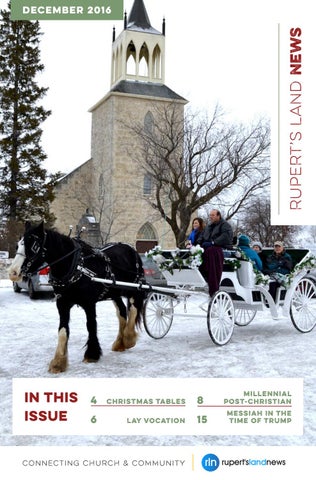
Subscription queries: Administrative Assistant for the Diocese (204) -4200 | general@rupertsland.ca RLN welcomes story ideas, news items, and other input. If you want to be involved in this media ministry, please be in touch with the editor. Contents copyright 2016 by Rupert’s Land News. All rights reserved. Cover: The old fashioned Christmas at St. Andrew's on the Red is December 3. There will be wagon rides again this year.
2
Pasto ral note
Saving the world, h u m a nly spe a ki n g Donald Phillips
Photo: Pete, Flickr
If you had the opportunity to save the world – how would you do it? You might respond with the question, “Save it from what?” but even a glance at public media would suggest that all is not right in our world. Look at the health of creation – the state of the environment. Species are becoming extinct and global warming is negatively impacting local environments around the world. Or turn to the majority of people in the world who do not have enough to eat each day and those who are sick or die needlessly – simply because they don’t have access to medical care that others have. What about the many instances of complete disregard for human life around the world? If one places any value in the created order and quality of life for all humanity – it’s not difficult to conclude that the world needs help. So how does one save the world? One might decide to redistribute food RUPERT’S LAND NEWS
sources in a fair and equitable way around the world. Or perhaps laws could be passed making it illegal to carry out any kind of manufacturing that harms animals. One could try to expose all the violence and oppression carried out against humans and attempt to hold the perpetrators accountable. But the problem with these strategies is that they will be effective only if we can be changed – if human minds and hearts can be transformed to see this world and each other differently. In order to save the world, human minds and hearts need to be transformed. How can we change the hearts of others, renew their minds, and help them see themselves, each other, and the world differently? The Creator is determined to save this world and decided that the only way to do that was to become a human. 2000 years ago, first century disciples experienced this transformation of
heart and mind in the person of Jesus of Nazareth. In him, they saw the fulfilment of Isaiah’s prophecy: “For a child has been born for us.” Those around the little town of Bethlehem heard of the words of angels: “To you is born this day in the city of David a Saviour, who is the Messiah, the Lord.” After his death and resurrection, Jesus’ identity as God incarnate became fully realized by those around him: “And the Word became flesh and lived among us, and we have seen his glory.” You and I are witnesses to God’s transforming power. It is in our lives that the evidence of a world being saved becomes real. The best Christmas gift you can give is to open yourself afresh to the light of the newborn Christ, allowing it to shine in and through you. Blessings of Advent and Christmas to you.
Donald Phillips, Bishop of Rupert’s Land 3
L iving Faith
Christmas tables of many kinds Sarah Campbell
Do you eat dinner at the table? With demographics showing nearly 30% of homes to be single occupant residences, and less than half of families reporting eating together up to five times a week, statistically you may not! With Thanksgiving and harvest behind us, and the bounty and abundance of Christmas celebrations ahead, our planning and celebrating centres so often around food. Why is there such emphasis on the dinner table culturally (the highly idealized family dinner), and why is the opulence of the holiday spread so attractive? Isn’t the dinner table just another reminder of our disconnection from the community ideal that we hold in high esteem but so regularly fail to achieve? Decorated with a mound of bills and paperwork, frequently abandoned in favour of take out, in my busy household it more often
RUPERT’S LAND NEWS
represents the chaos that takes place around its edges, if we make it to a shared dinner at all. Yet the dinner table has, by all accounts, a multifaceted, positive impact on people. Paul Fieldhouse, and adjunct professor at the University of Manitoba, writes that eating together, “is also a central part of social relationships and cultural rituals, as well as a symbolic and a material means of coming together. Across cultures and time, food sharing is an almost universal medium for expressing fellowship; it embodies values of hospitality, duty, gratitude, sacrifice and compassion. The shared meal is an opportunity not only to eat, but also to talk, to create and strengthen bonds of attachment and friendship, to teach and learn.” Rich in symbolism, ritual, community, and connection, its not surprising that we
joyfully anticipate the invitation to the holiday feast. The dinner table is an equalizing gathering point for people from all backgrounds, traditions, and beliefs. In Jesus’ ministry, his disciple Matthew comments on this: “Then it happened that as Jesus was reclining at the
4
L iving Faith table in the house, behold, many tax collectors and sinners came and were dining with Jesus and his disciples” (Matt. 9:10). The table as well as the master invited sinners to join him in breaking bread. Some of us may not find this image difficult to conjure while sitting across from grumpy uncle Gus and gossiping aunt Gertrude at our own holiday festivities! The table is an invitation of Christ, as expressed in
his invitation to share in the last supper, come together as equals and experience grace, remember together, and celebrate the hope that is found in Jesus. The table is as expansive as the ground around the cross where we all come as we are. We leave there transformed, filled with the provision of Jesus. This holiday season, I invite you to gather, welcome, and partake in the
Thorvaldson Care Center AN INTERMEDIATE CARE FACILITY FOR SENIORS 24 hr care and supervision Registered Nurse on site Assistance with medications, dressing, hygiene
All meals, laundry and housekeeping Recreation programs Private bed-sitting rooms
hospitality of the season. Consider those around the table as equals in their own pursuit of connection, love, and celebration, as much as merry food-munchers. Allow the holiday table be a place of grace, care, and hospitality for you and those you share the table with. As the letter to the Hebrews reminds us, “Do not neglect to show hospitality to strangers, for by this some have entertained angels without knowing it” (Heb. 13:2). The table is set and there is room for all who wish to join and share in the feast. In this, we enact the hope of Christ that the season holds.
OVER 55 YEARS
caring for senio rs
495 Stradbrook Ave | Winnipeg, MB | R3L 0K2
ph (204) 452-4044 | fax (204) 452-4054 thorcare@shaw.ca | www.thorcare.ca
RUPERT’S LAND NEWS
Sarah Campbell is the Executive Director of Meals on Wheels in London, Ontario.
5
Disc ipl eship
Transforming the world one lay vocation at a time Shelagh Balfour
At a National Church gathering, a group of men and women settled around a conference table. It was a mixed group, comprised of both clergy and laity. They had come from parishes across the country and were strangers to one other, so they began with introductions. “Hi, my name is George,” said one. “I’m just a lay person.” “I’m Judy,” said another. “I’m nobody, just a lay person.” Yet another began her introduction with “I’m nothing. I’m a lay person.” She went on to assure the group her parish priest was actually present, but attending another workshop. This pattern repeated itself again and again throughout the conference as participants and facilitators alike expressed their inferior status or apologized for their lack of qualification to speak to the gathering solely on the basis that they were lay people, not clergy. They conveyed the message that they were “second best,” tagging along behind the “real deal,” the clergy they had come with. The subject of the conference was evangelism in the Anglican Church of Canada, a subject many found daunting. People shared common stories — being approached by RUPERT’S LAND NEWS
Photo: Tetris by Mishka
someone in the mall asking them if they had been “saved,” or being stopped by a person on the street who asked to pray for them right then and there. This was the image of evangelism many carried, and reactions to it around the room ranged from nervousness to embarrassment. Few felt comfortable with attempting it themselves. The keynote speaker at the conference shared a much broader vision of evangelism, beginning with her translation of the Great Commission of Matthew 28:19: “Going, therefore, make disciples of all nations.” Her point was this: While certain Christians are gifted with the skills for direct evangelism — sent into the world with the specific task of preaching the Gospel
and converting people to Christianity — most of us are not. Nor is that what is expected. This doesn’t let anyone off the hook, however. The rest of us, she said, are called to evangelize as we go about our daily lives, as we work and play and care for one another. It is in the way we live the lives God calls us to that we demonstrate the good news of Jesus to others. It is this lived faith that will create opportunities for others to get to know Jesus for themselves. This model of evangelism depends, not on highly trained professionals with a specific skill set, but on lay members of the Church confidently living out their faith in the midst of their daily lives. As I compared this 6
Disc ipl eship
#
vision of evangelism with what I had heard from lay delegates at the conference, it made me wonder, How do men and women who see their roles in the Church as secondary and peripheral live out a confident faith in the world? How can people who describe themselves
CHOCOLATE CHANGES
THIS
FARMERS’ LIVES Learn how at fairtrade.ca
RUPERT’S LAND NEWS
as “nothing” and “nobody” envision themselves demonstrating the good news of Jesus to others? In Romans 12:4, Paul tells us, “For as in one body we have many members, and not all the members have the same function, so we, who are many, are one body in Christ, and individually we are members one of another.” There are members of the Body of Christ whom God has called to particular, ordained, leadership roles in the Church. In the Anglican Church, we value the orders of bishop, priest, and deacon. Equally, though, God has called members of the Body to exercise their ministry in roles we have come to view as secular and therefore somehow irrelevant to the life of faith. Consider how the world would be transformed if we regarded every role, every life, as a holy calling — if the man who drives your bus in the morning knows he is called to that task by God, or the grandmother who cares for her children’s children. Imagine doctors,
lawyers, nursing assistants, and McDonald’s fry cooks confident that this is where God has called them to be at this moment in their lives. I’m sure that, like me, the other lay people at that evangelism conference had roles within their parishes, whether teachers or lay readers, administrants or wardens. What I wished for each one present was the gift of seeing that there is no environment, no role that is less sacred, less permeated with the holy than any other; that wherever we find ourselves in life, we are disciples of Jesus living out his call to us. My turn around the conference table came and I introduced myself. “My name is Shelagh,” I said. “I am not ‘nothing.’ I am not ‘nobody.’ I am a lay person.” I pray for the grace for each of us to live out our faith confidently, wherever we find ourselves in God’s world. Shelagh Balfour is the administrative assistant and an active member of St. Peter’s, Winnipeg.
7
Pr o fil e
To stay or go:
th e M i lle n n i a l pos t-Chris tian Allison Courey
Maureen Hanlon, a 30-year-old Winnipegger, is like many of the Millennials you may know: baptised Roman Catholic, she attended an Anglican church as a teenager but no longer identifies as a person of faith. When I asked her what changed, her answer wasn’t what you might expect. It had nothing to do with righteous indignation against the abuses of organized religion; there was no awakening in her education which convinced her that God didn’t exist. Instead of being pushed out of the Church by something negative, she simply wasn’t convinced to stay by anything positive. “I’m not a Christian,” she explained, not because of anger or distaste, but because, “I have never heard the voice of God. I can’t say what [belief]’s right and what’s wrong.” Maureen assumes that her peers who remain in the Church have had a spiritual encounter that she never experienced. She even wishes that she could have
It’s not too soon to get ready for the Christmas season.
RUPERT’S LAND NEWS
that sense of belonging, but to claim it without evidence would ring false to her. While she respects the many expressions of spirituality she encounters, Maureen figures there’s enough right in front of her to occupy her concern. Instead of trying to understand the unknowable, she focuses her energy on creation care and concrete issues of justice. Like much of the “none” generation — that demographic which claims no religious affliation — Maureen is a product of a postmodern understanding of truth. It just doesn’t make sense to her that one system of belief would be given precedence over another in her multicultural, pluralistic, globalized world. I asked if she is ever bothered by a sense of the unknown. “I’m not worried about the sense of uncertainty,” she replied. But while she doesn’t consider herself spiritual, she does acknowledge that there is more to life that she doesn’t understand. It just “seems naturally un-
knowable to me.” At a younger age, Maureen found meaning and connection in her church community. Today, she finds those things elsewhere. Being outdoors and involvement in environmental activism give her a sense of purpose, while she finds community in friends and family. The initial disconnection with religion came from what
This Christmas, support local – support Canadian.
8
Pr o fil e she describes as the circular reasoning of faith. It was as if you had to believe in order to experience it, she explains, and you had to experience it in order to believe. It increasingly made no sense within her worldview. Furthermore, the faith community she found herself in was quite conservative and had no space for women in leadership. “I became conscious enough to realize that the values I’d been
RUPERT’S LAND NEWS
taught were not my own.” This caused her to reject religion entirely at first, but that rejection softened considerably as she grew older. “I wish I had a reason to believe in things I can’t see,” she told me, “I just don’t. It’s really beautiful to be part of a community that’s existed for thousands of years.” Still, Maureen hopes that if she has children, they will be raised in the Church. She credits the religion of her
childhood with teaching “the basic idea of charity and kindness” and the realization that “your life isn’t about you.” Religion is good for children, she says, because excessive empiricism can make young people become closed minded. Once they have absorbed those values from the Church, they are welcome to stay or to engage those principals elsewhere. For her part, having children is the only thing that would motivate Maureen to become involved in a religious community - unless she experienced “an epiphany.” Like so many of her peers, she finds meaning and community elsewhere. For her, it’s as simple as that.
9
L iving Faith
Reading the Bible as metap hor David Pate
One of the more annoying things about public media today is the way in which Christianity is presented. With rare exception, it is generally assumed that a literal interpretation of Scripture is the only way in which contemporary Christianity can be understood. As a retired priest, I find that educated friends with no history of Church connection assume that my belief in God is comparable to belief in fairies at the bottom of the garden. I admit that my background includes a liberal theological training in the 1960s and was buttressed by three study leaves in 1980s, 1990s, and 2000s at the Graduate Theological
Union in Berkeley, California. Having been exposed to critical, analytical thinking at theological college, I have always been open to the understanding of metaphor in interpretation of biblical texts. Apart from the metaphorical understanding of the creation narratives in Genesis, the birth and infancy narratives of Matthew and Luke are fanciful stories which contradict one another. They are great stories which hold valuable truth about salvation history, but no historical information. This is, in part, because they were both written nearly one hundred years after the birth of Christ. This need not interfere with our celebration of the Christ-
Great suites still available 204-989-5927 oldgracehousingcoop.ca RUPERT’S LAND NEWS
Photo: Cory Jim
mas season or awareness of God entering human history in Christ any more than the difficulties in the crucifixion, resurrection, and ascension narratives in the Bible destroy our celebration of the liberating awareness of God's love for us in these acts. To read some of the comments made by some members of General Synod concerning the proposal to allow same-sex marriage in the Anglican Church of Canada is almost enough to make one weep, as if Leviticus 18 is the last (or any) word on the subject of same-sex marriage. To understand the Bible as largely shaped by metaphor is to allow a wonderful, freeing understanding of God's love and acceptance. It also frees us from all those awkward questions about where Cain got his wife or what a father should do about a stubborn and disobedient son (stone him to death
10
L iving Faith at the city gates – Deuteronomy 21:18). It provides some perspective to Psalm 137, where we are advised to dash the heads of our enemies' babies against the rocks, and St. Paul's somewhat violent wish against those who argue for circumcision (Galatians 5:12). A metaphor reveals a more significant truth than historical accuracy. How much more welcome is the news that God cares enough about us to enter into our lives than the news that a young Palestinian girl became pregnant under unusual circumstances and an older man married her to legitimize the birth, as angels and dreams foretold? 1 Timothy 5 (where the Church is instructed to honour “real” widows but not others) is not a metaphor; but it is much more instructive to understand it as a political argument about women in ministry than an eternal edict about how “real” widows are allowed to serve the Church (read “men” in this case). A modern worshipper who accepts a metaphorical interpretation of Scripture can sit undisturbed and enjoy a liturgy where the first reading has God advising Hosea to marry a prostitute and have three children with given names about how angry God is with Israel. That same Sunday, the Gospel reading is from Luke, where a man is unhelpful to a neighbour because he has already gone to
RUPERT’S LAND NEWS
bed; but because of the stubbornness of the neighbour, the man gives in and helps him. It is much more useful to understand the Hosea reading as teaching that God will accept us no matter how much we mess things up, and the Luke passage as a strong reminder that we all share responsibility for one another. I believe the responsibility of the Christian living in 2016 is to help others to have the positive, hopeful ex-
perience of knowing a living God and a risen Christ.
David Pate is a retired priest and an honorary assistant at St. Paul's, Fort Garry.
GP Complete Care Exceptional care since 1973 WORK WITHIN SENIORS’ BUDGETS
PROVIDING HELP WITH: Daily routines Housekeeping Meal prep Personal care Laundry Medication Reminders WE ARE ALWAYS HERE FOR YOU
(204) 869-1076
gloribp55@gmail.com
11
C o mmunity
PARISH NEWS ROUND UP st. benedict’s table
st. benedict’s is hosting a “longest night” service in recognition that Advent and Christmas can be difficult for many people. Come to a simple service of reflection, music, and worship on December 20 at 7:00 p.m., whether this is a particularly difficult year for you or if the holidays are always a struggle.
Diocesan Advent Open House
All are welcomed for refreshments and fellowship at the Anglican Lutheran Centre on December 7, 3:00-6:00 p.m.
St. Andrew’s on the Red
The annual old fashioned Christmas at the little stone church and heritage site will be December 3, 12:30-4:00 p.m. Join the community for music, refreshments, a bazaar, carriage rides, and tours of the old rectory.
St. Luke’s, Winnipeg
There will be a Christmas rummage sale on December 3, 9:00 a.m.-12:00 p.m.
Holy Trinity, Headingly
Holy Trinity’s old fashioned Christmas evensong will be December 4 at 7:00 p.m. Period dress reminiscent of 1885 is welcome.
St. Stephen & St. Bede
The Seniors’ Information Days series is hosting a discussion on real estate transitions, including downsizing, leasing, and family land, on December 7 at 2:00 p.m.
St. Peter's, Winnipeg
The Christmas cookie walk and bake sale will be December 10, 10:00 a.m.-12:00 p.m. Come get your Christmas baking!
RUPERT’S LAND NEWS
Festivals of Lessons and Carols
A list of the festivals of lessons and carols happening throughout the Diocese can be found on the Rupert’s Land News website. If your parish’s service is not listed, please update us with your information.
St. Matthew’s Maryland Community Ministry
Donations of new or gently used gifts are needed for the low cost Christmas gift store in Winnipeg’s West End. Gift wrapping supplies and volunteers are also needed for the store, which runs December 13-16. Please drop off donations at the West End Commons on the 13.
1JustCity Christmas
Our inner city ministry umbrella organization has released a Christmas catalogue listing ways to support Winnipeg’s under-loved. Buy coffee for a day, warm socks, or support a mentorship program in the name of someone on your Christmas list. Check out the catalogue on its website to make a donation and receive a card of thanks for your loved one.
12
C o mmunity
Gifts for Mission
Gifts for Mission brings together the ministries of The Anglican Church of Canada and its partner, The Primate’s World Relief and Development Fund (PWRDF). Give a gift this Christmas in support of international development, northern ministry, or whatever it is your loved one cares about. Full details and available gifts can be found in the catalogue included with December’s Anglican Journal or on the Gifts for Mission website.
Holy Trinity, Winnipeg
The traditional Christmas pageant, complete with actors, choir, and pipe organ, is December 3 at 4:00 and 7:00 p.m.
St. Peter’s, Winnipeg
A Christmas cookie walk and bake sale will be held at the church on December 10, 10:00 a.m.-12:00 p.m. Get your Christmas baking all at once!
Rupert’s Land News
The Bishop is please to announce that a new editor has been hired for Rupert’s Land News. Kyla Neufeld attends st. benedict’s table and comes to us with strong editing experience as well as a background in Bible and theology. Kyla will begin transitioning into her new role this month and introduce herself more fully in the January magazine.
RUPERT’S LAND NEWS
St. Margaret’s, Winnipeg
An Amnesty International letter-writing event for the International Day for Human Rights will be held at the church on December 10, 10:00 a.m.-4:00 p.m. Join them to write a letter on behalf of a a person who is wrongfully imprisoned or persecuted somewhere around the world. Cases and letter-writing supplies are supplied.
40 Years of Ordination for Women
In celebration of the 40th anniversary of women to the priesthood, a gathering of women priests is being held in Stratford, Ontario, November 28-December 1. Karen Laldin and Bonnie Dowling are attending the celebration on behalf of Rupert’s Land.
Week of Prayer for Christian Unity
The 2017 Week of Prayer for Christian Unity is January 18-25. To mark the 500th anniversary since the beginning of the Reformation in Europe, this year’s theme will be “Reconciliation — the love of Christ compels us.” Watch the events page for local details as they become available.
Centre for Christian Studies
The annual cookies and carols open house is December 8, 4:00-6:00 p.m. Join them for refreshments, singing, and good cheer.
13
C o mmunity St. Alban’s Cathedral Celebrates 100 Years
On January 1, 2017, the bell at St. Alban’s, Kenora, will peal 100 times, not only greeting the New Year, but celebrating 134 years of ministry in Kenora and 100
years at the Main Street building. Anglican services began in Kenora in 1882 and the first church was built two years later. After the loss of two buildings to fire, St. Alban’s current building was constructed in 1917. 100 years later, they give thanks to God and to those who came before them, who, with courage and hope, built the place of worship. It is here that we begin our service to others. Their anniversary kick-off was the sale of 100 glass votive holders, created by
the children and sold at this year’s Christmas Tea. They raised over $450, which will be used to assist in building their second school in Vietnam. Then plan to fill their entire anniversary year with celebration, as they discover more opportunities to reach out to their community and to the world, thanks to the children’s leadership. There is an open invitation to join the congregation in worship and prayer as they celebrate the first 100 years of ministry from their building and look forward to the next 100.
Update from the Companions Program at SSJD
“Life isn't about finding yourself. Life is about creating yourself.” — George Bernard Shaw
In order to create yourself, you first need to understand yourself. You must learn who you are within your own context and in relationship to both God and those around you. This is a major growing year for me. I have entered the Sisterhood of St. John the Divine in Toronto to walk alongside the sisters for a time of spiritual discernment in their new companions program. It has not been easy to leave friends and family, some of whom do not understand what I am doing. Still, I feel that I am meant to be here to more fully understand my relationship with God. RUPERT’S LAND NEWS
In discerning whether or not to join the Sisters this year, the most important advice I received was from God. Listening to God and trusting is not an the easiest concept for me. Understanding why I am here is not clear yet, and I suspect that there will be lessons about myself, how to live in community, and how God is alive in my life. I am learning to create a life rather than hoping to find it. In the past two months, I have gone though many changes, asked a lot of questions, and contemplated my future. The questions that come up are some of the
hardest questions that I have asked myself. The support of this community has been crucial for my discernment process. Discernment here looks different for each companion. Our typical day is quite busy: chapel, prayer, work, and study. If you are interested in next year’s program, please contact Sister Constance Joanna, the companions coordinator, at companionj@ssjd.ca. Be sure to check out the companions’ website and blog at www. ssjdcompanions.org. Amanda Avery is an SSJD companion from Halifax 14
Via Me dia
The Messiah in the time of Trump Adam Smith
In the warm, spindled foyer where I go to university, there hangs a collection of paintings. On the stairway they are flanked by portraits of nineteenth century university doyens, in anachronistic yet recognizable clothing – principles, deans, emeriti. They are joined in the middle by six bearded and awkwardly collared reformers, gawking pensively at each other past their gold-ribbed picture frames. At the far end, on the wall just adjacent to my first-ever university classroom, dangles Richard Hooker. He is the Anglican of this group. Looking stoic and tranquil, he stands in the foreground RUPERT’S LAND NEWS
of an English meadow split by a lazy stream. Wearing a black cassock topped with a billowed ruff, Hooker’s hands are almost raised in prayer. Only the tips of his fingers are touching, spread apart, in a reversed rabbinic blessing. Surely, it speaks to the tranquil orderliness that the artist wanted to convey. I noticed the painting while an undergraduate and, since the election of Donald Trump, have been thinking about Richard Hooker and this painting again. The Anglican Church, of course, was founded because of a dispute over the nature of political authority, a crisis between the secular and sacred. In the Act of Supremacy of 1558, the state affirmed itself as the head of the Church. The full ramifications of this are articulated in the work of Richard Hooker, surely the most compendious thinker Anglicanism has ever produced. The results of Hooker’s oversized volumes collected as The Laws of Ecclesiastical Polity shape the Anglican Church and its establishments as a state Church. And so it was thusly, the Church of England found itself ensconced within the machinery of the state, theorized latterly by Richard Hooker, one of the first faces I saw when I
started attending university. In the early weekday mornings when I had to walk through Hooker’s imposing shadow, as now, I couldn’t help but think that Hooker had missed something essential. Can Christianity be reduced merely to a spirituality that both intermixes with and undergirds the state? What are we to make, then, of the Messiah who also happens to have been crucified by the state? In his book The Time that Remains, the Italian philosopher Giorgio Agamben wants to remind us that Christianity is messianic, and moreover that it posits that we live in the time after the Messiah. But don’t we know this already? This, I would argue, is what Hooker misses when he wants to legislate a non-acrimonious relationship with the state. To clarify, messianic time is not itself the end, the apocalypse where time finally exhausts and yields itself to eternity. Rather, it is the time of the end, the penultimate time between the Messiah and the end; the “already” that is also the “not-yet.” As Paul writes, it is the contraction of time; and so it changes the way we experience time itself. In messianic time, the time that now is, we are to live and experience differently, 15
Via Me dia aware that time is coming to an end. The end that is Jesus – the messiah – has already arrived and thus we are in the time that it takes time to end. These seemingly paradoxical formulations have but one goal: to realize that, as Paul says, “The appointed time has grown short” (1 Cor. 7:29). This means that the Church must recognize the potential and fecundity that exists within the immediate, and that deference or deferral is no longer possible. The Greek word for “grown short” (synestalmenos) has the connotation of contraction, such as that of wrapping up a bandage or the furrowing of sails. By this, Paul means that time takes on a distended tightness, and that we are in the “now” time of the Messiah. If the messianic time involves a different way of experience this penultimate time, this time that it takes for time to end, and it does so be revoking the validity all vocations, this means recognizing that every political authority is essentially illegitimate. Paul structures this as the “as-not”: “And those who buy as though they had no possessions, and those who deal with the world as though they had no dealings with it. For the present form of this world is passing
rln
away” (1 Cor. 7:30-31). Here we can see the structure of Paul’s messianic version of time: the ultimate changes the penultimate, not by abolishing it, but by rendering it inoperative, to use Agamben’s technical term. This is why Agamben sees the specific vocation of the Messiah as the revocation all vocations. Paul and the early Church called the legitimacy of the powers that be – and indeed the law itself – into question without entering into conflict with them, but rather by considering them inoperative, given the coming of the Messiah. Perhaps, by keeping the faith of the Messiah in mind, this can open a space for Anglicans (and all Christians), contrary to the political deference that is enjoined to Anglicans in the political theology of Richard Hooker et al., to both symbolically and politically resist. This will enable us to actively resist, fight, and refuse the explicit racism, vulgar sexism, veiled white supremacy, anti-Semitism, and outright fascism that is not only endemic to, but also constitutive of, our time, especially the time of Trump’s presidency. Perhaps we will also see that it is not our job to offer conciliation or well-wishes to Trump and other illegitimate
rupert'slandnews
RUPERT’S LAND NEWS
powers, to reconcile ourselves to them, or work with them in any way. Rather, we are to blotch them with the question mark that is the Gospel, nothing other than the crucified Messiah, while simultaneously resisting the very real political implications of Trump’s presidency. In the last instance, the question is: can the Church live out the political ramifications of its original assertion that, as the theorist Jacob Taubes puts is, “it wasn’t the nomos [law] but rather the one who was nailed to the cross by the nomos who is the imperator.” Will we defer this yet further with our usual political theologies? The Anglican Church must at least remember that messianic time is nothing other than the now. Time, indeed, grows short.
Adam Smith is a Rupert's Lander completing an MA in religious philosophy at the University of McGill.
CONNECTING CHURCH & COMMUNITY 16