RUPERT’S LAND NEWS
O c to ber 2016
IN THIS ISSUE 7
w hen the church holds space
8
#BlackLivesMatter
12
Youth Ministry Without a Frame
15
Sarcasm in John's Gospel
CO N N ECT I N G C H U R C H & CO M M U N I T Y
rln
rupert'slandnews
rln
rupert'slandnews
CONNECTING CHURCH & COMMUNITY
Publisher | Bishop Donald Phillips Editor | Allison Courey Accounting | Bernice Funk Advertising | Angela Rush Layout & design | cityfolkcreative.ca
Advertising: RLN accepts advertising in our monthly magazine and our weekly email. Our rate sheet is available at rupertslandnews.ca/ads. To discuss advertising call (905) 630-0390 or email: rlandnews.ads@gmail.com.
Rupert’s Land News - is published 10 times per year (September - June) by the Diocese of Rupert’s Land, in the Anglican Church in Canada. It connects churches and communities from Portage la Prairie, MB, to Atikokan, ON. by offering news, events, opinion, and ideas to 6,000 readers per month. RLN is available in a variety of formats:
Editorial offices: Anglican Lutheran Centre 935 Nesbitt Bay Winnipeg Manitoba R3T 1W6
• • • •
rupertslandnews.ca facebook.com/rlandnews twitter.com/rlandnews instagram.com/rlandnews
We also deliver timely news and information via a weekly email. Sign up at: rupertslandnews.ca/email RLN exists to explore issues at the intersections of faith and life. In doing so we solicit and publish a range of opinions, not all of which reflect the official positions of the Diocese.
RUPERT’S LAND NEWS
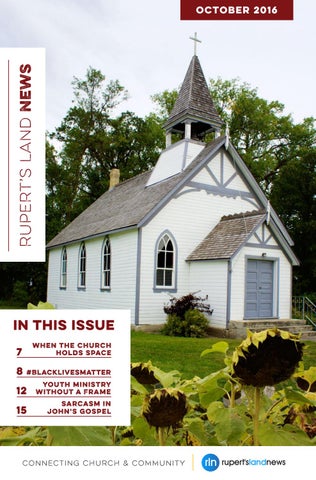
Subscription queries: Administrative Assistant for the Diocese (204) -4200 | general@rupertsland.ca RLN welcomes story ideas, news items, and other input. If you want to be involved in this media ministry, please be in touch with the editor. Contents copyright 2016 by Rupert’s Land News. All rights reserved. Cover: St. Paul's, St. Francois Xavier, is a municipal heritage site built in 1910. It opens for worship once a year for an anniversary celebration and picnic. This year, the service took place on September 18 in a field full of sunflowers ready for harvest.
2
L et ter s
Dear Rupert’s Land — it’s been an absolute joy to serve as Editor of RLN for nearly two and a half years, during a time of immense transition for RLN and for the Church. We have, I believe, been stretched and grown together as we’ve navigated what it looks like to be a connector of Church and community in the 21st century. It’s been exciting to see interaction with stories like never before because of media like Facebook. Our most popular stories in the past two years, bar none, were the celebration of the new St. Matthew’s worship space in the WestEnd Commons after the old nave was converted into affordable housing, and the Bishop’s letter about the vote on the marriage canon at General Synod. The time has come for a new Editor to carry RLN into its next phase of connecting Rupert’s Landers. The Diocese is looking for a creative individual with a diversity of communications and media experience, and education in Bible and theology. Please check out the short job description on the RLN website for more information, including how to apply. The position is approximately 15
RUPERT’S LAND NEWS
hours a week and includes putting together the monthly magazine and RLN Weekly, and engaging parishioners through the website and social media accounts. In this issue, you’ll find a diversity of articles exploring what it looks like to be a community of welcome. We are, in a sense, a “Thanksgiving people,” called to offer hospitality in whatever context we find ourselves. Rupert’s Landers share their
experiences of welcome among youth, refugees, those struggling with mental illness, and our neighbours. In the via media column, John Stafford looks at Jesus’ own welcome of his disciple Nathaniel and the use of humour in that text. Please remember those in your own community who are not experiencing hospitality this Thanksgiving, welcoming them in whatever way you are able.
Do not neglect to show hospitality to strangers, for by doing that some have entertained angels without knowing it. -Hebrews 13:2
Great suites still available 204-989-5927 oldgracehousingcoop.ca
3
Pasto ral note
Taking up the Family Bus ines s Donald Phillips
Some of the most-loved movies and T.V. shows are based on plots that involve people who are linked together in both business operation and family life. Inevitably, the interplay of values and expectations between the family system and the business structure give rise to a world of intrigue, conflict, and altruistic sacrifice. Have you ever thought about how true this is in our experience of the Church and its ministry and mission? On the one hand, we speak about our “church family,” usually referring to our home congregation. Our diocese and national Church are something like extended family to whom we relate on an occasional basis. Every three years, a few of us get to attend the Anglican Church of Canada’s “family reunion,” otherwise known as a meeting of the General Synod. One such reunion took place this past July in North York, Ontario. Our immediate branch of the family has its own reunion (diocesan synod) taking place in Winnipeg from October 20–22. How does this interplay between family and business get lived out in the Church? First, the Church is definitely in business. I am not referring to its issues of land, salaries, and expenses. It is clear from the New Testament that the RUPERT’S LAND NEWS
Church is in the business of proclaiming, in words and actions, the emerging presence of God’s reign in our lives and the life of our world. This work is its raison d’etre. But the Church is also referred to in the New Testament as the Body of Christ. Its members are to be as intimately bound to one another as the limbs and organs of a single body are interdependently connected. As any healthy family knows, if the family operates in an effective and mutually-supportive way, everyone benefits. Likewise, if the family behaves divisively, everyone suffers. On a cerebral level, this makes complete sense. But in real life, it isn’t easy to live out. In the letters of the New Testament, the early churches are constantly being challenged to be more disciplined and committed to living together as a mutually supportive family, focused on
the business of proclaiming the Gospel of the Kingdom. In the Letter to the Ephesians we read, “I therefore, the prisoner in the Lord, beg you to lead a life worthy of the calling to which you have been called, with all humility and gentleness, with patience, bearing with one another in love, making every effort to maintain the unity of the Spirit in the bond of peace.” (Ephesians 4:1-3) [emphasis mine] How are we to do this? By realizing that the “head” of this family — the risen Christ — calls us to seek his will in all things. As we put that call ahead of our own personal desires, we become more effective at loving each other as family. As our words and actions exemplify Christ’s family, we become more effective in carrying out the family business — the proclamation of the Gospel.
Donald Phillips, Bishop of Rupert’s Land 4
O utr e ac h
Welcoming R e fugees The Diocese of Rupert’s Land has been engaged in refugee sponsorship for as long as anyone can remember. Today’s crisis in Iraq and Syria is just the most recent of many international crises which have pushed parishioners to look for ways to come alongside some the world’s most vulnerable peoples. It is impossible to say exactly how many refugees have been sponsored in Rupert’s Land because they are in so many stages of the process. Many wait overseas for years even after finding a sponsor, while others are fast-tracked by the Canadian government. Some 11 parishes are currently involved in refugee sponsorship.
Students from the General Wolfe School Human Rights Club welcome new refugees at the Richardson International Airport in January.
In 2013, the Diocese created the Diocesan Refugee Fund to meet the needs of three families sponsored by Jim Wolfe, a priest who died before the families could arrive in Canada. A man with a large heart, Jim heard stories of need he could not say no to: a woman with three young children who went into hiding after
Thorvaldson Care Center AN INTERMEDIATE CARE FACILITY FOR SENIORS 24 hr care and supervision Registered Nurse on site Assistance with medications, dressing, hygiene
All meals, laundry and housekeeping Recreation programs Private bed-sitting rooms
OVER 55 YEARS
caring for senio rs
495 Stradbrook Ave | Winnipeg, MB | R3L 0K2
ph (204) 452-4044 | fax (204) 452-4054 thorcare@shaw.ca | www.thorcare.ca
RUPERT’S LAND NEWS
her husband disappeared, and a blinded breadwinner whose small family had been through terrifying ordeals in their country of asylum. Gail Schnabl, the volunteer Refugee Coordinator for the Diocese, was able to welcome one of these three families on July 19 after years of waiting in asylum overseas. The family is being cared for at Hospitality House, but their needs are beyond what the staff there can handle. Parishes and individuals which are not able to take on a refugee sponsorship themselves are encouraged to make donations to the Diocesan Refugee Fund. Schnabl’s summer goal to meet the immediate needs of these families was $25,000, and the need is now $12,000. If you are able to assist newcomers in more practical ways, such as driving them to medical appointments, please contact Schnabl directly and she will put you in touch with the most pressing need.
5
Missio n
Anglicans and Lutherans I N G od's N e igh bourhoods Missional theologian and leadership writer Alan Roxburgh was in Rupert’s Land this September, leading Anglicans and Lutherans in planning a lay-led, neighbourhood-based discernment project. “Anglicans and Lutherans in God’s Neighbourhoods” is a new initiative to explore the ways God is at work in our neighbourhoods and join in what God is doing. It is rooted in the idea that God is at work everywhere, and all we need to do is pay attention and take part. Jesus says, “The harvest is plentiful but the labourers are few.” The pilot project, beginning this fall, has selected four neighbourhoods where there are five to nine people interested in meeting together for a period of eighteen months. Over that time, they will gather in public spaces — “loitering with intent” — to discern how God wants them to be the face of Jesus to their neighbours. Together, they will seek to understand what it looks like to represent the kingdom of God in their own contexts. Roxburgh made it clear that this is not about “doing,” it is about “being”; just looking for a new service project moves the focus off of what God is doing and back onto ourselves. He told the RUPERT’S LAND NEWS
story of one man who did something simple to connect the kingdom life with his neighbours. Excited about the first warm day of summer, he decided to pack a cooler full of beer, grab his lawn chair, and hang out on the front lawn for the afternoon. Soon, neighbours started doing the same, until the yard was full of neighbours building community as they chatted about faith and life. Unlike a traditional approach to evangelism, which tends to presume that I have something for you, the missional approach assumes that God is already at work teaching a person about faith and the way of Jesus. All we need to do is join the conversation. This can lead to extraordinary stories of crossing bridges and barriers, as fresh friendships and faith communities are formed. Simon Blaikie pointed out that such a discernment process will look different
depending on the neighbourhood. Being intentionally present in a middle class suburb is not the same as being present in a rural community or an impoverished inner-city area. It will be up to the first four neighbourhood groups to figure out what this will look like in their time and space. Then, they will report back to others in the Diocese and Synod, and after 18 months new groups will be commissioned. The point of all this is to become a Church that is not bound by four walls. Jesus lived his story of hope at dinner tables and on street corners, so it only makes sense that his followers would do the same. If you missed the discussion with Roxburgh last month, you can watch it online. Visit the RLN website to join the conversation about where this experiment might take us, or send in your questions.
6
Disc ipl eship
When the church Hol ds S pace Rachel Courey
You are likely familiar with the invitation to be the hands and feet of Jesus in the world. Being the Church means we carry that identity into our homes and workplaces. These spaces often feel routine, but every once in awhile our daily grind is interrupted. Perhaps a coworker’s father passes away, a friend suffers from depression, or your brother looses his third job this year. Maybe you’ll offer a few words of comfort, but what affect does this have on the world around us? What does it look like to be the hands and feet of Jesus in these moments? As the Church, we are called to a ministry of presence, staying in those spaces of fear, loneliness, and loss. This does not mean allowing fear or loneliness to take root. It means staying in those places without the need to fix, “holding space” in situations where there is pain and discomfort.
RUPERT’S LAND NEWS
For the Church to hold space, we must be present, without judgment, offering the unconditional love that is shared without words or even action. Holding space is not approval or disapproval; it is neither ignoring issues nor preaching orthodoxy. As one who works in a challenging helping profession, I often try to make things better. Yet holding space is often the most valuable thing I can offer the marginalized individuals I work with. This gives me the opportunity to listen more wholly, enabling them to feel validated and safe. When a young woman shares her story of trauma with me, I often feel like there's little I can do to help. But I am always able offer the gift of holding space. When I make it a practice to hold space for a woman in my care, our interactions change. We relate to one another differently, and she begins
Photo: Lushpup Images
to trust me with burdensome details of her life. I change, too: I am less frustrated when she spends her rent money or misses an important appointment I booked for her. As I practice compassion, I let go of the need to have solutions, and become a better support. Better yet, she gradually becomes more confident to take steps toward her goals. Being the hands and feet of Jesus in the world isn’t about following a formula or having all the answers. Sometimes, it can be as simple as holding space for another as he or she experiences the trials of life.
7
O pinio n
Why #BlackLivesMatter Is a Canadian Struggle, Too Catherine Kayumba B.
Here, in not-Africa, race is uncomfortable and racism is unpalatable, I think as I hear the chuckle of a blue-eyed, muscular, white classmate at the University of Manitoba. He tells me, agitated, that he cannot take another immigrant or person of colour whining about racism on his Facebook feed. I look at him, trying to remember why, three years ago — staring at a red field with a white square and a red maple leaf, beautifully printed on my study permit — I had not anticipated agony of this kind. It is just another day at the university. Meanwhile, he proceeds to tell me that the self-proclaimed victims of racism are given the most breaks. Those who do not advance up the social and economic ladder, on the other hand, are not
Alicia Garza has been a major leader in the #BlackLivesMatter movement. Credit: Personal Democracy “tough enough.” This is a typical example of modern racists whose unconscious racism allows them the privilege to believe that racism is a horrendous thing of the past. When we affirm #BlackLivesMatter, it is our resistance against this kind of ignorance, abuse, and debasement of black peo-
GP Complete Care Exceptional care since 1973 WORK WITHIN SENIORS’ BUDGETS
PROVIDING HELP WITH: Daily routines Housekeeping Meal prep Personal care Laundry Medication Reminders WE ARE ALWAYS HERE FOR YOU
(204) 869-1076 RUPERT’S LAND NEWS
gloribp55@gmail.com
ple’s lived experiences. It is our fight for the humanity of black folks and our desire to heal our wounds while we recognize the necessity of our human rights. We affirm black lives because our sanity depends on it, our lives depend on it, and nowhere did the oppressed become liberated by chance. But wait, what is all this talk? Pause. The air is hot and humid at the Canadian National Exhibition in Toronto and the atmosphere is not yet engulfed with the smells of the foods that should not be deep-fried. It is about 9:15 am. Some of the midway game concessions are up in the air. My white co-worker and I are just putting awnings up when her boyfriend scurries in like a policeman would after a criminal. “If you ever talk to my girlfriend like that [regard8
O pinio n ing events of the previous night, when we fought over customers because we are paid commission], I will f****** send you back to your monkey ass country,” he barks with the confidence of having delivered a blow that had the power to hurt. My troubled feelings are left abandoned in the back of my throat as he leaves just as quickly as he had come. Except, it is just another day at the carnival. This example reveals another case of racism against black immigrants in Canada. I take note of the uncomfortable chuckles every time I say, “white people.” It is as if our pain from the micro-aggressions that daily assaults us will somehow disappear if we would just not talk about them, risking making some people uncomfortable. Since July 2013 and the years following the acquittal of George Zimmerman — an American who fatally shot black, unarmed, 17-year-old Trayvon Martin — more people have taken the #BlackLivesMatter demand into the streets across the United
RUPERT’S LAND NEWS
States and Canada. What began as a Twitter trend, created by activist Alicia Garza and others to protest police brutality and institutionalized racism, has become a movement for transformative social change. As Garza explains, “Black Lives Matter is an ideological and political intervention in a world where Black lives are systematically and intentionally targeted for demise. It is an affirmation of Black folks’ contributions to this society, our humanity, and our resilience in the face of deadly oppression” (thefeministwire. com/2014/10/blacklivesmatter-2). While racism in Canada today may not be delivered with a gun, the exploitation which daily assaults the bodies and spirits of African Americans in the United States assaults black people here, too. When we affirm that #BlackLivesMatters, it is important not to replace “Black Lives” with “All Lives,” as some have been wont to do. Yes, all lives do matter, but to homogenize
our different experiences is to perpetuate the same white privilege that continues to wound and to kill. It is our experiences of marginalization and white privilege which necessitate that we affirm, every day, that we matter. We do not need diluted unity, but unwavering solidarity and defence of the human rights and dignity of black folks. It is only then that our fight may constitute an act of love, opposing the lovelessness which lies at the heart of racist domination and violence.
Catherine Kayumba B. is a Christian student at St. John's College. She comes from Rwanda and studies Global Political Economy.
9
Sa in ts ' S tor ie s
The Indomitable Spirit of st. benedict's table
Helen Lyons, July 3, 1942 - May 24, 2016 Remembered by Jamie Howison In the fall of 2003, a small group of people began to gather for Sunday evening worship at St Alban’s Church to explore the possibility of starting what was to become saint benedict's table. On one of those evenings, Martin and Helen Lyons dropped by to join us — or as Helen put it, “to check out what was going on in my church.” As we chatted over coffee after the liturgy, Helen told me that she thought what we were doing was “awesome” and that they’d be back. Little did we know… At the time, Helen was doing a fine arts degree and had just begun work on a new series of the Stations of the Cross. The series had originally been conceived as a set of paintings to be to be gifted to St Alban’s, yet when we voiced interest in the project, Helen changed the medium from painting to printmaking so that copies could be gifted to both communities. That says a good deal about Helen’s character: she was a whirlwind of activity, generous in so many ways, with a deep love of people, an indomitable spirit, and a passion for art. We have used Helen’s Stations every year during Holy Week, but that isn’t the only art she gifted us with. The following Eastertide, I preached on the figure of RUPERT’S LAND NEWS
the Good Shepherd, remarking that most conventional portrayals gave us an image of a very clean and pure looking shepherd, whereas it was in fact hard and dirty work. The next week, Helen arrived with a new painting of a shepherd with dirt smudges on his face and strong working hands. One year, I mentioned that I wished we had an image of a pregnant Mary to display during Advent, and by the time the season began, Helen presented us with a large clay sculpture of a very pregnant peasant girl. Yet these gifts of her art were not her most important contribution to saint benedict's table. Helen awoke us to the place of the arts in the life of our community. She regularly organized tours of exhibits at the Winnipeg Art
Gallery, helping us to see art through the eyes of faith. She co-curated two exhibits of the art of people from our own community, celebrating the work of other peoples’ hands. She enthusiastically supported the work of our arts committee, particularly the establishment of our artist-in-residence position. During her final years Helen lived with a debilitating lung condition that forced her to slow down and step back from some of the things she most loved. It slowed her down, but it certainly didn’t stop her. Just three days before she died, she entertained friends in the home she and Martin shared, a home full of art, laughter, love, and life. Helen has left a deep and lasting mark on saint benedict's table, and for this we give grateful thanks to God. 10
Th a n ks g iv in g
The Hospitality Way of Life Allison Courey
For the Maritime Plymouth Brethren, hospitality has always been a way of life. Ever since they became a people in exile, they remembered the feeling of unwelcome and in turn opened their doors to strangers. My grandparents, perhaps the 12th generation of such people, remembered their own parents welcoming “hobos” for meals during the Great Depression. Every summer when I went to visit, they had a different person staying with them or another visitor sitting at their table. My grandmother was so generous, in fact, that we would write her name on gifts in permanent marker to prevent her from giving them away to the next person who needed something. Complete strangers would find her number and call to ask for help of one kind or another.
RUPERT’S LAND NEWS
If you had asked those old Nova Scotians what hospitality meant for them, they would have given you a blank stare and offered you more molasses for your toast. To them, hospitality was a way of life; it was as indistinguishable as oxygen running through their blood. It wouldn't have occurred to them to do anything other than welcome guests to their home on a Sunday afternoon or to grow twice as much food as they could possibly use. Like many children of the Depression, my grandparents didn’t go to high school, so theological language wasn’t something they identified with. But they went early to open the church every Sunday, welcoming their neighbours in the ways they new how: handing out hymn books and cleaning up after
children. Hospitality wasn’t glamorous, but it became the building blocks of their lives, together and in community. It is not uncommon, decades later and halfway across the country, for me to run into people who say they ate my grandmother’s cooking or were welcomed into her home when they had no where else to go. My grandmother was not a perfect woman and could have used a lesson in boundary-making. But if I came up with a short list of the people I’ve known who most exemplify Jesus, she would make the cut. I think of her every Thanksgiving, when we celebrate harvest by welcoming guests into our homes. I wonder what risks she took and sacrifices she made in order to care for the people God brought across her path. Was it hard work? Uncomfortable? Probably. But did she find in hospitality the fulfillment of being who God created her to be? I have no doubt. Nearly a century following the Depression, our neighbours are perhaps more in need of hospitality than ever; may we too become people of such welcome.
11
Youth
Ministry Without a Frame John Berard
Photo: Nino James
It was about 7:30 a.m. in the busy L’Enfant Plaza subway station. There among the crowd, a young man in jeans and a baseball cap was playing the violin. His case collected the occasional dollar, tossed in by a rushing passer-by. He played for 43 minutes. The Washington Post reported that 1,097 people passed by, six stopped to listen, and $52.17 was tossed into the case – just another busker in a subway station. No one realized that the young man was playing a 300-year-old Stradivarius, valued at 3.5 million dollars, or that he was playing one of the most difficult pieces ever written for violin (Chaconne by Bach). With the exception of one woman, who tossed him $20, no one recognized that the young man was Joshua Bell, a world-renowned violinist. It was an experiment RUPERT’S LAND NEWS
to see if people would recognize a musical feast prepared by a world-class artist. The Washington Post called the subway concert, “art without a frame.” What would an experiment in youth ministry without a frame look like? Youth ministry is normally framed in pronouncements like, “if you build it they will come,” or “bigger is better.” I once sat in on a parents’ meeting where the senior pastor told the room that the youth ministry philosophy of that church was “go big or go home.” Sometimes, it is framed by what we experienced as youth, or the latest trend. Youth ministry done that way can be frustrating for volunteers and troubling for a congregation. In some ways, that musical experiment in the subway was about recognizing
what’s good in front of us and stopping long enough to take it in. Youth ministry is much the same. Recognizing what’s in front of us
Over a decade ago, the work of the Youth Ministry and Spirituality Project provided youth workers and congregations with a simple yet profound practice to recognize the young people in front of them. When encountering young people, they said, see them, hear them, be moved by them, show kindness, and delight in them. Conversely, when young people encounter us, be seen, be heard, let them be moved, receive their kindness, and let them delight in you. When adults in any congregation engage young people like that, something more than mere youth ministry happens. 12
Yo uth
St. John's College students play a game while on retreat at Camp Assiniboia. Seeing that it is good
What we think about youth determines how we experience young people. Recently, I asked a teacher how the year was and he said, “If I didn’t have students, teaching would be great.” Are youth seen as something to be tolerated? Or do we see them as something good? The same is true about youth ministry: what we think about youth ministry determines how youth and the congregation experience it. We need to stop seeing young people as merely objects of ministry and instead empower them as agents of ministry. Bonheoffer argued that it’s a mistake to set aside youth as some kind of privileged consumer of youth ministry alternatives. Rather, he said, youth ministry ought to be ministry that moves youth into the centre of community life, rather than separate from it. Instead of planning a full calendar of social events for youth, hoping that it keeps them in the church, we should think a little more about engaging them at various levels
RUPERT’S LAND NEWS
of church life. It is important to listen to their ideas, be experiential with faith formation, and involve them in ministry of al kinds. William Willimon, Professor of Ministry at Duke University, writes, “Some of the greatest moments in youth ministry happen when you grab somebody by the collar and say, ‘Hey, kid, come over here. You, try elementary school teaching. You, try nursing. You…’ In college, I meet so many who are just desperate for an adult to say, ‘You know what you are good at?’ ‘You know what we could use from you?’” Stopping long enough to take it in
One of the leading strategies in youth ministry has been the importance of small groups. Whether as a means to community or for faith formation, the move to small groups has been ubiquitous. The good news in this is that having four, five, or nine youth is enough for youth ministry to happen. Instead of relying on resources designed for larger groups, look into the abundance of resources developed specifically for small group ministry. These resources are often designed to be experiential and can be easily adapted as youth group materials. One of the principles of small group theory is to use the size of the group as a means to determine where the group meets. So experiment. Meet the five high schoolers at their favourite coffee shop or restaurant
rather than the church basement. Good youth ministry is a blend of small group and large group activities, so take advantage of denominational youth events, city-wide events, and maybe even plan an event or two with another church to provide a larger feel. In doing this, youth just might stop long enough to take it in. Youth ministry without a frame is about experimenting with what we have and knowing that it is more art and craft than it is science or marketing. It is more relationship than technology. It is about knowing that youth don’t simply need to be entertained by the church, but they need to be connected in faith community. Youth ministry without a frame is about providing spaces for young people to encounter Christ who, as Andy Root of Luther Seminary notes, “meets them not with a call into a fashion but with an invitation to follow.”
John Berard has been a leader in youth ministry for over 30 years and is a member of st. benedict's table. 13
C o mmunity
PARISH NEWS ROUND UP Bishop’s Dinner
The annual Bishop’s Dinner is November 9 with David Northcott as the keynote speaker. The executive director of Winnipeg Harvest, Northcott has received several distinguished awards for his work and commitment to working with some of the city’s most vulnerable populations. Details and ticket information is available on our website.
Blessing of the Animals
The Feast of St. Francis of Assisi on October 4 means there are pet blessings taking place across Rupert’s Land on the weekend of October 1 and 2. Visit the RLN website for a list of service locations and times.
St. Peter’s, Winnipeg
A jazz vespers is being hosted at St. Peter’s on October 18 as a fundraiser to help their sponsored refugee family with their first Manitoba winter. The music will be offered at 7:30 p.m. by the Bob Watts trio with Cuban pianist Pablo Cardenas.
St. Paul’s, Fort Garry
Brushworks, the annual show and sale featuring 36 Manitoba artists, is being held October 14-16. Visitors are welcomed to a wine and cheese on the Friday evening as they mingle with the artists.
The Centre for Christians Studies
CCS is hosting a leadership development day in conjunction with St. John’s College called “Becoming the Stories We Tell,” with guest speakers from the dioceses of Toronto and Ottawa. Join them for a day of fellowship, worship, and study as they explore what it looks like to embody the passion of Jesus.
Meditation Retreat Day
A quiet day of reflection is being hosted by Phil Barnett at St. Peter's, Winnipeg, on October 15. Visit the RLN events page for further details.
Spiritual Care
Eden Health Care in Morden is hosting world-renowned theological educator John Swinton for a lecture on severe mental illness and spirituality, October 25.
St. John’s College
This month’s Bible & Breakfast welcomes Loraine McKenzie-Shepherd, the minister at Wentworth United Church and a sessional instructor for the University of Winnipeg. On October 18 at 9:00 a.m., she will lead participants in a study of post-colonial approaches to biblical interpretation. There is a $12 charge for breakfast; students are free. RUPERT’S LAND NEWS
14
Via Me dia
The Call of Nathaniel: Sarcasm in John's Gospel John Stafford
The account of Jesus’ meeting with Philip and Nathanael early in John’s Gospel is the first extended affirmation of John the Baptist’s declaration that Jesus is to be understood as the “Lamb of God” (1:29) and “Son of God” (1:34). Andrew’s disclosure to Peter that “We have found the Messiah” (1:41) positions the reader for a similar reaction from Philip and Nathanael. However, Nathanael’s initial response is one of great scepticism and disbelief. “Can anything good come from Nazareth?” Yet immediately following Jesus’ visionary reply, “I saw you under the fig tree before Philip called you” (1:48), Nathanael says, “Rabbi, you are the Son of God! You are the King of Israel!” (1:49). This appears to be an exaggerated reply to Jesus’ apparent foreknowledge of Nathanael seated under a fig tree. Such a rapid move from doubt based on Nathanael’s stereotypical understanding of the inhabitants of Nazareth, “Can anything good come out of Nazareth?” (1:46), to ontological affirmations about Jesus seems intrinsically unlikely when viewed as a piece of historical reporting. A better reading is that John is laying the theological groundwork for Jesus’ self-disclosure as the Christ. Nathanael’s RUPERT’S LAND NEWS
response is sarcastic—he believes no such thing. How does Nathanael’s alleged insight follow logically from Jesus’ vision of him beneath a fig tree? Why, in a parallel example, does the Samaritan woman consider Jesus only to be a prophet when he reveals similar special knowledge of her domestic circumstances? Need it be the case that Jesus’ assumption of Nathanael’s belief (1:50) implies actual belief on the part of Nathanael? What Nathanael uttered may not be what Nathanael meant though Jesus (and John) take it to be true. How do we account for this highly compressed dialogue? One possibility is that the author of John has constructed a dialogue for the purpose of arguing that Jesus’ true identity was known prophetically at a very early stage of his ministry and that such knowledge was only available by special revelation confirmed by Jesus’ concluding reply (1:50). In such a historicist view the interpersonal encounter between Jesus and Nathanael and its recollection became widely known and embedded in the Johannine tradition. As such, it became a model for many similar encounters with Jesus. Notwithstanding, the person of Nathanael is ultimately left as undefined as Nicodemus, the Samaritan woman and
Photo: Hallie Newman
others—in John, the various actors often serve as narrative foils or cyphers, appearing and disappearing as the plot unfolds. However, applying only the assumptions of historical method results in weak conclusions—what historical method cannot do is make John’s assessment of Jesus sufficiently plausible to stimulate belief that Jesus is the Christ which is the stated goal of John’s Gospel (20:30f). Some other technique must be in view. In the Gospels generally event and interpretation are very intricately woven by the narrator. John has introduced Jesus thus far—he is “unknowable” in his role as Christ—“. . . the world did not know him” (1:10). John’s dogmatic exploration moves Philip to add new information to John’s emerging disclosure of Jesus by announcing his identity with Moses (1:17) and the prophets, but also his temporal identity with Joseph and 15
Via Me dia Nazareth (1:45). This elicits Nathanael’s scoffing reply at v46. However, an interesting reversal takes place. Philip invites Nathanael to “Come and see.” (1:46) but now the vantage point shifts and Jesus sees Nathanael coming toward him (1:47). Jesus’ estimation of Nathanael as “an Israelite in whom there is no deceit” (1:47) immediately places the Israelite identity of Nathanael in the foreground and calls up the quintessentially deceitful Israelite, namely Jacob. This is not accidental and invites the idea that there might actually be such a person as a “true” Israelite that is, one who embodies the defining qualities of Israel’s relationship with God, him “of whom Moses wrote” (1:45). This excur-
rln
sion into Israel’s theology is further strengthened by the observation that again, the discourse reverses and it is Jesus who “sees” Nathanael in response to Nathanael’s question, “Where did you get to know me?” (1:48). Jesus observes Nathanael “under the fig tree before Philip called you.” (1:48). The motif of the fig tree was associated in biblical thought with seasons of peace, prosperity and divine blessing (cf. 1 Kings 4:25; Micah 4:4; Zech 3:10; 1 Macc 14:12)—the peaceable eschatological kingdom now made possible through Jesus. Gradually, Nathanael disappears leaving only Jesus in view and the inference that Jesus is the true Israelite in whom the ancient texts of the patriarch Jacob
rupert'slandnews
RUPERT’S LAND NEWS
and his vision take their embodiment—the One where heaven and earth meet. Nathanael has not believed at all but eventually he does. His sarcasm serves to stress the limitations of any temporal grasp of Jesus—belief is the gift of Christ.
John Stafford is a Professor of Biblical Studies at Providence University College and an Anglican priest.
CONNECTING CHURCH & COMMUNITY 16