RUPERT’S LAND NEWS
MAY 20 16
IN THIS ISSUE
CO N N ECT I N G C H U R C H & CO M M U N I T Y
6
Culturally Rooted Church
7
Legalizing Marijuana?
12
Devon Mission Anniversary
15
Connecting to a Global Church
rln
rupert'slandnews
rln
rupert'slandnews
Publisher | Bishop Donald Phillips Editor | Allison Chubb Accounting | Bernice Funk Layout & design | cityfolkcreative.ca Rupert’s Land News - is published 10 times per year (September - June) by the Diocese of Rupert’s Land, in the Anglican Church in Canada. It connects churches and communities from Portage la Prairie, MB, to Atikokan, ON. by offering news, events, opinion, and ideas to 6,000 readers per month. RLN is available in a variety of formats: • • • •
rupertslandnews.ca facebook.com/rlandnews twitter.com/rlandnews instagram.com/rlandnews
We also deliver timely news and information via a weekly email. Sign up at: rupertslandnews.ca/email RLN exists to explore issues at the intersections of faith and life. In doing so we solicit and publish a range of opinions, not all of which reflect the official positions of the Diocese.
RUPERT’S LAND NEWS
CONNECTING CHURCH & COMMUNITY
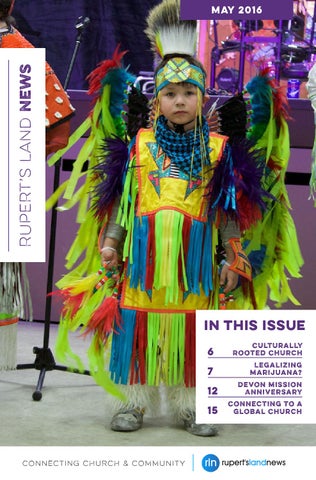
Advertising: RLN accepts advertising in our monthly magazine and our weekly email. Our rate sheet is available at rupertslandnews.ca/ads. To discuss advertising call (905) 630-0390 or email: rlandnews.ads@gmail.com. Editorial offices: Anglican Lutheran Centre 935 Nesbitt Bay Winnipeg Manitoba R3T 1W6 Subscription queries: Administrative Assistant for the Diocese (204) 992-4200 | general@rupertsland.ca RLN welcomes story ideas, news items and other input. If you want to be involved in this media ministry, please be in touch with the editor. Contents copyright 2016 by Rupert’s Land News. All rights reserved. Cover: A six-year-old boy performs a traditional grass dance at the 175th anniversary of the Devon Mission on Opaskwayak Cree Nation.
2
L et ter s
There has been so much to follow since Easter you’d be forgiven for missing a thing or two. From the House of Bishops’ statment and the ensuing discussions to the Manitoba election, Rupert’s Land has been a busy place. Don’t miss the parish news roundup on page 14, which details many of the events happening across the Diocese this month. Below are a few news snapshots from last month, just in case you’ve missed something.
new way of thinking about ethnicity, discrimination, and power, both in society and in the Church. Young Rupert’s Landers have joined the movement as well, in their frustration at being unheard and unseen. What do the voices of Black Lives Matter and Idle No More have to teach the Church? The Christian Century has released a set of seven essays exploring the “Jesus of the Resistance” and what it looks like to be a follower of Christ in the midst of such a climate. Christianity Today has also published an article in response to the movement, explaining why it’s important that Jesus was an ethnic minority in “Why Jesus’ Skin Color Matters”.
Allison
Physician-Assisted Dying Bill
Black Lives Matter
The movement for African-American rights in recent months has grown from a cluster of protests to a
RUPERT’S LAND NEWS
Earlier this year, a conference was held at St. Peter’s, Winnipeg, to wrestle with pastoral responses to physician-assisted dying, a bill which was already on
its way when the Liberal government assumed office in October. The bill was finally tabled on April 14, and Anglican responses to the new legislation are as mixed as any other group of Canadians. Read the Anglican Journal’s article about the political timeline and the task force on assisted dying here. Discussion around the Marriage Canon
A flurry of meetings and conversations have been happening across the country over the past month in preparation for the vote regarding a change to the marriage canon to include same-sex couples at General Synod in July. A parishioner at st. benedict’s table has written a synopsis of these events and why they matter to her on the church website. If you haven’t read This Holy Estate, the report of the national Church’s Commission on the Marriage Canon, you can find it here.
3
Pasto ral note
Culture:
a to ol for se e in g and being s een Donald Phillips
For most of us, when we think of culture we think of people and countries whose customs and language are different from ours. When one belongs to the dominate culture of a community, it is natural to assume that the language, dress, customs, and values that we hold are normal, and that other languages, apparel choices, and ways of living that are different from ours are “cultural” – meaning that they are different from “the usual way.” We use our own culture as the default reference point from which we observe, evaluate, and perhaps even criticize what we see as different in other people. When we lived in a world where most people experienced only their own local culture, the whole notion of culture and cultural differences didn’t impact us. However, in today’s world of global travel and communication, we experience many different cultures on a regular basis. This interaction can be interesting and educational, but it can also be the cause of misunderstanding, prejudice, and even violence. Whether we like it or not, our culture is the lens through which we observe our world. All of the verbal and non-verbal communication we receive is filtered through RUPERT’S LAND NEWS
it. Likewise, the way in which others receive us is filtered through their cultural lens. Our culture affects the way we use language too. In the 20th century, United States and Great Britain were compared with this ironic phrase: “Two nations divided by a common language!” As disciples of Jesus Christ, we must come to terms with the impact of our blindness to our cultural bias. The spreading of the gospel that accompanied the age of English colonial expansion introduced the truth of God’s love expressed in Jesus. Yet even if our intent was good, havoc was also wreaked on peoples whose culture was different from their ours. We are now learning how culture and theological understanding are intertwined. We sometimes speak of the conflict between culture and Christianity. But the reality is that there is no way to communicate the gospel except in and through a particular culture. Inevitably, some aspects of that culture will be in accordance with the way of life in Jesus Christ (such as the rights and dignity of every person) and some aspects will be in direct opposition (such as the capitalist oppression of the poor in order to serve the desires of the wealthy). If there is no “cultureless
norm” with which to compare our values and practices, what are we to do? St. Paul taught that there are different parts in the Body of Christ and that we all need each other to make the Body whole. We are called to be open to receive all the truth of the gospel expressed in the great diversity of cultural expressions – not as a threat but as a gift – in order to broaden and enrich our own understanding. What is the appropriate way to live in a multi-cultural world? It is to understand and value one’s own culture, and at the same time to make room for and receive the gospel and its values as expressed in other cultures. In this way, we are blessed rather than threatened by the differences we experience in the people that make up our multicultural society.
Donald Phillips, Bishop of Rupert’s Land 4
PW R DF
Update from a partner In India Simon Chambers, Communications Coordinator for PWRDF With the support of Anglicans across Canada, the Primate's World Relief and Development Fund makes financial and human resources available to numerous partner organisations and their local initiatives throughout the world. This story comes from a partner in India. The Organisation for Eelam Refugees Rehabilitation (OfERR) is an organization of Tamil refugees supporting Tamil refugees, both in India and those who have and continue to return home to Sri Lanka. 70,000 refugees continue to live in camps in the Tamil Nadu province of India, which have been home to some of the refugees for more than 30 years, since the first Tamils arrived in 1983. One of the keys to OfERR’s success in its programs is its focus on empowering women. “The men were disoriented by the
Women pool their milk to get a better rate from the merchants RUPERT’S LAND NEWS
change in their life situation when they arrived in the refugee camps,” said S.C. Chandrahassan, OfERR’s founder. “So women took on the burden.” The role of women in the organization has continued to grow throughout its history. As more of OfERR’s work focused on women, more women got involved. In 1996, 70% of the staff and management of OfERR were women. “Women think of a permanent home,” said Chandrahassan. “Women are more careful with their money, so in the camps, it is the female head of the household who receives money from the government.” This led to a significant economic change as women, instead of men, were in charge of the money. One of the ways OfERR has worked with women in the camps is to create and promote self-help groups. This brings small groups of women together to engage in micro-credit loans within their group. The women then use the loans to start small businesses to support their families. As the program grew, self-help groups began to meet at the regional and district level as well. Members of the groups took on leader-
ship roles, received training, and developed decision making and policy making skills. Leaders of the self-help groups came to have input into the refugee camp coordinating committees. This grassroots level training has helped the women to look beyond being refugees to their roles in their communities when they return to Sri Lanka. They are thinking about democratic rights and responsibilities, and about how to rebuild their communities and ensure that their families and neighbours are able to support themselves when they are back home. Today, there are about 480 self-help groups in the camps in India. Most of them are made up of women, although a few men have taken the women as role models and joined the groups themselves. The groups are now able to take loans from banks to allow their members access to more capital, saving them from predatory loan sharks who charge exorbitant levels of interest on loans to refugees. The Tamil refugee women have grown to take charge in their households and in their self-help groups, and to take on significant leadership in their communities.
5
O pinio n
Culturally Rooted Expressions of Church Monybuny (Abraham) Kuol Chuol It is not always easy for one to leave their place of origin and culture, but there are many reasons why people need to immigrate to another country, such as safety and economic security. Like many other immigrants, members of Emmanuel Mission (the South Sudanese Dinka congregation) left their country of origin mainly because of political instability that resulted in a prolonged civil war. The immigrant experience is rewarding as well as challenging culturally, socially, economically, and spiritually. A culturally rooted church not only serves as a source of comfort and strength, but also as an anchor for immigrants while navigating their new environments. Moving to a new cultural setting is testing to families and individuals. Kids and youth are quick to adjust, but adults, in general, take more time to integrate socially and culturally. Although living in Canada has brought many benefits to the South Sudanese diaspora, it also has brought challenges, especially in maintaining language and culture. Many families struggle to stay together under the pressures of their new society. As in many immigrant communities, the South Sudanese faith community represents a place where the culture can be preserved and passed on to the next generation. It gives people a RUPERT’S LAND NEWS
sense of belonging and identity that helps ground them and encourage them. People share their joys and sadness, gaining strength from one another. They have been affected by the civil war, whereby many people have lost, and continue to lose, friends and relatives. The Church is always evolving as perceptions and culture change. A culturally rooted church like Emmanuel Mission can become a bridge between generations, playing a pivotal role as a place for people to receive culturally appropriate counselling and spiritual guidance. It is a cultural hub where their language, customs, and values can be expressed and renewed, as well as challenged. Culturally rooted churches are also places for mainstream congregations to learn and appreciate the cultural backgrounds of newcomer populations. Immigrants have brought their culturally influenced faith with them and continue to practice it in Canada. Such faith groups are the agents to effect changes in the Anglican Church of Canada. The world is globalizing and getting more interactive in many aspects of life. As immigrants are to learn a new culture, it is necessary for the wider society to be culturally competent, helping the newcomer feel welcome and integrate. Although the South Suda-
nese Mission is relatively small and new, it has been able to connect to the wider faith community in different ways to overcome its isolation. For example, its affiliation with the Diocese has encouraged a relationship with various other churches and clergy. The Diocese has also supported youth programming at the Mission, which has a positive impact on the lives of many, helping our young people overcome crime in the city. This partnership has become a relationship that will continue to grow over time. We also appreciate the people of St. Matthew’s, who have assisted us with space and trust, enabling us to better access the Diocese. It is important for all people of faith to acknowledge that our duties are to fulfill God’s call to discipleship here in Winnipeg, building an inclusive and welcoming society where we appreciate and respect our diversity.
Monybuny (Abraham) Kuol Chuol is the priest at Emmanuel Sudanese Mission. 6
Bur ning Bush
What Should Christians Think about Legalizing Cannabis?
Photo: Pablo, Flikr In Favour Kalyn Falk and Ro Walker Mills are part of the community of saint benedict’s table.
The process of marijuana legalization in Canada has been layered with fear and lack of factual evidence. This article will outline our current understanding of marijuana and the flaws inherent in it, the economics of legalization, and our role in mandat-
RUPERT’S LAND NEWS
ing behaviour. “Not because of sound science, but because of its absence, marijuana was classified as a schedule 1 substance” (Robert Ferris, “These Are The 9 Reasons That Sanjay Gupta Changed His Mind About Marijuana”). This means the United States government considers pot a drug with no accepted medical use and a high potential for abuse. Other drugs in
this category include LSD, heroin, and ecstasy. In Canada, marijuana is considered schedule 2, which makes research more feasible and acknowledges that it should be considered fundamentally different than more harmful substances. America’s definition has shaped some of our fear around marijuana. Yet while, “marijuana leads to dependence in... 10% of its adult users, cocaine, classified as a (less addictive) schedule 2 substance, hooks 20% of those who use it. Around 25% of heroin users and 30% of tobacco users become addicted” (Ferris). The medical benefits of marijuana, however, are widely recognized. “Seventy-six percent of physicians surveyed would prescribe marijuana to ease the pain of women suffering from breast cancer” (Ferris). Other 7
Bur ning Bush medical benefits include relief from inflammatory bowel disorder and Crohn’s disease, reduction in seizures, help with glaucoma, slowing down the advancement of cancer and Alzheimer’s, and anti-anxiety (Jennifer Welsh and Kevin Loria, “23 Health Benefits of Marijuana”). Since it has been proven to be of medical use and not prone to abuse, it is time to legalize and regulate marijuana like alcohol. With 23 states legalizing marijuana for medical purposes and another 4 legalizing it for recreational use in a country that still considers it section 1, we should be willing to pursue regulation as well. This would allow us to do more effective research and ensure that doses, strain varieties, and modalities (ingestion, inhalation, topical methods) are based on robust science and clear-eyed understanding. Legalization would also have enormous economic implications. There are three main areas where money would be recouped: taxing cannabis sales, recouping
black market sales, and reducing the prison population. Marijuana tax would be roughly the same amount of money as the tobacco tax, just under $7.5 billion in 2011-2012. Trudeau has already said that the majority of this money would be used to address public health and addictions issues. From 2006-2012 (when the Harper government came to power), arrests for pot possession jumped 41%. “In those six years, police reported more than 405,000 marijuana-related arrests, roughly equivalent to the populations of Regina and Saskatoon combined” (Ken MacQueen, “Why it’s time to legalize marijuana”). Imagine the amount of time and money that was lost, not only in court proceedings, but also in how much it costs to keep people in the prison system. Finally, the biggest question is our role in creating laws. Is the point of law to dictate morality? If so, whose morality trumps others? If we choose to state that the use of marijuana is immoral and
Photo: Chuck Grimmett
RUPERT’S LAND NEWS
illegal, we unwittingly force people who choose to use it into an identity as deviant or criminal, when actually they may not be causing harm to themselves or others. In any case, has prohibition been effective? We’ve seen historically that using law to restrict freedoms simply forces behaviours underground, where there are no safety or control mechanisms. When we set laws based on a specific morality and not a shared understanding of doing no harm, we are in danger of dehumanizing people who have a different experience than ourselves. More helpful would be a response that meets our fears and concerns: how do we ensure that standards are in place to ensure quality control over products, safety for the public, and restrict access for young people? If we treated marijuana like alcohol, we could ensure protective mechanisms that would meet all of these concerns, while still valuing individuals’ rights to self-determination and personal choice.
The Burning Bush is a semi-regular column which features debates and discussions on current issues in culture and media and suggested ways for Christians to engage them through the lens of faith. New article ideas are always welcome.
8
Bur ning Bush In Opposition Geoff Woodcroft is the priest at St. Paul's, Fort Garry, and writes with the assistance of Huelwen Jones.
When we ask for something that is illegal to be seen as not illegal, are we necessarily asking for it to be legalized? Likewise, when we ask for something to be made illegal, are we asking that it be changed from being legal, or from being “not illegal”? Things may be not illegal, not because we approve them, but because they are new things the law hasn’t caught up with yet, like cyberbullying. Or perhaps we don’t want to criminalize them with severe consequences, but also don’t want to encourage them, such as engaging in prostitution. Does making pot not illegalmean we tolerate but discourage its use? Cigarettes are legal – but do we approve their use? This brings us to the issue of regulation. Tobacco and alcohol are highly regulated, but they are not necessary for life. Water is a necessity of life which we claim as a human right, but water rights can be bought by businesses and the water sold for a profit. Who has the privilege to sell water rights, and by what law is ownership of water permissible? There are tried and tested medicinal uses for pot that should be covered under the laws governing medicine. The leaders in the RUPERT’S LAND NEWS
pharmaceutical industry can move to include or exclude whatever drugs they determine, and they are a powerful lobby group. I expect that they are not interested in the legalization of pot, because research and development, in a sense, is being done for them. I find myself in a different space than I was 30 years ago, when I was very much in favour of legalization. Now, as I watch poorly guided public discourse, radically diverse medical studies, and political strivings over the issue of legalization, I fear that we are poising our colonial selves to once again destroy through over-regulation something God has made: a simple plant. I remember the day my brother came home from the
local fall fair with a t-shirt that said, “Man made booze, God made weed; who do you trust?” I also remember my mother that same day... The point here is that we are discussing a part of God’s creation that we do not fully understand. If we keep pot illegal, we remove much opportunity to understand, wrestle with, and discover something that obviously has a natural power. However, should we choose to legalize pot, I think we run more of a risk to abuse, waste, genetically modify, and privatize that which God naturally made to be part of this world with us. Canada should remove the illegal status that pot presently has, thus making it not illegal, but not make it legal and therefore vulnerable to regulation.
Thorvaldson Care Center AN INTERMEDIATE CARE FACILITY FOR SENIORS 24 hr care and supervision Registered Nurse on site Assistance with medications, dressing, hygiene
All meals, laundry and housekeeping Recreation programs Private bed-sitting rooms
OVER 55 YEARS
caring for senio rs
495 Stradbrook Ave | Winnipeg, MB | R3L 0K2
ph (204) 452-4044 | fax (204) 452-4054 thorcare@shaw.ca | www.thorcare.ca
9
Bo o ks
Indian Residential Schools: Another Picture Every age has its dangerous ideas. These ideas are dangerous because they challenge a prevailing moral order. Today, one of these ideas is that the Churches’ involvement in Indian Residential Schools (IRS) had some positive effects on the students. Surprisingly, virtually no positive effects have been included in the Truth and Reconciliation Commission (TRC) report. Instead, the report is filled with heart-breaking testimony of abuse and deprivation, and this is almost all we hear in radio programs and read in newspapers. Fortunately, Eric Bays, a retired Anglican Bishop (Diocese of Qu’Appelle, 1986-97), has challenged this pervading moral order by painting “another picture”, one that shows some of the good work Christians did and some of the positive effects this had on students. I resided in Old Sun, the Anglican residential school on Siksika Blackfoot Nation during the summer of 1966, and was the senior boys’ supervisor in Stringer Hall, the Anglican residential hostel in Inuvik, during the 1966-67 academic year. My observations are similar to what Bishop Bays reports. He writes with sensitivity about the reported experiences of many people, aboriginal and non-aboriginal, involved in the IRS system: “There are many former students for whom the schools provided a good experience, and more, I think, who found RUPERT’S LAND NEWS
some problems with the schools but who also found them to be generally beneficial. And there are many staff members who, as faithful Christians, responded to the church’s call to help a group of children whose needs were largely ignored by the rest of Canada’s population. By developing the stories from these two groups, I hope to provide some balance to current public perceptions.” Indian Residential Schools: Another Picture covers many of the issues that have been discussed in the media: culture and faith, recruitment, food, language, health, sexual abuse, and Church policy. Bays interprets his observations and experiences, and those of the people he inteviewed, from a Christian perspective. In the chapter on sexual abuse, undoubtedly the most controversial and heart-breaking issue, he writes: There is no doubt that physical and sexual abuse did occur in some cases, and, as
far as I am aware, there are no church leaders or members today who would not agree that such behaviour in any school, let alone one administered by a church, is reprehensible. Such abuse was a serious breech of trust, an enduring wound to individuals, and through them, to communities, and an offense to the Gospel by which the churches claim to be governed. In 2005, Archdeacon Jim Boyles explained that the number of sexual abusers known in the Anglican schools were about six or eight, but certainly less than ten (Archdeacon Boyles was the person in charge of the IRS file while working for General Synod). Some think that Bishop Bays is a heretic because he challenges the claims in the TRC report. On the contrary, I believe that Bishop Bays is a concerned Christian trying to give an honest and balanced perspective. In the time I spent in the IRS, students abusing others was an important issue that is largely absent from the TRC Report. Read this short book and perhaps your understanding of IRS history will be changed just a little. To read a less favourable review of Bays’ book, visit the Anglican Journal’s website.
Rod Clifton is a retired professor of education at St. John's College and a former residential school dormitory supervisor. 10
Pr o fil e
Father Henry: the surprising journey of a (not so) new Canadian
Henry Falconer walked into Holy Trinity Church in downtown Winnipeg his first Sunday in Canada and he hasn’t looked back for 27 years. It wasn’t long before his infectious smile and positive attitude landed him in the role of verger and caretaker of the space. Like many newcomers to Canada, Father Henry was surprised by the poverty and outright hunger he began running into on a daily basis after moving into a suite attached to the church. What began as regularly sharing a sandwich with his needy neighbours turned into the Holy Trinity Mission, which today feeds 150 hungry Winnipeggers a day, hosts a clothing room, and gives out over 70 food hampers each Christmas, primarily to new refugee families. For Father Henry, meeting the needs of his inner city neighbours is in his blood. Growing up in his native Jamaica, his rural farming family was accustomed to going without. He remembers a time of famine when the family had no food. RUPERT’S LAND NEWS
His mother put on a pot of water and waited for God to provide. Sure enough, a neighbour soon came knocking with some potatoes. “It wasn’t just my parents who raised me” he explains, “it was a village.” Ordained 17 years ago about the time the Mission began, Father Henry is still unsure how he ended up becoming a priest. The Bishop just asked him to move toward ordination, and so he did. Perhaps it is that spirit of humility which draws people to him. “Father Henry,” remarked one woman, “you put a face on Jesus.” Yet the past 20 years of wrestling with hunger in Winnipeg’s downtown have been no tea party. It is discouraging for Father Henry and his 48 volunteers to find that, not only is the hunger problem not disappearing, it is getting worse and diversifying in the populations it affects. Hunger does not seem to discriminate, he says, “We have every colour and culture of people in our soup lines.” Quick to point out the positive, he explains that
such diversity is important because we learn from one another. “I wouldn’t be part of a black church,” he remarks. “I’m part of a church where there are people.” For Father Henry, the sacramental life of the Church and the daily needs of the people cannot be separated. About a year ago, the Mission ran out of bread for making sandwiches and they didn’t know where more would come from. He held up the host while praying the Eucharistic Prayer and exclaimed, “Lord, we need bread!” Shortly thereafter, they received more bread, and ever since they have had more than enough for sharing. In many ways, the people he serves are more than volunteers or patrons to Father Henry - they are his family. They chose him to become their leader because of his care for the poor, his sacrificial love, and a sense of trust that is rare in communities today. May each of our communities be blessed with such hope in God’s goodness. 11
R ec o nc il iatio n
The Devon Mission C e l e b rat e s 175 Y ears in The Pas During the first weekend of April on Opaskwayak Cree Nation (OCN), Anglicans and others from across the country gathered to celebrate God’s faithfulness with the 175th anniversary of the Devon Mission. A colourful procession of Cree dancers, led by a crucifer and an eagle staff, marked the importance of the area as a gathering place for Cree and settler peoples alike. In many ways, the land - now divided between the town of The Pas and OCN - exemplifies the breath of indigenous-settler relations in Canada. Located some 600 km northwest of the Red River Settlement (now Winnipeg), the Devon Mission began when explorer Sir John Franklin sent word to England in 1819 that the trading post there would make an excellent place for a mission. The following year, Rev. John West was sent by the Church Missionary Society as the Hudson’s Bay Company chaplain to the area. Finding life in the northern outpost too difficult, West took two young Cree boys back to the Red River Settlement. There, he educated them in English, bible, and theology, that they might return to minster to their own people. One of these boys was 8-year-old Sakachiwescum, whose father had recently RUPERT’S LAND NEWS
Back row (l-r): Freda Lepine, Fred Hiltz, William Cliff; front row: Nellie Morrisseau (sister of Rupert's Land priest Barbara Shoomski), Melinda Robinson, Connie Young died and whose mother accompanied him south. Given the English name “Henry Budd,” the young man returned north in 1840 to open the Mission, where he spent his life teaching the Gospel to his people in their native Cree. Several years later, the first Bishop of Rupert’s Land, David Anderson, ordained Henry Budd at the Red River Settlement, making him the first indigenous cleric in what is now Canada. The Henry Budd School of Ministry, opened in his honour in 1960, trains indigenous catechists and spiritual leaders to this day. The anniversary speakers, however, did not shy away from acknowledging the painful parts of indigenous and settler relations over the past 175 years. As a Cree priest, Henry Budd was paid just half of the stipend the white clergy
received. “I can never tire of apologizing for the wrong done,” Primate Fred Hiltz told the crowd. “In many ways, this event is about looking back. But this is also about looking forward. The elders here have said that they believe there is a way forward.” Five Anglican bishops participated in the gathering, which comes on the heels of the Truth and Reconciliation Commission’s final report in December. Welcomed as honoured guests in the community, they were invited to see and experience what God is doing in northern Manitoba. “I was deeply humbled and will never forget (being invited to pray with the elders),” remarked the Primate. For some, the celebration of indigenous expressions of Christianity marked a return to the days of their ances12
R ec o nc il iatio n
Rebecca Graham, Pastor of Christ Church, The Pas, leads the procession beside a traditional Cree dancer.
RUPERT’S LAND NEWS
tors, when God was at work in new and exciting ways as the Gospel was expressed through Cree culture and language. Rev. Barbara Shoomski and Nellie Morrisseau, great-great granddaughters of John Sinclair, explained how their grandfather worked alongside Henry Budd to translate scripture into Cree and take the message of Jesus to more remote communities in the area. In a mixture of pride and pain, the women spoke of Sinclair being one of the first to attend St. John’s College, getting ordained, and then having to leave the Red River Settlement because the settlers wanted him replaced with a white priest. The sisters remember the tears of their community when, in1960, his grave was flooded by Manitoba Hydro. Still, they were filled with hope as they watched their bishops and elders pray
side-by-side, thanking the Creator for caring for their people. “I was so happy when I saw the cross and the eagle feathers side by side,” one elderly woman explained, “My grandmother said that one day this will come, and now it’s here.” Participants left the gathering with equally mixed feelings. While it is undeniable that there is much to celebrate from the past 175 years, it is equally clear that there is much work to be done. The river running between the reserve and the town is a stark reminder of that which remains to be overcome on the journey toward reconciliation. Yet both the elders and the bishops affirm a sense of hope for the future. “We do not have two cultures,” said National Indigenous Bishop Mark MacDonald, “We are indigenous Christians.”
13
C o mmunity
PARISH NEWS ROUND UP St. Matthew’s Maryland Community Ministry
A luncheon in support of the Anglican and United Church ministry is being held at Charleswood United Church, May 11. For tickets, call (204) 832-3667.
St. Mary Magdalene, Winnipeg
Vicar of Dibley on Stage
The popular English comedy is coming to Crescent Fort Rouge United Church in an adaptation for the stage, May 6 and 7. All actors are Anglican and United Church clergy, including Helen Kennedy, Di Panting, Donald MacKenzie, Lenise Francis, and Allison Courey. For tickets, call (204) 996-6172.
St. Bartholomew’s, Winnipeg
The Associates of the Sisters of St. John the Divine are hosting a spring quiet day, led by Sister Brenda on May 7. Please visit the events page for RSVP information and further details.
St. Chad’s, Winnipeg
Community games nights will be hosted May 12 and June 9 at the Church (472 Kirkfield St.) All are welcome.
St. Stephen’s, Winnipeg
The annual yard sale will be held May 7, 9:00 a.m.-1:00 p.m.
The personal preparedness seminar, “What if I got hit by a bus?” is being hosted the afternoon of May 21. Find the registration form and other information on the website.
St. Mark’s, St. Vital
A Chinese dinner fundraiser will be held May 27 at the Norwood Legion. For tickets, call (204) 233-6088.
St. Alban’s Cathedral
A day-long Bridges out of Poverty workshop is being hosted on June 14 with a guest facilitator to explore the cycle of poverty in our communities. Gain a deeper understanding of both the challenges and strengths of people living in poverty and how to best engage them in our own contexts. Find more details on the website or email St. Alban’s to register.
GP Complete Care Exceptional care since 1973 WORK WITHIN SENIORS’ BUDGETS
PROVIDING HELP WITH: Daily routines Housekeeping Meal prep Personal care Laundry Medication Reminders WE ARE ALWAYS HERE FOR YOU
(204) 869-1076 RUPERT’S LAND NEWS
gloribp55@gmail.com 14
Via Me dia
Cultural Expressions of Christianity and the Anglican "Bonds of Affection" Maylanne Maybee
In January, my parish priest and another member of our parish church accompanied Bishop Phillips and others on a ten day visit to Uganda. More than one eyebrow was raised at the expense and time required for such a journey, wondering whether it was the best use of our resources. Yet for the fourteen years I worked with the partnerships department of General Synod (now defunct), the importance of nurturing relationships with partners throughout the Communion was a priority of the Anglican Church of Canada. We knew that the delicate web of the Anglican Communion was held together by “the bonds of affection” – bonds that needed to be strengthened by experiencing one another in our own culture and context, by spending time and money, and disrupting our lives in order to be with one other. Anglicanism is an ethnic expression of Christianity that originated in England and spread its influence around the world along the paths of colonialism. We have been slowly discovering our call to mend what was broken by the effects of our history, to embrace the differences of others, and to heal elements of racial and cultural mistrust that have grown up among RUPERT’S LAND NEWS
Photo: United Methodist News Service
us. I believe that we do this by deepening our understanding and practice of intercultural ministry. The call is not restricted to Anglicans. It especially involves the settler people of North America, and calls out to any groups who have inherited a sense of privilege and cultural superiority. Last December, I was part of a delegation of the United Church of Canada to China at the invitation of the China Christian Council. We travelled on a chartered bus, stayed in comfortable hotels, and ate sumptuously as guests of local churches. Our guide was a young woman who had been educated in the US and was well versed in theological questions that engage North Americans. Unlike that visit to Uganda, and other mission trips I’ve been part of, economic disparity was not a factor. For the most part, we were not traveling outside our comfort zone. On the one hand, I expe-
rienced many of the obvious cultural differences between China and Canada. I was acutely aware of different sights and smells that disturbed the senses, of strange foods, of quirky sounds like the chimes of Shanghai ringing a patriotic tune every half hour. I observed China’s dense population in oceans of motorized bicycles, the pollution of its cities, the entrepreneurial aspiration of its people. I learned about its complex government that is known for its record of human rights violations but also for introducing unprecedented development and prosperity. On the other hand, I was struck by how much daily life in Chinese cities had in common with North America, as brand names and advertisements urged the population to consume. The pre-Christmas fever was not very different from what would be going on in any Canadian city. The first church service I attended was familiar 15
Via Me dia
Maylanne Maybee (right) is the principal at the Centre for Christian Studies. too – the liturgy, the hymn tunes, the sermon, the handshaking, and refreshments afterward. There were parts of China and the Church there that were more like a mirror of the familiar than a window to the unknown. What surprised me more than these differences and similarities was the disparity in what other members of the delegation remembered upon returning home. I sometimes wondered whether we were on the same trip! One person commented on the Communist government’s repression of non-governmental organizations, including the official Christian Church. Yet while I read about it upon return, I didn’t perceive this as a major preoccupation of those partners with whom I spoke. In retrospect, I think this disparity in observation was like the six blind men who touched different parts of an elephant, each convinced that what they touched and sensed was the whole beast.
rln
There were indeed differences in priority and values that made me uncomfortable. But perhaps the most important “take away” were the words of Katharine Hockin, a Canadian missionary to China prior to 1949 and also the daughter of a missionary: Perhaps we should remind ourselves at the outset that the search for understanding is not… whether the Chinese Christian is wrong or right. We will not necessarily find ourselves in
rupert'slandnews
RUPERT’S LAND NEWS
agreement with our Chinese fellow Christians. We may have to recognize tearing differences, but at least we may come to some glimmer of sympathetic awareness of their position… For surely we must listen, and listen, and listen with loving intent to understand, to see our own failures, rather than to engage in the polemics of justification of self and condemnation of others. To me, this is the reason as Anglicans and Christians we visit Uganda or China, why we do it in groups or in pairs, why we eat the food that is set before us, why we actively seek to be givers and receivers of culture – our own and others’. It is a way of learning to listen and listen and listen that we might be transformed by the Word who made the ultimate intercultural journey from being God to being human, and dwelt among us.
CONNECTING CHURCH & COMMUNITY 16