RUPERT’S LAND NEWS
M A RC H 2 0 16
Missional
Livi ng
IN THIS ISSUE
CO N N ECT I N G C H U R C H & CO M M U N I T Y
5
FOUR KINDS OF LEADERS
9
moving toward a missional model
12
through the eyes of a child
15
river life, theologically speaking
rln
rupert'slandnews
rln
rupert'slandnews
Publisher | Bishop Donald Phillips Editor | Allison Chubb Accounting | Bernice Funk Layout & design | cityfolkcreative.ca Rupert’s Land News - is published 10 times per year (September - June) by the Diocese of Rupert’s Land, in the Anglican Church in Canada. It connects churches and communities from Portage la Prairie, MB, to Atikokan, ON. by offering news, events, opinion, and ideas to 6,000 readers per month. RLN is available in a variety of formats: • • • •
rupertslandnews.ca facebook.com/rlandnews twitter.com/rlandnews instagram.com/rlandnews
We also deliver timely news and information via a weekly email. Sign up at: rupertslandnews.ca/email RLN exists to explore issues at the intersections of faith and life. In doing so we solicit and publish a range of opinions, not all of which reflect the official positions of the Diocese.
RUPERT’S LAND NEWS
CONNECTING CHURCH & COMMUNITY
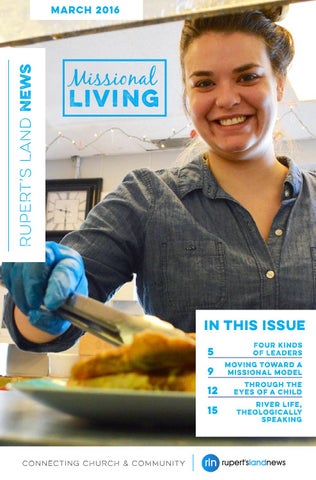
Advertising: RLN accepts advertising in our monthly magazine and our weekly email. Our rate sheet is available at rupertslandnews.ca/ads. To discuss advertising call (204) 996-6172 or email rlnews@rupertsland.ca Editorial offices: Anglican Lutheran Centre 935 Nesbitt Bay Winnipeg Manitoba R3T 1W6 Subscription queries: Administrative Assistant for the Diocese (204) 992-4200 | general@rupertsland.ca RLN welcomes story ideas, news items and other input. If you want to be involved in this media ministry, please be in touch with the editor. Contents copyright 2016 by Rupert’s Land News. All rights reserved. Cover: Ashley Loschiavo serves breakfast at the Gifts of Grace Street Mission's "breakfast and a move," run in part by St. Saviour's, Winnipeg.
2
L et ter s
LETTER TO THE EDITOR
Hi Allison, Thank you so much for registering me for the Rupert’s Land News. I read it this evening. I much preferred the paper edition because I would take it with me to appointments etc. and read it while I was waiting. Also in the summer I would take it down on the dock and read it there. I do not have internet at the lake and even if I did I would not take my I pad or lap top onto the dock. I know that the change is a money saving issue but I still prefer a paper edition.
The online version is meant to be very easy to print, but I'm also offering workshops for anyone that's having trouble figuring it out. Do you have a printer? It's true that the change is in part about costs (only about 10% of readers made donations in the past), but it's primarily about connections. Because the paper had to be printed off so early in Toronto with the Journal, the news was always a bit behind. With the new website and online magazine, we can
get information out more quickly. Also, we found that because most people are reading things only online now - particularly the baby boomers - we needed to catch up to them if we want to keep their interest into the future. I hope you're able to print the paper. Please do let me know if you have any trouble or if you'd like to come to the workshop.
Allison
Thanks again, Rupert’s Land Reader
Hi Rupert’s Land Reader, How wonderful to spend the summer by the lake with no internet! I wouldn't trade that either. I know others who just print off the paper at home and take it to the lake (or wherever) with them. RUPERT’S LAND NEWS
3
Pastora l not e
LIVING INTO
OU R M I SSION A L IDENTITY Donald Phillips
In both secular and Church life, we hear and see the word “mission” often in recent years. Companies, organizations, even clubs, have mission statements. Twenty years ago, parish mission statements were all the rage – being replaced more recently by mission action plans. It is not uncommon even for coffee chains or fast-food restaurants to post a mission statement, usually a kind of over-arching, idealistic view of how they hope to be experienced by their consumers. Yet some of our most profound mission activity we never think of as “mission.” Consider a young person’s plans to complete an educational program in order to fulfill a vocational goal. Surely the decisions, actions, and attitudes that he or she develops all contribute to the overall mission of obtaining that goal. Even less obvious is the mission of parenting. We don’t speak about the strategic actions we take as parents to ensure that our children become the very best, accomplished, and loving members of society that they can become as our “mission” – we simply accept that responsibility and incorporate it into who we are. Carrying out that mission
RUPERT’S LAND NEWS
becomes as much about who we are as what we do. Most of us who commit to a life partner would not think to list “making our relationship as fulfilling and life-giving as it can be” as a primary “mission” in our lives, but again, being a faithful love-mate is much more about who we are than about what we do. The Scriptures constantly describe the mission of God as the creation and, ultimately, the redemption and re-creation of the world and everything in it. However, this mission is always portrayed as a function of who God is – and from that flows what God does. The same is true of Jesus. What he did was a direct expression of who he is. In fact, we have no other knowledge about God other than how our ancestors in their day (recorded in Scripture), and now we in our day, experience the mission of God. The revelation of Jesus Christ as God’s mission in our midst, and our being grafted into Christ as his disciples, means that our primary identity – who we are – is defined by God’s loving mission in our world. Our lives, therefore, are part of God’s mission in living and active form. Like our role as faithful partners and
parents, our role as disciples of Jesus is first and foremost who we are. It is from faithfully living out that identity that our acts of mission flow. When we reflect on mission, in our lives and in our congregations, it does not begin with “stuff we ought to be doing.” It begins with deeply establishing who we are as God’s people. It is from our identity in God’s mission that our ‘missional’ character will become clear – and the work that we are to engage in will be as obvious and natural as changing our baby’s diaper, attending our daughter’s sports game, or helping our son buy his first house. It flows from who we are as disciples of Jesus Christ.
Donald Phillips, Bishop of Rupert’s Land 4
L EADER SHIP
FOUR KINDS OF LEADERS
for Fou r Se ason s of Church John Bowen
Leadership comes in many shapes and sizes — not just one. And different situations call for different styles of leadership. So what types of leader does the Church need right now?
1. The Traditional Pastor
Traditional, healthy churches need leaders who can preach and teach, train and give pastoral care, lead inspiring worship, and be competent administrators. It is a tall order, but over the years, even centuries, many have done this wonderfully well. And seminaries continue to turn out good shepherds of this kind. Frankly, however, there is a limited need for those with this skill-set. This kind of pastoring assumes that the congregations to which they go are in healthy midlife, and simply need building up and encouraging in the way they are already going. But, sadly, there are not many of those around. It is true, of course, that a good traditional pastor may be able to win back the lapsed and get them energised again. That is a much-needed contribution to the work of the Kingdom, since the “dechurched” are still a significant portion of
RUPERT’S LAND NEWS
Each season in the Church requires a different kind of leader. Photo: Stanley Zimny the Canadian population. But the dechurched are a limited market. It is those who have never had a church experience — the unchurched — that is the fastest-growing demographic (the “nones,” as they are often called), particularly among the young. So if traditional pastors are the only kind of leader we are producing, soon there will be nobody left for them to pastor.
2. The Palliative Care Leader
Many churches will not survive the next ten years — in some cases, the next five years. What kind of leader-
ship do they need? In my Doctor of Ministry cohort some years ago was a woman who, with her husband, was pastoring a small ethnic congregation, originally from central Europe, in a small town in the Niagara Peninsula. The young people were long gone, and the community of those who still spoke their mother tongue was shrinking. Humanly speaking, there was no way that congregation would ever grow. The pastor told me, “My husband and I feel called to minister to this congregation until the last person dies.” I have the utmost respect 5
L E A D ER S H I P for that kind of calling — one I am sure I could never fulfil myself — and the need for “congregational palliative care” is both crucial and growing. Congregations die all the time, just as (please God) new churches are born all the time; but to help them die with dignity and even joy is crucial. God loves these people, after all, and they have often served God faithfully for long decades, through thick and thin. There are too many stories of how such churches have been “closed” with needless clumsiness and lasting hurt. Where are the palliative care pastors such situations need? And who is training them?
3. The Turnaround Leader The third is perhaps the most difficult of the four models of leader: the one who can help moribund congregations change from looking after their existing members to understanding that they are called to participate in the mission of God. Why is this difficult? Well, for one reason, the changes required are pretty fundamental, in all likelihood involving their grasp of the Gospel, their understanding of Church, their long-standing ministry habits, and (not least) their theology. Twenty years ago, I thought in my naivety that most struggling congregations would be willing and even excited to make this kind of change in order to
RUPERT’S LAND NEWS
thrive again: all they needed was to know how, and good leadership to help them do it. Now we know that is not the case. Given the choice beWe need a variety of gifts and leadership styles across our Church. Here, Primate tween changing Fred Hiltz, Deacon Gwen McAllister, and dying, Bishop Don Phillips, and Priest Cathy many will Campbell celebrate the consecration of the weigh the opnew St. Matthew's worship space. tions: Change? Death? Hmmm . . . and then leaders who can start new choose death as the easier Christian communities (often choice. Why is it easy? called fresh expressions of Because all they have to do Church) in contexts where exis keep doing what they have isting churches can never go: always done. new churches which reflect The other reason this has the culture of their context, proved difficult is that most and which have mission in “traditional pastors,” howevtheir DNA from day one. er much they might want to What kind of leader can bring about change, simply do this? One who is unusualdo not know how. It requires ly gifted in evangelism, who a different skill-set. For a is as comfortable in secular pastor to try to bring about culture as in Church culture, that kind of change without who has experience pulling the requisite gifts, and in the innovative teams together, face of the inevitable resiswho has a track record of tance, is a recipe for conflict starting things, and has a and sometimes burnout. competent grasp of orthodox Of course, there are theology. (The last is particsome congregations who will ularly important for church choose the painful road of planting teams because, in change. They need leaders the new situation, they will with clear vision and thick be the sole “bearers of the skins and stick-to-it-ivenes — tradition”!) not to mention lots of love In many cases, we will — to guide them through the need to recruit such people, transition. These are the turnrather than waiting for them around pastors. to come to us. Often the young people who come up 4. The Pioneer Leader through our churches’ farm Finally — and maybe system know little apart from in the long run most importlife in the traditional conant — we have a need for gregations they come from, 6
L EADER SHIP and which have recognised that they have gifts for . . . traditional ministry. But the kind of people who are gifted to pioneer new congregations have in many cases never considered ordination because their image of ministry leadership is the traditional one, and they know that is not for them. We need to persuade them that they are exactly what the Church needs these days — and train them appropriately.
Why does this matter?
remember why these things are important. The need for suitable leaders is not, in the first place, about the Church or leadership, or teaching and training. At the heart of all this concern is the Gospel of God — the good news of Jesus. After all, it is the Gospel that brings the Church into being (if there were no Gospel, there would be no Church), it is the Gospel that gives shape to what we mean by leadership, and it is the Gospel that directs our understanding of mission.
After all this, we need to
John Bowen is the director of Wycliffe Serves! and was the founding director of the Institute for Evangelism at Wycliffe College in Toronto
M i s s i on a l Sn a pshots St. Saviour’s, Winnipeg:
weeks a year, with a fantastic group of core volunteers. Our outdoor serving location is adjacent to Main Street Project and behind Thunderbird House. Many of the patrons we serve have substance abuse or mental health issues and are not always served at other soup kitchens or shelters. Our Sunday breakfasts are also
St. Mary’s, Charleswood:
warm atmosphere in which relationships of interest, humour, care, and concern are built. Counselling, prayer space, and a short worship service provide “soul food.” St Mary’s Community Garden shares space for those who wish to grow produce. This is missional living, made possible by dedicated volunteers.
Gifts of Grace Street Mission is run entirely by volunteers as part of the mission and outreach efforts of St. Saviour’s. Our mandate is to provide food, friendship, and compassion to our homeless friends in Winnipeg. We provide a weekly Sunday breakfast and Thursday supper, 52
When the parish of St Mary, Charleswood, started their food bank, the co-ordinator, Susan Brown, was determined not just to feed hungry people but to build community. The people who come for food from Winnipeg Harvest are welcomed with hot coffee and snacks, and chat or read newspapers while waiting. It’s a
RUPERT’S LAND NEWS
served at this location in the warmer months (May-October). In the colder months, breakfast is served indoors at the Red Road Lodge as “Breakfast and a Movie,” where our homeless friends can get inside for a few hours, kick back, and enjoy a hot breakfast and a movie.
7
SE RVANTHO O D
DEACONS: THE CONNECTORS Tanis Kolisnyk
The work of the diaconate is alive and well in Rupert’s Land, as there continues to be ongoing development and growth in diaconal ministries and initiatives. During the past six months, Bishop Donald has been working with the Diaconal Working Group to develop the Diocesan
where they live, work, and worship. They are often agents of hope in a complicated world, change agents when injustices need to be addressed, and advocates for marginalized people in our society. Do you have a deacon in your parish? If so, make
The Lenten deacons' retreat, with Peter Flynn (back, centre), facilitated by Maylanne Maybee (middle, right of centre) and David Lappano (front, centre). Diaconate Ministry Group (DDMG). This new committee is to be a resource to parishes, the Diocesan Discernment Group for Ordained Ministry (DDGOM), and an extension of the Bishop’s ministry with deacons. At the heart of the diaconate is a servant living in the community and proclaiming the Gospel in the world. The deacon’s presence brings the needs, concerns, and hopes of the world to the Church, and his or her ministry is a living reminder of the community’s call to servanthood. Deacons use their varied gifts and are active in the communities RUPERT’S LAND NEWS
sure to pray for them and encourage them in their various ministries within the Church and in the wider community. Make sure you ask them to share their stories of servanthood with your parish family. Stories of God’s grace and mercy, and hearing how God transforms lives, will enhance our understanding of the work of deacons in our midst. One of the blessings of being a deacon in the community where you live, work, and worship is that you get to know people more completely. It is important for deacons to be visible in the life of their parish and to bring the needs
of the world forward. You may see deacons reading the Gospel, leading prayers of the people, preaching, visiting in hospital, or serving during Communion. You may rarely see glimpses of your deacon in his or her employment setting in secular life. This is where a deacon has the opportunity to connect with people who may not have ever entered a church building. Simply listening and not judging can be a starting point for deeper conversations down the road. My full time employment at the University of Winnipeg allows me to work with students, including those who are part of the Youth in Care Tuition Waiver program, and with incarcerated women at the Women’s Correction Centre in the Inside Out: Walls to Bridges program. I thank God for my call to the diaconate and I always pray, “Lord, use me where you plant me,” in the Church and in the community. The work of the DDMG is an important piece in growing diaconal ministers in Rupert’s Land. There will be more news in RLN to highlight deacons’ servanthood in issues to come. May their stories empower people to bring the best of who they are to the Church and encourage the discernment of diaconal vocations.
8
BE ING C HUR C H
Moving toward a M i s s i o n a l M ode l
Simon Blaikie
What does it mean to be a disciple of Jesus Christ and to be part of the Church in today’s society? I suspect Christians have been asking that question for two millennia, and today’s Christians are no different. What is different for today’s people are the answers, renewing a focus on Luke 10 and the role we have in how God is bringing about the kingdom ofPhoto: heaven. Flikr Within contemporary missiology, a term has arisen called “missional church” and within the last 15 years, the body of written works on the subject has rapidly grown. The subject is too large to summarize here, but it is my hope that this may whet some appetites and provide a catalyst for further conversations. During the 20th century, North American culture began to change in radical ways. Some have argued
that we were encountering situations that presented adaptive challenges in addition to technical problems (Ronald A. Heifetz & Donald L. Laurie, “The Work of Leadership”). The answers to the former are easily identifiable, while the responses to the latter are elusive. It is key to recognize the difference if any organization is going to appropriately respond to the changing context. At the same time as western culture was changing, there was a paradigm shift in the Church of North America. Christendom had come to an end. More and more people within the Church began to discern that God was up to something big, not just stirring the pot, but calling upon the Church to prepare a new meal. This “something” is wonderful and life-giving, as well as daunting and, at times, over-
whelming. For many Christians and churches, learning to live in this new paradigm has, and continues to be, challenging. That notwithstanding, it is the belief of an ever-growing number of Christians that God is calling us out — out of our buildings — out of our complacency — out of our old attitudes about mission, and sending us into the world. This movement is now referred to by many as missional Church. Although Jesus has always been sending us into the world, the roots of this current movement can be traced to two major events in the 20th century. First, significant development occurred at the International Missionary Council (Willingen, 1952). It was here that missio dei (mission of God) theology reached theological consensus. A more detailed accounting
Becoming missional means learning to think differently about goals and priorities for our communities. Photo: Grant Cameron RUPERT’S LAND NEWS
9
BE ING C HUR C H of the history can be found that the term “missional” has initiated a breakfast club in in Michael Goheen’s paper been overused and one must a nearby school, where re(http://www.missionworlbe careful when deciding lationships are being formed dview.com/wp-content/ what to read. As Reggie with students and faculty. uploads/2011/06/HistorMcNeal has said, if you Another parish that distributes ical-Perspecfood on behalf tives-on-Missionof Winnipeg al-Church.pdf). Harvest has A subseopened their hall quent milestone to all that come. of significant Coffee, tea, and importance ocsome light refreshcurred in 1998 ments are offered. with the publishRelationships are ing of Missional being formed Church: A with people; it Vision for the is more than a Sending of the handout. Still anChurch in North other parish has America. It was started a reading Being missional isn't something we can do alone. this publication club in a local Photo: Flikr that first introschool. duced the conception and title your book Missional It would be wonderful language of missional Church Cat Grooming, it will sell a if everyone started to tell in a series of papers written million copies. McNeal, one stories. There is a group by various theologians seekof the most prolific speakers of people who meet reguing to bring the discussion of at the moment, can be found larly to learn and discuss missio dei and the work of at missionalchurchnetwork. their experiences. The next Leslie Newbigin to the North com/reggie-mcneal-video/. meeting is set for March 14, American Church. Other noteworthy authors 6:00 p.m. at the Folio Café The argument presented include Alan Hirsch, Michael on Grant (in the new CMU is that the Church in North Frost, and Alan Roxbourgh. Library building). Please feel America was focused on its Being a missional person free to stop by and share. own internal needs in an efor being part of the missional fort to maintain its privileged Church is all about relationplace in our culture. This had ships: building relationships been the “Christendom mod- with the people around us, el” of Christianity. However, around our home, within our with Christendom coming parish, within the city, and in to an end, some within the the world. Although outChurch began to see the reach is an element of being futility of those efforts and to missional, the terms are not discern that God was calling interchangeable. The former us into something new, that is vitally important and is is, the opportunity to reimag- often the bridge to becoming Simon Blaikie is the ine our identity as people missional, but it is not the priest at St. George's, of God being sent into the same thing. Crescentwood, and world, partnering with God As I travel about and the Archdeacon for in God’s redemptive mission engage in conversations, Mission in Rupert's in the world. I hear stories. One parish Land It needs to be mentioned in our diocese has recently RUPERT’S LAND NEWS
10
Lo cal L ife
Thank You,
ANGL I CA N FOU NDATION In 2015, Rupert’s Land received three grants from the Anglican Foundation. The projects being supported are listed below. The Anglican Foundation of Canada describes itself as "seeking to provide abundant resources for innovative ministries, Anglican presence, and diverse infrastructure projects across the Canadian Church." To become a member or donate, please visit www. anglicanfoundation.org.
St. John’s College
St. John’s College is excited to have been approved for a grant from the Anglican Foundation to host a new inter-group dialogue program being launched at the University of Manitoba. The program, started at the University of Michigan and now a requirement for all undergraduate students at that institution, brings together students of two different groups for dialogue, conflict resolution, and mutual learning. These groups have included black-white, Palestinian-Israeli, gay-straight, and Christian-Muslim conversations, among others. The groups coming together at St. John’s will be indigenous students and settler Canadian students, led by trained facilitators. This is particularly fitting, given the history of the College in both
RUPERT’S LAND NEWS
indigenous education and ministry as well as the residential school system. With this grant, the College will create a safe environment for indigenous and non-indigenous students to explore their prejudices and assumptions, ultimately learning to dialogue and learn from the experience of the “other.”
The Centre for Christian Studies
In 2013, the Centre for Christian Studies (CCS) introduced a course designed to explore diakonia within the Anglican tradition, focusing on Anglicans preparing to become vocational deacons. One of the students found that, “Listening to others challenged me to recognize preconceived opinions I needed to work on.” Another commented, “The teaching on home Communion, healing prayers, and our work with those who suffer was wonderful. I now have the tools to serve with joy and integrity.” The trial was judged a success; however, it reached only eight students in one diocese. We would like to be able to reach more Anglicans across Canada with programming that explores ministry rooted in reflection and action. With a grant from the Anglican Foundation, CCS is undertaking a
review and redesign of our curriculum to make this a priority, while at the same time seeking to provide accessible, relevant, and responsive theological education for the United and Anglican Churches into the future.
St. Mary Magdalene, Winnipeg
The Anglican Foundation grant enables the parish of St. Mary Magdalene to safely support community groups and daycare. 27 community groups use St. Mary Magdalene’s building for their activities. In providing a fully accessible building, we support many seniors and youth programs. Thanks in part to this grant, this year’s construction of a paved parking lot by the entrance will provide safe access to the building. A 48-space daycare is being built next door in 2016. The parish has offered its new parking area as a safe drop-off location for the children. We see this parking lot project as part of St. Mary Magdalene’s response to the call to become a missional church. We have faith that this involvement will increase the awareness of St. Mary Magdalene as a “good place” among young families in south St. Vital while assisting the many initiatives of the community groups we support. 11
C HIL DR EN
SEEING GOD THROUGH THE EYES OF A CHILD Heather Skublics Lampman Go therefore and make disciples of all nations, baptizing them in the name of the Father and of the Son and of the Holy Spirit, and teaching them to obey everything that I have commanded you. And remember, I am with you always, to the end of the age.
Matthew 28:19-20 The mission of the Church is to make disciples of all nations, baptizing and teaching them – and to do this in confidence that Christ is with us always. What an amazing image of growth, of life, and of power at work in us, greater than we can ask or imagine! Have we got the faith, the courage, the audacity to do that work, to live in that confidence? What help can we find? There is a group of people in the Church whose capacity for faith, whose ability to enter with joy into the limitless power of God’s kingdom, has the potential to infuse all of us with a deeper, richer, and more empowering faith. Yet we often fail to give these people a place in the Church at all, let alone listen to their voice. But Jesus told us we need to learn from them: the children. Children have a spirituality which is not a smaller version of an adult spirituality, but something unique. Young RUPERT’S LAND NEWS
children have a capacity to be wholly present in their religious experience, while for adults, many aspects of life are always jostling for attention, and it is an effort
screen to the transcendent reality that seems to be so apparent to the child. And above all, the adult has lost in his [or her] relationship with God the essentiality that
"Children have a spirituality which is not a smaller version of an adult spirituality, but something unique." to clear the way to rest fully in God. Young children enter fully into the present moment, and if that is an experience of God, then joy and love suffuse their entire beings. In the words of Sofia Cavalletti, “For the adult the immediate reality at times acts as a
is one of the most characteristic aspects of the religious personality of the child. The younger the child, the more capable he [or she] is of receiving great things, and the child is satisfied only with the great and essential things (Religious Potential of the 12
C HIL DR EN Child, p. 47). Additionally, children who learn with their bodies are naturally attuned to language of sign and parable, which is the language of the Church. What adults may find difficult to express or explain is often received with simple acceptance and understanding by young children when approached through sign and parable. The mustard seed, the leaven, the hidden treasure… children easily see the kingdom of heaven in these parables, and learn through them to recognize the kingdom of heaven hidden in many more ordinary events of life. They learn to read God’s signs all around them. Similarly, they can see in the gestures of the Eucharist the heart of the covenant rela-
tionship they live with God. “Children will help the adult to recover certain aspects of the message and to keep awakened certain vital wellsprings within him [or her]self. Thanks to the children, the sense that the relationship with God is first of all one of joy will stay especially alive in the adult, and the adult will be enabled to free him [or her]self from some somber aspects characteristic of a particular formation, which is not yet completely overcome in our time” (Cavalletti, p. 49) It is unsurprising, then, that Jesus told us we must become like children to enter the kingdom of heaven, which they inhabit so easily. How can we strengthen the Church with the witness of the children? The first step is
to give children the dignity of truly believing we are in this discovery of faith together and that they have something unique to offer. Next, we need to learn to speak the language of symbol with children, working through sign and parable to delve deeper into mystery, and thus into the presence of God. Let the parables open us into wonder instead of closing them up in definition. Let children see and wonder about the signs and gestures of the sacraments we celebrate: they provide for us the essence of the faith (and children can only see them if they are present, participating, and close to the front during the liturgy!) Most of all, we need the humility to recognize that we are as much the recipients in this shared faith journey as they are… maybe even more so. Our Father… your kingdom come!
Heather Skublics Lampman is a catechist at St. Luke's, Winnipeg, and a school teacher
RUPERT’S LAND NEWS
13
C o mmunity
PARISH NEWS ROUND UP St. Peter's, Winnipeg
Artists are wanted for the annual emerging artists display and sale in April. Details can be found on the St. Peter’s website. (stpetersanglican.ca)
St. Andrew's, Woodhaven
The Royal Canadian College of Organists is hosting a short organ Communion service for Lent, the first three Wednesdays of March at 12:15 p.m.
The Great Triduum
St. Mary's, Charleswood
As part of their “Compassionate Learning” speaker series, St. Mary’s is having guest speakers in to discuss the Truth and Reconciliation Commission (March 2 and 9) and mental health (March 16 and 23). All sessions begin at 7:00 p.m. For more information, please contact the church (stmary1@mts.net).
St. John's College
Bible and Breakfast this month is hosting Vincent Solomon, the indigenous neighbours’ coordinator at the Mennonite Central Committee and an Anglican priest. On March 19 at 9:00 a.m., Rev. Solomon will host a comparative study between Old Testament and traditional Cree understandings of the land. There is a $12 charge for breakfast; students are free. Please RSVP to allison.chubb@umanitoba.ca.
Churches around the world celebrate the great pascal mystery March 25-27. If your parish isn’t hosting the service you’re looking for, or the time doesn’t work for you, check out the options at another church nearby. They’ll be happy to have you!
Pinawa Christian Fellowship
Folks at the Pinawa Christian Fellowship, a shared ministry of the Anglican, Mennonite, Presbyterian, and United Churches, wanted to find a way to respond immediately to the current refugee crisis. In just four weeks, they sewed and shopped and put together 101 hygiene kits for the Mennonite Central Committee. These kits provide basic hygiene items for people who have fled their homes because of disaster or war. A big thanks to everyone to helped make the project a success!
St. Paul's, Fort Garry
A Lenten silent retreat will be held on March 19, 10:00-3:30, with Phil Barnett, who recently led a workshop series on Christian meditation. There will be several periods of meditation and two videos offered throughout the day, as well as quiet time to spend alone. Please RSVP to phil.barnett@ mymts.net. RUPERT’S LAND NEWS
Pinawa Christian Fellowship 14
Via Me dia
RIVER LIFE T H EOLOG ICAL LY S P EAKING David Lappano
Before arriving in Winnipeg just over a month ago, I lived in cities in Ontario, the UK, and, briefly, the American Midwest. What links these distant places to Winnipeg is how important their rivers are to the social life of the city. Guelph, Ontario, has the Speed River; London has the Thames; Oxford has the Cherwell; Northfield, Minnesota, has the Cannon River; and Winnipeg surrounds the intersecting Assiniboine and Red rivers.
and people. Beyond the obvious, or maybe because of it, or perhaps in spite of it, rivers have tremendous symbolic and narrative power for us. Think of the Ganges, the Nile, the Danube, and the Amazon, to name only a few. On the importance of rivers, the Bible is no exception. In fact, with respect to the Christian Bible as a whole, we can say, “a river runs through it,” from the primeval garden where our
For nearly 200 years, St. Peter's, Dynevor, has been a meeting place for Christians along the Red River. Photo: Flikr We should not be surprised that societies gather next to rivers. There are obvious reasons for this, which are both biological and prudent: water satisfies our thirst and cleans our bodies, but rivers are also a very effective way to transport things RUPERT’S LAND NEWS
life in relationship to God began (Genesis 2:10-14) to the kingdom-city vision that represents a restored society for creatures and creator (Revelation 22:1-3). Rivers can also help to make sense of our complicated spiritual relationship
between the eternal and our daily life. (And like rivers that meander, I will wind my way to what this means). The complication is this: while we are spiritually drawn to the eternal and the infinite, we are nevertheless also undeniably temporal and finite creatures. This is an anxious tension within us. It causes anxiety because the temporal and eternal seem to compete for our singular attention. On the one hand, we desire to honestly and responsibly attend to the material conditions that we and our neighbours face today. On the other hand, we strive in hope for greater human possibilities beyond the minutiae or structures of the status quo. We want to acknowledge that our life in God, in light of resurrection, is not confined to strict material processes. Paul’s epistles represent the epitome of this anxiety, maintaining the day-to-day operation of newly forming Hellenic-Judaic congregations and expressing the eternal significance of God incarnate/God resurrected. Where do we look, to the future in hope or to the present with sober prudence? Where do we look, to the spirit in possibility or the material world in necessity? It’s a question of direction and attention. We are reminded in prayer to “look for the resurrection and the life 15
Via Me dia is with the next day. When, with the help of the eternal, a person lives absorbed in today, he turns his back to the next day. The more he is eternally absorbed in today, the more decisively he turns his back to the next day; then he does not see it at all” (Christian Discourses).
Pulled in different directions. Photo: Flikr of the world to come,” but we are also warned against worrying about tomorrow, for today has troubles of its own that require attention. One religious task, then, is to combine these two directions into a single movement, which takes seriously our daily and historical life, but which is not cut off from God’s life-giving kinship with
rln
the eternal. How can that double direction be managed for creatures such as ourselves? This brings me back to the river, and specifically, to the image of a rower. The Danish theologian, Søren Kierkegaard, once wrote, “The one who rows a boat turns his back to the goal toward which he is working. So it
rupert'slandnews
RUPERT’S LAND NEWS
David Lappano is a new member of the Program Staff at the Centre for Christian Studies in Winnipeg
CONNECTING CHURCH & COMMUNITY 16