RUPERT’S LAND NEWS
OCTOB E R 2 0 15
IN THIS ISSUE Children in Worship
3 10
Preaching Today
12
A Christian Vote?
15
Heart Surgery
Giv in g
Thanks
CO N N ECT I N G C H U R C H & CO M M U N I T Y
rln
rupert'slandnews
rln
rupert'slandnews
Publisher | Bishop Donald Phillips Editor | Allison Chubb Accounting | Bernice Funk Layout & design | cityfolkcreative.ca Rupert’s Land News - a section of the Anglican Journal - is published 10 times per year (September - June) by the Diocese of Rupert’s Land, in the Anglican Church in Canada. It connects churches and communities from Portage la Prairie, MB, to Atikokan, ON. by offering news, events, opinion, and ideas to 6,000 readers per month. RLN is available in a variety of formats: • • • •
rupertslandnews.ca facebook.com/rlandnews twitter.com/rlandnews instagram.com/rlandnews
We also deliver timely news and information via a weekly email. Sign up at: rupertslandnews.ca/email RLN exists to explore issues at the intersections of faith and life. In doing so we solicit and publish a range of opinions, not all of which reflect the official positions of the Diocese.
2
CONNECTING CHURCH & COMMUNITY
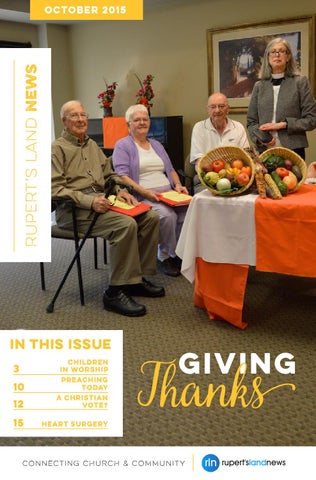
Advertising: RLN accepts advertising in our monthly magazine and our weekly email. Our rate sheet is available at rupertslandnews.ca/ads. To discuss advertising call (204) 996-6172 or email rlnews@rupertsland.ca Editorial offices: Anglican Lutheran Centre 935 Nesbitt Bay Winnipeg Manitoba R3T 1W6 Subscription queries: Administrative Assistant for the Diocese (204) 992-4200 | general@rupertsland.ca RLN welcomes story ideas, news items and other input. If you want to be involved in this media ministry, please be in touch with the editor. Contents copyright 2015 by Rupert’s Land News. All rights reserved. Cover: Susan Titterington and Ann Hunt take communion to residents at Boulton Bay Retirement Community.
RUPERT’S LAND NEWS
FR O M THE E DITO R
Feasting INTO The Kingdom Allison Chubb
October has a particular focus on community in Rupert’s Land, as we gather for our diocesan Faith Horizons conference, host parish suppers, and the Bishop holds his annual dinner. There are pet blessings, clothing sales, and new ministry celebrations. You'll find a particular focus on Indigenous ministry in the Diocese this fall, with the search for an Indigenous Ministry Developer well underway, Murray Sinclair speaking at the Bishop’s dinner, Kevin Lamoureux leading an exploration of
faith, truth, and reconciliation at Faith Horizons, and a special November issue of RLN on Indigenous ministry. In this month's issue, you will find two excellent pieces by Tim Sale and Tony Harwood-Jones (page 12) exploring the most important issues for us to consider as we head to the polls on October 19. As those charged with living into God’s kingdom here on earth, we have the opportunity and responsibility to push for positive change in our government by getting out to vote. As both writers suggest, voting is a particularly Christian duty because it means investing in our neighbours and our communities. But voting is only one small way we are called to build our communities. On
Letter To t he e d itor Dear Editor, I am sorry to read that I am a solitary voice, but I must then write: I am that mother who strongly believes in keeping my children with me in church. It has not been an easy road, but I have never believed that easy meant right. My husband being the priest, I have been a single parent in the pew, with more scrutiny than the average parent. However, RUPERT’S LAND NEWS
page 6, a member of the Little Flowers Community tells the story of one small group of Christians and how God taught them to love their neighbours in Winnipeg’s inner city by doing life together. Perhaps this is why so many of us love Thanksgiving; it is a taste of that great abundance we are promised in God’s kingdom, when the greatest and least will sit down and enjoy food together. As we gather with friends and family this holiday, may we be reminded of all the goodness of the world and how much we have to share. If there is room for one or two more at your table this year, look around your congregation or neighbourhood and see who might like to join you. May yours be a blessed feast.
Heather Skublics Lampman
Jesus was clear that children were welcome with him, and I have held onto the belief that they belong in the Church as much as the adults do. They need to know and feel that. It needs to be a home, a “native language”, for them to be in church, not a language learned with great difficulty once the time for establishing who they are has passed. I learned early on that keeping my children at
the back was harder than keeping them near the front, where they could see the liturgical actions, not just the backs of adults taller than them. In the front, they notice and ask and become at home in the service. Even very young, my children have noticed and repeated things that they heard in church. Special words would grab their attention, and they would become opportunities for reflection. At one-and-a3
Letters half, the Holy Week liturgies filled James’s head with such treasures as “Hosanna” and “covenant”, and the words often sung in the liturgy become part of the daily reality of home. Needless to say, it took preparation and packing to keep two small children occupied (a little easier when it was only one small one) and to train them to be quiet in church, and I wasn’t always successful. But I collected Bible or prayeroriented books, brought pipe cleaners to shape and soft puzzles to make, and usually a snack to pull out when everything else was failing. When they were little, I walked; even when they were toddlers and would have been happier running, I would pick them up and walk around, drawing their attention to things in the windows and on the walls. I tried to make sure the activities also fed their life in Christ. There were days I wondered why I was putting myself through this… but then the little pearls of response would come, and I knew this was a gift for them for their whole lifetimes.
4
Our family recently visited another church and was greeted by these cards in the pews: TO THE PARENTS OF OUR YOUNG CHILDREN, MAY WE SUGGEST… • R elax! God put the wiggle in children; don’t feel you have to suppress it in God’s house. All are welcome!
• R emember that the way we welcome children in church directly affects the way they respond to the Church, to God, and to one another. Let them know that they are at home in this house of worship. • P lease let your child use the reverse side of this card to draw and doodle.
• S it toward the front where it is easier for your little ones to see and hear what’s going on at the altar. They tire of seeing the backs of others’ heads.
TO THE MEMBERS OF THIS CHURCH:
• Q uietly explain the parts of the liturgy and actions of the pastor, elders, acolytes, choir, etc.
• P lease welcome our children and give a smile of encouragement to their parents.
• S ing the hymns, pray, and voice the responses. Children learn liturgical behaviour by copying you.
• C hildren, feel free to do your artwork or words on the back of this page!
• I f you have to leave the service with your child, feel free to do so, but please come back. As Jesus said, “Let the little children come to me.”
• T he presence of children is a gift to the Church and they remind us that our church is growing.
As a parent who has “fought this fight”, and also as a catechist who has studied the religious needs of children, I say, “Thank God! Someone, finally, understands!”
RUPERT’S LAND NEWS
Pasto ral Note
Living T ha n ksgiving
“And what do you say?” asked my daughter-in-law as she gave the requested toy truck to our two-year old grandson. “Thank you,” came the reply as he gleefully grasped it and ran off. Most of us remember being trained to respond politely with those words when given something. As children, we adopted this behaviour simply because our parents and other adults expected it of us – and often gave us signs of approval when we responded appropriately. As adults, we accept (and often expect) the same kind of courtesy. However, I think for most of us it is “transactionally based”, meaning that it is connected to some kind of concrete transaction that’s taken place. I’ve held the door open for you; you’ve brought me a cup of coffee. Thank you. But the Scriptures call us to a different understanding of giving thanks. God’s people are to be people who are continually giving thanks. In many places in the Psalms, the author tells us, “Give thanks to the Lord, for he is good.” In 1 Thessalonians 5:16 (one of the oldest pieces of writing in the New Testament), we read, “Rejoice always, pray without ceasing, give thanks in all circumstances, for this is the will of God in Christ Jesus for you.” This kind of gratRUPERT’S LAND NEWS
Donald Phillips
itude or thanksgiving does not result from a pleasing transaction. Rather, it flows from an attitude of the heart. Its outward manifestation comes from an inner conviction about life: that it is God-given and its purposes are ultimately good. We are being called to develop and live in a culture of thanksgiving. And this is not something we can do alone. It is an invitation to participate in a community of thanksgiving. For better or for worse, the national community we call Canada has managed to cultivate a culture of apology. The stereotypical Canadian is portrayed as always saying that he or she is “sorry” for something; even things that they had no control over. As the community of disciples of Jesus Christ, the Church, we are to be known as the people who give thanks. This should not surprise us. The climactic prayer of the central act of Christian worship – the Eucharist – is called The Great Thanksgiving. (The word ‘eucharist’ is borrowed from the Greek and it means ‘to give thanks.’) We are about to celebrate the Thanksgiving holiday, which traditionally emphasises giving thanks for the harvest. In urban areas, sometimes persons bring a symbol of their labour (paid or unpaid) in thanks
for the abilities that God has enabled in them. All of this is good. But we need to see these kinds of ritual observances as symbols of something deeper and more constant. Our own lives and the persons whom God has brought to us as companions – those who break bread with us, whether it’s a doughnut at Tim Horton’s or the consecrated bread of Holy Communion – are all a gift. This gift flows from the eternal love of God; for you, for me, for all of us. When my grandson learns to say thank you, he is beginning to discover, ever so subtly, that his whole life is a gift, and these little transactions of giving and receiving with thanks are simply signs of the life God has given us to embrace and enjoy.
Donald Phillips, Bishop of Rupert’s Land 5
C hris t ia n Li f e
Learning to Do Community Like Jesus Laura Everett
Community is my life. I often hear comments about how hard community is and how not everyone can “do community”, but I genuinely believe that it is a calling from Jesus; it is as fundamental to our faith as prayer, worship, or service. It is not an “extra” we choose in our faith. We are called to join in community and let it infiltrate our lives the way incense does our senses: you smell it, see it, feel it, taste it. As the letter to the Philippians exhorts, “Let each of you look not to your own interests, but to the interests of others. Let the same mind be in you that was in Christ Jesus” (Phil. 2:4-5). As obvious as it might seem, community looks different for different communities, and in that sense it can be hard to implement. We can get stuck with stories or ideas of what community should look like and get overwhelmed or discouraged when we can’t meet these visions. But every community is different, and will need to function in different ways according to its needs. Some communities run as churches; others are large houses with
people learning to share; others are in a few different houses; and the list goes on and on. I would define community as a place or time that is shaped by the people in that time and space, through the sharing of gifts, pain, and joy.
different houses each week and as a larger group once a month. There is laughter, tears, joy, and pain shared. I sit with a community member while she mourns the loss of her spouse. That same community member takes care of me when I am sick. It is thousands of these moments given and shared that create community. It is possible to look at Little Flowers and think, “Wow, they have three community houses, two house church locations, and an intentional community apartment building; I could never do that!” Well, you can! It has taken us almost seven years and a wide range of people, skills, and commitment to arrive at this place. It all started with a group of people having dinner. Breaking bread. Sharing moments. These weekly meals grew, and more people would come week by week. One day, someone said, “Let's start a church!” and it grew day by day into what we have now. Yet I must admit that I have almost quit countless times. I get tired and fed up, and my heart aches for a normal life: a self-centered life with a high paying job in
Let community infiltrate our lives the way incense does our senses...
6
Little Flowers is the faith community I participate in. It has taken a variety of forms at different times, as, I think, it should. There have been times of joy, sorrow, mourning, organization, chaos, miracles, failings, growth, shrinking, and so on. We have by no means done it all right, but we have learned that community takes work, vulnerability, honesty, and commitment. Little Flowers is a faith community supported by Youth With A Mission Winnipeg and the Mennonite Church of Manitoba which participates in life in the West End of the city. It is a neighbourhood that is culturally diverse but economically poor. We meet in two
RUPERT’S LAND NEWS
C hr istian L ife
The Little Flowers community gathers for dinner and worship in a home. a safe neighborhood, where I don't have to worry about other people's problems. As much as that sounds easy, I just can’t do it; the calling I feel is too deep. Being Jesus to all the messy, dirty, broken people around me is too important. So where do we start? How do we do it? Many times in my journey, I have needed to go back to the words of Jesus: “strive first for the kingdom of God and his righteousness, and all these things will be give to
you as well” (Matt 6:33). This verse reminds me that I need to simplify my life; that chasing after God’s kingdom is all that matters. Community begins with breaking bread: a meal shared and Jesus' body broken. It is really very simple at this point. It starts with just a notion or dream, and then we step out into it. As we begin to make community a way of life, we reflect God’s image as we become more like Christ. And as we encourage one other to love and
good works, community can spread out the load of the burdens we have been carrying alone. Even when I am feeling burdened with caring for a hurting person in our community, the whole burden is not on me. It is my job to love such a person like Christ, and the rest I can leave in my community's hands.
Laura Everett is the Clothing Program Coordinator at Siloam Mission and a member of the leadership team in the Little Flowers community.
RUPERT’S LAND NEWS
7
COMMU N I T Y
PARISH NEWS ROUND UP Anglican Fellowship of Prayer
The AFP invites you to an evening with their new National Director, Paul Feheley, on October 5, 7:00 p.m. at St. Mary Magdalene, Winnipeg. “Singing is Praying Twice” will explore music as a means of prayer and will be of particular interest to those involved with parish music or prayer. See the events calendar for details.
Centre for Christian Studies
CCS is pleased to announce the hiring of two new program staff: Janet Ross and David Lappano. Janet joins them from Emmanuel College, Toronto, while David arrives from Oxford, England. Read the full article at rupertslandnews.ca/centre-forchristian-studies-hires-two-new-staff/.
Introduction to Christian Meditation
A six week course will be held at four Winnipeg churches, four different times a week, for six weeks beginning October 12. If you’ve ever had an interest in exploring Christian meditation, visit rupertslandnews.ca/event/intro-to-christian-meditation/ to find out which time and location suit you best.
Breaking the Cycle of Violence
Knox United Church is hosting internationally recognized speaker and author Barbara Coloroso, October 14 at 7:00 p.m. Barbara will be speaking about her new book, The Bully, the Bullied, and the Not So Innocent Bystander. To reserve tickets or read more, visit rupertslandnews.ca/event/ barbara-coloroso/.
Evensong Schedule
The 2015-2016 schedule for parish Evensong has been posted at rupertslandnews.ca/evensongschedule-2015-2016/. If your parish is holding a special evensong not listed here, please email the Editor with details.
St. Paul’s, Fort Garry
Join St. Paul’s for their annual Brushworks art show and sale, celebrating Manitoba artists, October 16-18. There will be a wine and cheese on the Friday evening. For details, visit rupertslandnews.ca/ event/brushworks-2015/.
St. Andrew’s on the Red
October 9 at 7:00 p.m., St. Andrew’s is hosting Infinitely More, a Christian folk duo nominated for the 2015 East Coast Music Awards. Tickets are $15, available at the door. See rupertslandnews.ca/event/ infinitely-more-in-concert/ for details.
8
RUPERT’S LAND NEWS
C o mmunity
Pet Blessings
Parishes across the Diocese are holding pet blessings in honour of St. Francis on October 3 and 4. Visit rupertslandnews. ca/event/pet-blessings to find a church where your pet may be blessed.
st. benedict’s table
Steve Bell and Jamie Howison invite you to the launch of their new book, I Will Not Be Shaken: A Songwriter’s Journey Through the Psalms, October 6 at 7:00 p.m. at McNally Robinson Booksellers.
Spiritual Direction
St. Benedict’s Retreat Centre is hosting an exploratory evening for those interested in finding out more about spiritual direction and possibly connecting with a director, October 19 at 7:00 p.m. For details, visit rupertslandnews.ca/event/spiritualdirection-exploratory-evening/.
International Justice Camp
Justice Camp, an annual conference held by the Anglican Church of Canada in a different city every year, will be taking place in conjunction with the Episcopal Church of Cuba next May. Only 25 Canadians will be chosen to attend, so those interested should apply early by contacting bill.mous@niagaraanglican.ca.
Syrian Refugees
The Rupert’s Land Refugee Coordinator, Gail Schnabl, has written a letter to the Diocese detailing ways for us to get involved with sponsoring Syrian refugees to come to Winnipeg. To donate or become involved with a sponsorship, read her letter at rupertslandnews.ca/ letter-to-ruperts-land-re-syrian-refugeecrisis/ or write to the Editor to find a parish near you pursuing sponsorship. Photo: Jewish Journal
Bishop’s Dinner
The Bishops’ Dinner is at Victoria Inn on October 22. This year’s speaker is Murray Sinclair, the Chair of the Truth and Reconciliation Commission. Visit rupertslandnews.ca/event/bishopsdinner-2015/ for more information.
http://wearesparkhouse.org/adults/ animate/practices/ RUPERT’S LAND NEWS
9
WORS H I P
Preaching Today:
Where to Go from Here? “The sermon is an important and integral part of the liturgy,” states Dennis Michno in The Priest’s Handbook, 1986. The author reminds the intended reader, likely a seminary student, that, “careful attention should be given to the lessons for the day, especially the Gospel… and the sermon is not a break in the liturgical action… It belongs to the proclamation of the word and must be approached and prepared with the appointed lessons in mind.” He also cautions that, “As priests, we must strive to ensure that our preaching is consistent with the tone and teaching of the lessons and hymns for a given occasion and does not introduce alien elements.”
I have to wonder, in the complexities of our society, just what the author meant by “alien elements”. I hear from some millennials and others, who do not participate in church regularly, that hope, purpose, and meaning of life are what they listen for in a sermon. In our age of mission and a desire to embrace the missio Dei, or mission of God, in this place and time, the sermon could be seen as the ultimate call to action, that action being lived out through the living, breathing, body of Christ. However, preaching is also about affirming the hope and the love of Jesus. With shifts in thinking about preaching as well as the lectionary itself, several
The changing style of pulpits over the last two hundred years is testament to the changing role of the sermon in parish communities. Photo: Lee
10
questions arise. 1) How does one address the issue of the narrative lectionary, where one major text is used, or 2) How does the preacher attend to the emerging issues that, for the pastoral well-being of the congregation, may require that a sermon be given on a difficult subject, or the need to address issues in the news that are on the minds of the people? How does the preacher illuminate the gospel so that it cuts through the darkness of this world and inspires the body to take action? There are two trends within the Church that our traditional approach to the sermon might not fit. There are times when the lectionary points to a certain long standing theological interpretation, at least in my mind, that may not be fully embraced today. This leads the preacher to attempt to make the irrelevant, relevant. On occasion, the readings do not easily connect, at least for me, and thus leave the preacher to focus on one passage over another or search for the filament that connect the readings of the day in a meaningful and relevant way. One shift in preaching is that of the inclusion of more lay preachers. Accepting the notion that God speaks to and through whomever God chooses, ordained or not, the inclusion RUPERT’S LAND NEWS
Wo r ship of lay people as preachers, sometimes without classic seminary training, can breathe new life into tired theology. Contextual preaching challenges the preacher to recognize that culture shapes our theology and requires us to search our own culture and power constructs. In order to understand to what degree the dominant culture influences the pulpit message, the preacher needs to search beyond the classic, and often personally embedded, understanding of the scriptures and seek the refinement of the Spirit in stripping away the power structures, the patriarchy, and the preacher’s own world view. It may mean that the preacher might find that what they preach has no
relevance or connection to those who hear it, theologically or spiritually. Leonora Tubbs Tisdale, writing in Preaching as Local Theology and Folk Art, defines the needed role of three within the church and local congregation: the role of the prophet, the poet, and the professional theologian. Tisdale posits that the pastor (preacher) must be all three if they are to fulfill Augustine’s goals for preaching: teaching, delighting, and persuading. (p. 55) When we look out at our congregations and communities, we often see faces different than our own. The missio Dei calls us to learn more about the cultures and contexts of our missions in Christ. We can no longer come from the Eurocentric,
male dominant, heteronormative, and western mindset that exists quietly or loudly, depending upon whom you ask, within the Church. The Western and North American Church has, for centuries, presented a certain worldview and theology, and has reinforced this worldview from the pulpit. This worldview is no longer helpful as we learn from the recent journeys of women, LGBTQ folks, Aboriginals, immigrants, and refugees. Those who are called to draw the metaphors out of the stories, connect people to Jesus, and bring about a change in mind, body, and spirit will always be needed by God’s people as they seek to live into the missio Dei.
Susan Titterington is the priest at St. Chad's, Winnipeg, and recently completed her Doctorate of Divinity under Leonard Sweet.
RUPERT’S LAND NEWS
11
B U RNIN G B U S H
Election 2015: A Christian Vote? Tony Harwood-Jones & Tim Sale
Two retired priests address the question, “What is the most important issue for Anglicans to consider in the upcoming election?”… each from personal perspective and experience. Tony Harwood-Jones:
Dual Citizenship
Anglicans — indeed, all Christians — are dual citizens. I don’t mean “British Canadian” or “Lebanese Canadian.” Our other citizenship is the Kingdom of Heaven, where Jesus Christ is ruler of all earthly rulers. We are fortunate to live in Canada, for it is one of the best places on
Tony Harwood-Jones is a retired priest in Rupert's Land.
12
earth to live, but our primary loyalty is, and must be, that other “country” to which we belong. If ever there is a conflict between the policies of Canada and the law of God, there is no question what we must choose. Admittedly, we Christians can get into horrible tangles about what some of the laws of God might actually be. We have struggled over divorce and remarriage, and over the status of women, among other things. A struggle over euthanasia is just around the corner. But what Christian anywhere will disagree with the greatest law of all: “Love God with all your heart”? And what about the one that is a close second: “Love your neighbour as yourself”? And what Christian cannot also endorse, “Forgive those who sin against you,” or the importance of generosity, and care for the poor? Currently there is no political party in Canada, in my opinion, that is evil and opposed to God’s standards. Christians may well prefer any one of our federal parties for the values they up-
Photo: Elections Canada
hold: the Conservatives, for their desire to lower taxes, promote personal freedom, and reduce red tape for businesses; the Liberals, for their moderation and willingness to pick the best from both left and right; the NDP, for the priority it places on social well-being; the Greens, for their commitment to the environment; and the Bloq, for its commitment to French language and culture. Of course, the parties all have failings, too, but Christian Canadians have every right to emphasize the good in their preferred party, and work to get the bad fixed.
RUPERT’S LAND NEWS
BUR NING BUSH
Here are some policies that have a genuine Christian flavour: – care for the poor – care for the environment – a commitment to community: particularly good infrastructure (transportation, energy, telecommunications, medical care, and public safety) – a preference for rehabilitation, rather than punishment and retribution, of convicted criminals (remember, Christians are commanded to forgive both enemies and neighbours) – foreign trade that does not benefit from child labour and sweatshops – military action for moral,
Tim Sale:
The Elephant in the Room The length of this election has at least one blessing: it gives us Anglican Christians time to reflect carefully on the issues. The pundits are pointing to the fragile Canadian economy as the central issue. Some see the various trials currently underway involving senior civil servants and politicians as a central issue. Others would focus on the state of health care, or point to the threat of climate change and Canada’s weak response to that threat. Advocates for education, health care,
RUPERT’S LAND NEWS
rather than economic, causes Of course, the country is ultimately run by people, so we should not blindly vote for party or policy when the person who represents that position in our riding is immoral or incompetent or both. Here is my list of desirable traits in political candidates: – – – – – –
respect for constituents courtesy intelligence wisdom respect for the rule of law mercy, peacemaking, and a thirst for righteousness (see Matthew 5) – patience, kindness, gen-
and housing (of which I am one), those speaking for business and labour, and a myriad of other concerns compete to make their voices heard -- as they should and must in a free society. As much as I care deeply about many of these issues, for me there is a deeper and more central issue, namely the actual health of the Canadian version of democracy. “Democracy is the worst form of Government, except for all those other forms that have been tried from time to time.” So said Sir Winston Churchill in the House of Commons in 1947. If asked, he might also have reflected on the fragility of
erosity, gentleness, and self-control (see Ephesians 5:22) Undesirable traits: – lust for power – lying; preferring “spin” to truth – excessive enjoyment of privilege and ‘perks’ – lust for material gain – inability to work cooperatively with others When you prepare to vote, treat this article as a checklist. I suspect that our true sovereign would be pleased.
Photo: Becky Mayhew
democracy and how easily and quickly the legislative process can be corrupted. The integrity of a democracy rests on several pillars, most of which have
13
B U RNING B U S H been weakened by various Canadian governments over several decades. The first and most basic is free and fair elections. Fundamentally, a free election means all citizens, including the poorest, are both encouraged and enabled to vote. Voter suppression, whether by bad law or by nefarious practice, debases democracy. Free and fair elections means limits on funding and limits on donors. To see why, we have only to look south, where literally billions will be raised and spent, and only those with the connections to do so need apply to run.
Tim Sale is a retired Manitoba MLA and an Anglican priest.
Nominations also need to be open and fair. Candidates must have a reasonably equal chance to be heard, to contact voters, and to be seen and questioned in public. The same should be true of the leaders of parties: to take part in debates, to be accessible to the press and the public, to articulate a vision for Canada, and have the capacity to address that vision. Once a parliament is summoned, the most important figure is the Speaker, who oversees the process by which every law of the land is created. If a strong government wishes to pass a bad law by evading or distorting procedures which have been developed over centuries to prevent the rise of a totalitarian government, it is only the Speaker who can defend due process. Any modern government also needs a non-partisan and highly professional, civil service. Of course, the civil service has to carry out the lawful decisions of government. But it also is a key source of wisdom, information, and guidance. To share that wisdom and give good guidance, it must be both free of political bias and secure enough that, in “speaking truth to power”, it does not find itself either
Respond to Tony and Tim with your own opinion on the most pressing issue in the upcoming election by visiting this article on our website: rupertslandnews.ca/election-2015.
14
fired or shunted off to the sidelines. Much modern policy requires rigorous scientific input that must be available freely to all, both inside and outside the political process. Other key roles in a modern democracy rest on the officers of parliament: the Auditor General, the Supreme Court, the Governor of the Central Bank, the heads of critical regulatory bodies involving food safety, nuclear power generation, rail and pipeline safety, and so forth. All such senior officials need a sense of security to do their job well, because in many cases, doing their job will mean being critical of government. Finally, an enduring democracy rests to a great degree on its openness to inquiry and challenge, whether from individual citizens, members of the press, or other levels of government. So then, for me, there are many important issues, but the central one is the state of our democracy itself. The appropriate response to the many important issues we all care about rests on the free and effective functioning of parliament, the honour and integrity of the government, and the strength of the structures around that government. What do you think?
Remember, what’s most important is to get out and vote! If you cannot vote for reasons of identification or mobility and would like assistance, please email the Editor.
RUPERT’S LAND NEWS
Via me dia
Heart Surgery:
Old Te s ta me n t M etap hor and New Te s ta me n t R e a li ties Lissa Wray Beal There are several metaphors used in both the Old and New Testaments to describe spiritual realities. One such familiar image is God as a shepherd. The power of metaphor lies in its unexpected pairings (God and shepherd). These arrest us, enable fresh engagement with the subject, and often effect new thinking and action. One such metaphor is that of circumcision of the heart. The idea of a heart being circumcised is a bizarre picture! The physical rite of removing the foreskin was, for Israel, a sign of covenant identity. It was a reminder of God’s choice and covenant with Abraham and his descendants so that ultimately the world would be blessed through one descendant, Jesus the Christ. Circumcision
RUPERT’S LAND NEWS
was also a reminder that Israel was to respond with lives of worship, holiness, and justice. Circumcision was external but it was really about commitment of heart and life. That is where the metaphor comes in. God says that Israel is “uncircumcised of heart” (Lev 26:41; Jer 9:26). The heart as the place of will, emotion, and intellect is descriptive of one’s whole life. Israel’s “uncircumcised heart” had lost the heart-and-life commitment that was to characterize covenant people. They were so blasé about loving God and loving their neighbor that God tried to wake them up by using this strange picture. In Deuteronomy 10:1222, Moses urges Israel to this heart-and-life commitment. Moses says, “circum-
Photo: Rainer Fritz
cise then, the foreskin of your heart” (v. 16). Israel was to remove every barrier of will, intellect, and emotion, loving God with “all your heart and all your soul” (v. 12; see also Deut 6:4-5). And Moses in this passage tells the people why God is worth loving: (1) although creator and owner of all, God loved and chose them (vv. 14-15); (2) although all-powerful, God justly defends the weak (vv. 17-19); and (3) God rescued Israel (vv. 21-22). Being loved by such a God, it seems that loving God back is a natural response. Out of this love, the heart is circumcised and one desires to please God in thought, word, and action. Sadly, Israel could not do this. Several centuries later, the prophet Jeremiah laments the same problem (Jer 4:4; 9:25). Even more, Jeremiah describes their
15
V IA M E D I A hearts as “evil” (Jer 7:24), “hard tablets” (Jer 17:1) and “stubborn” (Jer 13:10; 23:17). This describes not only Israel’s heart, but (because of sin), the heart of all humanity. To solve this ongoing problem, Jeremiah proclaims a solution (Jer 31:31-34): God will make a “new covenant” with his people, putting God’s instructions in people’s minds, and writing it on their hearts. God will be “their God” and they will be “his people.” God will “forgive their wickedness” and “remember their sins no more.” This is an astounding promise to people who persisted in uncircumcised, hard hearts. Israel couldn’t solve the problem, so God in compassion does. The New Testament recognizes in Jeremiah’s words a prophetic anticipation. At the Last Supper Jesus speaks of a “new covenant in my blood” (Luke 22:20; see also Matt 26:28; Mark 14:24). The Eucharistic Table reminds us that this New Covenant is in place because of Jesus’ life, death, resurrection, and ascension. The Apostle Paul says that what was impossible in the Old Testament has now happened. Believers in Christ have been circumcised with a “circumcision not performed by human hands.” By faith, and through baptism into
rln 16
Christ, we experience that “circumcision of the heart” (Rom 2:28-29; Col 2:1112; 3:11). All the promises of the New Covenant are fulfilled in Christ: our sins are forgiven and remembered no more. We are God’s people. The Law of the Spirit is written “not on tablets of stone, but on tablets of human hearts” (2 Cor 3:3). All this has taken place in Christ. But the reality of our world is that — until Christ returns and renews everything — sin is still powerfully present. Our own hearts, softened and circumcised, can stray from God. Thus, James urges that we “purify our hearts” (Jms 4:8) by submitting to the circumcision God has performed and living accordingly. The act of submission to God’s circumcising work is a daily act. So, there is a “nowand-not-yet” sense to the New Covenant. The New Covenant is fulfilled: we are Christ’s; our hearts are
rupert'slandnews
circumcised. But it is a reality to which we must daily submit. We are now people of “circumcised hearts” and by the power of God’s Spirit we are disciplined to live accordingly. The complete experience of the New Covenant — with sin and its effects destroyed — awaits Christ’s return. In that in-between time we worship together, and encourage one another to “love the LORD our God with all our hearts, all our souls, all our minds, all our strength.”
Lissa Wray Beal is Professor of Old Testament at Providence Seminary and an Anglican priest.
CONNECTING CHURCH & COMMUNITY RUPERT’S LAND NEWS