RUPERT’S LAND NEWS
JU N E 2 0 15
IN THIS ISSUE High-powered Reconciliaton
6
Buddha on the Prairies
8 10
Eat my Body
15
Coming up Jesusie
CO N N ECT I N G C H U R C H & CO M M U N I T Y
rln
rupert'slandnews
rln
rupert'slandnews
Publisher | Bishop Donald Phillips Editor | Allison Chubb Accounting | Bernice Funk Layout & design | cityfolkcreative.ca Print & mail | Webnews Printing Inc. North York, ON. Rupert’s Land News - a section of the Anglican Journal - is published 10 times per year (September - June) by the Diocese of Rupert’s Land, in the Anglican Church in Canada. It connects churches and communities from Portage la Prairie, MB, to Atikokan, ON. by offering news, events, opinion, and ideas to 6,000 readers per month. RLN is available in print and online: • • • •
rupertslandnews.ca facebook.com/rlandnews twitter.com/rlandnews instagram.com/rlandnews
We also deliver timely news and information via a weekly email. Sign up at: rupertslandnews.ca/email RLN exists to explore issues at the intersections of faith and life. In doing so we solicit and publish a range of opinions, not all of which reflect the official positions of the Diocese.
2
CONNECTING CHURCH & COMMUNITY
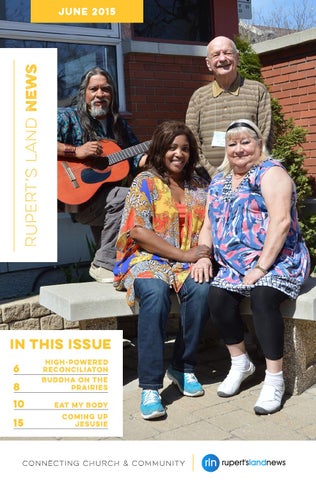
Advertising: RLN accepts advertising in the print edition, online, and in our weekly email. Our rate sheet is available at rupertslandnews.ca/ads. To discuss advertising call (204) 996-6172 or email rlnews@rupertsland.ca Editorial offices: Anglican Lutheran Centre 935 Nesbitt Bay Winnipeg Manitoba R3T 1W6 Subscription queries: Administrative Assistant for the Diocese (204) 992-4200 | general@rupertsland.ca RLN welcomes story ideas, news items and other input. If you want to be involved in this media ministry, please be in touch with the editor. Contents copyright 2015 by Rupert’s Land News. All rights reserved. Cover: Gordon, Consolate, Zyta, and Bill spend some time in the sun outside West Broadway Community Ministry.
RUPERT’S LAND NEWS
FR O M THE E DITO R
THROUGH THEir EYES Allison Chubb
We Anglicans are a diverse bunch, a reality reflected well in this month’s magazine. We do church in different places and a variety of ways; we come from many traditions and cultural backgrounds. For some, this can be seen as a weakness, but I believe it is our strength because it makes it harder to create divisions between “us” and “them” when “they” are also “us”! In his article, “Coming up Jesusie: early Inuit reception of Christianity”, Chris Trott warns us of what can happen when we make assumptions about the other and how they see the world. At our worst, the Church has presumed to have such a corner on the truth that it was forced on others; at our best, we are gentle listeners who learn from those who have experienced life and faith differently. In his incarnation, Jesus became “the other” in order to truly know and identify with them. He invites us to do likewise by walking the roads others walk and learning to see life through their eyes. In our new “Who Is my Neighbour?” column, Sensei RUPERT’S LAND NEWS
Frederich Ulrich shares a very different lens through which he sees the world: that of Buddhism. This column began with one reader’s curiosity about the others he encounters on a regular basis. Unwilling to assume that others experience the world in the same way he does, he wanted to catch a glimpse of life through their eyes. The process of taking Rupert’s Land News online has been just such a cultural experiment for many. Some of us welcome the transition as only natural, while others exclaim, in the words of one reader, “I will always be a digital immigrant!” While the magazine will no longer be printed on newsprint and shipped from Toronto come September, we want to ensure that everyone who’s interested in reading it will receive a copy. The
magazine is sent by email on the first of every month, but it is also available on our website. When you click on the picture of the magazine, it pops up to become available for online reading. The font is small so you can see the whole thing at once, but it can easily be made larger using the sizer at the top left. This takes a little getting used to, but with practice it works well. If you’d prefer to print off the magazine for reading yourself or taking to someone without a computer, there will be a link available for download on the website. Once the PDF is downloaded to your computer, it can be easily printed. If you need help finding this link, please let me know. Have a wonderful summer!
3
PAS TORA L N OT E
Conquering Change: Th e RL N On lin e Donald Phillips There are three words that initially come to mind for me when I think of change: loss, fear, and effort. When we make changes to the church’s worship and liturgy, people are often worried about what they will lose, such as particular feelings and thoughts that certain phrases and prayers evoke for them. Will the new forms leave them feeling detached from the experience of God that they are seeking? Often, dealing with change involves feelings of fear — or at least anxiety — that we will not be able to manage aspects of our lives as quickly or easily. There have been lots of changes in the way we use credit
Donald Phillips, Bishop of Rupert’s Land
4
cards over the last five years. With the introduction of a ‘chip’ on credit cards, no longer are we able to simply sign our name on a receipt, receive a copy, and leave the store. Now we have to insert our card in a machine (whose operating instructions are different in every single store we enter), remember a PIN, and enter it at the correct time, doing all of this while a lineup of impatient shoppers gathers behind us. Change, inevitably, also involves more effort, regardless of what the innovators of that change try to tell us! It involves more effort because we have to learn new operations, and with that comes the concern about how well we may be able to learn and carry out those new steps. I believe we can come at changes in our lives using one of two attitudes. We can assume that all we’re going to be able to do is cope with something new — make the best of it — while quietly admitting to ourselves that it will never be as good as the way it used to be. Or, we can decide that we are going to conquer something new — wrestle it to the ground — and discover its new potential. The change that is facing us as members of the Dio-
cese of Rupert’s Land is the loss of the monthly paper edition of the Rupert’s Land News and the gaining of a weekly online/email RLN communication and a monthly online magazine (some might even respond: “What’s not to like?”). But some of us might be thinking: “Will I be able to figure out how to access the website? Will I be able to move around the site and get to the pieces I want to read? And what about my dear friends who either don’t have, or rarely use, their computer? Will I, and others, be able to cope with this change?” No: you will not merely be able to cope. You will be able to conquer! When I look back at the scenarios of change I mentioned above, I realize that what made the difference between merely coping and conquering the change was confidence. I realized that I have been able to work through and master previous technological changes in my life, and I will be able to master this one too! The challenge I had to overcome was being able to believe in myself. You can do this too; I am confident that you, and all of us who are managing this change, will find ways to make it work — and work well!
RUPERT’S LAND NEWS
O pinio n
Church of the
Gr eat O u t door s Gwen McAllister Despite the fits and starts of spring, summer is almost here, and many people are eagerly looking forward to the months of warmth and sun. Until recently, I have lived and attended church in an area where summer weekends at the cottage are an experience foreign to most of the parishioners; summer is, instead, a time when some of us can pick up extra work. But whether or not it is accessible to us, we all need time in natural surroundings. David Suzuki reports on his blog that, “spending time in nature helps with recall and memory, problem-solving, and creativity. Children (and adults) who spend more time outside are also physically healthier.” In his book Biophilia, Edward O. Wilson writes that, “To explore and affiliate with life is a deep and complicated process in Gwen McAllister is a transitional deacon serving a placement at St. Saviour's, Winnipeg.
RUPERT’S LAND NEWS
mental development… our so different from one another, existence depends on this except in the numbers with propensity, our spirit is wowhich we are gathered (and ven from it, hope rises on its whether they are primarily currents.” human or other lifeforms). Communion with the Perhaps because our society land and its creatures, or is ordered so hierarchicallack of such communion, ly, we have been better at affects our mental, physical, understanding God as tranand yes, spiritual health. We scendent — far beyond our know this. How many times comprehension — than as have we felt close to God in immanent, pervading each nature, or heard a friend say, of us and all things. Our “The outdoors is my church”? scriptures are clear that the Such communion can make God of our faith tradition is us feel alive, connected, both, and reducing God to more human, more real. It is one or the other is idolatry. no secondary sort of alterThe irreducible Source of life native spiritual road: only if is wondered at both in worwe have ship services read our Communion with the land... and on prairies scriptures at sunset, and can make us feel alive with is with us as veiled the Beloved, eyes will we be surprised to the Christ, in both the Euchafind our Source in creation. rist and in the warm grass. This sense of reality is The integration of these countercultural. Our Western ways of being in relationship megaculture seems designed takes us deeper into our to devalue this reality, faith tradition. Herein lies claiming that what is “real” is the healing of our cultural commerce, institutions, and estrangement from conentertainment. In our society, nectedness: in bringing our cottage ownership is one of sacramental reverence to our the few sanctioned ways for outdoor experiences, and in us to ensure regular contact bringing the All we encounwith the living world, and ter in creation into our church access to it is parcelled out worship. In so doing, we will to small family units rather better understand our faith, than to whole communities. our humanity, our relationship But however we manage with one another and the to access it, the experience land. May this be a summer of God in nature is often of such faith practice, howfar from our experience of ever and whenever we are church. able to commune with the Yet these should not be living God. 5
S t e wa r d s h i p
High-powered Reconciliation: healing the wounds of dams Will Braun
Premier Greg Selinger stood on a stage in a school gym in Cross Lake, Manitoba in front of a crowd of 225 people who came to hear something they had never heard before. "I wish now on behalf of the Government of Manitoba,” Selinger said, “to express my sincere apology to Aboriginal peoples affected by hydro development." "We recognize," he continued, "that reconciliation is an ongoing process and are committed to work with communities toward building respectful relationships." The audience, from a community that has been battered by hydro dams for decades, clapped politely for Selinger. That was in January of this year. In 1975, a committee representing their community and four others made the following statement in a presentation to an interchurch inquiry into hydro. Our submission can have no other theme than to object to the project in the strongest terms possible. . . . Neither Cree culture, Cree values, nor the native communities affected are against change, but we cannot and do not condone a project which changes 50,000 miles of life-creating and life-supporting shorelines and which
6
Photo: Les Dysart of South Indian Lake stands next to severely eroding shoreline. Hydro permanently raised the lake level by three metres.
floods some 415,000 acres of ancestral lands. . . . The simple fact is that if the communities affected would have a choice in the matter, they would not trade this choice for any amount of compensation; they would veto the project. The project went ahead. Now, Manitoba's five largest rivers and six of its 12 largest lakes have been fundamentally altered in order to produce electricity. These changes create wounds on the lands and in the hearts of the people for whom those water bodies are home. In 2001, the report of a second interchurch inquiry into the hydropower system said the following. For Manitoba Hydro, the
governments, and consumers the [hydro system] is a success, but in northern Manitoba it constitutes an ongoing ecological, social, and moral catastrophe. These imbalances must be redressed. There is a growing sense among non-Aboriginal Canadians that we must walk a path of redress and reconciliation with Indigenous people. There is a sense that the relationship is askew and we would all benefit from a more fair and honourable arrangement. But what exactly does reconciliation look like? The Interchurch Council on Hydropower works at one very specific piece of reconciliation—bringing healing to the relationship
RUPERT’S LAND NEWS
Ste war dship between hydro customers at the southern end of the transmission line and affected Indigenous peoples at the northern end. Rooted in a 40-year legacy of interchurch involvement in hydro issues, we advocate for fair treatment of people and lands affected by Manitoba's hydropower system. We build relationships in the north, we monitor the activities of our utility and government, we participate in public discourse by means of media, regulatory hearings, development of school curriculum, public presentations and a photo-video exhibit that has been shown in a dozen venues. Our message is that hydropower is not clean. Many people still carry the stain of ongoing hydro damage in their hearts. And the damage to tens of thousands of kilometres of shoreline is evident for anyone to see. Much reconciliation is required. And it is entirely possible. Hydro could review how it manages water regimes so as to reduce environmental impact, as has been done
effectively in other provinces. The $125 million in water rental fees that Hydro pays to the province each year could be redirected to affected peoples for community development initiatives. Hydro could pursue aggressive geothermal and Power Smart programs for affected peoples to ease the debilitatingly high power bills many of them face. Hydro could charge affected peoples a flat heating rate based on the average cost of heating a Winnipeg home with electricity. Northern Hydro workers receive such an accommodation, but affected peoples pay hundreds in monthly hydro bills during winter. Hydro speaks of a “new era” of development in the north. That era is rooted in concepts of consent and benefit sharing. But it applies primarily to First Nations near new dam sites. These First Nations make up only about one-third of affected peoples (and even among the one-third, a significant number are bitterly dissatisfied with the new era).
Government has recently acknowledged that reconciliation must extend to all affected peoples. Some progress has been made in this regard but a great deal of healing and redress is still needed before southern consumers can be satisfied that when they flick the light switch, people at the other end of the power line have been dealt with fairly. The forced imposition of a massive hydropower project on the north was an injustice of unthinkable proportion, consequence and duration. The task of making that as right as is possible is the difficult, exciting task of living into God's love. Hydropower is an admittedly complex reality in Manitoba, but the call of the Gospel is simple: love your neighbour. The people who live the consequences of producing the power in our toasters and laptops are our neighbours. We at the Interchurch Council on Hydropower feel honoured that mainline denominations have entrusted us with the task of working at reconciliation with hydro-affected peoples. We humbly invite your interest and support. To receive semi-regular information about our work, email Project Coordinator Will Braun at wbraun@inbox.com. Will Braun is a journalist who represents the Interchurch Council on Hydropower
RUPERT’S LAND NEWS
7
Ne ig hb o u r s
Discovering Buddha On the Prairies Fredrich Ulrich
The Buddha was born in India, but there was once a boy who found the Buddha, right here where the prairie grass grows. How is that possible? The answer started one day when, as that boy, I roamed my grandfather’s farm. I liked to dig in the wolf pasture in the early morning, my bare feet wet from the prairie grass. The pasture’s name reflected the time when the wolves used to den up among the gullies riven by small streams. Tipi rings witnessed that others had been here before, ancient others. I lay in the grass, feeling the earth breathe. The waving prairie grass bore a lesson. I would later call this Dharma. This was a place of no place, the addressless. In the future, this would be Photo: Robert Miyai
8
called sukha vati, the happiness place. On this morning, there was a sense of deep connection. This would, in my more mature years, be named sangha, community. When I became a young man, Buddha roared into my life right out of books written by Albert Schweitzer. The Iliff School of Theology in Denver Colorado had received a large number of books by this great being (maha satva). Cataloging these titles was my first step in becoming a Buddhist priest of The Japanese Pure Land tradition. The message of reverence for life moved me deeply. Albert Schweitzer, too, had a happiness place — his hospital in Africa. He too had an awakening, on the wild Ogowe River. Schweitzer commented later that he had been thinking of Buddha. This happened deep
in the African wilderness, an addressless place. The books were eventually cataloged and well read. It was time to visit the Denver Buddhist Temple. The early part of the morning was called Dharma School, but it was not exactly “school.” It seemed chaotic, with children running around freely. Old people sat in a groups laughing. The minister, Sensei Tsunoda, wandered about smiling in all directions. This took place in the main hall (hondo) in front of a beautiful shrine that glistened with lanterns and lotuses. It spoke in the lavish artistic tradition of Japanese Shin Buddhism. There were classrooms in the temple, but no one seemed interested. They stayed right there in front of the statue of Amida Buddha, the Infinitely Awake. Eventually, a gong began to sound a deep slow cadence. The minister had invited the gong to speak. There was a scurrying of feet as chairs were set up by the men. The women brought out service materials. The gong gradually faded, a quiet lingering tone. Then the children came parading in to take their seats in the front rows. The elders sat in the rows on the right. Sensei Tsunoda, now in his robes, started the Triple Refuge in the Buddha, Dharma (teachings) and sangha, a chant RUPERT’S LAND NEWS
Neighbo ur s from the time of the Buddha. There followed a reading from the letters by Shinran, the founder of Shin Buddhism. Then the Sensei intoned the first lines of the sutra (scripture) for the morning. It was the Twelve Gratitudes, Junirai in Japanese. The minister and the elders chanted the sutra by heart. It ends with a wonderful scene in which the earth was so happy that flowers sprang forth in array. The sky, in its joy, sent a refreshing rain of sweet green tea. As the minister gave his Dharma talk in Japanese, I looked around at the objects of beauty in the hondo (meeting hall). The walls were covered in art work. Scrolls hung from hooks bearing the likeness of important people.
RUPERT’S LAND NEWS
There were also scrolls of calligraphy for the names of the Buddha, embedded in haiku. A brush-stroked picture showed the Buddha sitting before animals teaching Dharma. Origami cranes decorated the speaker’s stand, where Sensei next spoke in English about the importance of interdependence. The service finished with silent meditation (seiza), followed by chanting Namo Amida Buddha, Gratitude to the Infinite Awake. Then everyone offered incense into a large pot with a lion on top. And there was lunch, chop sticks and all. These were typical experiences found in any Shin Buddhist Temple. They are still in evidence today, with about 60 Shin Buddhist
Fredrich Ulrich is a retired Sensei at Manitoba Buddhist Temple
temples in the U.S. and 12 in Canada. These groups have been in North America for over 100 years, with the first Buddhist temples built in Canada being Shin Buddhist Temples. Life in these places is full of sangha. It sometimes involves keeping the temple in shape with hours of scrubbing and polishing. It means funerals, Buddha’s Birthday, study groups, memorials and special services, like Obon dancing in Japanese costumes. Obon is a time when the lines between life and death disappear. Amazingly, I finally became a Sensei myself. I served for 25 years on the prairies in Alberta and Manitoba. I am now retired, a mere wrinkle in time. Still, the vision of my boyhood happiness place has never faded. This Buddhist life has been a journey from beginning to beginning. 9
E u cha r i s t
Eat Me:
What did Thomas Cranmer Really Mean? Graham MacFarlane
Cranmer on "This is my body": Literal or Figurative?
“This is my body… this is my blood.” These “words of institution” are taken literally by some Anglicans and figuratively by others. What was the view of Thomas Cranmer (1489-1556), the first Anglican archbishop of Canterbury and primary author of the Book of Common Prayer? Cranmer’s view on the mode of Christ’s presence in the Eucharist underwent two major transformations in his life, first around 1532 and again around 1547, yielding three phases. During the first and second phases, he took the words of institution literally. The creation of the Book of Common Prayer dates from the third phase, in which he 10
took the words figuratively, indicating Christ’s spiritual presence in the partaker at Communion. In the first phase, Cranmer accepted the Roman Catholic doctrine of transubstantiation, according to which the bread and wine undergo an imperceptible physical change at the time of consecration, such that they become the actual body and blood of Christ. The change is so thorough that there remains no bread or wine at all in the elements; despite their look and feel and taste, they have physically become the body and blood. Cranmer abandoned this view sometime around 1532, in favour of the Lutheran view of consubstantiation. This view also teaches that Christ’s body and blood are physically present in the elements, but it rejects the idea that the bread and wine have undergone a change into the body and blood. Rather, the body and blood are made present in and with the bread and wine, but not in such a way as to replace them. Cranmer held this view for more than a decade, until 1547, when Henry VIII died and was succeeded by his son Edward VI. It was during Edward’s sixyear long reign that the
liturgical, theological, and ecclesiastical foundations were laid for a Reformed Church of England, including the all-important Book of Common Prayer (BCP), first published in 1549. The BCP dates from the third phase of Cranmer’s thinking on the Eucharist, when he held that Christ is not physically present in the Eucharist at all. Cranmer’s final thinking around Eucharistic presence can be summarized in five points: • Christ makes himself present where and when he wishes. He is not restricted to only manifesting himself in or through the Eucharist, though we can be confident that he does make himself present in the Eucharist. • Christ’s presence in the Eucharist is not a physical presence, but a spiritual presence. • Christ is present in both his human and divine natures, but by virtue of his divine nature and not of his human nature. • Christ is never present (either physically or spiritually) in the Eucharistic elements as such (i.e. the bread and wine); rather, he makes himself presRUPERT’S LAND NEWS
E uc har ist ent to the person who is receiving the elements within the context of the Eucharistic rite as a whole. • Christ can be said to be figuratively present in the bread and the wine, because these elements symbolize his body and blood. It is important to distinguish sharply between Christ’s spiritual presence and his figurative presence; these are not synonymous. Christ is figuratively present in the bread and wine, while he is spiritually present in the person taking Communion. The spiritual presence is true presence, even if it’s not physical. The figurative presence is not true presence, but a figure of speech that points toward to the spiritual presence. So when we say that Christ is spiritually present, we do not mean that he is only metaphorically present. We mean that he really is truly, non-metaphorically present -- just not in a physical way. Cranmer is nota ‘memorialist’; the Communion does not just make us remember and ponder Christ’s sacrifice. Christ really is present in the Eucharistic rite. Further, it is Christ who actively and intentionally makes himself present to people who partake at Communion. This means that Christ is not bound to make himself present to, say, a mouse that RUPERT’S LAND NEWS
gets into the consecrated bread, or to a person who takes Communion in bad faith. This is in contrast to the Roman Catholic transubstantiation and Lutheran consubstantiation doctrines, both of which hold that Christ’s body and blood are present in the elements themselves, no matter who eats them. In sum, the Cranmer that shaped the BCP regarded “This is my body” as figurative language that points to the fact that Christ has promised to make himself spiritually present, in both his divine and human natures, to the communicant within the context of the Eucharistic rite considered as a whole. But Cranmer does not forcefully push his own views onto the Eucharistic liturgy. The wording of the Communion rite in the 1549 BCP does not rule out any of the three views of Eucharistic presence just discussed, and so it allows a great latitude of interpretation among communicants. The 1552 edition more clearly reflects the third phase view of spiritual presence but this edition was only in circulation for a matter of months. The version of the BCP that both shaped and reflected the mainstream Anglican view during the formative Elizabethan period is that of 1559, which, like the 1549 edition, allows for a variety of interpretations. This meant that the same prayerbook could be used and cherished by people with diverse theo-
logical opinions -- by those who understood “This is my body” literally, and by those who, like Cranmer in his third phase, understood it to figuratively indicate Christ’s true spiritual presence in the communicant. Further reading: Cranmer wrote two treatises on the question, A Defence of the True and Catholic Doctrine of the Sacrament of the Body and Blood of our Saviour Christ of 1550 and his so-called Answer (A Crafty and Sophistical Cavillation devised by M. Stephen Gardiner) of 1551; both are available at archive.org. See also Diarmaid MacCulloch, Thomas Cranmer (1996), pp. 181-3, 390-408.
Graham MacFarlane is a parishioner at St. Margaret's, Winnipeg, who recently finished his PhD in Systematic Theology at the University of Aberdeen. 11
M in is t ry
That Quiet Little Church on t h e High way Dick Kennedy
It’s 6:30 in the morning. The wind is howling, the temperature is hovering around -25°, and it’s time for me to hit the road. The service is at 8:30, and I have at least an hour and a half of driving ahead of me. It’s been snowing all night, and I know the plows won't be out yet. Good thing I have four-wheel drive. Just pray that the moose have enough sense to stay off the roads! It’s a long and winding road, but somehow I manage it with only one huge mug of coffee and a lot of prayer. I shovel the steps, open the church, set up for communion, and welcome the one person who braves the elements to join me in worship. Another Sunday in rural
12
ministry! It’s not always like this, of course. Sometimes it’s more like a zoo, with more children than adults. There’s no time for quiet, meditative prayer on these days. We are that quiet little church that you pass on the side of the highway, the one you always want to stop and take a look at. We’re there on a Sunday afternoon, the ancient pump organ squawking out the tunes as we sing the old familiar hymns. Perhaps you’ve stopped at the little church in that tiny community where we don’t have a regular parish priest, but the dedicated few members keep the church alive and welcome anyone who wants a place to worship. The priest shows up every
couple of months to celebrate the communion, but mostly we manage on our own as worship is led by lay readers and music is done karaoke style with the old tape deck. Maybe you’ve driven through our community. We’re too large to be called a town, but much too small to be a city by most standards. There’s only one Anglican church; the next one is at least an hour away. It doesn’t matter if the priest can’t sing or gets lost half way through the service; we love him anyway! He keeps our church alive. There may be times when the bills aren’t quite up to date, or the phone doesn’t get answered, but the church is never quiet.
RUPERT’S LAND NEWS
Ministry We have an altar guild to keep everything neat and ready for the next service. With Bible study, AA meetings, and Messy Church, we’re like the city churches, only smaller. Almost every month there is a supper or a garage sale or a fund raiser. It’s these suppers and sales that keep our church afloat. Have you noticed the hitch-hikers on the side of the road? They often stop at our church, looking for a meal or a place to spend the night. It might be early in the morning or late at night. Sometimes we find them something in the freezer that we can heat up, or we take them over to Safeway and buy them some food for the road. Maybe it’s a single mom on her way west, who has run out of money and needs a meal for her family. One night, the rain was pelting down, and there was a knock at the rectory door. “No, you can’t sleep in the church”, I told the man, “but we have an extra bed and a hot shower downstairs.” “Why don’t we have any young people in church?” folks ask. The main answer is that many of them have left town, moving to the big city where there is more opportunity. Like many churches, the most common hair colour is grey. Funerals are a big deal, because we know that we have lost another member who can’t be replaced. As we say goodbye to them, we mourn their loss, but celebrate the contribution and life that
RUPERT’S LAND NEWS
Photo: St. Paul's, Poplar Point; Ken Yuel
they gave to our church. The congregation is gradually shrinking, but we celebrate any time a new family shows up. They bring new life and new hope. Rural ministry is a ministry of long distance travel, of late nights and early mornings. It can be lonely, when the nearest Anglican priest is an hour and a half away and just as busy as you are. Sometimes, it is like living in a fish bowl, where it seems that everyone in town knows your business better than you do, where you are recognized because “you do good funerals,” even for people you don’t know. Rural ministry is also found in bringing the gift of hope, the gift of the resurrection to churches that are afraid of dying. It is the joy of sharing the Gospel through our love for each other and by welcoming strangers into our midst. Dick Kennedy is the Priest at St. Luke's, Dryden 13
COMMU N I T Y
PARISH NEWS ROUND UP
St. Margaret’s, Winnipeg
Summer Events
This is the last parish news roundup for the summer, but events which are timely and of interest to the wider diocese can still be sent to the Editor to go up on the events page at rupertslandnews.ca/events. Don't forget to check the page over the summer!
st. benedict’s table
St. benedict’s table welcomes Kate Bowler to speak about her new book, Blessed: A History of the American Prosperity Gospel on July 15, 7:30 p.m. at Sam's Place. For details, visit rupertslandnews.ca/event/blessed-book
St. Margaret’s welcomes parishioner Clint Curle for a lecture and conversation on human rights on June 25 at 7:30 p.m. Clint works at the Canadian Museum for Human Rights.
St. Benedict’s Retreat Centre
Spiritual directors Kalyn Falk and Rachel Twigg are again facilitating a weekend retreat called “Fermata: come away with me and rest awhile,” July 30-August 2. For details, visit rupertslandnews.ca/fermata
A Chap lain ’s R e fl ec tio n s from t he C ity Jail Brian Flower For most people, the story ends with the evening news. The crime is committed, the perpetrator is caught, and the guilty are sentenced; the story ends. For most people, it happens in another neighbourhood and to other people. But for the chaplains and staff at the Winnipeg Remand Centre (WRC), this is where it really begins, or, more often than not, begins again. This is a building simply over filled with men and women who have made bad choices, who hurt other people, who have suffered or who cause grievous loss, 14
who are caught in the web of terrible life-altering addictions, anti-social lifestyles, or abusive relationships. Some of them fell between the cracks; other were born in the cracks. Some stay for a few days, while others stay far longer. But for all of them, this is a place where life is put on hold. It is a place where some long to escape from, while for others it is a rare place of food, safety, and security. Into this, chaplaincy seeks to bring a measure of honesty, a greater sense of meaning, purpose and perhaps even holiness. Chaplains seek to uphold and nurture the better nature
of the inmate, to provide a new direction in life for when the individual leaves. In private conversation with a chaplain, some inmates feel a sense of relief after being open and honest, “coming clean” about their actions and life. Perhaps for some, this is the first time they are honest about who they are and the choices they have made. The chaplain does not try to excuse what they are said to have done, but tries to learn their name, part of their story, and hopefully, strengthen them for the journey beyond their time in custody. The chaplain juggles the balance between “grace” and “law” with people who need the grace but too often decline it, necessitating the law. RUPERT’S LAND NEWS
VIA ME DIA
Coming Up Jesusie:
ea r ly I nu i t r ece p tion of C h ri s ti a n i t y Chris Trott
When I went to Arctic Bay, Nunavut (then part of the Northwest Territories), in 1979, I was surprised to find an active and clearly committed Christian community with no ordained minister. My anthropological training had taught me that the missionary influence had undermined and destroyed the “traditional” cosmologies and was thus incompatible with our research objectives. I found out that the last missionary in the area had died in 1946, and that although Arctic Bay was an outpost of the mission at Pond Inlet, the local people had maintained the Anglican Church throughout that time on their own. How was this possible? The first mission on Baffin Island began in 1894 when The Rev. Edmund Peck arrived at the whaling station on Ummanarjuaq (Blacklead Island) in Cumberland Sound. The story of the qallunaat (white) missionaries over the next fourteen years is so full of missteps and blunders that one wonders how the Inuit even took these men seriously. The missionaries introduced the syllabic system of writing and taught Inuit to read and write in their own language. These skills spread rapidly from camp to camp as Inuit taught each other, so that by the time it reached North Baffin Island, RUPERT’S LAND NEWS
Photo: McCord Museum
Inuit were convinced that they had invented the writing system. The only reading material at the time was the four Gospels and a version of the Book of Common Prayer (quite different from what we are familiar with, as there were no Psalms and it used Watt’s Catechism). The missionaries provided whaling captains with copies of these texts and had them distribute the books wherever they wintered over. We must recall that the Inuit had become engaged in commercial whaling beginning in the 1850’s, and by the 1890’s the industry was collapsing. The whaling stations closed in 1908. Inuit had gathered into the whaling stations over this period, and with the closure of the stations, re-disbursed over
the land to their traditional camps. This entire period was a time of rapid change, with the whaling way of life disappearing and the authority of the shamans who had provided the spiritual support for this way of life now undermined with the disappearance of the whales. The collapse of these colonial structures may have created an opening for the Christian missions. Inuit in North Baffin Island (today Igloolik, Arctic Bay, and Pond Inlet) received their first copies of the Gospels and Book of Common Prayer from Captain Comer at Fullerton Harbour in 1904. What sense did they make of these texts? What were sheep, camels, vines, Continued on page 16... 15
V IA M E D I A
Continued from page 15... and olive trees – the whole apparatus of an agricultural society – to whale hunters in the arctic? Indeed, what were kings, governors, judges, Pharisees, and priests in a society that is fundamentally egalitarian? We have no way of answering these questions without considering the events that followed. At the same time, a series of religious movements, called siqqiqtiq1 in Inuktitut, traveled up the north coast of Baffin Island to Pond Inlet. We become aware of them through the writings of Captain Munn, who tells us that a man from Cumberland Sound called Akumalik led the people through “Coming Up Jesusie”. Akumalik questioned Captain Munn closely over the meaning of “Trinity” (the Captain demurred to explain), and further declared that his daughter’s child was a virgin birth. One of Akumalik’s disciples was a man called Umik, along with his son Nuqallaq2.
rln 16
Umik and Nuqallaq moved south to the Igloolik area. In the spring of 1921, they gathered men and women together in a circle to confess their sins. Umik then took seal organs (heart and liver), cut them up into small pieces and passed them to each person saying, “This is my body”3. He then filled a ptarmigan heart with caribou blood and passed it around saying, “This is my blood”. These Inuit were now Christians. They flew white flags from their homes, greeted travelers by lining up and shaking hands (including the dogs), turned over all the meat they hunted to Umik for distribution, and exchanged spouses with Umik and Nuqallaq. This is a very different process of “conversion” from the stories we are familiar with. There were no Christian missionaries present – all the work was done by Inuit leading other Inuit. The puzzling pieces (to us) in the last paragraph show that Inuit received Christianity within
rupert'slandnews
their own cultural context. I believe that these two pieces grounded the Gospel in Inuit communities and leads to the faithful perseverance up to today. Ten years later, Christian missionaries (Anglican and Roman Catholic) arrived in Pond Inlet and began teaching a much more orthodox understanding of the Gospel. The more familiar missionary story of colonial dominance of the Church by qallunaat took root during the 1930’s, suppressing the vibrant explosion of faith in the earlier period. a caribou walking down a slope on the land and out onto the sea ice 2 In a Winnipeg connection to this story, Nuqallaq ended up in Stony Mountain Penitentiary for the murder of Robert Janes. 3 For an Inuit account of these events see the movie The Journals of Knud Rasmussen (2006) released by Isuma Productions and directed by Zacharias Kunuk. 1
Chris Trott (left) is Native Studies Professor and Warden at St. John's College
CONNECTING CHURCH & COMMUNITY RUPERT’S LAND NEWS