RUPERT’S LAND NEWS
DECEMBER 2014
IN THIS ISSUE 7 8 11 14
CO N N ECT I N G C H U R C H & CO M M U N I T Y
rln
Christmas
in Prison
C h a n g es to prostitution
legislation
A dv e n t l i t u r gy
at home
The old pistis c h r i s to u d e bat e
rupert'slandnews
rln
rupert'slandnews
CONNECTING CHURCH & COMMUNITY
Publisher | Bishop Donald Phillips Editor | Allison Chubb Accounting | Bernice Funk Layout & design | cityfolkcreative.ca Print & mail | Webnews Printing Inc. North York, ON.
Advertising: RLN accepts advertising in the print edition, online and in our weekly email. Our rate sheet is available at rupertslandnews.ca/ads.
Rupert’s Land News - a section of the Anglican Journal - is published 10 times per year (September - June) by the Diocese of Rupert’s Land, in the Anglican Church in Canada. It connects churches and communities from Portage la Prairie, MB, to Atikokan, ON. by offering news, events, opinion and ideas to 6,000 readers per month. RLN is available in print and online:
Editorial offices: Anglican Lutheran Centre 935 Nesbitt Bay Winnipeg Manitoba R3T 1W6
• • • •
rupertslandnews.ca facebook.com/rlandnews twitter.com/rlandnews instagram.com/rlandnews
We also deliver timely news and information via a weekly email. Sign up at: rupertslandnews.ca/email
2
To discuss advertising call (204) 996-6172 or email rlnews@rupertsland.ca
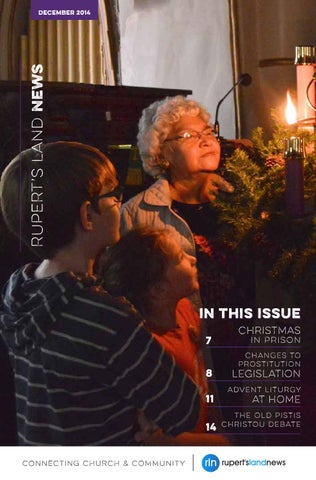
Subscription queries: Administrative Assistant for the Diocese (204) 992-4200 general@rupertsland.ca RLN welcomes story ideas, news items and other input. If you want to be involved in this media ministry, please be in touch with the editor. Contents copyright 2014 by Rupert’s Land News. All rights reserved. Cover: William Dolloff, Alexis Waldner, and Anges Morgan light the first Advent candle at St. Mary la Prairie in Portage la Prairie.
RUPERT’S LAND NEWS
FROM THE EDITOR
HAPPY NEW YEAR
December will be a mixture of uncertainty and hope. It is the nature of Advent, as we wait anew for the mystery of the incarnation. In this issue, you will find a reflection on what it’s like to spend Christmas in prison, a discussion on the upcoming federal legislation on prostitution, a theological explanation of the old “pistis christou” debate, and more.
As you read the piece on Advent practices, you are invited to join the discussion online to share the things you or your family do during Advent. Perhaps together we can find new ways to slow down and wait this season! Join us at rupertslandnews. ca/advent-practices. “Blue Christmas” is a reflection on the tensions of the Advent story, recognizing that while this is a joyful time of year for many, there are always those among us who struggle through this season. My prayer for you is that no matter where you find yourself this Advent, you will have the opportunity to be
LETTERS TO THE EDITOR SPOTLIGHT ON HUMAN RIGHTS: While Winnipeg was celebrating the opening of the Human Rights Museum, hundreds of us gathered to hear about a tragic case of human rights neglect. Dennis
RUPERT’S LAND NEWS
Edney shared with us his passion for his client Omar Khadr. Edney’s admiration for this young man who has suffered so much shines through his conviction that our
still in anticipation. At Rupert’s Land News, we have begun the third and final phase of the new format, which is the “sustainability” phase. This means broadening our team to include a greater diversity of people across the diocese as well as calling for regular subscriptions. If each subscriber gave an annual donation of just $12, RLN would be sustainable far into the future. The recommended subscription is $20; donations of $25 or more will receive a tax receipt. Please send your subscription fees to Bernice Funk, c/o Anglican Lutheran Centre. human rights record has not been upheld by our justice system. Khadr is a victim of injuries, torture, and imprisonment. He was a “child soldier” and held in Guantanamo by the US military. He is now 27, released to the Canadian justice system, and held in solitary confinement. Dennis Edney says, “Omar wishes to be a doctor, and when I ask him why, he says because I never want people to be abused like me… Omar has no bitterness; he has nothing but forgiveness.” Every week, our Rupert’s Land Peace and Justice Circle remembers Omar’s case. — Fletcher Stewart, St. Matthew’s, Winnipeg 3
TO THE EDITOR TO THE EDITOR
LETTERS TO THE EDITOR READERS ARE SAYING...
— Teresa Cameron, St. Paul’s, Fort Garry
As one who counts Lynn Pate as a dear friend and has been blessed to join her around many of those tables and experience her hospitality many times over many years, I think you “got her”!
— Jocelyn Barnard, St. Bartholomew’s
— Alan Marsh, St. Mary la Prairie
Just a note to let you know that we absolutely love the new format and content of the RLN. It is much easier to read and this morning I took it down to the dock to sit in the sun.
I know for a fact that in years gone by, we outside of Winnipeg have had to put up with “perimeteritis”. It has happened too many times. So if you could start to redress the imbalance, I would be so grateful, and that would encourage us all to submit other relevant articles. Thank you in advance. — Denise Fortier, St. Chad’s, Winnipeg
Just wanting to let you know how much I am enjoying the online RLN. It seems to arrive when I most need to hear a message! I would also welcome the possibility of being able to “share” individual articles or links on Facebook. It might be worthwhile to spread great news and ideas, and to make folks aware of the publication. Even if we can’t necessarily put their butts in pews on Sunday morning, I think there are still a lot of people out there who would be intrigued and enlightened through exposure to RLN and The Anglican Journal in their new formats.
4
RUPERT’S LAND NEWS
PASTORAL NOTE
ARE YOU
WATC H IN G OR WA I TING? Donald Phillips
I spend a lot of my life waiting. Sometimes I am waiting for something I look forward to and wishing the time would go by more quickly. Other times, I am rushing to finish a task (or more likely a bunch of tasks) and I am waiting, in dread, for time to run out — fearing it will happen before I’m finished. As I look around, I am conscious of people all around me… waiting. Worried parents are waiting for their alienated teenager to come home, while in other families, children hide in their rooms waiting for Mom or Dad to emerge from their alcoholic stupor. Seventeen-year-olds wait with great anticipation for their next birthday — eager to explore their new found freedom and responsibility. Sixty year-olds become increasingly concerned about their advancing age — waiting for the lay-off notice or the early retirement package to be thrust upon them. In all of these instances, there is a sense of powerlessness for those who wait. Jesus didn’t say much to his disciples about waiting, except perhaps after his resurrection when he told them to wait in Jerusalem until they had received “power
RUPERT’S LAND NEWS
from on high” before attempting to be his witnesses. But he did exhort them to watch — watch for the signs of the coming Kingdom of God. He constantly reminded his disciples to “remain alert,” to “stay awake,” so that they were prepared to see and experience the in-breaking of God’s reign. Watching is very different from waiting. Waiting often has uncertainty around it. It positions one in a passive mode, perhaps even as a victim, life being temporarily suspended until someone or something else takes action. Watching, on the other hand, is active and carries with it the expectation of action; action that one can and will engage with and respond to. We are beginning a time of year that the Church has named as “Advent,” four weeks of preparation for Christmas. But it is not a period of waiting for Christmas. Instead, it is a time of watching for Christmas — watching for the evidence in ourselves and others that the birth of the Christ Child has forever changed this world. It is a time of watching for opportunities to offer our life of discipleship in this world that God is saving and blessing. It is a period
Donald Phillips, Bishop of Rupert’s Land
of watching for the attitudes and fears in our lives that block the revelation of God’s transforming love in Christmas and releasing those to the cleansing power of the Holy Spirit. Watchfulness begins from the conviction that there is something (and someone) to watch for! When I am watching, I am focused outward, ready to experience and engage with whatever is happening around me. If I am watching for the light of Christ in the world around me, I am not pre-occupied with myself. I am not waiting to catch the “Christmas spirit.” Rather, I am watching for ways in which the spirit of Christmas might engage me and bring me alongside what God is doing — in my community, in my workplace, and in my family. So don’t wait for Christmas — watch for it!
5
ADVENT
EXPECTING CHRIST
IN A SMA RT P H O N E AGE Donald McKenzie
I love my technology. I love social media. We have new ways of communication that were previously only the domain of science fiction writers. Yet with every gain, there comes loss. One notable loss seems to be in our inability to let any story play out. It is easier than ever for us to fall prey to half-truths and outright lies simply because they are presented in a compelling visual form. Along with this, technology continues to speed up our lives. One consequence of this is that it becomes harder and harder for us to imagine a world any different from the one that is. We put all of our energies into trying to cram as much activity into as little time as possible. Advent is the Church’s New Year. New Year’s is always a time of new prospects and new possibilities. However, it is hard to discover these new prospects and possibilities
while we are simply trying to keep up with a world moving at an ever increasing speed. Advent invites us to slow down. The contemporary themes for the four weeks of Advent are hope, love, joy, and peace. None of these are properly experienced, or even experienced at all, at breakneck speeds. Love, joy, and peace are found as part of the Fruit of the Spirit listed in Galatians 5:22-23. If we look at the rest of that list we find, “patience, kindness, generosity, faithfulness, gentleness, and self-control.” These, too, are qualities that speak of a life that is not in a hurry. Too often, we are encouraged to live a life that is marked by what we do. Advent encourages us to live lives that are marked by who we are and how we relate to one another. Advent is also the time when the Church traditionally looks forward to the return of Christ. Some seem to want to find ways to speed this up. Yet we are asked to live in this future reality now, and not worry ourselves over times and dates. We sing “Joy to the World.” Too often, this hymn gets classified with our Christmas music, yet Advent is its proper season.
x Joy to the world, the Lord is come! Let earth receive her King; Let every heart prepare Him room, And Heaven and nature sing, And Heaven and nature sing, And Heaven, and Heaven, and nature sing. Joy to the earth, the Saviour reigns! Let all their songs employ; While fields and floods, rocks, hills and plains Repeat the sounding joy, Repeat the sounding joy, Repeat, repeat, the sounding joy
x
Joy to the earth, the Saviour reigns. As Bishop Don stated in his pastoral letter following the shootings in Ottawa, “This is still God’s world.” This always has been and always will be God’s world. Advent invites us to slow down, ponder, and reflect on how this world could be different if we embraced the fact that “This is still God’s world.”
Donald McKenzie is the incumbent at St. Philip’s, Norwood 6
RUPERT’S LAND NEWS
CHRISTMAS
CHRIST CHILD
SH OWS U P I N P RI S ON Norman Collier
“Would you want to be born in a prison?” The question was pretty direct, and somehow our Christmas conversation had steered into uncharted territory. But it was exactly the kind of question I had been hoping for. Since the beginning of December, I have been meeting with small groups of Agassiz residents to talk about Christmas. It doesn’t take much imagination to realize that Christmas in a jail is not going to be the same as Christmas in your living room. There is no fireplace, no Christmas pudding, no pretty packages, no warm candlelight glow, no family. Christmas looks pretty bleak. Facing me are 10 young teens trying to put the Christmas story together. They are in jail for good reason. One is an auto thief, one traffics drugs, several are here for assault. Robbery, impersonation, breaching court orders; even second degree murder. It is all here in this room. Several of them know the story, and with a little help they can identify Mary and Joseph, Bethlehem, and the three Wise Men. But what do all these details mean, beyond a sentimental portrayal of the first Christmas? So I start to explain that the eternal and omnipotent God did something unimagRUPERT’S LAND NEWS
inable. God could have chosen to be born in a castle, to appear with power and glory, to settle into the lap of luxury, to visit the greatest city in the world. But that’s not what we got. Instead, God appeared in rural Bethlehem with a teenage mom, in a barn that stank with manure. God could have had the best, but instead God chose the worst. To get the discussion going, I ask them where God might appear today if Jesus were to be born in 2014. Where are the places of need, the places of poverty, the forgotten places, the rough places? I wait anxiously. Suddenly, one guy says a broken home. Another shouts out Afghanistan. Someone from Winnipeg says Jarvis and Main.
Photo Credit: Mary of Nazareth, Ignatius Press Films
And the guy beside me says Agassiz. The perfect answer. Then another resident asks, “Would you want to be born in a prison?” And the answer, of course, is no. No one would. Except God. Christmas is the celebration of the Incarnation. It means that God became flesh at the place of our greatest need. God does not require perfection or respectability. God simply requires our need — and is ready to be born at any moment in the heart of all who call out for help. Your Christmas might include presents and family and carols. But it won’t be Christmas until it includes the birth of Christ in the place of your greatest need. In prison or out. Norman Collier is chaplain at Agassiz Youth Centre. 7
NEW LAWS
Yes, No, or Somewhere In Between:
The Changing Face of Sex Work Legislation This month in the “Burning Bush,” we take a look at the proposed changes to national prostitution legislation, the Protection of Communities and Exploited Persons Act (Bill C-36). We first hear from Michelle Brock, co-founder of the NGO, Hope for the Sold. Part Two has been submitted by Bruce Bryant-Scott, priest at St. Matthias’ Church in Victoria, B.C.
M ich el l e Brock is in favour of Bi ll C -36: On June 4, Justice Minister Peter MacKay introduced the Protection of Communities and Exploited Persons Act (Bill C-36). The bill was drafted as a response to last year’s Supreme Court decision, which ruled Canada’s existing prostitution laws to be unconstitutional. Parliament was given one year to propose new legislation in response. And now the time has come. For the first time in Canada’s history: • the buying of sexual services would be illega • prostituted/trafficked people will be seen as victims of coercion or circumstance • the government will provide millions of dollars to help women and youth leave the sex trade For far too long, prostitution has been an anonymous, low-risk activity for those seeking to purchase sex. Considering that prostitution has a high degree of violence (regardless of legal context), the only way to reduce the harm on a wide, long-term scale is to reduce demand for paid sex. If partnered with an awareness campaign that educates Canadians about the realities 8
of prostitution, we have an opportunity to shift the way people view the purchase of sex, and we will make great strides toward gender equality. The bill marks a paradigm shift in how we view people who sell sex. It is no longer assumed that they are criminals; rather, they are seen as vulnerable people who need protection and services. If police are adequately trained, this law gives those selling sex the ability to reach out to police if they need help. Our two options as a country right now are Bill C-36 or full decriminalization. Do we want to make it easier or harder for people to purchase sex? If we want to take a stand against commercial sexual exploitation, Bill C-36 is worth considering. It’s likely that there will be a court challenge. However, the three things that prosex work groups requested at the Supreme Court have been granted: a person can now sell sex out of an indoor space, they can hire security and accountants, and they can communicate for the purposes of sex as long as it’s not in an area where chil-
dren could reasonably be expected to be present. But some want to take it further. They want full decriminalization, including the buying of sex, even though the majority of Canadians disagree. They want to expand the market for paid sex, while the government is Many sex trying to decrease sexual exploitation. would make it il Considering that prostitution disproportionately affects marginalized and vulnerable groups, and is rife with violence regardless of legal context, the government’s decision to reduce demand for paid sex is definitely a move in the right direction. We applaud Minister MacKay on his courageous first step of introducing legislation that recognises the need for addressing demand and for pledging much needed funding for frontline programs. Let’s continue to push ahead and work together to ensure safety and dignity for women, men, and children. RUPERT’S LAND NEWS
NEW LAWS
B ru c e Bryant- Scot t is oppos e d to Bi ll C -36: Bill C-36 has passed the House of Commons and will undoubtedly pass on to become law. It looks like a natural thing for Christians to
x workers oppose the new law which
llegal to hire them. Photo: Reuters
support, and, indeed, many Evangelical and Roman Catholic groups have given vocal support. Yet a group of nearly forty Anglicans based on Vancouver Island, clergy and lay, have publicly opposed it with a signed submission to the House of Commons Justice Committee and the media. Together, we wrote: “First, we believe that it infringes upon the human rights of sex workers to health, safety, and life. It disregards the issues raised by the Supreme Court of Canada when it struck down the provisions of the Criminal Code that target sex workRUPERT’S LAND NEWS
ers. It simply re-inscribes the old provisions in different language, and will result in immediate legal challenges. This does not further the welfare of sex workers, but continues their marginalization. “Second, the proposed Bill C-36 will drive sex workers and their clients further underground, putting sex workers at even greater threat of violence. “Third, there was almost no consultation with sex workers or their advocates prior to the drafting of this bill; the viewpoints shared in the online consultation by these parties were not duly considered. The provisions of this bill run counter to a considerable body of sex work research conducted in Canada and other jurisdictions. The provisions of the bill are not based on evidence, but unproven assumptions. (The most current research into the actual situation of sex workers in Canada – funded by the Federal Government’s Institute for Health Research – can be found in the “Team Grant Working Paper” at understandingsexwork.com). “Fourth, there is no meaningful provision to deal with the underlying economic and social conditions that result in many people engaging in sex work. This
bill continues to criminalize poverty, especially amongst indigenous peoples, youth coming from government care, women with disabilities, and lower income single mothers, who are all disproportionately represented among sex workers. “While we can debate the pros and cons of sex work in our Canadian society, and bring our religious beliefs to bear upon both sides of this question, we are all agreed that this proposed legislation does nothing to advance the welfare of sex workers and, in fact, it increases the potential for dangerous situations.” I am concerned that something which is a precious gift from God is being treated as just another commodity. However, I have no interest in seeing sex workers continue to be marginalized and be made victims of violence. The shadow of the B.C. Missing Women’s Commission and the forty-nine murders of Robert Pickton hangs over this bill. Nothing in this legislation will serve to prevent another series of atrocities. As Christians, do we not have a responsibility to speak up on the part of those whose voice is not heard? Interested in writing for The Burning Bush? In February, we will address “The Ten Percent Tithe -- a thing of the past?” The deadline for submission is December 10. 9
COMMUNITY
PARISH NEWS ROUND UP St. Andrew’s, Woodhaven
On December 14 at 4:00 p.m., St. Andrew’s is holding a “Blue Christmas” service, marking the darkest week of the year. This is particularly for those who find this time of year painful and difficult. See their article at rupertslandnews.ca/ blue-christmas.
Festival of Lessons and Carols
You can find a list of the parishes offering the ancient festival of lessons and carols on our website: rupertslandnews.ca/festival-oflessons-and-carols. Email the editor to have your parish added to the list.
Book Challenge
Brent Neumann, interim priest at St. George’s, Crescentwood, has created a library challenge for Headingley Correctional Centre. Parishes are invited to collect soft cover books of all kinds for the prison, with the goal of collecting 1500 books. For more information, contact Brent: (204) 452-5642
Advent
The first Sunday of Advent is November 30, marking the beginning of a new Church year. The colour of Advent is blue or purple. For those parishes using the Revised Common Lectionary, we are now in year “2” for daily prayer services and year “B” for Eucharistic services.
Interfaith Prayer Circle
The group is continuing to meet inside the Canadian Museum for Human Rights on Tuesdays at 12:15 p.m. for 15 minutes (past the Ghandi statue outside, bearing to the right and through the public entrance). They stand for a period of contemplation, concluding with a short prayer from various traditions. All are welcome.
Trinity Conference
This year’s conference is “Creating Common Good,” held at Trinity, Wall Street, in New York City. Speakers include Justin Welby and Cornel West. Join the conference by webcast at St. John’s Cathedral, Winnipeg, January 22-24. For more information, visit rupertslandnews.ca/creating-common-good.
PWRDF
Anglicans coast to coast, including our own Jeanne Bryan, priest at Emmanuel, Ignace, rode their bikes to raise money for PWRDF’s work in South Sudan. Well done, Jeanne! Read about it at pwrdf.org.
Order of Rupert’s Land
Every two years, the Order of Rupert’s Land is awarded in recognition of outstanding support and leadership in the Church. This year, the recipients are Cathy Mondor and Donna Cawker. Cathy is the long-time Administrative Assistant for the Diocese, and Donna has served in a wide variety of roles in the Church and community. Congratulations, Cathy and Donna! Read about their accomplishments at rupertslandnews.ca/ order-of-rupertsland-2014.
St. Peter’s, Winnipeg
The annual Jazz Vespers for Advent will be held Friday, December 12, at 7:30 p.m., featuring the Bob Watts trio with Pablo Cardenas on piano and Steve Kirby on bass. All are welcome. 10
RUPERT’S LAND NEWS
HOME LITURGY
HURRY UP & WAIT PRACTICING ADVENT AT HOME In our churches across the diocese, Advent tends to look pretty predictable. We have set colours, prayers, and practices in use from Portage la Prairie to Atikokan. But while there are only four Sundays in Advent, there are some 21 days we spend at work and home. The practices during those days vary from person to person and from family to family. For many, this is a sacred time for themselves and a valuable teaching period for their families. One father, his children now grown, explains that when they were small, he began putting out a stable and animals on the first Sunday of Advent. Mary and Joseph were set up on the other side of the house, so that as Christmas approached they would come closer and closer to the stable. Finally, on Christmas Eve, the baby would be placed in the manger. This worked well for their family, because the children were able to enter the story RUPERT’S LAND NEWS
through tactile learning. On Christmas Day, the Wise Men would begin their own journey from the other side of the house, slowly moving to join the Holy Family on Epiphany (January 6).
A young mother tells a similar story of inviting her children to join in Advent practice. They use a chocolate calendar from Ten Thousand Villages because the chocolate is fair trade and tells the story of the cocoa farmers who produced it alongside the story of Mary’s journey to Bethlehem. She explains that this is important
for her because “a journey towards justice is linked with awaiting the Messiah.” Another family, whose children are now teenagers, still have an Advent wreath on the dinner table and lights the appropriate candles each evening. They observe together the family prayers found in the green Book of Alternative Services (BAS) on page 687. Over the years, this practice has taught both children and parents the importance of stillness, quiet, and patience as they await the Christ Child in the midst of a busy season. A seminary student, in the midst of her busy routine, has discovered a beautiful online resource put out by Lutheran chaplains in Ontario. At the end of a day full of studies and classes, she quiets herself beside the Advent wreath to read a short reflection, listen to a piece of music, and meditate on the daily art piece. This year’s Advent blog, produced by Lutherans Connect, can be found at lcadventdevotional2014.blogspot.com. Continued on Page 12...
11
HOME LITURGY
Her friend, a young priest, has found life in rediscovering some of the ancient Advent prayers used in monastic traditions. He uses the O Antiphons, traditionally recited during the seven days before Christmas and found on page 119 of the BAS. Recently, he has also been using the Advent Novena, a meditative prayer dating back to the Middle Ages. Starting on St. Andrew’s Day, November 30, it is traditionally recited fifteen times a day until Christmas. A “Novena” is a simple prayer used repeatedly in order to meet God in a place of stillness and meditation. In the case of the Advent Novena, the purpose is to, “help us increase our awareness of the real meaning of Christmas and help us prepare ourselves spiritually for His coming.”
12
x Hail and blessed be the hour and moment in which the Son of God was bornof the most pure Virgin Mary, at midnight, in Bethlehem, in the piercing cold. In that hour vouchsafe, I beseech Thee, O my God, to hear my prayer and grant my desires, [(here mention your request)]
through the merits of Our Saviour Jesus Christ, and of His Blessed Mother.
Other practices across the diocese are aimed at enabling us to slow down and be still in anticipation of Christ, not an easy task when the hustle and bustle of Christmas shopping begins before Advent does! Some have chosen to not shop during December and or to listen only to Advent-themed music. Many put up decorations and listen to music as part of their anticipation during Advent, while others put this off until Christmas Eve. In the BAS, more Advent prayers and meditations can be found on pages 86, 96, 105, and 268-272. No matter what your own practice, may you find room to be still and watch for Christ this season.
x Amen.
RUPERT’S LAND NEWS
GOOD NEWS
BLUE CHRISTMAS? GOOD NEWS IN CONTEXT Gilbert Berg
Jolly Old St Nicholas! Deck the Halls! God Rest You Merry Gentlemen! It seems, sometimes, that we want desperately to avoid thinking about the challenges and sadness that are often part of this season that proclaims peace. The gospel narrative of Jesus’ birth offers a perplexing mixture of good and bad news. The angels, in their message to the shepherds, highlight this birth as good news. The breaking into our existence of God in human form gives hope, if not immediate resolution. It offers, in the midstream of our brokenness, that there is a God, Immanuel, who stands in the brokenness with us, having been himself broken and having survived. And, yes, not only survived, but in the end triumphed. Much of my own experience of the incarnation story has centred on the good news, tending to slip past the perplexities of the story. “Peace on earth, goodwill to all” has been the primary message. But the delivery and practice of the good news has many twists and turns; it is complex and, at times, downright contradictory. Mary, for example, is told by an angel that she is going to give birth. She is likely a young teenager, engaged to Joseph. The consummation will happen RUPERT’S LAND NEWS
later. This was a family affair and involved a payment, or “mohar,” made by the young man’s father. In ancient Jewish tradition, much was made of the fact that a young bride be a virgin. But Mary was already pregnant and the marriage contract involving both families had already been negotiated. Good news!? Joseph, “being a just man,” Matthew tells us, decides to break the engagement to avoid the rumour mill or worse. No mention is made in the gospel account of the conversations that occurred in Mary’s home at mealtime. Was there willingness to hear her story and her sense of pride at being chosen to be the bearer of the God-child, or was she shut down with comments like, “What will your grandfather think? This brings shame to our name here in Nazareth!” Given family expectations, this probably was not good news! An angel appears to Joseph, instructing him to go ahead with the marriage. He brings Mary to his home. Good news?! Yes, a measure of relief for the young couple. But there is another turn on the horizon. Word comes from the political powers requiring everyone to travel to their ancestors’ home for a census. For Joseph and pregnant Mary, this means
a journey on foot over 160 kilometres. They make it to a temporary dwelling place in time for the birth. Good news!? Not long after the birth, they make another long trip to Egypt, this time to escape the wrath of a monarch who finds it intolerable that anyone be born who is said to be king. And there are tears in many Bethlehem homes as an indirect result of this unusual birth. Good news!? However, in view of all that has happened, the story refuses to simply allow us to sink into the challenges, pain, and tragedy connected to this story. Mary will not abandon the promise made to her by the angelic messenger. The story also refuses to let us stay in our own pain, but holds up the radical option of hope and peace. Good news, yes, indeed!
Gilbert Berg coordinates the mental wellness group at st. benedict’s table. 13
VIA MEDIA
Pistis Christou
faith IN Christ or faith OF Christ? Roy Jeal Biblical scholars, like those of every discipline, look at the broad ideas of their material, the Bible, reading and analyzing its narratives, its proclamation, its theology, and its faith and ethical concerns. They also look at details, recognizing that both meaning and wisdom become understood more clearly by drawing out ideas from close and critical examination of the particulars of language. One of
the things they have been 14
looking at—and debating—for some time is what they call the “pistis Christou” wording found in the Greek New Testament at Galatians 2:16 and Romans 3:22. In the English translations of the Bible we typically use in church, such as the New Revised Standard Version, these texts read: ...we know that a person is justified not by the works of the law but through faith in Jesus Christ. And we have come to believe in Christ Jesus so that we might be justified by faith in Christ... (Galatians). ...the righteousness of God through faith in Jesus Christ for all who believe (Romans). Justification by faith. In Christ. We get it, don’t we? The problem is that pistis Christou, read in a direct grammatical way, does not mean faith in Christ, it means faith of Christ. The grammatical question is, should these words be read objectively, where
Jesus Christ is the object of faith, the one receiving the faith, or subjectively, where Jesus Christ is the subject of faith, the one performing the faith? It is easy to see that the way these passages are understood makes a dramatic difference. What brings about justification (itself a biblical and theological term that deserves analysis)? Is it our faith in (trust in) Christ? Or is it the faith of (the faithful work of) Christ himself who lived, who died “for our sins,” and was raised from death? It is possible, technically, to read these texts either way. For example, we can understand the phrase “the love of God” (see 1 John 2:5) to mean our love for God or God’s love for us. How can we tell the difference? The context of the wording must be examined, certainly, and major clues are found there. Both passages, Galatians 2:16 and Romans 3:22, are set in contexts that point out that humans cannot justify themselves. They cannot declare themselves to be righteous persons because they are sinners, guilty of RUPERT’S LAND NEWS
VIA MEDIA
doing wrong things, unable to change or reverse what they have done in the past. Even one’s own faith (and faithfulness) does not remove guilt. How much faith would you need? How much would be enough? The biblical answer to this human problem is that Christ has been faithful. Jesus Christ provides “redemption… by his blood” (Rom 3:24-25). Righteousness is a gift given by God’s mercy to humans who cannot acquire it on their own. There is no place for boasting, as Romans goes on to indicate (3:27), because it is all a gift. This suggests, then, that the subjective reading is correct. The actual Greek grammar that reads through the faith of Christ is to be taken seriously. Even our own faith does not itself make us humans into justified, righteous, guiltless persons.
Believers, or many of them, have long recognized this. Interestingly, the beautiful language of the King James Version Bible has read the faith of Christ in Galatians and Romans for nearly 400 years. It turns out that this level of grammatical detail has pastoral, preaching, and practical value. We may
take comfort in knowing that we rest as justified and transformed people, not on our own merits, but because Christ has been faithful on our behalf. This is a wonderful comfort at those moments when we recognize weaknesses in our trust. This is a gospel to proclaim. It leads to peace of heart, to trust in God’s mercy.
Roy Jeal is the head of the Religion Program at Booth University College and a parishioner at St. Margaret’s, Winnipeg. RUPERT’S LAND NEWS
15
LIVES LIVED
SAINTS STORIES Cynthia Walkes St. Paul’s Fort Garry was packed to overflowing for a Celebration of the Life of Cynthia Walkes, who passed away on September 20. Along with her husband, Stirling, Cynthia was a long-time member of St. Luke’s, Winnipeg, and St. Paul’s, Fort Garry. Born in Port of Spain, Trinidad, Cynthia obtained her Bachelor of Education from the University of Manitoba. She taught at Churchill High School before becoming the Vice-Principal at General Wolfe Junior High School, Kelvin High School, and Elmwood High School. Later in life, she served as Vice Chair of the Board of Governors of the University of Manitoba. Cynthia and Stirling were married in 1964 by the Rev. Blake Wood in St. John’s College Chapel. They had two children, Stirling Jr. and Suzanne, in
rln
16
addition to numerous grandchildren. In her spare time, Cynthia sewed her own clothes. After retirement, she played golf at Southwood and, during chilly months, deep in the heart of Texas. Quite often, usually at the change of the seasons, Cynthia would give me a large bag of children’s clothes to sort through. Our children were roughly the same age as the Walkes’ and pretty well the same size. I picked out clothes for our three, and the rest went to the Whale Sale at St. Luke’s. We had the best dressed children around because the Walkes children were models for a department store flyer, and they got to keep the clothes. I think ours were the only children on our block fortunate enough to have snow suits for play and better wear, courtesy of Cynthia. Cynthia was also appointed to the Manitoba
rupert'slandnews
Cynthia Walkes
Women’s Advisory Council. In the Diocese, she was an ardent worker serving on Synods and the Diocesan Discernment Group for Ordained Ministry. At St. Luke’s, she was a Sunday School teacher and superintendent, Vestry member, and Peoples’ Warden. She was also on the altar guild, serving as president. Cynthia was a blessing to her community and will be dearly missed among us. Sheila Welbergen is a parishioner at St. Luke’s, Winnipeg
CONNECTING CHURCH & COMMUNITY
RUPERT’S LAND NEWS