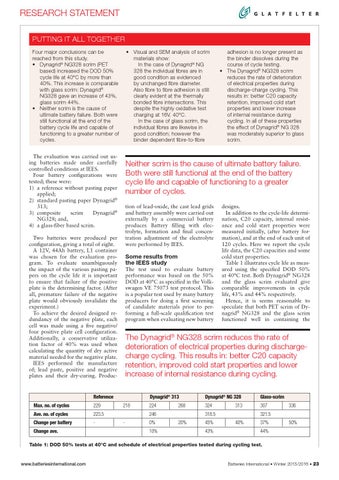
RESEARCH STATEMENT PUTTING IT ALL TOGETHER Four major conclusions can be reached from this study. • Dynagrid® NG328 scrim (PET based) increased the DOD 50% cycle life at 40°C by more than 40%. This increase is comparable with glass scrim: Dynagrid® NG328 gave an increase of 43%, glass scrim 44%. • Neither scrim is the cause of ultimate battery failure. Both were still functional at the end of the battery cycle life and capable of functioning to a greater number of cycles. The evaluation was carried out using batteries made under carefully controlled conditions at IEES. Four battery configurations were tested; these were: 1) a reference without pasting paper applied; 2) standard pasting paper Dynagrid® 313; 3) composite scrim Dynagrid® NG328; and, 4) a glass-fiber based scrim. Two batteries were produced per configuration, giving a total of eight. A 12V, 44Ah battery, L1 container was chosen for the evaluation program. To evaluate unambiguously the impact of the various pasting papers on the cycle life it is important to ensure that failure of the positive plate is the determining factor. (After all, premature failure of the negative plate would obviously invalidate the experiment.) To achieve the desired designed redundancy of the negative plate, each cell was made using a five negative/ four positive plate cell configuration. Additionally, a conservative utilization factor of 40% was used when calculating the quantity of dry active material needed for the negative plate. IEES performed the manufacture of; lead paste, positive and negative plates and their dry-curing. Produc-
• Visual and SEM analysis of scrim materials show: In the case of Dynagrid® NG 328 the individual fibres are in good condition as evidenced by unchanged fibre diameter. Also fibre to fibre adhesion is still clearly evident at the thermally bonded fibre intersections. This despite the highly oxidative test charging at 16V, 40°C. In the case of glass scrim, the individual fibres are likewise in good condition; however the binder dependent fibre-to-fibre
adhesion is no longer present as the binder dissolves during the course of cycle testing. • The Dynagrid® NG328 scrim reduces the rate of deterioration of electrical properties during discharge-charge cycling. This results in: better C20 capacity retention, improved cold start properties and lower increase of internal resistance during cycling. In all of these properties the effect of Dynagrid® NG 328 was moderately superior to glass scrim.
Neither scrim is the cause of ultimate battery failure. Both were still functional at the end of the battery cycle life and capable of functioning to a greater number of cycles. tion of lead-oxide, the cast lead grids and battery assembly were carried out externally by a commercial battery producer. Battery filling with electrolyte, formation and final concentration adjustment of the electrolyte were performed by IEES.
Some results from the IEES study
The test used to evaluate battery performance was based on the 50% DOD at 40°C as specified in the Volkswagen VE 75073 test protocol. This is a popular test used by many battery producers for doing a first screening of candidate materials prior to performing a full-scale qualification test program when evaluating new battery
designs. In addition to the cycle-life determination, C20 capacity, internal resistance and cold start properties were measured initially, (after battery formation), and at the end of each unit of 120 cycles. Here we report the cycle life data, the C20 capacities and some cold start properties. Table 1 illustrates cycle life as measured using the specified DOD 50% at 40°C test. Both Dynagrid® NG328 and the glass scrim evaluated give comparable improvements in cycle life, 43% and 44% respectively. Hence, it is seems reasonable to speculate that both PET scrim of Dynagrid® NG328 and the glass scrim functioned well in containing the
The Dynagrid® NG328 scrim reduces the rate of deterioration of electrical properties during dischargecharge cycling. This results in: better C20 capacity retention, improved cold start properties and lower increase of internal resistance during cycling.
Reference Dynagrid® 313
Max. no. of cycles
229 218 224 268 324 313 307 336
Ave. no. of cycles
223.5
Change per battery -
-
Change ave.
246 0%
Dynagrid® NG 328 318.5
Glass-scrim 321.5
20% 45% 40% 37% 50%
10%
43% 44%
Table 1: DOD 50% tests at 40°C and schedule of electrical properties tested during cycling test.
www.batteriesinternational.com
Batteries International • Winter 2015/2016 • 23