HEROES OF THE GRID: MARIA SKYLLAS-KAZACOS and Michael began working in different departments within Bell Telephone Laboratories at Murray Hill, New Jersey. Both grandmothers each joined the family for several month-long stints to help look after Nicholas. Working in John Broadhead’s battery group, Maria gained valuable experience in lead acid batteries and identified a new ionic species that forms as an intermediate during the charge-discharge reactions at the positive electrode. The result: her first single author paper published in the Journal of the Electrochemical Society that was to later earn her the Royal Australian Chemical Institute’s Bloom-Guttmann Prize for the best young author under 30. Despite a permanent position at Bell Labs on offer, in 1980 the family moved back to Australia after Maria won the prestigious Queen Elizabeth II fellowship. This enabled her to continue her research in liquid junction solar cells in the School of Physics and the University of New South Wales. The birth of her second son George followed. In 1982 Skyllas became a lecturer in the School of Chemical Engineering and Industrial Chemistry at the university. Meanwhile, professor Bob Robins invited her to join a research project on lead acid batteries funded by a National Energy Research Development and Demonstration Council of Australia grant. Then she had her eureka moment with vanadium. Chlorides of vanadium were generated in 1830 by Nils Gabriel Sefström. He named the new element vanadium after the Germanic goddess of beauty and fertility, Vanadis. The use of vanadium in batteries had been suggested earlier by NASA researchers and by others in 1978, but no one had previously used vanadium redox couples in a working flow battery. A reason for this was the low solubility of pentavalent vanadium compounds in acidic solutions that would limit the practical energy density of such a system. The fact that vanadium exists in several oxidation states however, made it an excellent candidate for a single element flow battery that might overcome the problem of cross contamination observed with the Fe/Cr battery by NASA researchers in the 1970s and 80s. “The early NASA work on the Fe/Cr system that drew my attention to the new flow battery concept,” says Ma-
60 • Energy Storage Journal • Summer 2015
Her preliminary studies with VCl3 solutions in H2SO4 showed good reversibility for the V(II)/V(III) and V(IV)/ V(V) couples but further research was needed to optimize the solution chemistry to achieve a practical system
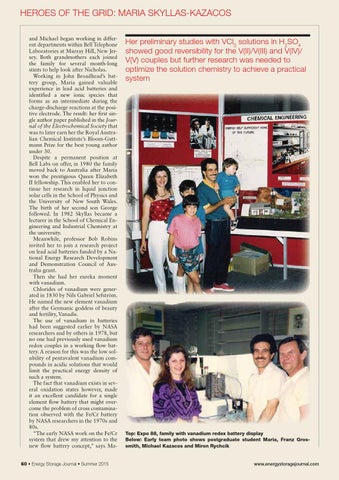
Top: Expo 88, family with vanadium redox battery display Below: Early team photo shows postgraduate student Maria, Franz Grossmith, Michael Kazacos and Miron Rychcik
www.energystoragejournal.com