CONFERENCE IN PRINT Can the conductance of a flooded and VRLA lead-acid cell indicate real state-of-health of new as well as operational cells and if so, could there be a reference value of conductance for the cells of a particular capacity? Manish Singh Bisht, Gauri Negi, Rajesh Kumar from India’s National Institute of Solar Energy report on their research.
State of health assessment of operational lead acid cells as a function of conductance This article looks at a relatively new method of examining operational field batteries, under actual conditions, which is quick, reliable and does not involve any waste of power. This method is based on the assessment of state of health of a battery through its conductance. This paper also proposes reference values of conductance for flooded and VRLA lead acid cells of a particular capacity so that they may be used as a reference to examine batteries of the same capacity. Conductance describes the ability of a battery to conduct current. Various test data have shown that at low frequencies, the conductance of a battery is an indicator of battery state-of-health showing a linear correlation to a battery’s timed-discharge capacity test result and trending this measurement can be used as a reliable predictor of battery end-of-life. The use of conductance measurements to evaluate automotive battery performance was first reported in 1975 by US electrochemist Keith Champlin. It demonstrated a strong positive linear correlation between load tests and measured conductance for automotive batteries. Since then impedance and more recently conductance has been attracting both users and manufacturers to determine battery state-of-health. Initially, the conductance testing was limited to VRLA cells only but later interest expanded to flooded cells and nickel-cadmium cells as well. Now a number of studies have been published on this topic. But this method had not been experimentally tested on operational battery banks having high capacity cells. Even after so many studies, it is not clear that what should be the conductance range of unused lead-acid cells of flooded or VRLA types. All the studies have shown that a linear relation between capacity and conductance of a cell may exist but those studies have been limited to examination of very low numbers of samples. Further, it cannot be deduced that the batteries/cells of the same capacity but different technology, will reflect the same conductance values at the same state of charge. This study is an experimental demonstration of the conductance testing on both types of high capacity lead acid cells and also examines the feasibility of this testing on new/reference as well as operational cells. It provides an idea of the conductance values possessed by cells of a particular type, capacity and manufacturing process. It also
92 • Batteries International • Autumn 2015
establishes conductance testing as a tool to identify faulty cells in an operational battery bank. This research work was carried out on two operational battery banks — one flooded, one VRLA — of 240V, 1000Ah each, consisting of 120 cells of 2V, 1000Ah at the National Institute of Solar Energy, Gurgaon in the north Indian state of Haryana. These banks, installed two years before, are connected to two different inverters of 10KVA and 50KVA and are being used to power the loads of the campus. Both are hybrid inverters and operate on the grid as well as solar power. Both the inverters are also connected to the generator so that battery banks are not consumed to higher DOD. These banks are also provided equalizing charge once in a month to ensure proper health. Regular maintenance and topping up with water is also carried out as per schedule.
The conductance value of a battery reflects the integrity of inter-cell connections, ionic conductivity of the electrolyte, specific gravity of the cells and the actual battery state of charge.
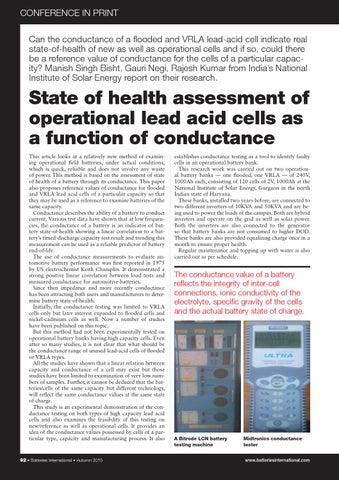
A Bitrode LCN battery testing machine
Midtronics conductance tester www.batteriesinternational.com