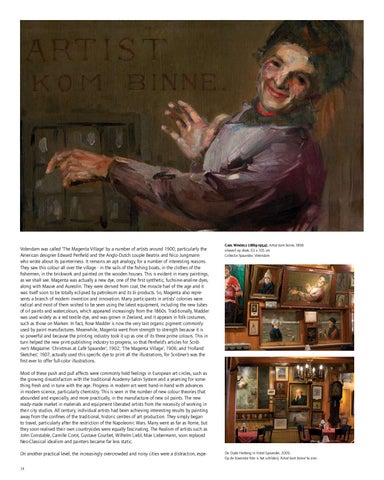
Volendam was called ‘The Magenta Village’ by a number of artists around 1900, particularly the American designer Edward Penfield and the Anglo-Dutch couple Beatrix and Nico Jungmann who wrote about its painteriness. It remains an apt analogy, for a number of interesting reasons. They saw this colour all over the village - in the sails of the fishing boats, in the clothes of the fishermen, in the brickwork and painted on the wooden houses. This is evident in many paintings, as we shall see. Magenta was actually a new dye, one of the first synthetic, fuchsine-analine dyes, along with Mauve and Aureolin. They were derived from coal, the miracle fuel of the age and it was itself soon to be totally eclipsed by petroleum and its bi-products. So, Magenta also represents a branch of modern invention and innovation. Many participants in artists’ colonies were radical and most of them wished to be seen using the latest equipment, including the new tubes of oil paints and watercolours, which appeared increasingly from the 1860s. Traditionally, Madder was used widely as a red textile dye, and was grown in Zeeland, and it appears in folk costumes, such as those on Marken. In fact, Rose Madder is now the very last organic pigment commonly used by paint manufactures. Meanwhile, Magenta went from strength to strength because it is so powerful and because the printing industry took it up as one of its three prime colours. This in turn helped the new print-publishing industry to progress, so that Penfield’s articles for Scribner’s Magazine: ‘Christmas at Café Spaander’, 1902; ‘The Magenta Village’, 1906; and ‘Holland Sketches’, 1907, actually used this specific dye to print all the illustrations, for Scribner’s was the first ever to offer full-color illustrations.
Carl Windels (1869-1954), Artist kom binne, 1896 olieverf op doek, 63 x 105 cm Collectie Spaander, Volendam
Most of these push and pull affects were commonly held feelings in European art circles, such as the growing dissatisfaction with the traditional Academy-Salon System and a yearning for something fresh and in tune with the age. Progress in modern art went hand-in-hand with advances in modern science, particularly chemistry. This is seen in the number of new colour theories that abounded and especially, and more practically, in the manufacture of new oil paints. The new ready-made market in materials and equipment liberated artists from the necessity of working in their city studios. All century, individual artists had been achieving interesting results by painting away from the confines of the traditional, historic centres of art production. They simply began to travel, particularly after the restriction of the Napoleonic Wars. Many went as far as Rome, but they soon realised their own countrysides were equally fascinating. The Realism of artists such as John Constable, Camille Corot, Gustave Courbet, Wilhelm Liebl, Max Liebermann, soon replaced Neo-Classical idealism and painters became far less static. On another practical level, the increasingly overcrowded and noisy cities were a distraction, espe14
De Oude Herberg in Hotel Spaander, 2009. Op de bovenste foto is het schilderij ‘Artist kom binne’ te zien.