Now, after moving to a dining model where chefs and their teams create and serve meals in six serveries — South, Sid Richardson, Siebel, Baker, West and North — Rice’s food has been highly ranked by USA Today and Princeton Review. With menu items like chicken Thai coconut soup and beet poke bowls with radish sprouts, it’s unsurprising that more than 90 percent of Rice students are also satisfied with the food. The current servery system’s success, however, came after years of pushback and challenges during the transition. In spring 1988, a Central Kitchen student employee published a guest column in the Rice Thresher. The column outlined the poor quality of food, citing “rancid” meat. Joyce Rubash, food service director at the time, immediately fired the student, but Marion Hicks, the director of Food and Housing, rehired him. Throughout their time at Rice, Rubash and Hicks faced criticism for Central Kitchen’s food quality, health code violations and unresponsiveness to student feedback. According to Rubash, the issue of food quality came down to what chefs were doing once the food was trucked from Central Kitchen to the unit kitchens. “It’s not poor quality food, it’s just poor quality when it’s served. When it leaves here it’s great,” she said in an interview with KTRU, Rice’s student-run radio station. No matter the initial quality of the food, the transportation process and
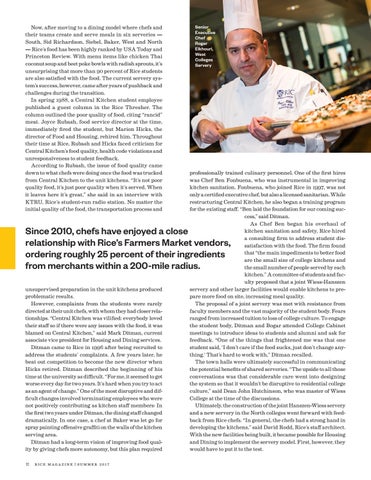
Senior Executive Chef Roger Elkhouri, West Colleges Servery
professionally trained culinary personnel. One of the first hires was Chef Ben Fonbuena, who was instrumental in improving kitchen sanitation. Fonbuena, who joined Rice in 1997, was not only a certified executive chef, but also a licensed sanitarian. While restructuring Central Kitchen, he also began a training program for the existing staff. “Ben laid the foundation for our coming success,” said Ditman. As Chef Ben began his overhaul of kitchen sanitation and safety, Rice hired a consulting firm to address student dissatisfaction with the food. The firm found that “the main impediments to better food are the small size of college kitchens and the small number of people served by each kitchen.” A committee of students and faculty proposed that a joint Wiess-Hanszen servery and other larger facilities would enable kitchens to prepare more food on site, increasing meal quality. The proposal of a joint servery was met with resistance from faculty members and the vast majority of the student body. Fears ranged from increased tuition to loss of college culture. To engage the student body, Ditman and Bogar attended College Cabinet meetings to introduce ideas to students and alumni and ask for feedback. “One of the things that frightened me was that one student said, ‘I don’t care if the food sucks, just don’t change anything.’ That’s hard to work with,” Ditman recalled. The town halls were ultimately successful in communicating the potential benefits of shared serveries. “The upside to all those conversations was that considerable care went into designing the system so that it wouldn’t be disruptive to residential college culture,” said Dean John Hutchinson, who was master of Wiess College at the time of the discussions. Ultimately, the construction of the joint Hanszen-Wiess servery and a new servery in the North colleges went forward with feedback from Rice chefs. “In general, the chefs had a strong hand in developing the kitchens,” said David Rodd, Rice’s staff architect. With the new facilities being built, it became possible for Housing and Dining to implement the servery model. First, however, they would have to put it to the test.
Since 2010, chefs have enjoyed a close relationship with Rice’s Farmers Market vendors, ordering roughly 25 percent of their ingredients from merchants within a 200-mile radius. unsupervised preparation in the unit kitchens produced problematic results. However, complaints from the students were rarely directed at their unit chefs, with whom they had closer relationships. “Central Kitchen was vilified; everybody loved their staff so if there were any issues with the food, it was blamed on Central Kitchen,” said Mark Ditman, current associate vice president for Housing and Dining services. Ditman came to Rice in 1996 after being recruited to address the students’ complaints. A few years later, he beat out competition to become the new director when Hicks retired. Ditman described the beginning of his time at the university as difficult. “For me, it seemed to get worse every day for two years. It’s hard when you try to act as an agent of change.” One of the most disruptive and difficult changes involved terminating employees who were not positively contributing as kitchen staff members: In the first two years under Ditman, the dining staff changed dramatically. In one case, a chef at Baker was let go for spray painting offensive graffiti on the walls of the kitchen serving area. Ditman had a long-term vision of improving food quality by giving chefs more autonomy, but this plan required 12
R i c e M a g a z i n e | s u mm e r 2 0 1 7