FALL 2016
Bioengineer Rebecca Richards-Kortum: Rice’s first MacArthur Fellow R I C E E NGI NE E RI NG
1
Rice Engineering Magazine is a production of the George R. Brown School of Engineering Office of Communications at Rice University. Dean Edwin L. “Ned” Thomas Associate Deans Walter Chapman Keith Cooper Ann Saterbak Bart Sinclair Yvette Pearson Weatherton
25
Editor Ann Lugg
MESSAGE FROM THE DEAN Just in time for Rice Engineering magazine to go to the press, we learned the great news that Professor Rebecca Richards-Kortum was named a MacArthur Fellow for, as the MacArthur Foundation said, “improving access to quality health care for all the world’s people . . . not only developing novel solutions but also training and inspiring the next generation of engineers and scientists to address our shared global challenges.” How great is it to have one of Rice faculty members’ work be recognized with one of the so called “Genius Grants”? So we had to go back to the drawing board, add Rebecca’s story to this issue, and give her the cover to match the honor she has brought to us! So, as summer is finally slipping into a little fall here in Houston, we’ve jumped into another academic year, welcoming a new class of engineering freshmen, 37 percent of which are women! That’s well above the national average of about 20 percent. This means that engineering at Rice is becoming even more attractive to women because of our programs and the ability of the faculty to connect the engineering curriculum so that students can help improve people’s lives. And it’s partially driven by the fact that engineering pedagogy is changing, to include more hands-on experiential learning, which is not only attracting more women but also more men! This is not your grandfather’s engineering education! This issue reflects what Rice Engineering is doing to deliver this notyour-grandfather’s-engineering-education: in the past year we have hired nine new faculty members, our research expenditures continue to grow and you can read about some of the projects our incredibly productive and creative faculty and students are undertaking. We have hired the first faculty director of the Rice Center for Engineering Leadership and we celebrate the amazing research and scholarship of our students. Our alumni continue to bring glory to the Rice name, with two elected to the National Academy of Engineering this year. Sadly, we’ve also paid our respects to three revered emeritus faculty, two of whom were former deans of engineering at Rice and all of whom were distinguished members of the National Academy of Engineering. Rice Engineering is strong and getting stronger and one thing that makes it so is the interaction between our alumni and students. Since I joined Rice in 2011, relations between the School of Engineering and Rice Engineering Alumni have grown and grown, with the REA now contributing to the development and welfare of our students in unprecedented ways with significant increases in both financial and mentoring resources. If you aren’t currently in touch with the REA, I ask you to get involved. Our students benefit greatly through relationships with alumni and that increases the influence of the George R. Brown School of Engineering and its graduates on the world.
Thank you, Ned Thomas William and Stephanie Sick Dean of Engineering
Writers Patrick Kurp Holly Beretto Graphic Design Donald Soward Benjamin Alcaraz Contributors Jade Boyd Mike Williams Photography Jeff Fitlow Tommy Lavergne Brandon Martin Donald Soward An Le Marilee Dizon Le Jaime Serrano
26
photo of Estrella Alabastro
Ruston Banal
Send comments or letters to the editor: Rice Engineering Magazine Rice University MS 364 P.O. Box 1892 Houston, Texas 77251 or email: engrnews@rice.edu
38
CONTENT
FACULTY
4 New faculty 6 Promotions and retirements 7 In memoriam 10 Rebecca Richards-Kortum named MacArthur Fellow 12 Teaching and Research Excellence Award LEADERSHIP 14 Growth is the name of the game RESEARCH 16 Unlocking the secrets of spider silk 17 Milk math 18 Editing the code 19 Determining genetic evolution 20 Flood alert! 24 Making sense of the ‘nonsense correlation’ 25 In search of the holy grail of computer chips 26 Building blocks for new materials 27 ‘Magnetic moments’ in cancer research 28 Managing the data flow 29 Restoration robots
10
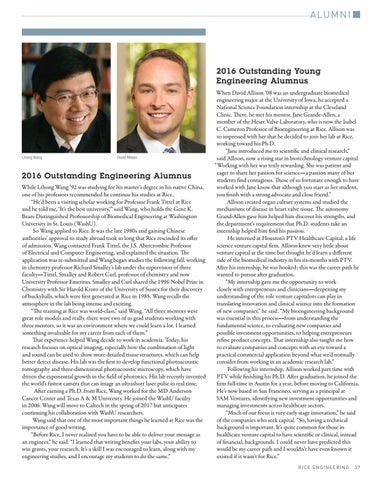
30 Hitting the trail for hippotherapy AWARDS 31 Student awards 32 Faculty awards 35 Staff awards ALUMNI 36 Alumni elected to National Academy of Engineering 37 Outstanding alumni 38 Alumna spotlight: Estrella Alabastro 40 REA president sets strategic initiatives 41 Optimizing on the battle field and in the field of finance 42 Student achievment recognized at picnic 43 Ann Hightower gives back
20
30
41
42
FAC U LTY
NEW FACULTY Eight new faculty members in five departments have joined the George R. Brown School of Engineering, and another will arrive on July 1, 2017.
ECE
MECH
Matthew Brake, the principal research and development engineer at Sandia National Laboratories, comes to Rice as an assistant professor of mechanical engineering (MECH). Brake earned three degrees in MECH from Carnegie Mellon: a B.S. in 2002, an M.S. in 2004 and a Ph.D. in 2007. He joined Sandia in 2008 after working there as a post-doctoral fellow. In 2012, he was a visiting academic at the University of Oxford, where he helped establish a multi-institution collaboration to pioneer research in mechanical joints and interfacial mechanics. Since 2012, Brake has served as an adjunct research assistant professor at the University of New Mexico. His research interests include interfacial mechanics, model reduction theory and nonlinear dynamics.
CAAM
Jesse Chan joined the Department of Computational and Applied Mathematics (CAAM) as an assistant professor. Chan earned a B.A. in CAAM from Rice in 2008, and an M.A. and Ph.D. in computational science, engineering and mathematics from the Institute for Computational Engineering and Sciences at the University of Texas in Austin, in 2013. For two years Chan served as a Pfeiffer Postdoctoral Instructor in CAAM at Rice, and in 2015, he worked as a postdoctoral researcher in mathematics at Virginia Tech, where his mentor was Tim Warburton, formerly a member of the CAAM faculty at Rice. Chan’s research interests include high-order discontinuous Galerkin methods for problems in wave propagation, discontinuous PetrovGalerkin methods as applied to problems in fluid dynamics, and high-performance implementations of numerical methods for partial differential equations.
MSNE
4
Palash Bharadwaj is an assistant professor of electrical and computer engineering (ECE). Before coming to Rice, he was a postdoctoral researcher in the Photonics Laboratory at ETH Zurich (the Swiss Federal Institute of Technology), and earned his Ph.D. in physics and astronomy from the University of Rochester in 2012. While there, he investigated the interaction of single quantum emitters (such as dye molecules or quantum dots) with optical antennas made from colloidal metal nanoparticles. His research focuses on the optical and electrical properties of nanomaterials and next-generation optoelectronic devices. He develops optoelectronic characterizations of functional nano-materials, and creates low-dimensional metal-semiconductor hybrid mesoscale materials and devices for applications ranging from solid-state lighting to quantum computing, and from photovoltaics to photocatalysis.
R ICE E N GIN EERIN G
Zachary C. Cordero, whose research focuses on metals processing, powder metallurgy, and alloy and microstructure design, joined materials science and nanoengineering as an assistant professor. He earned a B.S. in physics in 2010, and a Ph.D. in materials science and engineering in 2015, both from MIT. Starting in 2011, he worked as a research assistant with the Schuh Group at MIT, where his doctoral work focused on using the driven-alloy theory to predict the microstructure of transition metal alloys subjected to plastic deformation. Cordero served as a post-doctoral researcher in the Manufacturing Demonstration Facility at the Oak Ridge National Laboratory. At Rice, he heads the Additive Lab, which will develop techniques to print metal parts with complex shapes and dialed-in microstructures.
FAC U LT Y
MECH
Pedram Hassanzadeh joined MECH as an assistant professor. He received his M.A. in mathematics and Ph.D. in MECH from the University of California, Berkeley in 2013. In 2007 he earned a master’s in MECH from the University of Waterloo, Canada, and in 2005, a B.S. in MECH from the University of Tehran. Since 2013 Hassanzadeh has been a postdoctoral fellow in the Department of Earth and Planetary Sciences at Harvard University, where he received a two-year Ziff Environmental Fellowship from its Center for the Environment. His research interests include fluid dynamics of extreme-causing weather patterns, closure models for geophysical turbulence, eddy-mean flow interaction, stochastic models for climate systems, and jets and vortices in rotating stratified turbulence.
MECH
C. Fred Higgs III is the John and Ann Doerr Professor of Mechanical Engineering and faculty director of the Rice Center for Engineering Leadership. He joined the Carnegie Mellon University faculty in 2003 and was promoted to full professor in 2012. There he headed the Particle Flow and Tribology Lab and was a thrust leader in the NextManufacturing Center, which focuses on the future of additive manufacturing. Higgs earned a B.S. in MECH from Tennessee State University in 1995, and an M.S. and Ph.D. in MECH from Rensselaer Polytechnic Institute in 1997 and 2001, respectively. He was a postdoctoral research fellow at the Georgia Institute of Technology for two years before joining the Carnegie Mellon faculty.
CHBE
ECE
MSNE
Fred C. MacKintosh is professor of chemical and biomolecular engineering. He comes from the Vrije Universiteit in Amsterdam, Netherlands, where he served as professor of theoretical physics since 2001. MacKintosh received bachelor’s degrees in physics and mathematics from the University of Washington in 1984, and a Ph.D. in physics from Princeton in 1989. After two years as a postdoctoral researcher with Exxon Research and Engineering, MacKintosh joined the physics faculty at the University of Michigan. His research interests include cell mechanics; intracellular remodeling; extracellular matrices, including collagen; non‐equilibrium and active processes in biology; and soft biological and biologically inspired materials. Gururaj V. Naik joined ECE as an assistant professor. He became a postdoctoral scholar in materials science and engineering at Stanford University after earning his Ph.D. in ECE from Purdue University in 2013. He received a B.E. in electronics and communications engineering from B.M.S College of Engineering in Bangalore, India, in 2006, and an M.E. in microelectronics from the Indian Institute of Science, also in Bangalore, in 2008. Naik’s research focuses on nanophotonics, a discipline straddling nanotechnology and optics, with an emphasis on photon upconversion by loss-harvesting in extremely small metal particles. The research has applications in energy, medicine and bioimaging. In 2013 he received a Graduate Student Fellowship from the IEEE Photonics Society. Omid Veiseh will join bioengineering as an assistant professor on July 1, 2017. He earned his Ph.D. in materials science and engineering, and nanotechnology, from the University of Washington in 2009. For two more years he worked there as a research associate in the departments of neurological surgery, and of materials science and engineering. Since 2011 he has worked as a postdoctoral research fellow in the department of chemical engineering and the David H. Koch Institute for Integrative Cancer Research at the Massachusetts Institute of Technology. In 2013, Veiseh received a three-year, $300,000 Postdoctoral Fellowship Award for breast cancer research from the U.S. Department of Defense. This year he received a $380,000 Advanced Postdoctoral Fellowship from the Juvenile Diabetes Research Foundation. Rice won a $2 million grant from the Cancer Prevention and Research Institute of Texas to recruit Veiseh. R I C E E NGI NE E RI NG
5
FAC U LTY
PROMOTIONS
Christopher Jermaine
Luay Nakhleh
Six faculty members in four departments in the George R. Brown School of Engineering have been promoted with tenure. Christopher Jermaine, Luay Nakhleh and T.S. Eugene Ng in computer science, and Lin Zhong in electrical and computer engineering, were promoted to full professor. Ilinca Stanciulescu in civil and environmental engineering and Rafael Verduzco in chemical and biomolecular engineering were promoted to associate professor. The promotions took effect July 1.
T.S. Eugene Ng
Lin Zhong
Ilinca Stanciulescu
Rafael Verduzco
SORENSON, THOMPSON RETIRE “I was often amazed by the magic and elegant equations that Danny came up with, but he was also a fun person to be with. As many of us remember, his wild laughter could be heard from the opposite of end of the building.” So says a grateful former student, Chao Yang, of his recently-retired friend and mentor, Danny Danny Sorensen C. Sorensen, the Noah Harding Professor of Computational and Applied Mathematics (CAAM). Last Jan. 1, after 26 years at Rice, Sorensen retired from his tenured position but remains as a research professor and a Noah Harding Professor Emeritus. Sorensen was thesis adviser to Yang, who earned his Ph.D. in CAAM in 1998. Since 2000, Yang has worked as a senior scientist at the Lawrence Berkeley National Laboratory. “Danny is certainly a well-known and wellrespected teacher and scholar,” he said. “But he also strikes me as someone who really knows how to enjoy life.” Sorensen’s research interests include numerical linear algebra, numerical analysis, model order reduction, control of dynamical systems, numerical optimization and parallel numerical algorithms. In 2010, he was elected a Fellow of the Society of Industrial and Applied Mathematics (SIAM), and in 2013 was elected chair of SIAM’s activity group on Numerical Linear Algebra. Sorensen earned a B.S. from the University of California, Davis in 1972, and an M.A. and a Ph.D. from the University of California, San Diego in 1975 and 1977, respectively. He was an assistant professor at the University of Kentucky from 1977 to 1980, when he became a computer scientist in the Mathematics and Computer Science Division at the Argonne National Laboratory in Illinois. Sorensen joined the Rice faculty in 1989, and served twice as CAAM department chair, from 1995 to 1998, and 2005 to 2009.
6
R ICE E N GIN EERIN G
“We are very empirical,” said James R. Thompson, Noah Harding Professor of Statistics in the Department of Statistics at Rice University. “We have always been data-oriented. We deal with the real world.” Thompson, who retired July 1 after 46 years, was a statistician at Rice before there was a statistics department. When he joined the faculty in 1970, after three years teaching mathematics at Indiana University and three Jim Thompson years at Vanderbilt, it was as a member of the Mathematical Sciences Department in the School of Natural Sciences. Only in 1987 did statistics become a separate department, within the School of Social Sciences, with Thompson as the founding chair. It moved to the George R. Brown School of Engineering in 1990. “Jim was part of the great recruiting class in mathematical sciences that saw the arrival of Richard Tapia and Ken Kennedy. He organized a statistics steering committee that recommended creation of a stand-alone department,” said David Scott, the Noah Harding Professor of Statistics and a student of Thompson’s when working for his master’s degree and Ph.D. at Rice. Thompson earned a B.S. in chemical engineering from Vanderbilt University in 1960, and his M.A. and Ph.D. in Mathematics from Princeton University in 1963 and 1965, respectively. In recent years, his research has focused on statistical model building, biomathematics, quality control and computational finance. Thompson developed the SIMEST algorithm for creating multiple replicates of computer-generated pseudo-realities, which is used to estimate the parameters of the underlying model. With his student Marc Elliot he has also developed the MaxMean algorithm that permits the finding of the underlying structures of high-dimensional data sets. Thompson is a Fellow of the American Statistical Association, the Institute of Mathematical Statistics and the International Statistical Institute. He has directed 17 doctoral students and authored or co-authored 14 books.
FAC U LT Y
Michael M. Carroll, the Burton J. and Ann M. McMurtry Professor in Mechanical Engineering and Computational and Applied Mathematics at Rice University, and former dean of its George R. Brown School of Engineering, died on Jan. 17 at age 79. A wryly witty native of Ireland remembered as much for his kindness as for his research prowess and administrative flair, Carroll was an awardwinning playwright, poet and creator of crossword puzzles published in the New York Times. Carroll was born in Thurles, a town 90 miles southwest of Dublin, on Dec. 8, 1936, and grew up speaking English and Gaelic. He earned his B.A. and master’s degrees in mechanical engineering from University College, Galway in 1958 and 1959, respectively. Carroll came to the U.S. in 1960 and became a naturalized citizen in 1970. He earned his Ph.D. from Brown University in 1965. That year, Carroll joined the Department of Mechanical Engineering at the University of California, Berkeley as an assistant professor. He became a full professor in 1975 and held the title of Shell Distinguished Chair from 1983 to 1988. Carroll was elected to the National Academy of Engineering in 1987. In 1988 he became dean of the School of Engineering at Rice, with faculty appointments in mechanical engineering and materials science, and computational and applied mathematics. Neal Lane, the Malcolm Gillis University Professor and a senior fellow in the Baker Institute, was provost when Carroll was recruited to be a dean at Rice: “It was not easy to bring Michael to Rice. He was a distinguished member of the faculty at Berkeley, a world-class research university that considered itself well above Rice in stature. Many of his colleagues were surprised when he decided to leave. Michael brought his intelligence, prestige, Irish wit and legendary good nature to the position of dean.”
IN MEMORIAM
Michael M. Carroll
R I C E E NGI NE E RI NG
7
FAC U LTY
IN MEMORIAM
J. David Hellums
8
R ICE E N GIN EERIN G
J. David Hellums, the A.J. Hartsook Professor Emeritus in Chemical and Biomolecular Engineering, and of Bioengineering, former dean of the George R. Brown School of Engineering at Rice University, and a pioneer in biomedical research, died June 26 at the age of 86. “David was instrumental in developing the whole bioengineering effort at Rice,” said C. Sidney Burrus, the Maxfield and Oshman Professor Emeritus of Electrical and Computer Engineering and former engineering dean. “First there was the artificial heart project, then the bioengineering lab within chemical engineering, and finally the Department of Bioengineering within the school of engineering.” Hellums was born in Stamford, Texas, on Aug. 19, 1929. He earned a B.S. in chemical engineering in 1950 from the University of Texas at Austin, spent three years as a process engineer with the Mobil Oil Co., another three years as a statistical services officer with the U.S. Air Force, and returned to Austin to earn his master’s degree in chemical engineering. He joined the Rice faculty as an assistant professor of chemical engineering in 1960 and received his Ph.D. the following year from the University of Michigan. Hellums’ research in the 1960s shifted increasingly to biomedical applications. In 1964, Rice President Kenneth Pitzer called a meeting with Hellums, five other engineering professors and Dr. Michael E. DeBakey of the Baylor College of Medicine (BCM) to discuss plans for devising an artificial heart. One year later, surgeons at BCM implanted a working model in a patient, with the artificial pump moving blood from the left atrium to the aorta. In 1968, Hellums became a founding member of the Biomedical Engineering Laboratory at Rice, and later its director for 10 years. He became a full professor in 1968, and from 1970 to 1976 served as chair of the Department of Chemical Engineering. From 1980 to 1988 he was dean of engineering. He was elected to the National Academy of Engineering in 1998.
FAC U LT Y
IN MEMORIAM
Angelo Miele
Angelo Miele, the Foyt Professor Emeritus of Aerospace and Mathematical Sciences and research professor in mechanical engineering, died March 19 at the age of 93. His work in optimization and control proved critical to the aerospace industry. Miele was born Aug. 21, 1922 in Formia, Italy, and his formal education was completed in that country, where he received doctoral degrees in civil engineering (1944) and aeronautical engineering (1946). He became a naturalized American citizen in 1985. In 1959, Miele joined the Boeing Scientific Research Laboratories as director of astrodynamics and flight mechanics. He joined the Rice faculty in 1964. In 1967, Miele founded the Journal of Optimization Theory and Applications, of which he remained editorin-chief until 2009. Miele was elected in 1994 to the National Academy of Engineering for “contributions to flight mechanics and control.� He was an honorary fellow of the American Institute of Aeronautics and Astronautics, a fellow of the American Astronautical Society and a member of the Russian Academy of Sciences and the International Academy of Astronautics. Miele, who was also professor emeritus in computational and applied mathematics at Rice, was principal investigator for more than 100 grants, and author or coauthor of some 250 journal articles. He was adviser to 85 graduate students and postdoctoral fellows in aero-astronautics.
R I C E E NGI NE E RI NG
9
FAC U LTY
RICHARDS-KORTUM NAMED MACARTHUR FELLOW Rice University bioengineer and global-health innovator Rebecca Richards-Kortum has received a MacArthur Fellowship, familiarly known as the “genius grant,” given annually to artists, thinkers, scientists and engineers. The founder and director of Rice’s awardwinning Rice 360º Institute for Global Health, Richards-Kortum is the first Houston scientist, the first Houston woman and the first Rice faculty member to win a MacArthur. The Malcolm Gillis University Professor, professor of bioengineering and professor of electrical and computer engineering, Richards-Kortum, 52, was one of 23 MacArthur Fellows named in September by the John D. and Catherine T. MacArthur Foundation. MacArthur Fellowships come with a no-strings-attached grant of $625,000. The awards are given each year to 20 to 30 people who, according to the Foundation’s confidential selection committee, show “exceptional creativity.” “What characterizes Rebecca’s work is imagination, research and execution in the service of saving lives, notably the lives of poor infants and mothers,” Rice President David Leebron said. “She is simply one of the most inspiring people I know, and this extraordinary recognition is well-deserved.” Richards-Kortum joined Rice in 2005 and directs the Rice 360° Institute for Global Health, which administers undergraduate programs that engage students to design and implement new technologies to solve global-health challenges. Since 2006, Rice 360º has partnered with Queen Elizabeth Central Hospital in Blantyre, Malawi, to evaluate dozens of affordable health-care technologies developed by Rice students, including several that are commercially available and others used throughout Malawi. 10
R ICE EN GIN EERIN G
When Richards-Kortum and Rice 360º cofounder Maria Oden were recognized with the 2013 Lemelson-MIT Award for Global Innovation, they used their $100,000 prize as seed funding for a campaign to build a new neonatal ward at Queen Elizabeth Central Hospital, which was dedicated this past June. Richards-Kortum says great responsibility accompanies the MacArthur money, and she plans to use it to improve the health of children in Malawi. In addition to providing patient care for thousands of newborns each year, the new Queen’s neonatal facility serves as an innovation hub for NEST (Neonatal Essential Solutions and Technologies), a turnkey package of affordable neonatal technologies that could reduce newborn deaths in low-resource hospitals by more than 80 percent. NEST was featured in UNICEF’s 2015 annual report under the name “Nursery of the Future.” More than half of the technologies needed for NEST are in development at Rice, and Rice 360º hopes to make the full suite available to low-resource district hospitals within a decade for a cost of less than $5,000. Richards-Kortum’s laboratory in the BioScience Research Collaborative specializes in research in nanotechnology, molecular imaging and microfabrication to develop optical systems that are inexpensive, portable and capable of providing point-of-care diagnoses for diseases ranging from cancer to malaria. She is the holder of 40 patents, the author of the textbook Biomedical Engineering for Global Health published by Cambridge University Press (2010), and has written more than 300 refereed research papers and 11 book chapters.
She is the youngest Rice faculty member elected to the National Academy of Engineering. Richards-Kortum is a member of the National Academy of Sciences and the American Academy of Arts and Sciences and a past member of the National Academies Committee on Conceptual Framework for New Science Education Standards and the National Advisory Council for Biomedical Imaging and Bioengineering for the National Institutes of Health. She is a fellow of the American Institute for Medical and Biomedical Engineering (AIMBE), the American Association for the Advancement of Science, the Biomedical Engineering Society, the Optical Society of America (OSA) and the National Academy of Inventors. Her many honors include the National Science Foundation’s Presidential Young Investigator Award, OSA’s Michael S. Feld Biophotonics Award, Rice University’s George R. Brown Award for Superior Teaching and AIMBE’s highest honor, the Pierre Galletti Award. A native of Nebraska, RichardsKortum earned bachelor’s degrees in physics and mathematics from the University of Nebraska, and both a master’s in physics and doctorate in medical physics from the Massachusetts Institute of Technology. A former chair of Rice’s Department of Bioengineering and former director of Rice’s Institute of Biosciences and Bioengineering, she also serves as adviser to the provost on health-related research and educational initiatives.
FAC U LT Y
AutoSyP is a rugged, low-power syringe pump designed for low-resource hospitals in the developing world. Prototypes cost up to 10 times less than traditional syringe pumps, and AutoSyP is designed to keep working throughout prolonged power outages.
The first clinical study of a low-cost neonatal breathing system created by Rice University bioengineering students demonstrated that the device could save the lives of 178,000 low-birth-weight babies in Africa each year.
R IC E E NGI NE E RI NG
11
FAC U LTY
Jermaine, Grande-Allen win T+R^2 Award Christopher M. Jermaine, associate professor of computer science (CS), and Jane Grande-Allen, the Isabel C. Cameron Professor of Bioengineering (BIOE), have received the 2016 Teaching and Research Excellence Awards from the George R. Brown School of Engineering at Rice University. Each received a $10,000 award, with half the sum going directly to them and half deposited in a fund of their choice for use in “enhancing teaching and research.” The awards were first given in 2015.
Chris Jermaine
Christopher Jermaine earned his Ph.D. in CS from the Georgia Institute of Technology in 2002 and taught CS at the University of Florida until 2009, when he joined the Rice faculty. His research focuses on ways to manage and analyze archived data. Much of the work is statistical in nature, with an emphasis on Bayesian analysis. He also builds systems software that can be used to manage and analyze large, statistical data sets. Some of his research is devoted to analyzing specific data sets, and could be described as data mining or applied machine learning. Jermaine received a National Science Foundation CAREER Award in 2004 and has received several NSF grants. He and Swarat Chaudhuri, associate professor of CS at Rice, recently won a Google Research Award to pursue work on computer-assisted programming aimed at analyzing large volumes of open-source code. 12
R ICE EN GIN EERIN G
“Chris may look like a surfer dude and his speech may be peppered with phrases like ‘gonna’ and ‘not cool’ but he is, first and foremost, an incredible role model. “Chris is the kind of professor who keeps increasing the size of his classes to accommodate interested students. During this academic year he has taught two new classes: an undergraduate introduction to data science class and a graduate-level database implementation class. These classes are very telling. He explains fundamental concepts well and at a level that undergraduates can comprehend and be inspired by. Chris also has very in-depth knowledge, enabling him to teach complicated, specialized topics.” —Risa Myers, Ph.D. ’16
“In Chris, I see the embodiment of the perfect scholar. He has deep expertise in his areas of databases and data mining. But in addition, he possesses an extraordinary intellectual curiosity. Many less adventurous researchers would stick to ideas and applications that they know well, but not Chris. Working with him has been a delight and a privilege, and I look forward to continuous, close collaboration with him in the years to come.” —Associate Professor of Computer Science Swarat Chaudhuri
FAC U LT Y
Jane Grande-Allen
Jane Grande-Allen earned her Ph.D. in bioengineering from the University of Washington in 1998, joined the Rice faculty in 2003 and was promoted to full professor in 2013. She is director of the Integrative Matrix Mechanics Lab, where her research focuses on heart-valve disease and the extracellular matrix (ECM) that makes up cardiac tissue. She was recently named director of the Institute of Biosciences and Bioengineering at Rice. Grande-Allen’s studies of heart-valve tissue revealed that the ECM—collagen, elastin, glycosaminoglycans and proteoglycans— forms an intricate network of connective tissue influenced by valvular function, growth and abnormalities. By identifying how structural defects occur, she hopes to develop alternatives to conventional open-heart surgery for repairing and replacing diseased heart valves. These would include drug therapies and engineered heart valves.
The purpose of this award is to recognize engineering faculty who demonstrate excellence in both teaching and research and to encourage all faculty towards excellence in the classroom and the lab.
“By fusing technologies from genetic engineering, 3-D tissue culture and micro/ nanofabrication approaches, Jane’s work is leading to the development of novel biomaterials and tissue-engineered materials for heart-valve replacements and disease models. She has authored six book chapters and has more than 100 peer-reviewed articles either published or currently under review. She has an h-index of 30, according to Google Scholar Citations, and has been cited over 2,100 times in the last five years.” —Professor of Bioengineering Rebekah Drezek
“While her classes receive universal praise, mentoring students outside the classroom is where Dr. Grande-Allen has risen above the rest. She has mentored every level student allowed in the lab, from high-school students, to undergraduates, master’s students, Ph.D. students and post-doctoral fellows. She also mentors students through sponsoring undergraduate design teams, being heavily involved in the master’s program in bioengineering, and simply being accessible and available for general advice.” —Daniel Puperi, sixth year graduate student in Bioengineering
R IC E E NGI NE E RI NG
13
L EA DE R SH I P
GROWTH
is the name of the game
What do you do with a $15 million gift that’s earmarked for an engineering leadership program? First, you study programs in other schools of engineering. Then you take the best of them—those elements that will fit into your curriculum and culture—and you marry them to the donors’ vision to create a framework on which to build. That is how the Rice Center for Engineering Leadership (RCEL) came into being. Founded in 2010 with a $15 million gift from engineering alumni John ’73, ’74 and Ann ’75, ’76 Doerr, RCEL has grown from modest but ambitious beginnings into an organization that has as its centerpiece a credentialed leadership certificate program that teaches students soft skills like team building and effective communication. “During its first three years, RCEL was really trying to get a feel for how it would achieve its mission,” said Kazimir Karwowski, executive director of RCEL, who joined the program in 2013. “RCEL’s initial ENGI 140 course, Engineering Leadership, is now augmented by an introductory lab class, ENGI 218, which puts more emphasis on working in teams and on upperclassmen mentoring younger students. Our Certificate in Engineering Leadership program, which was approved by the Faculty Senate in 2014, really cements our commitment to a comprehensive leadership curriculum.” In 2015-16, 150 students were taking classes through RCEL, many of them enrolled in the 10-credit-hour certificate program, which requires students to
complete classroom and experiential electives, as well as an internship and senior presentation, placing emphasis on acquiring real-world skills and experience. Successful completion of the program is noted on students’ transcripts. “It’s a much broader program now than it was when it began,” said Christine Gardner, RCEL’s administrator, who’s been with the initiative since its inception. “We have students from nearly every department, which allows for enhanced exchange of ideas.” “There’s a growing investment in leadership training at the national level,” said Amanda Prestia, RCEL’s marketing specialist. “From people we talk to in industry and at national engineering conferences, we’re hearing that it is absolutely beneficial for students to be prepared to be leaders early in their careers.” Recent RCEL graduates think RCEL’s curriculum is right on track. It not only includes leadership labs and team-building projects, but also offers coursework in communication and professional development. “Xin Huang attended our engineering ‘Liftoff ’ freshman orientation event when he entered Rice and immediately enrolled in ENGI 140,” said Prestia. “He completed the certificate and now works for Microsoft.
C. Fred Higgs III leaves a trail of initials wherever he goes. There’s PFTL, his Particle Flow and Tribology Lab at Carnegie Mellon University. There’s his philosophy of mentoring student researchers—the RTFS Engine, short for Research, Teaching, Funding, Service. And there’s RCEL, the Rice Center for Engineering Leadership, where he became faculty director on July 1. “For years, I’ve been teaching leadership and mentorship in a stealth mode, not announcing it to people while I was doing my scholarly work. Without good leadership, people and organizations cannot flourish and teams cannot win,” said Higgs, who also became the John and Ann Doerr Professor of Mechanical Engineering (MECH).
14
R ICE EN GIN EERIN G
“Fred will lead RCEL and round out our team. He has been developing leaders, throughout his career as an engineer. He will serve as our faculty director,” said Kaz Karwowski, RCEL’s executive director since 2013. Higgs earned a B.S. in MECH from Tennessee State University in 1995, and an M.S. and Ph.D. from Rensselaer Polytechnic Institute in Troy, N.Y., in 1997 and 2001, respectively. He was a postdoctoral research fellow at the Georgia Institute of Technology for two years, joined the Carnegie Mellon faculty in 2003 and was promoted to full professor in 2012. At Rice, Higgs will set up his laboratory in George R. Brown Hall. He expects to work on developing near-frictionless sliding interfaces for improved energy efficiency, and bio-inspired surfaces resembling those found in nature.
L EAD E R S H IP MENTORSHIP PROGRAM GIVES PARTICIPANTS AN EDGE
Kazimir Karwowski
He told us that his participation in the orientation event cemented his decision to enter engineering, and that his involvement in RCEL was singular in his experience at Rice.” RCEL continues to evolve. This fall, a faculty director, C. Fred Higgs III, joined the RCEL staff. He is also the John and Ann Doerr Professor of Mechanical Engineering. RCEL instituted a mentorship program during the 2015-16 academic year at the urging of its upperclassmen. Its success can be measured in the increased number of students applying to participate this year. Engineers in the Room, a program in which professional engineers attend lab sessions and work with students on problem solving, is another popular component. For the future, RCEL looks to increasingly engage graduate students. “We’re enhancing our graduate curriculum, and we want to increase our undergraduate participation, without compromising quality,” said Karwowski. “Ultimately, our goal is to develop leadership skills in every engineering student who passes through the Sallyport, whether directly or indirectly. If we can accomplish that goal, it will make all of us at RCEL very happy.” In Pittsburgh, Higgs organized pre-college engineering workshops for at-risk minority high school students. He is co-founder and CEO of InnovAlgae, a Carnegie Mellon start-up company that develops technology to extract components from algae for use in nutrition, clean bio-energy and petrochemical-substitute products. “My goal has always been to produce engineering students who are technically strong but have the leadership skills to lead organizations with what I call sustainable leadership. That ensures all stakeholders, including the company, shareholders, employees and local community, win when the technology wins,” Higgs said. Higgs is a professor in the Alfred P. Sloan Minority Ph.D. Program, which works to
diversify the Ph.D.-holding workforce by increasing the number of underrepresented minority Ph.D.s in sciences, technology, engineering and mathematics. Among his goals as faculty director of RCEL, Higgs said, will be “working with my team to develop tomorrow’s ethical, emotionally intelligent engineering leaders who will enter the engineering workforce ready to deliver innovative products and technologies.” He added, “I think that recent gifts and investments made in Rice and the engineering school will enable us to become national leaders in training and developing students to become successful leaders, entrepreneurs and innovators. I’m looking forward to helping RCEL scale up its impact nationally and globally.”
Last fall, Executive Director of RCEL, Kazimir Karwowski, suggested a mentorship program for certificate program participants. “The student leaders loved the idea and took ownership from day one,” said Karwowski. “The RCEL Mentorship Student Committee, with the help of our staff member, Amanda Prestia, really took control of the program and put in a lot of work to get it going.” The program launched with 23 student/ mentor pairs and everyone involved agrees that it’s been of tremendous benefit. “It’s been invaluable,” said Emma Baker, a junior mechanical engineering major, who was paired with alumnus Al Hirshberg ’82. Hirshberg received his degree in mechanical engineering and is executive vice president overseeing production, drilling and projects for ConocoPhilips. “It’s extremely helpful to have someone in the industry to talk to about my career path and the choices I make, as well as someone who knows Rice and can offer advice about classes.” Baker and Hirshberg met in person, corresponded via email and talked on the phone, and Baker said he’s helped her consider courses and evaluate internship opportunities. “Emma asked a lot of good questions,” said Hirshberg. “She’s interested in figuring out what a career in engineering means, and she wants to know what engineers do in the real world.” Hirshberg encouraged Baker to stretch herself as an engineer. Last summer, she interned at Arup, an engineering consulting firm, working on a high-speed rail project. This year, she interned at Trumbull Unmanned, an unmanned aircraft systems provider to the energy industry. “RCEL has been going gangbusters,” said Ned Thomas, the William and Stephanie Sick Dean of Engineering. “They’ve done well, and their student leaders have done weTll; many of them have leadership roles in other organizations on campus. The mentorship program is a natural next step in RCEL’s growth.” For information on how you can become an RCEL mentor, visit rcelconnect.org.
R IC E E NGI NE E RI NG
15
R E SE A R C H
UNLOCKING THE SECRETS OF SPIDER SILK Scientists have long known that spider silk, weight for weight, is stronger than steel, not quite as strong as Kevlar, but tougher than both. New research suggests spider webs might also inspire new materials to manipulate heat and sound the way semiconducting circuits manipulate electrons. A paper in Nature Materials, co-authored by Edwin “Ned” Thomas, professor of materials science and nanoengineering at Rice, looks at the microscopic structure of spider silk and reveals the ways in which it transmits phonons, which are quasiparticles of sound. The research shows for the first time that spider silk has a phonon band gap. It can block phonon waves in certain frequencies in the same way an electronic band gap—the basic property of semiconducting materials— allows some electrons to pass and stops others. This is the first discovery of a “hypersonic phononic band gap in a biological material.” Thomas, the William and Stephanie Sick Dean of the George R. Brown School of Engineering, suggests that the crystalline microstructure of spider silk might be replicated in other polymers. That could enable tunable, dynamic metamaterials like phonon waveguides and novel sound or thermal insulation, since heat propagates through solids via phonons. “Phonons are mechanical waves,” Thomas said, “and if a material has regions of different elastic modulus and density, then the waves sense that and do what waves do: they scatter. The details of the scattering depend on the arrangement and mechanical couplings of the different regions within the material that they’re scattering from.”
16
R ICE EN GIN EERIN G
R ES E A R C H
MILK MATH There’s a growing demand for human breast milk, a substance that ought to be as abundant as mothers and babies, and yet sometimes is only sparsely available. “Some mothers can’t provide adequate breast milk for their infants, often because of absent or insufficient lactation, a problem that’s especially acute for mothers of premature infants. That’s why milk banks were organized,” said Andrew J. Schaefer, the Noah Harding Chair and Professor of Computational and Applied Mathematics. Milk banks, where mothers donate breast milk for babies in need, strive to meet the demand, and today dispense more than two million ounces annually in the U.S. Still, demand outweighs supply. In 2015, Schaefer, a physician and an industrial engineer from the University of Pittsburgh were awarded a three-year, $300,000 grant from the National Science Foundation to investigate “Optimal Management of Donor Milk Banks.”
“Our goal is to optimize the procedure—processing, storage, dispensing and prioritized allocation. How do we blend donations from different donors? How do we fulfill hospital orders and out-patient prescriptions, and how do we prioritize recipients?” Schaefer said. Mathematically, Schaefer will formulate these decision-making processes as large-scale, multistage stochastic programs, calibrated using data from multiple sources. The blending question will be modeled as a multistage, stochastic mixedinteger program, and the patient prioritization decisions will be modeled as a multistage, stochastic convex program. A combination of these decision processes will be modeled as a multistage, stochastic mixed-integer convex program. “It’s an appealing problem. The main intellectual merit lies in the modeling and algorithmic challenges to be overcome,” Schaefer said. And the merit to society will be in improving the availability of mother’s milk.
R IC E E NGI NE E RI NG
17
RE SE A R CH
EDITING THE CODE
18
R ICE EN GIN EERIN G
Rice University bioengineers have discovered new techniques for precision genome editing that result in fewer off-target errors. Gang Bao, the Foyt Family Professor in Bioengineering, and his lab spelled out their new strategies for improving the genomeediting technique CRISPR-Cas9 in the journal Molecular Therapy. Their technique maximizes on-target gene editing with biological catalysts capable of cutting DNA called “engineered nucleases.” CRISPR-Cas9, a naturally occurring defense system in bacteria, allows researchers to design a short sequence of RNA that targets a specific section of genetic code (DNA) in a cell. An associated Cas9 protein cuts the section, disrupts it or replaces it with the desired code. That’s how bacteria use CRISPR-Cas9 to immunize themselves from disease. Exposure to an invader causes the bacteria to adapt by adding the invader’s genetic signature to a CRISPR database. The bacteria then recognize future enemies and destroy them with an appropriate Cas9 protein. Three years ago researchers discovered that bacterial CRISPRCas9 could be modified to edit DNA in human cells by replacing mutant sequences with normal, or “wildtype,” sequences. The technique has potential for disease modeling and treatment, synthetic biology and molecular pathway dissection. CRISPR-Cas9 is still vulnerable to snipping the wrong sequences— called “off-targets”—in addition to the right ones. In therapeutic applications, Bao said, off-target cutting by CRISPR-Cas9 could cause detrimental effects, including cancer. Bao, who moved to Rice’s BioScience Research Collaborative in 2015 with a grant from the Cancer Prevention and Research Institute of Texas, is studying ways to refine CRISPR-Cas9, which he called “nanoscissors for editing genes.”
R ES E A R C H
DETERMINING GENETIC EVOLUTION Computer scientist Luay Nakhleh and his team have advanced their method for determining the most likely way genes have evolved over eons, within and across species. Nakhleh, graduate student Dingqiao Wen and postdoctoral researcher Yun Yu have added a Bayesian inference component to their lab’s long-running development of PhyloNet. PhyloNet is an open-source software package used to determine aspects of evolution that would not appear on a standard evolutionary—or phylogenetic—tree but would appear as part of a network. A paper on their research appeared in PLOS Genetics. Bayesian inference is a statistics-based method to estimate probabilities based on a data set. The massive amount of genomic data sets becoming available through sequencing presents opportunities to look deeper into the evolutionary history of life on Earth, and Nakhleh and his group are positioning PhyloNet to help biologists take advantage of them. Their research has evolved since Nakhleh joined Rice in 2004. “Our approaches originally were not statistical, but in the last five years or so we shifted toward likelihood-based ones,” he said. Methods based on maximum likelihood are giving way to Bayesian probability. It allows researchers to specify, in a probabilistic way, “prior” knowledge on the models being inferred for connections through hybridization or horizontal gene transfer— collectively known as reticulate evolution— which sidestep parent-to-child transfer as ways to spread favorable genetic traits. The new method samples evolutionary histories, called phylogenetic networks, and makes suggested connections between closely related species, or even multiple individuals within species.
R IC E E NGI NE E RI NG
19
RE SE A R CH
“These are still freakish weather events, but they are sort of the new normal.” That’s the considered judgment, not of a meteorologist but of an engineer with more than 40 years of experience dealing with the effects of severe meteorological events in Houston. Philip B. Bedient, the Herman Brown Professor of Civil and Environmental Engineering, has some thoughts about what Houston and the region might do to ameliorate their effects.
Bedient isn’t talking about the annual threat of hurricanes. He means conventional yet very destructive storms, like the one on Memorial Day 2015, when the heaviest rain fell inside Loop 610, especially in the area of Brays Bayou and Beltway 8. Some 3,015 homes, many in Meyerland, and more than 3,500 multifamily units were flooded. Eight people, several of whom were trapped in their cars on flooded streets, died as a result of the May 25-26 storm. Less than a year later, in mid-April 2016, another storm killed eight people and caused an estimated $5 billion in damage. Parts of northwest Harris County and Houston saw up to 15 inches of rain fall in 24 hours, most of it during a 10-hour period. In Harris County, more than 1,800 high-water rescues were conducted, and 9,800 homes and 2,700 apartments were flooded. Schools, including Rice, were closed for several days. “It makes the city look bad. This should not have happened like this. We have not planned well for water problems,” said Bedient, who since 2007 has served as director of the Severe Storm Prediction, Education and Evacuation from Disasters – SSPEED Center, for short. He leads a team of five universities and 15 investigators from the Gulf Coast.
20
R ICE EN GIN EERIN G
About the 2015 flood, Bedient notes that much rain had already fallen before the most intense phase of the storm arrived, filling the bayous and creating a dangerous flood along Brays Bayou near Meyerland and downstream. Parts of the Brays Bayou watershed in southwest Harris County exceeded 100-year precipitation totals (10.8 inches in 12 hours), resulting in over-bank flooding in the middle portions of the bayou. In part, Bedient said, Houston has become a victim of its own success and popularity. The population of Harris County has increased by 30 percent since 2000. The area is largely flat and its natural drainage system has been unable to keep up with years of residential and commercial development, in particular on the higher elevations north and west of downtown. Freshwater wetlands, which serve to collect and hold water, have been destroyed—more than 65 square miles in some 65 years, according to one study. “This has been a developer-run city. Not all developers are responsible for the problems we’re seeing today, but the political will has not always been there to deal with them,” Bedient said.
R IC E E NGI NE E RI NG
21
“There’s no way we could have engineered our way out of these storms. That could happen only if we had started making changes 40 years ago. As things are today, we can’t immediately solve the flooding problem but we can do a better job of warning people and learning to live with floods.”
There is a success story, in addition to the ongoing problems. Beginning in 1997, Bedient and others developed Flood Alert System (FAS) that alerts the Texas Medical Center of imminent risk of flooding. FAS3 predicted that a peak flow in Brays Bayou of 28,264 cubic feet per second (cfs) would occur at 3 a.m. on May 26, 2015. The peak flow was 28,500 cfs at 2:25 a.m. The FAS3 model predicted the peak flow with a 0.83 percent margin of error. The third generation of Bedient’s web-based Flood Alert System uses a free Google mapping service that enables users to observe flood levels expected in the next one to two hours. The success of FAS3 relates to the first of several suggestions Bedient has to ease the threat of flooding in Houston, especially in low-water crossings. “There’s no question,” he said, “we immediately need a better flood warning system. Too much has been left to chance. There will still be flooding but we can be better at alerting people to what’s coming.”
22
R ICE EN GIN EERIN G
He also suggests further study and regulation of newly proposed developments, as well as existing flood-prone areas. Additional greenspace that would permit better drainage could be built into their design. He hopes the city will work to more precisely identify the parts of Houston most vulnerable to flooding. Rainfall is often highly localized, Bedient said. Areas downstream from regions receiving heavy precipitation may get little rain themselves, but are still in jeopardy of flooding. “We need to face up to this and be more proactive,” he said. Bedient is heartened that Houston’s mayor, Sylvester Turner, has named a flood czar for the city, Steve Costello, an engineer and former city council member. But the problem and potential solutions are regional, and must be dealt with on the city and county levels. Also, after the two most severe recent storms, there is a sense of momentum that something bold ought to be done. “There’s no way we could have engineered our way out of these storms. That could happen only if we had started making changes 40 years ago. As things are today, we can’t immediately solve the flooding problem but we can do a better job of warning people and learning to live with floods,” Bedient said.
FLOOD PLAN TIES FOR DESIGN SHOWCASE WIN Six Class of 2016 civil engineers designed modifications to portions of the Brays Bayou channel in Southwest Houston with the goal of mitigating flooding of the 100-year floodplain. Their plan would protect commercial development and the Meyerland neighborhood, which suffered extensive damage in the 2015 Memorial Day flood. The team was one of two to win the top prize of $5,000 at the university’s Engineering Design Showcase in mid-April. The project is intended to enhance the ongoing and long-term Project Brays, a flood remediation project managed by the Harris County Flood Control District and the U.S. Army Corps of Engineers. The Rice plan would redesign the Greenbriar Drive traffic bridge, south of campus, while adding retaining walls in the Greenbriar and Meyerland areas and a detention pond for emergency floodwater storage on the east side of Meyerland, south of the bayou. Their proposal for the bridge would remove two of the four sets of piers currently in the water. “It will have two piers that sit on the side slopes of the channel,” said recent graduate Julianne Crawford. “Unlike the current Greenbriar bridge, our design eliminates obstructions to the primary flow, allowing increased conveyance through the channel.” She and her teammates, Marie Gleichauf, Avi Gori, Sam Greivell, Jinal Mehta and Kasia Nikiel, said the enhancements would remove 453 homes from the 100-year floodplain in addition to those protected by Project Brays. (A 100-year storm is one that has a one percent chance of occurring in any given year.) They estimate their plan would add about $30 million to the nearly half-billion-dollar cost of the overall project.
R IC E E NGI NE E RI NG
23
RE SE A R CH
Making sense of the ‘nonsense correlation’ “We call it ‘volatile correlation,’ but it was first known as ‘nonsense-correlation.’ That’s when two time series are independent, yet high correlation is observed. It’s ‘volatile’ because its distribution is both heavily dispersed and is frequently large in absolute value.” Philip Ernst, assistant professor of statistics, refers to a classic problem formulated 90 years ago by the British statistician Udny Yule, the first to observe high correlations between unrelated quantities varying with time. Yule called this phenomenon “nonsense-correlation.” “Yule’s work has interested many statisticians and economists. Yet Yule’s ‘nonsense correlation’ phenomenon was never precisely addressed. That’s what we wanted to do,” said Ernst, who joined the Rice faculty in 2014. In a paper co-written with the late Lawrence Shepp, Ernst’s adviser at the Wharton School of the University of Pennsylvania, and Abraham J. Wyner, also at Wharton, Ernst mathematically confirms Yule’s empirical “nonsense correlation” phenomenon. “On the Volatility of the Correlation of Two Independent Wiener Processes” has been accepted by the journal Annals of Statistics. “It was the most interesting and challenging problem I have ever worked on,” Ernst said. He and his colleagues prove that two independent Wiener processes can be highly correlated with significant probability. The spurious correlation is induced when each Wiener process, an integral of pure noise, is “self-correlated” in time. Apart from the satisfaction of solving a longstanding open statistical problem, Ernst believes his confirmation of “nonsense correlation” will be of use to researchers in such fields as climate science, economics, finance and “any of the applied sciences.”
“Yule’s work has interested many statisticians and economists. Yet Yule’s ‘nonsense correlation’ phenomenon was never precisely addressed. That’s what we wanted to do.” 24
R ICE EN GIN EERIN G
R ES E A R C H
In search of the Holy Grail of computer chips “Think of a bendable computer chip, rather than a brittle silicon one, and the potential is clear. That’s the holy grail for this field.”
Graduate students Xiaowei He and Weilu Gao with Professor Junichiro Kono
With the aid of a simple filtration process, densely packed carbon nanotubes line up with geometric precision to form flexible, waferscale films. In the proper solution, under the proper conditions, the tubes assemble by the millions into long rows more perfectly aligned than thought possible, according to research conducted by Junichiro Kono, professor of electrical and computer engineering, materials science and nanoengineering, and physics and astronomy. With support from Los Alamos National Laboratory, Kono and his lab have made inch-wide films of chirality-enriched singlewalled carbon nanotubes through a process they detail in an article published in Nature Nanotechnology. The thin films hold promise in the manufacture of flexible electronic and photonic devices. “Think of a bendable computer chip, rather than a brittle silicon one, and the potential is clear,” Kono said. “That’s the holy grail for this field. For the last 20 years, people have been looking for this.” The Rice lab is closing in, he said, but the films reported in the current paper are “chirality-enriched” rather than single-chirality. A carbon nanotube is a cylinder of graphene, with atoms arranged in hexagons. How the hexagons are turned sets the tube’s chirality, and that determines its electronic properties. Some are semiconducting like silicon, and others are metallic conductors. A film of perfectly aligned, single-chirality nanotubes would have specific electronic properties. Controlling the chirality would allow for tunable films, Kono said, but nanotubes grow in batches of random types. R IC E E NGI NE E RI NG
25
RE SE A R CH When tuned with a rotating magnetic field, Lisa Biswal’s micronsized droplets assemble in clusters and chains, and appear animated, like high-energy microorganisms. “With colloids, we’re learning how to control their interactions and generate new structures. The ease of tuning interactions, size, shape and composition makes these nano- and micrometer-sized particles very appealing probes,” said Biswal, associate professor of chemical and biomolecular engineering, and of materials science and nanoengineering, who published her findings in two recent articles. Low magnetic fields cause colloids—solutions in which small particles remain evenly distributed—to form liquid-like clusters or droplets. Higher magnetic fields form more rigid clusters and resemble pearls on a necklace. “By manipulating the particles, we can study their fundamental properties. When we’re able to control their interactions, we can generate new structures,” said Biswal, who expects her research to contribute to such applications as fabrics requiring flexibility that can become rigid when needed. Colloidal crystals can also be used as tunable lenses to manipulate light. Her lab manipulates micron-sized particles and links them with DNA to form colloidal “bead-spring-bead” systems that can describe polymer systems. The particles can form 2-D colloidal crystals when placed in a high-frequency magnetic field. “We’ve found a nice system for mimicking polymer dynamics and classical statistical mechanics. It’s large enough to visualize individual beads, but it’s small enough that Brownian forces still dictate the chain’s motion,” Biswal said. “We have developed chains of patterned magnetic colloids that have rigidity and length specificity. They can fold and selfassemble. We have a system that mimics the coalescence of crystals or water droplets. Now we need to understand the fundamental chemistry and physics of the assembly processes,” she said.
Brownian motion is the random motion of particles suspended in a liquid or gas resulting from their collision with the fast-moving atoms or molecules in that medium. It is a transport phenomenon named after botanist Robert Brown, who noted its property in 1827, while looking at pollen grains moving through water.
26
R ICE EN GIN EERIN G
BUILDING B LOCKS FOR
NEW
M ATERIALS
Chains of iron-rich polystyrene beads are formed with magnets and linked by nanoscale strands of DNA. Image courtesy of the Biswal Lab.
R ES E A R C H
‘MAGNETIC MOMENTS’ IN CANCER RESEARCH
Brian Ho, Eric Sung, Rachel Hoffman
Nanoscale magnets offer a new way to detect faint, early traces of cancer in patients, according to three students in computational and applied mathematics working on a method to capitalize on the magnets’ properties. The trio, who graduated in May, refined a program to analyze magnetic relaxometry signals from iron-oxide nanoparticles that find and attach themselves to cancerous cells. Brian Ho, Rachel Hoffman and Eric Sung developed a novel way to analyze data for cancer researchers who hope to use magnetic nanoparticles to locate signs of cancer that X-rays cannot detect. Magnets have magnetic “moments,” like invisible needles that can move and react to magnetic fields, even if their physical hosts cannot. These ghostly needles align when exposed to an external magnetic field; when the field is removed, they “relax.” Relaxometry measures this characteristic. The moments relax at a different rate when they belong to nanoparticles that are bound to cancer cells. The students are working with Béatrice Rivière, the Noah G. Harding Chair and a professor of computational and applied mathematics, and doctors at the University of Texas MD Anderson
Cancer Center to develop programs that analyze “traces” of these moments as they relax. Albuquerque, N.M.,-based Senior Scientific, in collaboration with MD Anderson, is developing a commercial relaxometry platform for the early detection of cancer. The 25-nanometer superparamagnetic iron-oxide nanoparticles are enhanced with antibody proteins that target biomarker proteins produced by cancer cells, Sung said. “Once they bind to the cells, their range of motion is severely restricted, and this restricted movement is pretty important,” he said. The team noted today’s best cancer detection methods only catch tumors with more than 10 million cancer cells. The new approach has the potential to detect tumors with as few as 20,000 cells. The students expect methods that rely on relaxometry will also be safer than current methods that expose patients to ionizing radiation. All three students are pursuing graduate studies: Ho in the M.D./Ph.D. program at the Baylor College of Medicine; Hoffman in biostatistics at the University of North Carolina at Chapel Hill; and Sung in the M.D./Ph.D. program at Johns Hopkins School of Medicine. R IC E E NGI NE E RI NG
27
RE SE A R CH
Managing the data flow “Data replication means resilience against failures, but it also takes up limited disk bandwidth. The system gets congested and it processes data much slower.” That’s how Simbarashe Dzinamarira, a fourth-year graduate student in computer science (CS), poses a familiar dilemma in highperformance computing. When processing even routine workloads, replication traffic contends arbitrarily for limited bandwidth with time-sensitive data flows. “As a result, task execution times are increased and cluster-wide resource utilization becomes highly inefficient,” said Dzinamarira, a native of Harare, Zimbabwe, who received a bachelor of engineering degree in CS from the Hong Kong University of Science and Technology in 2013. Dzinamarira’s research suggests that use of a customized flowcontrolled file system, Pfimbi, will help clean up the digital clutter. “Pfimbi” in Shona, a Bantu language of the Shona people in Zimbabwe, means “the safe keeping of goods in a warehouse.” In a departure from the conventional design, it would decouple replication from primary data and perform job-aware flow control on file system traffic. 28
R ICE EN GIN EERIN G
Just as users do not back up their computers when they are busy, so Pfimbi pauses the replication process when computers in a cluster are processing data. “Pfimbi uses established flow-control techniques such as creditbased flow control and weighted fair queuing in novel ways. This speeds up the execution of tasks,” said Dzinamarira, whose faculty adviser is T. S. Eugene Ng, professor of CS and of electrical and computer engineering, and director of the BOLD (Big Data and Optical Lightpaths Driven) Lab at Rice. Dzinamarira has augmented HDFS (Hadoop Distributed File System), a Java-based file system that offers scalable, reliable data storage, to create Pfimbi. “We can halve the duration of a job’s write phase, and at the same time reduce the average job’s runtime in a realistic workload by up to 20 percent using our version of HDFS,” he said. Dzinamarira was one of eight students to receive a graduate fellowship from the Ken Kennedy Institute for Information Technology. “The capacity to move around data is limited. When the system is busy, we slow down backup so the time-critical flows can move faster, and time is always critical,” he said.
R ES E A R C H
Restoration robots While still in high school, Andrew C. Erwin, a fifth-year graduate student in mechanical engineering (MECH), knew he wanted to use his education and technical knowhow, as he puts it, “to help people in a very direct, practical way.” Now on his way to a Ph.D., Erwin’s resolve has translated into designing and building robotic exoskeletons for patients who have lost upper-limb strength and range of motion. For those who have suffered strokes or spinal cord injuries, this means at least partial restoration of autonomy and freedom. “We hope to assess people at the neurological level and determine how they can best be helped by robots. Our goal is to develop hardware that is practical, reliable and useful for the patient,” said Erwin, who works in the Mechatronics and Haptic Interfaces Lab, directed by Marcia K. O’Malley, professor of MECH at Rice. The lab focuses on humans physically interacting with robotic systems. One thrust of O’Malley’s research is to design haptic feedback and shared control between robotic devices and human users for training and rehabilitation.
“When I joined the lab, I started by designing a grip-force sensor that can measure the strength of a patient’s hand and arm. Since then we’ve moved on to using fMRI (functional magnetic resonance imaging) in conjunction with haptic devices,” said Erwin, who earned a B.S. from the University of Massachusetts at Amherst in 2012 and a master’s degree from Rice in 2014, both in mechanical engineering. “By measuring changes in the brain activity of patients during neurorehabilitation, we can figure out optimal, patient-specific therapy regimens for them individually. What we have made is a parallel, three-degrees-of-freedom, MR-compatible haptic device. This device can measure and support the patient’s wrist movements during fMRI,” Erwin said. The device, which underwent a pilot trial with healthy subjects at the Baylor College of Medicine in Houston, is called the MRSoftWrist. “The process is complicated but very useful. We are able to determine exactly which areas of the brain are being activated. In this way we hope to be able to customize each patient’s rehabilitation,” Erwin said.
R IC E E NGI NE E RI NG
29
D E SIGN
Amy Ryu, Erik Hansen, Jaime Gomez, Brett Berger
Hitting the trail for hippotherapy Hippotherapy, also known as equine-assisted therapy, helps people with such disorders as autism, arthritis and cerebral palsy. The rhythmic motion is thought to enhance balance, coordination and motor development. Thanks to four engineering students who developed a robotic steed that can be ridden indoors, hippotherapy may become much more affordable and accessible. Hippo Riders created their device as a senior capstone design project. Team members were Brett Berger, Jaime Gomez and Amy Ryu, all mechanical engineering; and Erik Hansen, bioengineering. All graduated in May. “It really does engage your core muscles and the ability to balance, and that’s what helps people,” Ryu said. The prototype was built with $1,200 in parts funded by Conroe-area physical therapist Janis Wells, who found her way to Rice through her work with team sponsors Harrell and Carolyn Huff. Carolyn is a Rice alumna, class of 1963. “Janis was my physical therapist,” Harrell Huff said. “One day we were talking and I said, ‘Isn’t it expensive to have a horse and all this stuff ? Why don’t y’all go to a bar and borrow one of those bucking broncos?’” Wells told the team she wanted a way for patients to ride indoors during inclement weather or when the cost of reserving a horse was prohibitive. Physical therapy sessions with a horse can cost as much as $150 an hour. The device differs from mechanical bulls in the degree of control offered by three motors that can be programmed to operate independently and simulate a variety of gentle gaits. The students expect a new team of electrical engineering and computer science students to pick up the project and devise a more sophisticated control system. 30
R ICE EN GIN EERIN G
ST U DEN T AWA R D S
NSF GRADUATE RESEARCH FELLOWSHIPS The National Science Foundation Graduate Research Fellowship Program has funded almost 50,000 graduate research fellowships out of more than 500,000 applications since it was founded in 1952. The purpose of the program is to “ensure the vitality of the human resource base of science and engineering in the United States and reinforce its diversity.” The program supports outstanding students pursuing researchbased master’s and doctoral degrees with a $34,000 annual stipend for three years plus $12,000 annual tuition reimbursement to the student’s institution. The Rice Engineering 2016 list of winners includes four seniors, five graduate students and five alumni. They are: Joao Ascensao ’16, Bioengineering Shelby Bieritz, Bioengineering graduate student Christopher Harshaw ’16, Electrical and Computer Engineering/Computational and Applied Mathematics Kathryn Kundrod, Bioengineering graduate student Minh Nguyen, Electrical and Computer Engineering graduate student Ben Schulze ’16, Civil and Environmental Engineering Nicole Thadani, Bioengineering graduate student Dragoslava Vekilov, Bioengineering graduate student Caleb Voss ’16, Computer Science
ALUMNI AWARDEES Kim Le ’15 BIOE, Georgia Tech Joseph Yu ’13 BIOE, Johns Hopkins Michael Franco ’14 CAAM, UC Berkeley Shayak Sengupta ’15 CEE, Carnegie Mellon University Sean Peters ’15 ECE, Stanford
Fulbright grants Recent graduates Joao Ascensao, a bioengineer, and Michael Donatti, a mechanical engineer, were among seven Rice students awarded prestigious Fulbright grants. The grants enable U.S. students to study, teach or conduct research in a foreign country. Ascensao plans to conduct research on the dynamics of gene regulatory circuits at Universitat Pompeu Fabra in Barcelona, Joao Ascensao Spain, for one year in the Dynamical Systems Biology Lab under Dr. Jordi Garcia-Ojalvo. “I will work on investigating how single bacteria control the copy number of certain plasmids, which are small, circular pieces of DNA,” Ascensao said. “This line of research has applications in a number of areas, including potentially gaining a better understanding of bacterial antibiotic resistance.” While at Rice, Ascensao worked in the Michael Donatti lab of bioengineering Associate Professor Oleg Igoshin on a project that revealed hidden details about geneexpression dynamics using bacteria that causes tuberculosis. He also traveled to Malawi with Rice 360˚ Institute for Global Health as a rising senior.
Donatti will spend a year in the United Kingdom working on a Master of Science degree in environmental policy and management at the University of Bristol with a Fulbright U.K. Partnership Award. “The program covers many aspects of environmental policy, including corporate environmental sustainability, legal and economic frameworks and climate science,” Donatti said. “I will also write a thesis as part of the degree. I hope to one day craft policy that reduces greenhouse gas emissions from energy production.” Donatti co-founded and served as the president of the Rice Environmental Society, and was the treasurer for Tau Beta Pi. As a freshman, he was part of a team that designed and built a bridge for the Houston Arboretum that would bypass the water and mud that accumulates from flooding in the space between the Arboretum’s playground and pavilion. The other Rice students receiving Fulbright grants were Beatrice Hermann, a senior biochemistry and cell biology major; Clare Monfredo, a third-year master’s student majoring in cello performance at the Shepherd School of Music; Erin Rieger, a senior chemistry and sociology double-major; Spencer Seballos, a senior biochemistry and cell biology major; and Abraham Younes, a senior sociology major. The Fulbright Program was established in 1946 and named for William Fulbright, who served more than 30 years in the U.S. Congress and had the longest tenure as chairman of the Senate Foreign Relations Committee. He had a profound influence on America’s foreign policy.
National Defense Science & Engineering Graduate Fellowship
Emily Yedinak
Emily M. Yedinak, a second-year graduate student in materials science and nanoengineering (MSNE), has received a National Defense Science and Engineering Graduate Fellowship to support her research. “The application process doesn’t require a specific project proposal but I will receive full funding for three years. They also pay tuition for three years and
provide $1,000 towards medical insurance. They give you a lot of freedom in what you can research,” said Yedinak, who works in the lab of Jun Lou, professor of MSNE. Yedinak earned a B.S. in chemical engineering and another in chemistry from Rose-Hulman Institute of Technology in Terre Haute, Ind., in 2013. “At Rice, I started out in carbon-based materials for water treatment applications, but I’ve begun looking into phosphorusdoped graphene for fuel cell catalytic material,” she said. R IC E E NGI NE E RI NG
31
FAC U LTY AWARDS
NSF CAREER AWARDS Four faculty members in three departments in the School of Engineering have received CAREER Awards from the National Science Foundation. Those honored at Rice are Genevera Allen, the Dobelman Family Junior Chair of Statistics and an assistant professor of statistics, and of electrical and computer engineering (ECE); Aydin Babakhani, assistant professor of ECE and director of the Rice Integrated Systems and Circuits Laboratory; Xaq Pitkow, assistant professor of ECE; and Jeffrey J. Tabor, assistant professor of bioengineering, and of biochemistry and cell biology. Allen holds a joint appointment in pediatric neurology at Baylor College of Medicine’s Jan and Dan Duncan Neurological Research Institute at Texas Children’s Hospital. Her CAREER research focuses on developing statistical machine learning methods for the exploration of large, complex data sets, and on creating new techniques in pattern recognition for integrated data sets. Allen received her B.A. in statistics from Rice and her Ph.D. from Stanford University in 2006 and 2010, respectively. She joined the Rice faculty in 2010. Babakhani’s research focuses on developing terahertz chips that send and receive signals at an unprecedented rate. His chips are already both transmitters and receivers, and in their final version should be able to send one-picosecond terahertz pulses.
He earned his M.S. and Ph.D. in electrical engineering from Caltech in 2005 and 2008, respectively, and joined the Rice faculty in 2011. He envisions inexpensive chips mounted by the thousands in densely populated areas. Along with his position at Rice, Pitkow is an assistant professor of neuroscience at Baylor College of Medicine. His lab develops mathematical theories to understand the function of neural circuits, and collaborates with experimentalists to test those theories. Pitkow received his A.B. in physics from Princeton University in 1997 and a Ph.D. in biophysics from Harvard University in 2006. He joined the Rice faculty in 2013. Tabor’s CAREER research will focus on developing technology for engineering next-generation sensors using a family of genes called bacterial two-component systems. These signal-transduction systems are the primary means by which bacteria sense and respond to stimuli. Tabor earned his Ph.D. in molecular biology from the University of Texas at Austin in 2006, and spent the next four years as a postdoctoral fellow in the Department of Pharmaceutical Chemistry at the University of California, San Francisco. He joined the Rice faculty in 2010.
Genevera Allen
Aydin Babakhani
NSF
photo courtesy of Baylor College of Medicne
The prestigious awards support the research and educational development of young scholars likely to become leaders in their disciplines. The five-year grants, usually totaling around $400,000, are among the most competitive awarded by the NSF, and are given to some 400 scholars per year across all disciplines.
Xaq Pitkow
Jeff Tabor
32
R ICE EN GIN EERIN G
FACU LTY AWA R D S Lifetime Achievement Award/NANOSMAT Prize Pulickel Ajayan, the Benjamin M. and Mary Greenwood Anderson Professor in Engineering and founding chair of the Department of Materials Science and NanoEngineering, has received two major honors in his field: the 2016 Lifetime Achievement Award in Nanotechnology from the Houston Technology Center and the 2016 NANOSMAT Prize. The Houston Technology Center is the largest technology business incubator and accelerator in Texas. The NANOSMAT Prize is the top honor from the NANOSMAT Conference, one of Europe’s premier annual meetings devoted to nanoscience, nanoengineering and nanotechnology. Ajayan’s research interests include synthesis and structure-property relations of nanostructures and nanocomposites, materials science and applications of nanomaterials, energy storage and phase stability in nanoscale systems. He earned his Ph.D. in materials science and engineering from Northwestern University in 1989 and spent three years as a postdoctoral researcher at NEC Corp. in Japan. He joined the Rice faculty in 2007.
Fellow of Society for Experimental Mechanics Jane Grande-Allen, the Isabel C. Cameron Professor of Bioengineering at Rice University, has been named a fellow of the Society for Experimental Mechanics (SEM). The society elected Grande-Allen to the grade of fellow for her application of tissue engineering analysis and biomaterials development to understand heart-valve mechanobiology and contributing factors of cardiovascular disease. Grande-Allen joined Rice in 2003. Her research, often conducted jointly with the Baylor College of Medicine, focuses on experimental methods to characterize, remodel and test the function of normal and diseased heart valve-tissues, and to assess their mechanical strength, growth and development of abnormalities. Her research has helped develop novel surgical and tissue engineering therapies that can be used to treat patients earlier in the disease process. New projects in her lab involve joint research with Baylor and the University of Texas MD Anderson Cancer Center to apply the latest techniques in tissue engineering toward the study of gastrointestinal disease. Grande-Allen is a 2016 winner of the School of Engineering’s Teaching and Research Excellence Award and is the director of the Institute of Biosciences and Bioengineering at Rice.
Pulickel Ajayan
Jane Grande-Allen
Philip Ernst
Naomi Halas
PBK Farb Prize Philip Ernst, assistant professor of statistics, was awarded the 2016 Sophia Meyer Farb Prize for Teaching by the Rice chapter of Phi Beta Kappa, the national honor society for the liberal arts. Since 1977, the campus chapter has recognized a non-tenured assistant professor for outstanding teaching performance. Ernst earned his Ph.D. in statistics from the Wharton School of the University of Pennsylvania in 2014, and joined the Rice faculty that year. After receiving the 2015 Graduate Student Association Teaching/Mentoring Award, Ernst said, “Teaching involves a responsibility to your students. I remember what I expected of my teachers—continuity, clarity, challenges, availability.” Ernst credits his own teachers and collaborators with inspiring both his research and his approach to teaching, including Lawrence Brown, Dean Foster, Robin Pemantle, Paul Shaman, and the late Lawrence Shepp, statisticians at the Wharton School, Andrew Obus at the University of Virginia, L.C.G. Rogers at the University of Cambridge, and Donald Rubin at Harvard University.
National Academy of Inventors Naomi Halas, the Stanley C. Moore Professor of Electrical and Computer Engineering and professor of chemistry, bioengineering, physics and astronomy, and materials science and nanoengineering, has been named a 2015 fellow of the National Academy of Inventors. Halas’ research focuses on the fundamental properties and potential applications of light-activated nanoparticles. She explores how they can be used in such applications as the treatment of cancer and molecular sensing to biomimetic photodetection, and off-grid solarpowered sterilization. She was among the 168 new fellows named by the NAI in 2015. Academy fellows are nominated by their peers. Halas is the first person in the university’s history to be elected to both the National Academy of Sciences (2013) and the National Academy of Engineering (2014) for research done at Rice. R IC E E NGI NE E RI NG
33
FAC U LTY AWARDS Sloan Fellow Adrianna Gillman, assistant professor of computational and applied mathematics, has been selected a 2016 Alfred P. Sloan Research Fellow in Mathematics. The honor recognizes researchers early in their careers in various STEM disciplines. Fellows have demonstrated “strong evidence of independent research and accomplishments.” Gillman’s grant will support her research into developing fast and reliable computational techniques for solving linear partial differential equations. Gillman earned her B.S. and master’s degrees in mathematics from California State University, Northridge, in 2003 and 2006, respectively, and a Ph.D. in applied mathematics from the University of Colorado at Boulder in 2011. That year she was a John Wesley Young Research Instructor in Mathematics at Dartmouth College. Gillman joined the Rice faculty in 2014.
Lucas Gold Medal George Hirasaki, the A. J. Hartsook Professor Emeritus of Chemical and Biomolecular Engineering, has been awarded the Anthony F. Lucas Gold Medal by the Society of Petroleum Engineers (SPE). The medal honors Hirasaki’s “distinguished achievement in the identification and development of new technology and concepts that will enhance the process of finding or producing petroleum.” With this honor, he automatically becomes a Distinguished Member of the SPE. After earning a Ph.D. in chemical engineering from Rice in 1967, Hirasaki worked as an engineer for Shell Development and Shell Oil Companies for 26 years. His research has focused on reservoir simulation, enhanced oil recovery and formation evaluation. In 2013 he retired after 20 years as a fulltime member of the Rice faculty, but continues to teach and advise Ph.D. research.
Anita Borg Technical Leadership Award Lydia Kavraki, the Noah Harding Professor of Computer Science and a professor of bioengineering, was named winner of the 2015 Award for Technical Leadership by the Anita Borg Institute. The institute, which promotes the progress of women in technology, presented the award to Kavraki at the 2015 Grace Hopper Celebration of Women in Computing last November. Rice was a gold sponsor of the event, which brought 12,000 women technologists to Houston’s George R. Brown Convention Center. The award recognizes women whose leadership raises the impact of women on technology. Kavraki, who joined the Rice faculty in 1996, is known for her invention of a motionplanning algorithm called a probabilistic roadmap, a fundamental contribution to robotic science. It allows robots to efficiently plan and carry out sophisticated movements such as those required by articulated manipulators. Kavraki received early recognition when she won the Association for Computer Machinery’s (ACM) Grace Murray Hopper Award in 2000. She is a member of the National Academy of Medicine and a fellow of the ACM, the Institute of Electrical and Electronics Engineers and the American Association for the Advancement of Science. 34
R ICE EN GIN EERIN G
Academy of Athens Rice University bioengineer Antonios Mikos was elected to the Academy of Athens—Greece’s national academy and highest research establishment—as a corresponding member in the Section of the Sciences. “Professor Mikos holds international acclaim as a global pioneer in the application of fundamentals of engineering and biological sciences toward the development of biomaterials for a wide variety of medical uses,” the academy noted. Mikos is the Louis Calder Professor of Bioengineering and Chemical and Biomolecular Engineering and a professor of chemistry and of materials science and nanoengineering. He is director of the J.W. Cox Laboratory for Biomedical Engineering and of the Center for Excellence in Tissue Engineering. His lab in the BioScience Research Collaborative specializes in the synthesis, processing and evaluation of biomaterials for use as scaffolds for tissue engineering, as nonviral vectors for gene therapy and as carriers for controlled drug delivery. He earned his Ph.D. in chemical engineering from Purdue University, and joined the Rice faculty in 1992. Mikos has been elected to the National Academy of Engineering, the National Academy of Medicine, the National Academy of Inventors and the Academy of Medicine, Engineering and Science of Texas. He is the recipient of a lifetime achievement award from the Tissue Engineering and Regenerative Medicine International Society–Americas.
Galletti Award The American Institute for Medical and Biomedical Engineering (AIMBE) presented its highest honor, the 2016 Pierre Galletti Award, to Rice University bioengineer Rebecca Richards-Kortum. Richards-Kortum, Rice’s Malcolm Gillis University Professor, professor of bioengineering and professor of electrical and computer engineering, is the first woman to win the Galletti Award, given for her “global leadership and exceptional innovation in creating the discipline of global-health engineering and pioneering engineering solutions to save countless maternal, newborn and vulnerable lives in resource-limited settings.” Richards-Kortum directs Rice 360° Institute for Global Health, a global-health engineering program that incorporates problem-solving and hands-on learning activities. She serves as special adviser to the provost on health-related research and educational initiatives. Richards-Kortum is a member of the National Academy of Sciences (2016), the National Academy of Engineering (2008) and the American Academy of Arts and Sciences (2015). She is also a fellow of AIMBE and the American Association for the Advancement of Science.
Outstanding New Investigator Junghae Suh, associate professor of bioengineering, has won this year’s Outstanding New Investigator Award from the American Society of Gene and Cell Therapy. The award goes to members of the organization who conduct original research in basic science, technology development or clinical translation in the field of gene and cell therapy and are in the first decade of their “active independent” positions. The society’s mission is to “advance knowledge, awareness and education leading to the discovery and clinical application of gene and cell therapies to alleviate human disease.” Suh’s Synthetic Virology Laboratory at Rice combines synthetic biology and virology to develop gene-delivery technologies to treat human diseases. The lab employs “therapeutic viruses” that use light to activate and deliver their disease-fighting cargoes to cells.
STAF F AWA R D S
Adrianna Gillman
George Hirasaki
Kim Hardy, Jennifer Mashburn
HARDY M. BOURLAND AWARD Lydia Kavraki
Antonios Mikos
Rebecca Richards-Kortum
Junghae Suh
The 2016 Hardy M. Bourland Award for Distinguished Service has been given to two staff members in the George R. Brown School of Engineering. This year’s honorees are Kim Hardy, graduate student and undergraduate program administrator for the Department of Materials Science and NanoEngineering (MSNE), and Jennifer Mashburn, coordinator and assistant to the chair in the Department of Civil and Environmental Engineering (CEE). In her nominating letter, Cindy Wilkes, MSNE’s senior department administrator, praised Hardy’s management of student programs, including the professional master’s program, which under Hardy’s guidance, has grown from two to 12 students in one year. “She acts as an advocate for the students and handles difficult issues with discretion and professionalism. Students trust her and come to her for advice,” wrote Wilkes, who added that Hardy facilitates the “integration of students to Rice. She developed a mentoring program through which she pairs new students with current students. She draws upon cultural backgrounds to match students with individuals they can relate to and learn from.” In her nominating letter, Qilin Li, associate professor of CEE and associate director for research for the National Science Foundations’ Center for Nanotechnology Enabled Water Treatment Center (NEWT) at Rice, wrote of Mashburn, who joined the CEE staff in 2011: “Jennifer played an essential role in two rounds of competition for the NSF Engineering Research Center, NEWT, which was awarded last year. I worked closely with her in the proposal stage and saw first-hand the strong initiative and amazing assistance she provided in organizing meetings and conference calls, coordinating efforts from all participants, engaging potential industry members, setting up the information hub, and collecting and editing proposal documents.”
The award is named for Hardy M. Bourland, who served as associate dean of engineering from 1975 until his retirement in 2000. Since 2001, the award has gone to a member of the School of Engineering staff whose contributions significantly improve his or her department, the school of engineering or the University as a whole. The winners were announced April 22 at the 2016 School of Engineering Ice Cream Social. Each recipient receives a plaque and $500. R IC E E NGI NE E RI NG
35
ALU M NI Two elected to National Academy of Engineering
Cynthia Hipwell
John Treichler
36
R ICE EN GIN EERIN G
Two Rice University engineering graduates, M. Cynthia Hipwell and John R. Treichler, were elected this year to the National Academy of Engineering (NAE). Hipwell was cited by the NAE for “leadership in the development of technologies to enable areal density increases in hard disk drives.” Areal density in a hard drive refers to the quantity of bits of information that can be stored on the surface area of magnetic disks. The Academy singled out Treichler for his “contributions to digital signal processing and its applications to national intelligence gathering.” Hipwell earned a B.S. in mechanical engineering from Rice in 1992. She went on to earn a master’s degree and Ph.D. in mechanical engineering from the University of California at Berkeley in 1996. That same year, she went to work for Seagate Technology, the data-storage company that developed the first 5.25-inch hard disk drive (HDD) in 1980. Much of Hipwell’s tenure at Seagate was spent as part of teams that developed new head-disk interface technologies, including air-bearing design, head-disk integration and spacing metrology. As a result of her work for Seagate, Hipwell is the author or co-author of 15 U.S. patents. Since last September, Hipwell has been vice president of engineering for Bühler, Inc., in Plymouth, Minn., a Swiss-owned company that develops facilities, equipment and services for processing foods and manufacturing advanced materials. Treichler is now the president of Raytheon Applied Signal Technology of Sunnyvale, Calif. He earned B.S. and master’s degrees in electrical engineering from Rice in 1970, and his Ph.D. from Stanford in 1977. After leaving Rice, Treichler served for four years in the U.S. Navy, attaining the rank of lieutenant. In 1977 he joined ARGOSystems, and in 1984 founded Applied Signal Technology Inc. The company, which builds advanced signal-processing equipment for the U.S. government, is now a business unit of Raytheon Inc. It develops technologies employed by the U.S. and its allies for use in foreign intelligence collection. Treichler’s research has also found applications in many commercial products, including advanced high-speed modems, broadcast high-definition television, wireless telephones and modern WDM (wavelength-division multiplexing) fiber optic transmission systems. The key paper enabling these breakthroughs, “A new approach to multipath correction of constant modulus signals,” was published in the IEEE Transactions on Acoustics, Speech and Signal Processing in 1983. In it, Treichler describes a now widely used technique for blind signal equalization known as the constant modulus algorithm. The paper has been cited more than 1,300 times. Much of Treichler’s work remains classified for reasons of national security. Hipwell and Treichler were among the 80 new members and 22 foreign members elected this year to the NAE, bringing the total U.S. membership to 2,275 and the number of foreign members to 232.
A LU MN I
2016 Outstanding Young Engineering Alumnus
Lihong Wang
David Allison
2016 Outstanding Engineering Alumnus While Lihong Wang ’92 was studying for his master’s degree in his native China, one of his professors recommended he continue his studies at Rice. “He’d been a visiting scholar working for Professor Frank Tittel at Rice and he told me, ‘It’s the best university,’” said Wang, who holds the Gene K. Beare Distinguished Professorship of Biomedical Engineering at Washington University in St. Louis (WashU). So Wang applied to Rice. It was the late 1980s and gaining Chinese authorities’ approval to study abroad took so long that Rice rescinded its offer of admission. Wang contacted Frank Tittel, the J.S. Abercrombie Professor of Electrical and Computer Engineering, and explained the situation. The application was re-submitted and Wang began studies the following fall, working in chemistry professor Richard Smalley’s lab under the supervision of three faculty—Tittel, Smalley and Robert Curl, professor of chemistry and now University Professor Emeritus. Smalley and Curl shared the 1996 Nobel Prize in Chemistry with Sir Harold Kroto of the University of Sussex for their discovery of buckyballs, which were first generated at Rice in 1985. Wang recalls the atmosphere in the lab being intense and exciting. “The training at Rice was world-class,” said Wang. “All three mentors were great role models and really, there were two of us grad students working with three mentors, so it was an environment where we could learn a lot. I learned something invaluable for my career from each of them.” That experience helped Wang decide to work in academia. Today, his research focuses on optical imaging, especially how the combination of light and sound can be used to show more detailed tissue structures, which can help better detect disease. His lab was the first to develop functional photoacoustic tomography and three-dimensional photoacoustic microscopy, which have driven the exponential growth in the field of photonics. His lab recently invented the world’s fastest camera that can image an ultrashort laser pulse in real time. After earning a Ph.D. from Rice, Wang worked for the MD Anderson Cancer Center and Texas A & M University. He joined the WashU faculty in 2006. Wang will move to Caltech in the spring of 2017 but anticipates continuing his collaboration with WashU researchers. Wang said that one of the most important things he learned at Rice was the importance of good writing. “Before Rice, I never realized you have to be able to deliver your message as an engineer,” he said. “I learned that writing benefits your labs, your ability to win grants, your research. It’s a skill I was encouraged to learn, along with my engineering studies, and I encourage my students to do the same.”
When David Allison ’08 was an undergraduate biomedical engineering major at the University of Iowa, he accepted a National Science Foundation internship at the Cleveland Clinic. There, he met his mentor, Jane Grande-Allen, a member of the Heart Valve Laboratory, who is now the Isabel C. Cameron Professor of Bioengineering at Rice. Allison was so impressed with her that he decided to join her lab at Rice, working toward his Ph.D. “Jane introduced me to scientific and clinical research,” said Allison, now a rising star in biotechnology venture capital. “Working with her was truly rewarding. She was patient and eager to share her passion for science—a passion many of her students find contagious. Those of us fortunate enough to have worked with Jane know that although you start as her student, you finish with a strong advocate and close friend.” Allison created organ culture systems and studied the mechanisms of disease in heart valve tissue. The autonomy Grand-Allen gave him helped him discover his strengths, and the department’s requirement that Ph.D. students take an internship helped him find his passion. He interned at Houston’s PTV Healthcare Capital, a life science venture capital firm. Allison knew very little about venture capital at the time but thought he’d learn a different side of the biomedical industry in his six-months with PTV. After his internship, he was hooked; this was the career path he wanted to pursue after graduation. “My internship gave me the opportunity to work closely with entrepreneurs and clinicians—deepening my understanding of the role venture capitalists can play in translating innovation and clinical science into the formation of new companies,” he said. “My bioengineering background was essential in this process—from understanding the fundamental science, to evaluating new companies and possible investment opportunities, to helping entrepreneurs refine product concepts. That internship also taught me how to evaluate companies and concepts with an eye toward a practical commercial application beyond what we’d normally consider from working in an academic research lab.” Following his internship, Allison worked part time with PTV while finishing his Ph.D. After graduation, he joined the firm full-time in Austin for a year, before moving to California. He’s now based in San Francisco, serving as a principal at 5AM Ventures, identifying new investment opportunities and managing investments across healthcare sectors. “Much of our focus is very early stage innovation,” he said of the companies who seek capital. “So, having a technical background is important. It’s quite common for those in healthcare venture capital to have scientific or clinical, instead of financial, backgrounds. I could never have predicted this would be my career path and I wouldn’t have even known it existed if it wasn’t for Rice.” R IC E E NGI NE E RI NG
37
ALU M NI
When Estrella Alabastro ’67 graduated with a bachelor’s degree in chemical engineering from the University of the Philippines, she was, by her own admission, “immature.” She knew she wanted further education. She knew she wanted to be an educator. When an uncle recommended that she look at Rice, she took his advice, and counts it among her life’s best decisions. “I grew up at Rice,” she said. “David Hellums was my adviser. But the other professors were mentors. They taught me to think. My talents were shaped and molded at Rice.” After earning a Ph.D. in chemical engineering, Alabastro returned to her home country and worked for a private company, then decided it was time to fulfill her dream of working in academia. She wanted to teach, but there were no female engineering professors at her alma mater; she was named chair of the Department of Food Science and Nutrition. “I guess I’ll have to learn food engineering,” she said to herself. That appointment opened the door to what would become a life in public service. Alabastro went on to serve as dean of the College of Home Economics, then led the Philippine Council for Industry and Energy Research and Development and later, the Philippine Council for Advanced Science and Technology Research and Development. In 2001, she became the first woman appointed secretary of the country’s Department of Science and Technology. “Engineering gave me very good training to be logical in my approach to problem solving,” she said. “It taught me how to think.” Alabastro said that logical approach was an asset when she was developing a program to give Filipino researchers better access to 38
R ICE EN GIN EERIN G
funding and more opportunities to improve the quality of their work. Although the program was intended to assist with university-level research, it turned out that stronger foundations needed to be laid at the high-school level in order to produce higher caliber scientists. “We identified 110 public schools and provided them with teacher training and facility improvements, all the things we felt a good high school should have to prepare students to go into science and engineering,” she said. “We sent teachers all over the world to visit engineering schools and learn best practices. We made great improvements in education, and today our engineers are some of the best in the world.” Alabastro, now retired, is still taking on new ventures. Together with her daughter, Stella Quimbo, she developed a shoe design and manufacturing business, creating fashion-forward footwear at reasonable prices. Although the business was Quimbo’s brainchild, she has handed the reins over to her mother when she was recently appointed head of the National Competition Commission. “My daughter loves shoes. She taught economics at the university and her husband is a congressman. The area he represents is known as the shoe-making capital of the Philippines, so we’re creating jobs for the region. It’s an exciting and interesting venture.” Engineering has taken Alabastro in many directions, and she looks back at her career with gratitude and pride. While she knows she is an engineer, she still considers herself a teacher. “I always knew teaching was what I wanted to do, and I am happy to have had a hand in making improvements to education in this country.”
R IC E E NGI NE E RI NG
39
ALU M NI
REA PRESIDENT SETS STRATEGIC INITIATIVES With four degrees from Rice, Joanna Papakonstantinou is an avid supporter of the University. She is excited to begin her tenure as Rice Engineering Alumni president, leading a team that helps keep engineering alumni engaged with both the School of Engineering and the University. She sees her role as harnessing the loyalty and skills of her fellow alumni in ways that make a difference for current Rice students. “We’re looking to be more proactive this year,” said Papakonstantinou. “And we’ve identified three strategic initiatives where we’ll direct our efforts.”
Increase sponsorship participation “Last year, we focused on sponsorship retention,” said Papakonstantinou. “This year, we’re looking to move that forward and garner more participation from alumni at the sponsorship level.” With sponsor donations, the REA provides funds for student travel to conferences, sponsors senior design teams and makes donations to School of Engineering initiatives.
Develop stronger ties with current students During the 2015-2016 academic year, the REA increased its outreach to graduate students, assisting with travel funds, stipends and a named teaching assistantship. This year, the group will continue building on that foundation, and work to make more in-roads with undergraduates. “For the first time, we’ll have an undergraduate representative attend our Board meetings,” said Papakonstantinou. “This will help us tap into what’s happening with undergraduates—what their needs are, what excites them about engineering— and will help us show them they will be a part of the REA.” Nicholas Sepulveda, a senior mechanical engineer, will be the student representative to the REA.
Upcoming REA Events Friday, October 21
REA Alumni Honors Presentation and State of the School Address 3:00 p.m. Reception at 4:00 p.m. McMurtry Auditorium, Duncan Hall
Saturday, November 5
Football Tailgate Tailgate Owley, Rice Stadium Event begins 2 hours before kickoff, which is dependent on broadcast schedule See riceowls.com for game time
Wednesday, December 7
Fall Social 6:30 p.m. St. Arnold’s Brewery 2000 Lyons Ave. Registration required See alumni.rice.edu/rea to register
Identify capital spending opportunities While the REA has donated to multiple capital expenditures over the last few years, including the Leadership Reaction Course, the group wants to better structure how it provides monies for School of Engineering needs. “We’re taking a longer look at how we dedicate funds,” said Papakonstantinou. “For instance, if we want to sponsor a lab, we want to select which one we should sponsor. That way, we can dedicate funds over a two- or three-year time frame.” 40
R ICE EN GIN EERIN G
Seek guidance. Share wisdom. Build careers.
Join today at sallyportal.org
A LU MN I Optimizing on the battle field and in the field of finance After a stint in the U.S. Army, Patrick Hamel ’16 majored in mathematics/operations research at West Point, graduating in 2004. He stayed in the service for a decade more, completing assignments in Iraq and Afghanistan. “Operations research is essentially optimization and problem solving of complex systems in a quantitative manner,” he said. “For example, modern portfolio theory is based on a mean-variance optimization problem of selecting the optimal mix of securities to maximize returns with the lowest level of volatility. In other words, how can you maximize return while minimizing portfolio variance?” The work intrigued him so much, he decided to learn about investing, which seemed similar. After separating from the Army, he applied for Rice’s coordinated degree program, which pairs the MBA with a professional master’s degree in engineering or science. Hamel’s interest led him to the Statistics professional master’s program. “I’d applied to the University of Chicago as well,” he said. “I knew I wanted a rigorous program that would give me a great deal of depth into the topic. My wife [Melanie Lunsford ’08] received her Ph.D. in psychology at Rice, so we were familiar with the school.” The joint-degree program allowed Hamel to tackle both theoretical and real-world applications. On the MBA side of the equation, he worked in teams on projects and developed quantitative solutions to projections. And while studying statistics, he was able to achieve more in-depth qualitative analysis to modeling and predictions. “All of my statistics classes focused on investing in some way,” he said. “And that gave me a tremendous foundational knowledge that I didn’t have before.” Hamel is now an investment specialist at JPMorgan Chase & Co., a position he started in July. Right from the start, he said he’s seen his joint degree pay big dividends. His role with the company is helping clients develop investment strategies; he’s constructing portfolios using equity, fixed income, alternative investments, currencies and derivatives. “I can’t overstate how much the coordinated program prepared me,” he said. “From understanding the mechanics behind derivatives pricing, quantitative portfolio construction, and fundamental, bottom-up equity analysis, I had the opportunity at school to take courses covering all aspects of markets, from economics, business and statistics, to Ph.D.-level finance courses. And I was able to participate in the student-managed investment fund and quantitative portfolio competitions.” Armed with that experience, Hamel knows he’s ready to take the next steps in his career.
“Operations research is essentially optimization and problem solving of complex systems in a quantitative manner.”
To gain admission to the Master of Business Administration/Master of Engineering program, applicants must complete two applications: one to the MBA program and the other to the engineering department of choice. See epmp.rice.edu for more information.
R IC E E NGI NE E RI NG
41
ALU M NI
STUDENT ACHIEVEMENT RECOGNIZED AT PICNIC Scholarships, grants and awards totaling $165,000 were handed out at the annual School of Engineering/Rice Engineering Alumni End-of-Year Picnic on April 16. “It was great to see all of the talented, next-generation Rice engineers receive these awards,” said Wendy Hoenig, then president of the REA. “It’s an outstanding way to cap the academic year and celebrate their accomplishments.” Baek Ho (Beko) Jang, a senior bioengineering major, received the Bob Dickson Award, which recognizes a student whose work benefits society. The Buckley-Sartwelle Scholarship is awarded to an outstanding junior in mechanical engineering and the 2016 recipient was Qingyun (Amelia) Bian. Two Hershel M. Rich Invention Awards were presented. The award recognizes the best engineering invention. Electrical engineers Richard Baraniuk, Ashok Veeraraghavan, Salman Asif, Aswin Sankaranarayanan, Ali Ayremlou and Lisa Anne Hendricks received the award for their FlatCam: A Lenseless Imaging System. Matteo Pasquali and Francesca Mirri of chemical and biomolecular engineering received the award for their invention, Carbon Nanotube Coated Substrates and Methods of Making the Same. Mirri, a fifth-year graduate student, also received the Ralph Budd Thesis Award. The Harrianna Butler Scholarship recognizes a married engineering student. The 2016 recipient is Amanda San Miguel, a firstyear graduate student in environmental engineering. Benjamin Schulze, a senior civil engineering major, and Caleb Voss, a senior computer science and mathematics double major, each received a James S. Waters Creativity Award in recognition of their unusual creativity in independent work. Ryan Yeh received the Alan J. Chapman Award, which recognizes an outstanding senior in engineering. The T.M. Panos Award recognizes an outstanding senior in mechanical engineering and the 2016 recipient was Alexander Kundrot. WombOx, the team of bioengineers Claudia Iriondo, Thomas Loughlin, Samir Saidi and Kathryn Wallace, received one of the two Willy Revolution Awards presented. Their device monitors fetal oxygen levels during surgery. Rice Eclipse received the other. The club, led by senior mechanical engineering majors Josh Kaye and Andrew Gatherer designs and builds hybrid rockets.
42
R ICE EN GIN EERIN G
For a full list of winners and awards, see engr.rice.edu/2016picnicwinners
A LU MN I
ANN HIGHTOWER GIVES BACK
Ann Hightower ’80 is carrying on the work she and her late husband, Joe, began together. Joe was a professor of chemical and biomolecular engineering; Ann earned a master’s degree in chemical engineering. She was so inspired by her experience at Rice that she decided to give back and is supporting areas that benefit students now. She and Joe have supported the Oshman Engineering Design Kitchen, undergraduate travel scholarships and the Rice Annual fund, all of which embody the spirit of the Initiative for Students. Ann continues to build on the legacy she and Joe began through her estate plans. She is currently funding an endowment for faculty in the the Department of Chemical and Biomolecular Engineering that will later be elevated to a junior faculty chair through her deferred estate gift. To find out how you can make an impact at Rice that benefits the Initiative for Students, contact the Office of Gift Planning at 713-348-4624 or rice.planyourlegacy.org.
R IC E E NGI NE E RI NG
43
Visit us at engr.rice.edu Sallyportal: A whole new way to connect! Join Rice’s new online professional development hub today at sallyportal.org Like us on Facebook: Rice University School of Engineering Follow us on Twitter: @RiceEngineering