Buildings in use
Living the dream Graeme Lockhart has always had a passion for sustainable design. In 2008, he was able to achieve an ambition and construct his low-energy house in Ely. Fifteen years later, he explains how he accomplished it, and how it has been adapted over time WORDS GRAEME LOCKHART, PRINCIPAL ARCHITECT AT CMP ARCHITECTS
W
ith our three children grown up and living in London, my wife Heather and I decided the time was right in 2006 to design a house around our own needs, desires and interests. So when the site came on the market, we bought it.
provided underfloor heating to the ground floor, with the double-height spaces allowing hot air to rise to heat the open-plan first floor. Back-up heating was provided in north-facing window seats and a log burner installed on the first floor to supply heat for sunless winter days. A 9m-high, 5kW wind turbine takes advantage of the relatively windy site to provide electricity. We separated pedestrian and vehicle entrances to the site, exploiting the good pedestrian link to the station, and provided timber walkways to access the house, a device familiar to the Fenland setting. A small, fully enclosed private garden adjacent to the house; a larger garden area around a deck by the pond to the south; a front meadow to the west; and a rear paddock to the east organised the space around the house. A significant amount of native hedging and trees have been planted.
The site
8 Cambridge Architecture
The open-plan first floor is heated by warm air rising from the ground floor
Low-energy thinking
Despite the essential use of concrete for the deep piles and concrete slab required, we © Muge Karatas / CMP Architects
The two-acre plot, originally part of a six-acre smallholding, was on the southern outskirts of Ely. A small existing house was slowly slipping into the Fenland soil and there were a number of derelict agricultural sheds. The site had spectacular views of Ely Cathedral, with the river Great Ouse to the foreground, surrounded by dramatic Fenland, and only a 10-minute walk to Ely railway station. With deep, flat soil, a high water table, and potential flood risk, however, the site presented a challenge. Taking account of the flood-risk assessment and climate change, the groundfloor level was set 1.2m above the external ground level. Ground investigations dictated a deep-driven piled solution for foundations supporting a concrete slab. Groundwater was found 800mm below ground, so it was decided to excavate and create a pond that would be a focal point to the south of the site, as well as part of the surface-water disposal system. It was decided to treat foul water via an anaerobic digester. I was keen to incorporate alternative energy solutions and sustainability into the design: a low-energy, low-running-cost house, functioning as a one-bedroom unit, with a three-bedroom annexe for visiting family and friends. Ground-floor bedrooms, a large kitchen-dining living space, and first-floor lounge, studio and library, taking advantage of spectacular views, emerged. The ground floor was planned around two large, glazed, double-height spaces, with an orientation designed to capture solar gain. A ground source heat pump (GSHP)
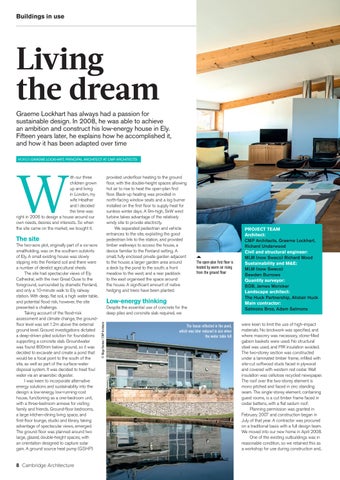
The house reflected in the pond, which was later reduced in size when the water table fell
PROJECT TEAM Architect: CMP Architects, Graeme Lockhart, Richard Underwood Civil and structural engineer: MLM (now Sweco) Richard Wood Sustainability and M&E: MLM (now Sweco) Bawden Burrows Quantity surveyor: BDB, James Woricker Landscape architect: The Huck Partnership, Alistair Huck Main contractor: Salmons Bros, Adam Salmons were keen to limit the use of high-impact materials. No brickwork was specified, and where masonry was necessary, stone-filled gabion baskets were used. No structural steel was used, and PIR insulation avoided. The two-storey section was constructed under a laminated timber frame, infilled with site-cut softwood studs faced in plywood and covered with western red cedar. Wall insulation was cellulose recycled newspaper. The roof over the two-storey element is mono pitched and faced in zinc standing seam. The single-storey element, containing guest rooms, is a cut timber frame faced in cedar battens, with a flat sedum roof. Planning permission was granted in February 2007 and construction began in July of that year. A contractor was procured on a traditional basis with a full design team. We moved into our new home in April 2008. One of the existing outbuildings was in reasonable condition, so we retained this as a workshop for use during construction and,