ments of the Brigade drove off the Germans, captured eight of their guns and held up the German Army’s advance for some time, causing great confusion as to the intentions of the British Expeditionary Force. The Battery was later renamed L Nery Battery in honour of its performance in this and other actions. The salute was taken by the Master Gunner. General Sir Timothy Granville-Chapman GBE, KCB and the local French Commander. In a spirit of reconciliation, the Commander Artillery from the German Army and several of his staff were present.
Lieutenant Colonel George Ansell was killed in the battle leading a mounted counter attack whilst commanding the 5th Dragoon Guards. Brigadier Georgie Powell represented the 2nd Dragoon Guards (Queen's Bays). The only Household Cavalry casualty in the battle was Lt Percy Heath, Royal Horse Guards who died on 4th September from wounds received at Néry while leading his troop against the German 18th Dragoons near the sugar factory. He was aged 26 and is buried nearby.
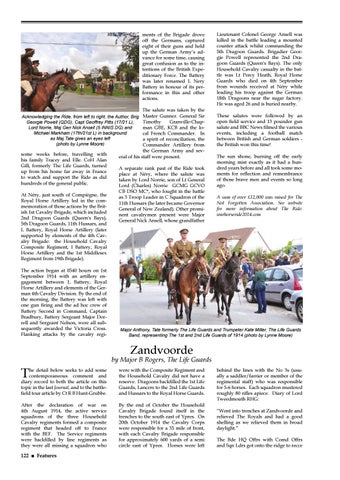
Acknowledging the Ride, from left to right, the Author, Brig Georgie Powell (QDG), Capt Geoffrey Pitts (17/21 L), Lord Norrie, Maj Gen Nick Ansell (5 INNIS DG) and Michael Markham (17th/21st L) in background as Maj Tate gives an eyes left (photo by Lynne Moore)
These salutes were followed by an open field service and 13 pounder gun salute and BBC News filmed the various events, including a football match between British and German soldiers the British won this time!
some weeks before, travelling with his family Tracey and Elle. CoH Alan Gill, formerly The Life Guards, turned up from his home far away in France to watch and support the Ride as did hundreds of the general public. At Néry, just south of Compiègne, the Royal Horse Artillery led in the commemoration of those actions by the British 1st Cavalry Brigade, which included 2nd Dragoon Guards (Queen's Bays), 5th Dragoon Guards, 11th Hussars, and L Battery, Royal Horse Artillery (later supported by elements of the 4th Cavalry Brigade: the Household Cavalry Composite Regiment, I Battery, Royal Horse Artillery and the 1st Middlesex Regiment from 19th Brigade). The action began at 0540 hours on 1st September 1914 with an artillery engagement between L Battery, Royal Horse Artillery and elements of the German 4th Cavalry Division. By the end of the morning, the Battery was left with one gun firing and the ad hoc crew of Battery Second in Command, Captain Bradbury, Battery Sergeant Major Dorrell and Sergeant Nelson, were all subsequently awarded the Victoria Cross. Flanking attacks by the cavalry regi-
The sun shone, burning off the early morning mist exactly as it had a hundred years before and all took some moments for reflection and remembrance of those brave men and events so long ago.
A separate rank past of the Ride took place at Néry, where the salute was taken by Lord Norrie, son of Lt General Lord (Charles) Norrie GCMG GCVO CB DSO MC*, who fought in the battle as 3 Troop Leader in C Squadron of the 11th Hussars (he later became Governor General of New Zealand). Other prominent cavalrymen present were Major General Nick Ansell, whose grandfather
A sum of over £12,000 was raised for The Not Forgotten Association. See website for more information about The Ride: warhorseride2014.com
Major Anthony, Tate formerly The Life Guards and Trumpeter Kate Miller, The Life Guards Band, representing The 1st and 2nd Life Guards of 1914 (photo by Lynne Moore)
Zandvoorde
T
by Major B Rogers, The Life Guards
he detail below seeks to add some contemporaneous comment and diary record to both the article on this topic in the last Journal, and to the battlefield tour article by Ct R B Hunt-Grubbe.
were with the Composite Regiment and the Household Cavalry did not have a reserve. Dragoons backfilled the 1st Life Guards, Lancers to the 2nd Life Guards and Hussars to the Royal Horse Guards.
After the declaration of war on 4th August 1914, the active service squadrons of the three Household Cavalry regiments formed a composite regiment that headed off to France with the BEF. The Service regiments were backfilled by line regiments as they were all missing a squadron who
By the end of October the Household Cavalry Brigade found itself in the trenches to the south east of Ypres. On 20th October 1914 the Cavalry Corps were responsible for a 35 mile of front, with each Cavalry Brigade responsible for approximately 600 yards of a semi circle east of Ypres. Horses were left
122 ■ Features
behind the lines with the No 3s (usually a saddler/farrier or member of the regimental staff) who was responsible for 5-6 horses. Each squadron mustered roughly 80 rifles apiece. Diary of Lord Tweedmouth RHG: “Went into trenches at Zandvoorde and relieved The Royals and had a good shelling as we relieved them in broad daylight.” The Bde HQ Offrs with Comd Offrs and Sqn Ldrs got onto the ridge to recce