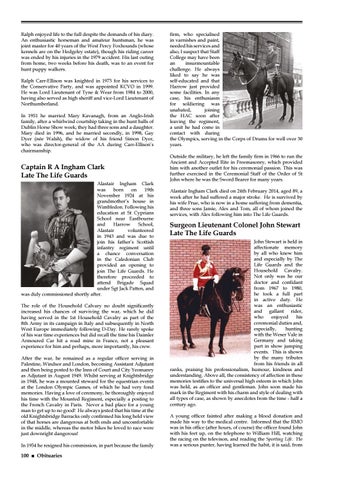
Ralph enjoyed life to the full despite the demands of his diary. An enthusiastic horseman and amateur huntsman, he was joint master for 40 years of the West Percy Foxhounds (whose kennels are on the Hedgeley estate), though his riding career was ended by his injuries in the 1979 accident. His last outing from home, two weeks before his death, was to an event for hunt puppy walkers. Ralph Carr-Ellison was knighted in 1973 for his services to the Conservative Party, and was appointed KCVO in 1999. He was Lord Lieutenant of Tyne & Wear from 1984 to 2000, having also served as high sheriff and vice-Lord Lieutenant of Northumberland. In 1951 he married Mary Kavanagh, from an Anglo-Irish family, after a whirlwind courtship taking in the hunt balls of Dublin Horse Show week; they had three sons and a daughter. Mary died in 1996, and he married secondly, in 1998, Gay Dyer (née Walsh), the widow of his friend Simon Dyer, who was director-general of the AA during Carr-Ellison’s chairmanship.
Captain R A Ingham Clark Late The Life Guards Alastair Ingham Clark was born on 19th November 1924 at his grandmother’s house in Wimbledon. Following his education at St Cyprians School near Eastbourne and Harrow School, Alastair volunteered in 1943 and was due to join his father’s Scottish infantry regiment until a chance conversation in the Caledonian Club provided an opening to join The Life Guards. He therefore proceeded to attend Brigade Squad under Sgt Jack Patten, and was duly commissioned shortly after. The role of the Household Calvary no doubt significantly increased his chances of surviving the war, which he did having served in the 1st Household Cavalry as part of the 8th Army in its campaign in Italy and subsequently in North West Europe immediately following D-Day. He rarely spoke of his war time experiences but did recall the time his Daimler Armoured Car hit a road mine in France, not a pleasant experience for him and perhaps, more importantly, his crew. After the war, he remained as a regular officer serving in Palestine, Windsor and London, becoming Assistant Adjutant and then being posted to the Inns of Court and City Yeomanry as Adjutant in August 1949. Whilst serving at Knightsbridge in 1948, he was a mounted steward for the equestrian events at the London Olympic Games, of which he had very fond memories. Having a love of ceremony, he thoroughly enjoyed his time with the Mounted Regiment, especially a posting to the French Cavalry in Paris. Never a bad place for a young man to get up to no good! He always jested that his time at the old Knightsbridge Barracks only confirmed his long held view of that horses are dangerous at both ends and uncomfortable in the middle, whereas the motor bikes he loved to race were just downright dangerous! In 1954 he resigned his commission, in part because the family
100 ■ Obituaries
firm, who specialised in varnishes and paint, needed his services and also, I suspect that Staff College may have been an insurmountable challenge. He always liked to say he was self-educated and that Harrow just provided some facilities. In any case, his enthusiasm for soldiering was unabated, joining the HAC soon after leaving the regiment, a unit he had come in contact with during the Olympics, serving in the Corps of Drums for well over 30 years. Outside the military, he left the family firm in 1966 to run the Ancient and Accepted Rite in Freemasonry, which provided him with another outlet for his ceremonial passion. This was further exercised in the Ceremonial Staff of the Order of St John where he was the Sword Bearer for many years. Alastair Ingham Clark died on 24th February 2014, aged 89, a week after he had suffered a major stroke. He is survived by his wife Prue, who is now in a home suffering from dementia, and three sons Jamie, Alex and Tom, all of whom joined the services, with Alex following him into The Life Guards.
Surgeon Lieutenant Colonel John Stewart Late The Life Guards John Stewart is held in affectionate memory by all who knew him and especially by The Life Guards and the Household Cavalry. Not only was he our doctor and confidant from 1967 to 1980, he took a full part in active duty. He was an enthusiastic and gallant rider, who enjoyed his ceremonial duties and, especially, hunting with the Weser Vale in Germany and taking part in show jumping events. This is shown by the many tributes from his friends in all ranks, praising his professionalism, humour, kindness and understanding. Above all, the consistency of affection in these memories testifies to the universal high esteem in which John was held, as an officer and gentleman. John soon made his mark in the Regiment with his charm and style of dealing with all types of case, as shown by anecdotes from the time - half a century ago. A young officer fainted after making a blood donation and made his way to the medical centre. Informed that the RMO was in his office (after hours, of course) the officer found John with his feet up, on the telephone to William Hill, watching the racing on the televison, and reading the Sporting Life. He was a serious punter, having learned the habit, it is said, from