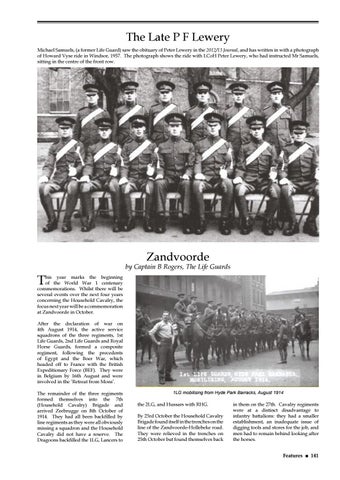
The Late P F Lewery Michael Samuels, (a former Life Guard) saw the obituary of Peter Lewery in the 2012/13 Journal, and has written in with a photograph of Howard Vyse ride in Windsor, 1957. The photograph shows the ride with LCoH Peter Lewery, who had instructed Mr Samuels, sitting in the centre of the front row.
Zandvoorde
T
by Captain B Rogers, The Life Guards
his year marks the beginning of the World War 1 centenary commemorations. Whilst there will be several events over the next four years concerning the Household Cavalry, the focus next year will be a commemoration at Zandvoorde in October. After the declaration of war on 4th August 1914, the active service squadrons of the three regiments, 1st Life Guards, 2nd Life Guards and Royal Horse Guards, formed a composite regiment, following the precedents of Egypt and the Boer War, which headed off to France with the British Expeditionary Force (BEF). They were in Belgium by 16th August and were involved in the ‘Retreat from Mons’. The remainder of the three regiments formed themselves into the 7th (Household Cavalry) Brigade and arrived Zeebrugge on 8th October of 1914. They had all been backfilled by line regiments as they were all obviously missing a squadron and the Household Cavalry did not have a reserve. The Dragoons backfilled the 1LG, Lancers to
1LG mobilising from Hyde Park Barracks, August 1914
the 2LG, and Hussars with RHG. By 23rd October the Household Cavalry Brigade found itself in the trenches on the line of the Zandvoorde-Hollebeke road. They were relieved in the trenches on 25th October but found themselves back
in them on the 27th. Cavalry regiments were at a distinct disadvantage to infantry battalions: they had a smaller establishment, an inadequate issue of digging tools and stores for the job, and men had to remain behind looking after the horses.
Features ■ 141